Water cycle
The same water has been travelling around Earth for billions of years.
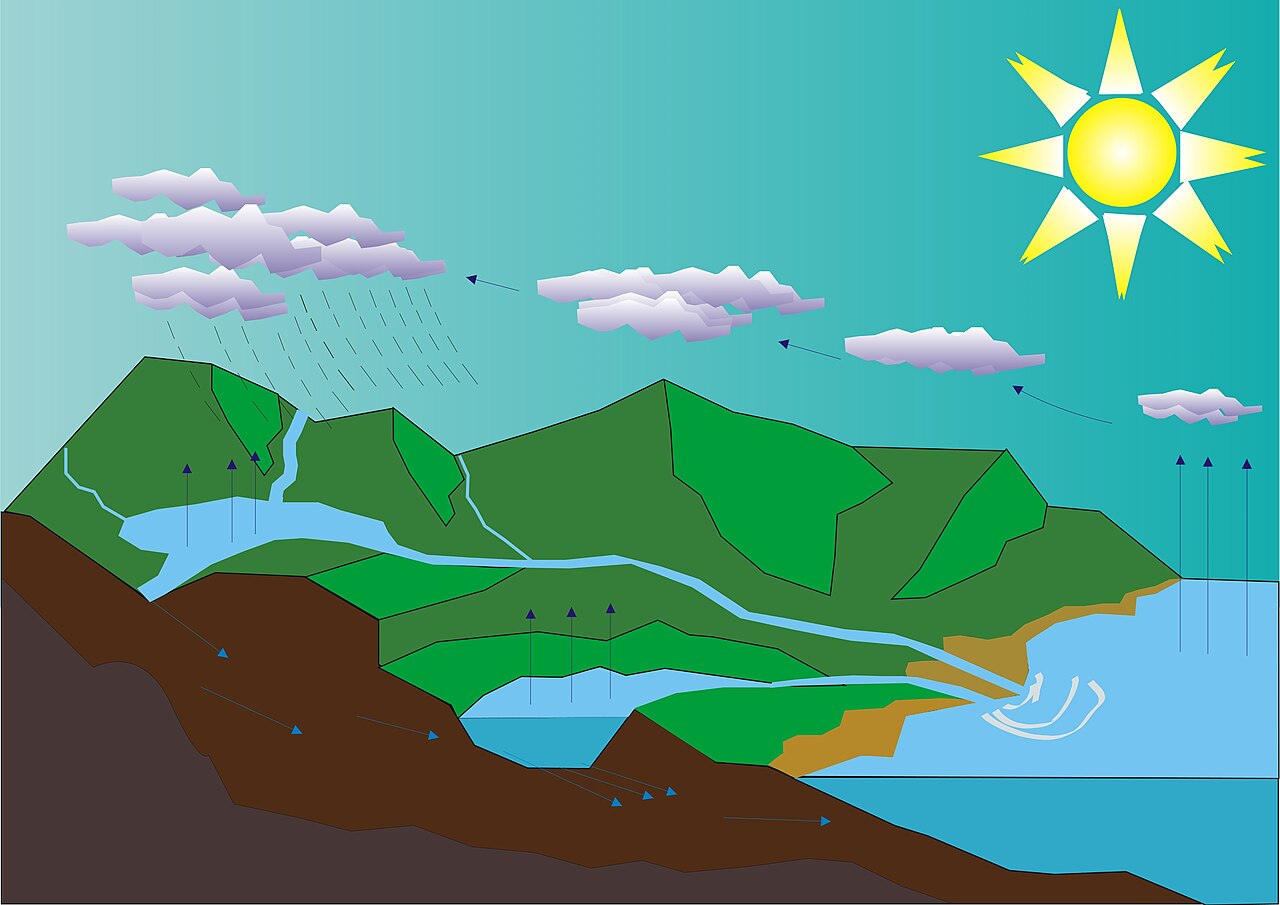
Every glass of water you drink has a long past. It may once have been ice in Antarctica, a cloud over the Pacific, or a river in a rainforest. Earth has almost exactly the same amount of water today as it had long ago, but that water never stays still. The Sun lifts it into the air, wind carries it across the sky, and rain and snow bring it back down. Rivers, soil, glaciers and oceans store it for days or for thousands of years. This endless journey is called the water cycle, and it shapes our weather, our landscapes and all life on Earth.
What is the water cycle?
The water cycle is the never-ending movement of water on, above and below the surface of the Earth. Water does not vanish and no new water is made. The same water moves from one place to another. Scientists call these places . The oceans are one reservoir. Lakes, rivers, ice caps, soil, underground rock and the air are others.
As water moves, it changes between three states. It can be a liquid, a solid (ice) or a gas (water vapour). Water vapour is invisible. You cannot see it, but it is in the air around you right now.
The cycle has no start and no finish, but it helps to begin at the sea. The oceans hold about 97% of all the water on Earth. They are also where most of the action happens. About 86% of all comes from the oceans and about 78% of all rain and snow falls back into them.
The cycle is more than a delivery service. It cleans water, because evaporation leaves salt behind. It carries heat from the warm tropics towards the cold poles. It also gives the land its fresh water, which almost every plant and animal needs to stay alive.
How does water climb into the sky?
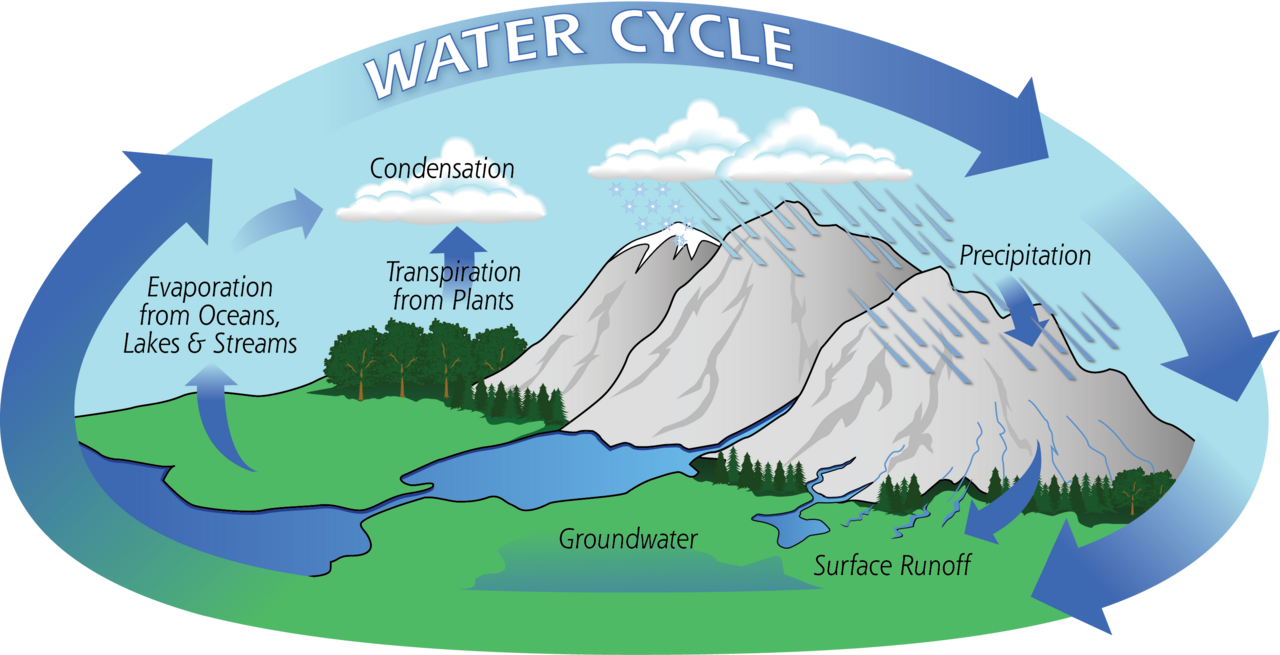
The engine of the water cycle is the Sun. Its heat warms the surface of oceans, lakes and rivers. Warm water molecules move faster and faster until some escape into the air as a gas. This is . It takes energy, which is why wet skin feels cool as it dries. Scientists call that energy latent heat.
Plants add to the supply. Their roots pull water from the soil, and they release water vapour through tiny holes in their leaves. This is . Because it is so hard to separate from evaporation off the ground, scientists often count the two together as evapotranspiration.
A third route is . In very cold or dry places, snow and ice can turn straight into water vapour without becoming liquid first.
The numbers are huge. Each year about 505,000 cubic kilometres of water rise into the air. About 434,000 of them come from the oceans. That is enough to cover the whole of the United Kingdom in water nearly 2 kilometres deep.
Evaporation is also a natural cleaning process. When seawater evaporates, the salt stays behind, so the vapour that rises is fresh water. Without this step the land would never receive fresh water from the sea.
How does invisible vapour become a cloud?
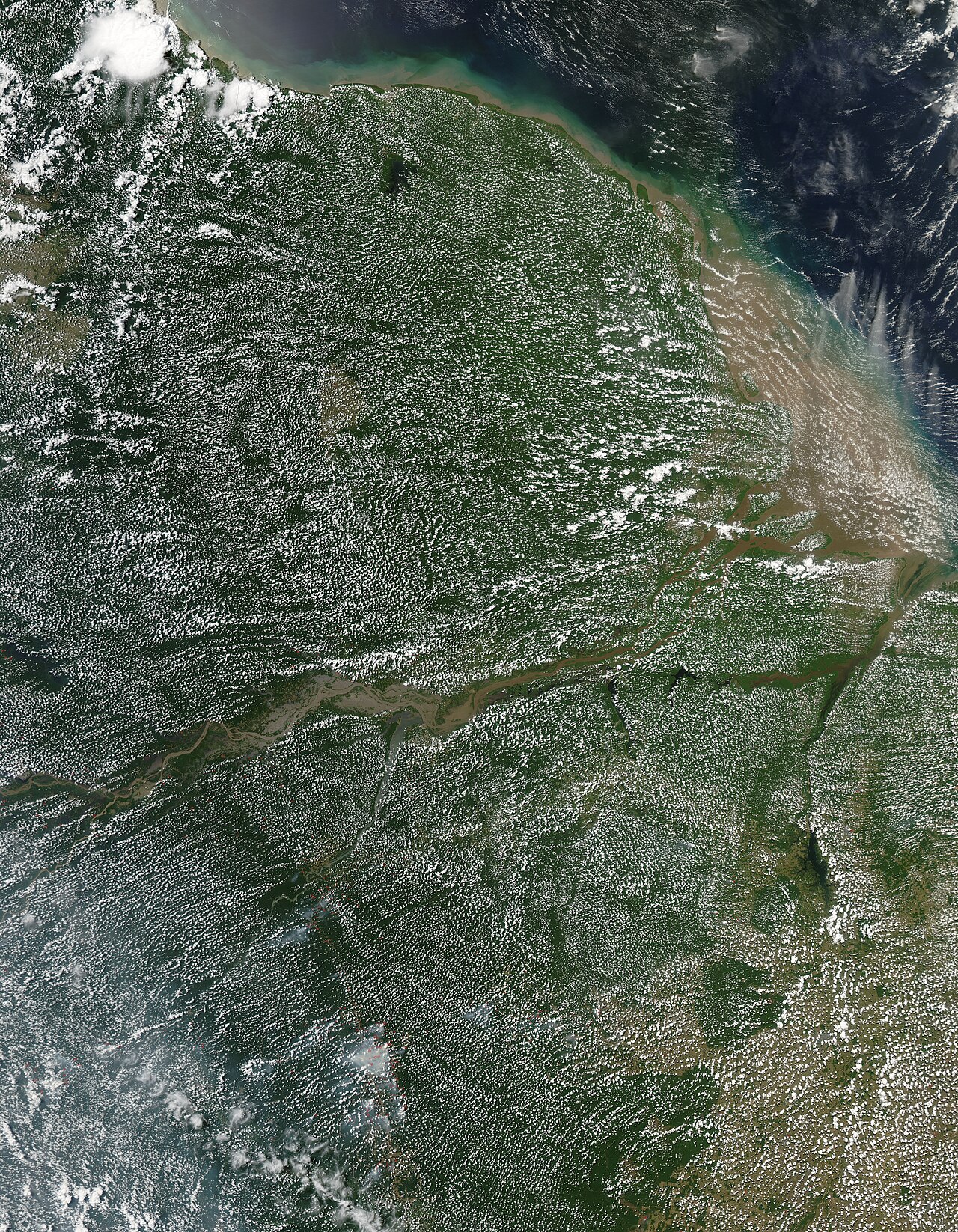
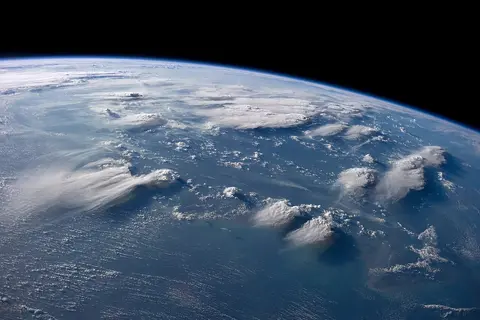
Once water vapour is in the air, it can travel a long way. Warm, damp air is lighter than cold air, so it rises. As it climbs, the air pressure around it drops and the air cools. Cold air cannot hold as much vapour as warm air. Some of the vapour condenses, which means it turns back into tiny drops of liquid water. These drops gather around specks of dust or salt in the air. When enough of them collect over a large area, we call it a cloud. A cloud is made of liquid droplets or ice crystals, not vapour. If the same thing happens close to the ground, we call it fog.
Wind then carries the water around the planet. Scientists call this movement of water through the air advection. Without it, water that evaporated over the oceans could never fall as rain over the land. Some of it travels in long, narrow streams of vapour called atmospheric rivers, which can carry huge amounts of water over thousands of kilometres.
Inside a cloud, droplets bump into each other and join together. They grow heavier and heavier until the air can no longer hold them up. Then they fall. The average water molecule spends only about 9 days in the air before it comes down again.
Where does the rain go when it lands?
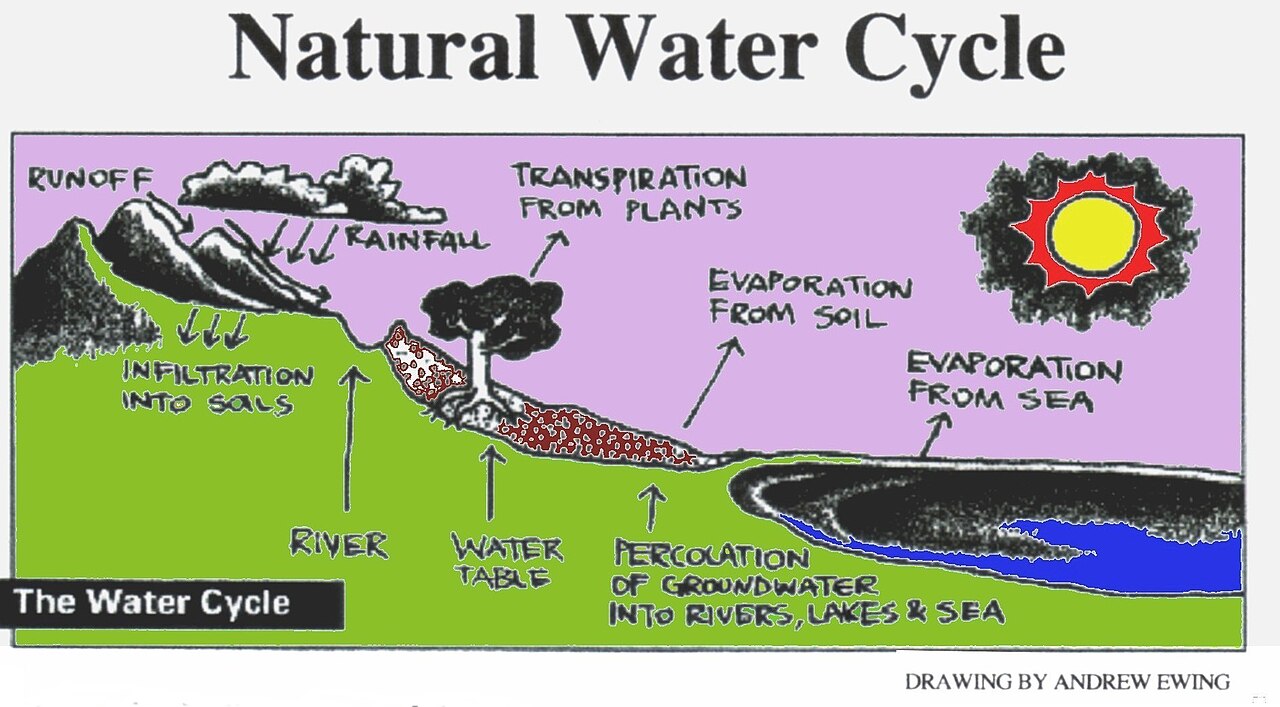
Falling water is called . Most of it is rain, but it also includes snow, hail and sleet. Each year about 505,000 cubic kilometres of water fall, which matches the amount that evaporates. Most of it, about 398,000 cubic kilometres, falls straight into the oceans. The rest lands on the ground.
What happens next depends on the ground. Some water runs across the surface as and gathers in streams and rivers, which carry it towards the sea. Some is stored in lakes on the way. A lot of it soaks into the soil. This is . Gravity then pulls the water down through soil and cracks in rock, which is called percolation.
Deep underground, water can fill the gaps in rock to form an . Water moves through rock very slowly, so can stay in an aquifer for more than 10,000 years. Very old groundwater is sometimes called fossil water. Some groundwater finds its way out again at springs, or it seeps into rivers and the sea.
Snow can follow a different path. When it falls on high mountains or near the poles, it may pile up into glaciers and ice sheets, which lock the water away as ice for thousands of years.
Where is all of Earth's water kept?
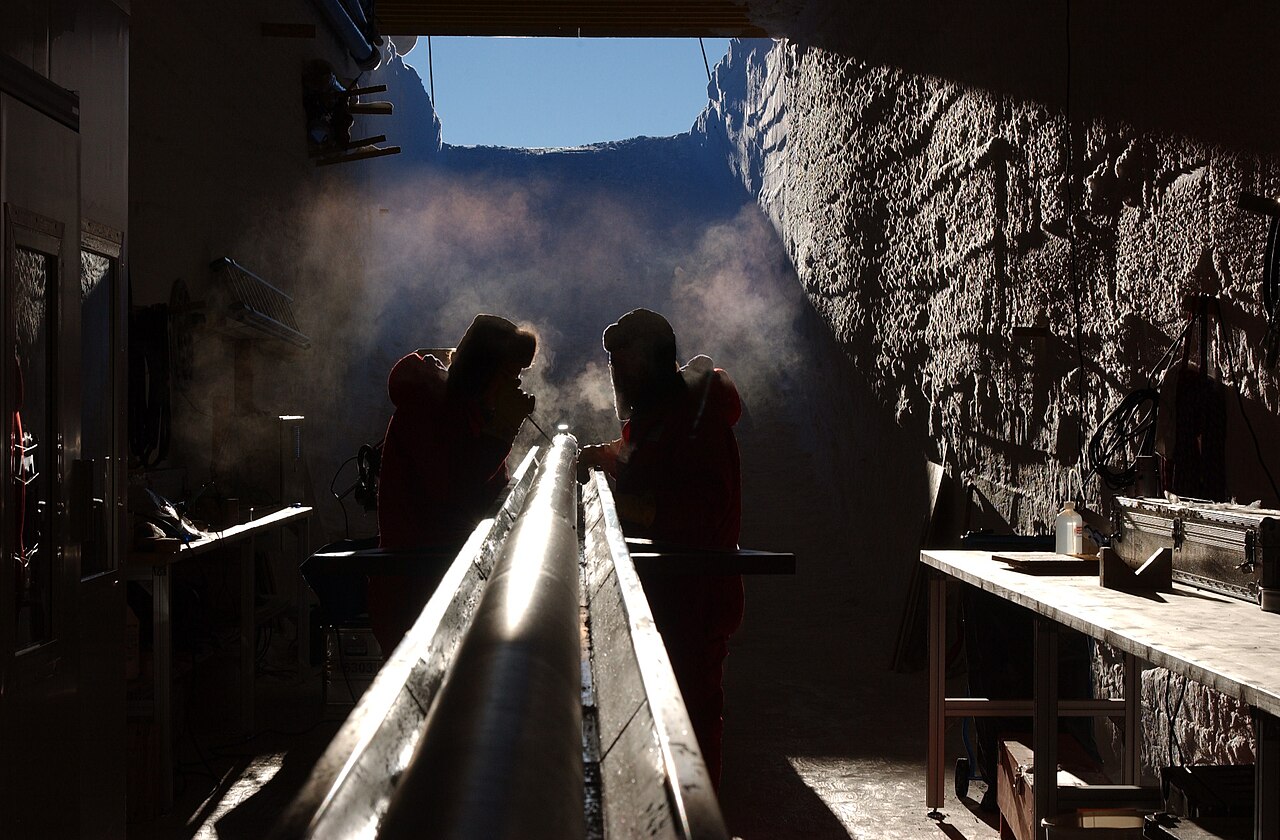
Most of Earth's water is not moving through the cycle at any one moment. It is in storage. Scientists estimate that the world holds about 1,386,000,000 cubic kilometres of water. About 1,338,000,000 cubic kilometres of it, around 97%, is in the oceans. That water is salty, so people cannot drink it or use it to water crops without treating it first.
The ice caps, glaciers and permanent snow hold about 24,064,000 cubic kilometres. That is only about 1.7% of all water. But it is about 68.7% of all the fresh water on the planet. Most of the rest of our fresh water is underground. Rivers and lakes hold only a tiny share.
Scientists use something called to describe how long water stays in each store. It is the average time one water molecule spends there. In the air it is about 9 days. In soil it is short, because water is soon lost to plants, rivers and . In deep it can be over 10,000 years. In the great ice sheets of Antarctica and Greenland it is longer still. Ice cores from Antarctica hold an unbroken record going back about 800,000 years. In 2025 scientists drilling a new core reached ice about 1.2 million years old. Even older pieces of ice have been found where old ice is pushed up to the surface.
To work out residence time, scientists divide the size of a store by the rate at which water flows through it.
Why do living things depend on the water cycle?
The water cycle does far more than make rain. It is how fresh water is delivered to the land. Without it, rivers would dry up, soils would turn to dust and most life on land would end.
Moving water also reshapes the planet. Rain wears down rock in a process called weathering. Rivers carry the broken pieces away, which is erosion, and drop them somewhere else, which is deposition. Over millions of years this carves valleys and builds deltas. Flowing water carries minerals around the world too. The salt in the sea comes from salts dissolved out of rocks on land and carried down rivers.
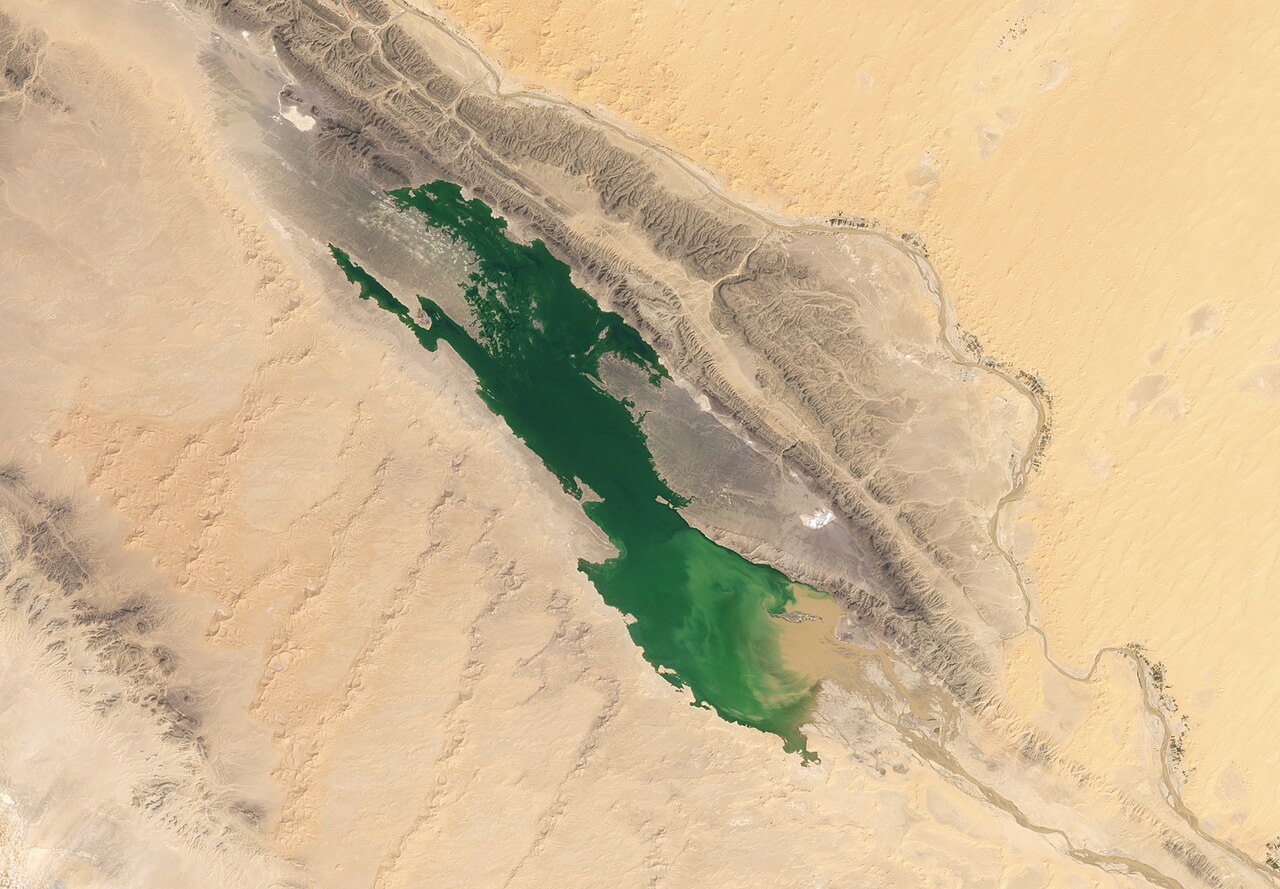
Sometimes a single downpour shows the whole system at work. In September 2024, heavy rain fell on the Sahara Desert in Algeria. Water ran into Sebkha el Melah, a salt lake that is usually dry, and satellites photographed it filled with water.
The cycle also moves heat. soaks up heat and gives it back. Together with ocean currents, this carries warmth from the tropics towards the poles and helps to keep the weather moving.
How are people changing the water cycle?
People change the water cycle in two main ways. The first is by changing the land. When forests are cut down, there are fewer trees to pull water from the soil and release it as vapour. The air above can get drier and local rainfall can fall. When cities replace fields with roads and roofs, rain cannot soak in. It rushes into drains and rivers instead, so floods become more likely. Dams change how fast rivers flow and can harm fish and other water life. The Aral Sea in Central Asia was once one of the four largest lakes in the world. It lost most of its water after the rivers that fed it were diverted to irrigate fields. In many places, farms, factories and towns pump water from underground faster than nature can refill it.
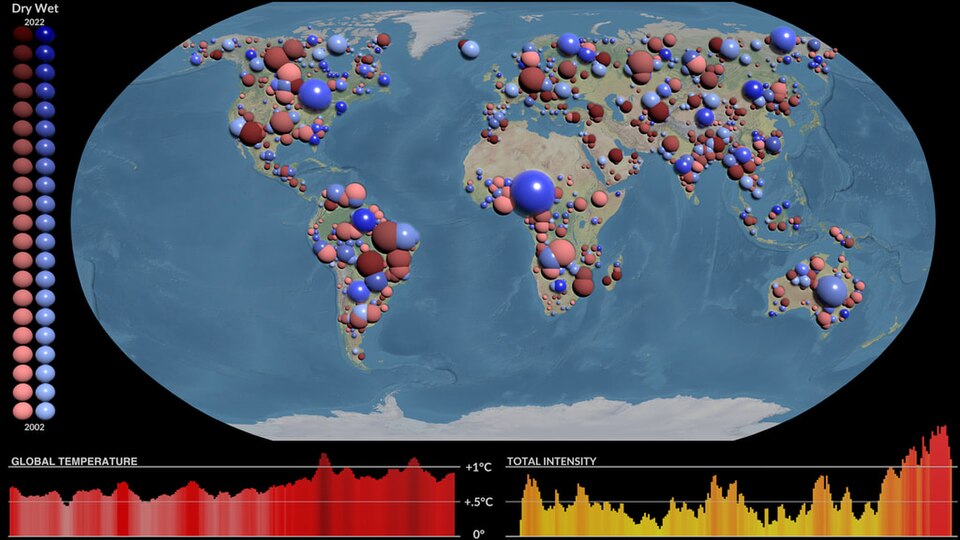
The second way is climate change. Burning coal, oil and gas adds gases to the air that trap heat. A warmer atmosphere can hold more water vapour, and warmer oceans evaporate faster. Scientists say this is making the cycle more intense. Since about the middle of the 20th century, changes to the global water cycle have been measured. Rainfall patterns are shifting. Extreme weather, such as heavy storms and droughts, is happening more often. In the summer of 2022, Europe had one of its worst droughts in at least 500 years. Rivers such as the Rhine, the Loire and the Po ran very low.
Water also carries pollution. Fertiliser washed off fields travels down rivers and out to sea. At the mouth of the Mississippi River in the Gulf of Mexico, it feeds so much algae that the water below runs low on oxygen and fish cannot live there.
How did people work out where rivers come from?
It sounds like an easy question, but people argued about it for over 2,000 years. Rivers keep flowing into the sea, yet the sea never overflows. Where does the water go, and where does it come from?
Many ancient thinkers believed that rivers were fed from below. The poet Homer, around 800 BCE, pictured the land floating on a vast body of water. Others got closer. Around 700 BCE the Greek poet Hesiod wrote about vapour lifted from rivers and turning to rain. By about 350 BCE the philosopher Aristotle explained that the Sun lifts water into the air, where the cold turns it back into rain. In China, the scientist Wang Chong described the cycle in the 1st century CE, but his neighbours did not take him seriously.
Strangely, the right idea was then lost to many for centuries. Thinkers including Leonardo da Vinci, around 1500, still believed that water pushed up from the sea through the ground to feed rivers.
The French potter and writer Bernard Palissy argued around 1580 that rainfall alone was enough. A study in 1674, usually credited to Pierre Perrault, tested the idea with measurements. In 1687 the English astronomer Edmond Halley measured how fast water evaporated from a heated pan. He worked out that from the Mediterranean was more than enough to balance all the rivers that flow into it. Even so, most scientists only accepted it in the early 1800s.
Explore Next
Your audio story keeps playing while you look around.

Words to Know
- aquifer
- An underground layer of rock or sand that holds water.
- condensation
- When water vapour cools and turns back into tiny drops of liquid water.
- evaporation
- When liquid water turns into an invisible gas called water vapour.
- groundwater
- Water stored in the soil and rock beneath the surface.
- infiltration
- When water soaks from the surface down into the soil.
- precipitation
- Water that falls from the sky, such as rain, snow, hail or sleet.
- reservoir
- Any place where water is stored, such as an ocean, a lake or an ice sheet.
- residence time
- The average time a water molecule stays in one store before moving on.
- runoff
- Water that flows over the land into streams, rivers and lakes.
- sublimation
- When ice or snow turns straight into a gas without melting first.
- transpiration
- When plants release water vapour into the air through their leaves.