Electricity
The invisible flow of charge that lights our homes and powers our world.
Electricity is the energy of tiny charged particles, and it is all around you. It makes a lightning bolt crack across the sky and a nerve signal race to your brain. It lights rooms, runs trains and powers every phone and computer. Nobody invented it, because nature had it long before people did. What humans did was learn how to make it, move it and put it to work. That story runs from rubbed amber in ancient Greece to power stations and microchips today. It also leads straight to magnetism, because the two forces are partners.
What is electricity?
Everything is made of atoms, and atoms contain smaller pieces. Protons carry a positive . carry a negative charge. Objects normally have equal amounts of each, so the charges cancel out and nothing seems to happen.
Rub a balloon on your hair and electrons move from one to the other. The balloon ends up with extra negative charge and your hair is left with extra positive charge. Now they pull towards each other. This is , and it follows a simple rule. Like charges push apart and opposite charges pull together.
The pull and push between charges is called the electric force. It is very strong. It is the force that holds atoms together, and it is the reason you feel a table when you touch it. The electric push between two electrons is about 1 followed by 42 zeros times stronger than the pull of gravity between them.
When charges move, we get an electric . That is what flows through the wires in your home.
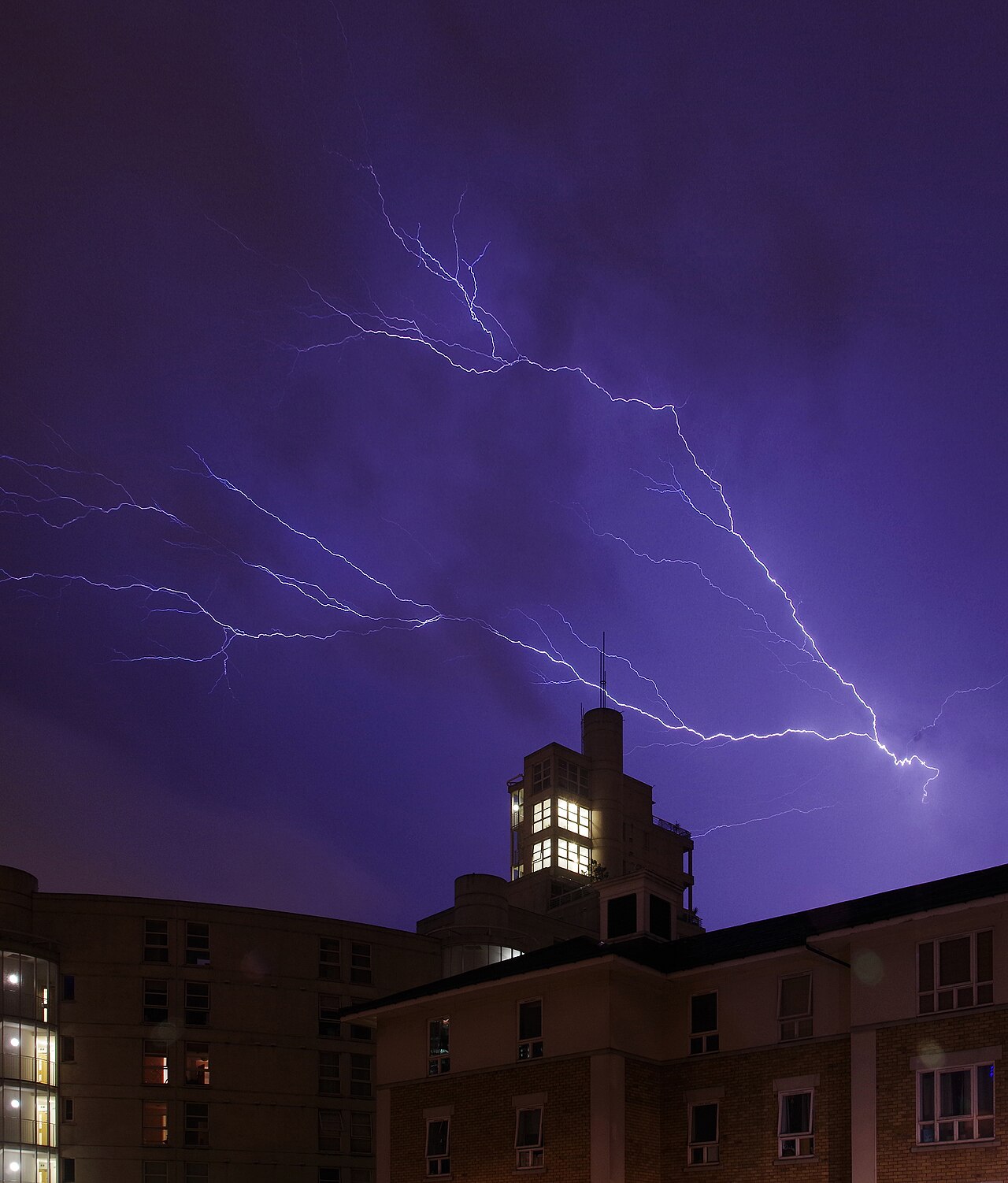
Lightning is static electricity on a giant scale. Rising air inside a storm cloud separates charge until the cloud holds far more than the air can hold back. Then the charge leaps across the gap as a huge spark. A big lightning cloud can reach about 100 million volts.
How did people first discover electricity?
The first clues were not wires at all. People in ancient Egypt, Greece and Rome knew that electric fish could give a powerful jolt. Doctors even told patients with headaches to touch one, hoping the shock would cure them.
Around 600 BCE, the Greek thinker Thales of Miletus noticed that a rod of amber, rubbed with fur, could pick up feathers. He thought the amber had become magnetic. He was not right, but he had found .
The real study began in 1600, when the English scientist William Gilbert showed that amber and lodestone act differently. He called the amber effect electricus, from the Greek word for amber, elektron. That is where our word electricity comes from.
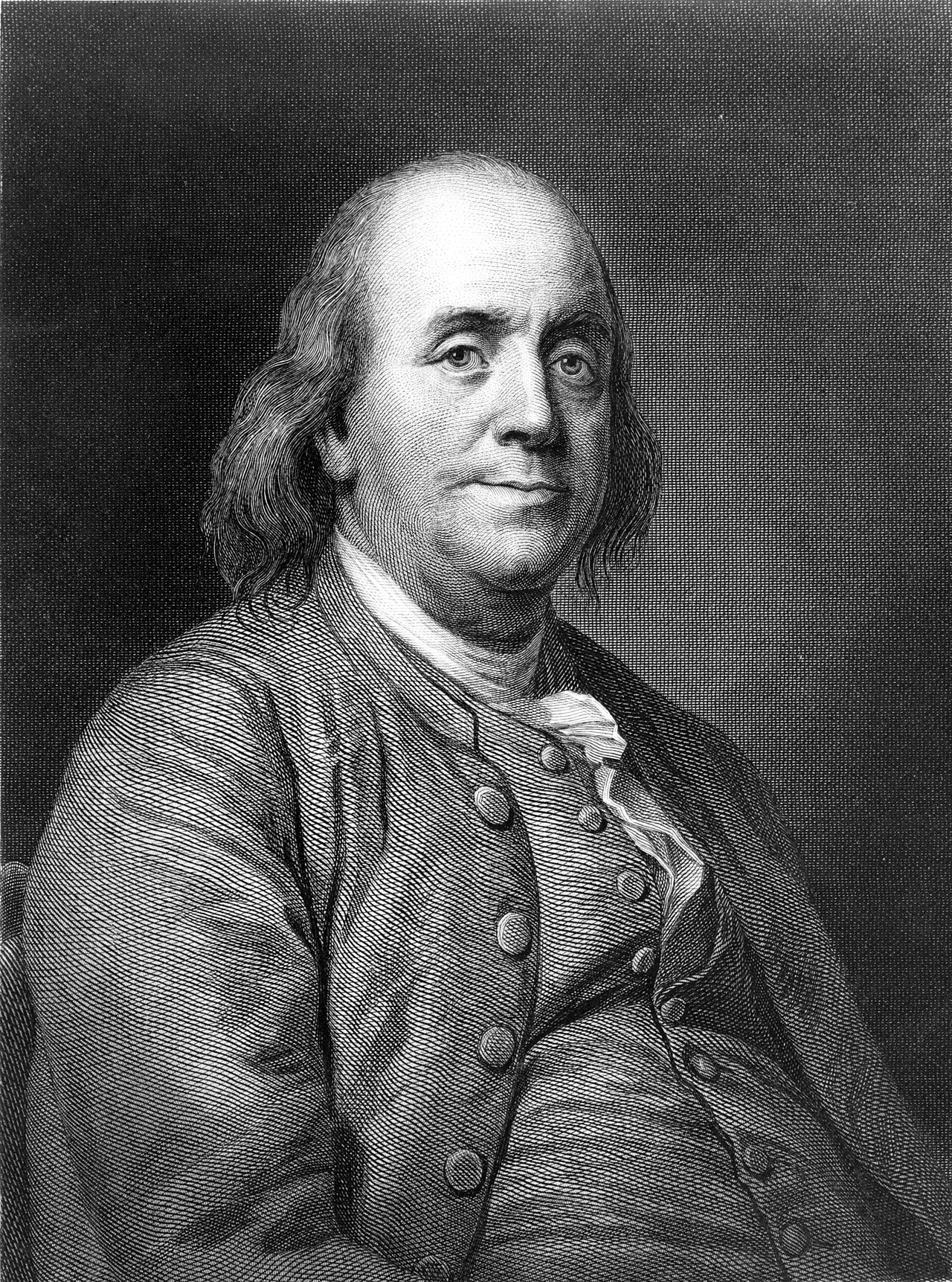
In the 1700s, Benjamin Franklin did a famous set of experiments. In June 1752 he is said to have flown a kite in a storm with a metal key tied near the string. Sparks jumped from the key to his hand, which showed that lightning is electrical. Franklin also worked out that electricity involves both positive and negative charge, and he explained the Leyden jar, an early device for storing charge.
In 1800, Alessandro Volta stacked discs of zinc and copper to make the first battery. For the first time, scientists had a steady supply of electricity instead of quick sparks.
What happens inside a wire?
A wire is full of metal atoms, and some of their are free to drift from atom to atom. When something pushes on these electrons, they all move in the same direction. That flow of charge is an electric , and it is measured in amperes, or amps.
What does the pushing? A battery or a power station gives charge a push called , measured in volts. A bigger voltage means a bigger push. Materials that let current pass easily, such as copper, are called . Materials that block it, such as rubber and plastic, are called . That is why electrical cables are metal inside and plastic outside.
The electrons themselves move quite slowly, only a fraction of a millimetre each second. Yet a lamp lights almost the moment you flick a switch. The reason is that the electric field travels along the wire at nearly the speed of light, and it nudges every electron into motion at once.
Current needs a complete loop, called a , to flow. Switches break the loop, and the current stops. Parts such as resistors push back against the current and turn some of its energy into heat. Georg Ohm described this link between voltage, current and resistance in 1827.
Batteries give direct current, which flows one way. Power stations send alternating current, which swaps direction many times a second. Both do the same job.
How are electricity and magnetism linked?
For centuries, people treated electricity and magnetism as two separate puzzles. Then, in 1820, the Danish professor Hans Christian Ørsted noticed something odd while preparing a lecture. A compass needle twitched when an electric passed through a wire nearby. A current makes a magnetic field.
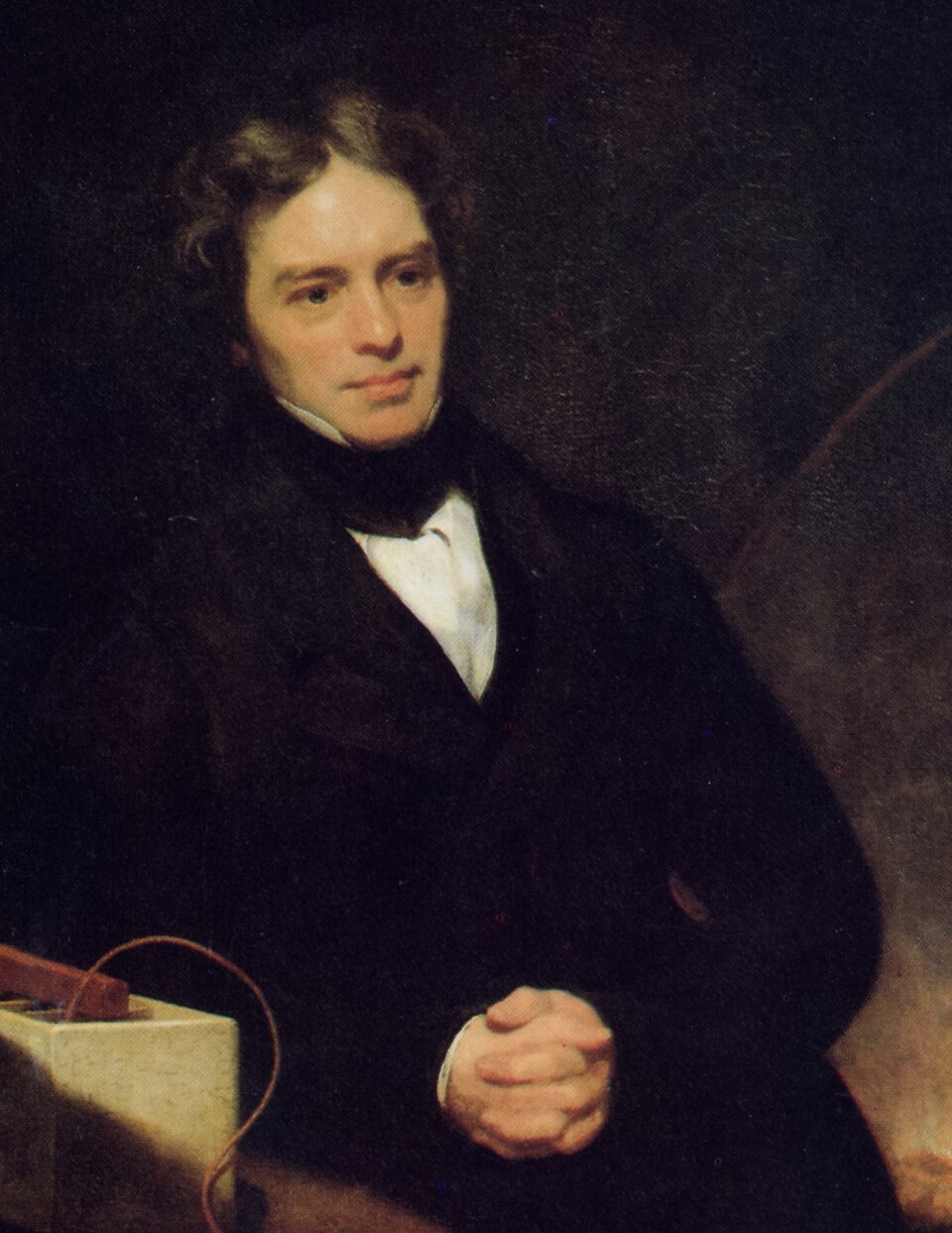
André-Marie Ampère soon showed that two wires with current in them pull or push on each other. In 1821, Michael Faraday used this idea to build the first electric motor. A wire carrying current circled round a magnet for as long as the current flowed.
Faraday went further. In 1831 he found that a magnet moving near a wire creates a current in it. This is called electromagnetic induction. It means movement can be turned into electricity, and it is the idea behind nearly every power station.
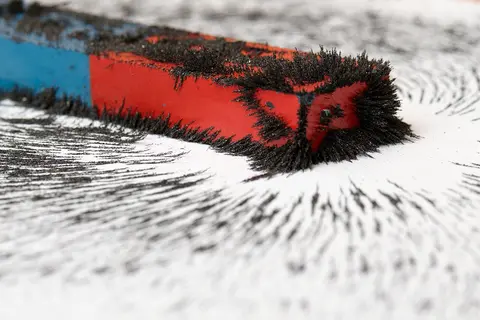
Faraday also pictured electric and magnetic fields as invisible lines of force filling space. The Scottish scientist James Clerk Maxwell turned these ideas into mathematics in the 1860s. His equations showed that a changing electric field makes a magnetic field and a changing magnetic field makes an electric field. Together they can travel as waves. Maxwell worked out that these waves move at the speed of light, so light itself is an electromagnetic wave. Radio waves are the same kind of wave, with a much longer wavelength.
Where does electricity come from?
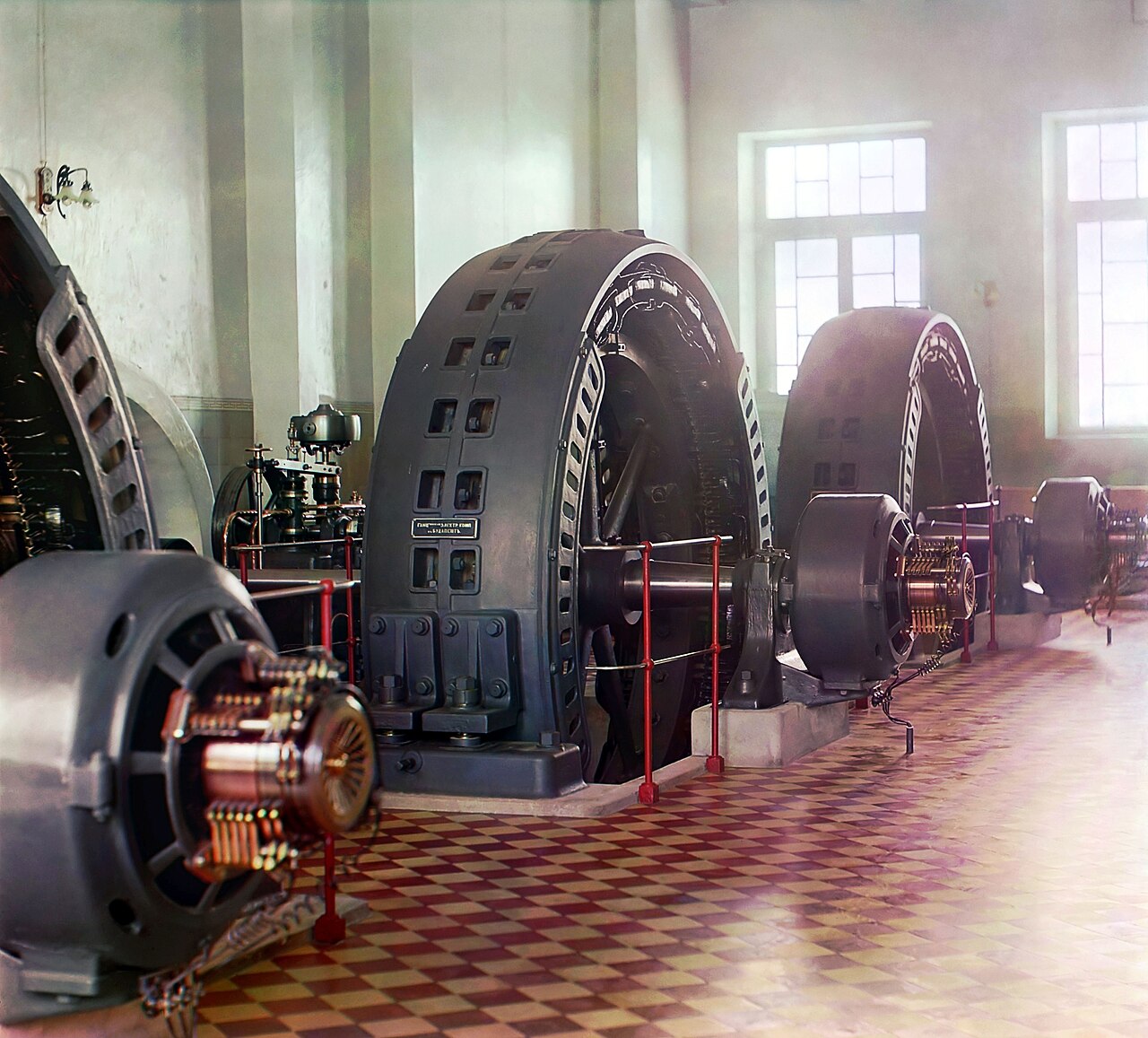
Most electricity today comes from . A generator uses Faraday's discovery in reverse. Something spins a coil of wire near strong magnets, and the movement pushes through the wire.
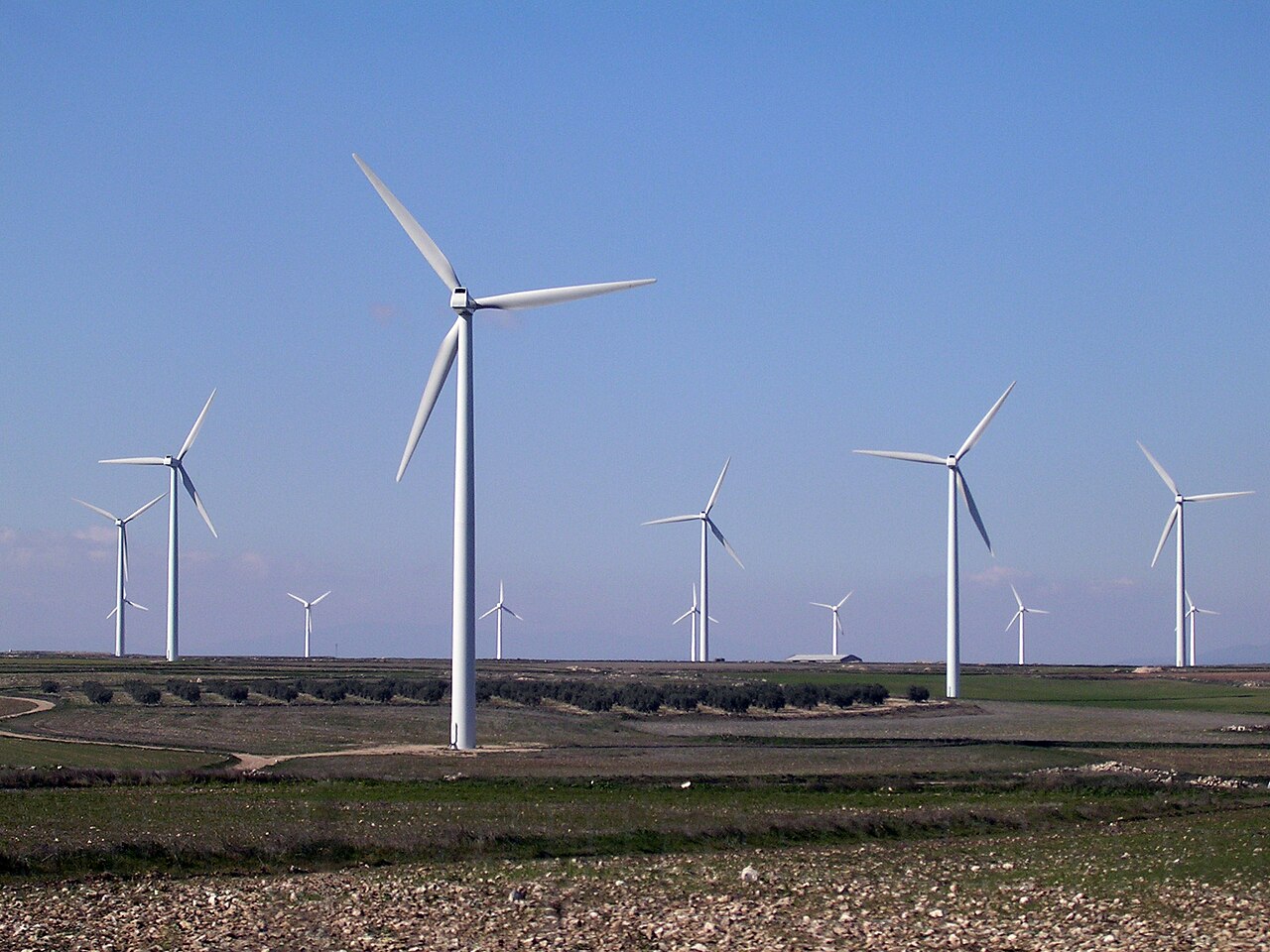
The spinning needs energy. In many power stations, burning coal or gas, or the heat of a nuclear reaction, boils water into steam. The steam blasts past the blades of a turbine and spins it. Sir Charles Parsons invented the steam turbine in 1884, and the design is still used. Hydroelectric stations use falling water instead. Wind turbines use moving air.
Solar panels work in a different way. Light knocks loose inside special materials, and this makes a current directly. It is called the photovoltaic effect. The French scientist Edmond Becquerel discovered it in 1839, when he was only 19. It is closely related to the photoelectric effect, which Albert Einstein explained in 1905. He won the 1921 Nobel Prize in Physics for that work.
Batteries make electricity from chemistry. Inside, a chemical reaction pushes electrons around a . Volta's first battery worked this way, and so do the ones in phones and electric cars.
Burning fossil fuels puts carbon dioxide into the air and drives climate change. For this reason many countries are building more wind and solar power. These have become cheap enough to compete with coal and gas in many places.
How does electricity get to your home?
A power station can be hundreds of kilometres from the houses it serves. Sending that far wastes energy as heat in the wires. The trick is to send it at a very high and a low current, because less current means less heat lost on the way.
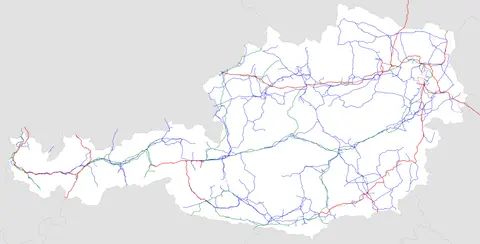
The device that makes this possible is the , invented in the late 1800s. It raises the voltage for the long journey. Smaller transformers near towns then lower it again, so that it is safe to use in homes. Thanks to transformers, big power stations can serve whole regions. The network of cables, pylons and stations is called the grid.
There is a big challenge, though. Electricity is hard to store in large amounts, so the amount made has to match the amount used at every moment. Wind and sunshine rise and fall with the weather. Engineers now use several ways to keep a store of energy ready. These include big batteries, pumping water uphill to run down later, heat stores, and making hydrogen.
Your meter keeps a running total of the energy you use. Energy is sold in kilowatt hours. A 1,000 watt heater running for 1 hour uses 1 kilowatt hour.
Long cables also carried messages. By the 1860s, telegraph wires crossed continents and oceans, and news could cross the world in minutes.
Can animals make electricity?
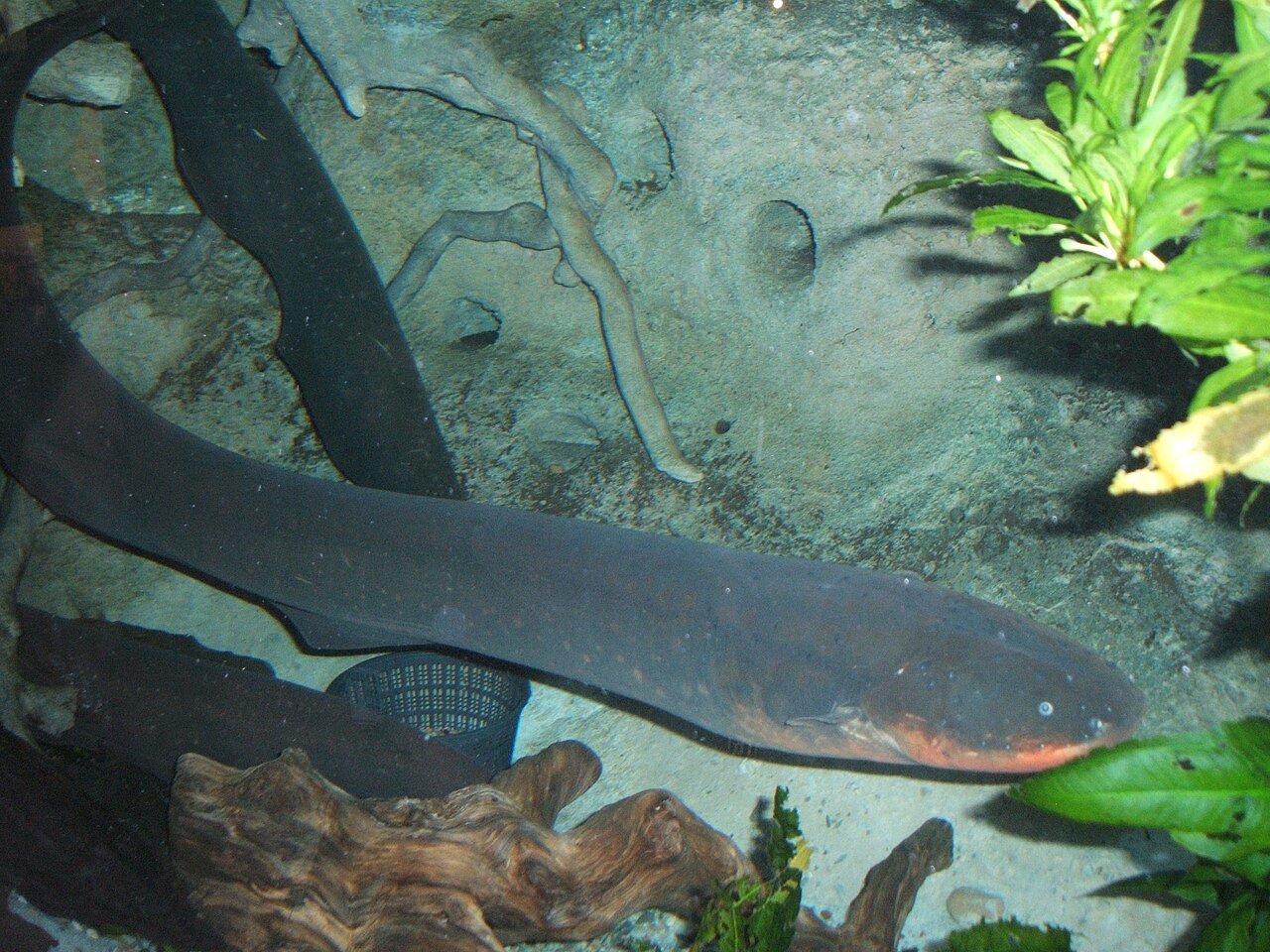
Yes. Living things use electricity all the time. Every nerve in your body sends messages by passing tiny electrical pulses along its surface. These pulses are called action potentials. They carry signals from your senses to your brain and from your brain to your muscles. An electric shock makes muscles tighten because it triggers the same system.
In 1791, the Italian scientist Luigi Galvani showed this by making the leg muscles of a dead frog twitch with electricity. His discovery showed that nerves and muscles work by electricity.
Some animals take it much further. The electric eel, which lives in rivers in South America, has special muscle cells called electrocytes. Thousands of them are stacked together like the cells in a battery. Together they make a high that can stun prey or scare off a predator. In 1775, Hugh Williamson reported on the shocks of electric eels to the Royal Society in London.
Other animals sense electricity instead of making it. Sharks can detect the tiny electric fields given off by hidden fish.
The Earth is part of this story too. Its magnetic field comes from flowing deep in its core, which act like a giant natural dynamo. Some crystals, such as quartz, even make a small voltage when squeezed. This is called piezoelectricity.
How did electricity change the world?
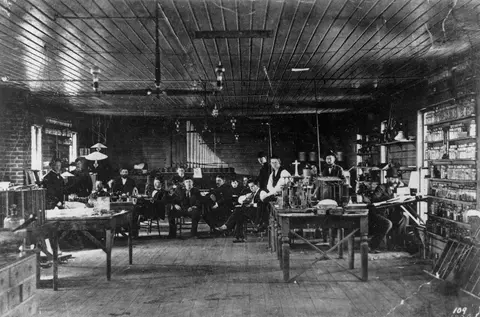
In the 1870s, inventors made the first practical electric light bulbs. Lighting was one of the first uses of electricity in homes and streets. Electric bulbs replaced gas lamps with their naked flames, and this made fires less likely in homes and factories. Cities set up electric companies. By the end of the 1800s, people such as Thomas Edison, Nikola Tesla, George Westinghouse and Joseph Swan had turned electricity from a curiosity into a tool for daily life.
Electric motors now drive trains, buses, lifts, washing machines and a growing number of cars. Heaters, fridges and heat pumps run on electricity too. Because electricity can be turned easily into movement, heat and light, it is among the most flexible forms of energy we have.
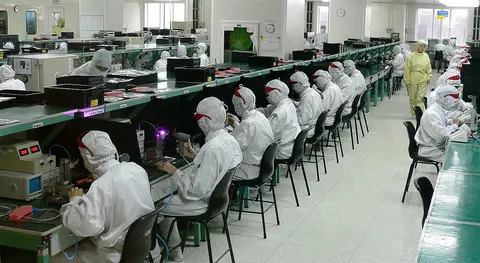
Electronics changed life again. It controls the flow of with parts such as diodes and . John Bardeen and Walter Brattain built the first working transistor at Bell Labs in 1947. Today a single chip the size of a coin can hold billions of transistors. They make computers, phones and the internet possible.
Electricity is also dangerous. A through the body can hurt the muscles and heart, and nothing about a live wire shows that it is live. That is why wires are covered and why people must never touch fallen power lines.
Explore Next
Your audio story keeps playing while you look around.
Words to Know
- circuit
- A closed loop that electric current can flow around.
- conductor
- A material that lets electric current pass easily.
- current
- The flow of electric charge, measured in amps.
- electric charge
- A property of matter that makes particles push or pull on each other.
- electron
- A tiny particle with a negative charge that moves around an atom's centre.
- generator
- A machine that turns movement into electricity.
- insulator
- A material that does not let electric current pass.
- static electricity
- A build-up of electric charge on an object.
- transformer
- A device that raises or lowers voltage.
- transistor
- A tiny switch that controls electric current in electronics.
- voltage
- The push that moves charge around a circuit, measured in volts.