Internal Structure of Earth
Journey to the centre of the planet, without ever leaving the surface.
Earth is built in layers, a little like a peach with a thin skin, thick flesh and a hard stone at the middle. The rocky crust we live on is only a few kilometres to a few tens of kilometres thick, yet the centre of the planet lies about 6,371 kilometres down. Nobody has drilled through more than a tiny part of that distance. So how do we know what is below? Scientists listen to the waves from earthquakes, study rocks carried up by volcanoes and squeeze metals in laboratories. Together these clues reveal a hidden world, with an ocean of liquid metal that creates Earth's magnetic field and a solid iron ball at the very centre.
What is inside the Earth?
Earth is not the same all the way through. It has layers, and each one has its own mix of materials, its own temperature and its own way of behaving.
Scientists describe the layers in two ways. The first way is by what they are made of. The outermost layer is the , a thin shell of rock. Below it lies the , a thick layer of hot rock that makes up most of the planet. At the centre is the , made mostly of iron and nickel. The core has two parts, a liquid outer core and a solid inner core.
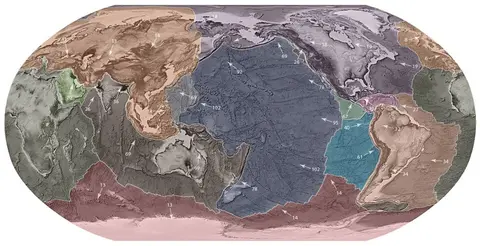
The second way is by how the material behaves. The crust and the top of the mantle together form the , a hard, rigid shell that is broken into the tectonic plates. Underneath is the , where the rock is so hot that it is soft and slowly bends and flows. Deeper still, the mantle is stronger again because of the huge pressure.
Pressure and heat both rise as you go down. At the bottom of the mantle the pressure is about 1.4 million times the air pressure at the surface. The weight of everything above squeezes the rock tightly, which is one reason why Earth's average density is about 5.5 grams per cubic centimetre. That is much denser than the surface rocks, so something heavy must lie deep inside.
How can we know what we cannot see?
The deepest hole ever drilled, in Russia, reached only about 12 kilometres. That is less than 0.2 per cent of the way to the centre. So scientists use indirect clues.
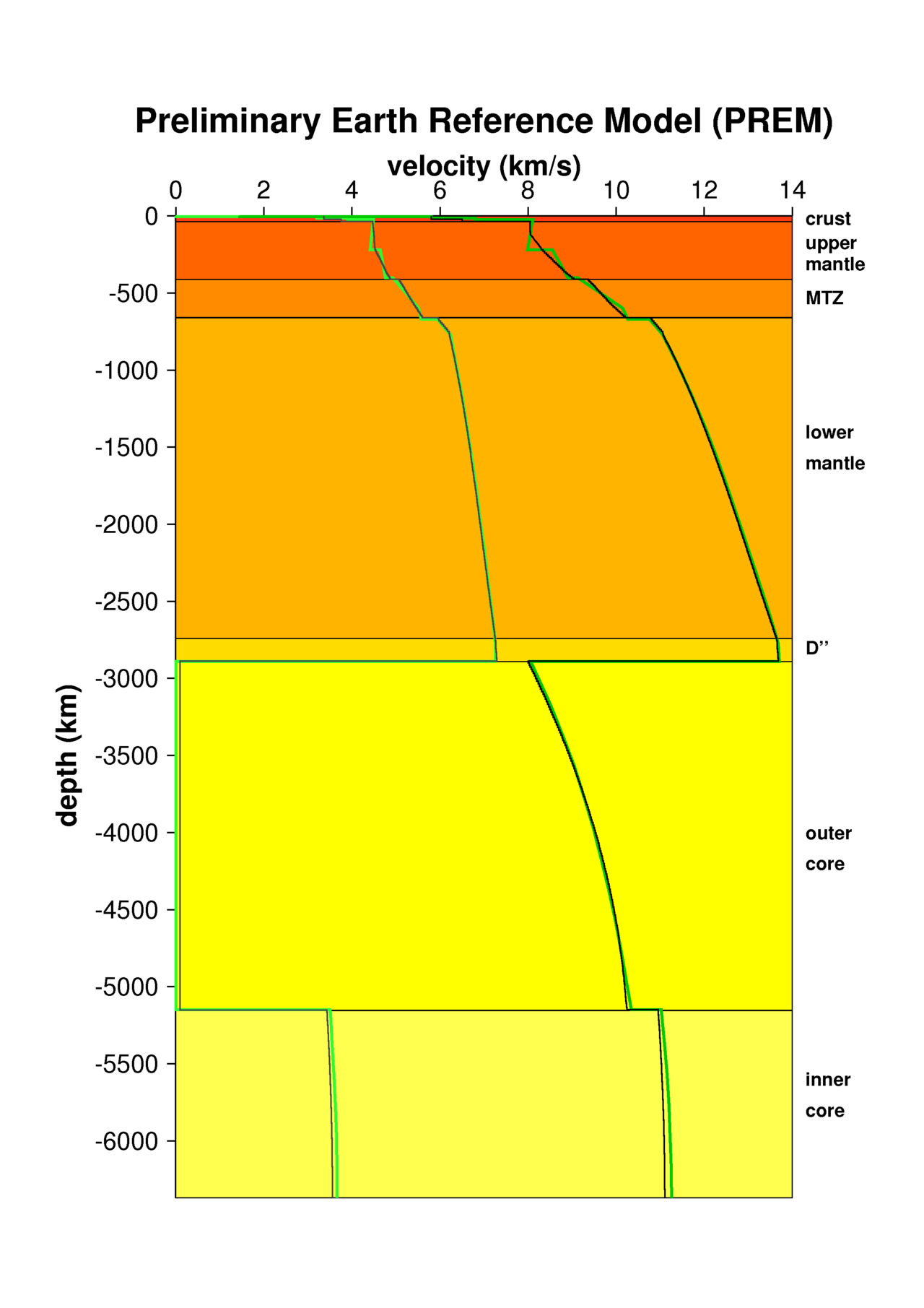
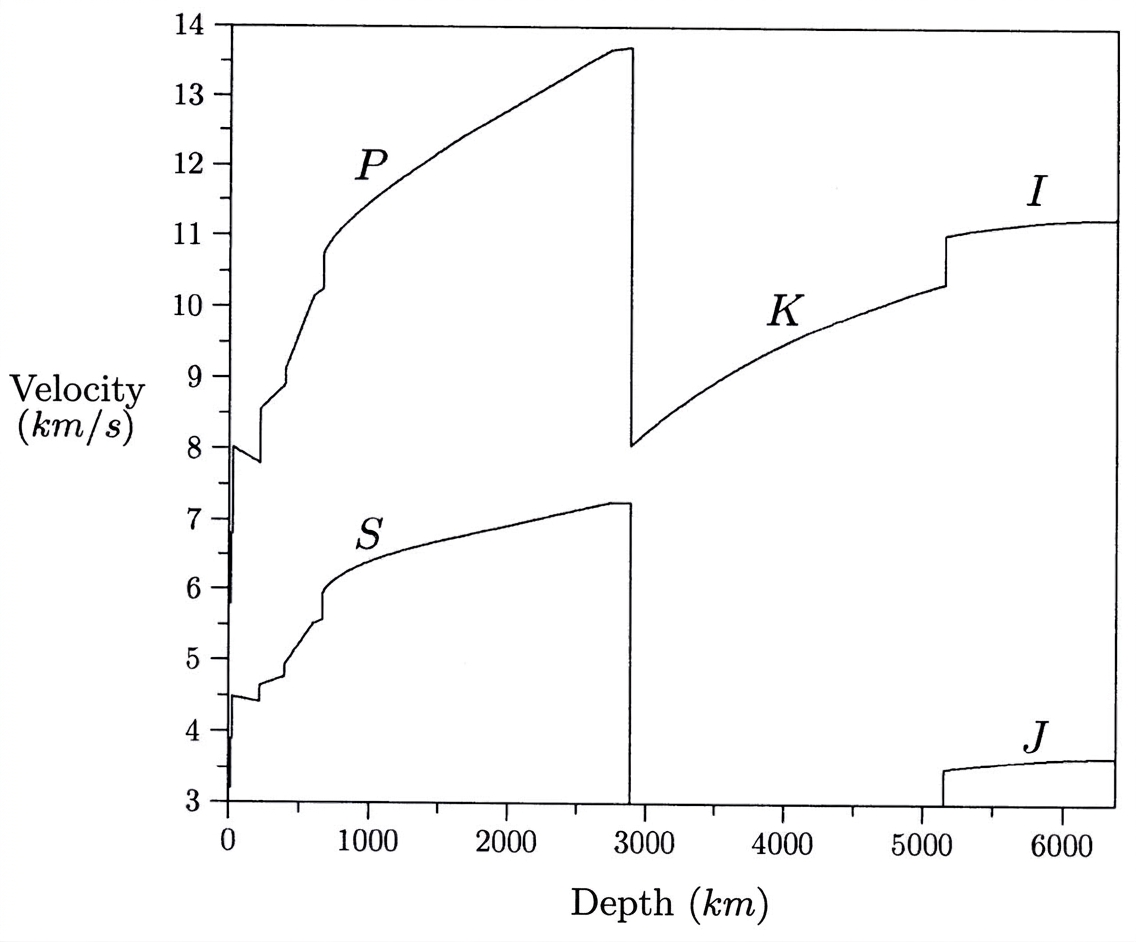
The best clue is . When an earthquake strikes, it sends waves through the whole planet. Seismometers all over the world record when each wave arrives and how strong it is. Waves speed up, slow down and bend when they pass from one material to another. Light bends in the same way as it goes through a glass prism. A big jump in speed can also bounce a wave back, like light off a mirror. By timing these paths, scientists build a picture of the layers.
There are two main kinds. P waves squeeze material forwards and backwards and travel through solids and liquids. S waves shake material from side to side and cannot pass through a liquid. On the far side of the world from a big earthquake, S waves never arrive, which leaves a shadow zone. That told scientists that part of the deep Earth is liquid.
Other clues help too. Gravity measurements give Earth's mass, which is about 6 x 10^24 kilograms. Volcanoes carry up rock from deep below. The points to moving metal. And in laboratories, scientists squeeze tiny samples between diamonds and heat them, to copy the conditions inside the planet.
How thin is the crust?
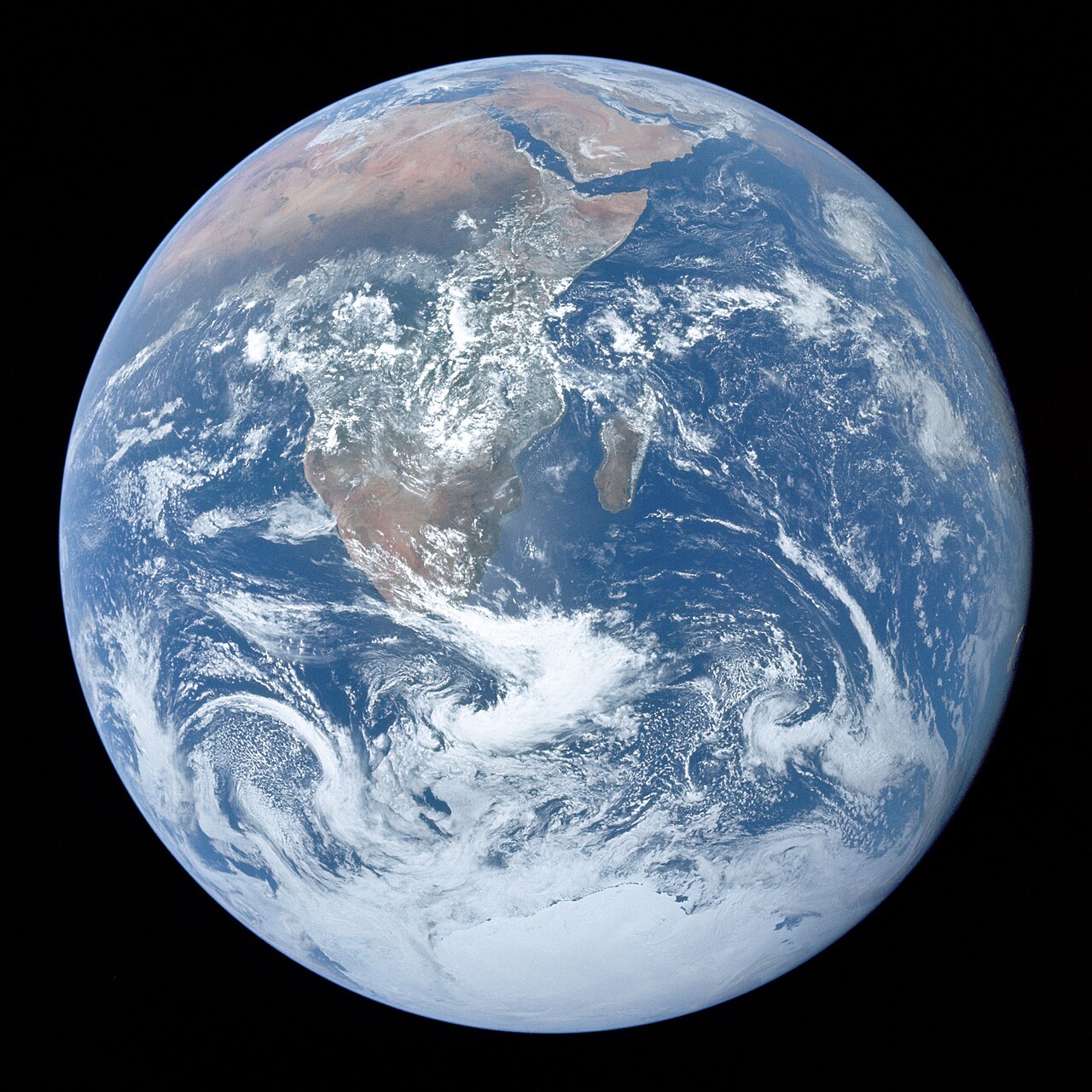
The is the outermost layer, and it is thin. If Earth were an apple, the crust would be thinner than the apple's skin. It makes up less than 1 per cent of the planet's volume.
There are two kinds. Oceanic crust lies under the ocean floors and is only about 5 to 10 kilometres thick. It is made of dark, heavy rock rich in iron and magnesium, such as basalt. Continental crust forms the land. It is much thicker, often 30 to 50 kilometres and more under big mountain ranges. It is lighter, and richer in minerals such as feldspar and quartz, which are found in granite.
Because continental crust is lighter, it floats higher on the . A large block of light wood floats higher than a block of heavy wood in the same way. That is one reason why the continents stand above the sea floor.
The boundary between crust and mantle is called the , short for the Mohorovičić discontinuity. speed up as they cross it, because the rock below is denser. It is named after Andrija Mohorovičić, who found it from earthquake records in the early 1900s.
Most of the ocean floor is surprisingly young, because moving plates keep recycling it. Yet some tiny mineral grains are about 4.4 billion years old. They show that Earth has had a solid crust for almost all of its history.
Can solid rock really flow?
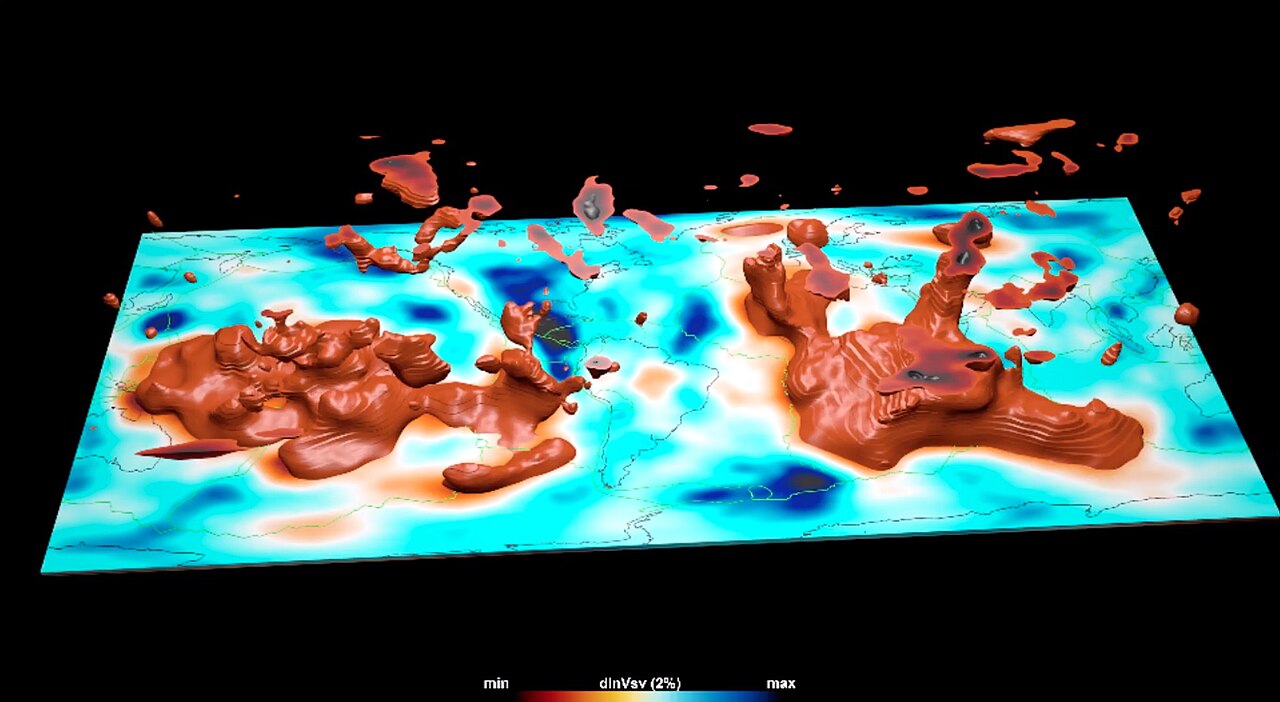
The is the thickest layer. It reaches down about 2,890 kilometres and makes up about 84 per cent of Earth's volume. It is built of silicate rock, richer in iron and magnesium than the .
The mantle is solid, not a sea of lava. Yet it is so hot, and the pressure is so great, that over very long times it moves like extremely thick tar. Its stiffness is far greater than that of pitch, the thick black material once used to seal ships. Even so, it creeps by a few centimetres a year, about as fast as your fingernails grow.
The mantle has an upper part and a lower part, with a transition zone between them. Deep down, the pressure squeezes the rock into denser forms, so the lower mantle flows less easily. The bottom of the mantle, next to the , is a strange region called the D double-prime layer.
Mantle rock does not sit still. Hot rock rises slowly, cools near the top and sinks again. This movement is called , and it works like a very slow pot of simmering soup. It drags the tectonic plates of the crust along, which is what moves the continents, opens oceans and builds mountains.
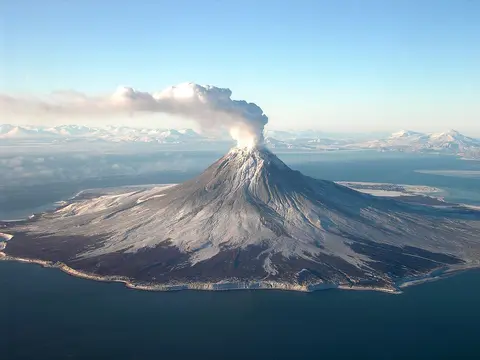
Volcanoes give us a glimpse of the mantle. Some bring up rock and crystals that formed far below the crust, and scientists can study them directly.
What is at the very centre?
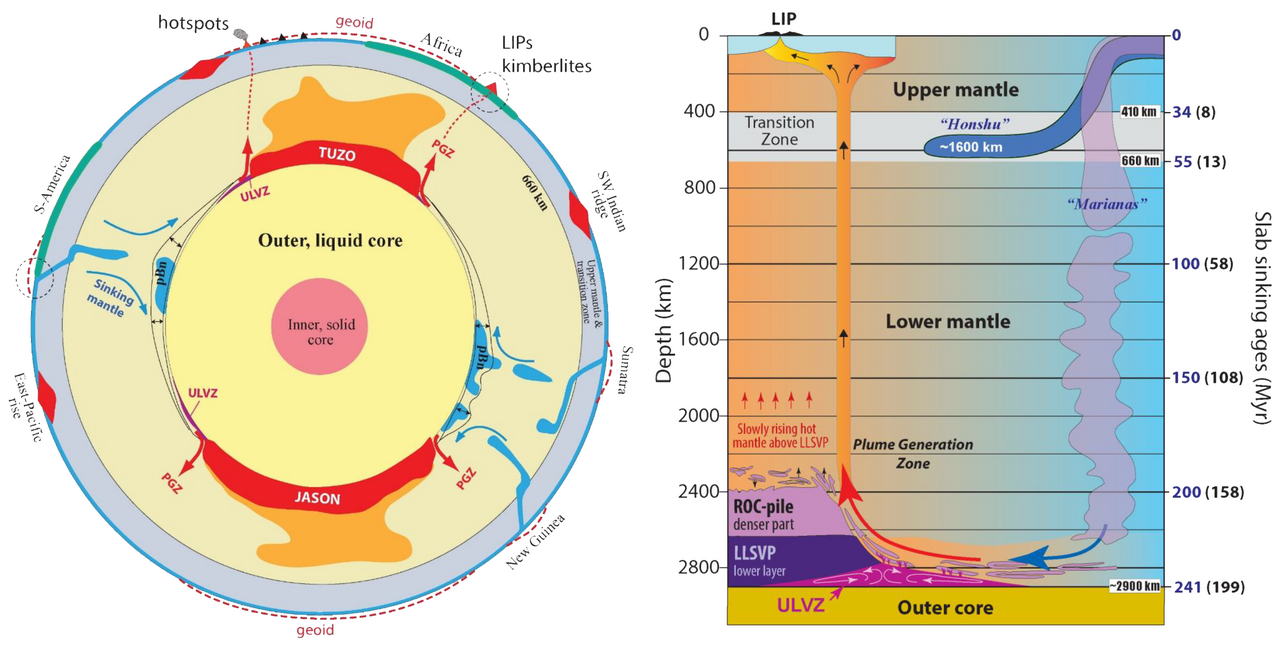
At the centre of the Earth is a made mostly of iron, with some nickel and a few lighter elements. It is split into two very different parts.
The outer core is liquid. It is about 2,260 kilometres thick and begins 2,890 kilometres below the surface. Its liquid metal flows constantly. The inner core is a solid ball with a radius of about 1,220 kilometres, around 70 per cent of the Moon's radius. It begins about 5,150 kilometres down.
Why is the inner core solid when it is the hottest place of all? Temperatures there are thought to be about 5,000 to 6,000 degrees Celsius, as hot as the surface of the Sun. But the pressure at the centre is enormous, and it squeezes the iron so tightly that the atoms cannot move apart to become a liquid.
The inner core was found in 1936 by the Danish scientist Inge Lehmann. She studied earthquake records and noticed some waves bouncing off something inside the liquid core. She worked out that there must be a solid ball in the middle. Later work showed that the inner core carries shear waves, which only solids can do.
Scientists are still studying it. Experiments suggest the iron may form giant crystals that line up north to south. Exactly how the inner core behaves at such pressures is still an active area of research.
How does the core protect life?
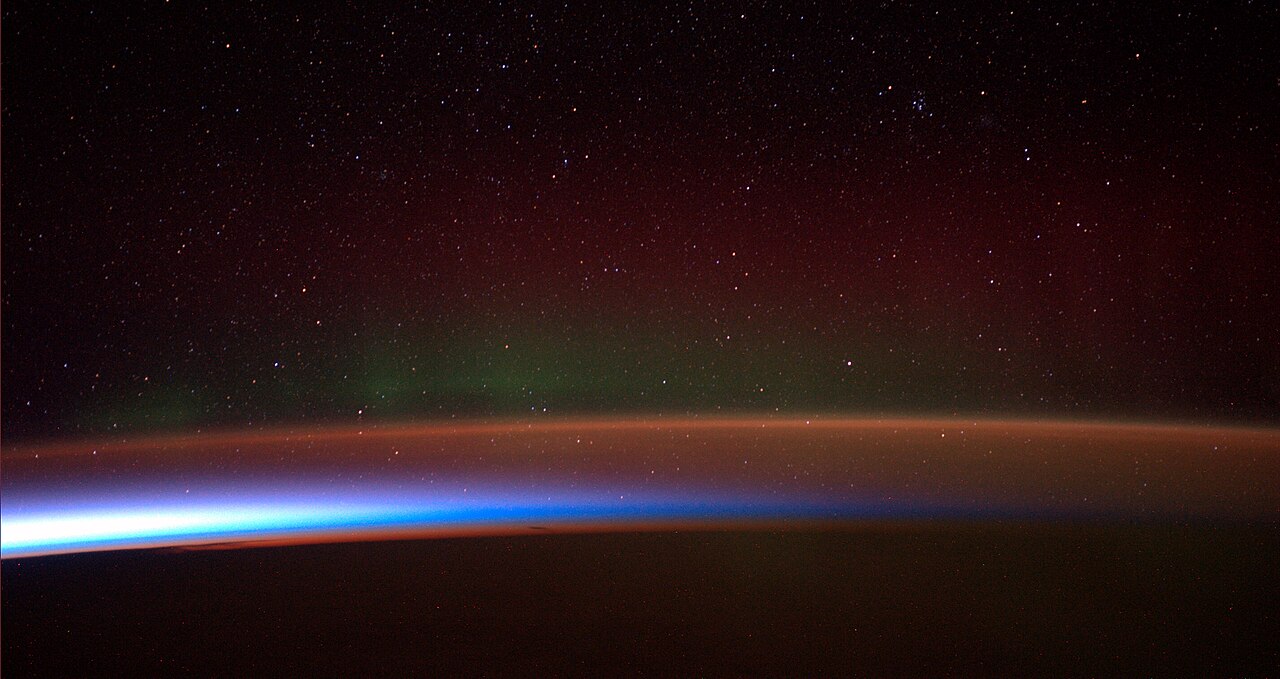
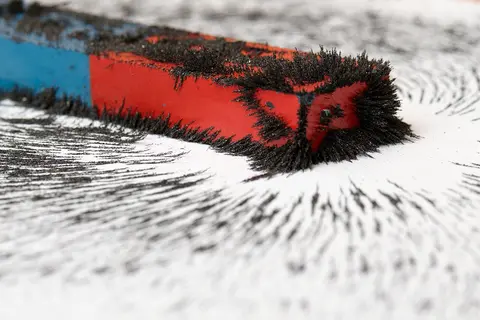
Earth acts like a giant magnet. A compass needle points north because of this . The field does not come from a permanent magnet buried in the ground. It comes from the moving liquid in the outer .
The process starts with heat escaping from the core, which makes the liquid iron churn in huge swirling currents. Earth's spin twists these currents. Moving metal carries electric currents, and electric currents create magnetic fields. This idea is called dynamo theory. The solid inner core is too hot to be a permanent magnet itself, but it probably helps to keep the field steady.
The field stretches far out into space. It forms a protective bubble that deflects most of the charged particles streaming from the Sun, which are called the solar wind. Without it, the wind would slowly strip away the atmosphere, and harmful radiation would reach the surface. Mars has no such global field today, and it has lost most of its atmosphere.
The field is also what makes the northern and southern lights. Charged particles guided by the field hit gases high in the air near the poles and make them glow.
The magnetic field is not fixed. Over millions of years its north and south poles have swapped many times. Rocks that cooled long ago still record the direction of the field, so scientists can read these changes.
How did the layers form?
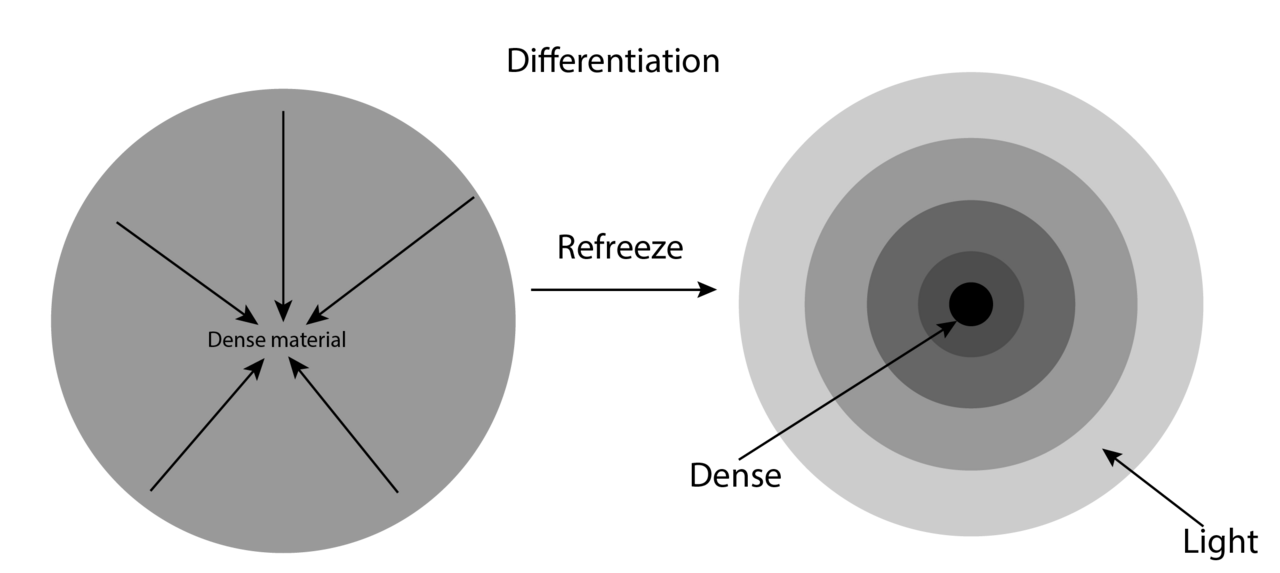
About 4.5 billion years ago, Earth formed from dust, rock and metal that crashed together around the young Sun. The impacts and the squeezing of so much material released great amounts of heat. The young planet was hot enough to be partly molten.
In a molten world, heavy things sink and light things rise, as oil floats on water. Heavy iron and nickel sank towards the centre and made the . Lighter rock floated upwards and formed the and the . This sorting is called planetary . Other heavy elements, such as lead and uranium, are too rare to matter much for the core, or they bind with lighter elements and stayed in the crust.
The core is believed to be about 80 per cent iron. Scientists know its approximate recipe because Earth's overall make-up looks similar to certain meteorites called chondrites. These are leftovers from the early Solar System. Starting around 1940, scientists such as Francis Birch used these meteorites as a guide to what Earth is made of overall.
As the planet cooled, a solid crust formed on top. The oldest mineral grains found so far are about 4.4 billion years old, so a crust existed very early.
The layers are still changing. Today the inner core is thought to grow very slowly as the liquid iron around it cools and freezes onto it.
What keeps Earth's inside hot?
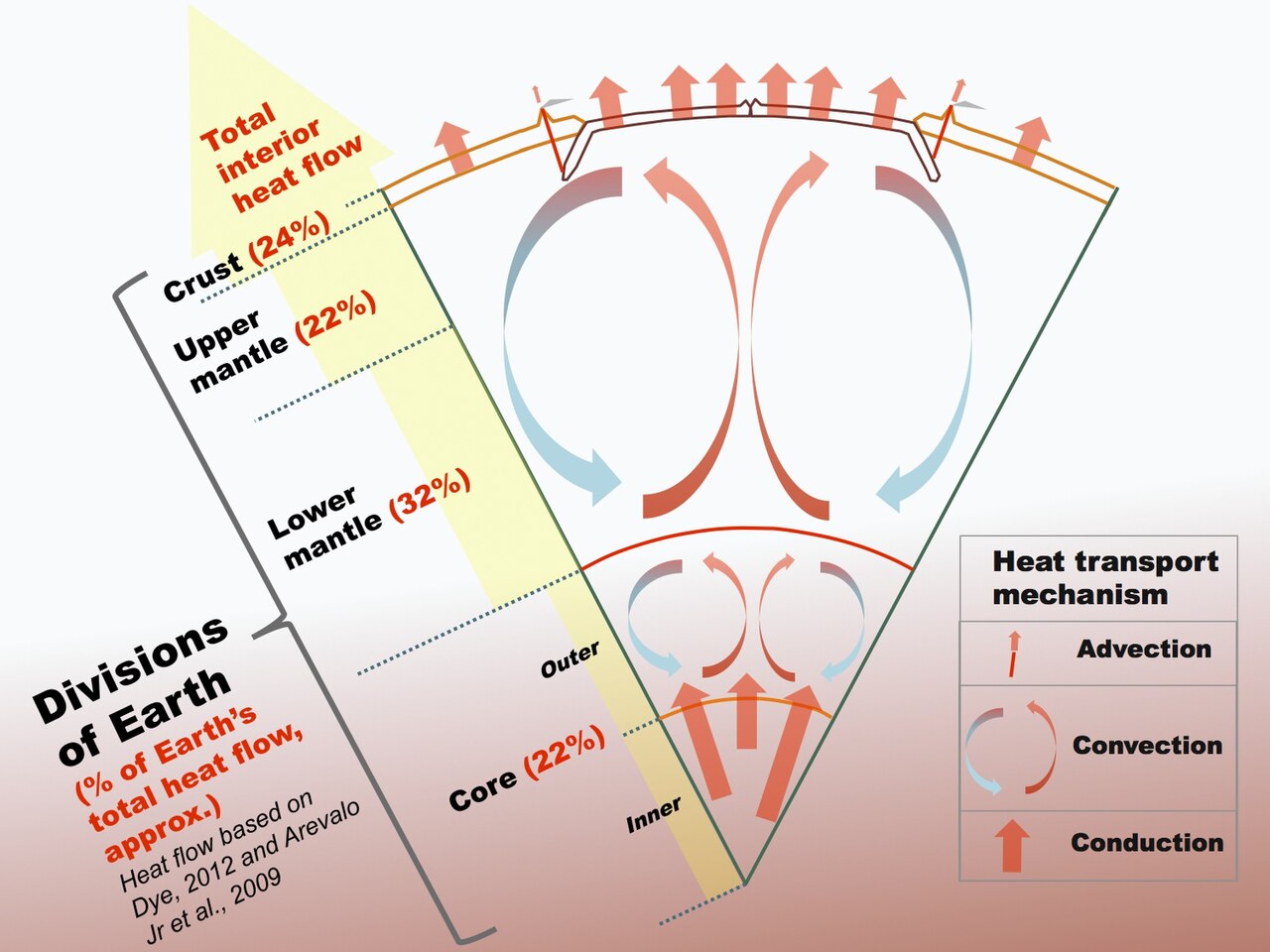
The inside of the Earth is hot for two main reasons. Some heat is left over from the planet's birth, when falling material and the pull of gravity released huge amounts of energy. The rest comes from radioactive atoms in the and . As these atoms slowly break down, they give out heat.
This heat is the engine of our planet. It drives in the mantle, which moves the tectonic plates. That brings earthquakes, volcanoes and mountain-building. It also keeps the outer churning, which makes the . A planet that loses its inner heat early, such as the Moon, ends up with no active volcanoes and no global magnetic field.
Heat travels outwards from the core in two ways. Conduction passes heat from atom to atom through solid material. Convection carries heat by moving the hot material itself. In the mantle and the outer core, convection is the more important of the two.
Will Earth ever run out of heat? Very slowly, it is cooling. One estimate says the core would take about 91 billion years to freeze solid, but the exact figure is uncertain. That is far longer than the Sun will last. In about 5 billion years the Sun will swell into a red giant and scorch the surface, long before the core goes cold.
Explore Next
Your audio story keeps playing while you look around.

Words to Know
- asthenosphere
- The soft, slowly flowing layer of the mantle beneath the lithosphere.
- convection
- The movement of heat by hot material rising and cooler material sinking.
- core
- The metal centre of the Earth, made mostly of iron and nickel.
- crust
- The thin, rocky outer layer of the Earth.
- differentiation
- The sorting of a molten planet into layers, with heavy material sinking to the middle.
- lithosphere
- The hard outer shell of Earth, made of the crust and the top of the mantle.
- magnetic field
- The invisible region of magnetic force around Earth, made by the moving metal in the outer core.
- mantle
- The thick layer of hot, slowly flowing rock between the crust and the core.
- Moho
- The boundary between the crust and the mantle, where seismic waves speed up.
- seismic wave
- A wave of energy that travels through the Earth, usually from an earthquake.