Tundra
Treeless lands of frozen ground, where life grows low and holds on tight.
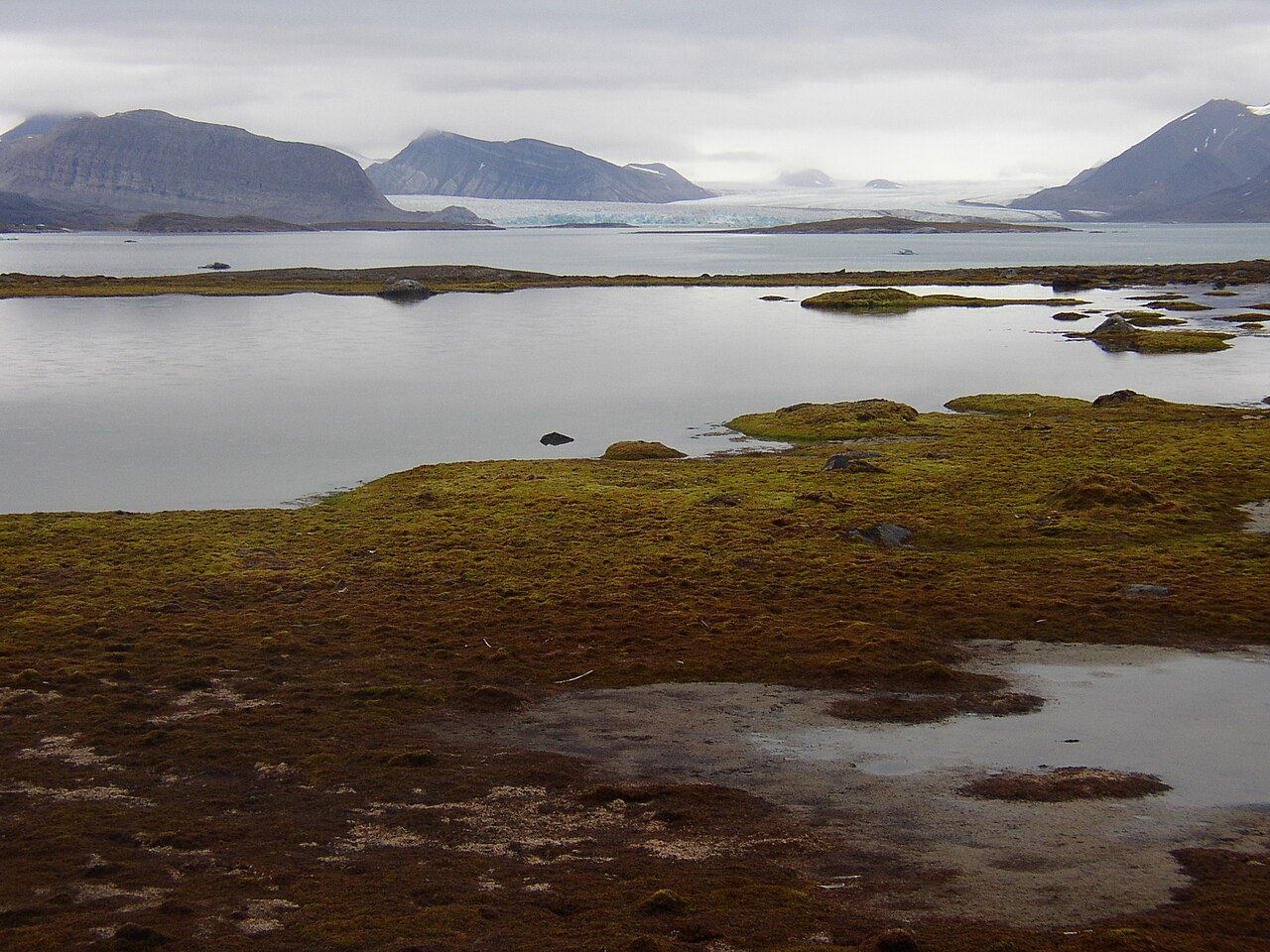
The tundra is a biome where it is too cold, and the growing season too short, for trees to grow. Instead the ground is covered by dwarf shrubs, sedges, grasses, mosses and lichens. There are three kinds. Arctic tundra rings the top of the world. Alpine tundra sits high on mountains everywhere. Antarctic tundra clings to a few rocky patches of the far south. In the Arctic, the soil beneath is permanently frozen. That frozen ground, called permafrost, holds huge amounts of carbon, so what happens to it now matters for the whole planet. How do plants and animals live in such a harsh place, and why is it changing so fast?
What makes a place tundra?
Tundra is land where trees cannot grow because it is too cold. The summers are short and cool, and the growing season may last only a few weeks. A tree needs warmth and time to grow tall, and the tundra gives it neither.
The word itself comes from Russian, which borrowed it from the Sámi languages of northern Scandinavia. In Kildin Sámi, tūndâr means a treeless plain.
Scientists use temperature to define the tundra climate. In the classification system named after Wladimir Köppen, tundra has at least one month with an average above 0 °C, which is warm enough to melt snow. But no month averages above 10 °C. Colder than that, the land is permanent ice. Warmer than that, trees can take hold.
The line where the trees stop is called the , or timberline. Near it the land is a mixture of forest and tundra. Beyond it, the plants are low. Tundra plants include dwarf shrubs, sedges, grasses, mosses and . In a few places, scattered trees still grow.
There are three regions of tundra. Arctic tundra lies in the far north, beyond the great northern forests called . Alpine tundra lies on mountains above the tree line. Antarctic tundra is found on the Antarctic Peninsula and on islands near Antarctica. The three look different, but they share the same cold, windy, short-summer rules.
Why is the tundra a desert full of lakes?
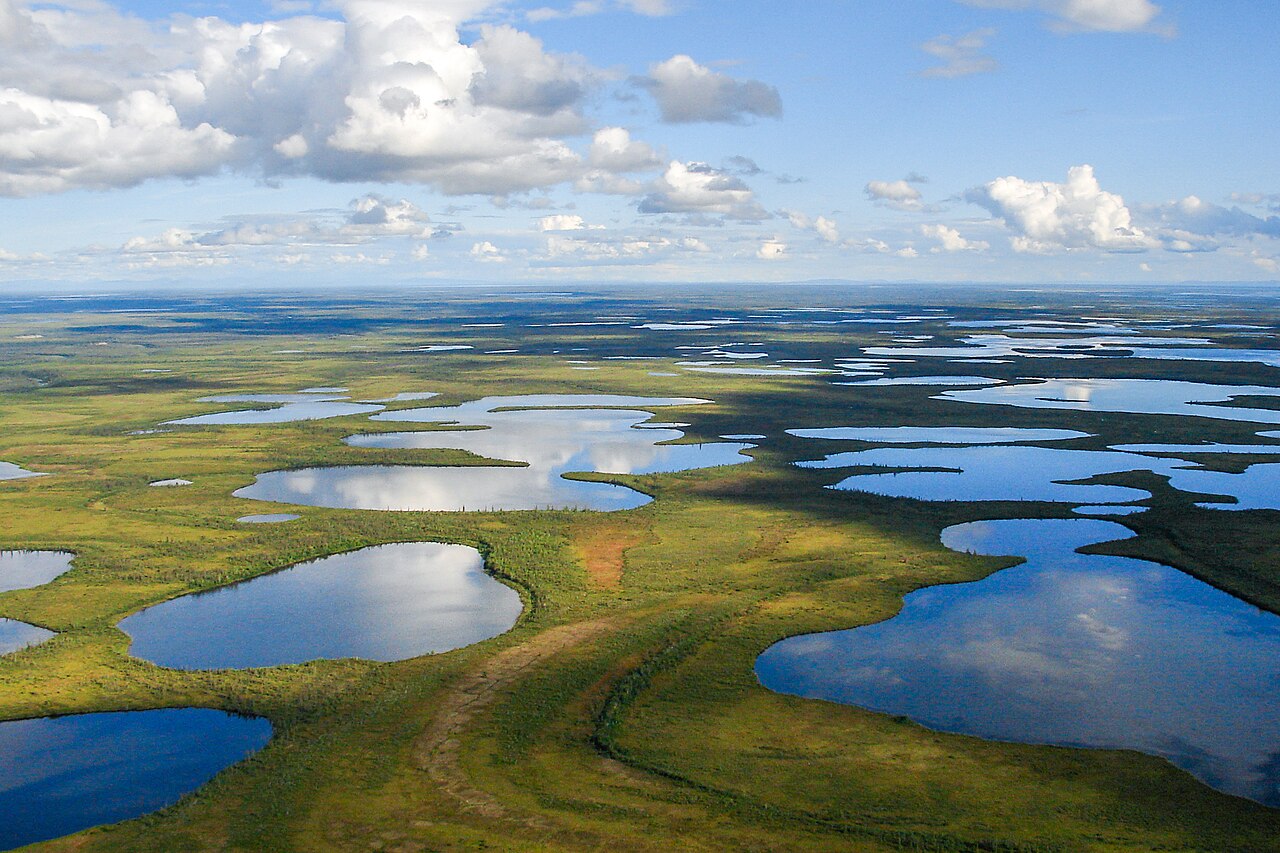
The Arctic tundra has two main seasons, a long winter and a short summer. Winter is dark, windy and very cold. The average temperature is around -28 °C, and it can drop as low as -50 °C. Summer brings some warmth. Daytime highs often reach about 12 °C, though they can fall back to 3 °C or below freezing.
It is also very dry. Only about 150 to 250 millimetres of rain and snow fall in a year, which is as little as in many deserts. The wind blows hard, often at 50 to 100 kilometres an hour.
So why are there so many lakes, marshes and bogs? The answer lies underground. A little below the surface, from about 25 to 90 centimetres down, the soil is frozen all year. This is . In summer the top layer thaws and turns soggy. But the water cannot drain through the frozen ground below it. It also evaporates slowly, because the air is cold. So the water collects in ponds, lakes and wet ground.
The tundra is not as cold as you might think. The lowest temperatures in Russia, Canada and Alaska were recorded south of the , in the forests. Cold air sinks into valleys there, and the inland winters are longer.
Wildfires can happen, too. In Alaska, a tundra fire returns to the same area about once every 150 to 200 years. In 2007 a fire burned 1,039 square kilometres on the north slope of the Brooks Range.
How do plants survive where nothing grows tall?
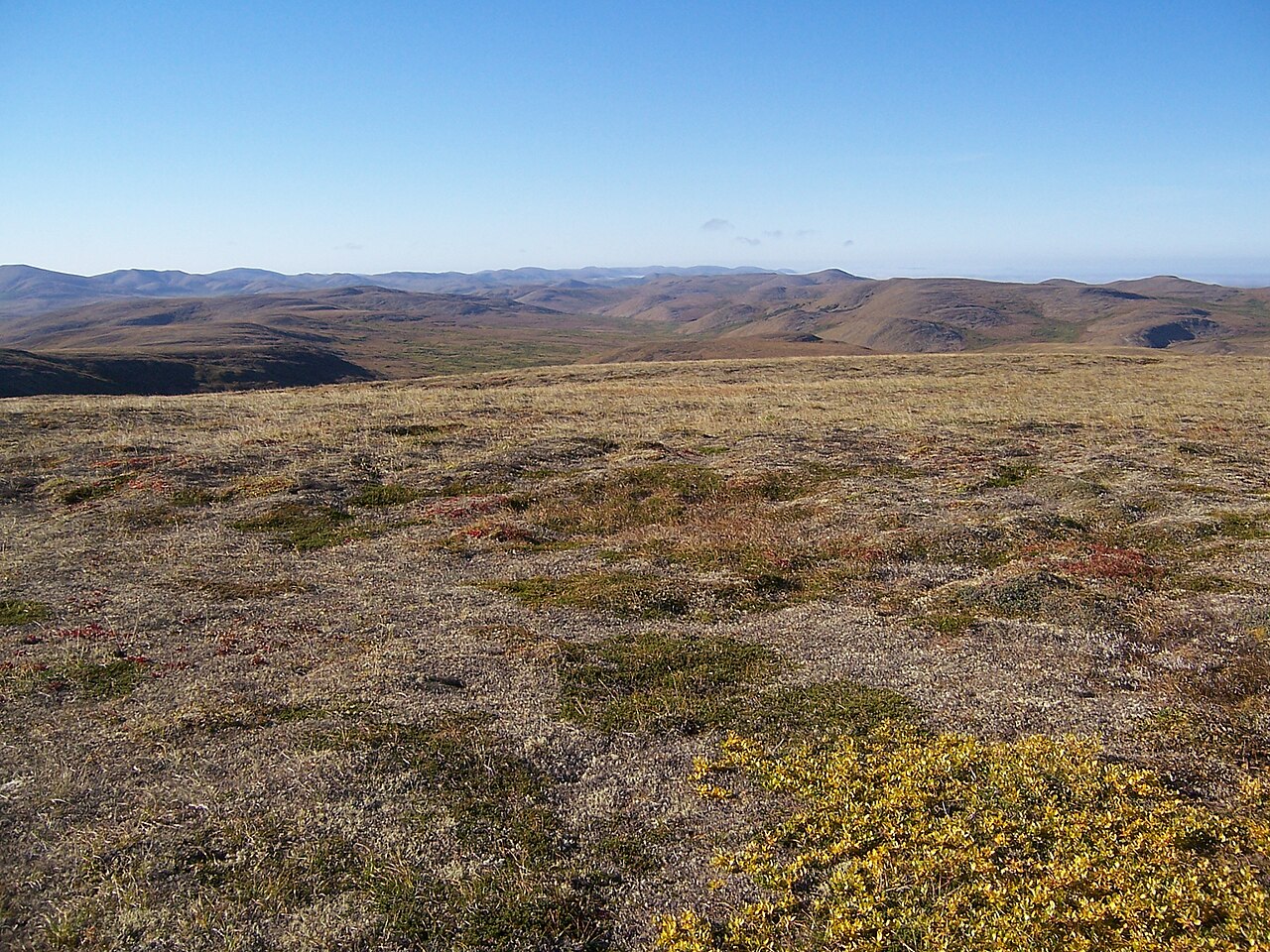
Tundra plants live life close to the ground. Mosses, , sedges, grasses and dwarf shrubs form a low mat. Roughly 1,700 kinds of flowering plant and fern, known as , grow in the Arctic tundra. That is very few compared with a rainforest.
Staying small is a clever answer to the weather. Near the ground, the wind is weaker, and the air is a little warmer. Plants that grow low also get shelter from the snow that lies over them in winter. Their roots cannot go deep, because the blocks the way. Short shrubs, such as crowberry and bearberry, spread sideways instead.
Many of these plants are tough and slow-growing. Notable ones include the bog blueberry, the crowberry, the lingonberry and the Labrador tea, a small shrub with leathery leaves. Another is reindeer lichen. A lichen is not a plant but a partnership between a fungus and an alga. It can survive drying out and freezing, and it is a main winter food for reindeer.
The tundra soil is rich in nitrogen and phosphorus, which plants need. It also holds a lot of dead plant material. In the cold, this does not rot away quickly. Instead it builds up and stores carbon. That makes the tundra soil a , a place that takes in more carbon than it gives out. The amount of plant material depends more on temperature than on rainfall.
Who lives on the tundra?

Not many kinds of animal live on the Arctic tundra. Only about 48 kinds of land mammal are found there. But the ones that do live there can be very common.
The best-known grazers are the reindeer, which are called caribou in North America, and the muskox. A muskox has a thick, shaggy coat that reaches almost to the ground. Small animals include Arctic hares, northern red-backed voles and lemmings, which are tiny rodents. They feed the hunters, such as Arctic foxes and snowy owls. Ptarmigan are grouse-like birds that stay all winter. Polar bears roam the tundra close to the sea.
Many animals leave in winter. Millions of birds fly to the tundra each summer to nest in the marshes and feed on the swarms of insects, among them mosquitoes. Then they migrate south before the cold sets in. There are a few kinds of fish, too.
One group is almost missing. The tundra has very few cold-blooded animals such as frogs or lizards. These animals cannot make their own heat, so they struggle in such cold.
Plant-eating animals have thick fur and fat to keep them warm. Some have white winter coats that hide them in the snow. Because there are so few species, one change can ripple through the web of life. When lemmings are scarce, owls and foxes may go hungry.
Do people live on the tundra?
Yes, and they have done for a very long time. The polar tundra is home to several peoples who are mostly reindeer herders. Nomadic means they move from place to place with the seasons. The Nenets and Nganasan live on the tundra of northern Russia. The Sámi live in Sápmi, in the north of Norway, Sweden, Finland and Russia. Their herds find fresh grazing as they travel, and the animals also give meat, skins and transport.
For most of history, the Arctic tundra saw little other human activity. The cold, wind and darkness made it hard to farm or build. But the land is rich in resources. Petroleum, natural gas and uranium lie under it. In recent times, people have begun to use these in Alaska, Russia and other places. The Yamalo-Nenets region of Russia produces about 90 per cent of the country's natural gas.
This brings new problems. Roads, pipelines and buildings are often built on permafrost. If the ground thaws, it can sink and buckle, and structures can crack or collapse. Engineers must design them carefully, sometimes raising buildings on posts so that their warmth does not melt the ground.
Some tundra areas are protected. In Canada and Russia, many are covered by national plans to protect biodiversity. Vuntut National Park in Canada is one example.
Is there tundra at the bottom of the world?
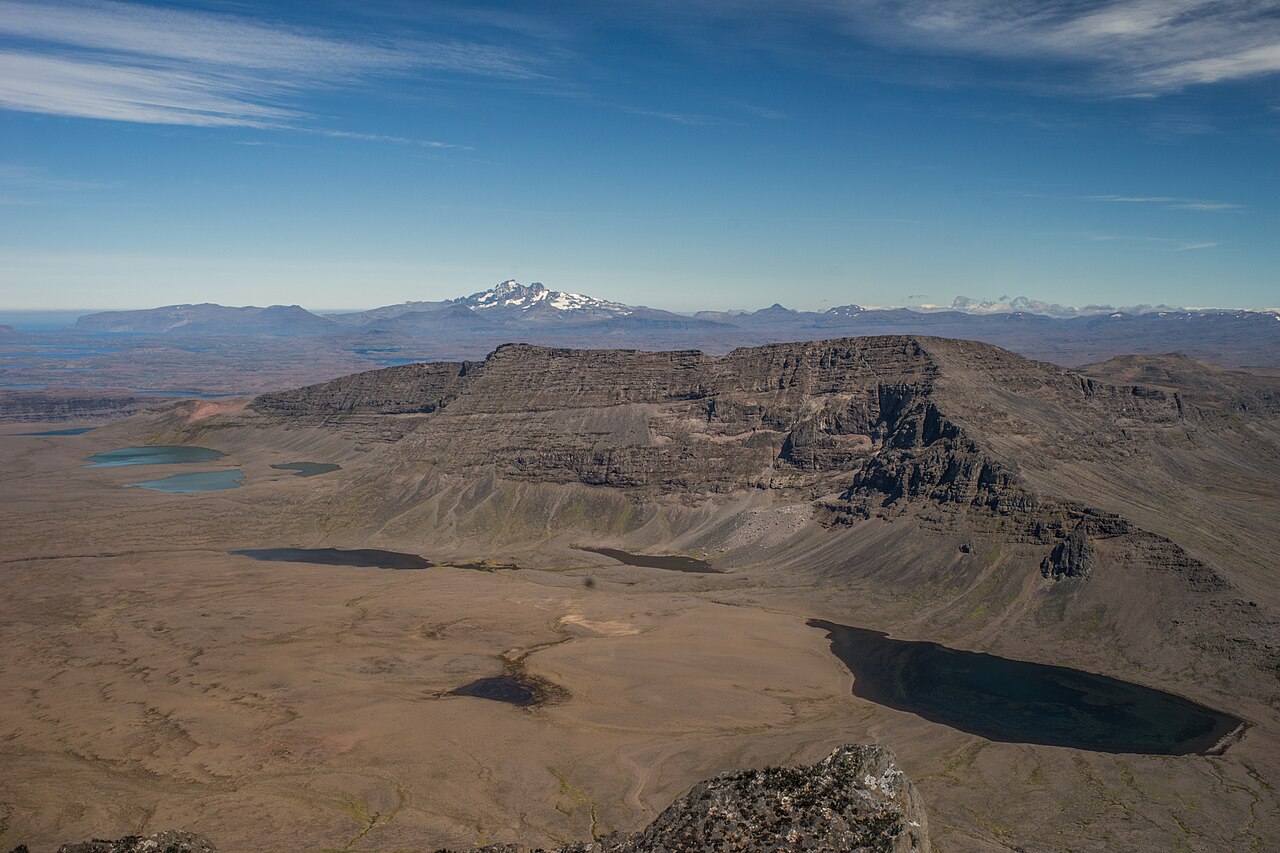
There is, but it is small and very different. Antarctic tundra is found on the Antarctic Peninsula and on islands such as South Georgia, the South Sandwich Islands and the Kerguelen Islands. Most of Antarctica is ice, or a cold desert with no plants at all.
Where rocky soil is exposed near the coast, life takes hold. About 300 to 400 species of , 100 of moss, 25 of liverwort and 700 of algae live there. Only two flowering plants grow on the continent. They are the Antarctic hair grass and the Antarctic pearlwort, and both are found on the northern and western Antarctic Peninsula.
The animals are also different from the Arctic. There is no large land mammal, mostly because the continent is so far from every other. Seals and penguins live near the shore, and seabirds nest on the cliffs. On some subantarctic islands, people have brought in rabbits and cats.
The subantarctic islands south of New Zealand and on Macquarie Island are home to species found nowhere else. They include the royal penguin, the Antipodean albatross and two helmet orchids, the only orchids that grow so far south.
A few scientists once counted the wet moorland of southern Chile as tundra. Newer research calls it temperate grassland. All the wildlife south of 60° south is protected by the Antarctic Treaty System.
What is tundra on a mountain?
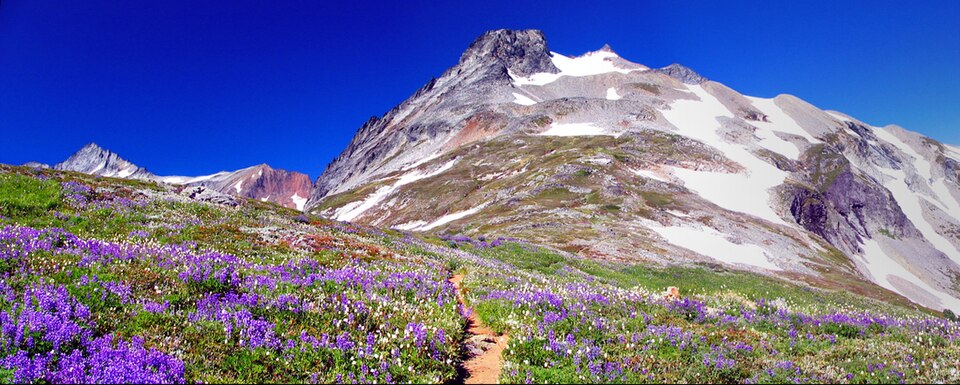
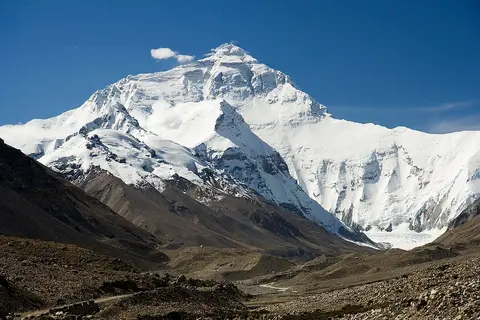
You do not have to go to the poles to find tundra. Climb high enough on almost any mountain and trees give out. Above that line is alpine tundra. It occurs on mountains all over the world.
The cause is the same as in the Arctic. The air gets colder as you go up, so alpine tundra has a climate much like the polar one. Soils are thin and the growing season is short. But alpine tundra is usually better drained than the Arctic, because there is no layer holding the water in.
Below the tundra, the forest does not stop at once. It thins into stunted, twisted trees called , a German word for crooked wood. They are bent by wind and ice into low shapes. The zone where forest meets tundra is the .
Alpine plants include perennial grasses, sedges, flowering herbs, mosses and . Many form tight cushions that hug the rock. They must cope with cold, drying winds, thin soil, a short growing season and strong ultraviolet light. The light is stronger up high because there is less air above to filter it. In summer they can burst into flower, and meadows of wildflowers cover the slopes.
Alpine tundra, too, can be changed by warming. Woody plants can creep upslope into the tundra, in what is known as woody plant encroachment.
What happens when the permafrost thaws?
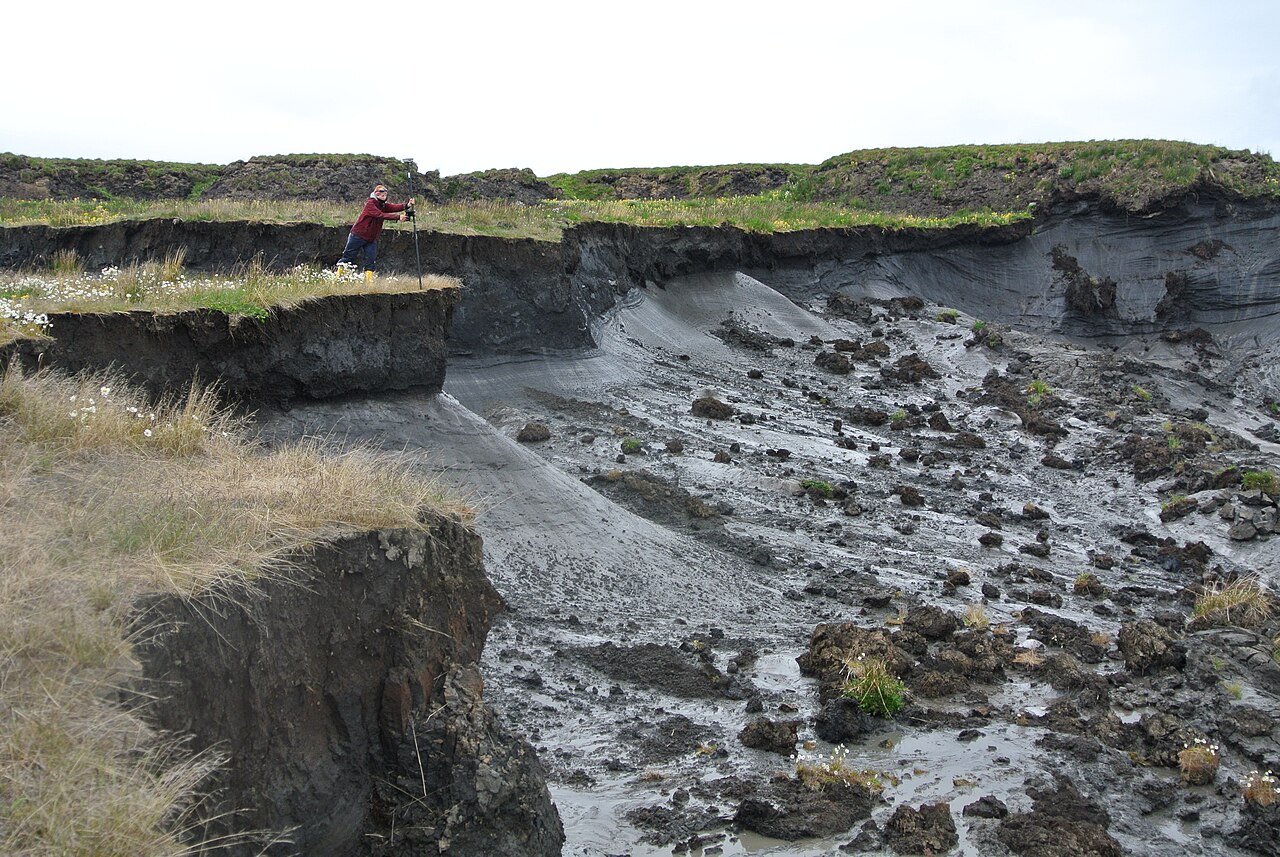
is a store of old plant and animal material that froze before it could rot. As it thaws, microbes start to break it down. They release carbon dioxide and methane, two , into the air.
That sets off a loop. Greenhouse gases trap heat, so the climate warms. Warming thaws more permafrost, which releases more gas. Scientists call this a positive , and it is one reason the Arctic is warming about three to four times faster than the world average. Warmer rain adds to the problem, because it carries heat into the ground and deepens the thaw.
How big could it be? The Intergovernmental Panel on Climate Change has estimated the possible release. For each degree Celsius of warming, thawing permafrost could give off the equivalent of 14 to 175 billion tonnes of carbon dioxide. For comparison, human activity added about 41 billion tonnes of carbon dioxide in 2024. A 2018 study suggested that at 2 °C of global warming, thaw would add about 0.09 °C more by 2100.
There are local effects too. Thaw can turn solid ground into slumps, ponds and mud. Roads and pipelines buckle. Plants and animals suited to cold ground may be replaced by others. Fires can burn dry peat.
We know all this from measuring ground temperatures, studying soil and tracking gas in the air year after year.
Explore Next
Your audio story keeps playing while you look around.
Words to Know
- carbon sink
- A place that takes in more carbon than it gives out.
- feedback
- A loop in which a change causes more of the same change.
- greenhouse gas
- A gas, such as carbon dioxide or methane, that traps heat in the air.
- krummholz
- Stunted, twisted trees that grow near the tree line.
- lichen
- A living partnership between a fungus and an alga, often growing on rock or soil.
- nomadic
- Moving from place to place instead of living in one spot.
- permafrost
- Ground that stays frozen all year round, for at least two years.
- taiga
- The cold forest belt that lies just south of the Arctic tundra.
- tree line
- The edge beyond which trees cannot grow, because of cold or altitude.
- vascular plant
- A plant with tubes for carrying water, such as a flowering plant or a fern.