Great White Shark
The ocean's most famous predator, and a far more careful hunter than its film fame suggests.
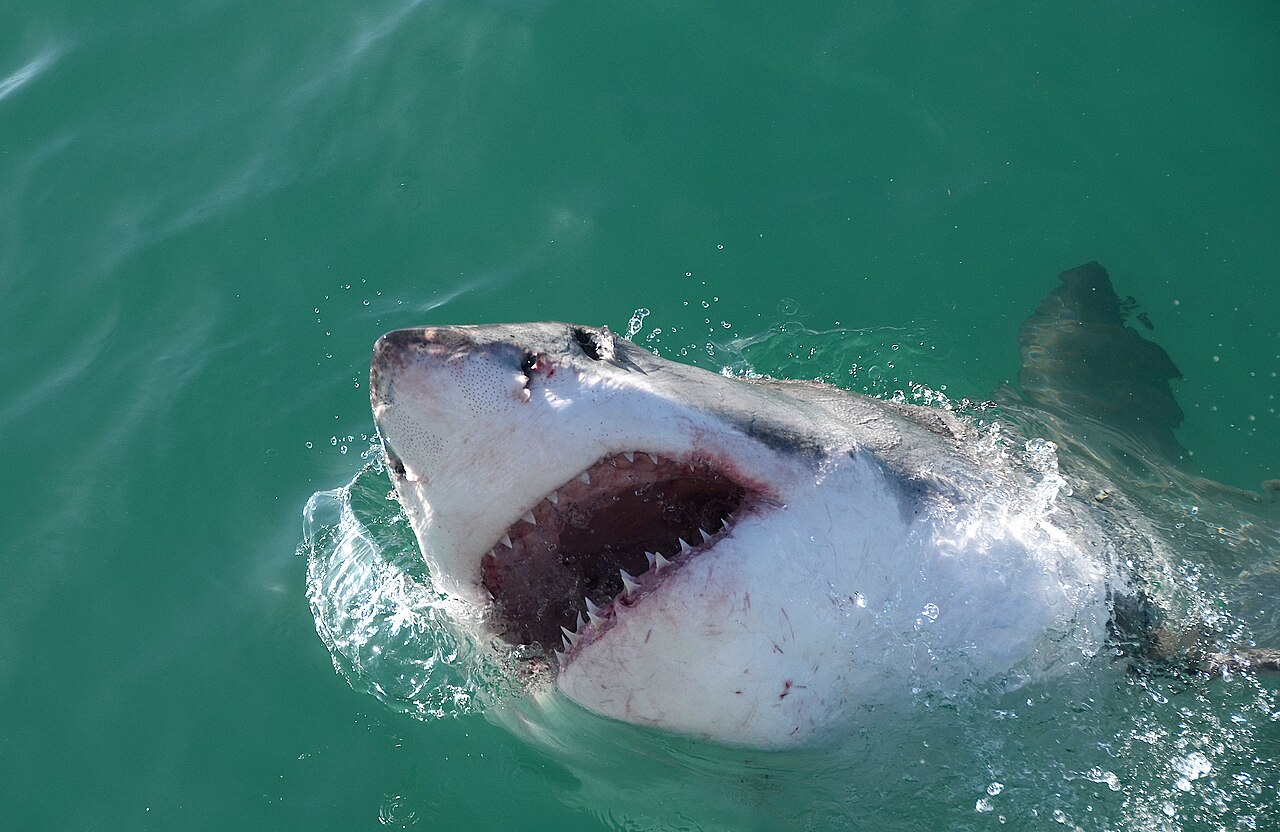
The great white shark is one of the biggest hunters in the sea. Adults are often 4 to 5 metres long, and the largest reliably measured was about 6 metres. It has around 300 serrated teeth and a body that is warmer than the water around it. It ambushes seals from below, then often slips back into the deep. It can cross whole oceans, and one shark swam from South Africa to Australia and back in about nine months. Films have made it a monster, but real great whites rarely bite people, and most bites are not fatal. Today the species is listed as vulnerable, and people are a bigger danger to it than it is to us.
What is a great white shark?
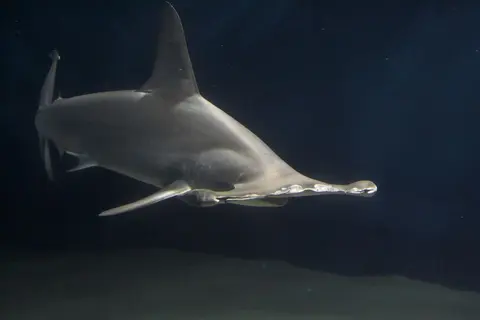
The great white is a big, stocky, torpedo-shaped shark with a cone-shaped snout and a tall triangular fin on its back. Its colour is a clever trick called . The back is grey and the belly is white. From above, the back blends with the dark sea, and from below, the white belly blends with the bright surface. This makes the shark hard for prey to spot.
Scientists often call it the white shark. Its Latin name, Carcharodon carcharias, comes from Greek words that mean "sharp tooth" and "shark". Australians call it the white pointer.
It is one of the largest living sharks that hunts other animals, and the adult females are bigger than the males. Females mature at about 4.5 to 5 metres, and males at about 3.5 to 4 metres. The biggest reliably measured fish was about 6 metres long and weighed 2,500 kilograms. Old stories of 10-metre monsters were never proved. The whale shark and the basking shark are bigger, but they eat plankton.
The great white is the only living member of its genus. Its closest relatives are the mako sharks, the porbeagle and the salmon shark, and all of these belong to the mackerel shark family.
It lives in warm and cool seas around the world. It is most common off the coasts of California and Mexico, eastern North America, South Africa, Australia and New Zealand.
How do its teeth and jaws work?
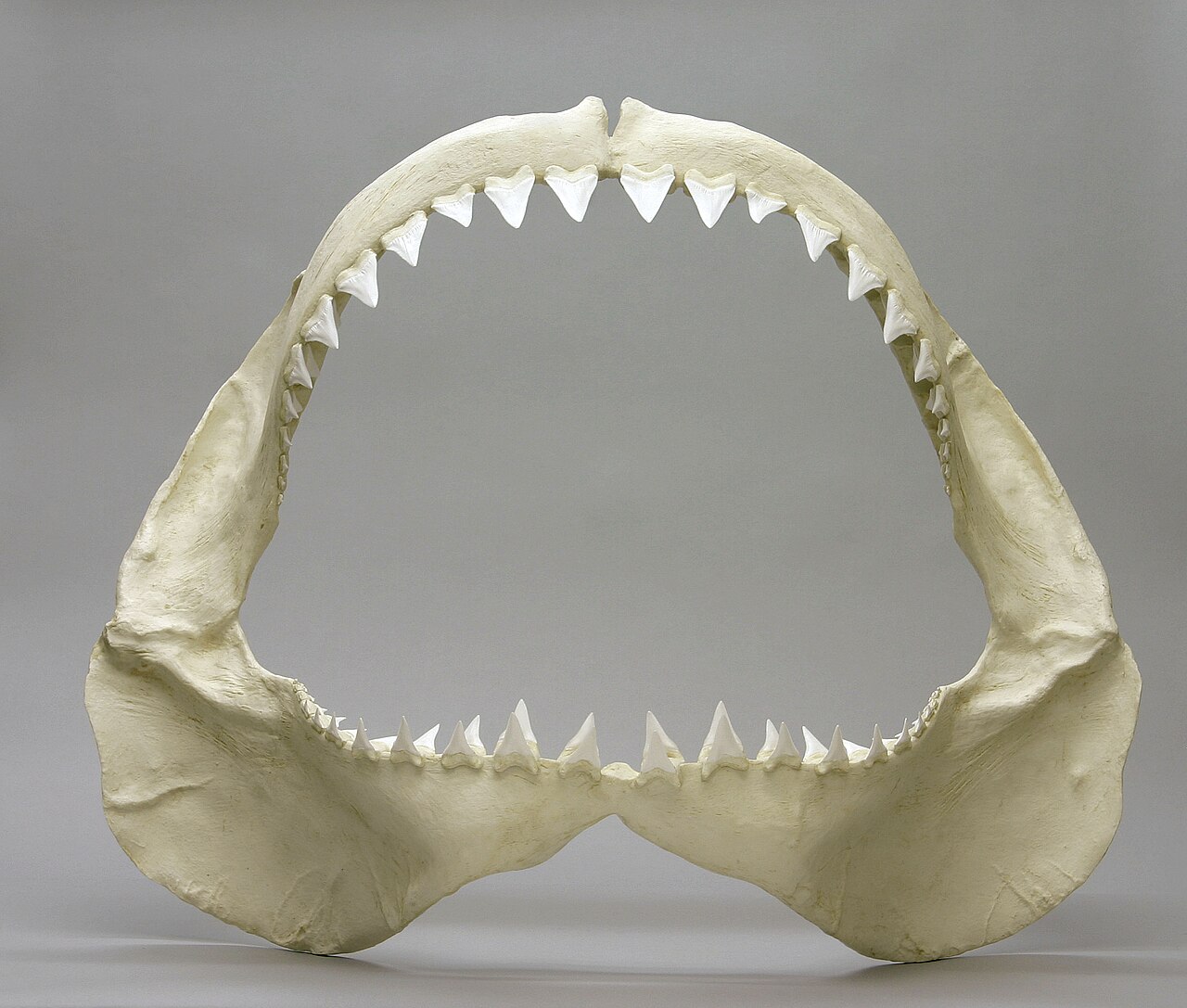
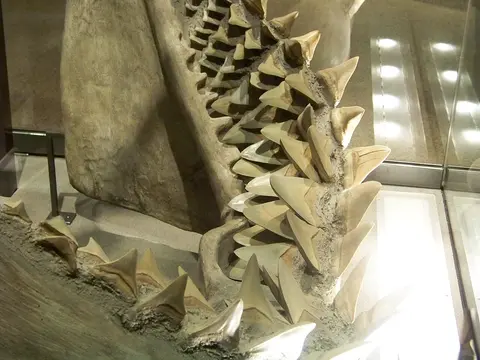
A great white has about 300 teeth, arranged in rows. The front row does the work, and spare teeth wait behind it. When a front tooth falls out, the next one moves forward, like a conveyor belt.
The teeth are triangular and have saw-like edges, and the biggest are up to 7.5 centimetres long. Young sharks have thin, pointed teeth that are good for catching fish. As they grow, their teeth become wider and more , and this is when the diet switches to seals and other mammals. The front teeth stab and hold, while the flatter back teeth cut through meat.
The jaws are not fixed to the skull. They hang from muscles and tendons, and they can shoot forward when the shark bites. The jaws are strengthened with hard, mineral-rich cartilage. Young sharks do not have this strengthening, so they eat softer food.
How strong is the bite? Scientists scanned a 2.5-metre juvenile and used a computer to calculate its bite force, then scaled this up to a 6.4-metre shark. The estimate for the biggest was over 18,000 newtons at the back of the jaw, which is a very strong bite. But the great white's power is not only bite force. It is a mix of speed, sharp teeth and a head-shaking tearing motion.
Why is a great white warm-bodied?
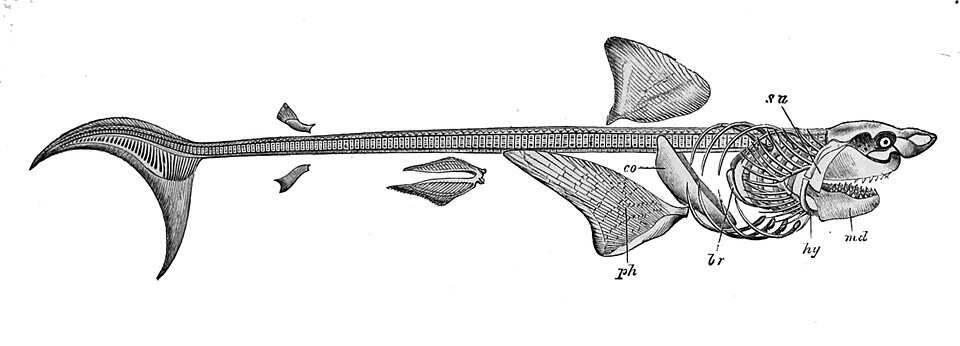
Most sharks are cold-blooded, so their body heat matches the water. The great white is different. Its swimming muscles make heat, and a web of blood vessels called the keeps it. Warm blood leaving the muscles passes close to cold blood coming in, and heat moves from one to the other and is trapped inside the body. This is called countercurrent exchange.
Warm muscles work faster and longer. Scientists found stomach temperatures of about 25 degrees Celsius in water that was 13 to 16 degrees. This is why the great white can hunt in cool seas, far from the tropics. It also has a big heart and lots of red blood cells, so it can carry plenty of oxygen to its muscles.
Most of the body is white, fast-twitch muscle, which is for sudden sprints such as when ambushing a seal. A thinner strip of dark muscle powers steady cruising.
Like many sharks, it has a huge oily liver that can be nearly a third of its body weight. The oil is lighter than water, so it helps the shark stay afloat, and it is also an energy store for long trips. One study found that a shark liver holds more energy than whale blubber.
The great white must keep swimming to breathe, because water has to flow through its gills all the time. The shark also heals fast, and studies of its genes show changes in genes linked to healing wounds.
How does a great white hunt?
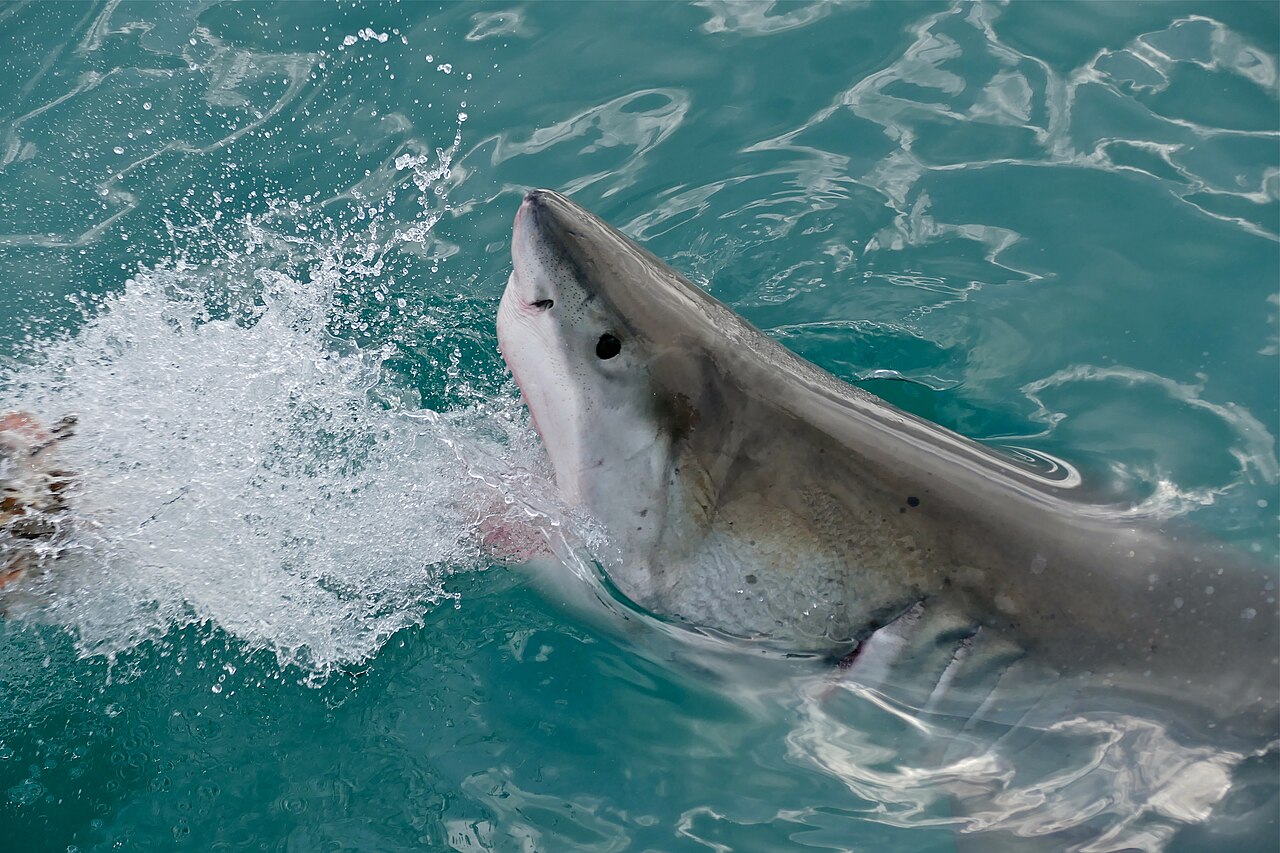
Great whites use sight and smell to find prey, and their brains show that these two senses are the best developed. The eyes can look black, but the irises are blue. The eyes have more cones than rods, which suggests they see best in daylight. Instead of an eyelid, the shark can roll its eyes back to protect them. A large smell centre helps it detect scent across the open ocean, and like all sharks, it senses electric fields and vibrations in the water.
Young great whites eat fish, squid and small sharks. Once they pass about 3 metres, they add seals, sea lions and dolphins. They also eat seabirds, turtles and dead whales. Fatty prey such as seals is best, because it gives the most energy.
The classic attack is an ambush from below. The shark cruises deep and then rushes upward, grabs a seal near the surface and drags it down. Often the first strike is on a young, newly weaned seal, because adult seals are strong and can hurt a shark. At some places, the shark leaps clear of the water as it hits, which is called .
Great whites normally cruise at 3 to 5 kilometres per hour, and when they sprint they can reach about 24. They have also been seen spyhopping, which means poking the head above water to look around.
Great whites have enemies too. Orcas sometimes hunt them, and they can flip a shark onto its back, which puts it into a trance-like state. Since 2017, a pair of male orcas called Port and Starboard has killed great whites off South Africa, and they take the shark's oily liver. After the killings, the sharks left places such as Gansbaai and False Bay, where cage-diving boats had once found them easily.
How far do great whites travel?
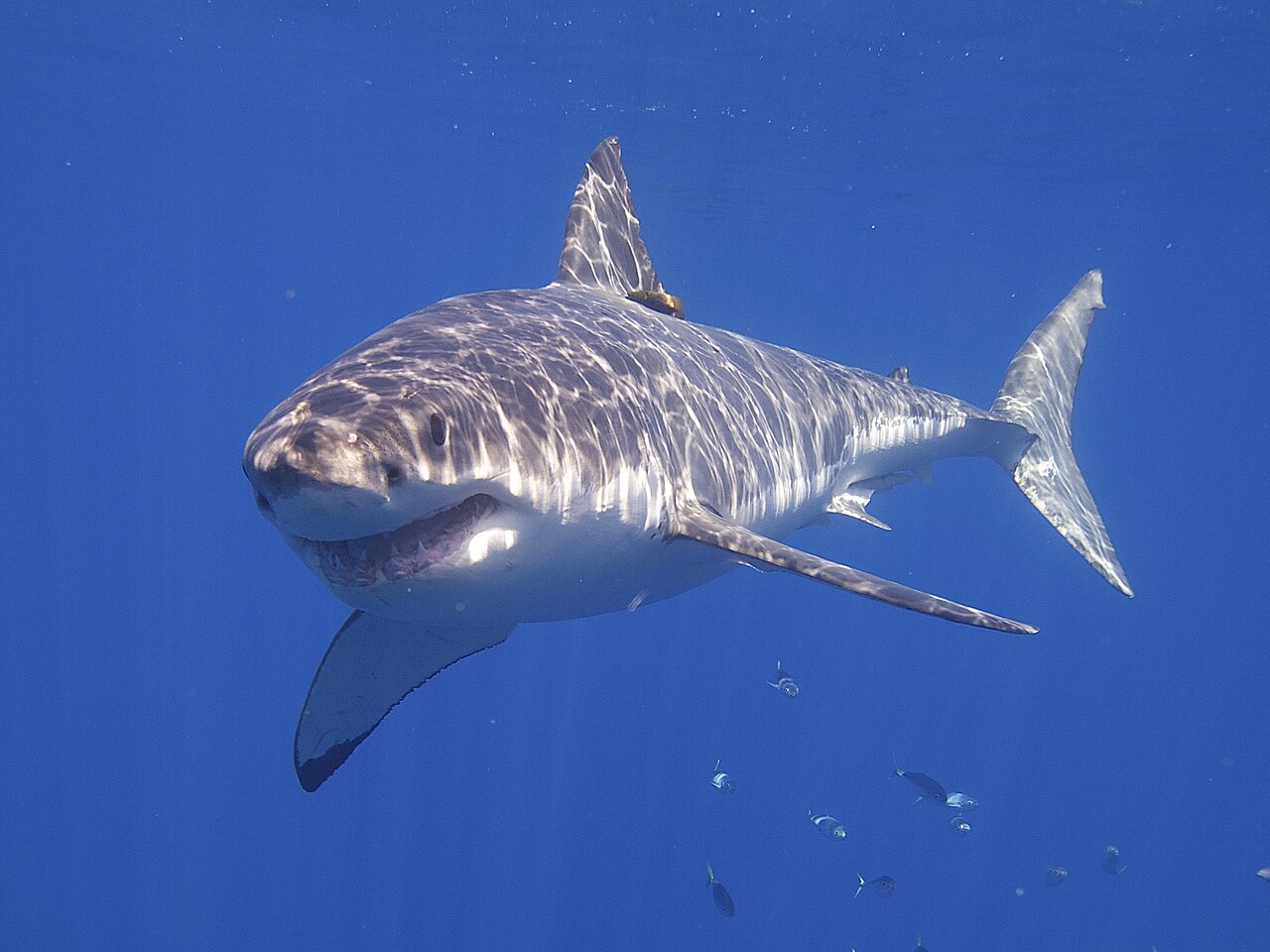
Great whites are some of the greatest travellers in the sea. Scientists use tags that record location and send it to satellites, and the results have been amazing.
In 2003 a female called Nicole was tagged off South Africa. She swam across the Indian Ocean to north-western Australia and back, about 20,000 kilometres in about nine months. In the Pacific, sharks travel between California, Mexico and Hawaii. They feed along the coast in autumn and winter, then go far out to sea in spring and summer.
One area in the middle of the Pacific is called the White Shark Cafe, and sharks gather there each year. Researchers are still working out why. They think the sharks may feed on prey that gather in warm swirls of water.
Why do they travel? Food is one reason, because seals gather at certain places at certain times and the sharks follow. Water temperature is another. Mating may also drive , though this has hardly been seen.
Great whites can dive deep, as far as about 1,300 metres, and deeper dives are more common in the open ocean. The young stay in warm, shallow water between 14 and 24 degrees Celsius.
In 2024, a satellite tag came back from a fisherman in Indonesia. It had been put on a young female off South Africa in 2012, which shows how far one shark can go.
Do great whites have a social life?
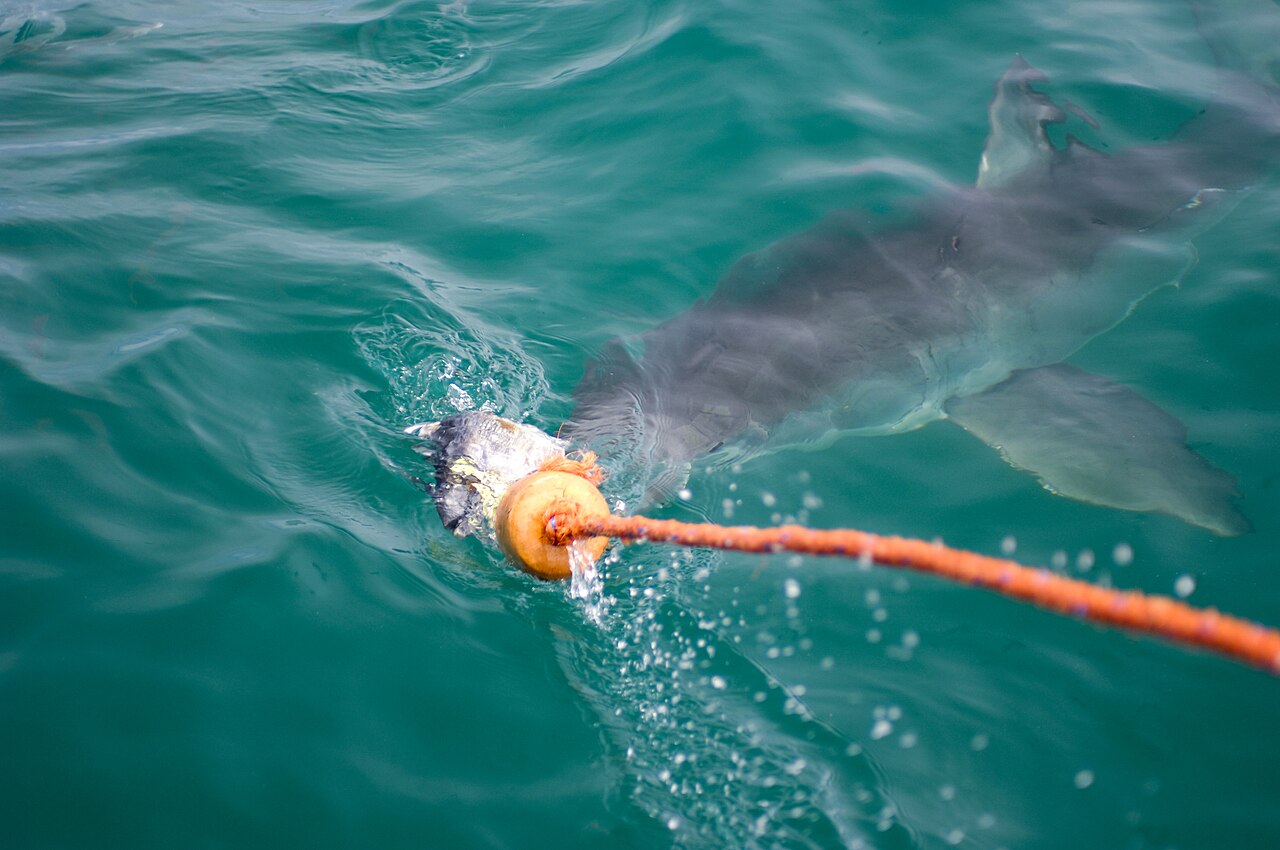
Great whites used to be called solitary, but we now know that is only partly true. They often hunt alone, but they also meet at feeding spots. Sharks at Guadalupe Island in Mexico and at the Neptune Islands in Australia gather in groups. Some research suggests that sharks may learn from others where to find food.
They also talk to each other, using body language, and scientists have noted at least 20 different signals. Two sharks may swim side by side, or circle each other, as if checking each other out. A shark may show off the side of its body. This seems to settle who is boss, and size usually decides, so the smaller shark gives way and avoids a fight.
Fights are rare. Instead, sharks use splash fights. One shark slaps its tail on the surface and splashes the other, and the rival either leaves or splashes back. The one that keeps splashing longest wins. Sharks have also used tail splashes to scare tiger sharks away from a whale carcass, and a few have even splashed at boats and cages.
At a few sites, many age groups mix. At the Neptune Islands, young females show up in April and May, and adult males arrive around September, so great whites seem to follow a regular calendar. Most of their private lives are still a mystery, though. Nobody has watched them mate for long, so scientists rely on a few short reports.
How do great whites grow up?
Great white pups hatch from eggs inside their mother, and then they stay there and grow. The embryos first feed on yolk, then drink a milky fluid made by the womb, and finally eat unfertilised eggs. After about 12 months, the mother gives birth to between 2 and 10 live pups, each 1 to 1.6 metres long. A mother does not have her next litter for at least two years.
Birthplaces are shallow, warm waters around islands. In July 2023, a newborn great white was filmed for the first time off southern California. It was pale from its milky diet. Before that, nobody had seen a great white pup so young in the wild.
How fast do they grow? Rings on their backbones work like tree rings. Early studies said they matured at 9 or 10 years, but a 2015 study found they grow slowly. Males mature around 26 years old at about 3.5 metres, and females take about 33 years and reach 4.5 to 5 metres. Growth slows after about age 40.
The oldest are thought to pass 70 years. Young sharks have a good chance of survival, at over 70 per cent per year, and adults do even better, at over 90 per cent. That is typical of slow breeders, and it also explains why the species is so . When too many adults are killed, there are few young to replace them, and recovery takes decades.
Where did great whites come from?
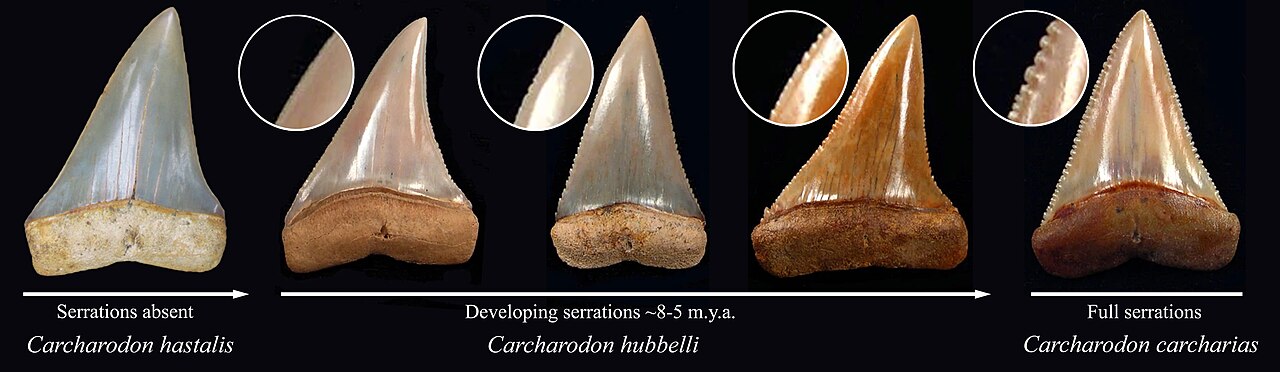
The great white is not very old for a shark. It first shows up in the fossil record about 6 to 5 million years ago, in the Pacific. Because cartilage rots, nearly all the fossils are teeth.
Teeth tell a story. A big shark called Carcharodon hastalis had teeth just like a great white's, but with smooth edges, and it ate mostly fish with some sea mammals. About 8 to 6 million years ago, a Pacific group evolved into a form called Carcharodon hubbelli. Its teeth slowly gained saw-like edges, which made it better at cutting through mammal flesh. The great white came from this line.
Some scientists disagree about where hastalis fits on the family tree, and some place it closer to the mako sharks. So the exact ancestry of the great white is still debated.
By the end of the Pliocene, about 2.6 million years ago, great whites had spread around the world. They took over from a much larger shark, the megalodon, which died out around 3.6 million years ago. The great white is not a small version of megalodon, because they are only distant cousins.
Today's populations are genetically distinct. A 2024 study found three main groups, and 2025 work suggests they separated about 7,000 years ago, after the number of sharks fell. Cold currents and warm equatorial waters may keep them apart.
Are great whites a danger to people?
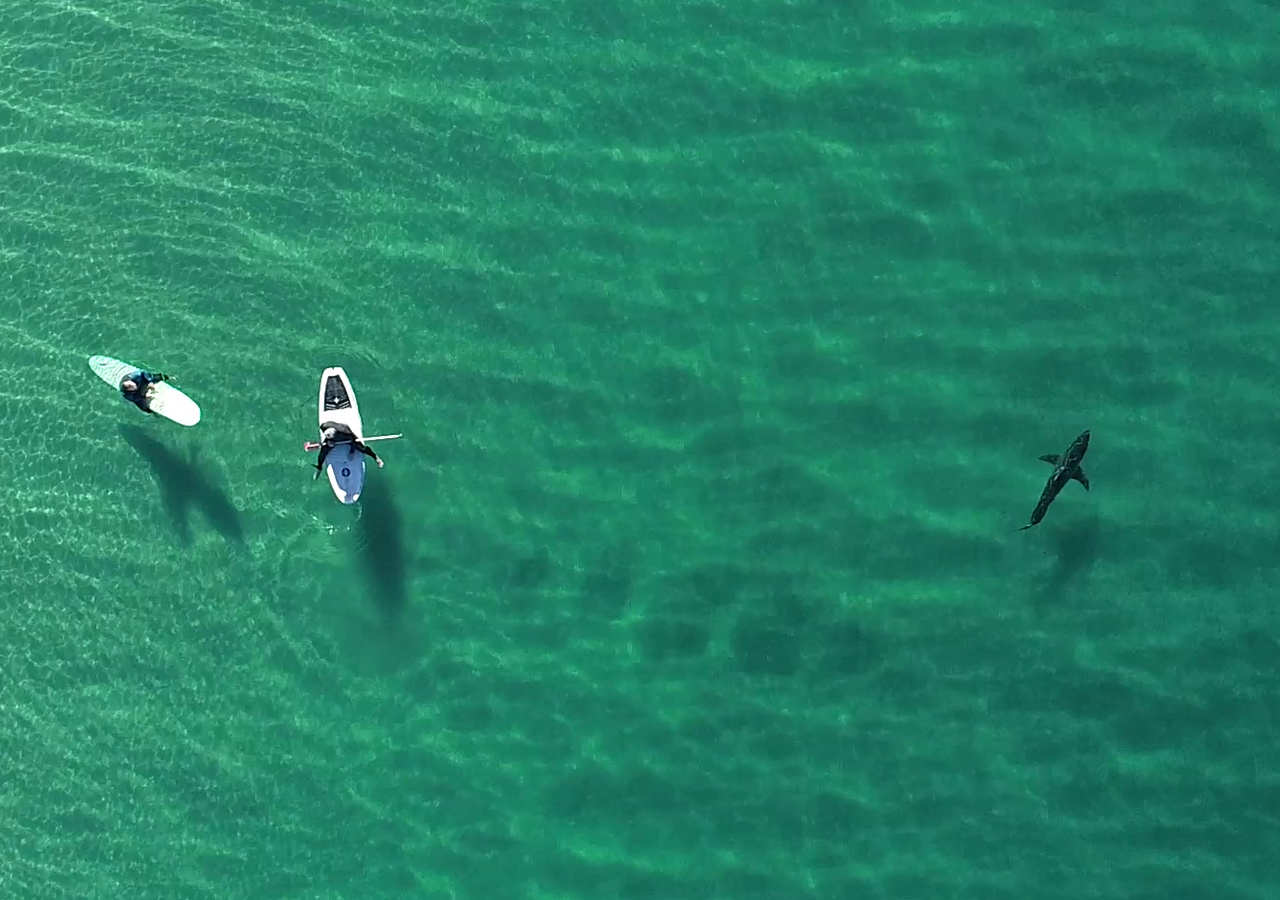
The great white has caused more recorded bites on people than any other shark. The count is 351 bites since 1580, up to 2024, and 59 of them were fatal. That works out at fewer than one death a year over the whole of modern history, and most bites were not deadly. In 2025, three surfers in Australia died from white shark bites. Humans are not a normal meal for great whites. Most researchers think these are exploratory bites or cases of mistaken identity, for example a surfer looking like a seal from below. In a 2025 drone study, researchers watched great whites at coastal hotspots and found no signs of aggression towards people.
The shark's image changed in the 1970s. The film Blue Water, White Death was released in 1971, Peter Benchley's novel Jaws followed in 1974, and the film in 1975. Benchley later said he regretted how the book had portrayed the shark.
The bigger danger is to the shark. The IUCN lists the great white as , and in Europe and the Mediterranean it is critically endangered. Fishing nets catch it by accident, beach nets can entangle it, and sport fishing took many in the past. Many countries now protect it, and killing it is banned in many places.
People also visit them. In South Africa and Australia, tourists view great whites from boats or from cages. Aquariums find the species almost impossible to keep, and great whites held in tanks have died or had to be released.
Explore Next
Your audio story keeps playing while you look around.
Words to Know
- apex predator
- An animal at the top of the food chain.
- breaching
- Leaping out of the water.
- countershading
- Colouring that is dark above and pale below, which helps an animal to blend in.
- migration
- A regular long journey made by animals, usually to find food or breed.
- ovoviviparous
- Producing eggs that hatch inside the mother, so the young are born alive.
- rete mirabile
- A web of blood vessels that keeps heat inside the body.
- serrated
- With a saw-like edge.
- unprovoked
- Not caused by any action from the person.
- vulnerable
- At risk of becoming endangered in the wild.