Megalodon
The giant shark whose huge teeth are the best clue we have to its size.
Megalodon was one of the largest and most powerful hunters ever to swim in the sea. The name means "big tooth", and its teeth could be longer than a person's hand. It lived from about 23 to 3.6 million years ago and hunted whales, seals and turtles. No complete skeleton has ever been found. A shark's skeleton is soft cartilage, which rots away, so scientists must work from teeth, some backbone pieces and comparisons with living sharks. That is why estimates of its length vary so much, from around 14 metres to more than 24. It is a story of how science builds a picture from small clues.
What was megalodon?
Megalodon was a giant shark of the warm and mild seas. It lived from the Early to the Early , roughly 23 to 3.6 million years ago. That is long after the dinosaurs, in the age when whales and seals were spreading across the oceans.
For a long time, scientists thought it was a giant relative of the great white shark, because both have big, triangular, teeth. Today, most scientists think the likeness is , which means that similar teeth evolved separately because both sharks hunted large prey. Megalodon belongs to a different, family called the Otodontidae, and its line split from the line leading to great whites in the Early Cretaceous, long before. The great white's closest relatives are the mako sharks. Not every scientist agrees, though, and a few still favour a closer link.
Megalodon's scientific name has changed several times. Louis Agassiz first named it in 1835, as Carcharias megalodon. He later moved it to the great white's genus, Carcharodon, and the name Carcharocles came later. Today most scientists call it Otodus megalodon.
It was one of the top predators of its time, but it was not the only giant. Sperm whales with huge teeth, such as Livyatan, hunted in the same seas.
How did people first understand megalodon teeth?
Megalodon teeth have been found by people for thousands of years. Native American peoples used them as tools, jewellery and offerings long before Europeans arrived. Some people in the Chesapeake Bay region mined them as early as 430 BC.
In Europe, nobody knew what they were. In AD 73, the Roman writer Pliny the Elder described them as stone tongues. People called them glossopetrae, or tongue stones. Some thought they fell from the sky during an eclipse of the Moon. In Malta, a story grew up that they were the tongues of snakes turned to stone by Saint Paul. People wore them as charms against poison.
The truth came slowly. In 1616, the Italian naturalist Fabio Colonna drew a Maltese tongue stone next to a great white's tooth. The likeness was clear, and he said they were shark teeth. But many scientists doubted him, partly because some of the stones were found far from the sea.
Later in the 17th century, the Danish scientist Niels Steensen, known as Steno, studied a shark's head and argued the same. Slowly the idea took hold that rock which is now dry land had once been sea floor.
So these fossils show a general rule. The same teeth that people once feared or worshipped are now the best evidence for a real animal.
How big was megalodon?
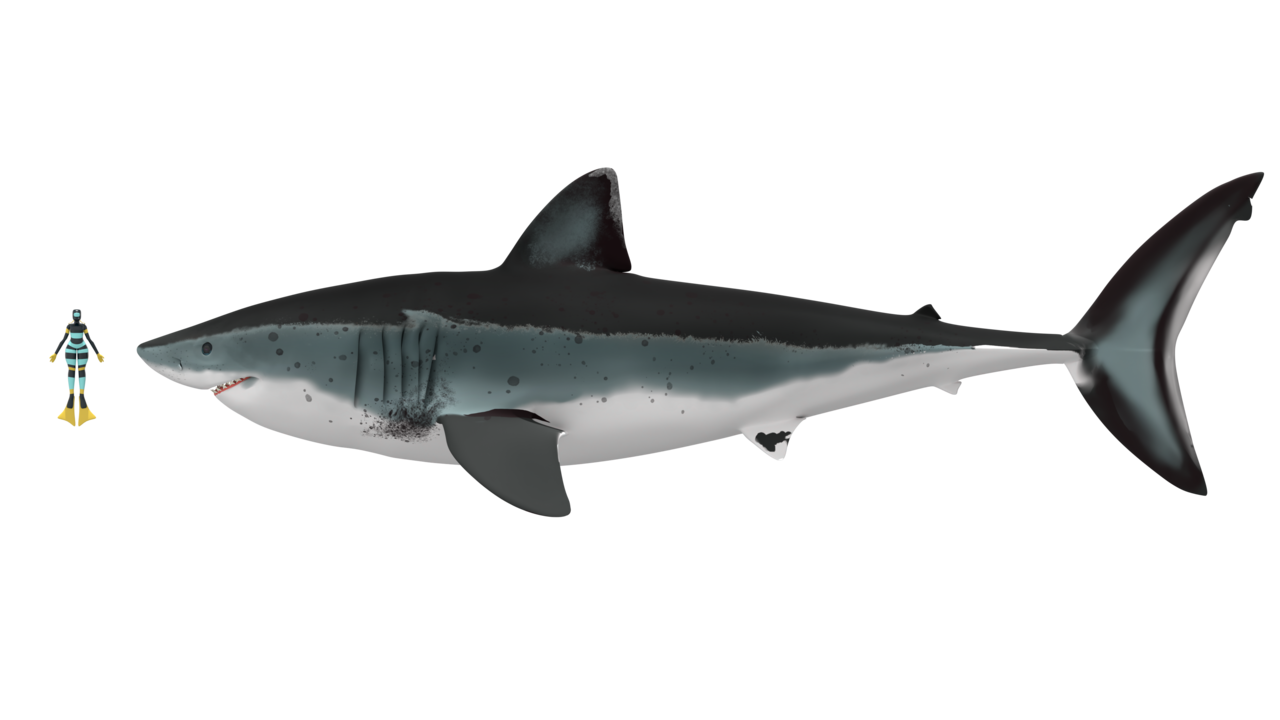
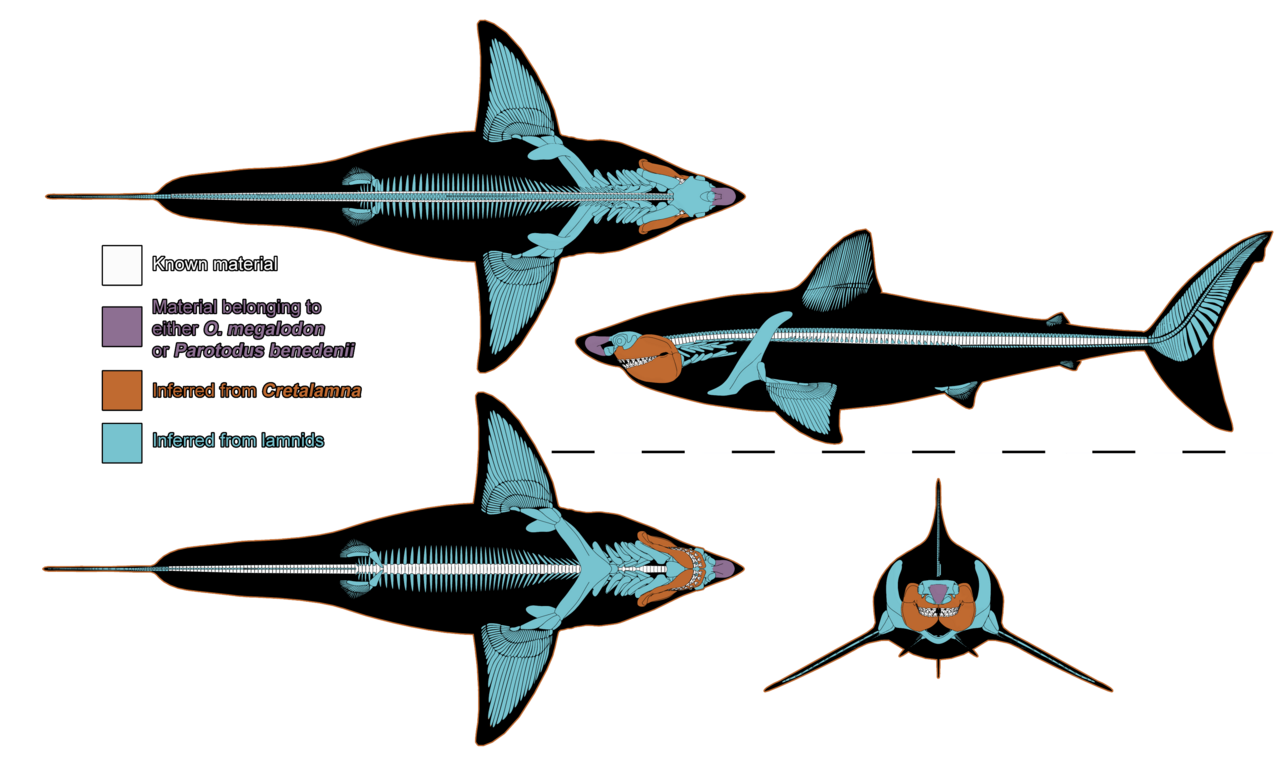
Nobody knows exactly. The only fossils are teeth and a few pieces of backbone, so scientists have to estimate. They compare the teeth with those of living sharks, mostly the great white.
Different methods give different answers, and estimates for the maximum length range from 14.2 metres up to 24.3 metres. A study in 2015 looked at 544 teeth and found a typical, or modal, length of about 10.5 metres. The range in that study was from 2.2 to 17.9 metres, and it included young sharks. A large great white is about 6 metres long, so a typical megalodon was nearly twice as long.
There is another puzzle. In 2024 and 2025, scientists suggested that megalodon had a longer, slimmer body than the older, great-white-like models. If so, the maximum would be at the high end, around 24 metres. In 2026 a team rediscovered a huge set of vertebrae, the bones of the backbone, from Denmark. They had been missing in a museum since the 1980s. The biggest is 23 centimetres across, the widest shark vertebra known, and it is the specimen behind the 24.3-metre estimate. Its growth rings suggest that this shark could have grown to almost 28 metres, but the authors call that model highly tentative.
Weight is also unclear. A 16-metre megalodon might have weighed about 60 tonnes, according to one 3D model, and a study of a 24-metre body gives 84 to 105 tonnes. For comparison, a blue whale can weigh well over 100 tonnes.
So the honest answer is a range. Megalodon was clearly one of the largest sharks ever, but its biggest size remains uncertain.
What did megalodon look like?
The old picture showed a great white shark that had simply been scaled up, with a stout body, a short rounded snout and wide jaws. Some artists gave it small, deep-set eyes.
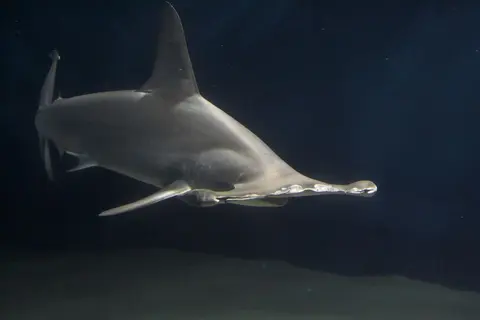
Another idea is that it was slimmer and more like a whale shark or basking shark in shape. It would have had a crescent-shaped tail, with a pair of ridges, or keels, on each side of the tail stalk. This body plan cuts drag, as in tuna and whales. The 2024 and 2025 studies suggest it was longer and more slender than the old models.
We know a little about its skin. In 2023, scientists described scales from a single megalodon. The scales were tiny, and their pattern fits with a shark that cruised slowly but could burst forward to catch prey. They also suggest it kept some body heat, like great whites and makos.
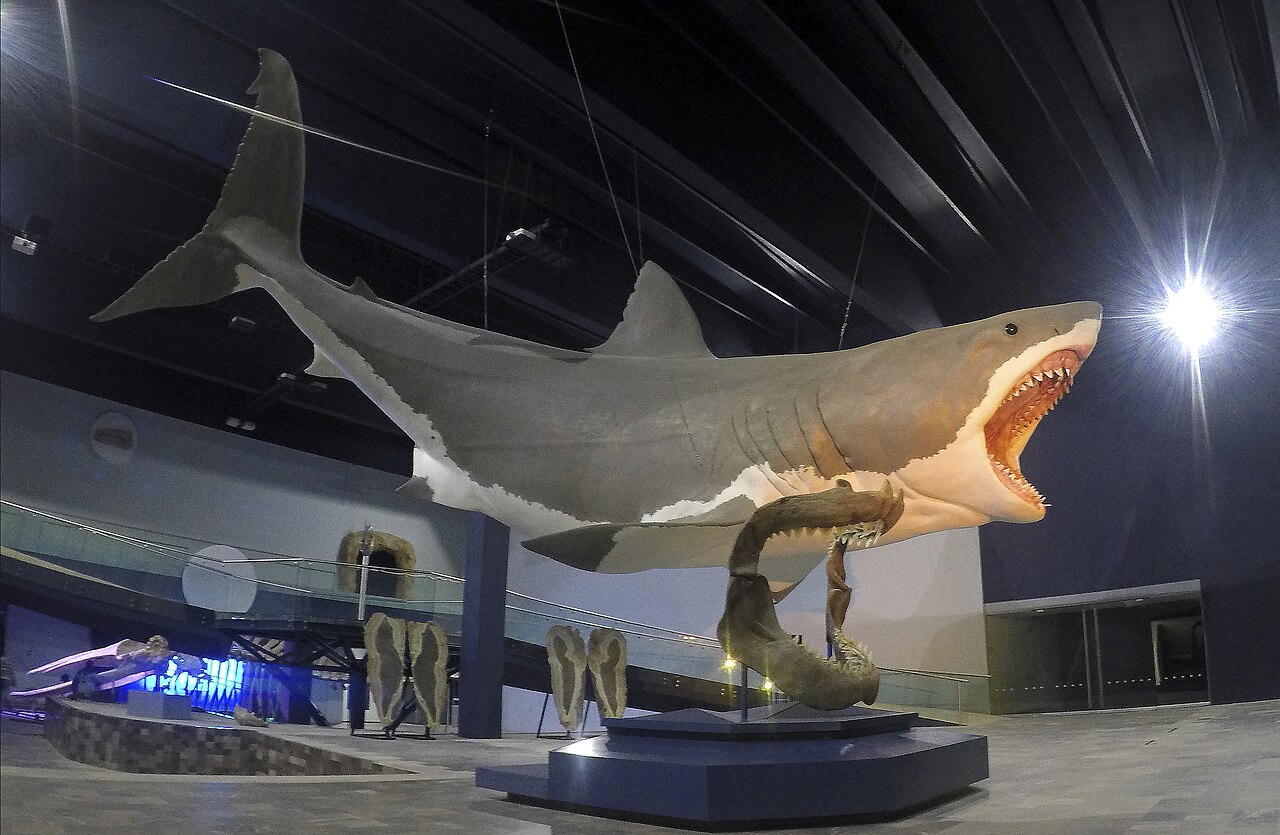
Its skeleton was made of , so very few parts survived. Museums show skeletons built on the great white's proportions, and one at the Calvert Marine Museum is about 11 metres long. These are best guesses, with missing parts filled in from living sharks.
Colour images are guesses too, because we do not know what colour megalodon was. Most artists draw it grey on top and pale below, like many sharks today.
How powerful was its bite?
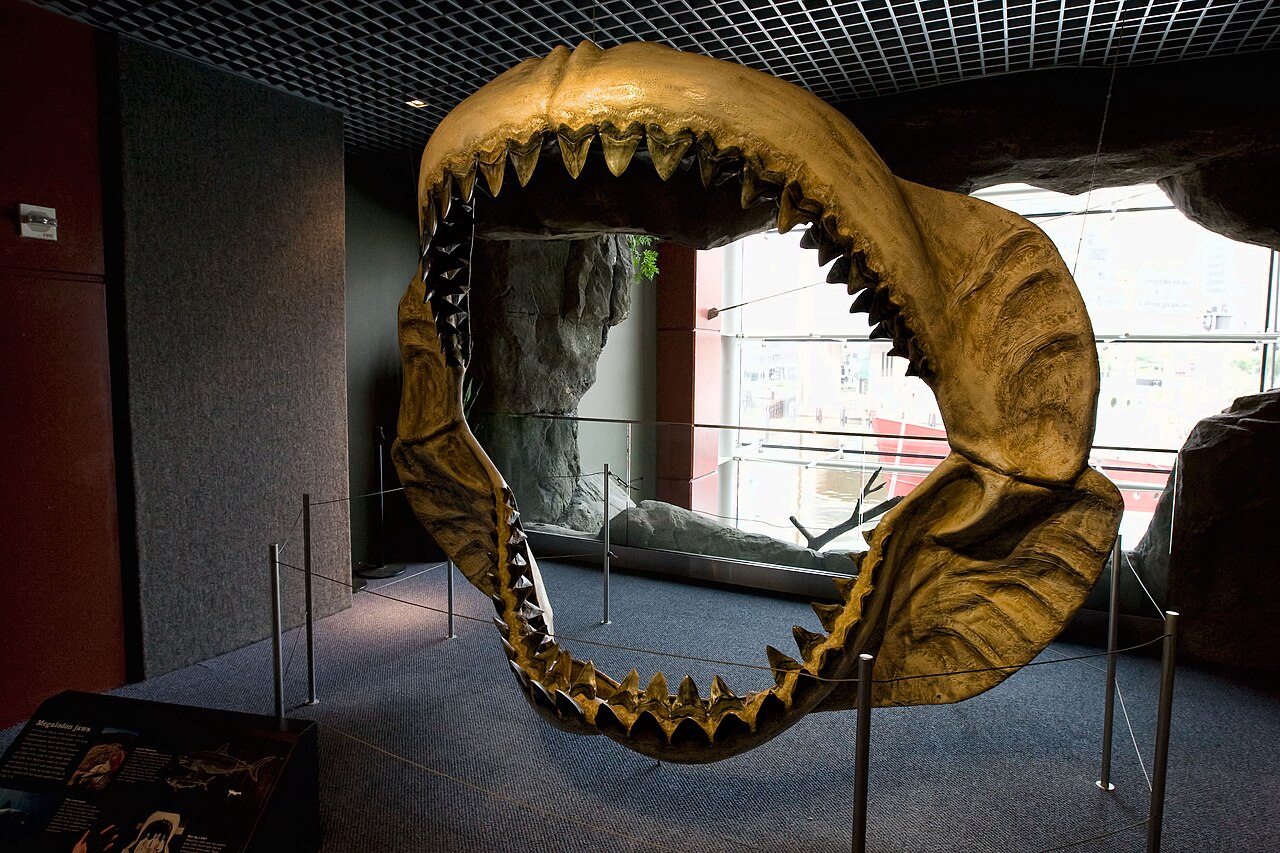
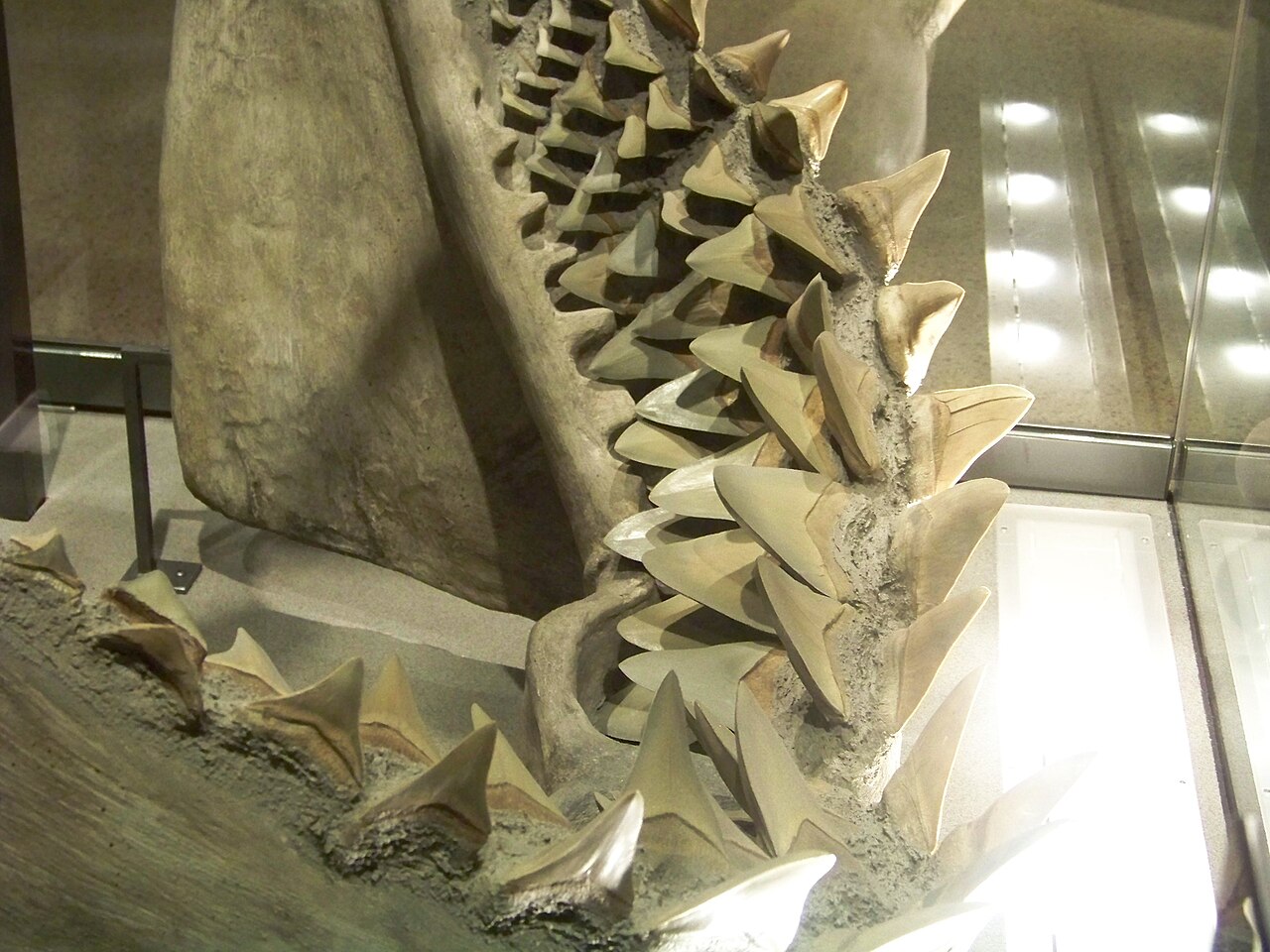
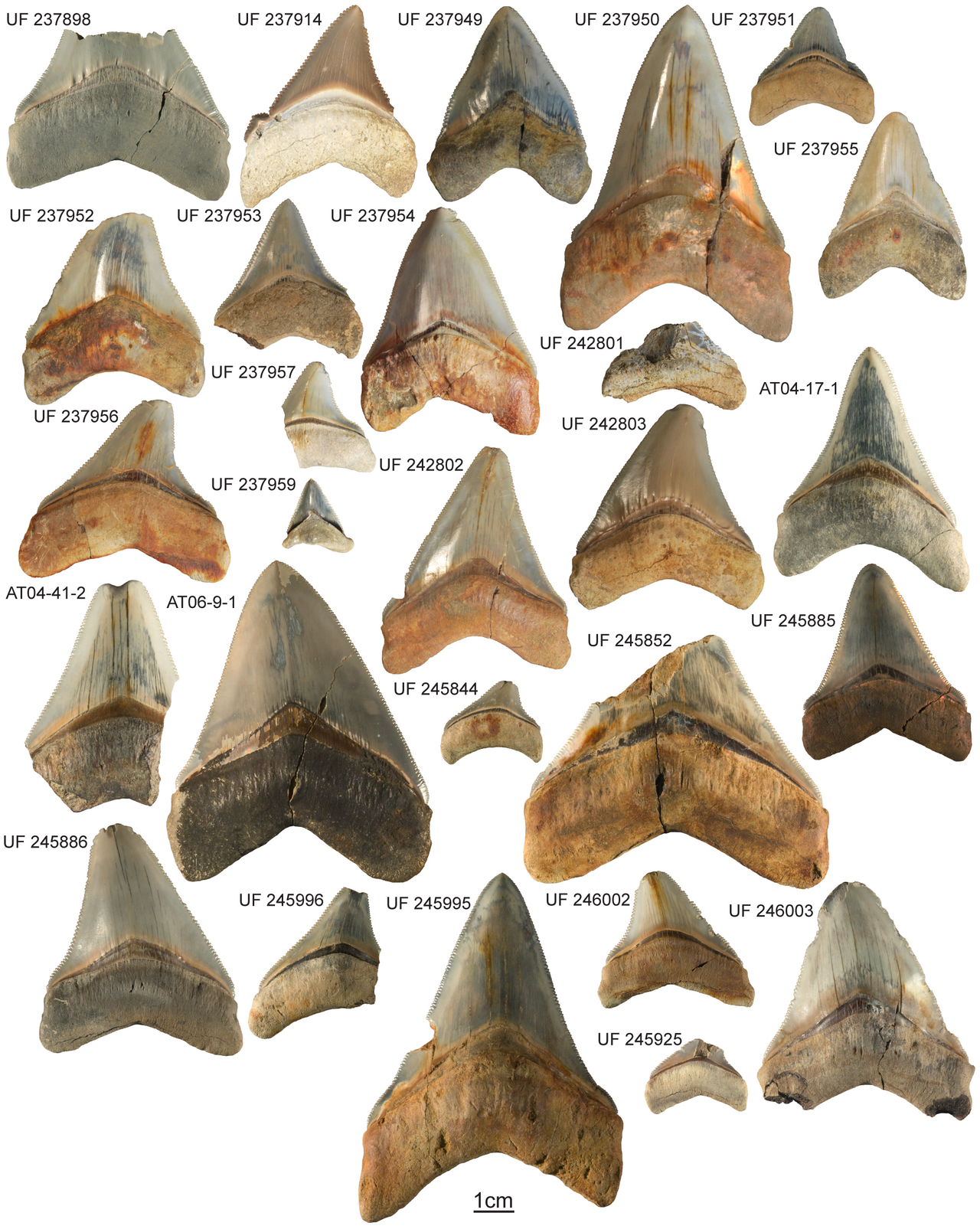
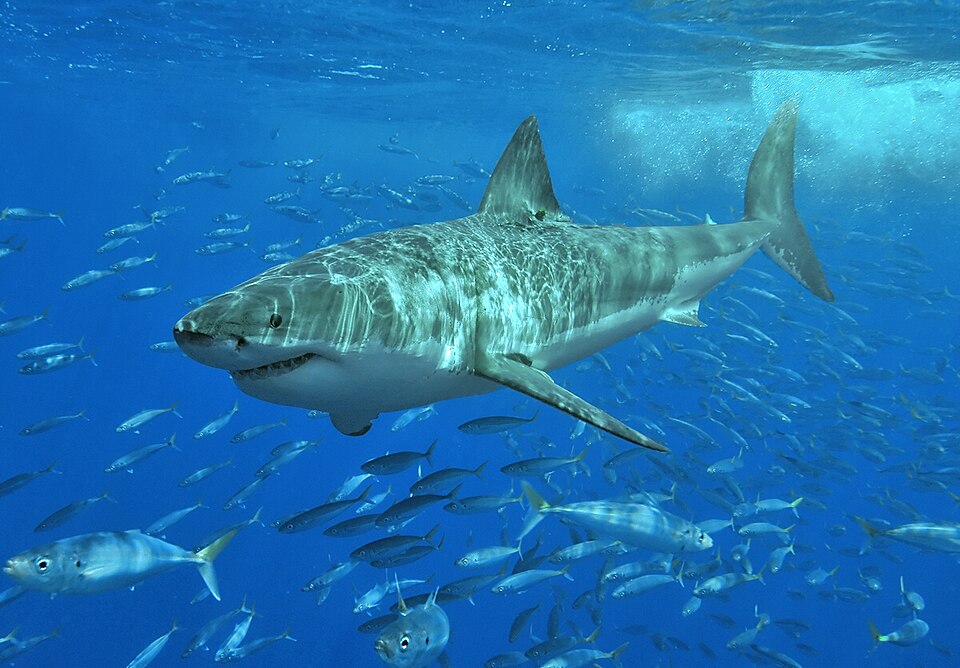
Megalodon teeth are the largest of any shark known, and big ones measure more than 18 centimetres along the slant. They are thick, with fine saw-like edges and a V-shaped neck where the root meets the crown. A great white tooth is about 7.5 centimetres at most, so held side by side, a megalodon tooth is far larger.
The jaws held over 250 teeth in five rows, and a big set might have been about 2 metres wide. As in other sharks, new teeth moved forward as old ones fell out. That is why fossil teeth are so common, because one shark could shed thousands.
How strong was the bite? In 2008, a team led by Stephen Wroe measured the bite of a 2.5-metre great white using computer scans, and then scaled it up. For megalodon, they gave 108,500 to 182,200 newtons at the back of the jaw. The largest great white tested gave 18,216, and another fish, the armoured Dunkleosteus, managed 7,495. Sharks also shake their heads while biting, which adds more force.
The teeth were also thick and strong, and later tests showed that the tooth shape could stand up to side-to-side tearing. Megalodon could probably bite through bone, which fits the evidence of what it ate, as bite marks on whale ribs show.
What did megalodon eat?

Megalodon ate almost anything big. Fossils show bite marks on the bones of dolphins, small whales, baleen whales, sea cows and seals, and it also ate sea turtles, big fish and other sharks. Tooth wear shows a varied diet, like that of a great white today.
Its hunting style may have differed from the great white, which often attacks from below and goes for the belly. In one fossil, a 9-metre baleen whale had bite marks on the ribs. They suggest megalodon aimed for the chest, where the heart and lungs are, and its thick teeth could break through the ribs. Small whales such as cetotheres show crushed bones consistent with being rammed hard from below.
For bigger whales in the , there is another pattern, because flipper bones and tail bones have bite marks. A shark that crippled a whale first could then kill it safely. Raptorial sperm whales such as Acrophyseter may have been attacked at the head.
Young megalodon ate fish and smaller prey in shallow, warm nurseries. Off Peru, adults seem to have hunted mostly small whales smaller than themselves. A fossil dropping, or , from the of South Carolina may belong to a giant shark like this. Its spiral shape is how many sharks' intestines leave their mark.
So megalodon was an opportunist, as most big sharks are. It took what was fat, available and easy to catch.
How did megalodon grow up?
Megalodon pups were probably born live, like most big sharks, and scientists think they were large at birth. Estimates run from about 2 metres to over 3.5 metres, compared with about 1 to 1.6 metres for a great white pup.
Why so big? One idea is intrauterine cannibalism. In some sharks, the biggest unborn pups eat their smaller siblings, so each generation would be larger, and the mother would need to be bigger too. Large size also needs a lot of food. A 16-metre shark might have needed about 98,000 kilocalories a day, about 20 times a great white, and warm body heat, called , would help.
How long did megalodon live? Rings on a backbone from Belgium gave an age of 46 years for an animal about 9 metres long, which grew about 16 centimetres a year. Scientists projected that a giant of about 15 metres could live for 88 to 100 years, and a 2026 study of the Danish backbone gave about 96 years.
areas matter, too. Fossil teeth of small, young megalodon are found in warm, shallow coasts such as Panama, Maryland, Florida and Spain, places with lots of food and few big predators. A 2023 study suggested that small fossils meant megalodon was smaller in warm places. A 2026 study reworked the same data, found no link between water temperature and size, and said these sites were nurseries. Science is still working this out.
Where in the world did it live?
Megalodon lived almost everywhere. Teeth have been found in Europe, Africa, the Americas, Australia and Asia, on the shores of every ocean of the time. It was most common in warm and mild seas, but it could handle surprisingly cold water, from about 1 to 24 degrees Celsius. Its ability to keep its body warm probably helped.
Adults lived mostly offshore, in deeper water, while young ones stayed in warm, sheltered coasts. Many adults probably moved between coastal and open water at different times of their lives.
The average size varied. In the Southern Hemisphere, the average was about 11.6 metres, while in the north it was about 9.6. The Pacific average was larger than the Atlantic.
Megalodon was part of the story of whale evolution. Whales and dolphins grew more varied during its time, and fossil evidence points to a link, because the shark was a big pressure on them. Some scientists think that big whales may have grown larger or moved to colder water, partly to get away from it.
It also had rivals. The huge sperm whale Livyatan hunted whales in the same seas, and early killer-whale relatives may also have competed, though that is less certain. Later, the modern great white appeared.
Why did megalodon die out?
No single cause is certain. Megalodon vanished about 3.6 million years ago, in the . Older books said 2.6 million, and a few claims of younger teeth have been discarded as unreliable, so a 2019 study moved the date earlier.
The main clues point to a changing ocean. The world was cooling and the ice ages were beginning, and megalodon liked warm water, so its range may have shrunk. Falling sea levels also destroyed the shallow, warm nurseries that the young depended on.
Food changed too. The number of kinds of baleen whales dropped, and many moved towards the poles, far from the warm seas. At the same time, baleen whales grew very large, which may have made them harder to hunt. A great deal of the food that megalodon relied on became scarce.
Competition added pressure, as fast, warm-blooded hunters such as killer-whale ancestors and the modern great white appeared. Great whites could eat a wider range of food and live in cooler water, and they were much smaller, so they needed less to survive.
Is megalodon still alive? No. Fresh teeth are never found, and the species is known only from old rock. A creature that big and warm-bodied would need huge amounts of food, and we would see its victims. Films and TV shows have made up the story, but the real megalodon is gone.
Explore Next
Your audio story keeps playing while you look around.
Words to Know
- apex predator
- An animal at the top of its food chain.
- cartilage
- A tough, flexible material that makes up a shark's skeleton.
- convergent evolution
- When unrelated animals evolve similar features for similar jobs.
- coprolite
- A fossil animal dropping.
- extinct
- No longer living anywhere on Earth.
- mesothermy
- A way of keeping the body warmer than the water by saving heat made by muscles.
- Miocene
- A time period from about 23 to 5 million years ago.
- nursery
- A safe place where young animals grow up.
- Pliocene
- A time period from about 5 to 2.6 million years ago.
- serrated
- With a saw-like edge.