Rainbow
Sunlight, water drops and a trick of angles paint a curve of colour across the sky.
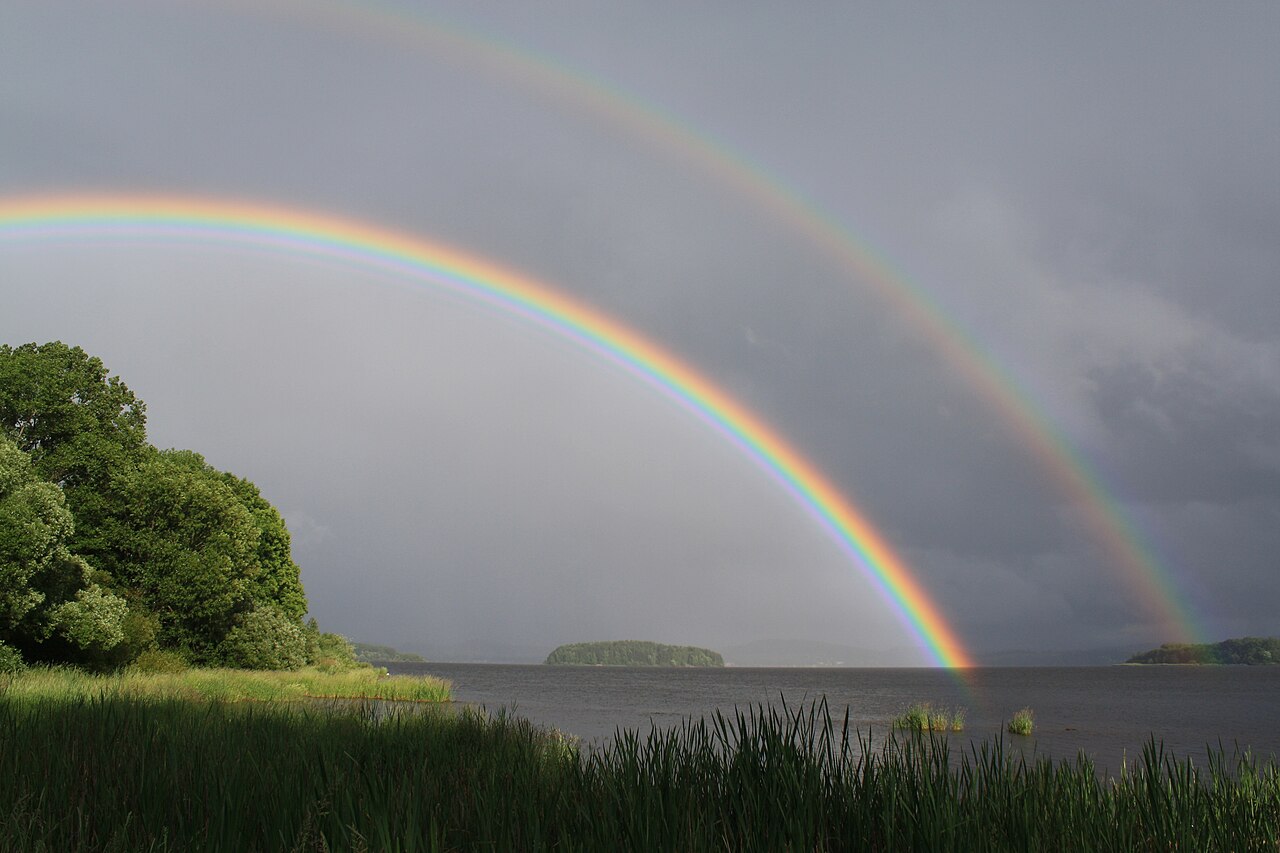
A rainbow is a curved band of colour that appears when sunlight passes through water drops in the air. Sunlight looks white, but it is really a mixture of every colour. Each raindrop acts like a tiny prism and mirror in one. It splits the light apart and sends the colours back towards your eyes at slightly different angles. That is why red sits on the outside of the arc and violet on the inside. A rainbow is not a solid thing in one place in the sky. It is an image that depends on where you stand, and no two people ever see exactly the same one.
What is a rainbow, really?
A rainbow appears whenever sunlight shines through a cloud of water drops. The drops can come from rain, but mist, the spray beside a waterfall and the fine fog from a garden sprinkler work too. In every case the Sun must be behind you, low in the sky, with the drops in front of you.
Sunlight looks white, yet it is a blend of all the colours we can see. Water drops pull that blend apart. Each colour leaves the drop in a slightly different direction, so your eye catches red light from some drops and violet light from others. The outer edge of the main arc is red. The inner edge is violet. Between them the colours melt smoothly from orange and yellow through green and blue.
A rainbow always appears in the part of the sky opposite the Sun. So anyone who sees a rainbow has the Sun at their back and is facing the falling rain.
A rainbow is not an object. You cannot touch it, drive towards it or find where it ends. It is a picture made by light, and it changes as you move. Two people standing side by side each see their own rainbow, built from different drops of water. People have wondered about this strange arc for thousands of years, and working out how it forms took some of history's best scientists.
How does one raindrop make colours?
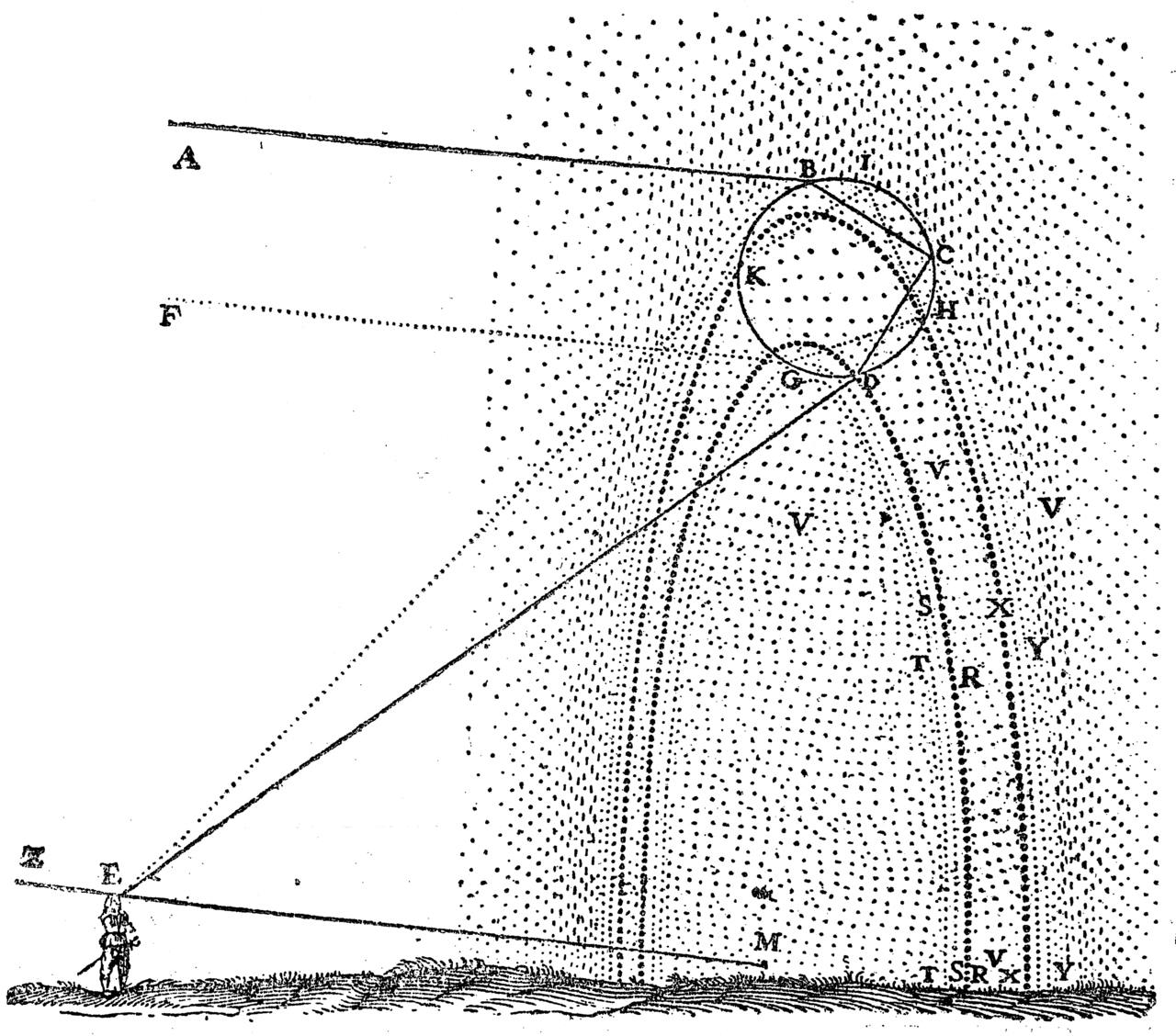
Follow a single beam of sunlight into a raindrop. When light passes from air into water it slows down and bends. This bending is called . Some of the light then reaches the back of the drop and bounces off the inside surface. That bounce is called . The light travels back to the front of the drop and bends again as it leaves. So a main rainbow needs two bends and one bounce.
The bending is not the same for every colour. Blue and violet light bend more than red light. Splitting white light into colours this way is called . After the bounce, red light leaves the drop at an angle of about 42 degrees and violet light at about 40 degrees. These angles are measured from the point in the sky directly opposite the Sun. Because of the bounce, red ends up on the outside of the arc and violet on the inside.
Why does the light gather into a bright ring? Light that enters near the edge of a drop and light that enters near its middle both come out at smaller angles than the best one. The light piles up around 42 degrees, which makes the bright band you see.
This angle does not depend on how big the drop is. Large and small drops all make the bow in the same place. If water did not split colours, a rainbow would be white, and brighter than the real thing. The sky inside the bow is also a little brighter than the sky outside it.
Why is a rainbow curved, and why can't you reach it?
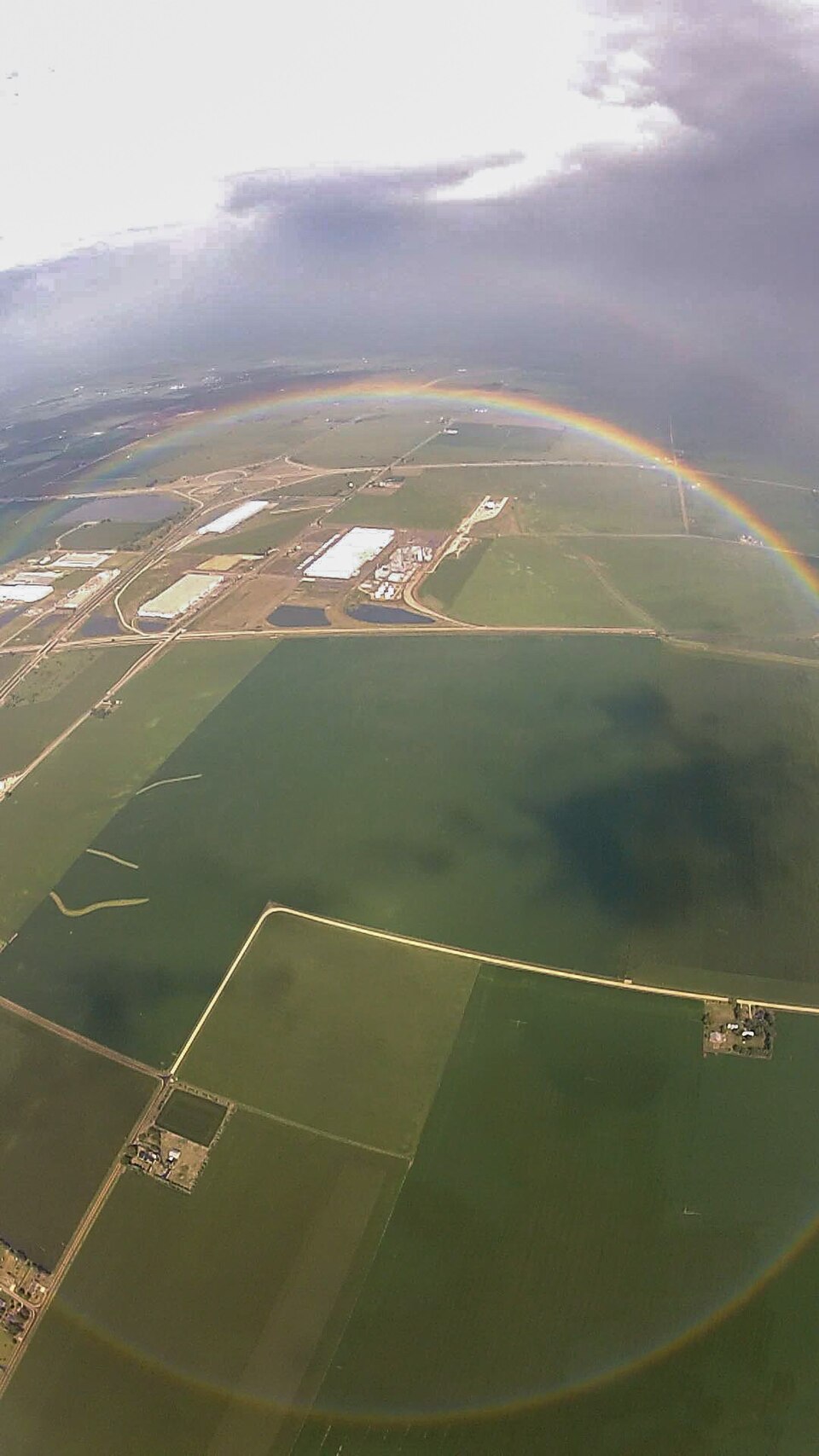
Imagine a cone with its tip at your eye and its wide end pointing away from the Sun. Every raindrop sitting at exactly the right angle, about 42 degrees from the point opposite the Sun, lies on the surface of that cone. Looking along it, you see those drops as a circle of light. That is why a rainbow is curved.
A rainbow is really a full circle, but from the ground the lower part is usually hidden. The land blocks the view, or there are no drops below the horizon, or sunlight cannot reach them. The lower the Sun, the more of the circle you see, up to about half at sunrise or sunset. From a plane or a tall building you can sometimes see the whole ring. The fine spray of a garden hose can also show a full ring close to the ground, when the Sun is behind the person watching.
The angle also explains when rainbows appear. If the Sun is higher than 42 degrees, the bow falls below the horizon. So in the tropics you rarely see one around midday. In many places the best rainbows come in the morning or early evening, when the Sun is low.
The finest rainbows appear when half the sky is dark with rain cloud and the Sun shines through a clear gap behind you. The dark cloud makes the colours stand out.
You can never reach the end of a rainbow. As you move, the drops that make it change, so the rainbow moves too. That is why the legend of a pot of gold at the end can never be tested.
How many colours does a rainbow really have?
Most people learn seven: red, orange, yellow, green, blue, indigo and violet. Some remember them with the name Roy G Biv, or the sentence Richard Of York Gave Battle In Vain. The list comes from Isaac Newton. In 1672 he first named only five main colours. Later he added orange and indigo to make seven, partly because seven matched the notes in a musical scale. Newton also admitted that his own eyes were not very good at telling colours apart. What he called blue we would now call cyan, and his indigo is what we call blue.
In truth a rainbow has no sharp stripes. The colours slide smoothly into each other, like a long gradient. Dividing them into bands is something our brains do. The number of bands you notice can depend on the size of the drops, and even on the language you speak. Researchers have found that people whose language has fewer colour words tend to see fewer separate bands.
A rainbow's colours are also paler than the colours made by a glass . Each colour is smeared out because light leaves drops at a spread of angles, and because the Sun is not a single point. It is a disc about half a degree wide.
There is more to a rainbow than we can see. Beyond the red edge lies infrared light and beyond the violet edge lies ultraviolet light. Our eyes cannot detect either one. The rainbow fades out because air and water scatter these rays.
What is a double rainbow?
Often a second, fainter bow appears about 10 degrees outside the main one. Together they make a double rainbow. The outer bow forms when light bounces twice inside each drop instead of once. That extra bounce flips the order of the colours, so red is on the inside and violet on the outside. The second bow is dimmer because some light escapes at each bounce and because the bow is spread across a larger patch of sky. In theory every rainbow is a double rainbow. Often the second bow is too faint to notice.
The dark strip of sky between the two bows is called . It is named after Alexander of Aphrodisias, a Greek philosopher who described it about 1,800 years ago. It looks dark because the drops send very little light to your eye at those angles.
Sometimes thin pastel stripes of pink, purple and green appear just inside the main bow. These are . They cannot be explained by bending light rays alone. They happen because light waves taking slightly different paths inside a drop can add together or cancel each other out. This is called . The effect gave scientists early proof that light behaves as a wave, and Thomas Young explained it in 1804.
Rainbows with three or more bounces are possible but very hard to see, because they point towards the Sun and are drowned in its glare. The third was photographed clearly in 2011 and the fifth in 2014. In laboratories, scientists have made bows of the 200th order using laser light.
Can there be rainbows at night, in fog or in ice?
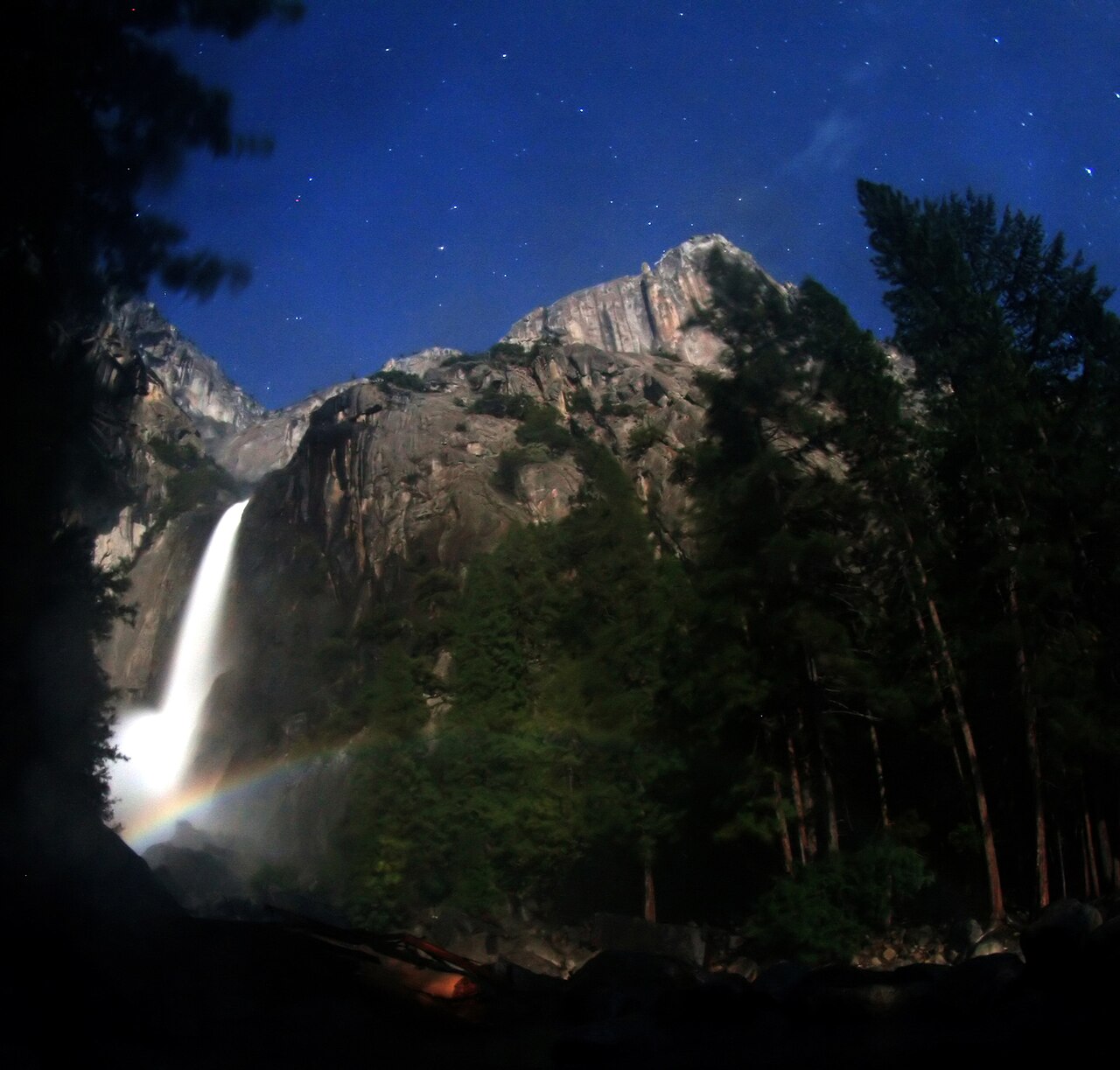
Yes, though they are rarer. A is a rainbow made by moonlight. It needs a bright, nearly full Moon and a dark sky. Moonbows are much dimmer than sunlit bows. Our eyes cannot see colour well in low light, so moonbows often look white. All the colours are there, and a long camera exposure can show them.
A forms in the same way as a rainbow, but the drops in fog and cloud are far smaller. Tiny drops spread light out so widely that the colours overlap and fade. A fogbow looks nearly white, with faint red on the outside and blue on the inside. Fogbows are often seen over cool water, where the air is chilled and mist forms.
A sleetbow appears when sunlight passes through falling sleet instead of rain. These have been photographed in the United States, and one of the first well-documented examples was seen in Virginia in December 2012.
Some arcs look like rainbows but are not. Halos, the circumzenithal arc and the circumhorizontal arc all come from sunlight passing through six-sided ice crystals high in the air, not through liquid water. The circumhorizontal arc is sometimes called a fire rainbow, but that name is wrong.
Rainbows may exist on other worlds too. Saturn's moon Titan has methane rain, and a rainbow there would be larger than ours, with a radius of about 49 degrees instead of 42.
Who worked out how rainbows work?
The Greek thinker Aristotle, who lived from 384 to 322 BC, was the first to study the rainbow seriously. His explanation was wrong, but it shaped thinking for centuries. The Arab scientist Ibn al-Haytham, who lived about 1,000 years ago, wrote a book on rainbows and studied light carefully. He thought clouds acted like mirrors. That was not correct, but it led others in the right direction. In Song dynasty China, the scholar Shen Kuo suggested in the 11th century that rainbows come from sunlight meeting raindrops.
Around 1307 to 1309 two scientists solved much of the puzzle. Theodoric of Freiberg in Germany and Kamal al-Din al-Farisi in Persia each worked out how light bends and bounces inside a drop. Both explained the main bow and Theodoric also explained the second bow. They tested their ideas with large glass balls filled with water.
In 1637 the French thinker René Descartes measured the angles of light leaving a water-filled glass ball. He showed that the main bow comes from one bounce and the second bow from two, and he calculated both angles correctly. The colours were still unexplained.
That step came from Isaac Newton. He used a glass to show that white light is a mixture of all the colours and that red light bends less than blue. Thomas Young added wave theory in 1804, and George Airy refined it in 1838. Modern descriptions use work published by Gustav Mie in 1908.
How do scientists test a rainbow?
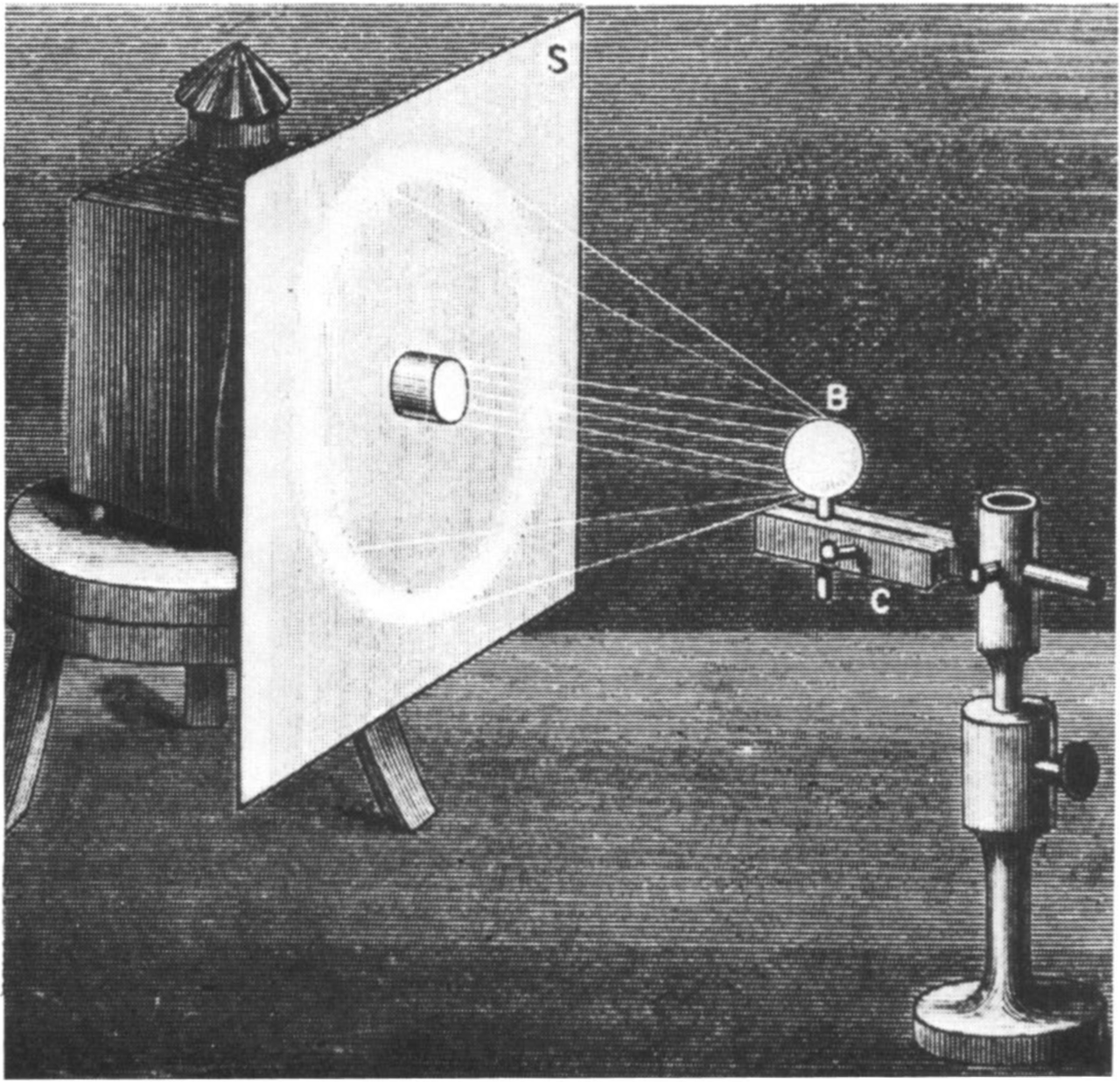
You cannot put a real rainbow in a laboratory, so scientists use one big raindrop. Al-Farisi used a glass sphere filled with water, placed inside a darkened box with a small hole to let in a narrow beam of sunlight. He watched how the light bent and bounced inside, and he worked out that the colours of a rainbow come from splitting white light.
Theodoric and Descartes later used round glass flasks of water in the same way. A version of this experiment, often called Florence's rainbow, is still shown in classrooms. A narrow beam of white light passes through a hole in a screen and into a round flask of water. A rainbow appears on the screen around the hole. Because the flask has thick glass walls and is far bigger than a raindrop, the angles are slightly different from the real thing. It still shows the basic idea clearly.
Liquids other than water give a hint of how the bow depends on the material. Salt water bends light a little more than rain water does, so a rainbow in sea spray has a slightly smaller radius than one in rain. Tiny glass beads used in road markings make bows with an even smaller radius. If the material bent light strongly enough, as diamond does, there would be no main bow at all. A diamond sphere would start with the second bow.
Why do rainbows appear in so many stories?
Rainbows are rare, beautiful and impossible to touch, so people everywhere have given them meaning. One of the oldest mentions is in the Epic of Gilgamesh, where a rainbow appears after a flood. In the Bible's book of Genesis, a rainbow is the sign of God's promise never to flood the whole Earth again.
In Norse myth, a rainbow bridge called Bifröst joins Midgard, the world of people, to Asgard, the home of the gods. In Greek myth, the goddess Iris was the rainbow itself, and she carried messages between gods and humans. For the Muisca people of what is now Colombia, Cuchavira was the god of the rainbow. When the rains ended, people thanked him with gifts of gold, snails and small emeralds. In Irish folklore, a leprechaun hides his pot of gold at the end of the rainbow, a place no one can ever reach.
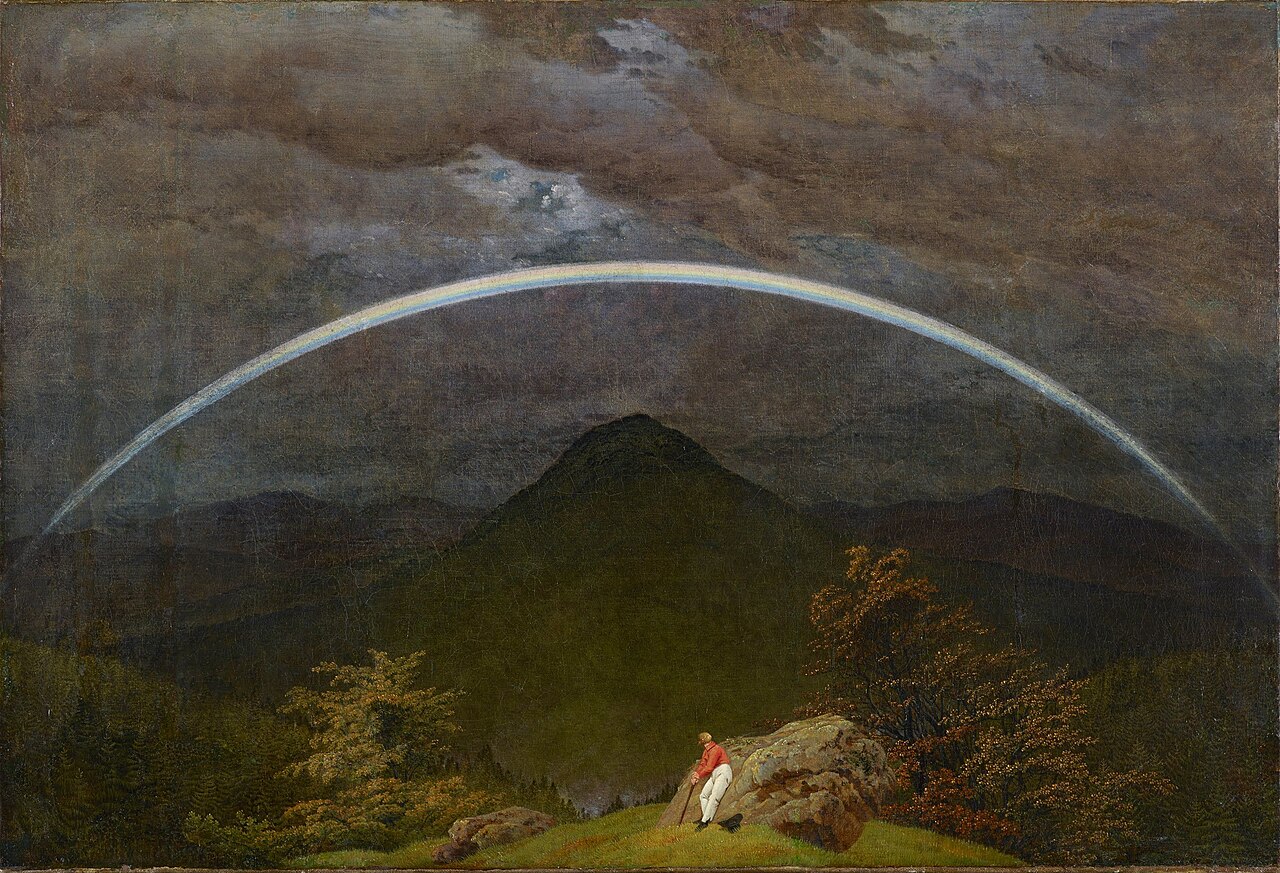
Artists have loved rainbows too. The German painter Caspar David Friedrich painted a mountain landscape with a rainbow in 1809.
The rainbow has become a popular symbol. Rainbow flags have stood for peace and for cooperation in different times and places. Since 1978 a rainbow flag, designed by Gilbert Baker, has also represented LGBT pride. In 1994, Archbishop Desmond Tutu and President Nelson Mandela described the newly democratic South Africa as the rainbow nation.
Explore Next
Your audio story keeps playing while you look around.



Words to Know
- Alexander's band
- The dark strip of sky between the main and second rainbows.
- dispersion
- The splitting of white light into its different colours because each colour bends by a different amount.
- fogbow
- A pale, wide, almost white bow made by the tiny droplets in fog.
- interference
- What happens when waves meet and add together or cancel each other out.
- moonbow
- A rainbow made by moonlight instead of sunlight.
- prism
- A piece of clear glass or plastic that bends light and splits it into colours.
- reflection
- Light bouncing off a surface instead of passing through.
- refraction
- The bending of light when it passes from one material into another, such as from air into water.
- spectrum
- The range of colours that makes up white light, from red to violet.
- supernumerary bow
- A faint pastel stripe just inside a rainbow, caused by light waves interfering.
- wavelength
- The distance between one peak of a light wave and the next, which sets its colour.