Sun
The star that lights our world, and the engine behind almost all life on Earth.

The Sun is the star at the centre of our Solar System. It is a glowing ball of hot gas so big that about 1.3 million Earths could fit inside it, and it holds 99.86% of all the mass in the Solar System. Every second, nuclear reactions in its core turn about 4 billion kilograms of matter into energy. That energy crosses space as sunlight, arrives at Earth in about 8 minutes and powers almost all life on our planet. The Sun formed about 4.6 billion years ago and is roughly halfway through its life. Its story includes a boiling surface, giant magnetic storms, a 250-million-year lap around the galaxy and a far-off future as a swollen red giant.
How big is the Sun, and what is it made of?
The Sun is a star, a huge ball of hot gas held together by its own gravity. Its diameter is about 109 times that of Earth, so you could line up 109 Earths across its face. Its mass is about 330,000 times the mass of Earth. Put the Sun on one side of a giant set of scales and everything else in the Solar System on the other, and the Sun would still win by a mile. It makes up 99.86% of the total mass.
The Sun is mostly hydrogen and helium. In its visible surface layer, hydrogen makes up about 75% of the mass and helium about 24%. All the other elements added together come to less than 2%. Oxygen, carbon, neon and iron are the most common of these. We know this because astronomers split sunlight into a rainbow, called a spectrum. Each element leaves its own pattern of dark lines in it. Meteorites that have never melted tell the same story, which is a strong check.
Astronomers call the Sun a G-type main-sequence star, and many people call it a yellow dwarf. Both names can mislead. Seen from space, the Sun's light is white. It looks yellow from the ground because the air scatters some blue light away. It is not small either. The Sun is heavier than about 95% of the stars near it, although most stars are dimmer red dwarfs. In our sky, the Sun is about 13 billion times brighter than Sirius, the next brightest star.
How does the Sun make its energy?
The Sun does not burn like a fire. A fire needs oxygen and would have run out long ago. The Sun shines because of in its core. There, the temperature is close to 15.7 million kelvin, about 15 million degrees Celsius, and the gas is squeezed to about 150 times the density of water. In these conditions the nuclei of hydrogen atoms crash together and join to make helium. A tiny part of the mass goes missing in each reaction and turns into energy. This is the idea behind Einstein's famous equation, which says that mass and energy are two forms of the same thing.
Every second, the core fuses about 600 billion kilograms of hydrogen and turns about 4 billion kilograms of it into energy. That equals about 90 billion megatons of TNT exploding every second. A megaton is a million tonnes. The biggest nuclear bomb ever tested gave out about 50 megatons, so the Sun does the work of nearly two billion of them every second. Yet each cubic metre of the core makes very little power. The Sun's output is huge because its core is so enormous.
The core also works like a thermostat. If fusion speeds up, the core swells a little and fusion slows down again. If fusion slows, the core shrinks and fusion speeds up. This keeps the Sun steady for billions of years.
The energy takes a long trip out. Particles of light, called photons, are absorbed and sent out again and again by the dense gas. Estimates say the journey takes between 10,000 and 170,000 years. Tiny particles called barely touch matter and escape in about 2.3 seconds. Detectors on Earth once counted only a third of the neutrinos expected. In 2001 scientists showed that neutrinos change type on the way, so the detectors had missed some.
What is inside the Sun?
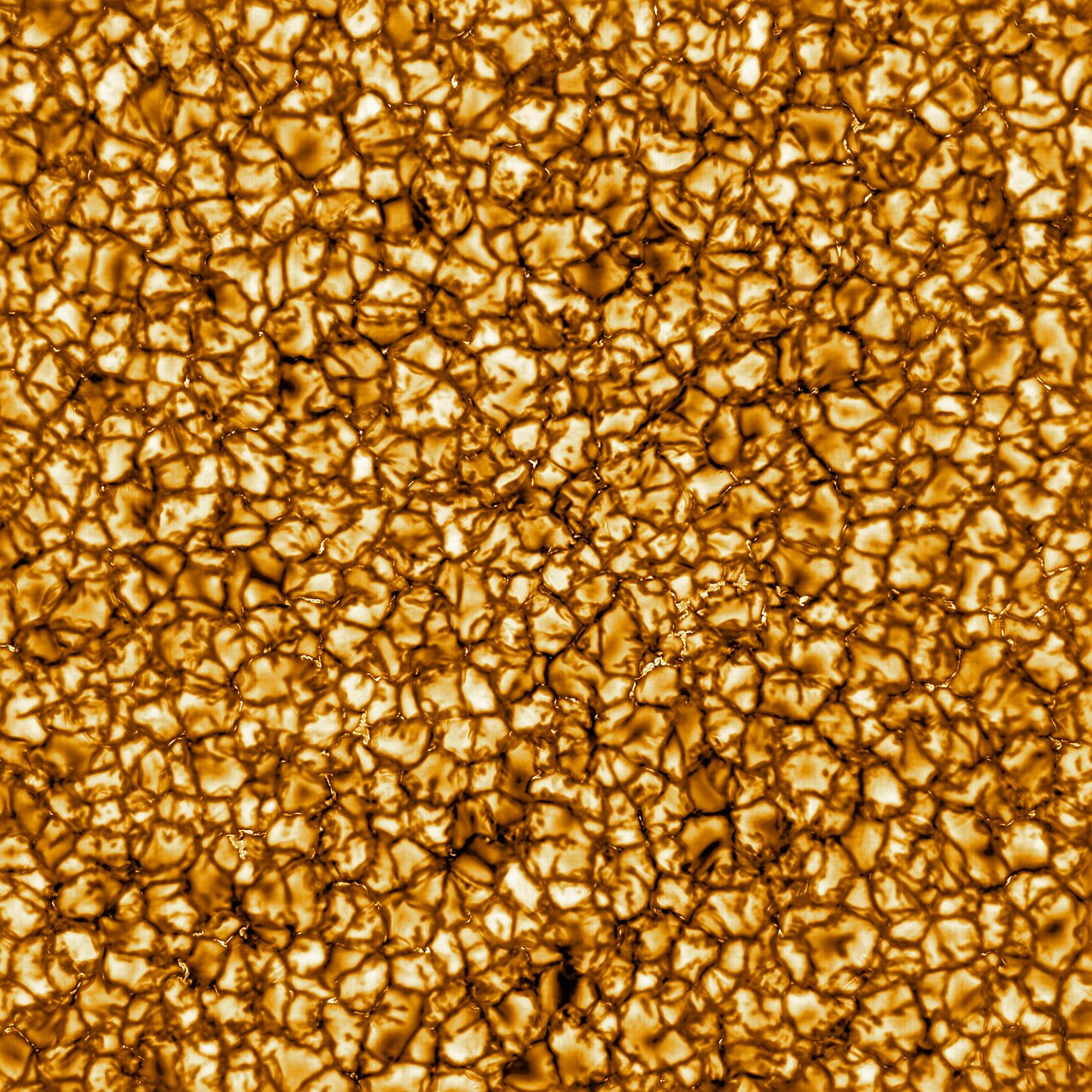
The Sun has no solid ground. It is built in layers of hot gas, and each layer behaves differently. The core reaches out to about a quarter of the way to the surface and makes 99% of the Sun's power. Around it lies the radiative zone, the thickest layer. Here the gas is so dense that energy creeps outward as light, passing from particle to particle.
At about 70% of the way out, the gas becomes thin enough to move. This is the convective zone, and it works like a pan of simmering soup. Gas heated at the bottom expands, grows lighter and rises. At the top it cools, grows heavier and sinks again. These rising and sinking columns carry most of the heat to the surface. Between the two zones lies a thin layer called the tachocline. Scientists think a magnetic dynamo there helps to create the Sun's magnetic field.
The tops of the rising columns make the Sun's surface look like a pattern of bright cells, called granules. Each one is about the size of a large country and lasts only minutes. At the top of the convective zone, the gas is about 350 times cooler than in the core and far thinner than air.
The Sun is also a spinner, but not like a solid ball. Its equator turns once in about 25.6 days, while the poles take about 33.5 days. The core spins about once a week. Gas can slide past other gas, so the Sun twists itself up as it turns.
Why is the Sun's atmosphere hotter than its surface?
The part of the Sun we see is the , which means light sphere. It is the layer where the gas becomes thin enough for light to escape into space. It is only tens to hundreds of kilometres thick, and its temperature is about 6,000 kelvin, or roughly 5,700 degrees Celsius. The edge of the Sun looks dimmer than the middle, because at the edge we look through cooler upper gas.
Above this lies the chromosphere, a thin layer whose name comes from the Greek word for colour. It shows up as a red-pink flash at the start and end of a total solar eclipse. Above that is the , a faint halo of gas that reaches far into space. Only during a total eclipse, when the Moon blocks the bright photosphere, can we see the corona with our own eyes.
Here is a puzzle that scientists have not fully solved. The corona is far hotter than the surface below it. Its average temperature is 1 to 2 million kelvin, and in the hottest regions it reaches 8 to 20 million kelvin. Heat should not flow from a cooler place to a hotter one. Some of the heat is known to come from magnetic reconnection, when twisted magnetic field lines snap and rearrange themselves. Waves and thousands of small flares called nanoflares may help as well.
In April 2021, NASA's Parker Solar Probe became the first spacecraft to pass through the corona's outer edge. It flew in about 16 to 20 times the Sun's radius from its centre. It was a real visit to the Sun's own atmosphere.
What are sunspots, and why do they come and go?
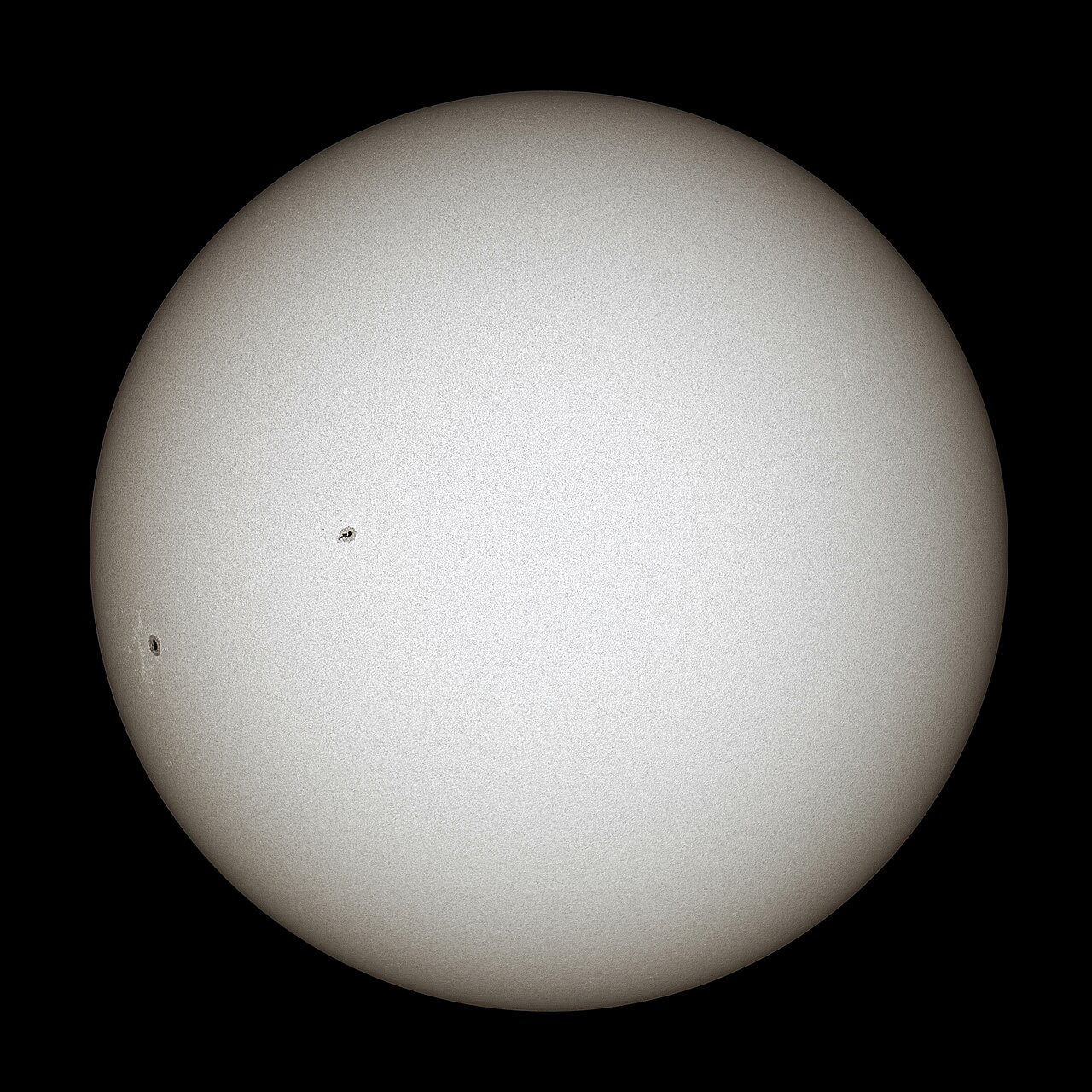
are dark patches on the Sun's surface. They look dark only by comparison. A strong magnetic field in each spot blocks some of the hot gas rising from below, so the spot is cooler than the gas around it. A sunspot on its own would still glow brightly. The biggest ones are tens of thousands of kilometres across, which is wider than Earth.
The number of sunspots rises and falls in a pattern called the solar cycle, which lasts about 11 years. At the quietest time, called solar minimum, few spots appear and sometimes none at all. They form far from the equator. As the cycle moves toward its busiest time, the solar maximum, spots appear closer to the equator and in larger numbers.
Behind the cycle is the Sun's magnetic field. The Sun spins faster at the equator than at the poles, and this twists the magnetic field lines tighter and tighter. At last the field bursts through the surface in pairs of spots. At the end of each 11-year cycle the Sun's magnetic poles swap over. A full magnetic cycle therefore takes about 22 years.
The cycle is not always steady. In the 1600s the Sun had very few sunspots for several decades, a time called the Maunder minimum. It matched the coldest part of the Little Ice Age, when Europe had unusually cold winters. The cooling began before the quiet spell, and most scientists now think volcanic eruptions played the larger part.
What happens when the Sun's magnetic field snaps?
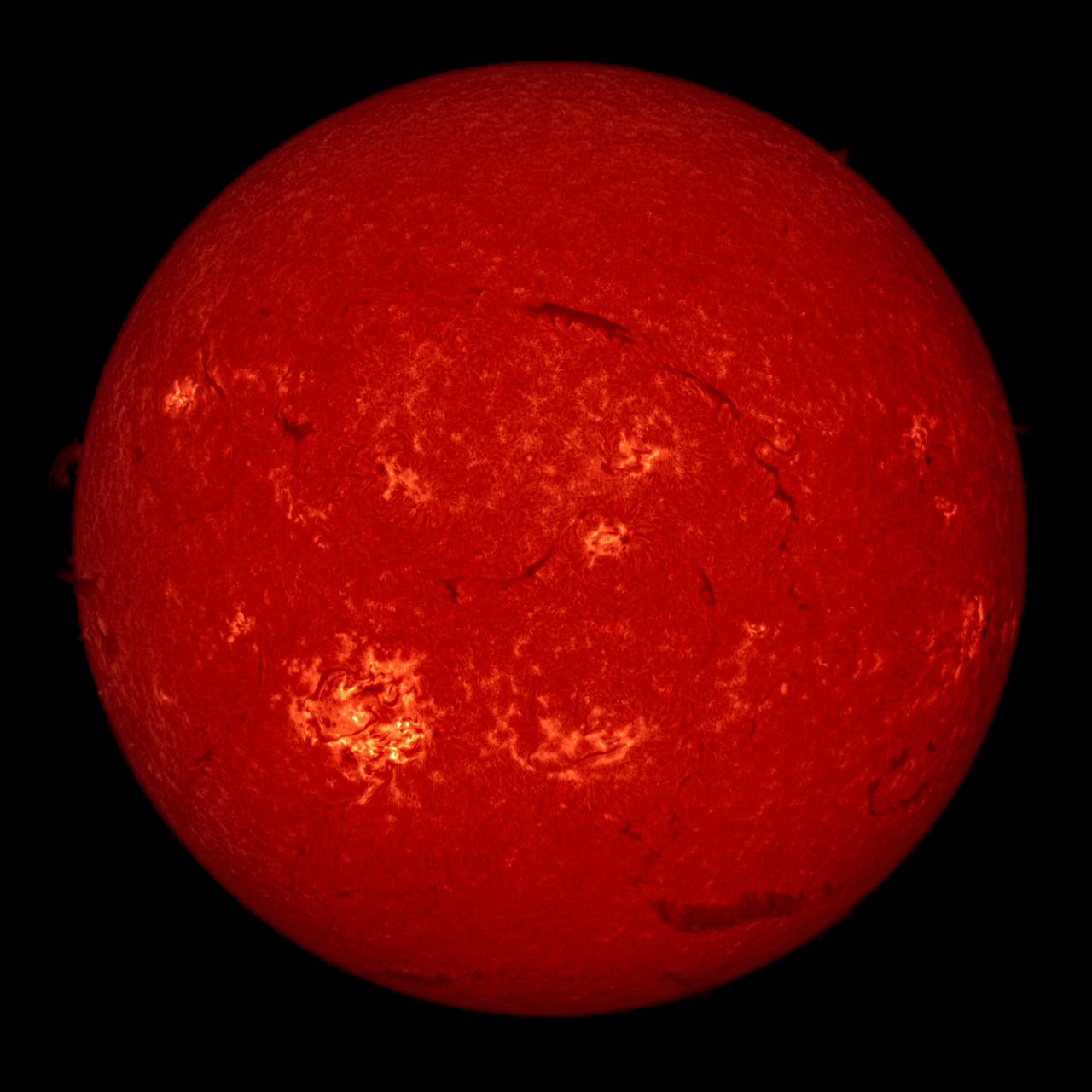
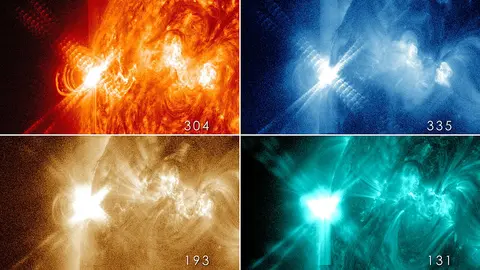
A group is a place where magnetic fields are strong and tangled. When the tangled field lines suddenly snap and settle into a simpler shape, they release a burst of energy. This is a solar flare, a flash of light and other radiation. Sometimes the Sun also throws out a huge cloud of gas and magnetic field, called a coronal mass ejection. Both tend to start near sunspot groups.
The Sun also sends out a steady stream of charged particles called the . Fast streams of it flow from dark areas of the called coronal holes. The solar wind carries the Sun's magnetic field out into space, and the Sun's spin curls it into a giant spiral.
When a burst of particles reaches Earth, our planet's own magnetic field takes the hit. Some particles flow toward the poles and light up the sky as auroras, the northern and southern lights. A big storm can also disrupt radio signals and electric power grids. Scientists call these effects space weather, and they watch the Sun with satellites to give warnings.
The solar wind blows far beyond the planets. It carves out a huge bubble around the Sun called the . Its edge, the heliopause, is where the solar wind is no longer strong enough to push back the gas between the stars. In 2012, the Voyager 1 probe crossed it, about 122 times farther from the Sun than Earth is. Voyager 1 became the first human-made object to enter interstellar space.
How was the Sun born, and how will it end?

About 4.6 billion years ago, part of a giant cloud of gas and dust began to collapse under its own gravity. Meteorites hold traces of iron-60, an atom made only in exploding stars. This suggests a nearby supernova may have squeezed the cloud and started the collapse. As the gas fell inward it spun faster and heated up. Most of it gathered in the middle, while the rest flattened into a disc that later formed the planets. When the centre became hot and dense enough, fusion began and the Sun switched on.
Today the Sun is in the middle of its main-sequence stage, which will last about 10 to 11 billion years in all. It is slowly getting brighter. Since it began, it has become about 48% more luminous, and it gains about 1% every 100 million years. In at least a billion years the heat will boil away Earth's oceans.
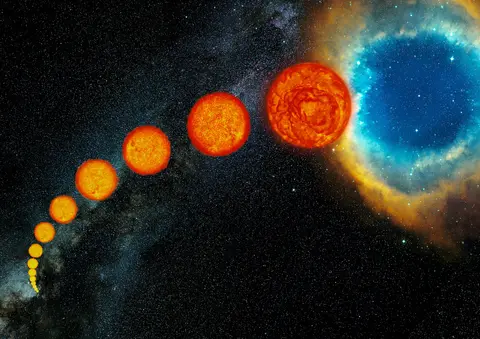
In about 5 billion years the core will run low on hydrogen. The core will shrink and the outer layers will swell, and the Sun will become a . It will grow to about 250 times its present size, swallowing Mercury and Venus. Earth's fate is less certain, but models suggest the Sun will swallow it too.
The Sun is too light to explode as a supernova. Instead it will blow off its outer layers as a glowing shell called a planetary nebula. What remains will be a , a hot core about the size of Earth with a little over half of the Sun's present mass. It will cool for trillions of years.
Where is the Sun going?
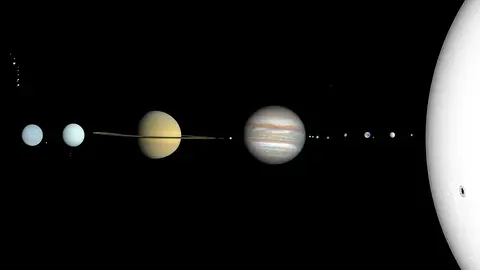
Earth is about 150 million kilometres from the Sun, a distance astronomers call 1 astronomical unit. The Sun is the centre of a system with 8 planets, nine bodies usually counted as dwarf planets, an asteroid belt and countless comets. The Sun is not perfectly still. The pull of Jupiter, Saturn, Uranus and Neptune makes it wobble in a small loop, so the Sun and the planets really circle a shared balance point. The Sun's own gravity rules over space out to about 2 , and icy comets drift in the distant Oort cloud.
The Sun and all its planets also race around the centre of the Milky Way. The Sun is about 24,000 to 28,000 light-years from the middle of the galaxy. It travels at about 230 kilometres per second, which is 828,000 kilometres per hour. Even at that speed, one lap takes about 220 to 250 million years. This length of time is called a galactic year. The Sun has made about 20 laps since it formed, so it has already seen many galactic years go by.
The Sun is also bobbing up and down through the flat disc of the galaxy, like a horse on a carousel. A lap of that bobbing takes about 83 million years. Some scientists have argued that crossing busy parts of the Milky Way's spiral arms might raise the chance of big space impacts on Earth. This idea is still debated.
How have people understood the Sun?
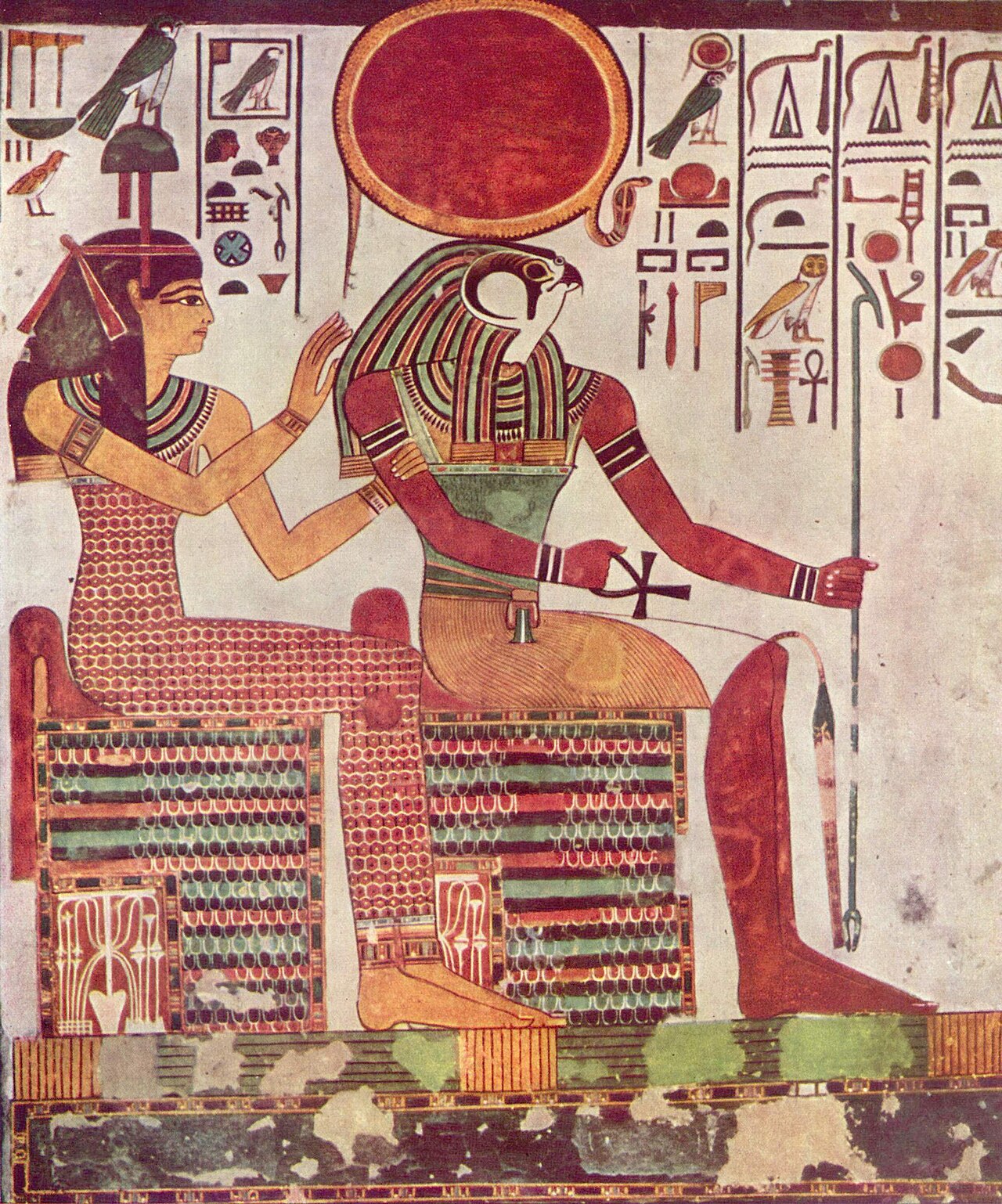
In many ancient cultures the Sun was a god. The Egyptians worshipped Ra, who crossed the sky each day in a boat. A painting of Ra survives in the tomb of Queen Nefertari from the 13th century BC. In Bronze Age Denmark, people made the Trundholm sun chariot, a gilded disc pulled by a horse. Early observers also noticed patterns. Babylonian astronomers saw in the early 1st millennium BC that the Sun moves at an uneven pace along its path through the stars.
The first scientific ideas came from Greece. The philosopher Anaxagoras, who lived in the 5th century BC, said the Sun was a blazing rock rather than a god. In 1543 Nicolaus Copernicus argued that the Earth goes around the Sun. In the early 1600s Galileo and other astronomers used the new telescope to spot , and showed that the Sun is not perfect and unchanging.
Then came the age of light and atoms. In 1868 astronomers found a new line in sunlight, and it belonged to an element nobody had met on Earth. They named it helium, after the Greek word for the Sun. In the 1930s physicists worked out that fusion could power the Sun.
Spacecraft have since brought us closer. The Ulysses probe, launched in 1990, flew over the Sun's poles. The SOHO observatory, launched in 1995, has watched the Sun almost without a break. The Parker Solar Probe, launched in 2018, now dives through the .
Explore Next
Your audio story keeps playing while you look around.

Words to Know
- corona
- The thin, very hot outer atmosphere of the Sun.
- heliosphere
- The huge bubble of space filled by the solar wind.
- light-year
- The distance light travels in one year, about 9.5 trillion kilometres.
- neutrino
- A tiny particle that passes through almost everything without being stopped.
- nuclear fusion
- A reaction in which small atomic nuclei join to make a bigger one and release energy.
- photosphere
- The visible surface layer of the Sun, where sunlight escapes into space.
- plasma
- A very hot gas whose atoms have been split into charged particles.
- red giant
- A huge, bright, cooler star that has used up the hydrogen in its core.
- solar wind
- A constant stream of charged particles flowing out from the Sun.
- sunspot
- A dark, cooler patch on the Sun where the magnetic field is strong.
- white dwarf
- The small, hot, dim core left behind by a star like the Sun.