Mirror
A surface so smooth that light bounces back as a picture.
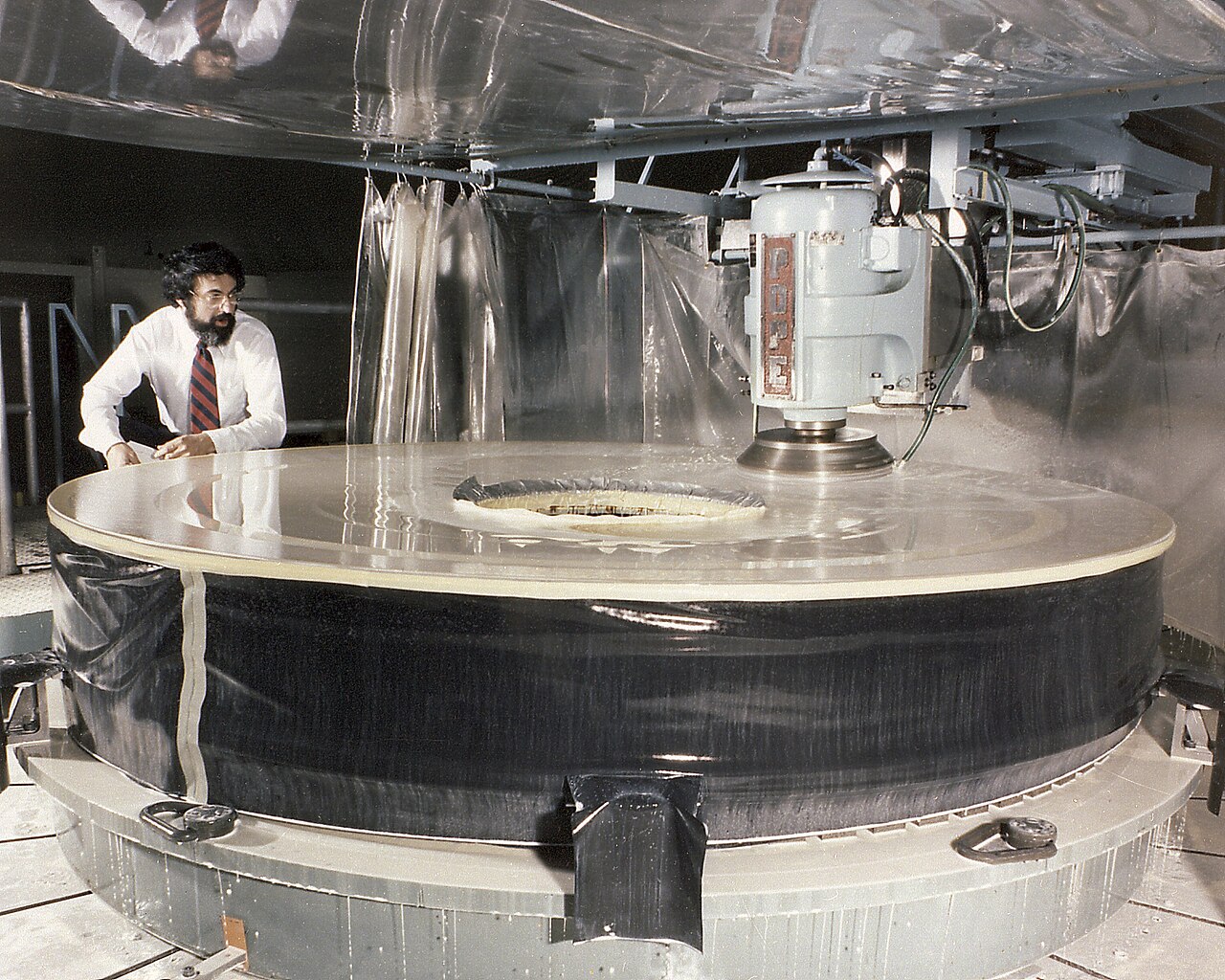
A mirror is a surface so smooth that light bounces off it in an orderly way, so you see a clear picture of whatever is in front of it. The first mirrors were still pools of water and polished stones. Today most mirrors are sheets of glass with a thin layer of metal behind them. We use them to check our hair, to spot a car behind us and to look inside a mouth. Giant ones collect faint light from distant galaxies. So how does a mirror work, why does it seem to swap left and right, and how did people learn to make better ones?
What makes a surface a mirror?

Light travels in straight lines until something changes its path. When light hits a surface, it can be absorbed, pass through or bounce back. A mirror is a surface that sends almost all of it back in a very tidy way.
The rule of the bounce is clear. Light leaves the surface at the same angle at which it arrived, measured from an imaginary line standing straight out from the surface. This is called the law of . A ball thrown at a slant against a smooth wall bounces off in a similar way.
Smoothness is what makes the tidy bounce possible. White paint reflects light too, but its surface is rough at a tiny scale, so the light scatters in all directions. That is called diffuse reflection. A mirror gives , where neighbouring rays all leave in the same direction. For this to work, the bumps on the surface must be smaller than the of the light. Visible light has wavelengths of only a few hundred nanometres, and a nanometre is a billionth of a metre.
Your eye does the rest. Light bounces off you, hits the mirror and enters your eye. Your brain follows the rays back in a straight line, so you seem to see a copy of yourself behind the glass. That copy is called a . It appears as far behind the mirror as you stand in front of it, but nothing is really there.
Does a mirror really swap left and right?
Raise your right hand and your seems to raise its left. Yet your head stays above your feet. So why would a mirror swap one direction and not the other?
The surprising answer is that it does not swap left and right at all. A mirror swaps front and back. Every part of you that is close to the mirror stays close to it in the image. Your nose points at the glass, but the nose in the reflection points back at you. The whole image is turned inside out in that one direction, a bit like a glove pulled inside out turns a left glove into a right one.
Your brain is the part that gets muddled. It treats the reflection as another person facing you. For a real person to face you, they would have to turn round, and turning round would swap their left and right. So your brain assumes the swap has happened, even though the hand in the mirror sits directly opposite your real right hand.
Writing shows the same effect. Hold text up to a mirror and it looks backwards, as if you were reading a page from behind. Because a reflection is inside out, you can never turn it round to match the original. Scientists say an object and its mirror image are chiral. Your left and right hands are the classic example.
There is one more surprise. The picture is not painted on the glass. Two people looking at each other in the same mirror see light arriving from different directions, so each of them sees a different image.
What do curved mirrors do?
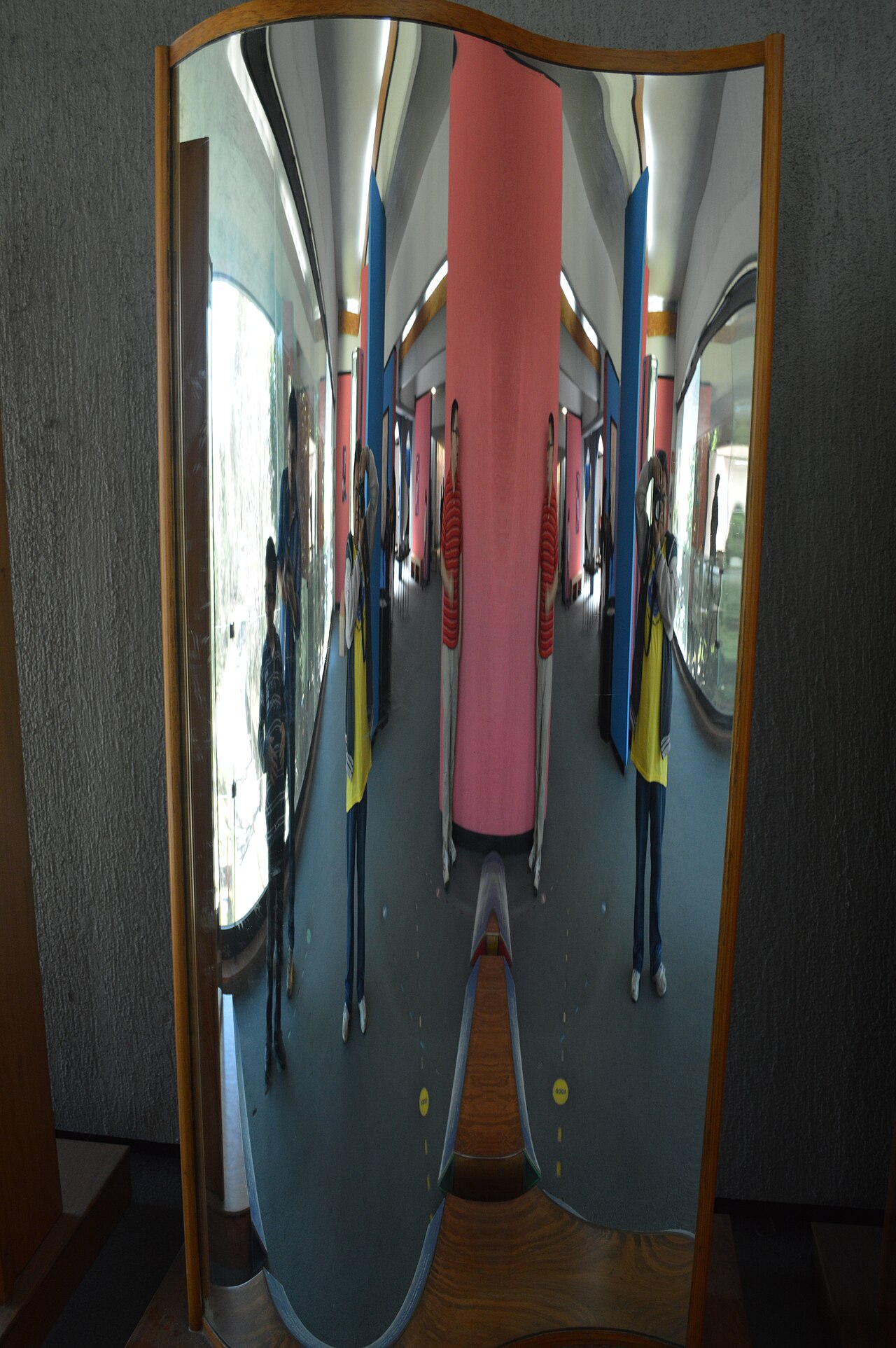
Not every mirror is flat. A curved mirror can make a picture bigger, smaller or stretched. The law of still holds at every point. The curve only changes the angle of the surface from place to place.
A mirror curves inwards, like the inside of a spoon. It brings parallel rays of light closer together. A mirror curves outwards, like the back of a spoon. It spreads parallel rays apart, so it shows a wider scene, although everything looks smaller. In a science museum, a wall of mixed concave and convex mirrors can stretch and squash your reflection at the same time.
The best shape for gathering light is a paraboloid, a bowl made by spinning a curve called a parabola around its axis. Every ray arriving parallel to the axis bounces to a single point called the . Telescopes, satellite dishes and solar furnaces all use this trick. Run it backwards and a light placed at the focus sends out a parallel beam.
A mirror shaped like part of a sphere is easier to make, but it does not bring all rays to one point. This flaw is called spherical aberration. It becomes tiny when the mirror is small compared with the sphere it was cut from, so spherical mirrors often stand in for parabolic ones.
People have studied curved mirrors for a very long time. The Greek mathematician Diocles wrote a book called On Burning Mirrors, and the scholar Ibn Sahl described parabolic mirrors in the 900s CE.
Who made the first mirrors?
The very first mirrors were not made by anyone. Still pools of water and shiny stones showed our ancestors their own faces long before anyone could shape a surface. A good mirror needs a very flat surface with bumps smaller than the of light, and calm water has exactly that.
The earliest mirrors that people made were pieces of polished stone. is a natural volcanic glass, and obsidian mirrors from Çatalhöyük, in modern Turkey, date to around 6000 BCE. Polished copper mirrors were made in Mesopotamia from about 4000 BCE and in ancient Egypt from about 3000 BCE. In Central and South America, people were polishing stone mirrors from around 2000 BCE.
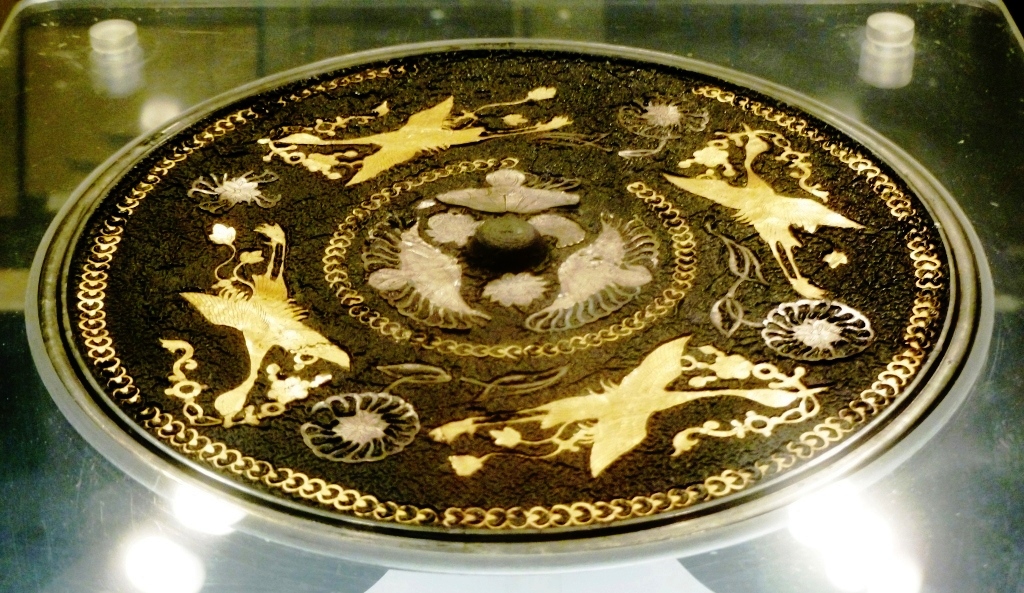
By the Bronze Age, many cultures used polished discs of bronze, copper, silver or other metals. The people of Kerma, in Nubia, were skilled mirror makers, and their bronze kilns have been found in the temple of Kerma. In China, bronze mirrors were made from around 2000 BCE. Some had richly decorated backs, like the Tang Dynasty mirror, with four phoenixes inlaid in lacquer.
Metal mirrors had problems. They tarnished, which means the surface slowly turned dull, so they needed frequent polishing. Bronze also reflected poorly and made colours look wrong. A famous line in the New Testament speaks of seeing "as in a mirror, darkly", and these dim mirrors help to explain it. Mirrors of precious metal or of speculum metal, a shiny mix of copper and tin, were hard to make, so only rich people owned them.
Why was a mirror once worth a whole farm?
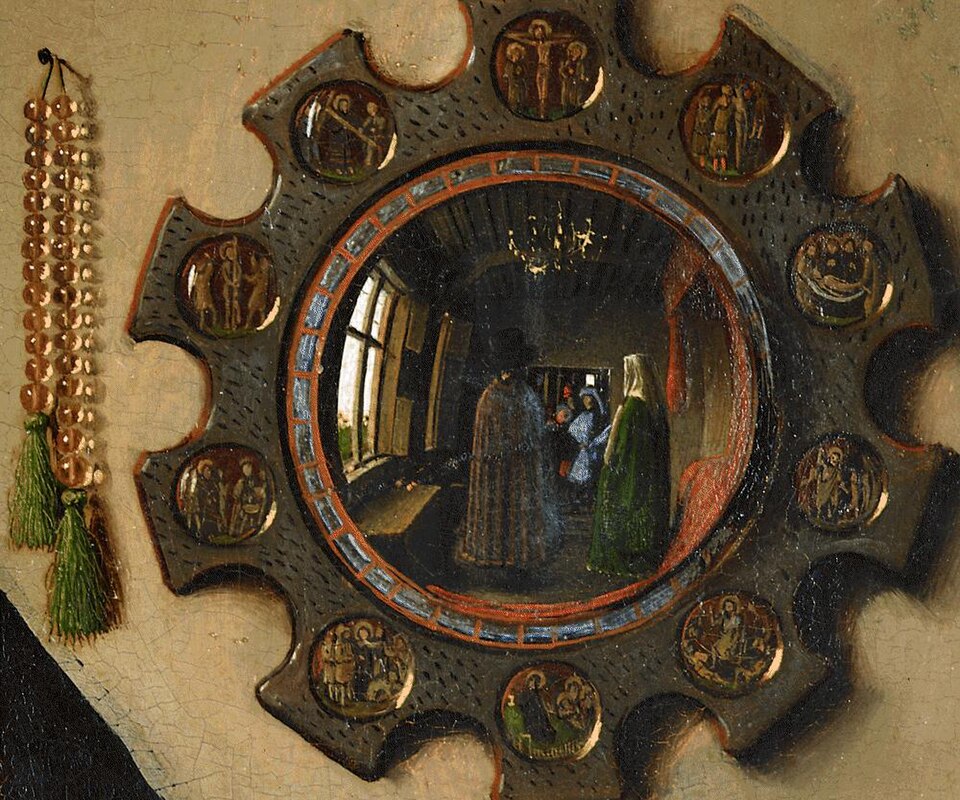
Glass came into the story about 2,000 years ago. The Roman writer Pliny the Elder said that craftsmen in Sidon, in modern Lebanon, made glass mirrors backed with lead or gold leaf. The metal gave the shine and the glass gave a smooth surface that protected the metal from scratches and . Archaeologists, however, have found no glass mirrors from before the 3rd century.
Early glass mirrors were small. Makers blew a glass bubble and cut a round piece 10 to 20 centimetres across from it. The piece was slightly curved, so the was warped. Because they were small, costly and poor, steel mirrors stayed common until the late 1800s. In China, mirrors of metal coated with silver appeared as early as 500 CE.
Better glass followed. Venetian makers blew a cylinder of glass, cut off its ends, sliced it along its length and unrolled it flat on a hot plate. By the 1500s Venice was also coating the back of the glass with a mixture of tin and mercury, then heating it until the mercury boiled away. This put less heat shock on the glass than the old method of pouring on molten lead.
For about a century Venice kept the method secret. Its mirrors, in rich frames, decorated palaces all over Europe. In the late 1600s the Countess de Fiesque reportedly swapped a whole wheat farm for one and thought it a bargain. Then the secret leaked through industrial spying. French workshops began making mirrors on a large scale, and ordinary people could finally afford them, despite the poisonous mercury fumes.
How is a mirror made today?
The big change came in 1835, when the German chemist Justus von Liebig found a way to coat glass with silver using a chemical reaction. A solution containing silver nitrate leaves a thin layer of silver metal on the glass. The process suited factories, and mirrors became cheap.
Glass is a good base because it is hard and naturally very smooth. In a household mirror, the metal goes on the back of the glass, with a layer of paint over it to guard against scratches and corrosion. You look through the glass at the metal, so the shiny layer is protected. The cost is that light must cross the glass twice.
Mirrors for instruments are made differently. The metal goes on the front, so light never enters the glass. Makers put the glass in a vacuum chamber, turn metal into vapour and let it settle as a very thin coat. John D. Strong used this method in the 1930s to make the first aluminium-coated telescope mirrors. A protective layer goes on before the mirror leaves the chamber, because air would start to corrode the coat at once.
Different coats reflect differently. Silver can reflect up to 98 or 99% of visible light but quickly. Aluminium reflects 85 to 90% and tarnishes less. coatings, built from layers of clear material, can reflect over 99.99% of one narrow band of colours, which suits lasers.
Shape matters as much as coating. A household mirror may be flat to within a few thousandths of a millimetre. A mirror for a laser or telescope can be accurate to about 12 nanometres, around 1/50 of the of light.
How do mirrors help us see the universe?
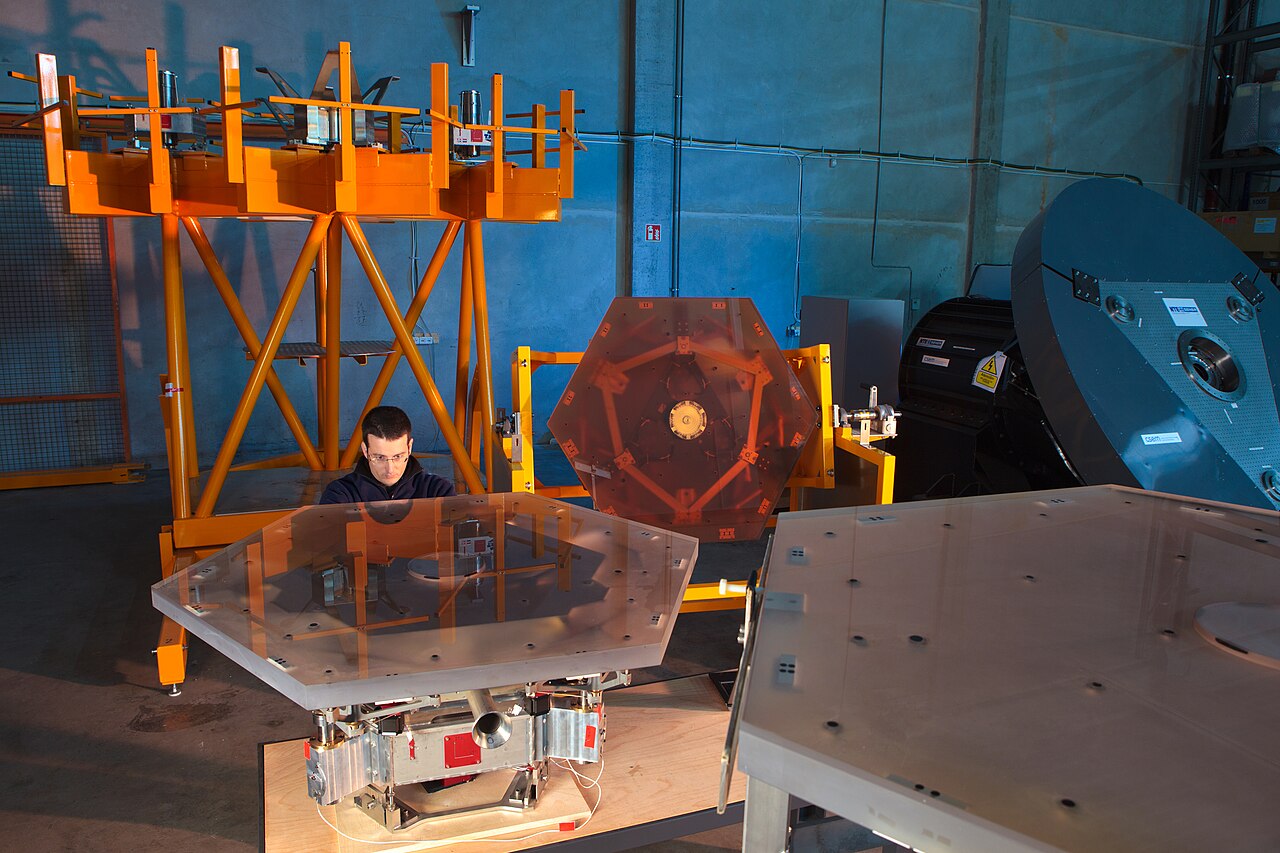
Astronomers use mirrors because a big mirror can be held from behind and only its surface needs to be perfect. A big lens would have to be flawless all the way through. A mirror shaped like a paraboloid gathers faint light and brings it to a , where a camera or an eye can use it.
Telescope mirrors usually have the metal on the front, and most are coated with aluminium. Aluminium reflects short better than silver does. The coats are delicate, and mirrors must be resurfaced from time to time. Some of the largest mirrors are built from segments. The Extremely Large Telescope, under construction in Chile, has a main mirror made of 798 pieces, and engineers test each piece's supports carefully. It is expected to see its first light around 2029.
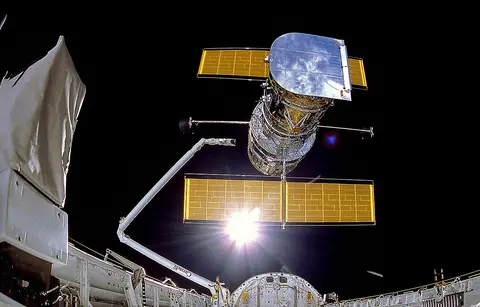
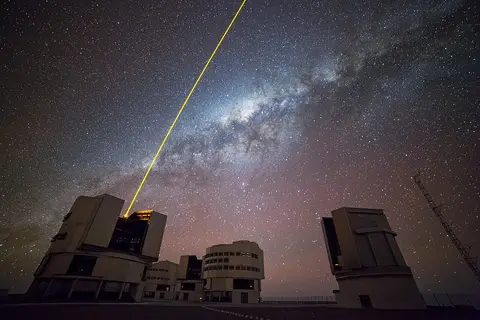
Air is a problem for ground telescopes, because moving air makes stars shimmer. A technique called measures the blur and changes the shape of a deformable mirror within milliseconds to cancel it. Space telescopes such as Hubble avoid the air altogether.
Mirrors work on invisible light too. Radio telescopes use big metal reflectors. In X-ray telescopes, the rays graze a very precise metal surface at shallow angles, and only a small fraction of them are reflected. Even sound has mirrors. An acoustic mirror reflects sound waves, and a parabolic microphone uses one to pick up distant noises.
Lasers depend on mirrors as well. Two mirrors facing each other make a cavity where light bounces back and forth. Very reflective mirrors, which can return over 99.999% of the light of one colour, make this possible.
Where do mirrors hide in everyday life?
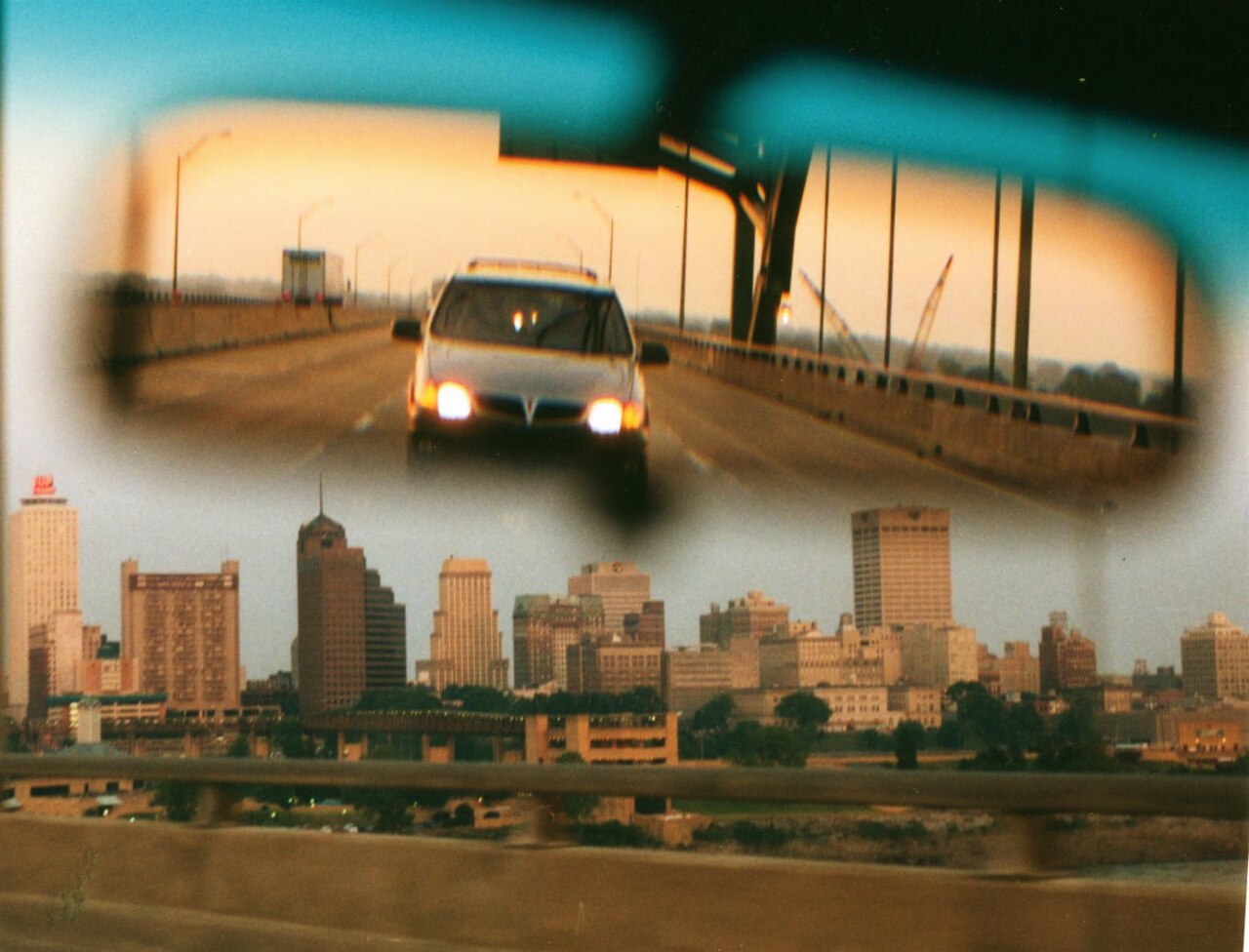
Looking at ourselves is the oldest use, and the old name "looking glass" still says it. Mirrors for grooming range from pocket size to full length. A cheval glass is a tall mirror on a frame that you can tilt.
Many mirrors help us see what we cannot see directly. A rear-view mirror lets a driver or cyclist watch traffic behind. Large lorries carry mirrors to shrink blind spots, and car parks put round convex mirrors at corners so people can spot a car coming. Dentists use small mouth mirrors to see and light the back of a tooth. A periscope uses mirrors to look over an obstacle, and soldiers used them in the trenches of the World Wars to look over the edge without exposing their heads.
Screens and discs depend on mirrors too. A DLP chip in a projector is about the size of a postage stamp, and its surface holds millions of microscopic mirrors. Each one tilts to send light to the screen for a bright pixel or into a dark trap for a dark one. On a CD or DVD, data is stored as tiny pits under an aluminium layer, and a laser reads the data from the reflected beam.
Mirrors can also send messages. On a sunny day, someone can flash sunlight with a small mirror to signal over long distances. Native American tribes and many armies used this method. Search and rescue teams look out for flashes of light from mirrors, which is why survival kits often include one.
Could a mirror set a ship on fire?
A story says that the Greek thinker Archimedes burned Roman ships at Syracuse by lining up mirrors to sunlight on them. Nobody has proved or disproved it. In 2004 the television show MythBusters tried it and failed to start a fire. In 2005 a team from MIT did set a mock-up wooden ship alight with 127 flat mirrors, but only after about 10 minutes of clear sunshine on a ship that never moved. When the MIT team repeated the test for MythBusters on a real boat, they managed only charring and a small flame. A moving fleet would have been far harder to burn, and flaming arrows would have been quicker. Testers did find that the glare made it hard for the people on the ship to see. That may be where the legend began.
The idea itself does work today. Solar power plants use fields of mirrors to concentrate sunlight. Some use long parabolic troughs that focus light onto a pipe.
Mirrors can also bring daylight to places the sun cannot reach. The Italian town of Viganella sits in a steep valley and gets no direct sunlight for seven weeks each winter. In 2006 the town installed a computer-controlled mirror, 8 metres by 5 metres, that reflects sunlight onto its square. In 2013 the Norwegian town of Rjukan did the same.
Sometimes the focusing goes wrong. Two skyscrapers, the Vdara in Las Vegas and 20 Fenchurch Street in London, have curved glass fronts that act like giant mirrors. Reflected sunlight from the Vdara could singe swimmers at the hotel pool.
The famous one-way mirror is not really one-way. It only works because bright light on one side drowns out the dim light coming through from the other. A true one-way mirror that needs no energy is not possible, because it would break the second law of thermodynamics.
Explore Next
Your audio story keeps playing while you look around.

Words to Know
- adaptive optics
- A system that changes a mirror's shape many times a second to cancel blur from the air.
- concave
- Curving inwards, like the inside of a spoon.
- convex
- Curving outwards, like the back of a spoon.
- dielectric
- A clear, non-metal material that can be layered to make a very reflective coating.
- focus
- The point where a curved mirror brings rays of light together.
- obsidian
- A natural volcanic glass that can be polished into a mirror.
- reflection
- When light bounces off a surface instead of passing through it.
- specular reflection
- A tidy bounce from a smooth surface, where all the rays leave in the same direction.
- tarnish
- The dull layer that forms on a metal as it reacts with air.
- vacuum deposition
- Coating a surface with metal vapour inside a chamber with the air removed.
- virtual image
- The picture you seem to see behind a mirror, where no light really comes from.
- wavelength
- The distance from one peak of a wave to the next, which is tiny for visible light.