Thermometer
The tool that turns hot and cold into numbers anyone can compare.
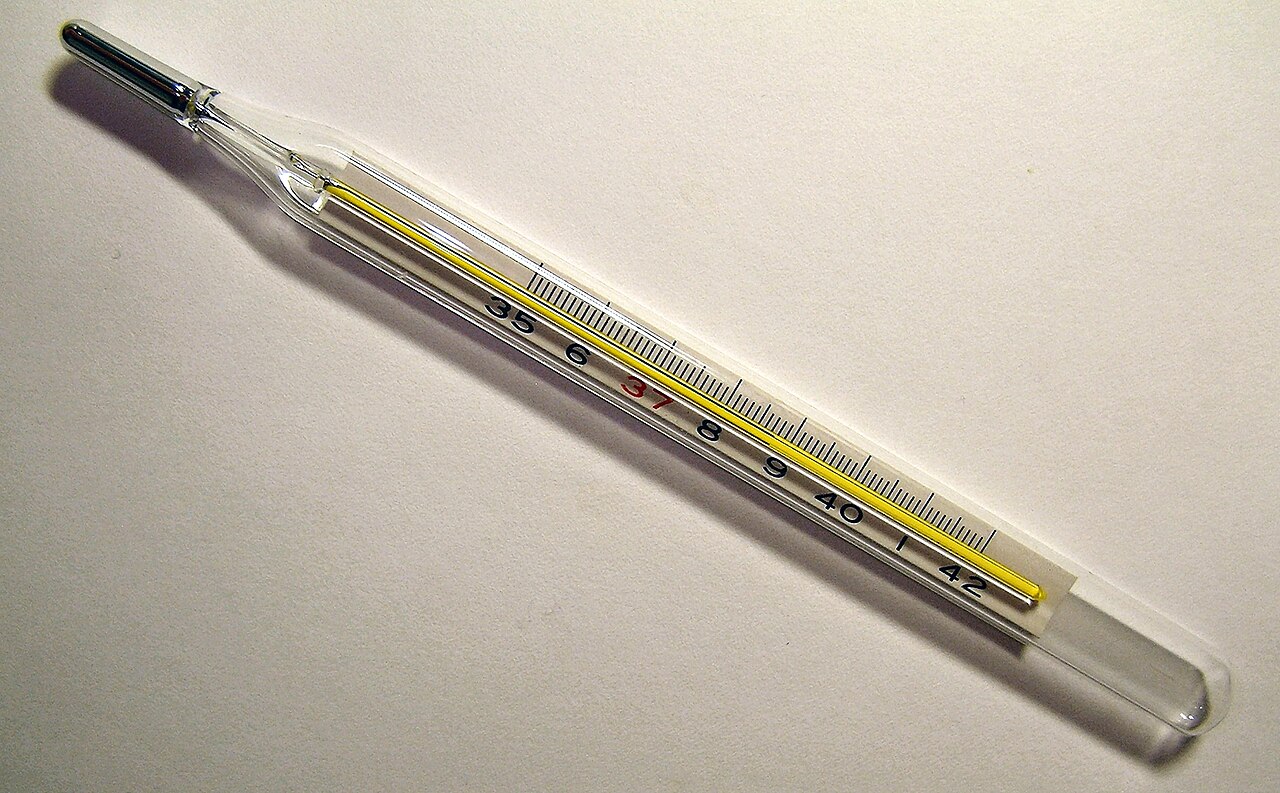
Your hand can tell you that a cup of tea is hot, but it cannot tell you how hot. Worse, your hand is easy to fool. Dip it in warm water after holding snow and the water feels scorching. A thermometer fixes that problem by turning hotness into a number. The word comes from two Ancient Greek words, thermos for warmth and metron for measure. Thermometers guide doctors, cooks, weather forecasters and engineers. Building the first reliable ones took more than 2,000 years of ideas, arguments and clever glassblowing, and many of the people involved never agreed on what the numbers should mean.
What does a thermometer really measure?
A thermometer measures , which tells us how hot or cold something is. Every thermometer has two key parts. The first is a , a part that changes when the temperature changes. In a classic glass thermometer the sensor is the bulb of liquid at the bottom. The second part turns that change into a number. In the glass thermometer, that is the scale printed along the tube. In a digital thermometer, it is the screen.
Why do we need a gadget at all? Because our bodies judge hotness by comparison. Your skin senses how fast heat flows in or out, not the true temperature. A metal bench and a wooden bench in the same room are at the same temperature. The metal feels colder because it pulls heat from your hand faster. A thermometer ignores that trick. It settles to the temperature of whatever it touches and reports it.
The number only helps if everyone agrees what it means. Two thermometers can only be compared if they follow the same scale. That need for agreement drove much of the story you are about to read.
What did the ancient Greeks work out about heat?
People watched heat do strange things long before anyone built a thermometer. In the 3rd century BC, a Greek engineer called Philo of Byzantium set up a clever experiment. He joined a hollow, sealed sphere to a tube. The other end of the tube stood in a container of water.
When Philo warmed the sphere with a candle or with sunshine, the air inside expanded. It pushed out of the tube as bubbles. When the sphere cooled, the air shrank. That left a partial vacuum, which sucked water up the tube. So the water level showed whether the air in the sphere was getting hotter or colder. The thermometer later used this link.
About 300 years after Philo, Hero of Alexandria described a fountain that worked the same way. Sunshine heated air, and the air pushed water around.
Galen, a Greek physician who worked in the Roman Empire, had a different idea. He said hotness comes in degrees. He also picked a fixed starting point, a mix of equal parts ice and boiling water. He put four degrees of heat above it and four degrees of cold below. This was the first scale with a fixed reference point. In the 1500s, a physician called Johann Hasler used Galen's degrees to work out how much medicine to give patients.
Did Galileo invent the thermometer?
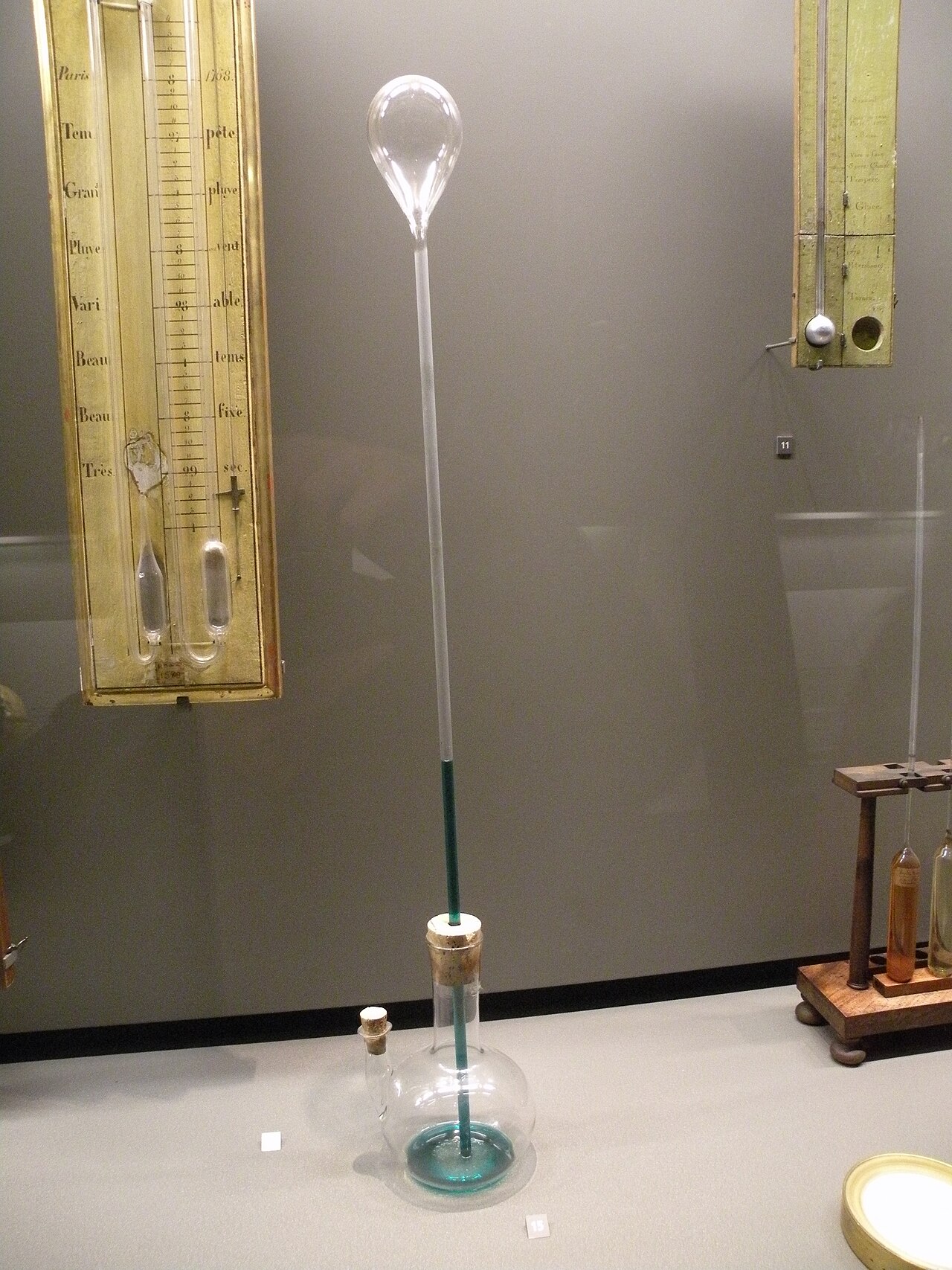
Many books say yes, but the truth is more tangled. The writings of Philo and Hero reached Italy in the late 1500s, and clever people began to experiment. Galileo Galilei had read Hero's work by 1594. He and an Italian physiologist named Santorio Santorio built new devices. Each had an air-filled glass bulb joined to a tube that was partly filled with water. When the air in the bulb warmed, it expanded and pushed the water down the tube. When it cooled, the water rose.
These devices are called . A thermoscope shows that something got hotter or colder, but it has no scale, so it cannot give a number. That is the difference between a thermoscope and a thermometer. A thermometer has a scale.
Giuseppe Biancani published the first clear drawing of a thermoscope in 1617. Santorio drew the first one with a scale in 1625. By then the word thermometer already existed. A French author, Jean Leurechon, used it in 1624 for a device with a scale of 8 degrees.
So who gets the credit? Historians name several possible inventors. They include Galileo, Santorio, the Dutch inventor Cornelis Drebbel and the British mathematician Robert Fludd. No surviving document shows that Galileo made one. The thermometer is better seen as a tool that many people improved step by step.
How did thermometers become reliable?
The early water-and-air devices had a flaw. Air pressure changes with the weather, and that moved the water in the tube too. So these instruments were also barometers. A reading could mean a change in heat or a change in the weather. The fix was to seal the tube so the outside air could not interfere.
Joseph Solomon Delmedigo studied with Galileo and Santorio in Padua. In 1629 he printed what seems to be the first picture of a sealed liquid-in-glass thermometer. It had a bulb at the bottom of a closed tube. The tube was partly filled with brandy and had a numbered scale. Around 1654, Ferdinando II de' Medici, the Grand Duke of Tuscany, made such thermometers. They relied on a liquid expanding and shrinking. Air pressure no longer mattered.
Next came a bigger problem. Every maker built their own thermometer with their own scale, so no two agreed. In 1714, the inventor Daniel Gabriel Fahrenheit made a dependable thermometer. He used , a metal that is liquid at room and expands evenly. Earlier makers had used alcohol and water mixtures. In 1724, he proposed a scale that still carries his name, slightly adjusted.
In 1742, Anders Celsius proposed another scale with 100 degrees between the freezing and boiling points of water. Oddly, he had them the opposite way round from today, with 0 at the boiling point. The scale was later flipped.
Why do we need a standard scale?
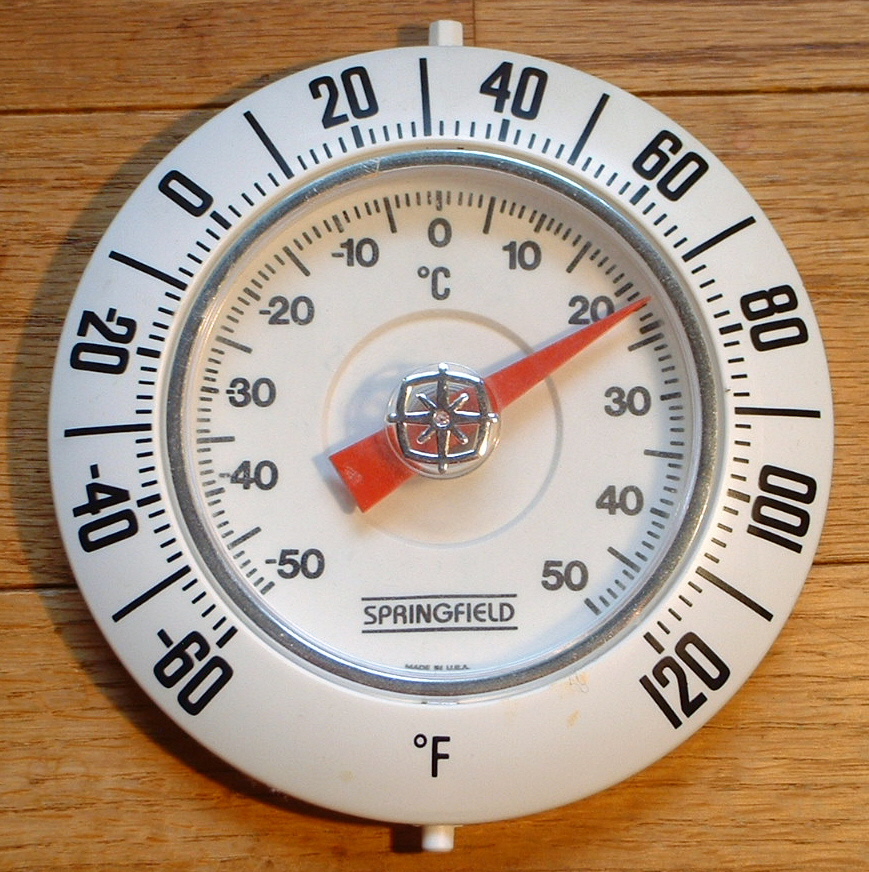
Imagine two friends who each own a thermometer. One says it is 20 degrees and the other says 25, though they stand in the same room. Unless both instruments follow an agreed scale, nobody can tell who is right. So scientists spent decades searching for . These are that nature repeats every time.
The best known are the melting point and boiling point of pure water. In 1665, Christiaan Huygens suggested using them. Joachim Dalence is said to have used two reference points in 1668. In 1701, Isaac Newton proposed a scale of 12 degrees between melting ice and body temperature.
Fahrenheit chose differently. His low point was the coldest temperature he could make with a mix of salt and ice. His high point was human body temperature, set at a number that divides neatly by 12. Body temperature varies, so the scale was later fixed to the boiling point of water instead.
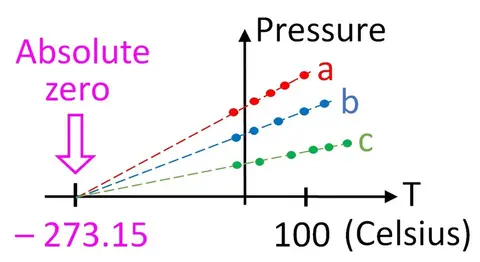
Today the Celsius scale puts the freezing point of water at 0 and its boiling point at 100. This holds when the air pressure is standard. Pressure matters because water boils at a lower temperature when the pressure drops. Scientists also use an absolute temperature scale. The latest official scale is the International Temperature Scale of 1990. Laboratories around the world use its fixed points.
How can a thermometer feel the temperature?
Most thermometers rely on one fact. Materials change when they heat up. The most common change is . and alcohol both expand when heated. In a liquid-in-glass thermometer, a bulb holds a lot of liquid. A very thin tube leaves little room for it. When the liquid expands, it can only go up the tube. So a tiny change in volume becomes a long, easy-to-read movement.
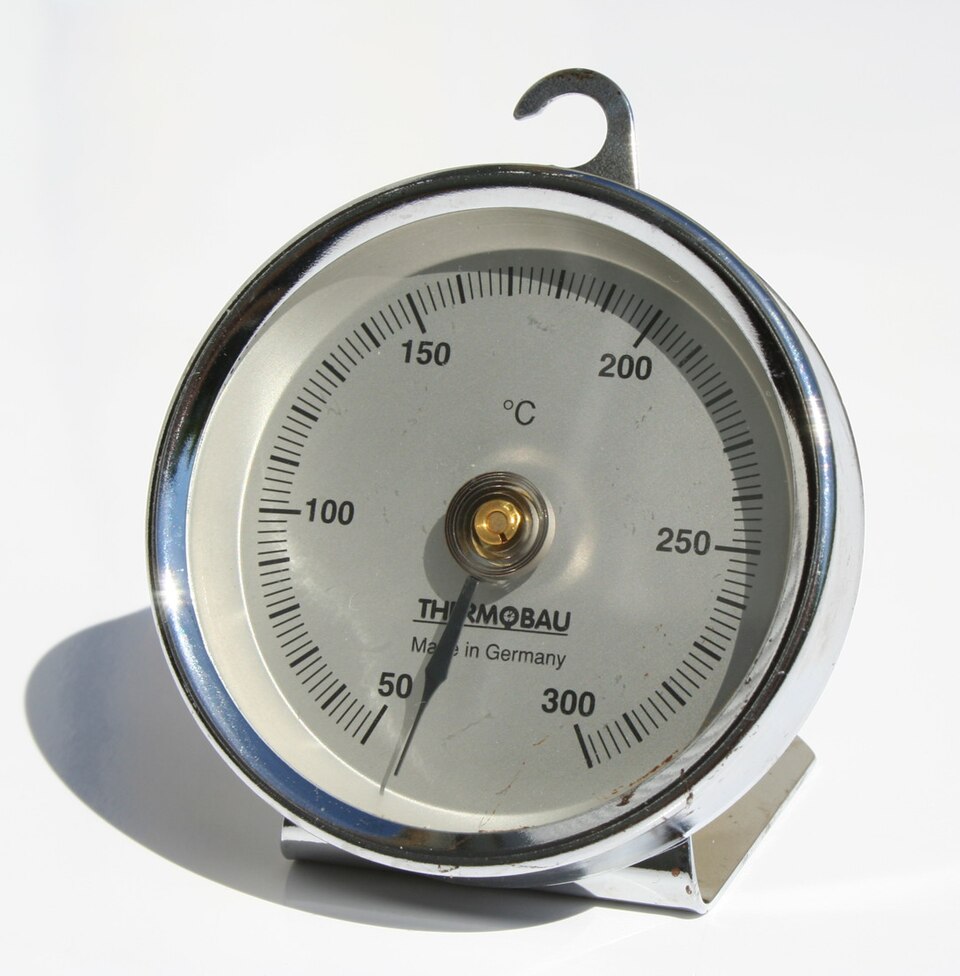
Solid metals expand too. An oven thermometer often has a dial. Inside is a coil, which is two different metals stuck together. One metal expands more than the other. The strip bends or coils when it warms, and a pointer moves across the dial. Gases can be used too. They behave so predictably that they were important in the history of thermometers.
Not every material is suitable. A good thermometer liquid must heat and cool quickly. It must return to its starting size every time. It must also always expand as it warms. Water does not follow the last rule. Around 4 °C it behaves oddly, so it cannot serve in a thermometer near that .
Some thermometers hold their reading after you move them. These are called registering thermometers. With a mercury medical thermometer, you shake the mercury back down before the next use.
How can you measure heat without touching anything?
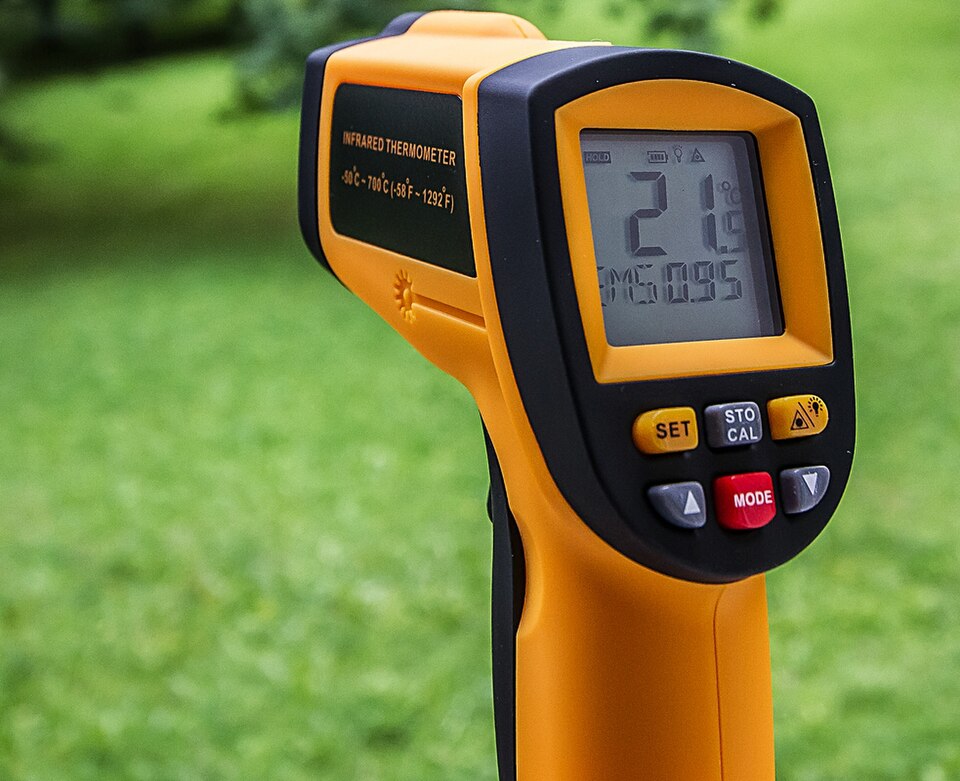
Every object gives off invisible light called radiation. Hotter objects give off more of it. An infrared thermometer, also called a pyrometer, points at a surface and measures that glow. It never has to touch. This helps with things that are too hot, too far away or too small to touch safely. At very high , objects glow with visible light. A glowing heating element is one example. The colour of a star's surface tells scientists its temperature in much the same way.
Other thermometers use electricity. A resistance thermometer checks how a wire's resistance to electric current changes with temperature. A is a small part that does the same job. You find them in fridges, air conditioners and water heaters. A thermocouple joins two different metals and makes a tiny voltage that depends on the temperature. Thermocouples work over a huge range, from extreme cold to above 1,000 °C.
Some thermometers use colour. Liquid crystal thermometers contain special crystals that change colour at set temperatures. They appear on forehead strips, in fish tanks and in mood rings. Scientists have even built nanothermometers. These measure objects smaller than a micrometre, which is far too small for ordinary thermometers.
How do thermometers help doctors and cooks?
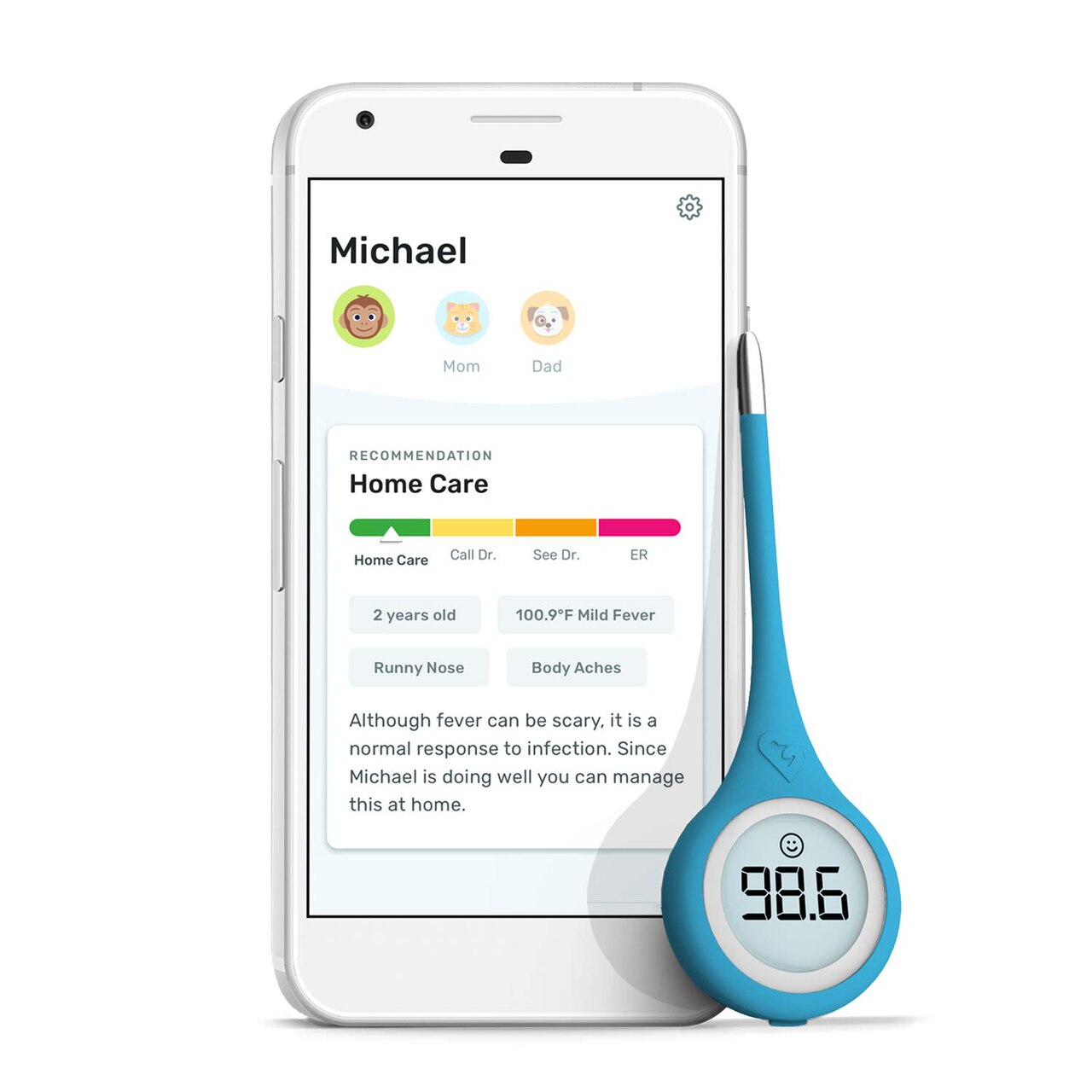
Doctors use to find out whether a person is ill. Herman Boerhaave was the first physician to use thermometer readings in everyday medicine. He lived from 1668 to 1738. Early medical thermometers were slow. In 1866, Sir Thomas Clifford Allbutt invented a clinical thermometer that gave a body temperature in 5 minutes instead of 20. In 1999, Dr Francesco Pompei introduced the first temporal artery thermometer. It scans the forehead in about 2 seconds.
Today, medical thermometers come in many types. Ear thermometers are usually . Forehead strips use liquid crystals. Many mouth thermometers use a with a digital display. Some even send their readings to an app on a phone. Doctors use them to spot a , where the body gets hotter than normal. They also spot hypothermia, where the body gets dangerously cold.
In the kitchen, thermometers protect your health. Bacteria that cause food poisoning grow quickly in food kept lukewarm for several hours. So cooks check fridges and the temperature of food kept hot. A meat thermometer shows when the middle of a roast is hot enough to be safe. A sweet-making thermometer works differently. Sugar syrup boils at a temperature that depends on how much water is left. The reading tells the cook how thick the syrup has become.
Where else are thermometers at work?
Thermometers are hidden in places you may never think about. In cold countries, in roads tell workers when ice may form, so that gritters can be sent out before drivers slide. In weather forecasting, thermometers sit at many levels of the air and the ocean. Aircraft carry them too, to check whether the air along a flight path could cause ice on the wings. These readings are fed into computers that predict tomorrow's weather.
Thermostats use them to keep a home comfortable. Older ones used a strip that bent to switch the heating on and off. Modern ones usually use a digital . A heat meter uses thermometers to measure how fast heat flows through a pipe.
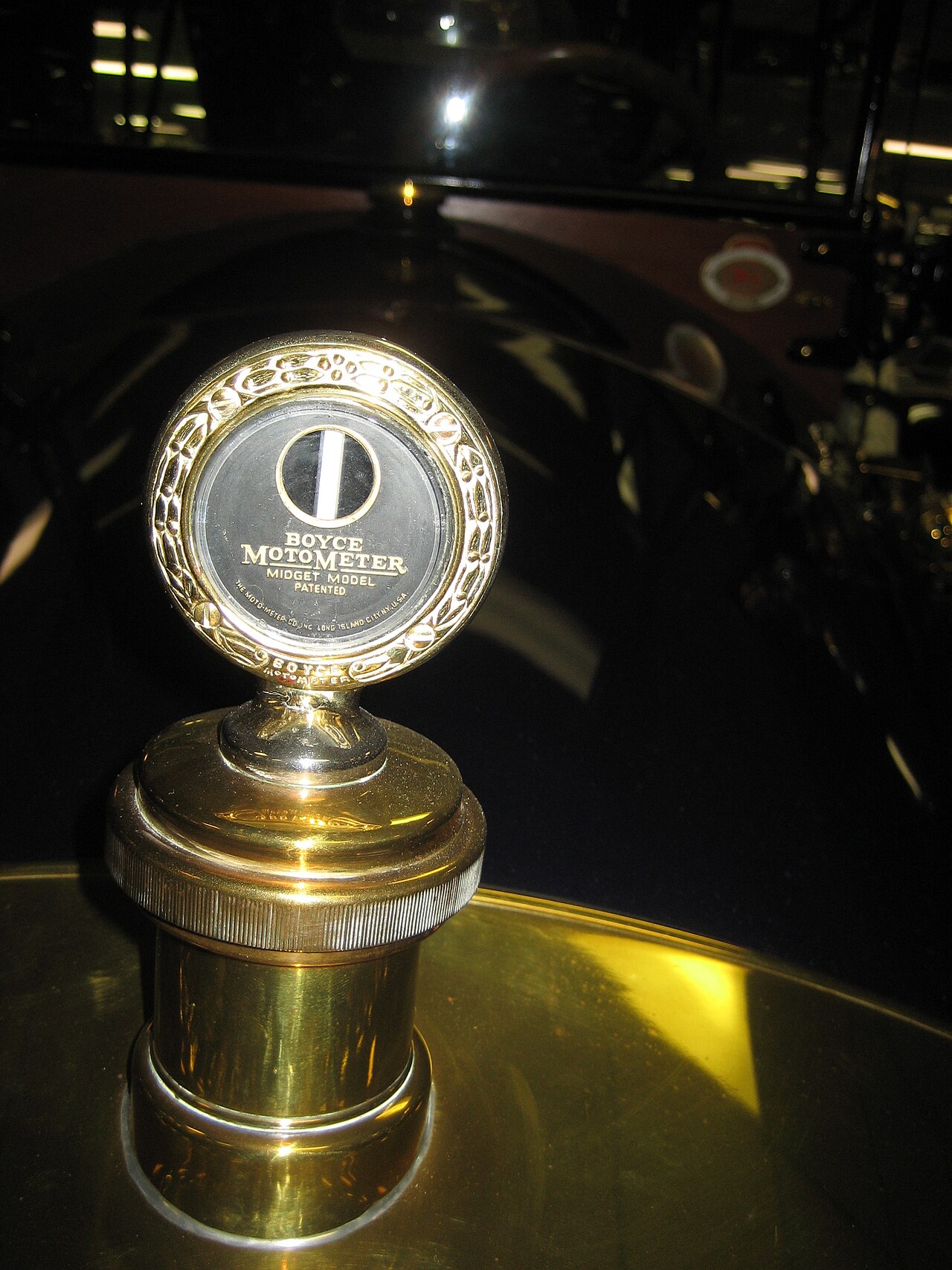
Early motorists had thermometers too. In the 1910s and 1920s, some cars carried a brass gauge on the radiator cap that measured the of the steam inside. The driver could see at a glance if the engine was overheating.
In a nuclear power station, special optical fibre sensors watch the temperature of the reactor core. They help to stop it getting dangerously hot. From a doctor's pocket to a power station, the same idea is at work. Find a material that changes with heat, then turn the change into a number that everyone can trust.
Explore Next
Your audio story keeps playing while you look around.

Words to Know
- bimetallic
- Made of two different metals stuck together, which bend when heated because they expand by different amounts.
- calibration
- Checking and marking a thermometer against known temperatures so its readings can be trusted.
- expansion
- When a material takes up more space as it gets hotter.
- fever
- A body temperature higher than normal, often a sign of illness.
- fixed point
- A temperature that nature repeats every time, such as the melting point of ice.
- infrared
- Invisible light given off by warm objects, which some thermometers can measure.
- mercury
- A shiny metal that is liquid at room temperature and was used inside glass thermometers.
- sensor
- The part of a thermometer that changes when the temperature changes.
- temperature
- A measure of how hot or cold something is.
- thermistor
- A small electrical part whose resistance changes with temperature.
- thermoscope
- An early device that shows heat changing but has no scale to give a number.