Temperature
How hot is hot? It depends on how fast the tiny particles inside are moving.
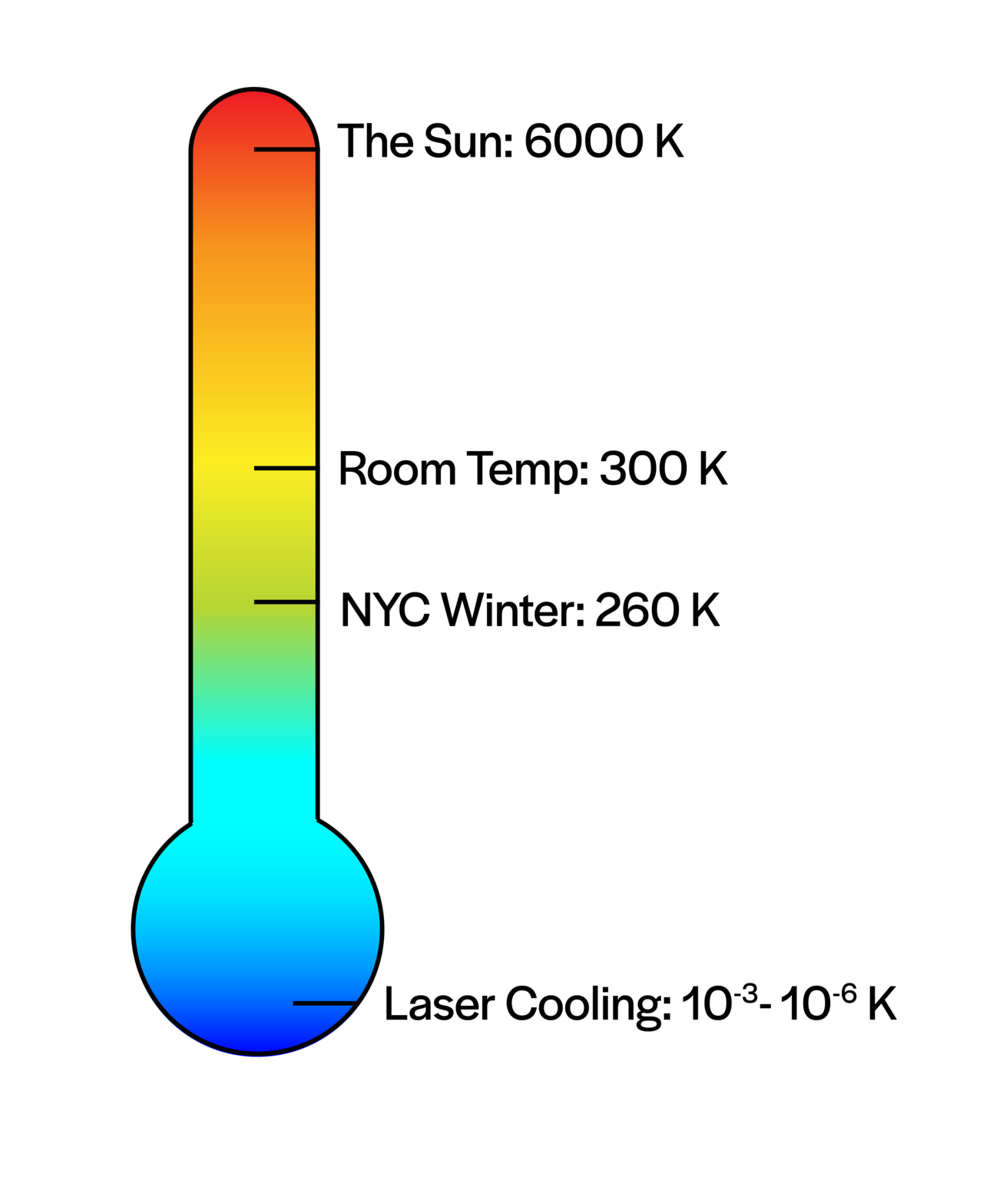
Temperature tells us how hot or cold something is. A cup of tea, a frozen lake and the surface of the Sun all have one. Underneath, the answer is about motion. Everything is made of tiny atoms and molecules that wobble and crash into each other all the time. The faster they move, the higher the temperature. This idea explains why ice melts, why a metal spoon gets hot in soup and why there is a coldest temperature that nothing can reach. We measure temperature with thermometers and with scales named after scientists such as Celsius, Fahrenheit and Kelvin.
What is temperature, really?
When you touch a mug of hot chocolate, your skin tells you it is hot. That feeling is useful, but it is not very exact. Scientists want a number, and to get one they first ask what hotness actually is.
The answer lies in the tiny pieces that make up everything. Every substance is built from atoms and molecules. In a gas, they zoom about and bump into each other and into the walls of their container. In a liquid, they slide past one another. In a solid, they cannot travel far, so they vibrate on the spot like people shivering in their seats.
measures the average energy of all this motion. Physicists call the energy of movement . The hotter a substance is, the more kinetic energy its particles have on average. A cup of boiling water has fast-jiggling molecules. A glass of iced water has slower ones.
Notice the word average. In a hot gas, some particles are slow and some are very fast. Temperature describes the typical particle, not any single one. It also only makes sense for large crowds of particles. One lonely atom does not really have a temperature.
Temperature matters in almost every science. Chemists use it to control reactions, doctors use it to spot illness, astronomers use it to study stars and engineers use it to design engines and bridges.
Why does heat flow from hot to cold?
and are close cousins, but they are not the same thing. Temperature tells you how energetic the particles are on average. Heat is the energy that moves from one thing to another because of a difference in temperature.
That movement always goes one way. Put a hot pan on a cold table and heat flows from the pan to the table until both reach the same temperature. When nothing more flows, the two things are in . Energy moves this way because fast particles pass some of their motion to slower neighbours when they collide. Over time the speeds even out.
Heat travels in three main ways. In , it passes from particle to particle through direct contact, which is why a spoon left in hot soup warms your fingers. In , warm liquid or gas rises and carries heat with it, which is how a radiator warms a whole room. In , hot objects give off energy as light and invisible rays, which is how the Sun warms Earth across empty space.
Heating something does not always raise its temperature. While ice melts, all the heat goes into breaking the bonds that hold the water molecules in place. The temperature stays at 0 °C until the last bit has melted.
Substances also need different amounts of heat to warm up. Raising 1 kilogram of water by 1 degree Celsius takes 4,186 joules. That is a lot, which is why oceans warm and cool so slowly.
How does a thermometer work?
A thermometer turns something you cannot see, the motion of particles, into something you can read. Most thermometers rely on the fact that many materials change in a steady way when they warm up or cool down.
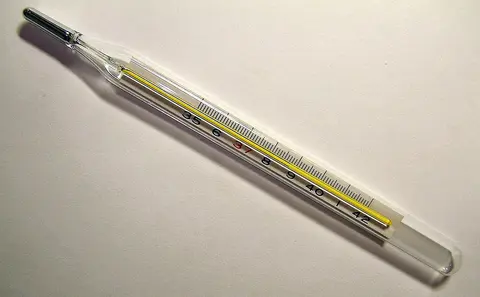
The classic example is the mercury-in-glass thermometer. A thin glass tube holds a little liquid mercury. Warm it up and the mercury expands, so it climbs higher in the tube. Cool it down and it shrinks back. Marks along the tube turn the height into a number. Many modern thermometers use coloured alcohol or electronic sensors instead.
No single material works everywhere. A mercury thermometer is useless above the point where mercury boils. Water is a poor choice too, because over some it shrinks as it warms. Near any material's boiling or freezing point, the readings stop being dependable.
Thermometers like ours go back to the early 1700s. Daniel Gabriel Fahrenheit improved a thermometer and a scale made by the Danish astronomer Ole Rømer, and he switched to mercury. Earlier, Galileo had built a thermoscope. It showed warming and cooling but had no scale. Newton had proposed a temperature scale of his own. They found that there are endless possible scales.
How do we know different thermometers agree? A rule called the zeroth law of thermodynamics says that if two things are each in balance with a third, they are in balance with each other. So any well-made thermometer gives the same reading for the same object.
Why are there so many temperature scales?
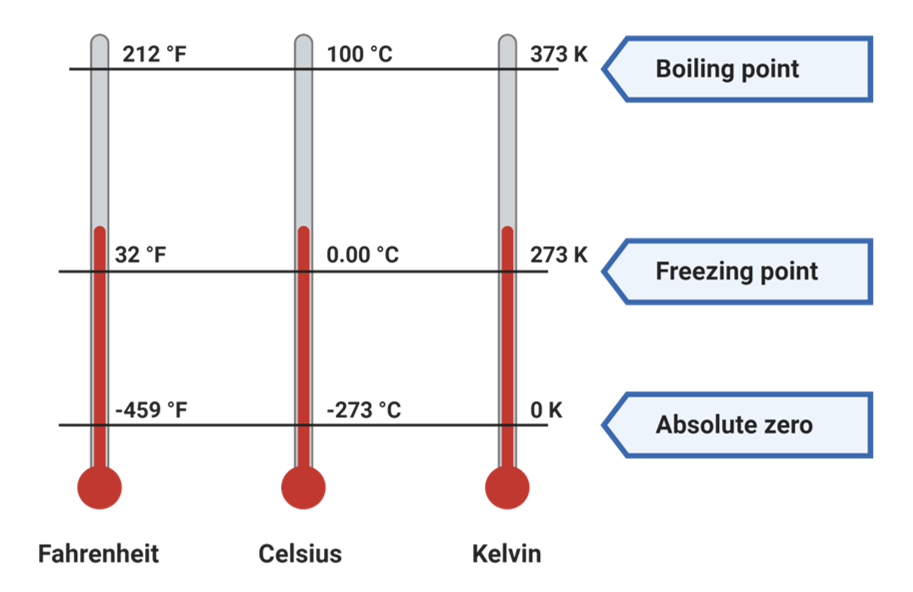
Every scale needs two choices. First, where is zero? Second, how big is one step, called a degree? Different scientists chose differently, so several scales grew up side by side.
The Celsius scale is used for everyday temperatures in most of the world. It was built around water. Zero degrees is the freezing point of water and 100 degrees is its boiling point, both at sea level. Because it has 100 steps between them, it was once called the centigrade scale. It is named after the Swedish astronomer Anders Celsius.
The Fahrenheit scale is the one used for everyday weather in the United States. On it, water freezes at 32 degrees and boils at 212 degrees. Only the United States and a few small countries and territories, such as the Bahamas, Belize, the Cayman Islands and Palau, mainly use it.
Scientists prefer the scale. Its zero is not a freezing point of anything. It is , the lowest temperature possible. One step on the Kelvin scale is exactly the same size as one degree Celsius, so you convert by adding 273.15. Water freezes at about 273.15 K. The kelvin is written without a degree sign and with a small k when spelled out. It is named after Lord Kelvin, who worked out the idea of absolute temperature in the 1840s and 1850s.
There is also the Rankine scale, which is like Kelvin but uses Fahrenheit-sized steps. Some American engineers use it. Other old scales, such as Réaumur and Rømer, have mostly vanished.
What is the coldest possible temperature?
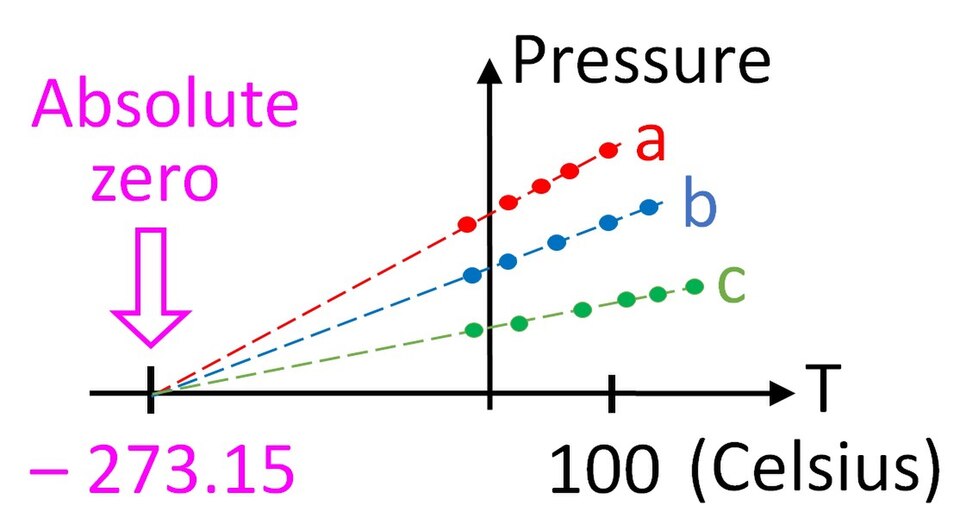
If is about moving particles, you can ask what happens when you take away more and more of their motion. They slow down, and then slow down again. At some point they would have no motion left to lose. That limit is , which is 0 K or −273.15 °C.
There is a clue to this limit in how gases behave. If you keep a gas in a sealed container and cool it, its pressure drops in a regular way. Plot a graph of pressure against temperature and the line heads steadily downwards. Follow it far enough and it reaches zero pressure at −273.15 °C, whatever gas you used. Real gases turn into liquids before they get that cold, so scientists extend the line on paper. This is called extrapolating.
Nothing can ever be cooled all the way down to absolute zero. A rule called the third law of thermodynamics says so. It also means you could never take any more energy out of something already at that temperature.
Scientists have come astonishingly close. The coldest temperature reached in an experiment is about 38 trillionths of a above absolute zero. That is far colder than outer space, which is still a few degrees above the limit.
Even at absolute zero, particles would not be perfectly still. Quantum physics says they keep a tiny leftover motion called zero-point energy.
How do we measure temperatures we cannot touch?
You cannot push a mercury thermometer into a star. Scientists have found cleverer methods that read from the way matter behaves.
One method uses glowing. Hot objects give off light, and its colour depends on the temperature. A cooler object glows dull red, a hotter one glows yellow and a very hot one glows white or blue. A rule called Wien's displacement law links the colour of the strongest light to the temperature. This is how astronomers estimate the surface temperatures of stars.
Another method uses sound. Sound travels faster through hot gas than through cold gas, because the particles move faster and pass the vibration along sooner. If you know the gas and its pressure, the speed of sound gives you its temperature very precisely.
A third method listens to electrical noise. Inside a resistor, charges jiggle at random and make a tiny hiss called Johnson noise. The hotter the resistor, the louder the hiss.
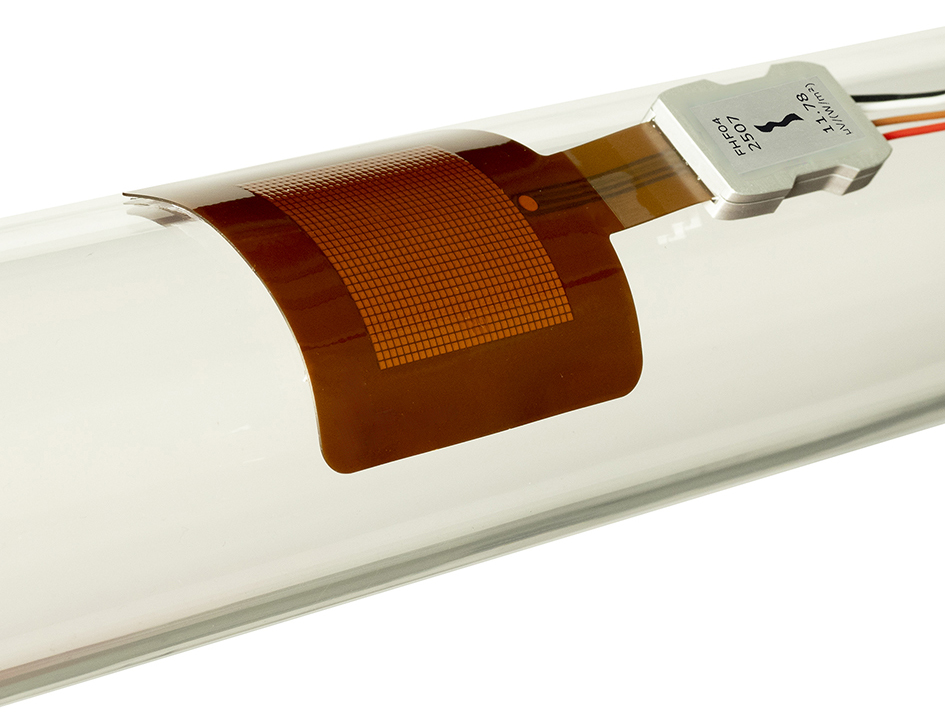
In factories and labs, flexible sensors are stuck onto pipes and machines. They record the temperature and the flowing through.
In May 2019, the was given a new definition. It is now fixed using the Boltzmann constant, a number that links temperature to the energy of moving particles. Before that, it relied on the triple point of water, where ice, liquid water and vapour exist together. Everyday use of the scales barely changed.
How does temperature shape the world around us?
quietly controls most of what happens on Earth. It decides whether water is ice, liquid or steam. In science these forms are called states of matter, and a fourth, , appears at extremely high temperatures. Temperature also changes how dense a material is, how well it carries electricity and how strong it is. Metals soften and glow when heated, and some materials crack when they get too cold.
Chemical reactions depend on it too. Warm food spoils faster than cold food, and a cake bakes only when the oven is hot enough. The speed of sound in a gas also depends on temperature, and so does the amount of an object gives off.
Air temperature affects every living thing. Plants and animals live in the range that suits them, and many have clever ways to cope with and cold. Humans are warm-blooded, so our bodies work to stay at about 37 °C.
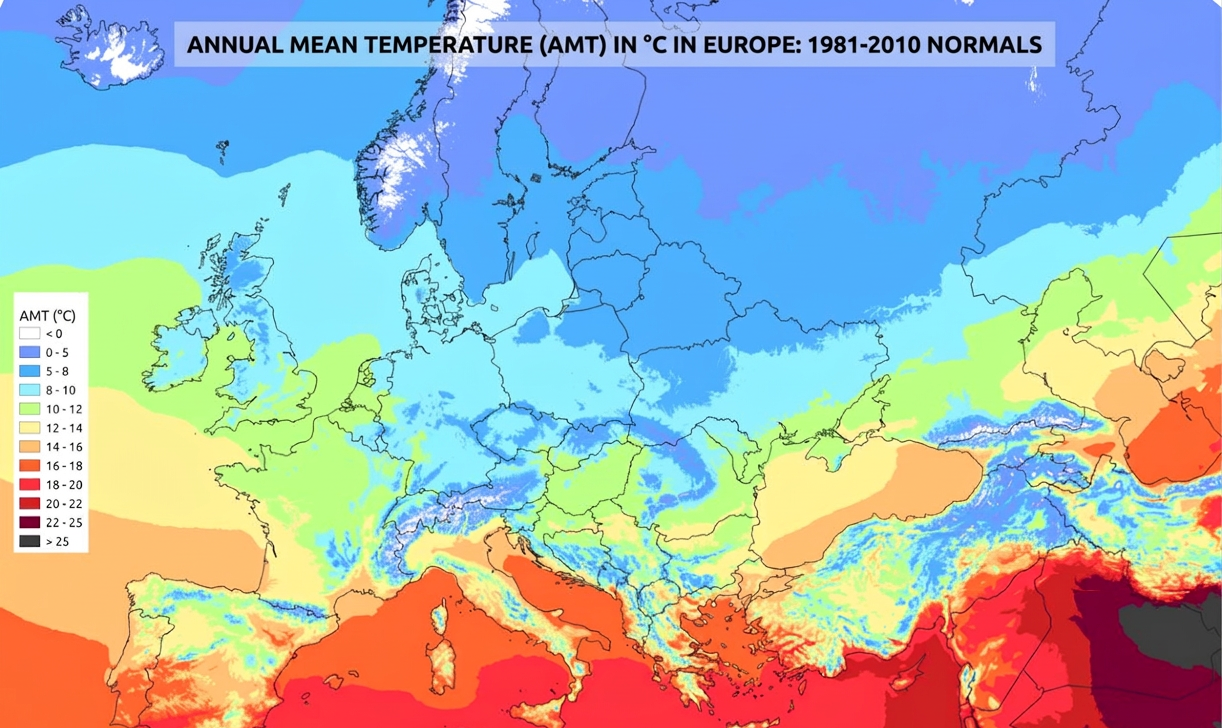
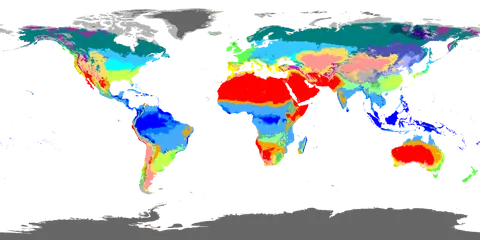
On a bigger scale, temperature draws the map of climate. Places near the equator get more direct sunlight, so they are warmer, while places near the poles are colder. Across Europe, average yearly temperatures run from warm in the south to cold in the north. Scientists use such patterns to split the world into climate zones, such as tropical and polar. Mountains add another twist, because the air generally gets colder as you climb.
These maps are changing. Earth's average surface temperature has risen by more than 1 °C since the late 1800s. The main cause is burning fossil fuels, which adds heat-trapping gases to the air. Europe is the fastest-warming continent. It is heating up about twice as fast as the world as a whole. As the planet warms, climate zones are slowly shifting towards the poles and up mountainsides.
Explore Next
Your audio story keeps playing while you look around.


Words to Know
- absolute zero
- The lowest possible temperature, 0 K or −273.15 °C.
- conduction
- Heat moving through a material from particle to particle.
- convection
- Heat carried along by a moving liquid or gas.
- extrapolate
- To extend a pattern or line beyond the measurements you have to predict what happens further on.
- heat
- Energy that moves from a warmer thing to a colder thing.
- heat capacity
- How much heat a thing needs to take in to warm up by one degree.
- kelvin
- The science unit of temperature, with zero at absolute zero.
- kinetic energy
- The energy something has because it is moving.
- plasma
- A very hot state of matter in which atoms are split into charged particles.
- temperature
- A measure of how hot or cold something is, based on the average energy of its moving particles.
- thermal equilibrium
- The state in which two touching things are at the same temperature and no heat flows.
- thermal radiation
- Energy given off by warm objects as light and invisible rays.