Moon
Earth's only natural satellite, a battered world that shapes our tides and skies.
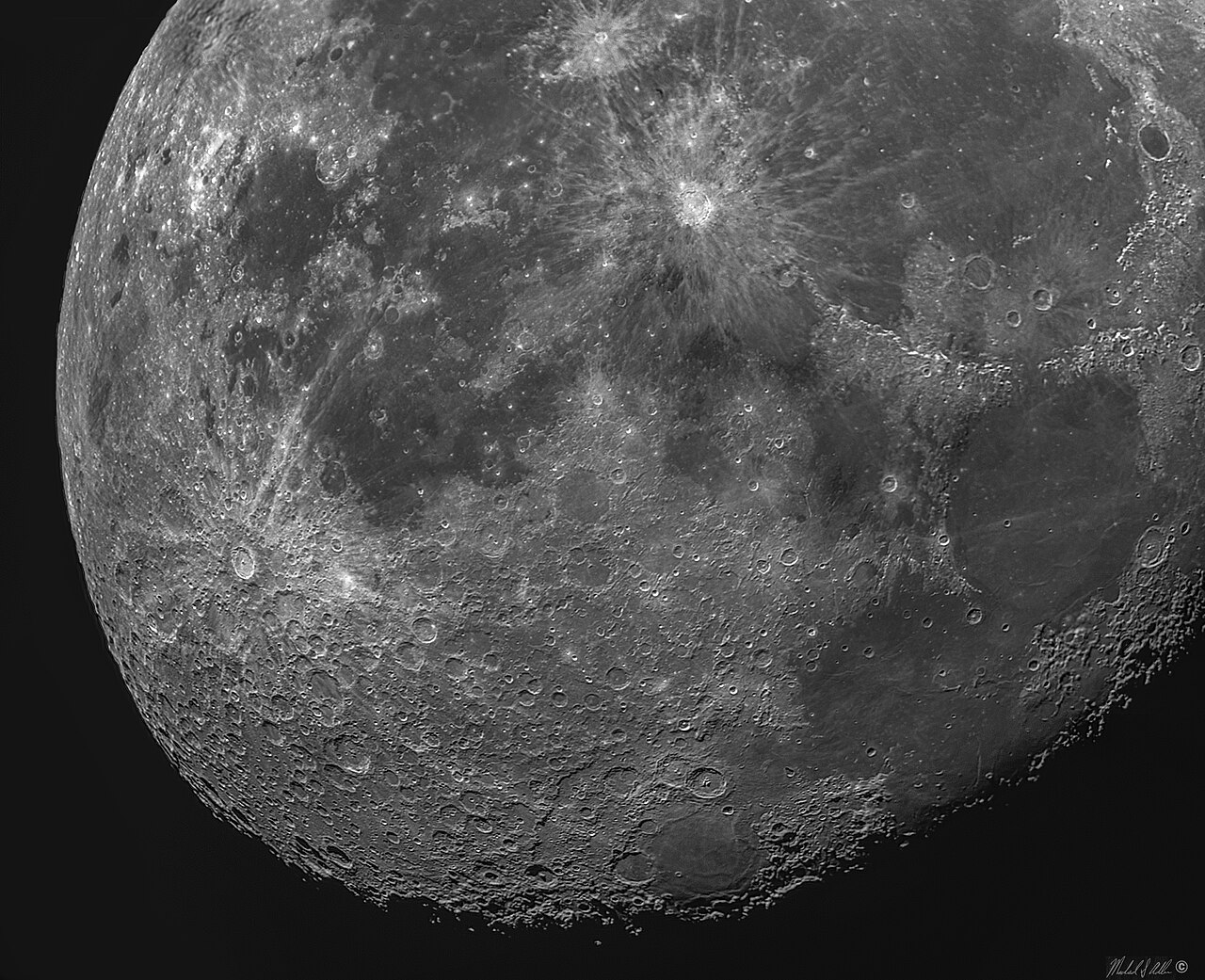
The Moon is Earth's only natural satellite, a ball of rock about a quarter as wide as our planet. It circles Earth every 27.3 days at a distance of about 384,000 kilometres, close enough that people have visited it. It is the brightest thing in our night sky, even though its surface is about as dark as asphalt. The Moon pulls on our oceans to make the tides. It was born in a giant crash 4.5 billion years ago. Its craters, lava plains and hidden ice hold clues to the early Solar System. Twelve people have walked on it, four more flew around it in April 2026 and humans are planning to return.
Where did the Moon come from?
The Moon is almost certainly a piece of the early Earth, rebuilt in space. Scientists call the leading explanation the giant-impact theory. About 4.5 billion years ago, not long after Earth formed, a young planet about the size of Mars crashed into it at a slant. Scientists have named that planet Theia. The blow melted rock and flung huge amounts of material into orbit around Earth. Over time the hot cloud of debris clumped together under its own gravity and became the Moon.
Why do scientists trust this idea? Older ones fail. Earth could not have spun fast enough to throw off a chunk of itself. Earth's gravity could not easily have caught a ready-made Moon drifting past. And if Earth and the Moon had grown side by side from the same cloud, the Moon would hold far more iron than it does. Instead it has only a small metal core. Computer simulations of giant crashes produce a pair of worlds with the right spin and orbit.
Rocks give more clues. Meteorites from Mars and from the asteroid Vesta have very different mixes of oxygen atoms from Earth rocks. Earth and the Moon match almost exactly, which points to a shared origin.
The story is not finished. Some details of the Moon's make-up are hard to explain, and experts still argue about how much of it came from Theia and how much from Earth. In 2023 one computer study suggested that pieces of Theia could still be buried deep inside our planet.
Why do we always see the same face?
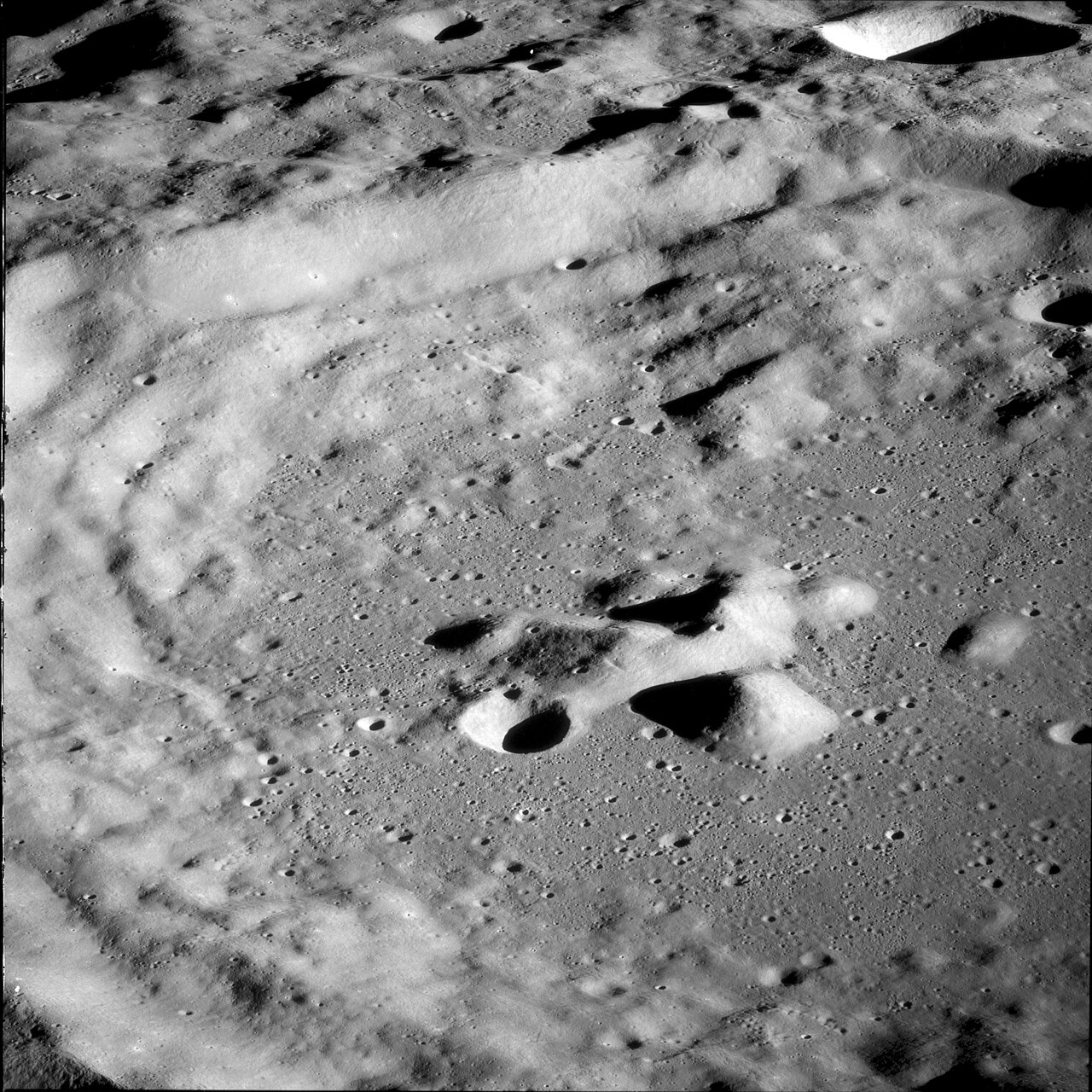
Look at the Moon on any clear night and you see the same pattern of dark patches and bright areas. The Moon always turns one side towards Earth. That side is called the near side. The other side is the far side. Over time you can see about 59% of the Moon's surface from Earth, because the Moon wobbles a little as it travels. This wobble is called and lets us peek slightly around the edges.
The reason is called . The Moon takes 27.3 days to spin once on its axis and the same time to go once around Earth. The two motions match, so the same face stays pointed at us. This was not always so. Early in its life the Moon spun faster. Earth's gravity stretched the Moon's rock slightly, and the pull on that stretched shape acted like a brake. The spin slowed until it matched the orbit. The lost energy turned into heat.
People often call the far side the dark side. That name is wrong. The far side gets sunlight as often as the near side, once every 29.5 days. During a new moon it is the near side that is dark.
The far side looks different too. It has far fewer dark plains and many more . The first photographs of it were taken by the Soviet probe Luna 3 in 1959.
Why does the Moon change shape?
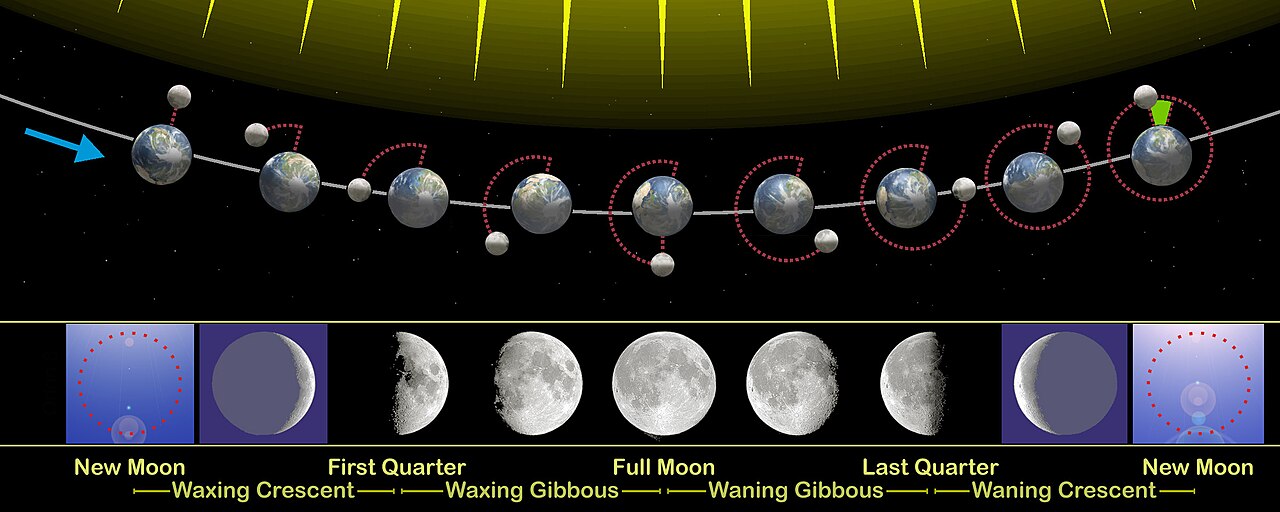
The Moon does not make its own light. It shines because sunlight bounces off its grey surface. Half of the Moon is always lit by the Sun, like the half of Earth that is in daytime. What changes is how much of that lit half we can see from Earth.
The Moon takes about 29.5 days to go through all its phases. When it sits between Earth and the Sun, its lit side faces away from us. We call this a new moon. A few days later a thin crescent appears. At first quarter we see half of the lit side. At full moon, Earth is between the Moon and the Sun and we see the whole bright face. Then the cycle runs backwards until the Moon is dark again. Our word month comes from the same old word as Moon.
You might ask why the cycle takes 29.5 days when the Moon circles Earth in 27.3. While the Moon travels, Earth also moves around the Sun. The Moon needs about two extra days to catch up with the Sun's position.
Sometimes the three bodies line up exactly. When the Moon passes through Earth's shadow, we get a lunar . When the Moon passes in front of the Sun, we get a solar eclipse. The Moon is about 400 times smaller across than the Sun but also about 400 times closer, so both look about the same size in our sky. That is why the Moon can cover the Sun completely.
How does the Moon move the oceans?
Gravity gets weaker with distance. The Moon pulls harder on the side of Earth nearest to it than on the far side. That small difference stretches the whole planet very slightly and creates tidal forces. Solid rock barely moves, but water flows easily. The oceans pile up into two bulges. One faces the Moon and the other points away from it.
As Earth spins, each coastline passes through both bulges every day. That gives most places two high and two low tides. The Moon also moves forward in its orbit, so the tides come about 12 hours and 25 minutes apart, not exactly 12. The Sun also pulls on the oceans, with about 40% of the Moon's effect. When the Sun and Moon line up at new and full moon, we get big spring tides. When they pull at right angles we get smaller neap tides.
Real tides are messy. Shallow seas, coastline shapes and sloshing water in ocean basins all change their timing and height. That is why sailors use tide tables made from local records.
The tides also pull on the Moon. Tidal friction slows Earth's spin and passes energy to the Moon, which climbs into a higher orbit. Laser beams bounced off mirrors left by Apollo astronauts show the Moon moving away by about 3.8 centimetres every year. That is close to the speed at which fingernails grow. Long ago the Moon was much closer and looked far bigger in the sky.
What is the Moon made of?
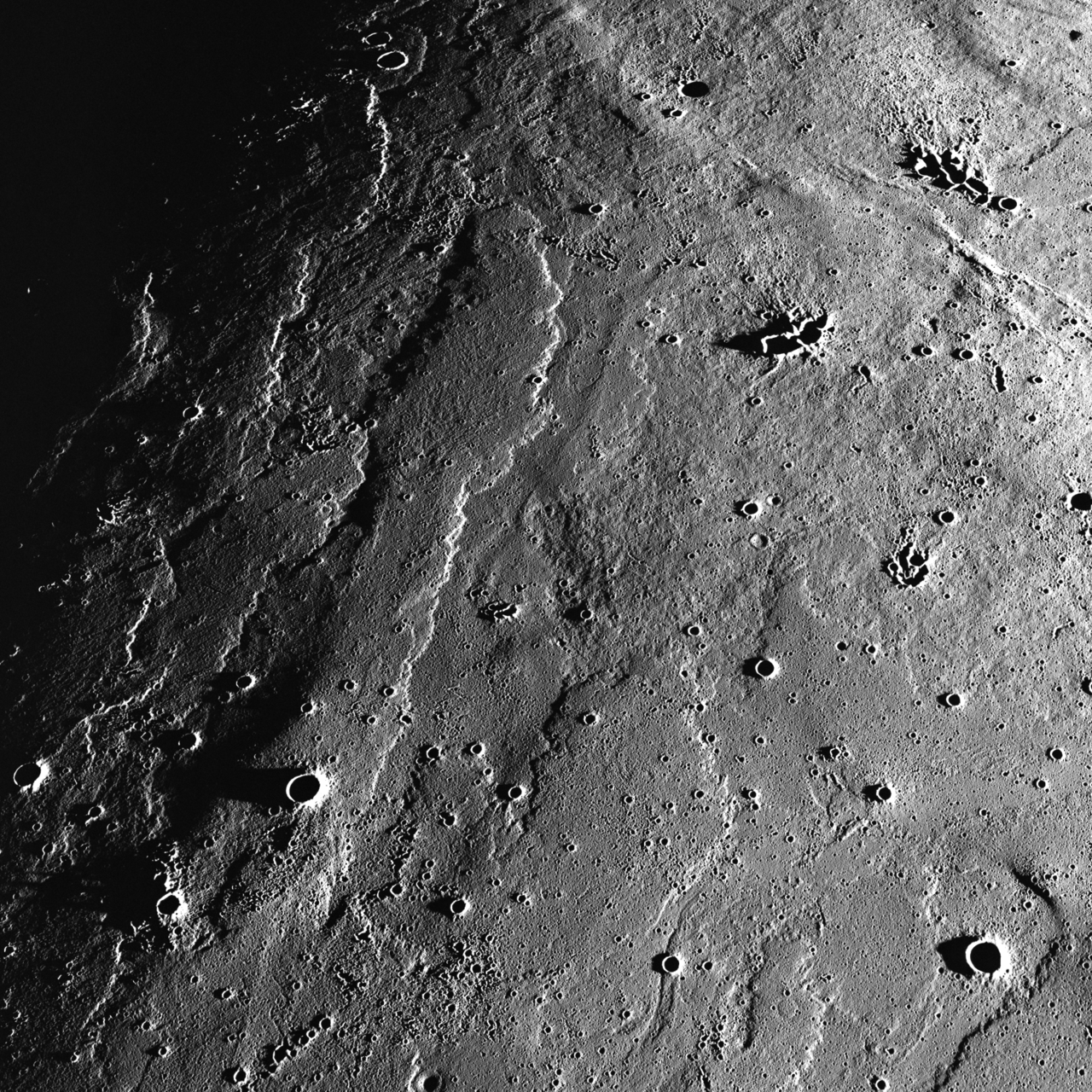
The Moon is a rocky world with layers, a bit like Earth. At the centre is a small core of iron. The inner part is solid and the outer part is liquid. Around it sits a thick mantle of rock. On top lies a crust that is about 40 kilometres thick on average. Early on, the whole Moon was covered by an ocean of molten rock. As it cooled, heavy minerals sank to make the mantle and light ones floated up to form the crust.
Next time you look at the Moon, you can see the result. The bright areas are highlands, made of pale rock that formed about 4.4 billion years ago. The dark areas are called , from the Latin word for seas. Early astronomers thought they were oceans. They are really huge plains of solid black volcanic rock called . Billions of years ago, lava rose from inside the Moon and flooded giant hollows left by impacts. Most of this happened between 3.3 and 3.7 billion years ago. The Moon stayed volcanically active until about 1.2 billion years ago.
Maria cover about 31% of the near side but only 2% of the far side. Scientists are still working out why. The crust on the near side is thinner, so lava may have escaped more easily. Heat-producing elements concentrated under the near side may also have helped.
Lava has left other marks. Long winding valleys called sinuous rilles are old lava channels. Wrinkle ridges formed as cooling lava shrank. Samples brought home by astronauts confirm that the Moon's rocks are rich in iron.
Why is the Moon covered in craters?
are the Moon's most famous feature. They are bowl-shaped scars left when asteroids and comets smashed into the surface. There are roughly 300,000 craters wider than 1 kilometre on the near side alone. Small craters are simple bowls. Bigger ones have flat floors, terraced walls and a central peak. The biggest impacts made basins with several rings. The largest is the South Pole-Aitken basin on the far side. It is the largest crater on the Moon and one of the biggest known in the Solar System.
Earth gets hit too, so why does the Moon look so battered? Earth has weather, oceans and moving plates of crust that wear craters away. The Moon has no air or rain, and little volcanic activity now. A crater can stay sharp for billions of years.
That makes the Moon a history book. Scientists count craters to estimate how old a surface is. More craters mean an older surface. Rocks that Apollo astronauts collected were melted by big impacts. Many are about 3.8 to 4.1 billion years old, which suggests that a burst of impacts hit the Moon around that time. This idea is called the Late Heavy Bombardment.
Some craters are very young. Tycho and Copernicus have bright streaks called rays, made of material thrown out when they formed. Rays fade with time, so bright ones mark recent craters. Even today the Moon is hit by rocks. Fresh craters keep appearing, and spacecraft have photographed them.
How harsh is the lunar surface?
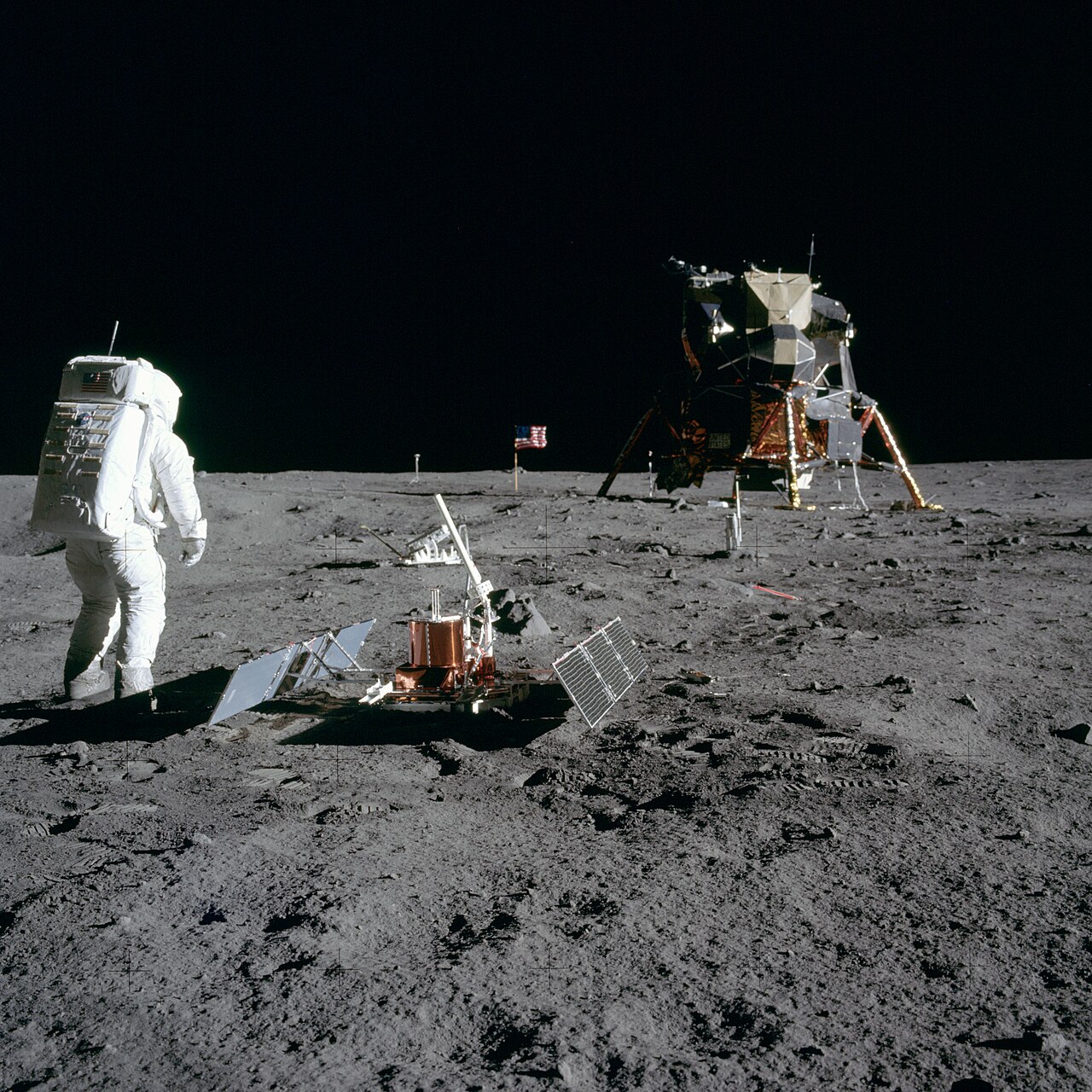
The Moon is a hostile place. It has almost no air. Its atmosphere is so thin that it is nearly a vacuum, with only a few atoms of gas such as helium and argon. Sound cannot travel through it, and the sky is black even in daytime. With no air to hold in heat, temperatures swing wildly. Sunlit ground can climb above 100 degrees Celsius, while shadowed ground falls far below freezing. Some deep near the poles never see sunlight. A NASA spacecraft measured temperatures in them that are colder than the surface of Pluto.
Gravity on the Moon is about one-sixth of Earth's. A person who weighs 60 kilograms on Earth would feel as light as a 10-kilogram child does at home. Astronauts could bounce along in big, slow steps.
The ground is covered in a grey layer of broken rock and glass called . It was made by billions of years of impacts. It feels a bit like snow, but it is sharp and sticky. Apollo astronauts said it smelled like spent gunpowder. Sunlight charges the dust with electricity so it clings to suits and machines.
With no thick air or magnetic field to protect it, the surface is also hit by radiation from the Sun and deep space. In daytime the dose is about 200 times higher than on Earth's surface.
Not all is bad news. The Moon tilts only 1.5 degrees, so some peaks near the north pole stay sunlit almost all the time. A cave near the Sea of Tranquillity could shelter future visitors.
Is there water on the Moon?
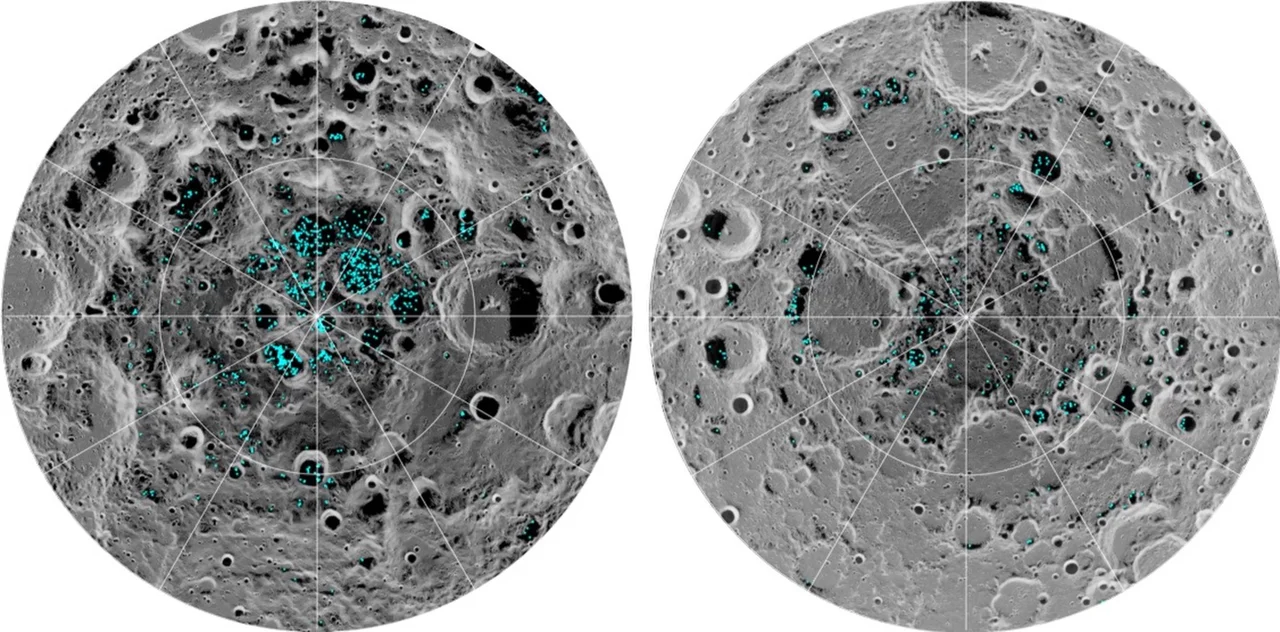
For a long time people believed the Moon was bone dry. In sunlight, liquid water cannot last on the surface. Sunlight breaks water into hydrogen and oxygen and the gases escape to space. But scientists suspected that ice might survive in places the Sun never reaches, such as the floors of deep at the poles.
Evidence built up over decades. In 1998 the Lunar Prospector spacecraft found lots of hydrogen in the soil near the poles. In 2008 India's Chandrayaan-1 carried an instrument called the Moon Mineralogy Mapper, which later confirmed ice on the surface. In 2009 NASA crashed a spacecraft into a dark polar crater and found water in the cloud of material that rose. In 2018 scientists reported definite signs of ice at both poles, with more at the south pole. In 2020 astronomers found water molecules on sunlit ground too.
Where did the water come from? Possibly from comets that struck the Moon, or from a reaction between hydrogen in the solar wind and oxygen in lunar rocks. Some water was even locked inside volcanic glass beads brought back by Apollo astronauts.
This matters for the future. Carrying water from Earth costs a huge amount, because every kilogram needs rocket fuel to lift it. Ice at the Moon's poles could give astronauts drinking water, and it could be split into oxygen to breathe and fuel for rockets. That is why the poles are the most likely sites for future bases.
How did people reach the Moon?
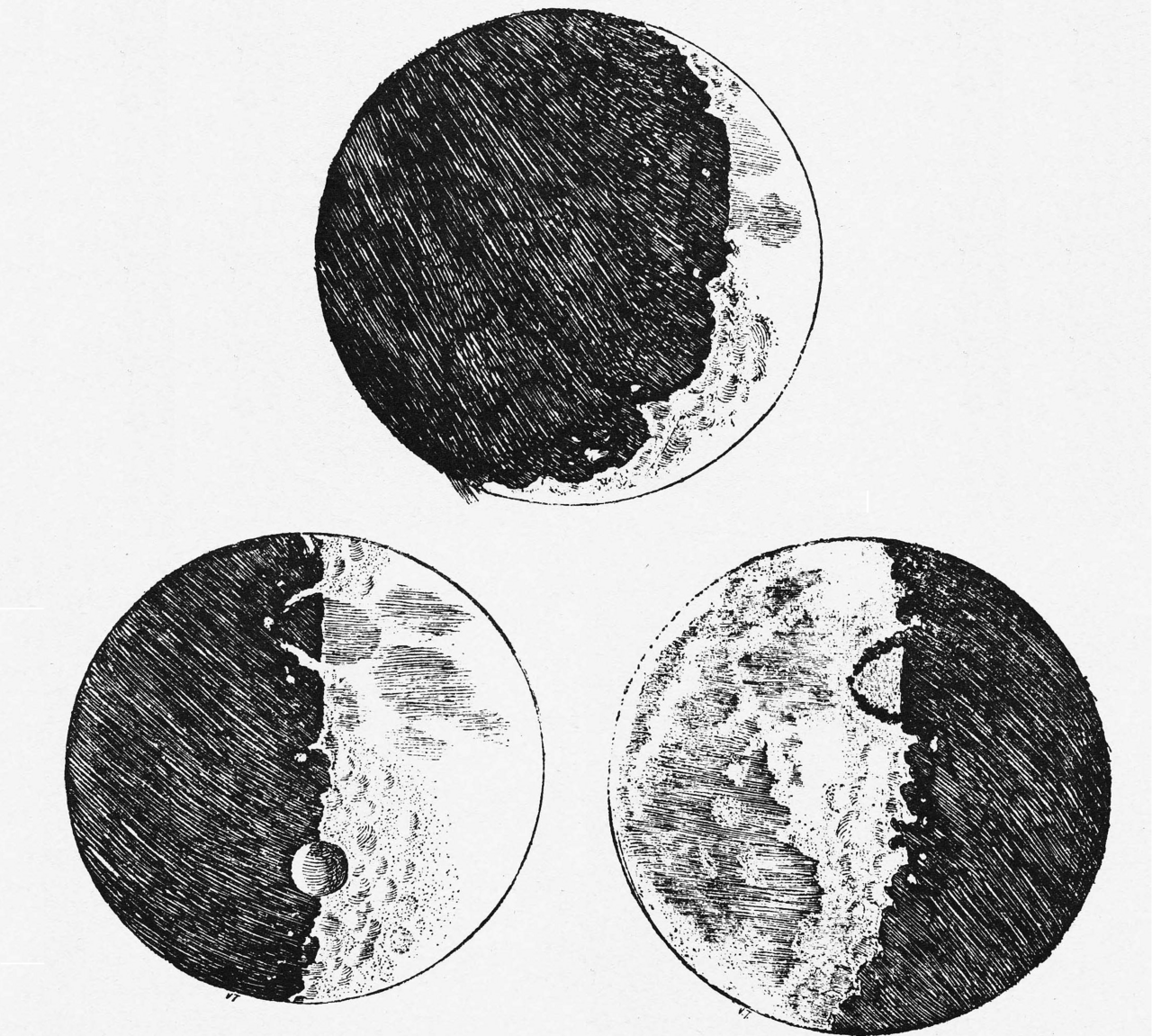
People watched the Moon for thousands of years before they could study it. They used its phases to build calendars. Many cultures told stories about it. The ancient Greeks had a moon goddess called Selene. In 1609 and 1610 Galileo Galilei pointed an early telescope at it. He drew mountains and and showed that the Moon was a rugged world and not a smooth, perfect sphere.
Then came the space age. In 1959 the Soviet probe Luna 1 flew past the Moon and Luna 2 crashed into it. Luna 2 was the first human-made object to reach another world. In 1966 Luna 9 made the first soft landing, and Luna 10 became the first spacecraft to orbit the Moon.
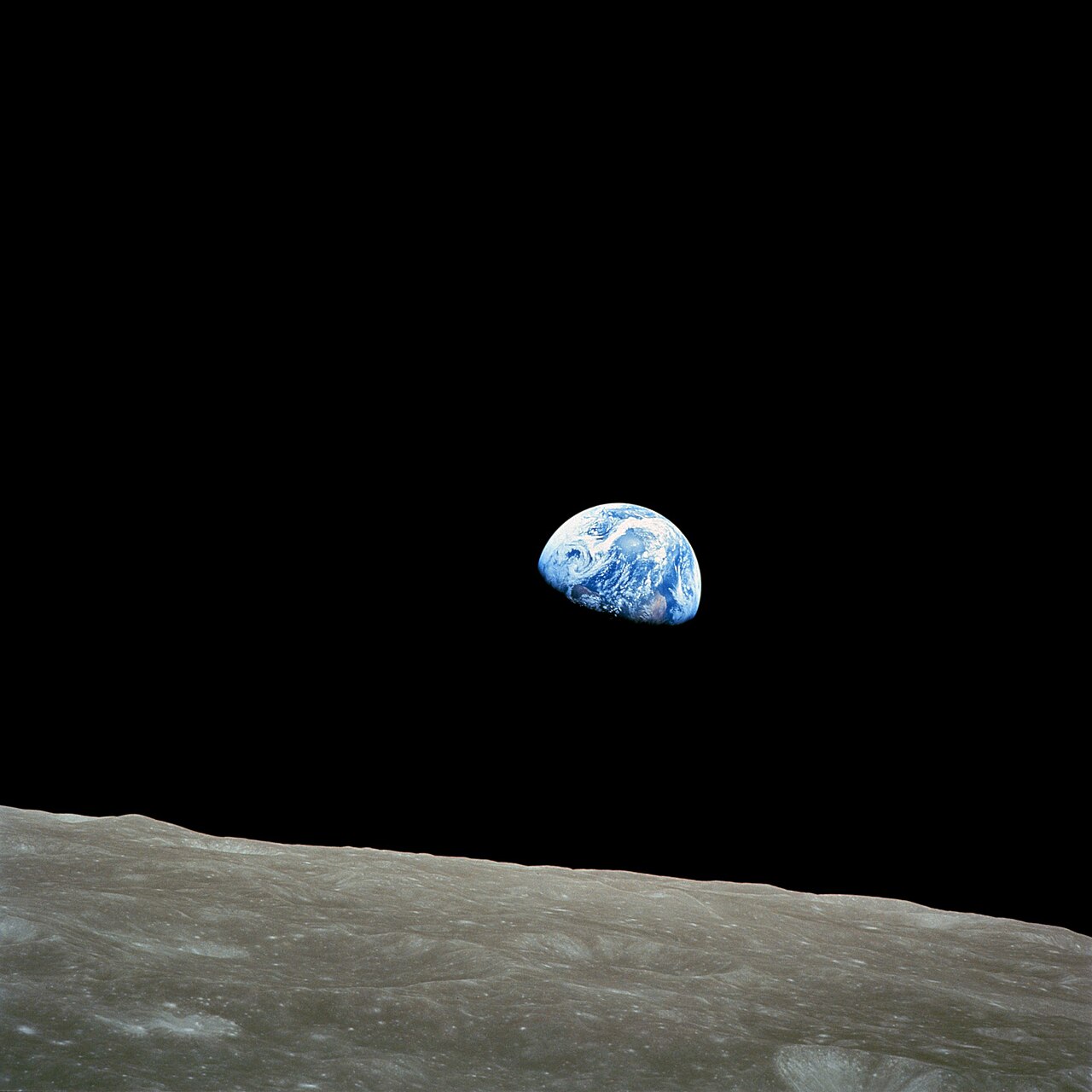
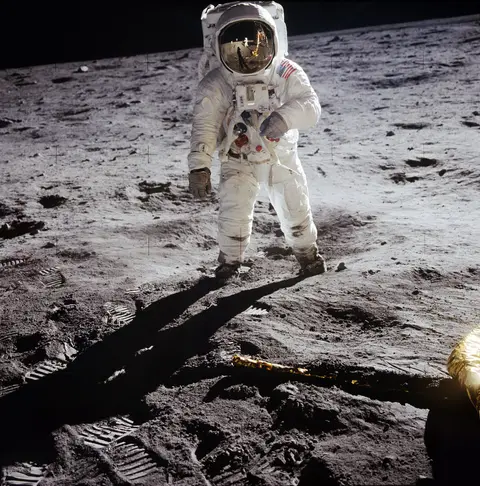
The first humans to reach the Moon were the crew of Apollo 8, an American mission. On 24 December 1968 they orbited it and took the famous Earthrise photograph. On 20 July 1969 the lander Eagle of Apollo 11 touched down at Mare Tranquillitatis, the Sea of Tranquillity. Neil Armstrong and Buzz Aldrin walked on the surface while Michael Collins stayed in orbit.
By 1972 six Apollo missions had landed twelve people on the Moon, who stayed up to 3 days. They collected rock samples, set up experiments and left mirrors that scientists still use to measure the Moon's distance. Their seismometers revealed moonquakes. No one has walked there since 1972.
Now robots have found water and plans are changing. China's Chang'e 4 made the first landing on the far side in 2019. India's Chandrayaan-3 landed near the south pole in 2023, and Chang'e 6 brought back the first far-side samples in 2024. In April 2026 the four Artemis II astronauts flew around the Moon, the first people to travel there since 1972. NASA's Artemis programme now aims to land people there again in 2028, after a crewed test flight in Earth orbit in 2027.
Explore Next
Your audio story keeps playing while you look around.
Words to Know
- basalt
- A dark volcanic rock formed when lava cools.
- crater
- A bowl-shaped hollow made when an asteroid or comet hits a surface.
- eclipse
- When one object moves into the shadow of another or blocks the light from it.
- exosphere
- An atmosphere so thin that its gas atoms almost never bump into each other.
- libration
- A slight wobble of the Moon that lets us see a little beyond the usual edge.
- lunar phase
- The shape of the Moon's lit part that we see from Earth.
- maria
- The dark plains of solid lava on the Moon, from the Latin word for seas.
- regolith
- The layer of broken rock and dust that covers the Moon's surface.
- satellite
- An object that orbits a larger one, such as a moon around a planet.
- tidal locking
- When a moon spins once for each orbit, so it always shows the same face to its planet.
- tide
- The regular rise and fall of the sea caused by the pull of the Moon and Sun.