Comet
Frozen wanderers from the edge of the Solar System that grow glowing tails near the Sun.
A comet is a lump of ice, dust and rock that circles the Sun. Most of its life is spent in the dark and cold, far beyond Neptune. When its orbit brings it close to the Sun, the ice turns to gas and a glowing tail may stretch across the sky for millions of kilometres. For thousands of years people feared comets as signs of disaster. Today we know they are leftovers from the birth of the Solar System, and spacecraft have flown past them, crashed into them and even landed on one. Their chemistry may even help to explain how our oceans and life began.
What is a comet?
A comet is a ball of ice, dust and rock that travels around the Sun. Most of the time it is dark, frozen and almost impossible to see. Then its path carries it close to the Sun, and it changes into one of the most beautiful sights in the sky.
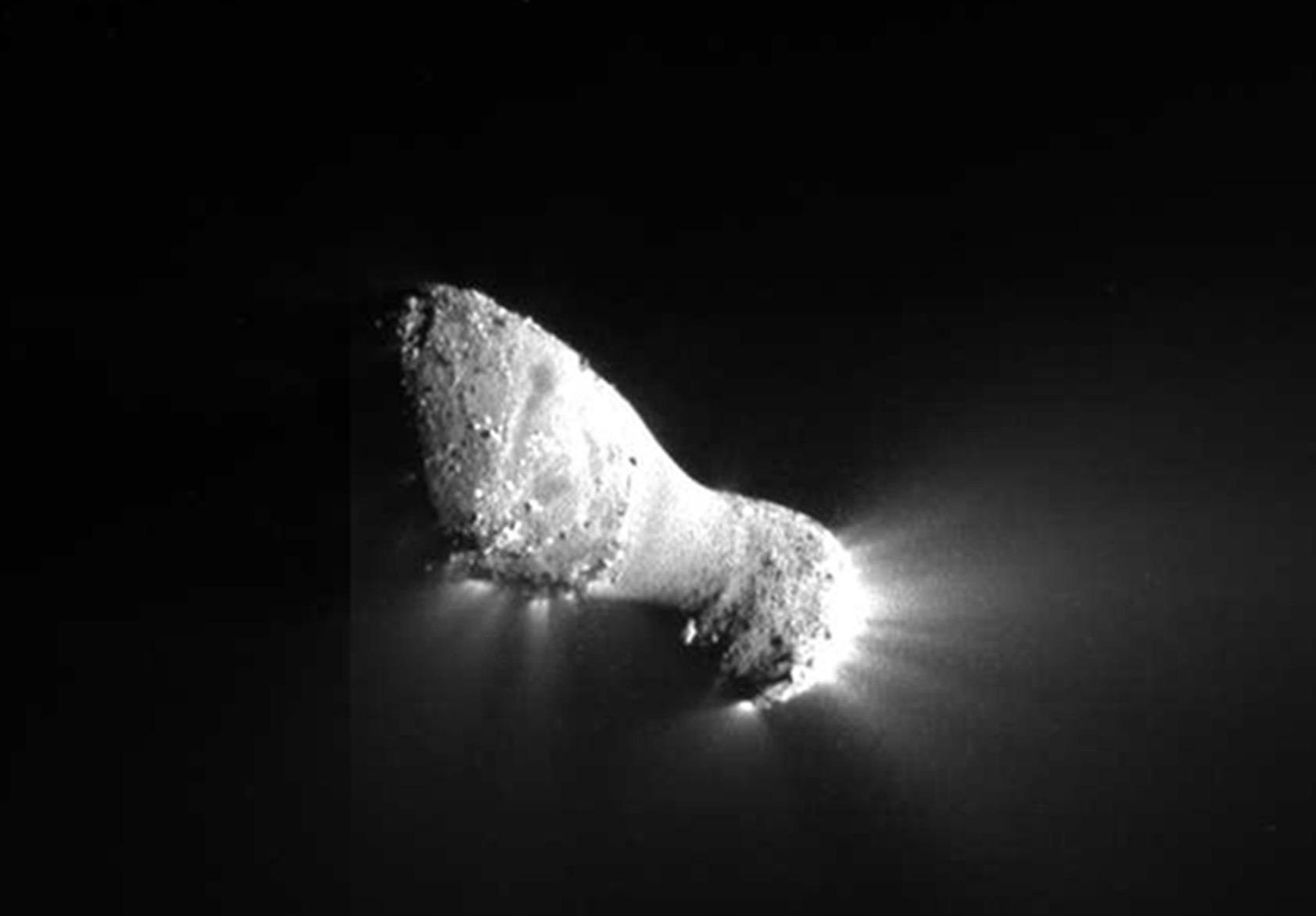
The solid part of a comet is called the . It is small by space standards. Most nuclei are between a few hundred metres and a few tens of kilometres across. Comet Hartley 2, which a spacecraft photographed up close in 2010, is about 2 km long. That is about the length of 20 football pitches placed end to end.
The nucleus is a loose mix of water ice, dust and small rocky bits. It also holds frozen gases such as carbon dioxide, carbon monoxide, methane and ammonia. In 1950 the American astronomer Fred Whipple suggested that comets are mostly ice with some dust in them. People called this idea the "dirty snowball" model. Later spacecraft showed it was close to the truth, although some comets seem to hold more dust than ice.
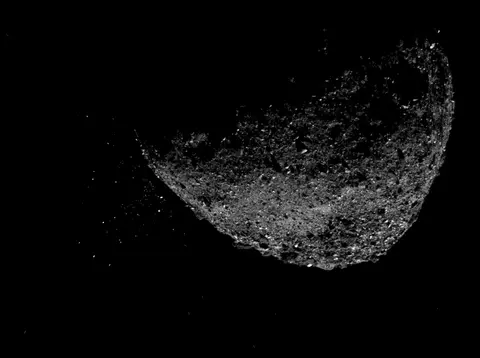
A nucleus is too small for its own gravity to squeeze it into a ball, so it stays lumpy and irregular. Its surface is also very dark. Halley's Comet reflects only about 4 percent of the light that hits it. Fresh asphalt reflects about 7 percent.
Why do comets have glowing tails?
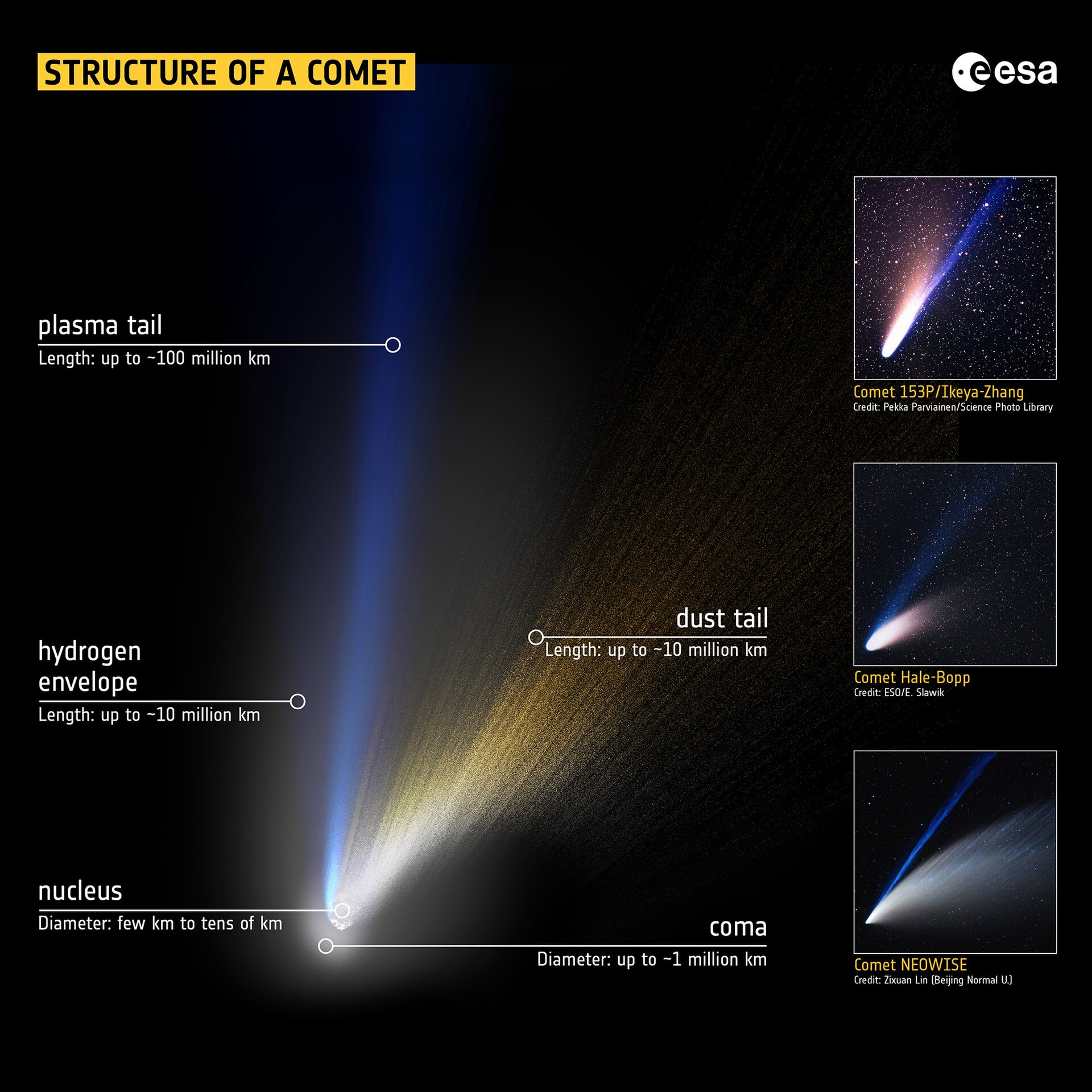
Far from the Sun, a comet is a frozen rock. As it moves closer, sunlight warms the ice. The ice does not melt into a puddle. Instead it turns straight into gas, a change called . The gas streams away and carries dust with it. Astronomers call this .
The cloud of gas and dust around the is called the . It can be huge. A coma may grow up to 15 times as wide as Earth. In 2007 the coma of Comet Holmes briefly became larger than the Sun.
Sunlight and the then push material away from the coma, and tails form. A comet has two main tails. The dust tail is made of tiny grains pushed along by sunlight. It is often curved. The ion tail is made of gas that has become electrically charged. The solar wind, a stream of particles blowing out from the Sun, sweeps it along. So the ion tail always points straight away from the Sun.
This means a comet's tail does not trail behind it like smoke from a plane. When a comet is heading away from the Sun, its tail points ahead of it.
Tails can be enormous. An ion tail can stretch for 150 million km or more, which is the distance from Earth to the Sun. We can see a comet only because the dust reflects sunlight and the gas glows.
Where do comets come from?
Comets are leftovers from the birth of the Solar System. Some icy lumps never became part of a planet. They were scattered into the cold outer regions, where they have stayed frozen ever since.
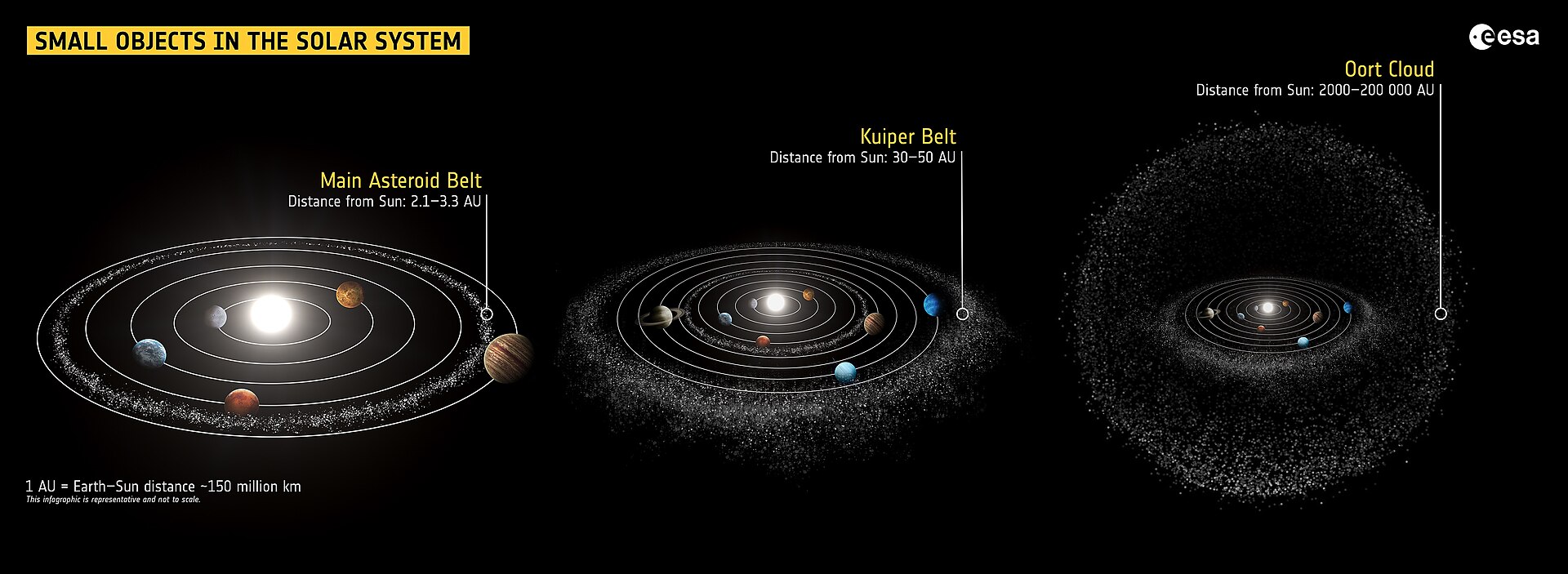
Two main storehouses hold them. The first is the , a wide ring of icy bodies beyond the of Neptune. A wider region around it, called the scattered disc, holds more. The second is the , named after the Dutch astronomer Jan Hendrik Oort. It is thought to be a huge sphere of icy bodies that surrounds the Solar System and reaches about halfway to the nearest star. It may hold around a trillion comets.
Nobody has ever seen the Oort cloud directly. Astronomers believe in it because of the paths that comets take when they arrive.
Something has to disturb a comet before it heads for the Sun. The pull of the giant planets can nudge Kuiper belt comets. Oort cloud comets can be set moving by the gravity of passing stars and by the pull of the Milky Way as a whole. Because that happens at random, a new comet can appear with no warning.
Comets are not only found around our Sun. Since 1987 astronomers have found signs of exocomets around other stars, such as Beta Pictoris. Comets seem to be common across the galaxy.
How do comets travel around the Sun?
Planets travel in that are close to circles. Comets do not. Their orbits are long, stretched ovals, so a comet swings in close to the Sun and then heads far away again. The more stretched the oval, the longer the journey takes.
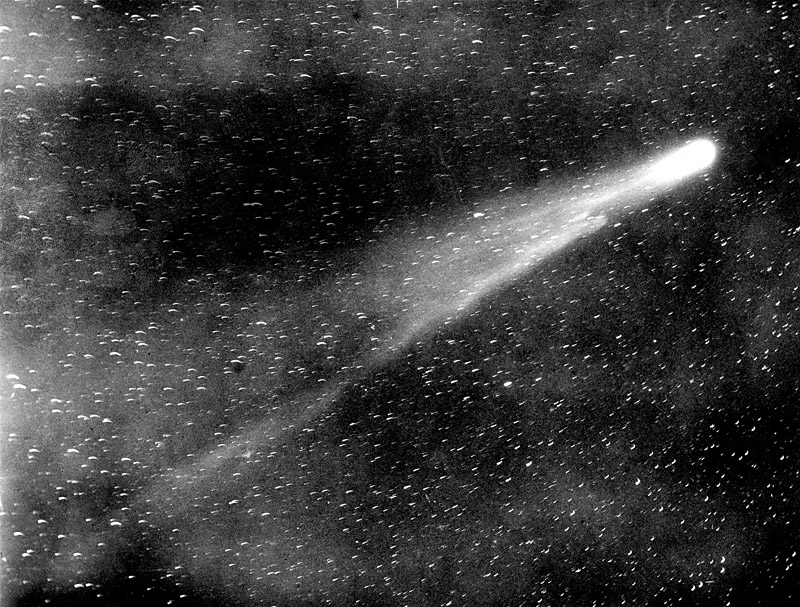
Astronomers sort comets by how long one trip takes. Short-period comets take under 200 years. Many of these come from the and travel in the same direction as the planets. Halley's Comet is the most famous. It returns about every 76 years, and its orbit takes it out to a little beyond Neptune. Long-period comets take more than 200 years, and some need thousands or even millions of years. They can arrive from any direction in the sky.
Planets can change a comet's path. Jupiter is more than twice as heavy as all the other planets put together. Its gravity can capture a long-period comet and trap it in a much shorter orbit. It can also fling a comet out of the Solar System for good. Comet C/1980 E1 had an orbit of about 7 million years. A close pass by Jupiter in 1980 sped it up so much that it will never come back.
A few visitors come from other stars. Comet 2I/Borisov, found in 2019, is the first interstellar comet that astronomers have identified. A third interstellar object, 3I/ATLAS, was found in 2025.
Why did people watch comets so closely?
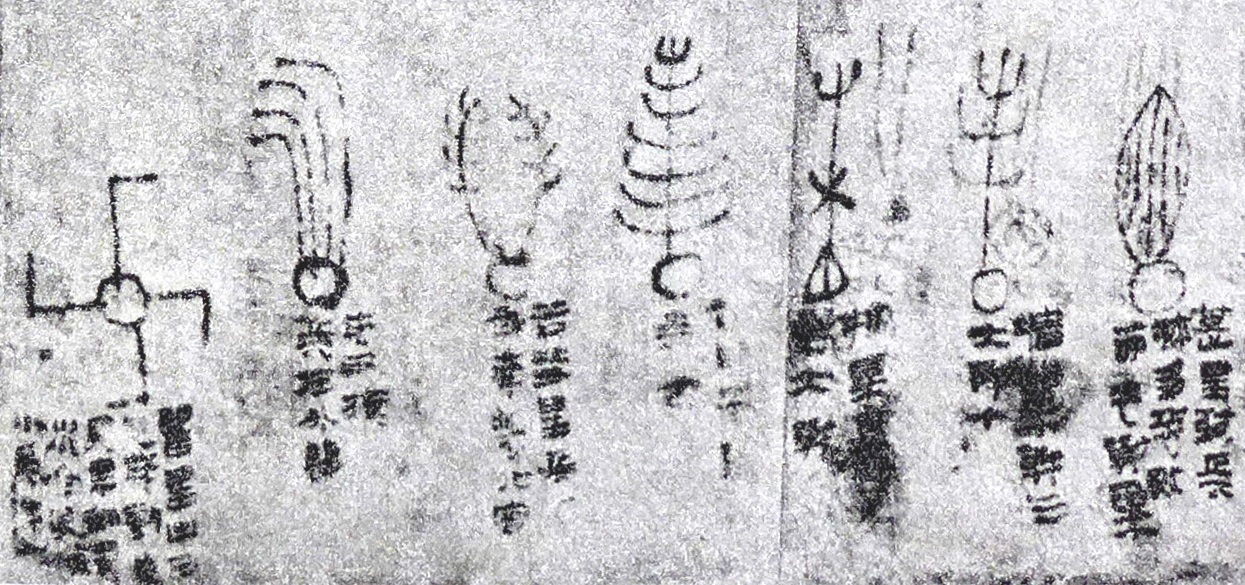
People have noticed comets for thousands of years. A silk manuscript from a Chinese tomb of the 2nd century BCE shows drawings of comets and describes 29 different kinds. Chinese records of comets reach back many centuries.
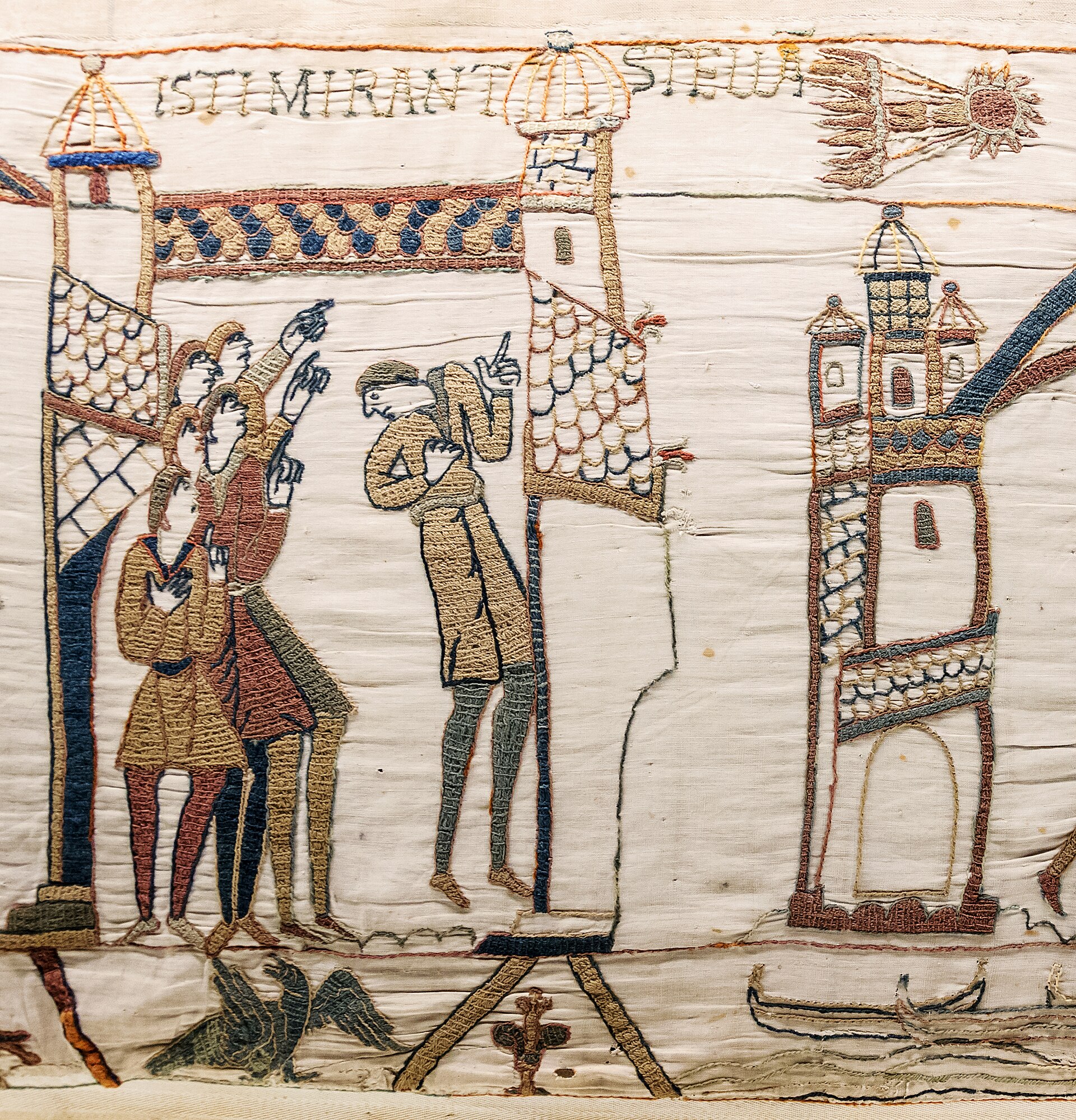
In many places a comet was read as a warning. Most things in the sky seemed to move in steady patterns, so a new light with a long tail looked like a sign that something was wrong. The word comet comes from a Greek phrase meaning "long-haired star". People linked comets to the deaths of kings, wars and disasters. The comet of 1066 is a famous case. We now know it was Halley's Comet. It blazed in the sky before the Battle of Hastings, and the Bayeux Tapestry, an embroidered cloth made soon after, shows people pointing at it in alarm.
Some people also wrote down real details. In India by the 6th century CE, astronomers thought that comets came back again and again. Around 1305 the Italian painter Giotto painted a comet as the Star of Bethlehem in a scene called the Adoration of the Magi. It was probably Halley's Comet, which he could have seen in 1301. His picture was so lifelike that nothing matched it for hundreds of years.
Comets could also not be predicted. Nobody knew when a new one would appear, and that made them seem even more frightening.
Were comets ever really dangerous to us?
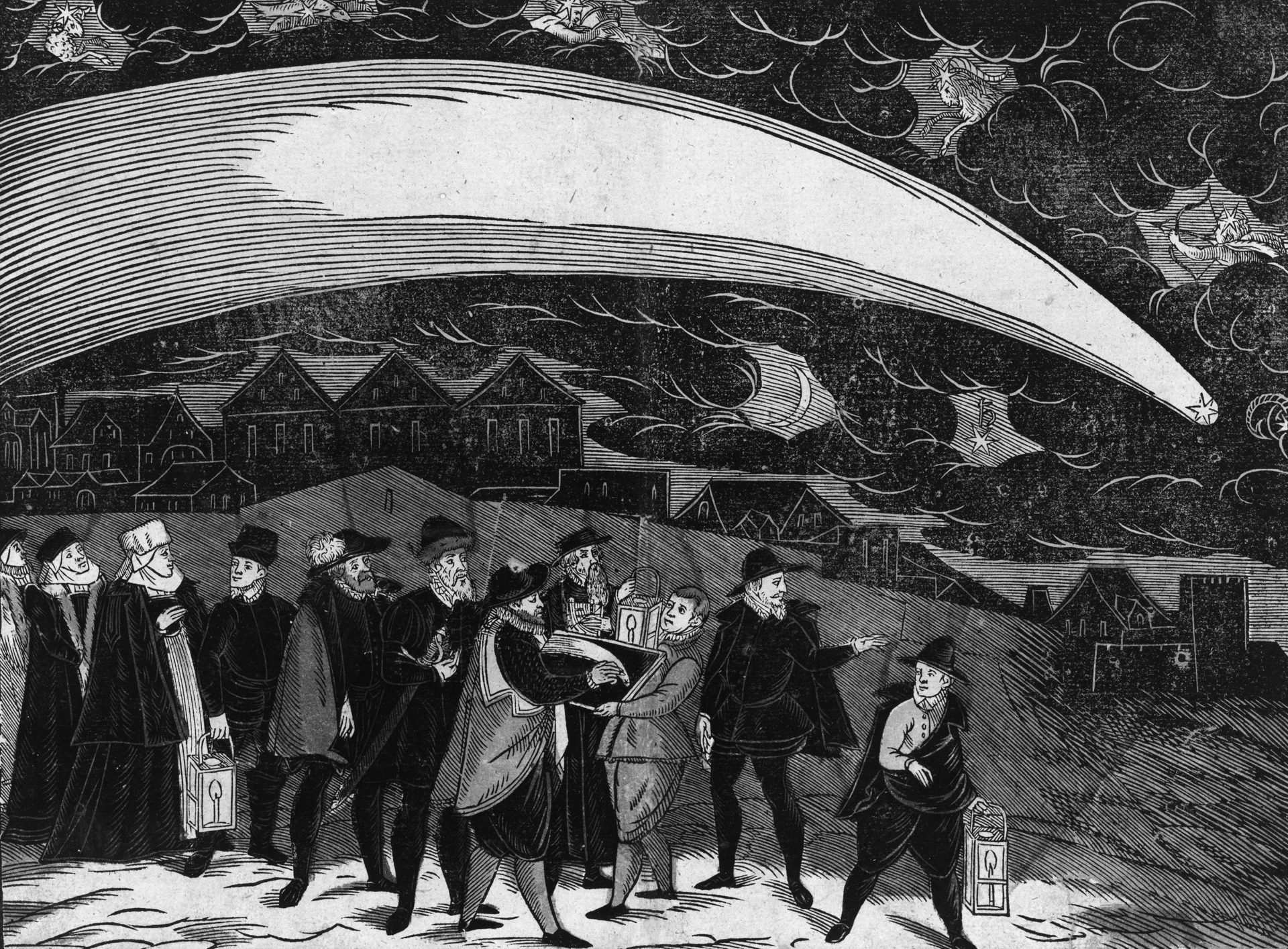
In Europe the fear of comets was strongest between about 1200 and 1650. In 1618 a writer named Gotthard Arthusius published a pamphlet saying that a great comet was a sign that the Day of Judgment was near. He listed ten pages of disasters that comets had supposedly brought, from floods to poor harvests. By 1700 most scholars had decided that such things happened whether a comet was in the sky or not.
The fear came back in a new form. In 1711 William Whiston claimed that the Great Comet of 1680 returns every 574 years and had caused the flood in the Book of Genesis. Comets were no longer only signs of trouble. Now people feared them as direct threats.
In 1910 panic spread again. Scientists had found a poisonous gas called cyanogen in the tail of Halley's Comet, and Earth was due to pass through it. Some people bought gas masks, "anti-comet pills" and even "anti-comet umbrellas". Nothing happened, because a comet's tail is far thinner than the air in the best laboratory vacuum on Earth.
There are real hazards in space, but they are rare. Comets have hit planets. In July 1994 the pieces of Comet Shoemaker-Levy 9 crashed into Jupiter. It was the first time astronomers had watched two objects in the Solar System collide.
How did we find out what comets really are?
For nearly 2,000 years the main idea came from the Greek thinker Aristotle, who lived in the 4th century BCE. He decided that comets were glowing gases high in Earth's air, closer than the Moon. In the 1st century CE the Roman writer Seneca doubted this. He argued that comets move too regularly to be air. He was right, but he could not prove it.
The proof came in 1577. The astronomer Tycho Brahe and others watched the Great Comet from different places and compared where it seemed to sit against the stars. This method is called . The comet hardly shifted, so it had to be far away. It was at least four times more distant than the Moon.
Then Isaac Newton explained how comets move. In 1687 he showed how gravity can guide a comet along a stretched path around the Sun. He tested his method on the comet of 1680.
In 1705 Edmond Halley used Newton's method on 23 comet sightings. He saw that the comets of 1531, 1607 and 1682 followed almost the same path. He decided they were one comet and predicted its return in 1758 or 1759. It came back, and it is now called Halley's Comet. Halley had died by then. Three French mathematicians, including Nicole-Reine Lepaute, refined the date to within a month.
What have spacecraft found at comets?
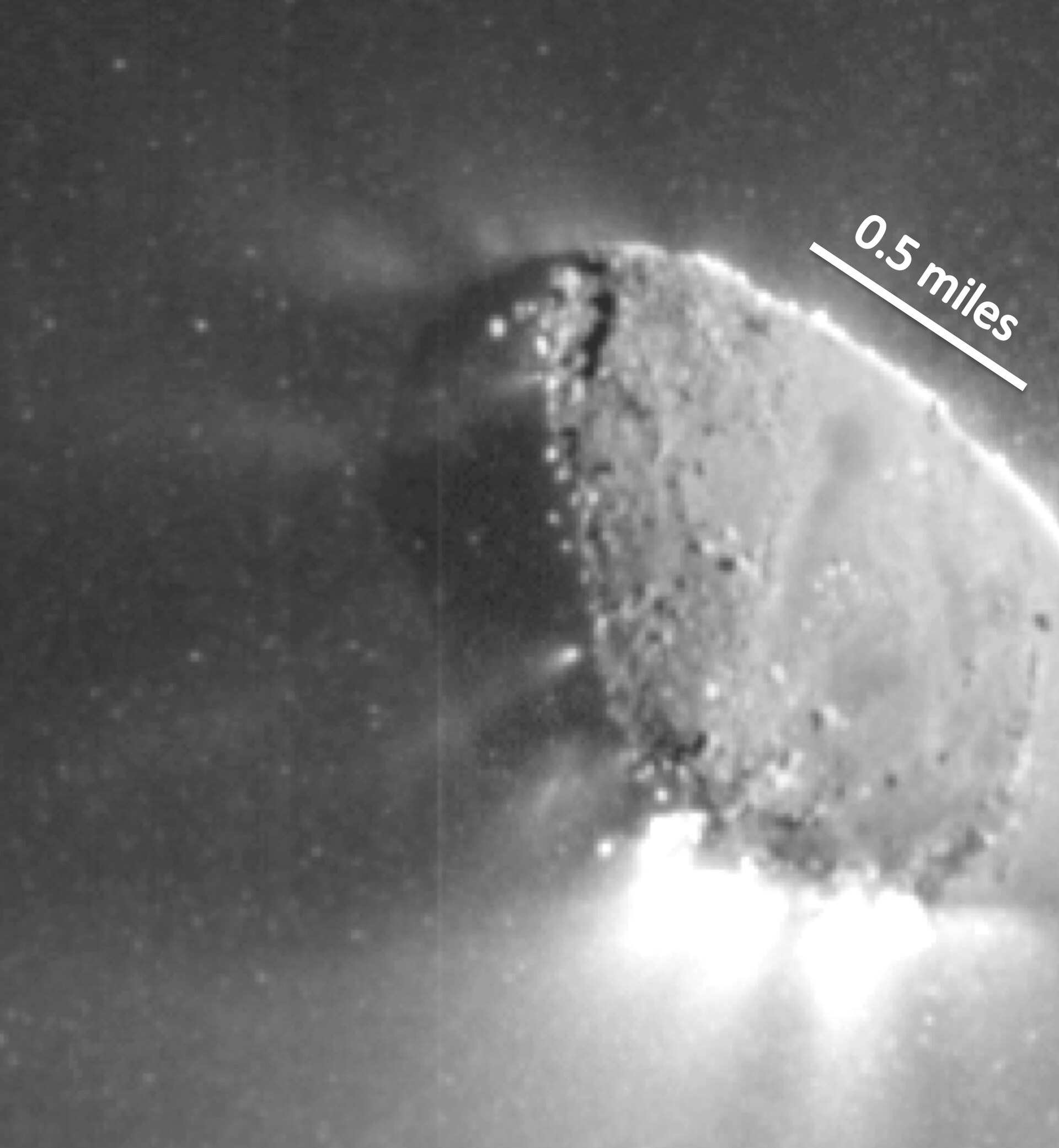
The best way to learn about a comet is to visit one. In 1986 a fleet of spacecraft met Halley's Comet. The European Space Agency's Giotto probe and the Soviet Union's Vega 1 and Vega 2 flew through its . They photographed the and saw jets of gas boiling off it. This helped to confirm Whipple's dirty snowball idea.
In 2005 NASA's Deep Impact spacecraft blasted a crater into Comet Tempel 1 to look at its inside. Most of the ice turned out to lie below the surface, and it feeds the jets. In 2010 the same spacecraft, renamed EPOXI, flew past Comet Hartley 2. It saw jets powered by frozen carbon dioxide, or dry ice, which turns to gas more easily than water ice does. Jets like these can even make a nucleus spin.
NASA's Stardust mission caught dust from Comet Wild 2 and returned it to Earth in 2006. Scientists found glycine in comet dust, an amino acid that living things use to build proteins.
The biggest success was the European Space Agency's Rosetta. It reached Comet 67P/Churyumov-Gerasimenko in 2014 and travelled with it for about two years. Its small lander, Philae, was the first robot to land on a comet. It found at least 16 organic compounds on the surface. Four had never been spotted on a comet before.
The next comet mission is already being built. The European Space Agency's Comet Interceptor is due to launch around the end of 2028. It will wait in space for a comet that is making its first trip towards the Sun, then fly past it with a main spacecraft and two small probes.
What happens to comets in the end?
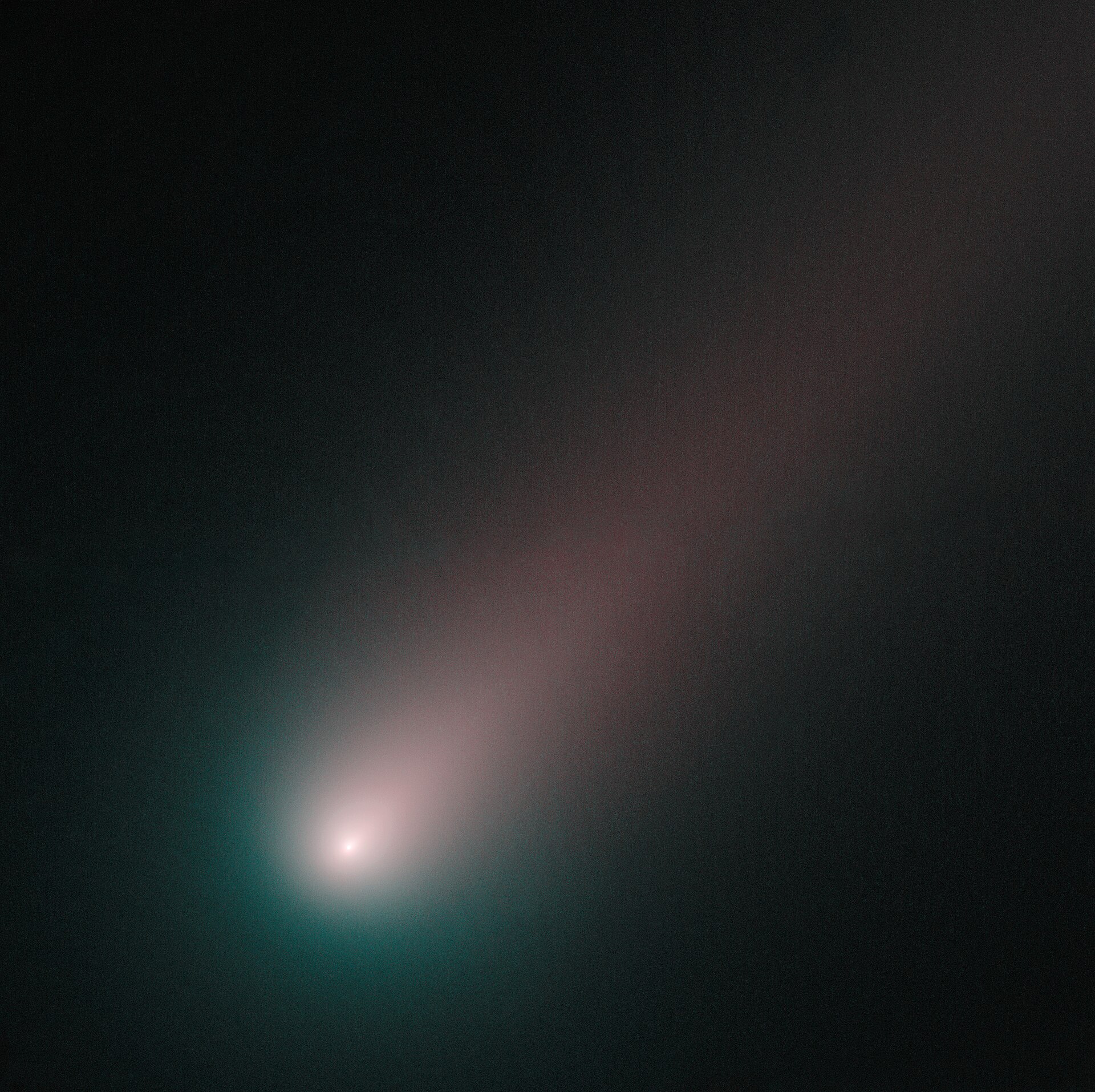
Every trip past the Sun costs a comet some of its ice. Jupiter-family comets stay active for about 10,000 years, or roughly 1,000 . Long-period comets fade faster. Only about 1 in 10 survives more than 50 close passes. Eventually the ice is used up. The comet becomes a dark, dry lump of rock that looks like an asteroid. About 6 percent of the asteroids that come near Earth are thought to be dead comets.
Some comets break apart. Their nuclei can be fragile, and heat, gas pressure or a close pass by a planet may split them. Biela's Comet split in two in 1846. Later the pieces vanished, and spectacular appeared in 1872 and 1885 where the comet should have been. Comet ISON fell apart in 2013 as it rounded the Sun.
Comets also leave gifts behind. A comet sheds dust and grit along its orbit. When Earth crosses this trail, the grains burn up in our air as shooting stars. The Perseid meteor shower each August comes from Comet Swift-Tuttle. Halley's Comet causes the Orionids each October.
Comets may have shaped our world too. Some scientists think that comets that hit the young Earth about 4 billion years ago brought part of its water. Others doubt it. Comets may also have delivered chemicals that helped life begin. This is still an open question.
Explore Next
Your audio story keeps playing while you look around.
Words to Know
- coma
- The huge, thin cloud of gas and dust that surrounds a comet's nucleus.
- Kuiper belt
- A ring of icy bodies beyond the orbit of Neptune.
- meteor shower
- Many shooting stars at once, made when Earth crosses a trail of comet dust.
- nucleus
- The solid core of a comet, made of ice, dust and rock.
- Oort cloud
- A huge sphere of icy bodies thought to surround the Solar System.
- orbit
- The path an object takes around another object.
- outgassing
- The release of gas from a comet as sunlight warms its ice.
- parallax
- The way an object seems to shift against the background when you view it from two places.
- solar wind
- A stream of charged particles that blows out from the Sun.
- sublimation
- When a solid turns straight into a gas without becoming a liquid first.