Solar System
One star, eight planets and a vast crowd of smaller worlds, all held together by gravity.

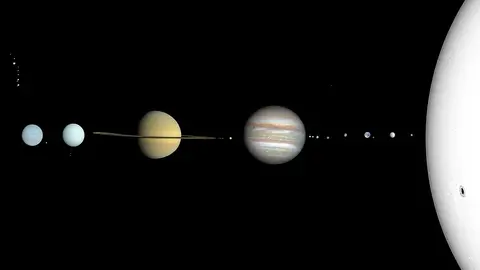
The Solar System is our home in space. It is made up of the Sun and everything that travels around it, held in place by the Sun's gravity. That includes 8 planets, at least 9 dwarf planets, hundreds of moons, millions of asteroids and countless comets. The Sun is so heavy that it holds more than 99.8% of all the mass in the whole system. Everything else is a tiny leftover. The Solar System began about 4.6 billion years ago as a collapsing cloud of gas and dust. Its story explains why Earth is rocky, why Jupiter is huge and why comets have tails.
What is in the Solar System?
At the centre sits the Sun, a star. Everything else is bound to it by , the pull that every object with mass has on other objects. The word "solar" comes from Sol, the Latin name for the Sun.
The most massive things that the Sun are the 8 planets. The four closest are small and rocky: Mercury, Venus, Earth and Mars. Scientists call them the , from the Latin word for land. Further out are four giants. Jupiter and Saturn are made mostly of hydrogen and helium gas. Uranus and Neptune hold large amounts of water, methane and ammonia that are frozen or squeezed into a thick liquid. Astronomers call these ices because of their low melting points.
Then come the smaller bodies. There are such as Ceres and Pluto. There are moons, which orbit planets and some dwarf planets. There are , which are rocky and metallic, and , which are icy. Between them all drifts a thin haze of dust and charged particles.
All of this has a surprising shape. Most of it lies close to one flat sheet, like marbles rolling on a tray. Almost every planet also travels around the Sun in the same direction, which is anticlockwise when seen from above Earth's north pole.
How did the Solar System form?
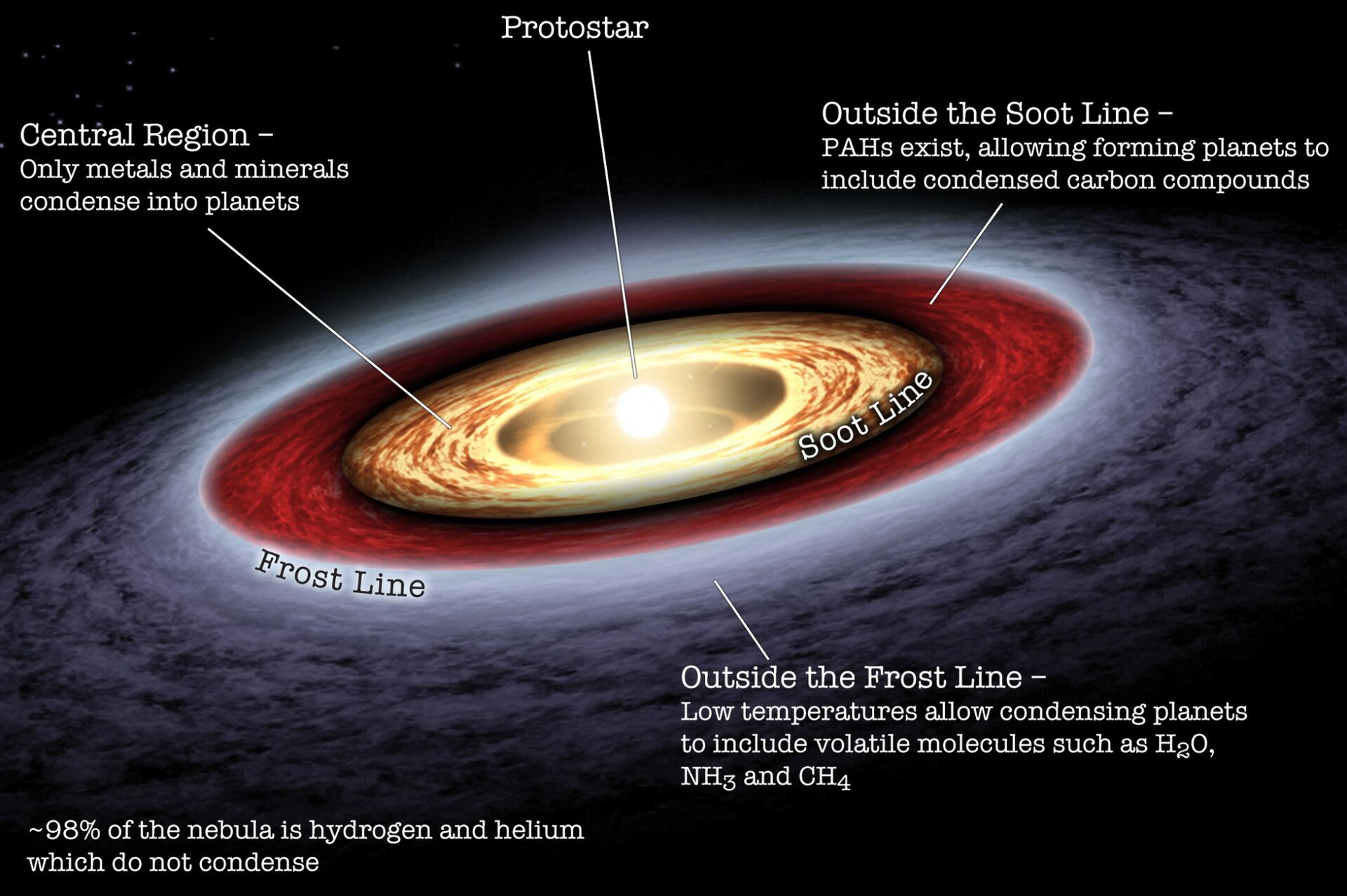
About 4.6 billion years ago, part of a huge cloud of gas and dust began to collapse under its own . The cloud was mostly hydrogen, with some helium and small amounts of heavier elements made by stars that had lived and died earlier.
As the cloud fell inwards, it spun faster, in the way a skater spins faster when they pull their arms in. The spin flattened it into a disc. Most of the material gathered in the middle and became very hot and dense. This was the young Sun.
The planets grew in the disc. Dust and gas stuck together and pulled in more material, making larger and larger lumps. Scientists call this accretion. Close to the Sun it was too hot for ices to survive. Only rock and metal could stay solid, and there was not much of either, so the inner planets stayed small. Beyond a boundary called the , at about 5 times Earth's distance from the Sun, ice could form too. There was far more of it, so the outer planets grew huge and trapped thick layers of hydrogen and helium.
Within about 50 million years the Sun's centre became hot enough for hydrogen fusion to begin. The Sun's wind then blew the leftover gas and dust out into space. Later, the giant planets probably shifted their , flinging many small bodies about.
The Sun: the engine of everything
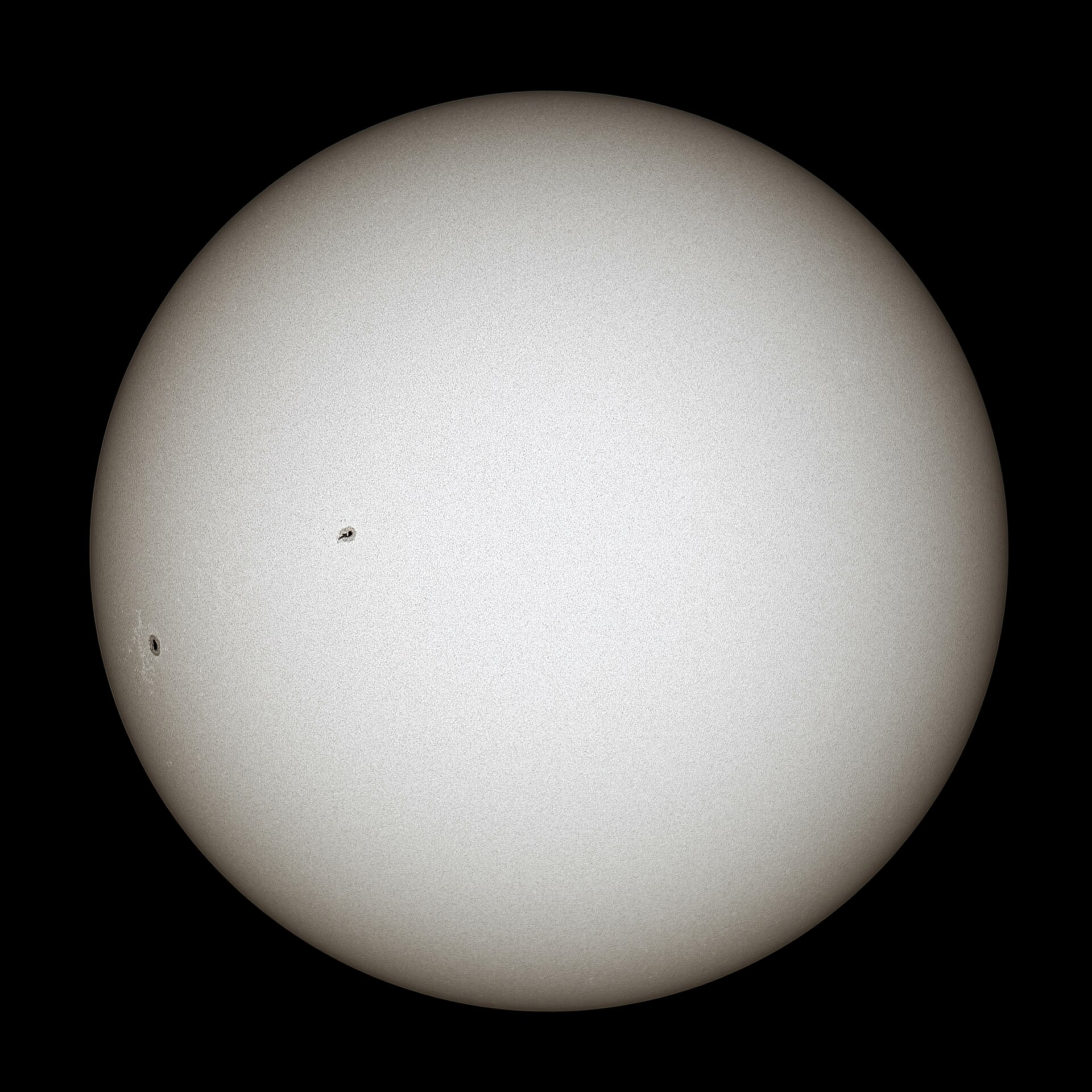
The Sun is a star, and it dwarfs everything around it. It holds about 332,900 times the mass of Earth. That is why the planets circle the Sun and not the other way round.
The Sun shines because of nuclear fusion. In its core the temperature and pressure are so high that hydrogen atoms are forced together to make helium. Each time this happens, a little energy is released. Added up over trillions of reactions, it is enough to light and warm the whole Solar System. Most of the energy leaves as light, and it peaks in the colours we can see.
Astronomers call the Sun a G2 main-sequence star. That means it is in the steady, long middle part of a star's life. It is brighter and hotter than most stars in our galaxy. About three-quarters of the stars that fuse hydrogen in the Milky Way are cooler, dimmer red dwarfs.
The Sun also sends out a constant stream of charged particles called the . This wind fills space around the planets and carves out a huge bubble called the . Sudden bursts such as solar flares can disturb it. When charged particles from the Sun reach Earth, our magnetic field guides them towards the poles. There they make glowing lights called aurorae.
Why are the inner planets rocky?
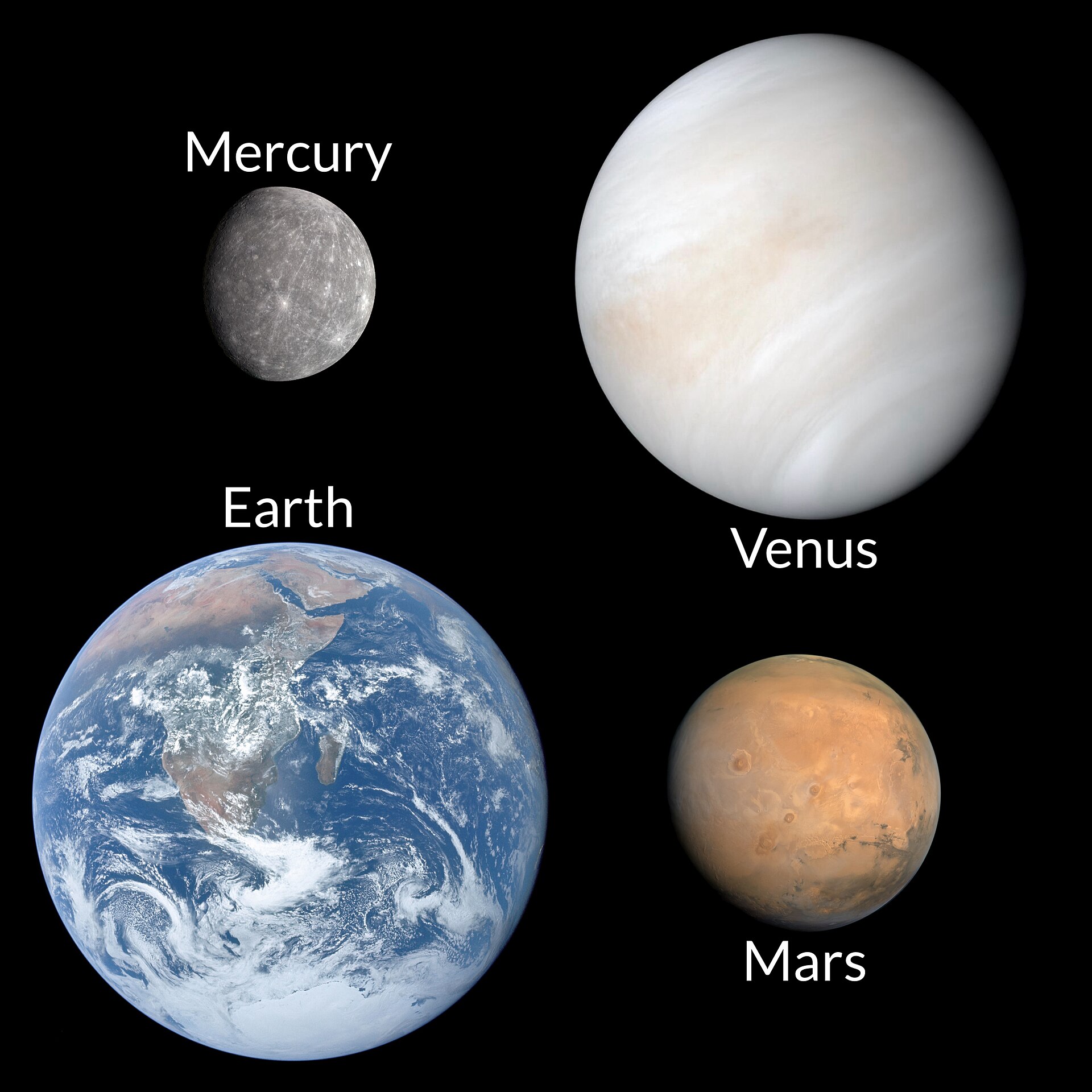
The four inner planets are solid balls of rock with metal cores. They formed where it was too warm for ice, so they are made of silicates, which are rocky minerals, and metals such as iron and nickel. All four have impact craters, volcanoes or rift valleys, and the marks of crust that has moved and cracked.
Mercury is the smallest planet and the closest to the Sun. Its surface is grey and cratered. Daytime is scorching and nights are freezing, because it has almost no air to hold in heat.
Venus is wrapped in a thick, bright atmosphere of carbon dioxide. At the surface the air pressure is about 92 times that on Earth. Trapped heat, a greenhouse effect, makes it hotter than any other planet.
Earth is the only place we know that has life and liquid water on its surface. Its air is 78% nitrogen and 21% oxygen, and the oxygen comes from living things. Our magnetic field shields the surface from harmful particles. Earth has one large moon, whose width is about a quarter of Earth's.
Mars is about half Earth's width. Iron oxide, or rust, in the soil makes it red. It has ice caps, huge volcanoes, deep canyons and a thin carbon dioxide atmosphere. Its two small moons, Phobos and Deimos, are lumpy and cratered.
What is the asteroid belt?
Between the of Mars and Jupiter lies a wide ring of rocky leftovers called the belt. It is sparse in practice. There are tens of thousands of asteroids wider than 1 kilometre, and possibly millions. Yet all of them together weigh less than a thousandth of Earth. The gaps between them are so large that spacecraft cross the belt regularly without trouble.
Why did these rocks never join up into a planet? Scientists think the answer is Jupiter. Its powerful kept stirring the region and stopped the pieces from gathering together.
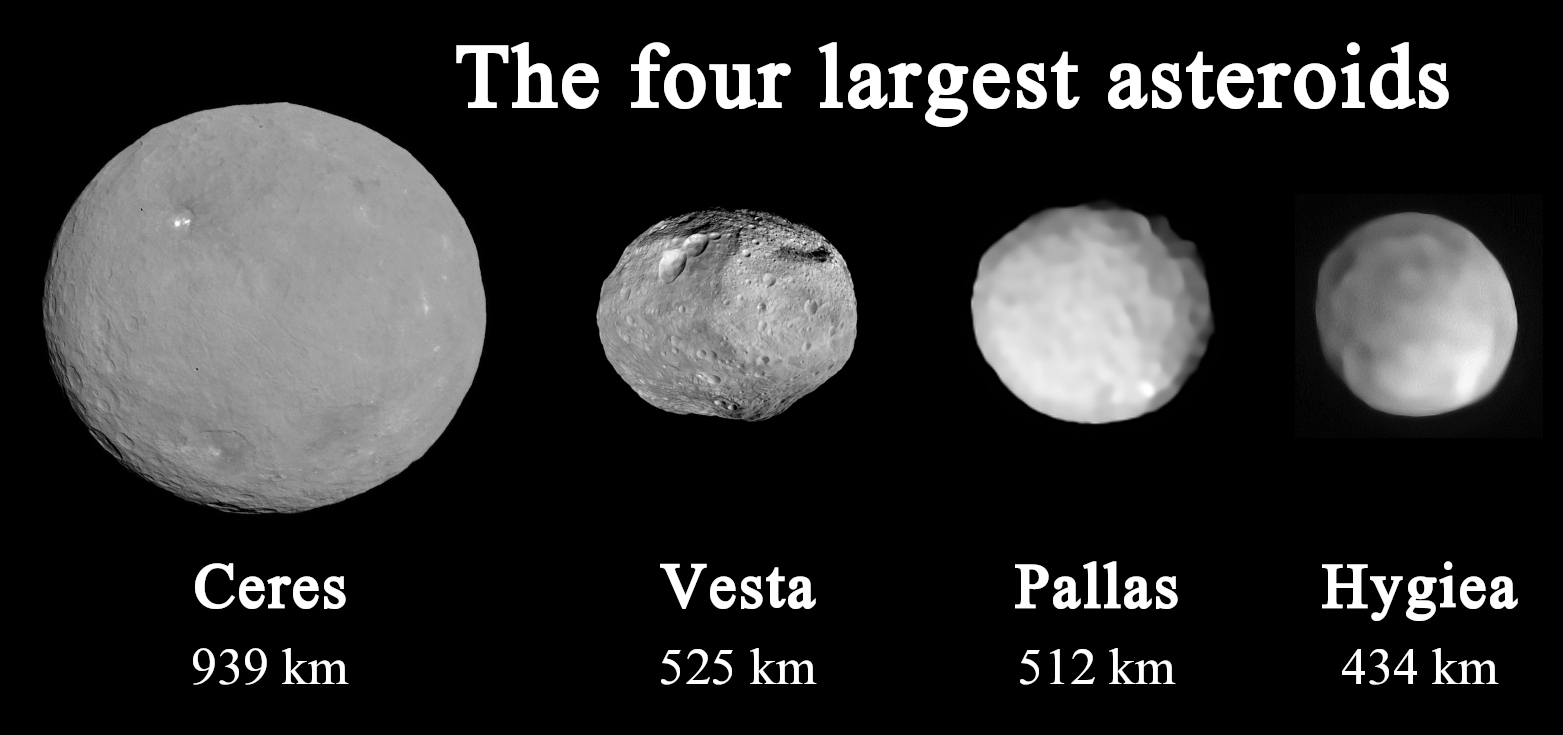
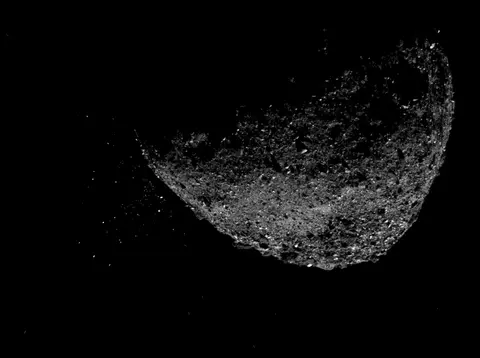
Asteroids are mostly rock and metal, with some ice. They range from a few metres to hundreds of kilometres across. The largest, Ceres, is about 939 kilometres wide. It is classed as a and holds a mix of carbon, frozen water and clay-like minerals. Next in size are Vesta, Pallas and Hygiea. Vesta has two giant craters. Pieces blasted from Vesta have fallen to Earth as meteorites, so we can hold bits of it in our hands. Of these four, only Ceres and Vesta have been visited by spacecraft.
Not all asteroids stay in the belt. Some have orbits that cross those of Mars, Venus or Earth. Over 37,000 near-Earth asteroids are known, and astronomers track them to check for any that might hit us in future. Some asteroids also share Jupiter's orbit and are called Trojans.
What are the giant planets like?
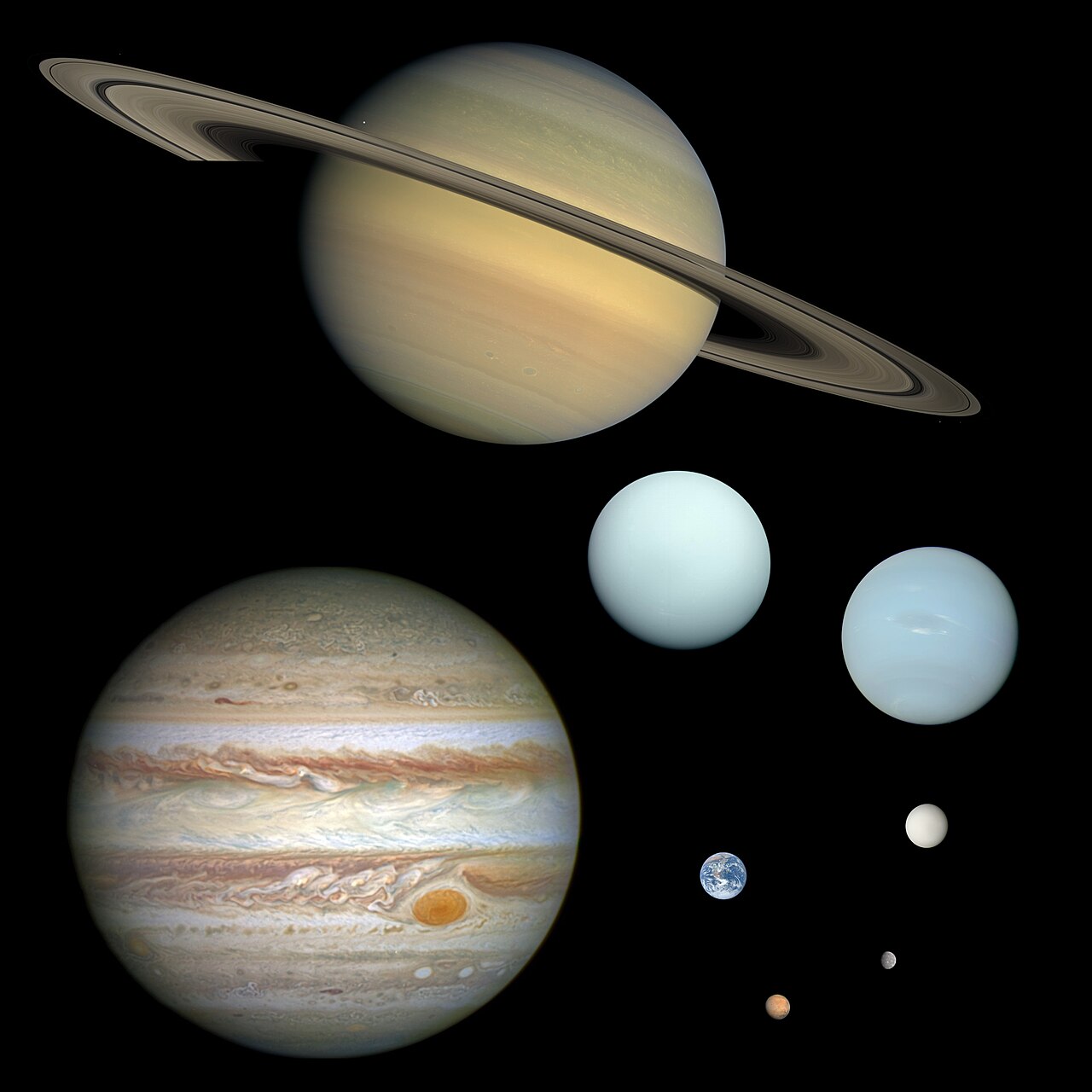
Beyond the belt lie the four giant planets. Together they hold 99% of the mass that the Sun. All four have many moons and rings, though only Saturn's rings are easy to see from Earth.
Jupiter is the biggest planet. Its orange-brown and white cloud bands are pushed around by fast winds, and the Great Red Spot is a storm that has lasted for centuries. Jupiter has 97 confirmed moons. Its four biggest, Io, Europa, Ganymede and Callisto, are large enough to be worlds in their own right.
Saturn is famous for its bright rings, which are made of small pieces of ice and rock. It has 274 confirmed moons. Titan is the only moon in the Solar System with a thick atmosphere. At each of Saturn's poles there is a six-sided storm wider than Earth.
Uranus spins on its side, so its poles take turns pointing at the Sun. This gives it extreme seasons. Neptune is the farthest planet known. It has dark storms and strong winds. Its largest moon, Triton, travels in the opposite direction to the planet's spin, and nitrogen geysers erupt on its surface.
Uranus and Neptune are called . Jupiter and Saturn are . They are made of the same light gases as the Sun, which is why they grew so large.
What lies beyond Neptune?
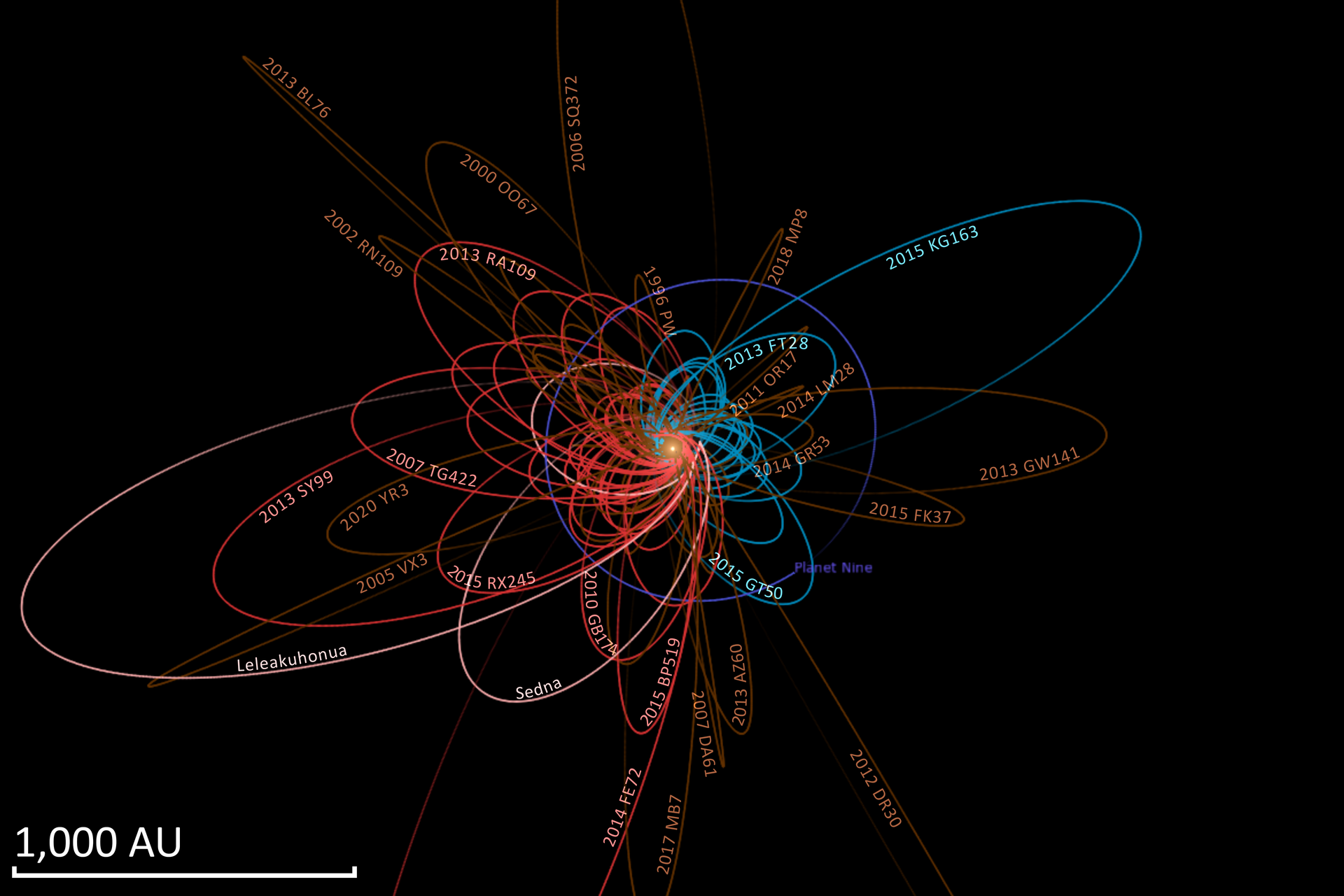
Past Neptune is a dark, cold and mostly unexplored region full of small icy worlds. The nearest part is the Kuiper belt, a doughnut-shaped ring of icy bodies between 30 and 50 times Earth's distance from the Sun. It is like the belt, but much bigger and made of ice. There may be over 100,000 objects wider than 100 kilometres, yet their total mass is only a fraction of Earth's.
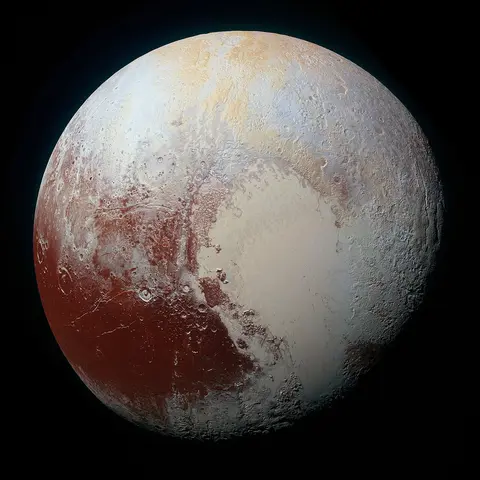
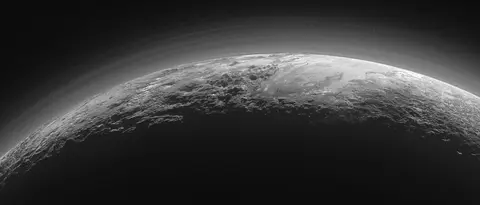
Pluto is the best known. It was once called the ninth planet. When Eris was found in 2005 and turned out to be about as wide as Pluto and more massive, astronomers had to decide what a planet really is. They created the class of . Pluto has five moons. The biggest, Charon, is so large that the two bodies circle a point in space between them. Haumea spins so fast that it is stretched like an egg. Makemake was discovered in 2005 as well.
Farther out is the scattered disc, whose icy objects were flung into stretched by Neptune's . Eris lives there. Still farther is Sedna, which takes about 11,400 years to orbit the Sun once.
At last the Sun's influence fades. The slows and stops where it meets the thin gas between the stars. This edge is called the heliopause, and it marks the start of interstellar space. Beyond it, a theorised sphere of icy bodies called the Oort cloud is thought to supply long-period .
Comets, meteors and dust: what are they?
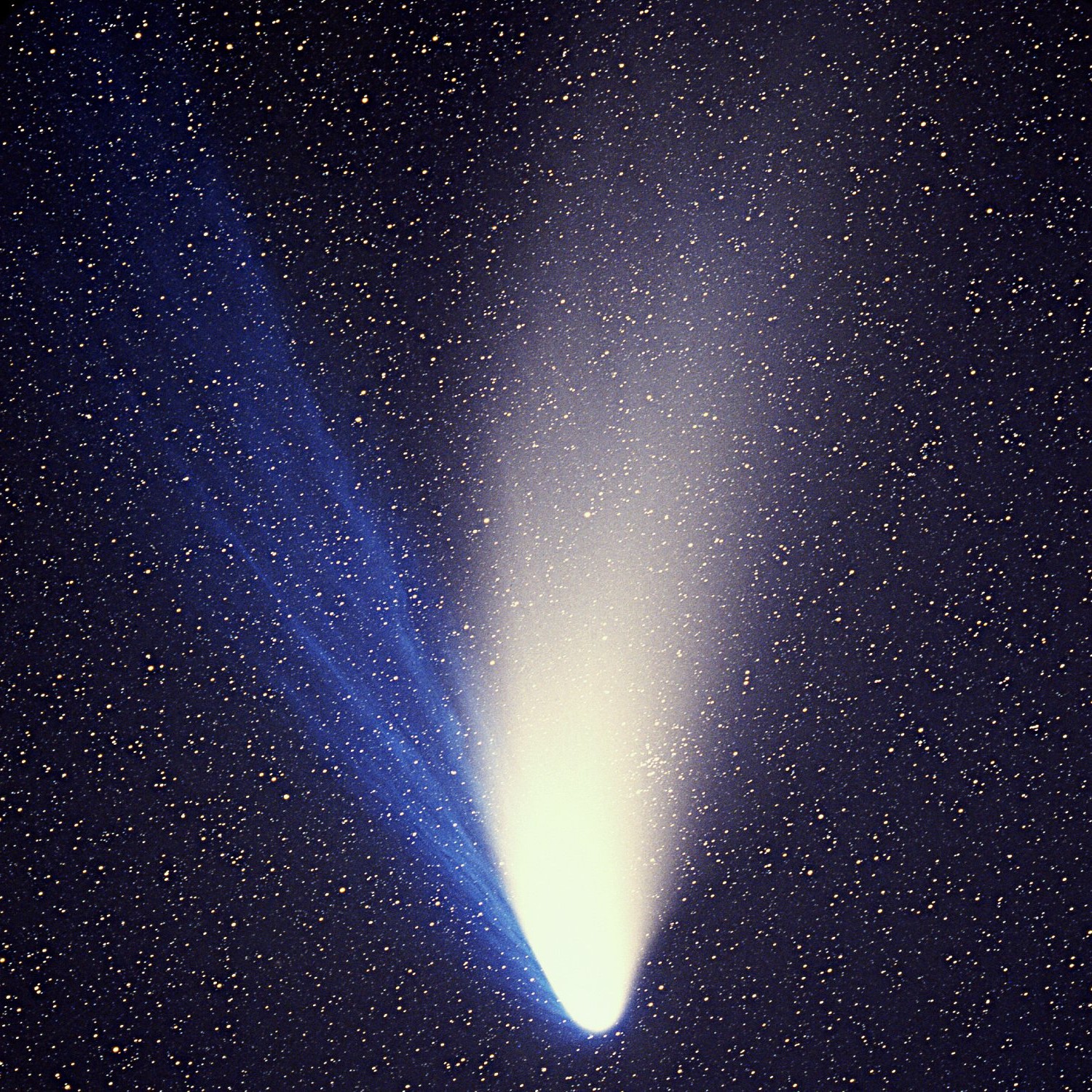
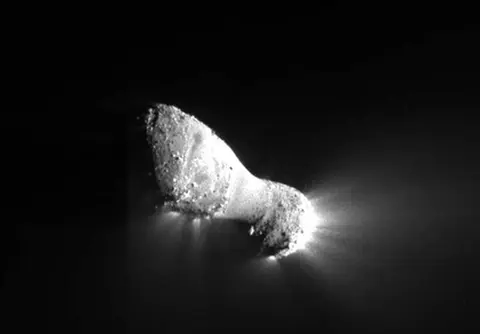
are small bodies of ice, dust and rock, usually only a few kilometres across. Their are very stretched. A comet may spend most of its time far beyond Pluto and then swing in close to the Sun.
When it gets near the Sun, the heat turns its ice straight into gas. The gas and dust stream away to form a glowing cloud called a coma and long tails that can be seen from Earth. A comet's tail always points away from the Sun, pushed by sunlight and the . Comet Hale-Bopp, which was easy to see in 1997, had a bright white dust tail and a blue gas tail.
Short-period comets take less than 200 years to go around the Sun and are thought to come from the Kuiper belt and the scattered disc. Long-period comets take thousands of years. They are thought to come from the Oort cloud. Old comets that have lost their ice can look much like .
Smaller pieces of debris are called meteoroids. When one hits Earth's atmosphere, it burns up and makes a streak of light called a meteor, or shooting star. Meteor showers happen when Earth passes through a trail of dust left by a comet. Tiny dust grains also spread through the whole Solar System.
What will happen to the Solar System?
For now the Solar System is steady. The planets have followed nearly circular for billions of years. Scientists have worked out their paths using the laws of motion found by Johannes Kepler and Isaac Newton and with computer models. These models show the system is still slightly chaotic over very long times, so tiny changes could add up. There is a small chance that a passing star could disturb it in the next few billion years.
The Sun is about halfway through its life as a main-sequence star. Its hydrogen fuel will last about 5 billion more years. As helium builds up in the core, the Sun slowly gets brighter. When the hydrogen in its core runs out, the Sun will swell into a red giant about 250 times wider than it is today. It will probably swallow Mercury and Venus, and Earth and Mars will become far too hot for life.
Eventually the Sun will throw off its outer layers into space. They may form a glowing shell called a planetary nebula. What remains will be a white dwarf, about half the Sun's present mass but only as big as Earth.
The material the Sun returns to space, enriched with elements such as carbon, can become part of new stars and planets. That is how the Solar System itself began.
Explore Next
Your audio story keeps playing while you look around.
Words to Know
- asteroid
- A rocky or metallic body that orbits the Sun and is smaller than a planet.
- astronomical unit
- The average distance from Earth to the Sun, used to measure distances in the Solar System.
- comet
- An icy body that grows a glowing tail when it comes close to the Sun.
- dwarf planet
- A round world that orbits the Sun but has not cleared other objects from its path.
- frost line
- The distance from the Sun beyond which ices can stay solid.
- gas giant
- A huge planet made mostly of hydrogen and helium, such as Jupiter or Saturn.
- gravity
- The pull that objects with mass have on each other.
- heliosphere
- The huge bubble of space shaped by the solar wind.
- ice giant
- A giant planet rich in water, methane and ammonia, such as Uranus or Neptune.
- orbit
- The curved path one object takes around another because of gravity.
- solar wind
- A steady stream of charged particles flowing out from the Sun.
- terrestrial planet
- A small, rocky planet such as Mercury, Venus, Earth or Mars.