Amphibian
Frogs, toads, salamanders and caecilians, animals that live two lives.
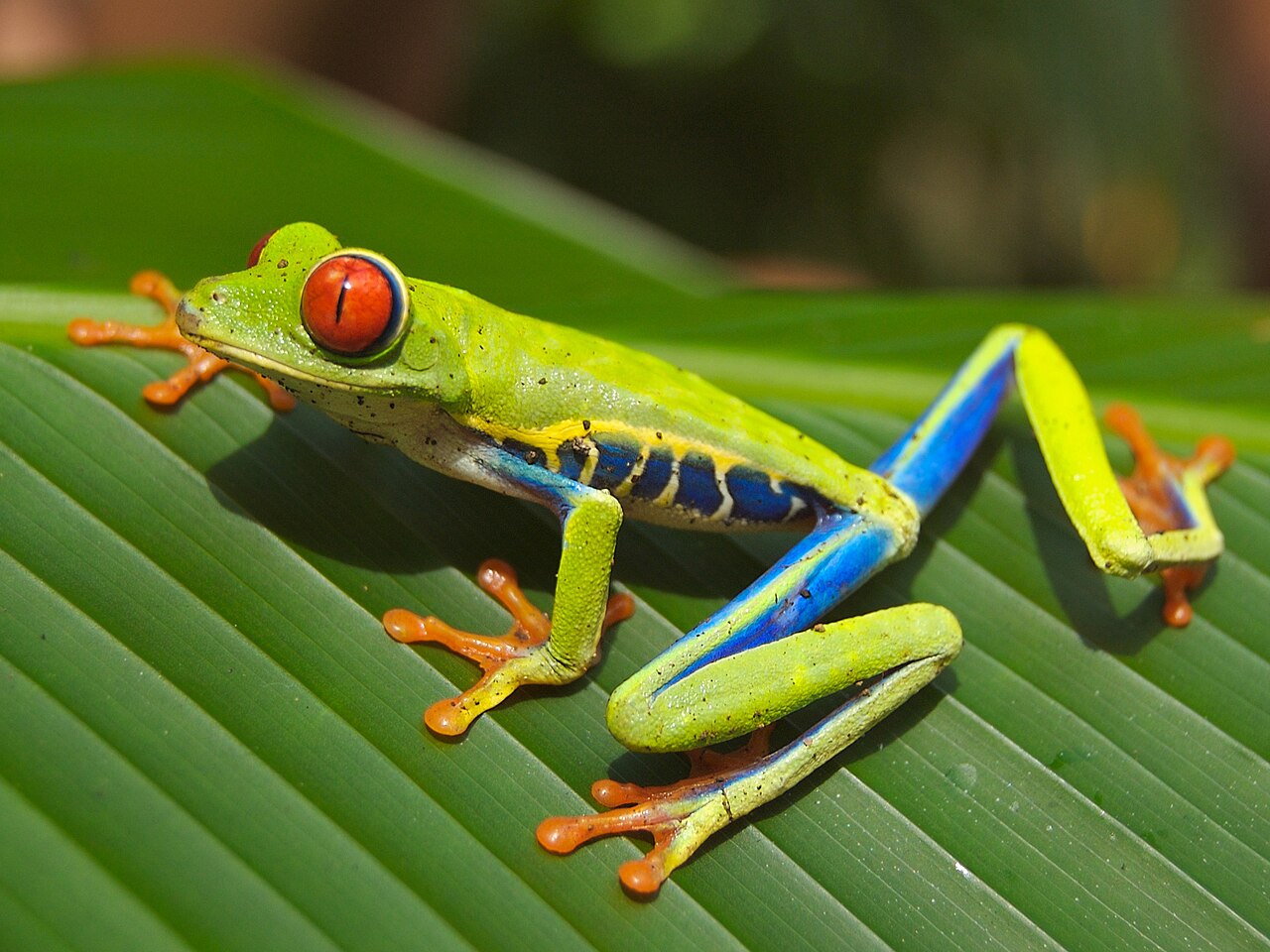
Amphibians begin life in water and many move onto land as adults. The word comes from Greek and means "both kinds of life". Frogs, toads, salamanders, newts and the worm-like caecilians all belong to the group. They have thin, damp skin that can take in oxygen, and most must return to water to breed. That makes them very sensitive to changes in their surroundings. Amphibians also have a long history. Their ancestors were among the first backboned animals to crawl out of the water, more than 360 million years ago.
What is an amphibian?
An is a cold-blooded vertebrate with four limbs, or one that descended from such an animal. Its body temperature changes with its surroundings, so it does not need as much food as a bird or mammal of the same size. Most amphibians have smooth, moist skin with no scales or feathers.
The word amphibian comes from Greek and means "both kinds of life". It was once used for any animal that could live on land and in water, even seals and otters. Today it has a narrower meaning. Amphibians usually start life as larvae with gills, called in frogs and toads. They grow and change shape in a process called . The adult breathes air with lungs and its skin.
Amphibians look a little like lizards, but they are very different. Reptiles, birds and mammals lay or carry eggs with protective membranes, so they can breed away from water. Amphibian eggs have no such covering and dry out easily. Most amphibians must therefore find water, or at least very damp places, to breed. None live in the open sea, though a few live in salty marshes.
There are three living groups. Frogs and toads are called anurans, a word meaning "without a tail". Salamanders and newts are called caudates, from the Latin for "tail". are called gymnophiones, which means "naked snakes".
The total is about 9,000 species, and the great majority are frogs.
What is the difference between frogs and toads?
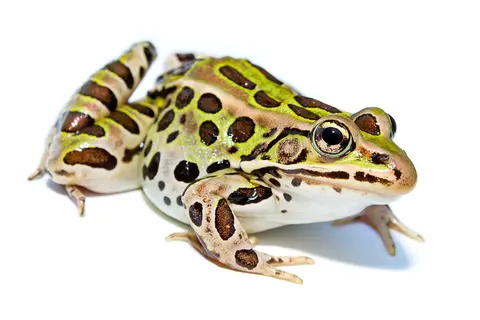
Frogs and toads make up nearly 90 per cent of all , with almost 8,000 kinds. They live on every continent except Antarctica. An adult has no tail, long hind legs that fold under the body, shorter front legs, big eyes and webbed toes without claws.
People call smooth-skinned ones frogs and warty-skinned ones toads. This is only a loose rule and scientists do not use it formally. There are many exceptions. The "true toads" form one family, called the Bufonidae.
Frogs show a huge range of sizes and lifestyles. The goliath frog of West Africa grows up to about 32 cm and weighs around 3 kg. At the other end, the Brazilian flea toad is only about 7 mm long, smaller than a pea. A 2024 study measured 46 of them and crowned it the smallest known vertebrate. A New Guinea frog, at 7.7 mm, held the record before it.
Most frogs live near water. Some have specialised: tree frogs have sticky toe pads for climbing. Burrowing frogs have hard bumps on their hind feet for digging. Desert frogs spend most of the year buried, then come out after heavy rain to breed. Other frogs live high in trees and never visit a pond.
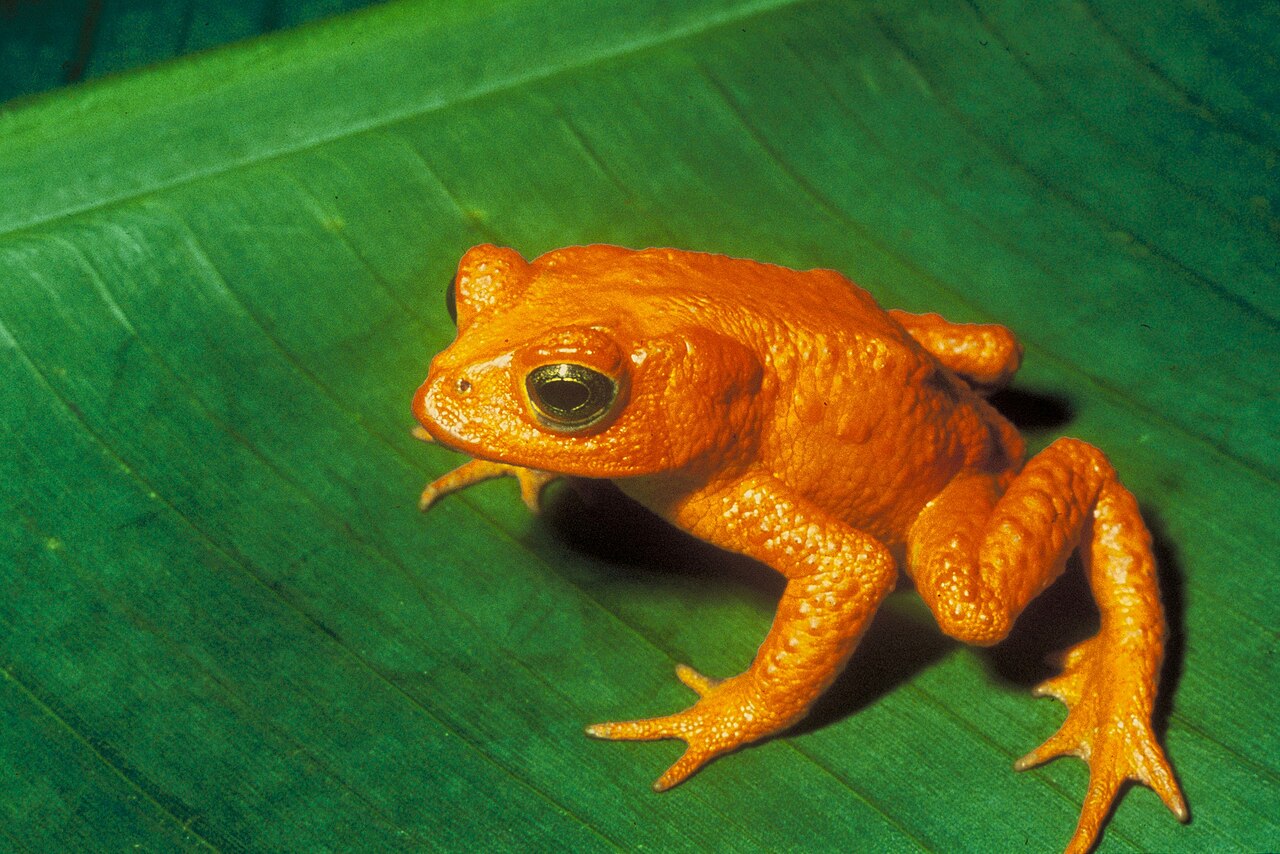
Some frogs are brightly coloured. Red, yellow or orange skin often warns hunters that the frog tastes bad or is poisonous. The golden toad of Costa Rica was bright orange. It was last seen in 1989 and is now believed to be extinct.
What are salamanders and caecilians?
Salamanders have long, low bodies, four short legs and a tail. They look like lizards, but they are not closely related to them. Their skin has no scales and no claws. Their tails are often flattened from side to side. Most are shorter than 15 cm. The smallest, a Mexican species called Thorius pennatulus, seldom grows beyond 20 mm. The biggest is the Chinese giant salamander, reported up to 1.8 m. Since 2018, studies have shown that it is really a group of at least three species.
Most salamanders live in the Northern Hemisphere. They hide under stones, logs and leaves by day and come out at night to hunt worms, insects and other small animals. About 60 per cent of all salamander species are lungless salamanders, which breathe only through their skin and the lining of their mouths. Newts are salamanders that belong to one subfamily.
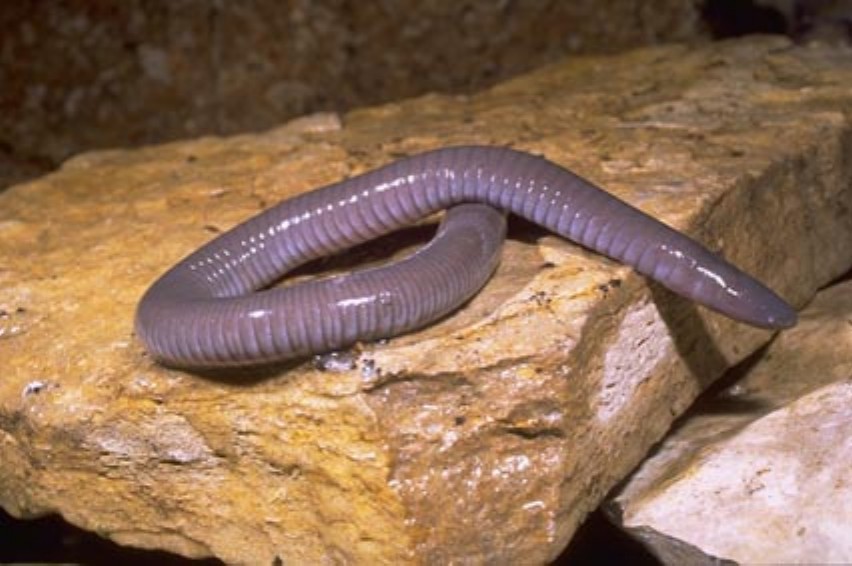
are the least known . They are long, thin and limbless, like worms or snakes. Most are 8 to 75 cm long, and Thomson's caecilian can reach 150 cm. Their eyes are tiny and covered with skin, so they can probably only tell light from dark. A short tentacle near each eye helps them touch and smell.
Most caecilians burrow in damp soil. Some live in water. Many lay eggs underground, and a few give birth to live young that feed on a milk-like fluid inside the mother. Caecilians live mainly in the warm tropics and have more than 230 species.
How do amphibians breathe and move?
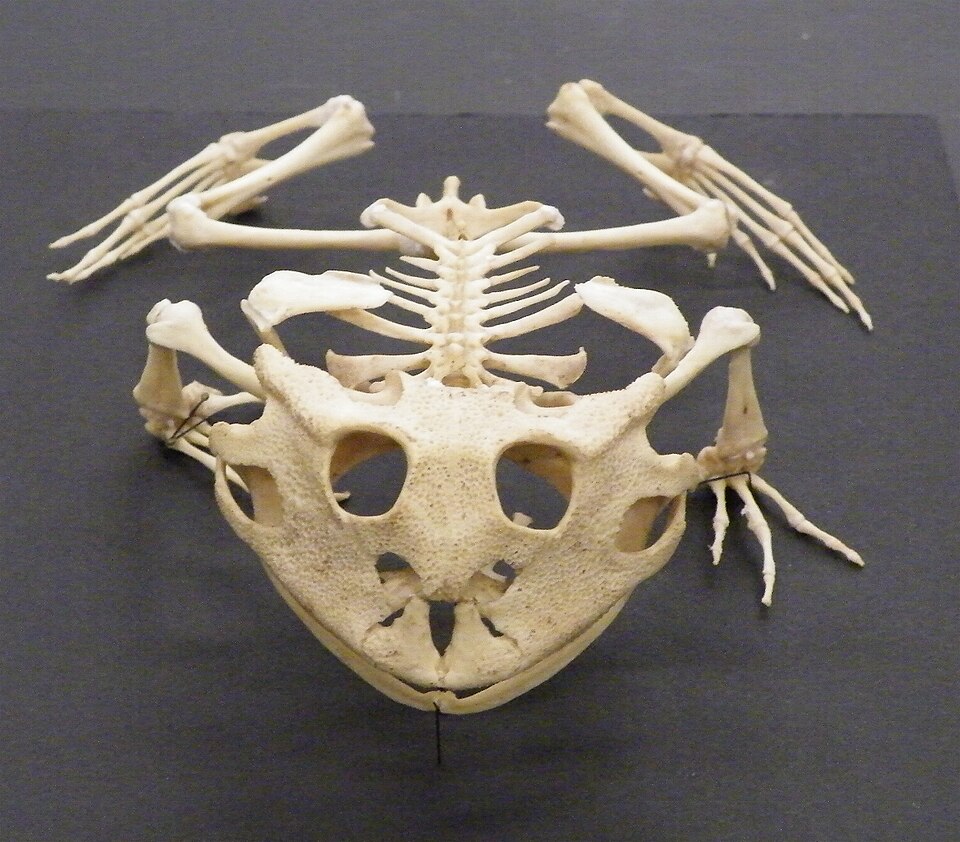
skin is thin and damp, and gases and water pass through it easily. Adults breathe with lungs and also through the skin, a process called . Because of this, they can stay underwater for a long time, and some even spend winter at the bottom of a pond. A few small salamanders have no lungs at all and breathe entirely through their skin. The skin must always stay wet for oxygen to pass through, which is why most amphibians live in damp places.
Thin skin dries out easily and is easily hurt. To protect it, amphibians have mucus glands that keep it moist. Many also have glands that make a nasty or poisonous liquid. Some toxins can kill a human, while others do little. The big bumps behind a toad's eyes are poison glands called parotoids.
Frog skin gets its colour from three layers of pigment cells, which make black, blue-green and yellow. Colour changes happen slowly, because hormones control them rather than nerves.
Amphibian hearts have three chambers, two atria and one ventricle. A frog's strong hind legs are for jumping and swimming. Salamanders walk, with their legs sticking out sideways, and swing their tails. burrow like earthworms, with waves of muscle running along the body.
Frogs have a large round eardrum behind each eye, and no outer ear. Many frogs call loudly to find a mate.
How do amphibians find a mate?
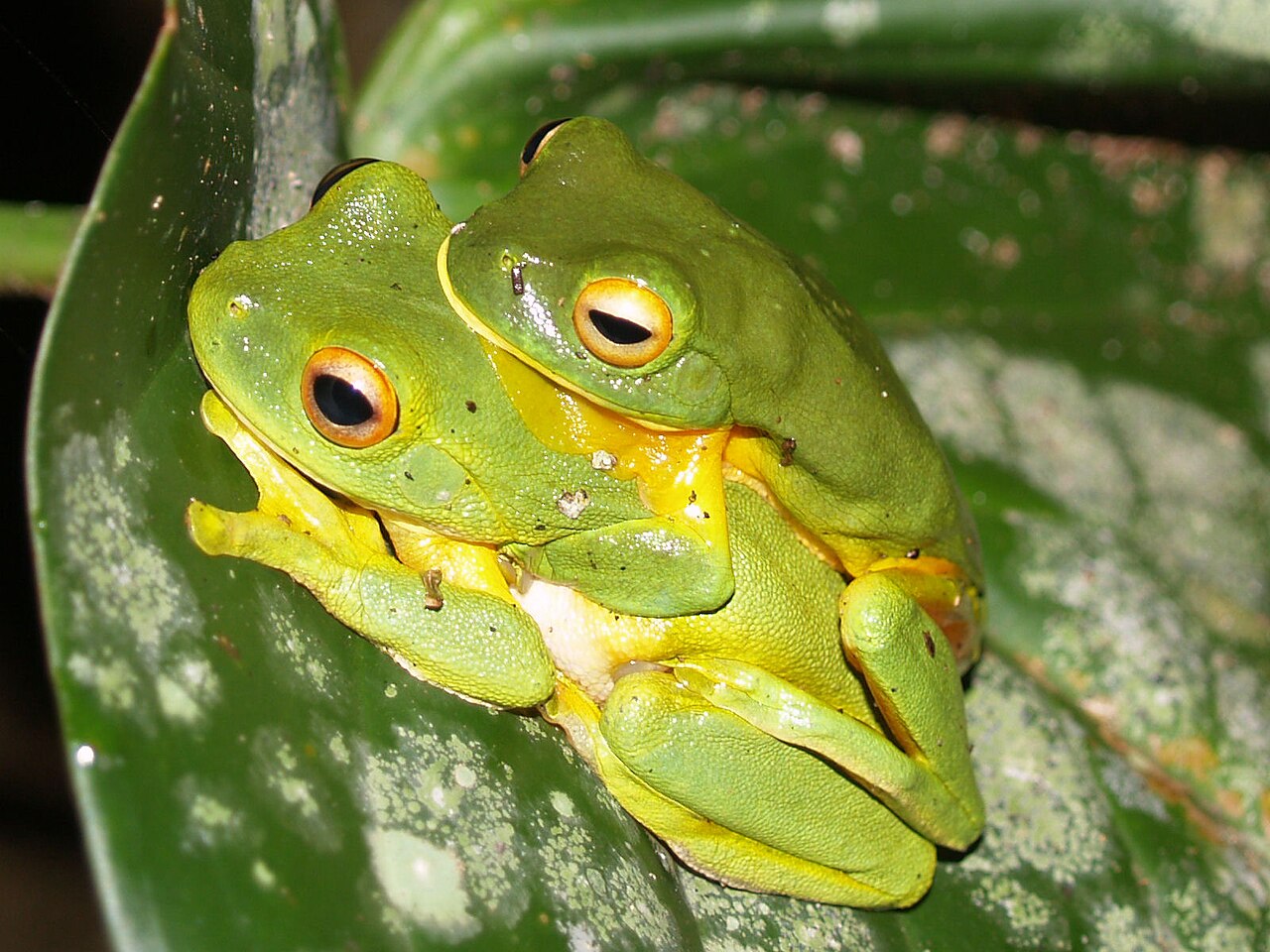
In many places, breed in spring, triggered by longer days, warmer weather or rain. In the tropics, many breed all year. In dry regions the trigger is often a big storm.
Male frogs call to attract females. Each species has its own call, and males gather at ponds and sing in a chorus. Some frogs are prolonged breeders. Their males set up territories and stay for weeks while females come and go. Other frogs, called explosive breeders, live in dry lands. They burrow underground and appear after heavy rain, when a temporary pool forms. They crowd into it and mate in a frenzy that lasts only a night or two.
Most frogs use external fertilisation. The male climbs onto the female's back and clasps her, a hold called . When she lays her eggs, he covers them with sperm. Rough pads on his hands help him grip.
Salamanders and newts have courtship dances. Most males leave a small packet of sperm, called a spermatophore, and the female picks it up. Males compete to impress the female, so their displays can be elaborate. A few salamander groups, including the giant salamanders, lay eggs in water and the male covers them with sperm.
The tailed frog of North America has internal fertilisation, using a tail-like organ. This stops sperm being washed away in the fast streams where it lives.
How does a tadpole turn into a frog?

A typical frog starts as a jelly-coated egg in water. Inside, the embryo floats in fluid and the yolk feeds it. The eggs hatch into larvae with external gills. Frog larvae are called . A tadpole has a tail with fins, a lateral line sense organ like a fish's, and horny ridges instead of teeth. It eats mostly plants. Its heart has two chambers and sends blood in a single loop through the gills, as in a fish.
Then comes . Hormones, mainly one called thyroxine, trigger the change. Over days or weeks the animal grows back legs, then front legs. The gills are replaced by lungs, and the gut gets shorter as the diet turns to meat. The eyes get eyelids, and the heart gains a third chamber. The tail and the other larval organs shrink and are absorbed by the body, in a process of controlled cell death called apoptosis. A young froglet then hops out of the water.
Salamander larvae look more like small adults from the start, with feathery gills and a finned tail. Their legs appear gradually.
Not all follow this plan. Several hundred frogs, many in tropical rainforests, do not need water to breed. Their eggs hatch directly into tiny froglets, and the tadpole stage takes place inside the egg. This is called direct development. Some and some salamanders also develop inside the egg.
Which amphibians have strange tricks?
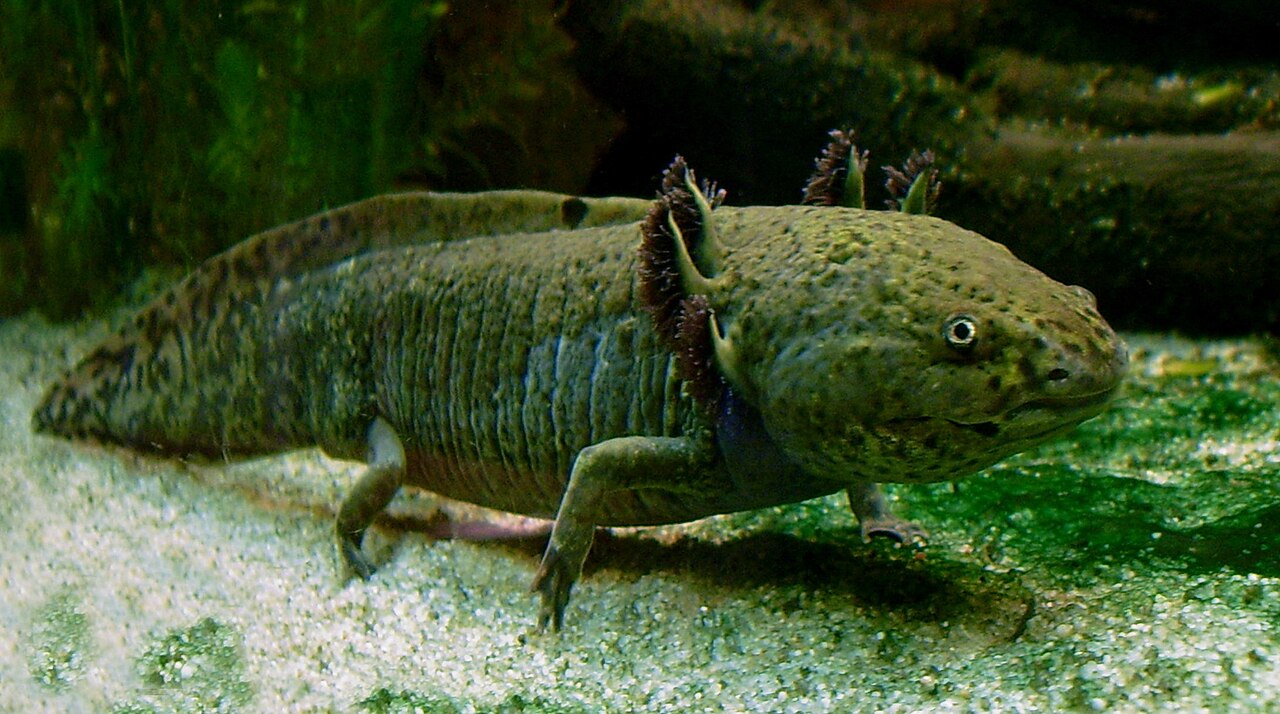
Some salamanders never fully grow up. The axolotl of Mexico keeps its feathery external gills and stays in the water all its life, yet it can breed. Biologists call this , which means keeping young features as an adult. Giant salamanders also keep some young features, such as gill slits and eyes without lids.
Many salamanders can drop their tails when attacked. This is called autotomy. The detached tail twitches and may distract a hunter while the salamander escapes. Salamanders can grow tails and limbs back. Adult frogs cannot regrow limbs, but can.
Poison is another trick. Bright such as poison frogs advertise their toxins. Others hide a warning. The fire-bellied toad flips over to show its bright underside when threatened.
In the Great Lakes area of North America lives a group of all-female mole salamanders. Their line has lasted about 5 million years, the oldest known of its kind among vertebrates. Sometimes they take genes from males of other species.
Many amphibians eat their own shed skin. Frogs swallow prey whole. They flick out a sticky tongue, then blink hard, and the eyeballs press down to push the food along the throat. Some desert frogs spend months underground in a resting state called aestivation, and wait for the rain.
Where did amphibians come from?
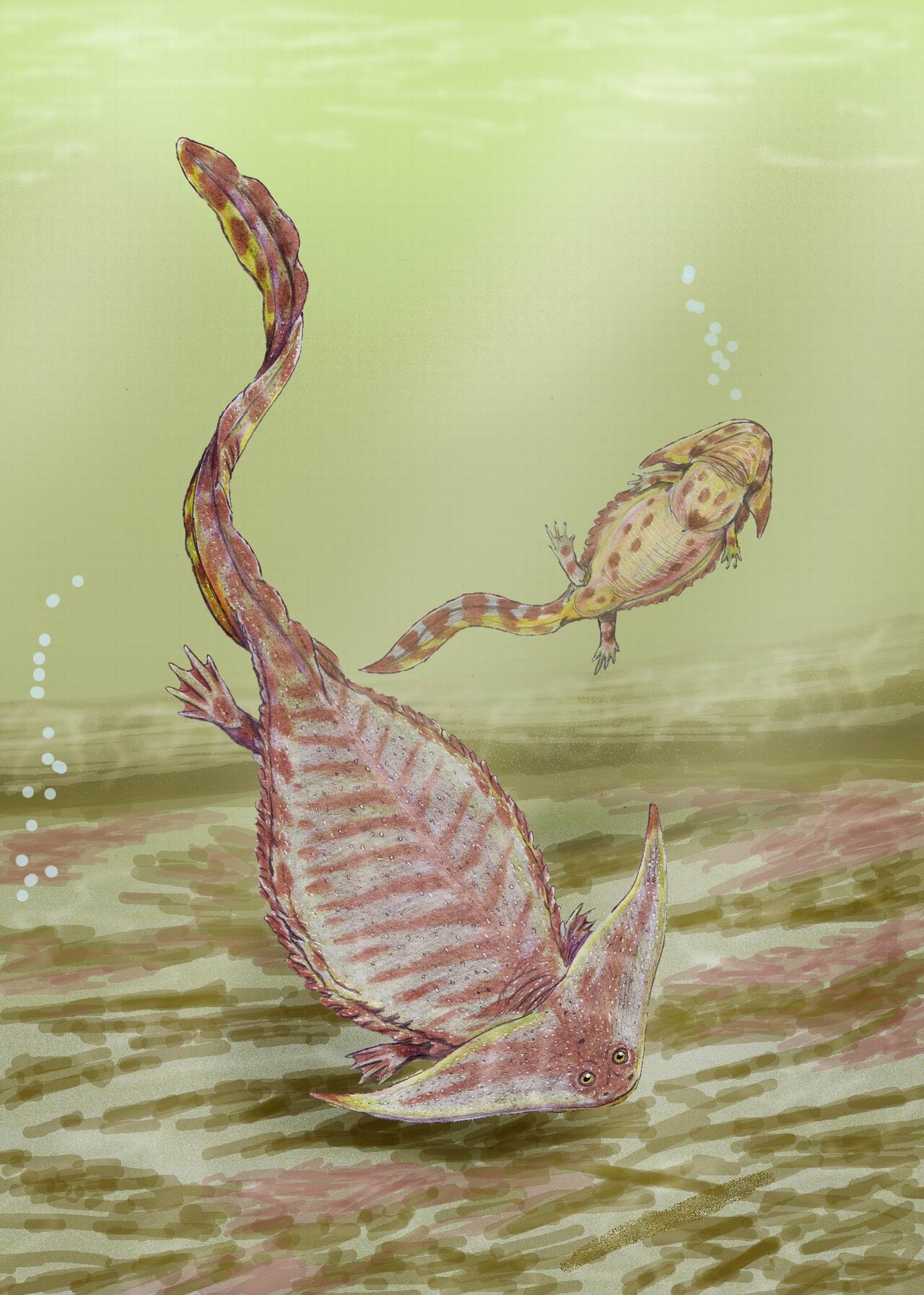
The first -like animals evolved about 370 million years ago, in the Devonian period. Their ancestors were lobe-finned fish, relatives of today's lungfish and coelacanth. These fish had bony, jointed fins and simple lungs. The lungs helped them breathe in stagnant swamps that were low in oxygen.
Over millions of years the fins turned into legs. Ichthyostega, one of the first four-legged animals, had four sturdy limbs, a neck and a tail with a fin. Its skull still looked much like a fish's. A bone behind the gills of a fish became the stapes, a tiny bone in the ear that lets land animals hear.
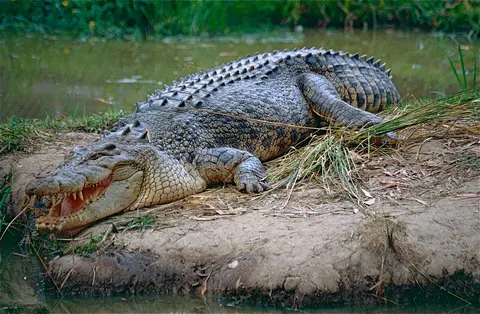
Amphibians ruled the land in the Carboniferous period, about 360 to 300 million years ago. The land had warm, wet swamps full of ferns and horsetails. At first there were no other four-legged animals. Amphibians were top predators, and some were several metres long. In many places they filled the roles that crocodiles hold today. A Brazilian giant called Prionosuchus lived in the Permian, about 270 million years ago. It looked like a crocodile and may have reached 9 m.
Then reptiles took over. Their eggs could survive on dry land, so they could roam far from water. The huge Permian-Triassic extinction, about 252 million years ago, hit amphibians hard.
Modern amphibians appeared in the Triassic period. The oldest known true frog, Prosalirus, lived in Arizona in the Early Jurassic.
Why are amphibians disappearing?
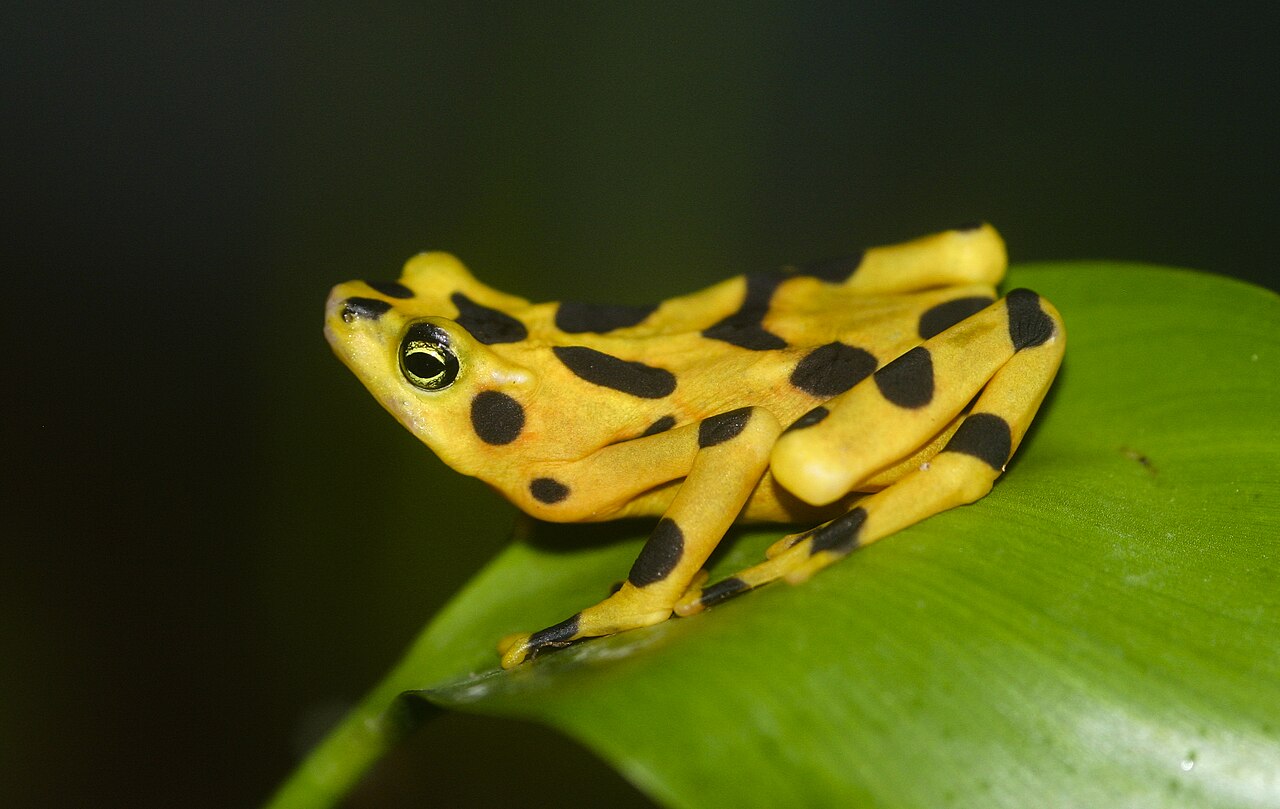
are one of the most threatened groups of animals. Many species have declined sharply in recent decades, and some have vanished. Scientists call amphibians indicator species. Their thin skins and double lives in water and on land make them quick to react to harm in the environment.
There are several causes. The biggest is habitat loss. Ponds are drained, forests are cleared and streams are polluted. Climate change shifts rainfall and temperature, which upsets breeding. Invasive species, such as fish put into ponds, eat . Chemicals can poison animals through their skin.
Disease has made the problem worse. A fungus called chytrid, Batrachochytrium dendrobatidis, infects the skin and stops it working. It was identified in 1998. A 2019 study in the journal Science found that it has driven at least 500 kinds of amphibian into decline over the past 50 years. About 90 of them are presumed extinct. A second , Batrachochytrium salamandrivorans or Bsal, was found in 2013 after it devastated fire salamanders in the Netherlands. It attacks salamanders and newts.
An international assessment published in 2023 found that around 41 per cent of amphibian species are threatened with extinction. That is more than for mammals or birds.
Some people are working to save species. Zoos run breeding programmes, and scientists clean up ponds and protect wetlands. Ordinary people can help too, by building garden ponds and keeping them free of fish. Because amphibians are so sensitive, their health is a useful early warning for everything else that lives in the same places.
Explore Next
Your audio story keeps playing while you look around.
Words to Know
- amphibian
- A cold-blooded vertebrate that usually starts life in water and breathes with lungs and skin as an adult.
- amplexus
- The hold that a male frog uses to clasp a female while she lays eggs.
- caecilian
- A limbless, burrowing, worm-like amphibian.
- chytrid fungus
- A skin disease of amphibians that has caused many declines.
- cutaneous respiration
- Breathing through the skin.
- ectothermic
- Having a body temperature that depends on the surroundings, often called cold-blooded.
- larva
- A young animal that looks very different from its adult form.
- metamorphosis
- A big change in body shape as an animal grows up.
- paedomorphosis
- Keeping young features, such as gills, in adult life.
- tadpole
- The water-living larva of a frog or toad.