Camouflage
How animals, and people, hide in plain sight or fool the eye.
Camouflage is any way of hiding something or making it look like something else. A leopard's spotted coat does it. So does a soldier's uniform and the leaf-shaped wings of a katydid. Some animals blend into their background, some copy twigs or leaves, and some are see-through. A few change colour in a heartbeat. Others make themselves easy to see but hard to catch. Camouflage is one of the clearest examples of natural selection at work, because animals that hide well survive and have more young. People have learned from nature too, in wars, in hunting and even in the design of mobile phone masts.
How do animals blend into their background?
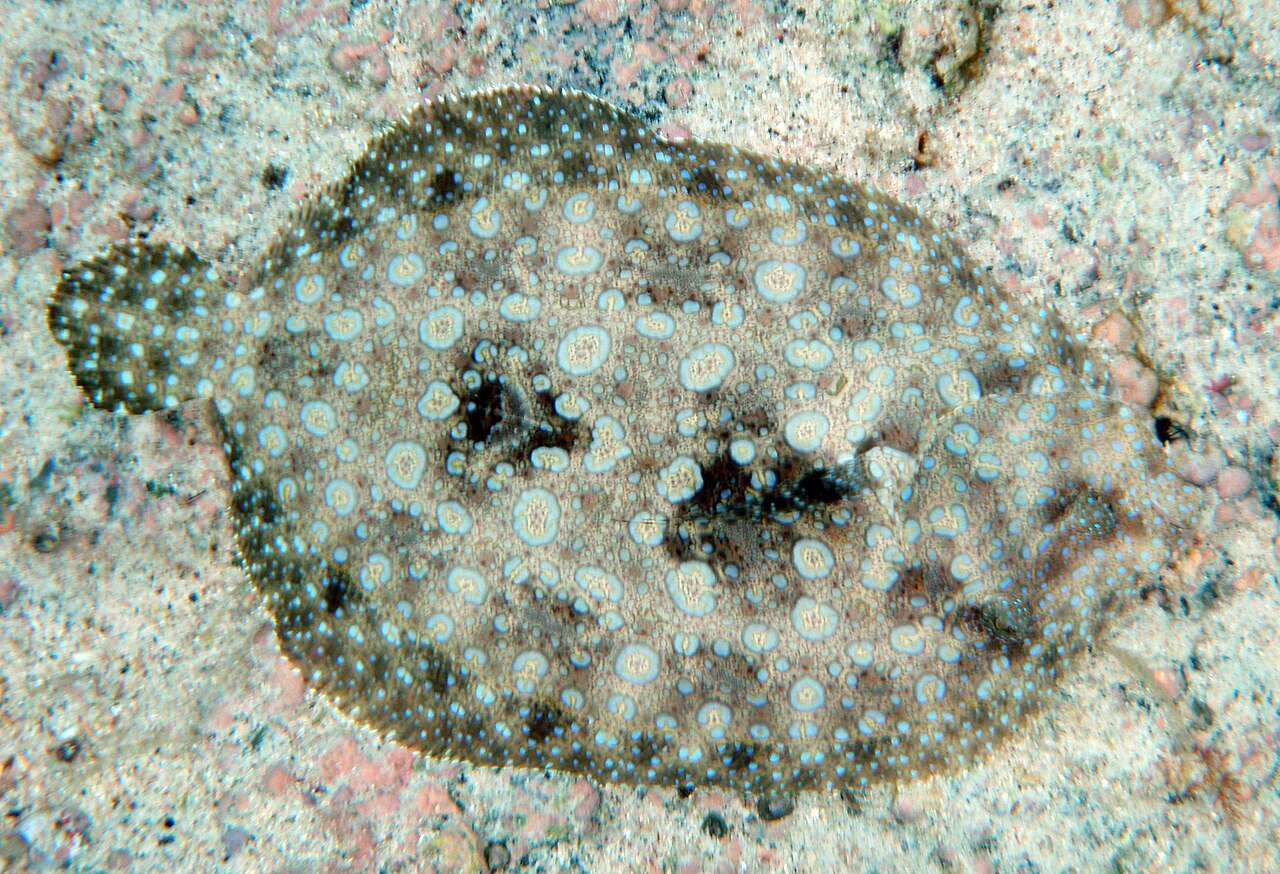
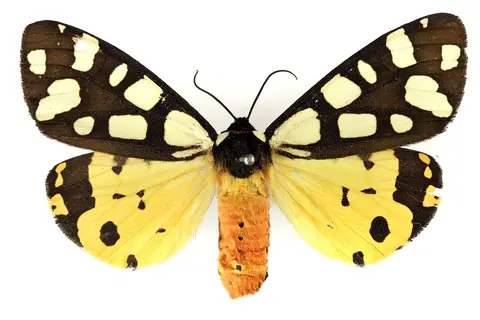
The simplest kind of is background matching. An animal's colours and patterns look like the place where it lives. Tree parakeets are mostly green. Woodcocks on the forest floor are brown and speckled, and bitterns in reed beds are streaked in brown and buff. Desert animals such as the fennec fox, the sandgrouse and the horned viper are almost all the colours of sand and dry earth. The peacock flounder is a flat fish that lies on the seabed and matches the pattern of the sand it rests on.
Many hunters and prey use the same trick. A hunter that blends in can creep up on its meal. A prey animal that blends in is harder to find. Scientists call this , which means being hard to see.
Camouflage only works if the animal also behaves the right way. Movement catches the eye, so camouflaged animals often keep very still. Young giraffes lie flat in cover for hours until their mothers return, and their coats blend with the plants around them. Stalking predators such as tigers move slowly and quietly.
One famous case is the peppered moth. Early in the 1800s most peppered moths in England were pale and speckled, like the lichen-covered trees where they rested. The first dark one was recorded near Manchester in 1848. As factory smoke blackened the tree trunks, darker moths became more common, and between 1860 and 1940 the moths changed to match the dark trunks. Then the story turned round. After clean-air laws of the 1950s cut the smoke, pale moths became common again. Zoologists take both changes as strong evidence that camouflage evolves by .
Why do stripes, spots and shading make animals harder to see?
Some patterns work by breaking up an animal's outline. This is called disruptive colouring. Bold, uneven patches of dark and light cut across the shape of the body, so the eye cannot easily pick out where the animal begins and ends. Leopards use it to creep up on prey. Common frogs have dark patches that hide their eyes, which are a giveaway.
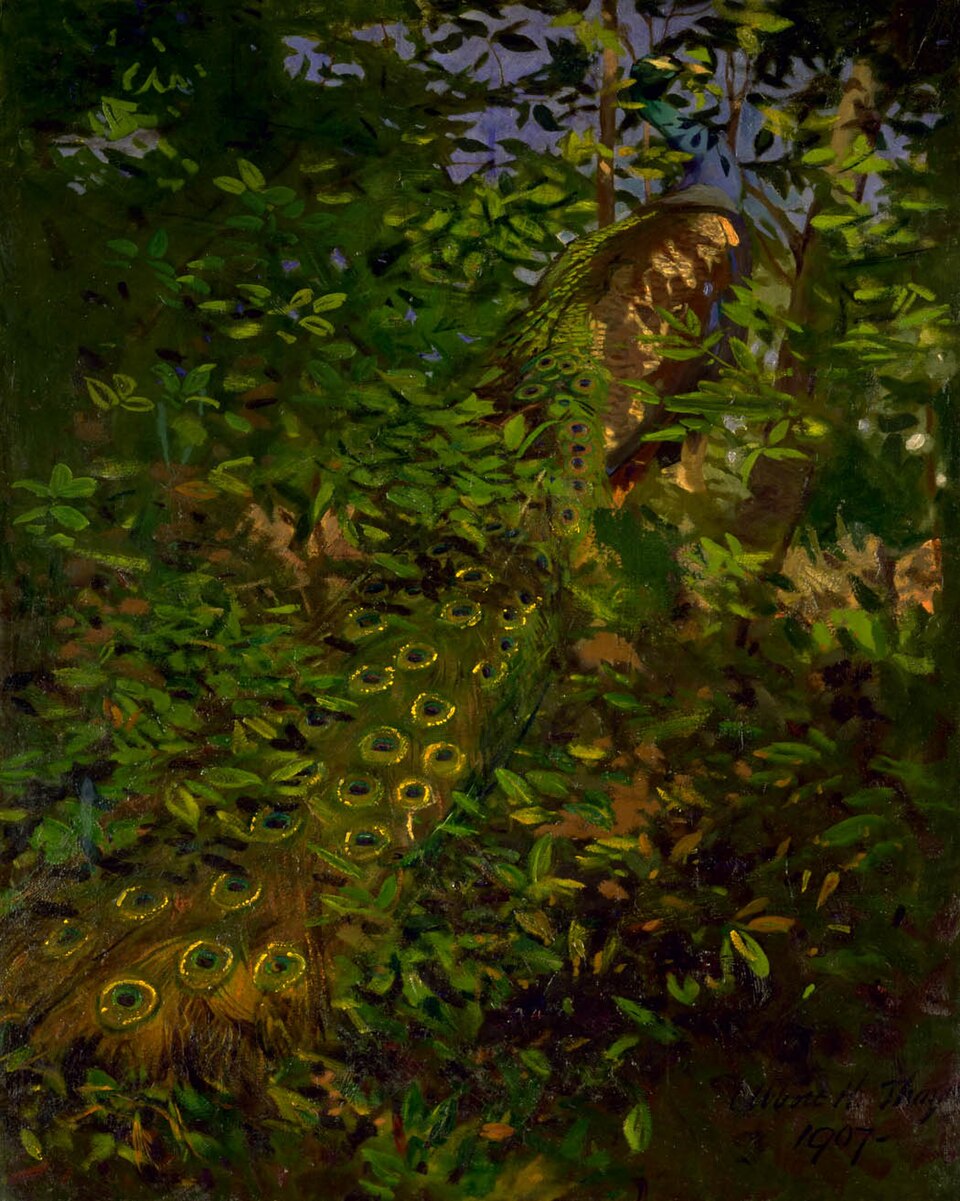
Another trick is . In sunlight, the top of an animal is brighter than its belly, which sits in shadow. This makes a solid, rounded animal easy to spot. Countershading paints the animal darkest on top and palest underneath, which cancels out the shadow and makes the body look flat. The American artist Abbott Thayer worked this out, and the idea is sometimes called Thayer's Law. Gazelles, sharks and dolphins are all countershaded.
Shadows give animals away, so some hide them. The horned lizards of North America have flat bodies with fringes of white scales along the edges. They press themselves to the ground, and the fringe hides any shadow that is left.
Not every bold pattern is . Thayer went too far and claimed that almost every colour in nature was for hiding. The zoologist Hugh Cott corrected him in 1940. The zebra's stripes puzzled scientists for years. One experiment in 2012 suggested that stripes make zebras less attractive to biting flies. Another study suggested that when zebras move, stripes may confuse the eyes of predators. This idea is called motion dazzle.
Can an animal pretend to be a leaf?
Sometimes an animal does not hide. It looks like something the hunter does not care about. This trick is called , or masquerade. A caterpillar of the peppered moth looks like a twig. A grasshopper can look like a dry leaf. A katydid has wings shaped and veined like a leaf.
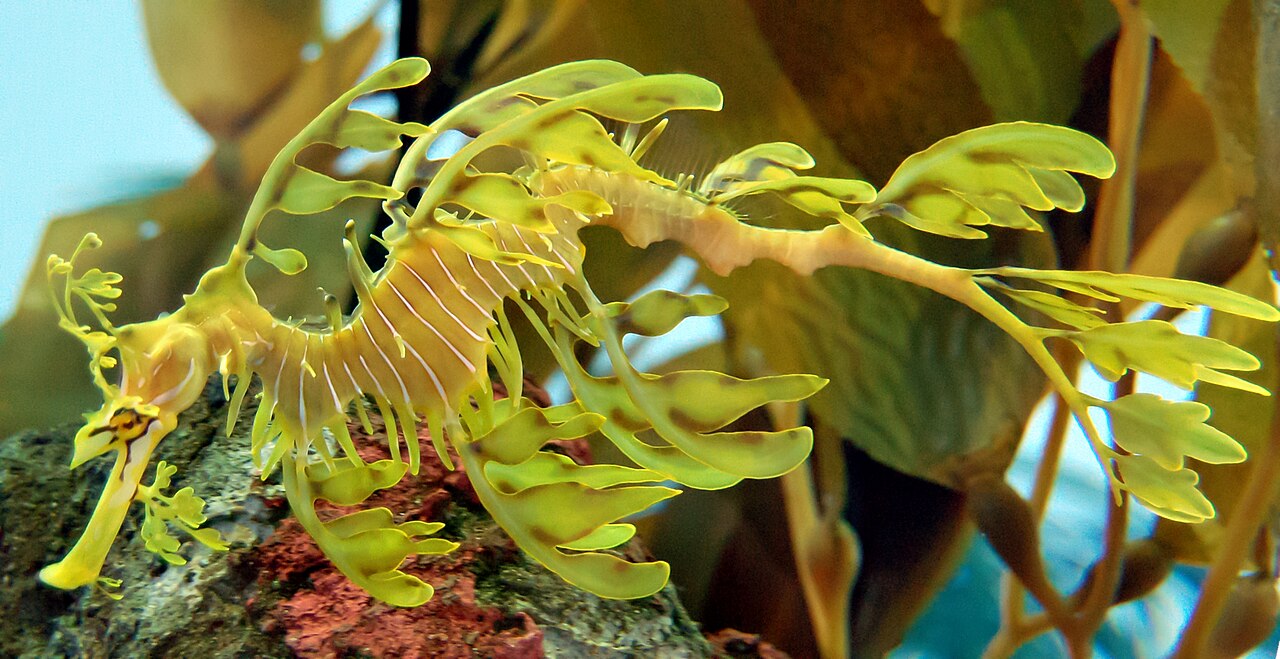
The leafy seadragon is a master of this trick. It is a fish related to seahorses, and its body is covered with leaf-like flaps of skin. It drifts among seaweed and sways gently, as if pushed by the water. Some insects, such as stick insects, sway too, as if they are twigs blown by the wind.
Hunters use mimesis as well. The flower mantis looks like an orchid or other flower, so insects land close enough to be caught. The common cuckoo uses it in two ways. The female looks like a sparrowhawk, a bird of prey, so small birds fly off in alarm. She then lays an egg in their nest. The cuckoo's egg also looks like the eggs of the host birds, so it is less likely to be thrown out.
Some creatures decorate themselves. A caddisfly larva builds a case from sand and twigs and lives inside it. A decorator crab sticks pieces of seaweed and sponge to its back. The young of the masked bug dust their bodies with sand. Soldiers do the same thing when they add grass and leaves to a suit.
How do octopuses change colour so fast?
Some animals can change colour. Octopuses, squid, cuttlefish, flatfish, frogs and a few chameleons all have special skin cells called . Each one holds a single colour of pigment.
In fish and frogs, the cells are star-shaped. When the pigment spreads out through the cell, the skin looks dark. When it bunches in the middle, the skin looks pale. In frogs, hormones control this slowly. In fish, the brain sends signals straight to the cells, so the change is faster.
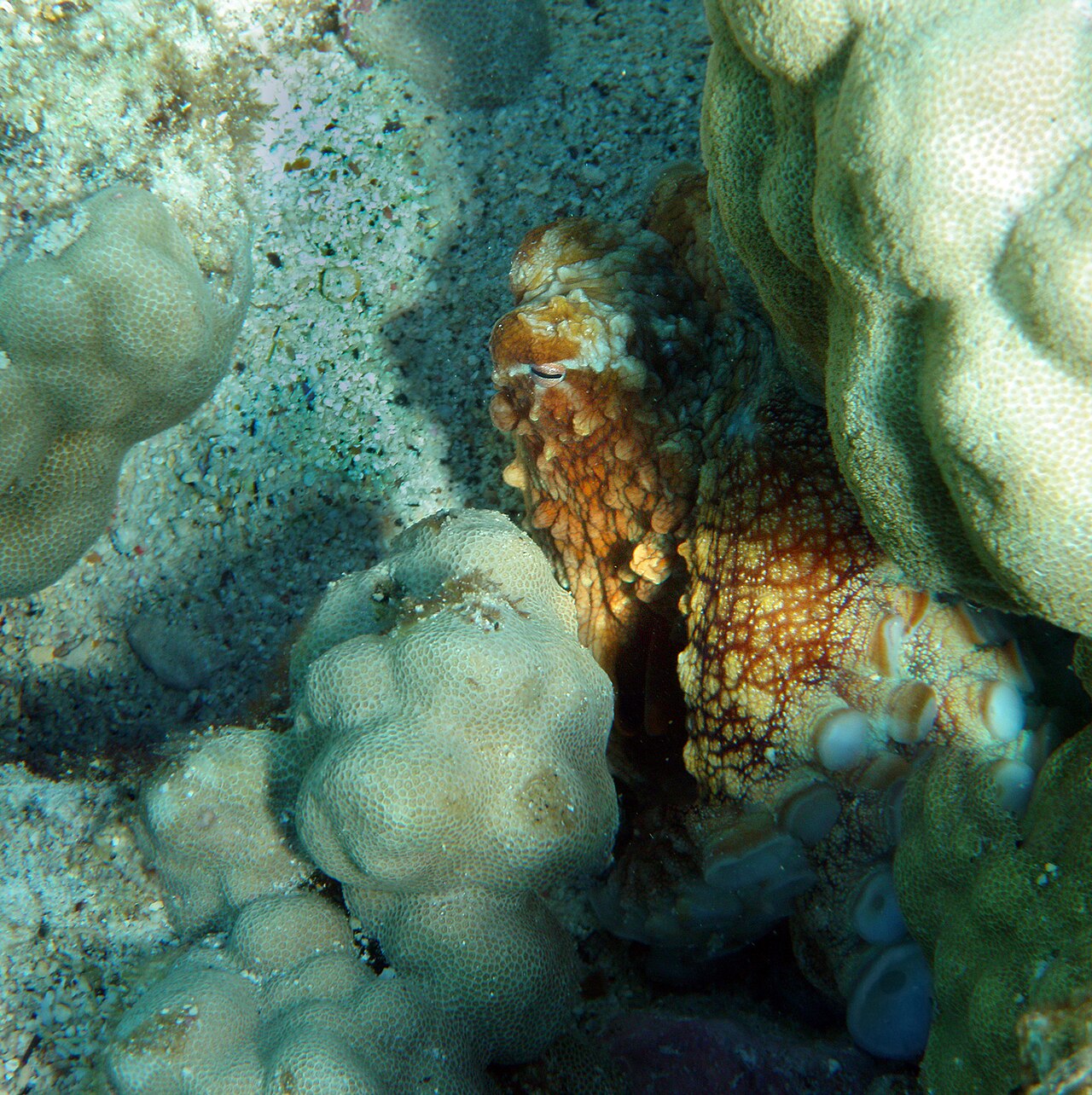
Octopuses and their relatives are the fastest of all. Each chromatophore sits in a stretchy sac, with tiny muscles around it. Nerves link the muscles to the brain. When the brain tells the muscles to pull, the sac stretches wide and shows its colour. When the muscles relax, the sac shrinks. With thousands of these units, an octopus can change its pattern very quickly. Aristotle wrote about this more than 2,000 years ago. The octopus can also change the texture of its skin to match coral or rock.
Other animals change more slowly. The Arctic fox, the Arctic hare, the stoat and the rock ptarmigan grow brown or grey coats in summer and white coats in winter. The Arctic fox is the only member of the dog family that does this.
Not all chameleons use colour for hiding. Most use it to send signals to other chameleons.
How do you hide where there is nowhere to hide?
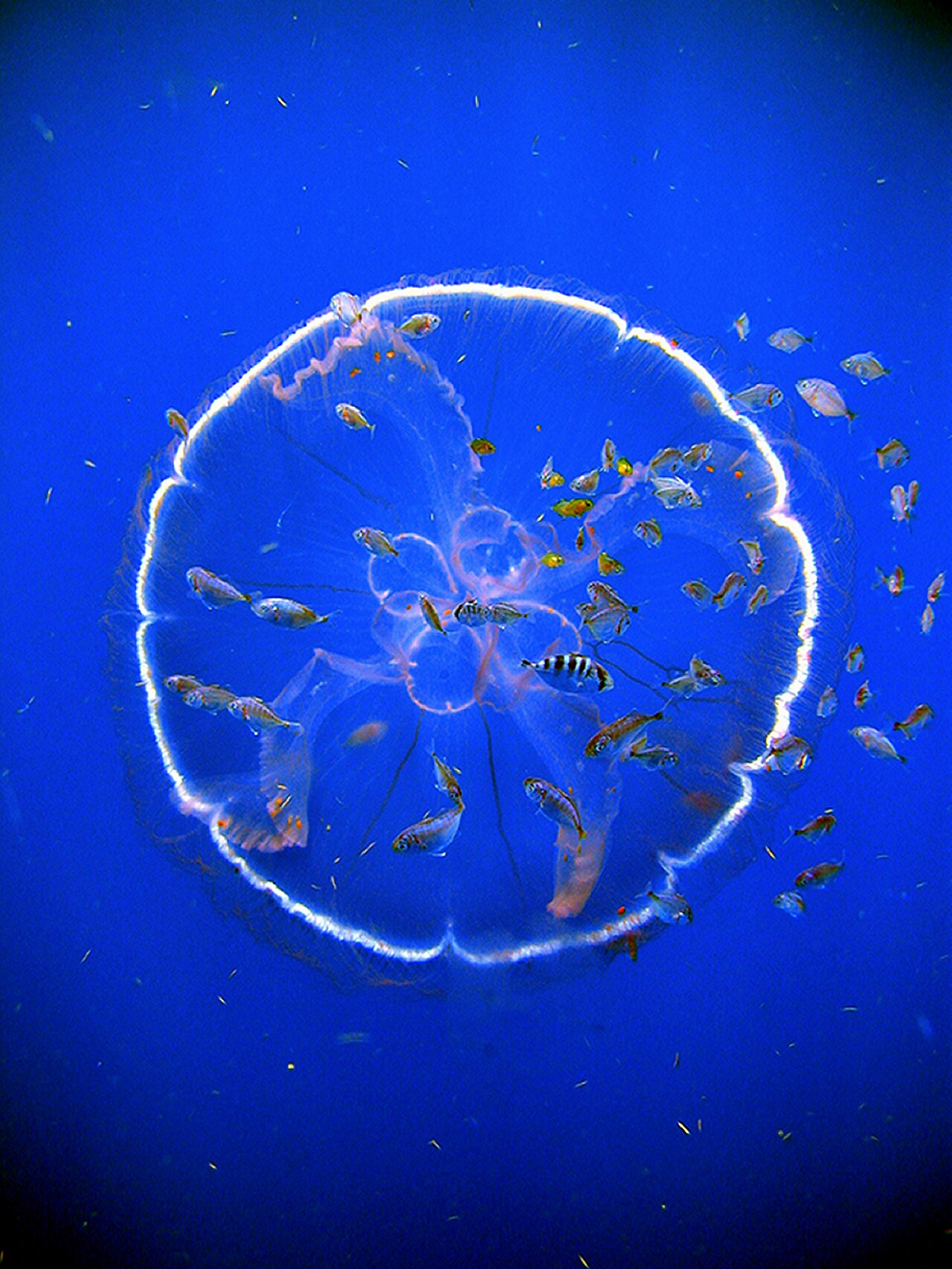
In the open ocean there are no rocks, plants or shadows to hide behind. Animals use different tricks.
The first is transparency. Many animals that float near the surface are clear as glass. Jellyfish, comb jellies and the larvae of many sea creatures have bodies that are mostly water. A predator looking at them sees straight through. Transparency works best in deeper water, where the light is dim. A body that is 50 per cent transparent is enough to make an animal invisible to a cod at a depth of 650 metres. In bright shallow water, a cod can still see prey that is 98 per cent transparent. There is a cost, too. A watery body is big for its muscles, so many jellyfish cannot swim fast.
Some parts of the body cannot be see-through. The retina of an eye must absorb light, so eyes always stay dark.
The second trick is silvering. Where transparency is impossible, animals can be mirrors instead. Fish such as sardines and herring have skin covered with stacks of tiny crystals that reflect light. Seen from the side, the fish reflects the water around it and seems to disappear. The marine hatchetfish is so thin and shiny that it looks like aluminium foil.
Octopuses, squid and cuttlefish have mirrors made of protein instead.
Can an animal hide by making its own light, or by being darker than dark?
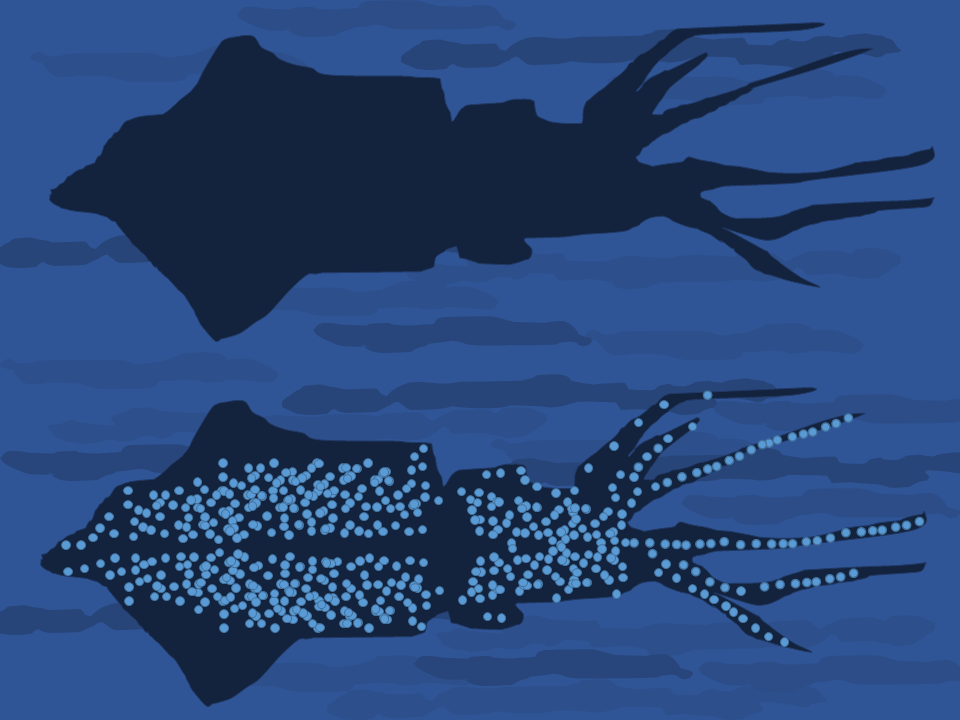
From below, an animal in the sea looks dark against the bright surface far above. Some squid solve this by glowing. The firefly squid and the midwater squid have light organs called photophores on their undersides. They make light that matches the brightness of the water above, so the squid does not appear as a dark shape. This trick is called . Many sea animals make light, which is called , and this is a likely reason for it, although light is also used to attract prey and to send signals.
In the deep sea, the opposite trick works. Little light reaches the depths, but some hunters make their own flashes of light to search for prey. Some deep-sea fish have skin that reflects less than 0.5 per cent of the light that hits it. This is ultra-blackness. Tiny particles in their skin soak up almost all the light and scatter the rest. One fish, a kind of anglerfish called Oneirodes, reflected only 0.044 per cent of blue light. Calculations suggest that this makes the fish about six times harder to see from a distance than a fish with ordinary dark skin. Many different fish evolved this skin separately, which shows how useful it is.
People tried counter-illumination in the Second World War. Planes carried lamps that matched the brightness of the night sky, so they could get much closer to ships before being seen. Radar made the idea useless, and the lamps never went into service.
How do we know camouflage really works?
In 1859 Charles Darwin explained how could arise. Animals that blend in are less likely to be eaten, so they live longer and leave more young. If their colours are passed on, the next generation hides better too. This is .
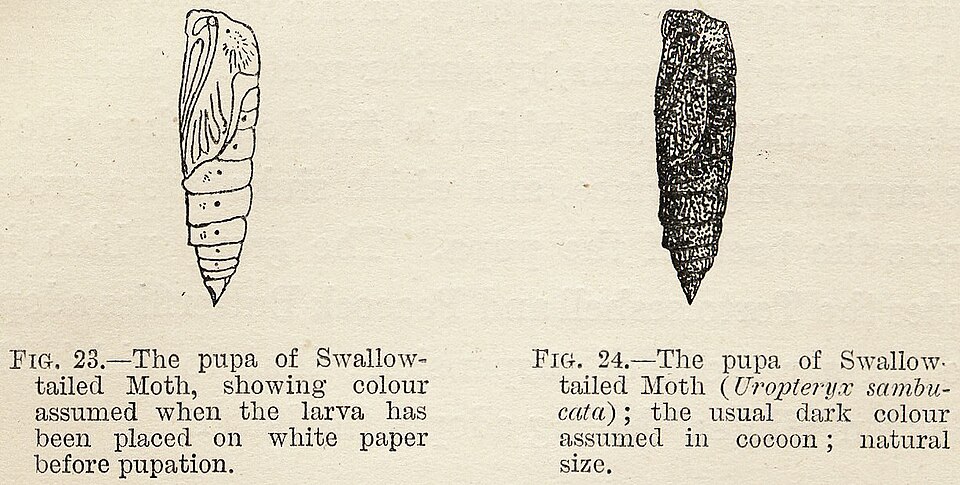
The English zoologist Edward Poulton tested the idea. He showed that the pupae of swallowtails and some other insects took on the colour of the background they grew up on as caterpillars. In 1890 he published a book that sorted the many types of animal colouring. Cott's book of 1940 brought together hundreds of examples.
Direct proof was slower to come. Experiments published in 2016 showed that ground-nesting birds such as plovers and coursers had more chicks survive when their eggs matched the ground well.
Fossils give a few clues, though skin rarely survives. Some Cretaceous sea reptiles had dark backs and pale bellies, and a 120 million year old dinosaur called Psittacosaurus was countershaded as well.
Scientists also study genes. In deer mice, one gene called agouti changed over about 8,000 years, and the changes made the fur more yellow. In cuttlefish, genes for a protein called reflectin help the skin shimmer.
Camouflage also has costs. A pattern that suits one place can make an animal easy to spot in another. Animals with an all-purpose pattern hide less well but can live in more places.
How did soldiers and sailors learn to hide?
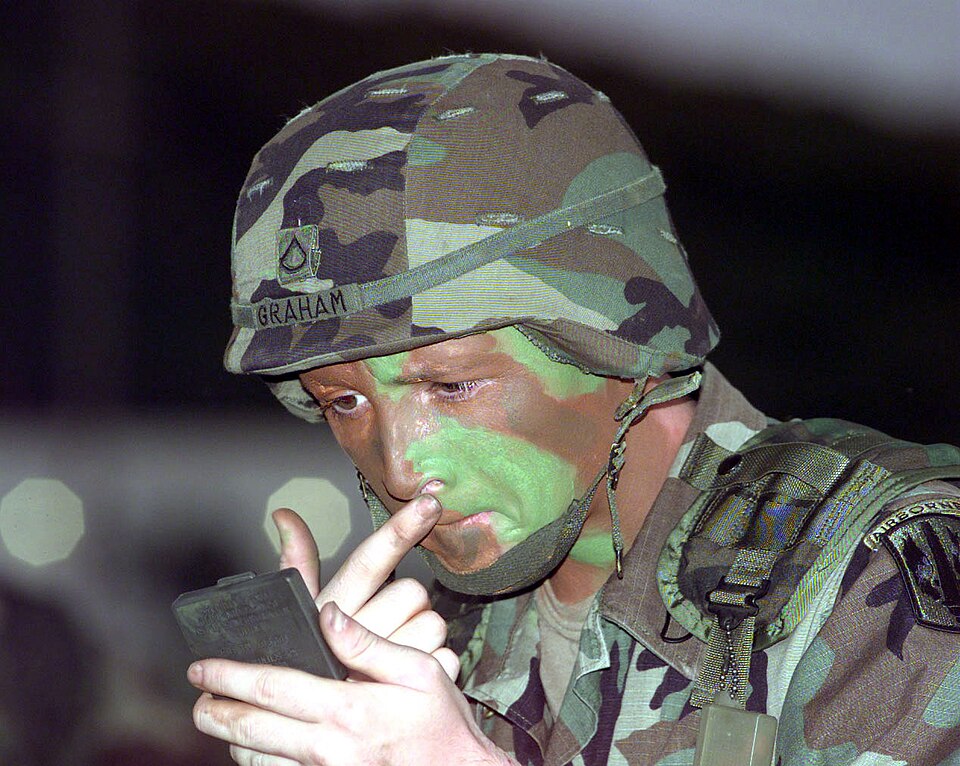
For most of history, armies wanted to be seen. Soldiers wore bright uniforms to show their side and look fierce. In the 1800s rifles became far more accurate and could hit targets from much further away. Being visible now meant being shot. Two British rifle regiments were the first to wear green jackets while others kept scarlet. In 1848 the Corps of Guides in India introduced dull khaki uniforms to be invisible in a land of dust. By 1902 the whole British army wore khaki.
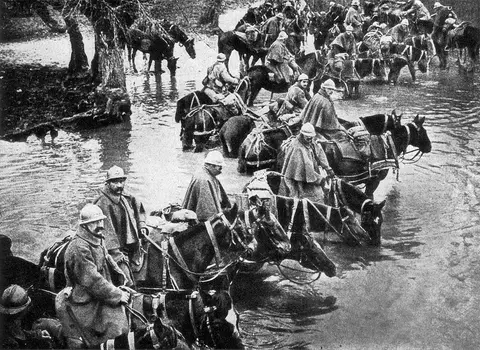
In the First World War, France formed a corps of artists, who were called camoufleurs. They painted guns and built fake trees to serve as lookout posts. The word camouflage probably comes from the French camoufler, which means to disguise.
At sea, the problem was submarines. In 1914 the zoologist John Graham Kerr had urged the navy to paint ships in disruptive patterns. In April 1917, the artist Norman Wilkinson thought of . Ships were painted in bold stripes and shapes. This did not make them hard to see. It made it hard for a submarine officer to judge which way the ship was heading and how fast.
In the Second World War, zoologist Hugh Cott persuaded the army to try . He painted one railway gun with it and another in an ordinary way. From the air, the countershaded gun almost vanished. Armies also built decoys, and fighters were often painted dark above and pale below. Radar later made it far less useful to camouflage aircraft.
Where else do people use camouflage today?
People use far beyond the battlefield. Hunters wear patterned clothes and sit in hides covered with branches, so that wary animals come close. Photographers use hides to watch birds without frightening them. Wildlife scientists use them too.
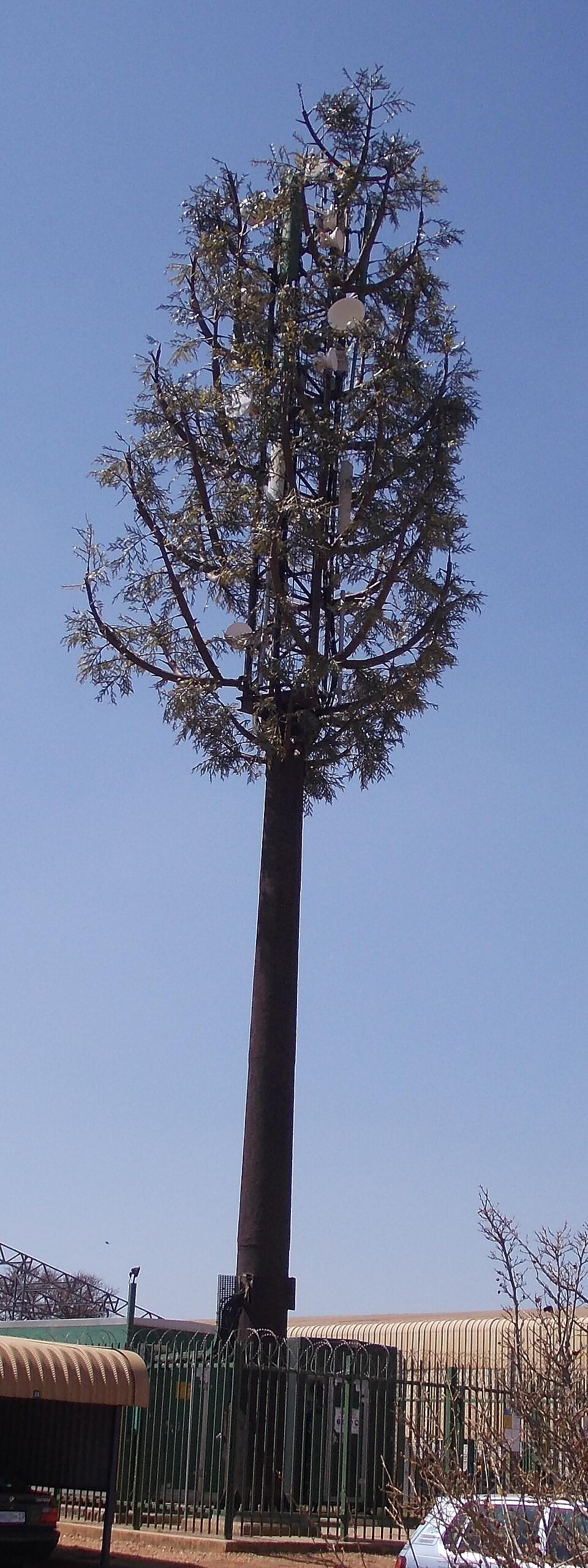
In towns, designers sometimes hide things that people do not want to see. The best-known example is the mobile phone mast made to look like a tree. This uses , the same trick as a stick insect, although it rarely fools anyone up close.
Camouflage patterns have also become a fashion. Many clothes use patterns taken from military uniforms, because the designs are bold and strong. Artists, writers and film-makers have used camouflage in their work, in stories about invisibility and disguise.
Engineers keep looking for new ideas. In 2011 the company BAE Systems announced Adaptiv, a system that covered the sides of a tank with about 1,000 small hexagonal panels. The panels could be warmed or cooled so that, to an infrared camera, the tank matched its surroundings. It could even look like a car. Other scientists study the skin of cuttlefish and octopuses to design materials that could change colour. Nature still has the best examples.
Camouflage is not only for sight. Researchers have also studied ways of hiding from smell and sound, though these ideas are newer and much less developed.
Explore Next
Your audio story keeps playing while you look around.
Words to Know
- bioluminescence
- Light made by a living thing.
- camouflage
- Any way of hiding something, or of making it look like something else.
- chromatophore
- A skin cell with pigment that can change an animal's colour.
- counter-illumination
- Making light to match a bright background and hide a dark body.
- countershading
- Colouring that is dark on top and pale underneath to cancel out shadow.
- crypsis
- Being hard to see, often by matching the background.
- dazzle camouflage
- Bold patterns that make it hard to judge a ship's speed and direction.
- disruptive coloration
- Bold patches that break up the outline of a body.
- mimesis
- Looking like an object of no interest, such as a twig or a leaf.
- natural selection
- The process in which animals best suited to their surroundings survive and have more young.