Food Web
Who eats whom, and how energy runs through every living community.
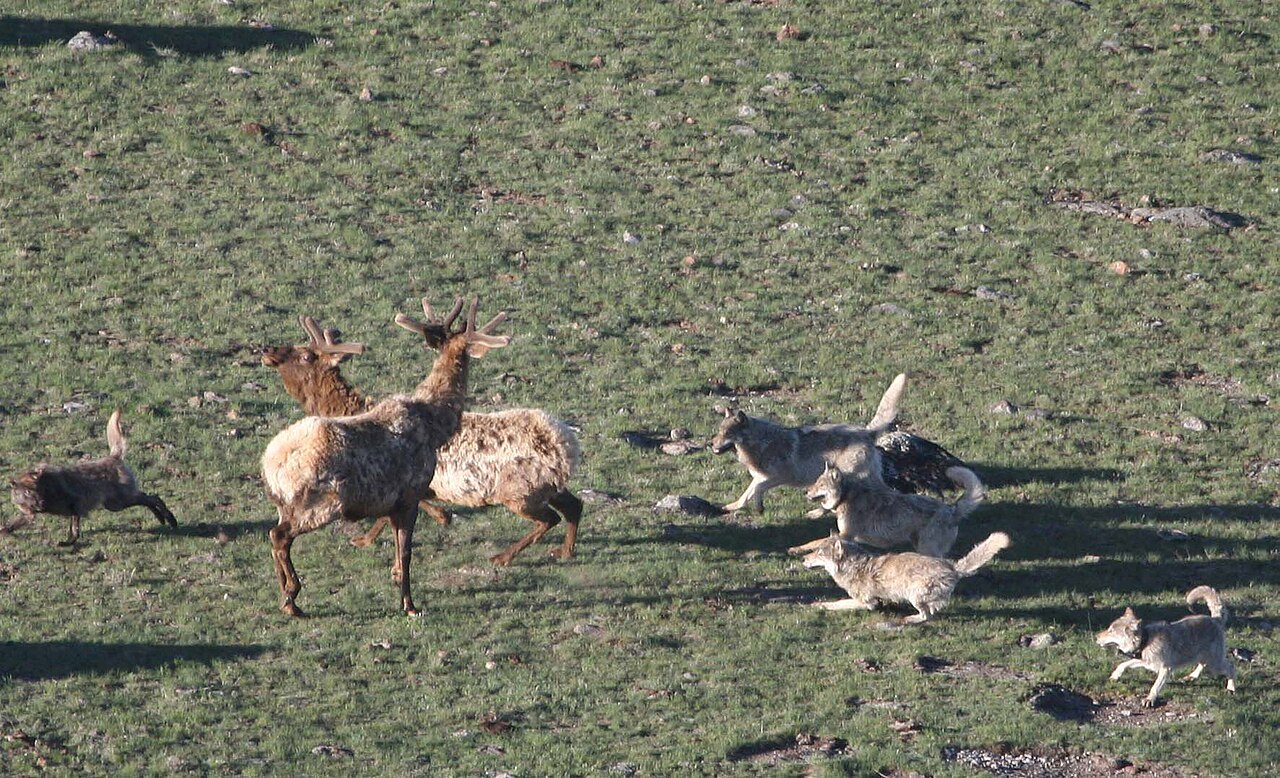
Every animal needs food, and almost every food is something that was once alive. A food web is a map of those links, showing who eats whom in a forest, a pond or an ocean. It joins many food chains into one tangled network. Following the links shows how sunlight captured by plants and algae ends up inside a deer, a wolf or a whale. It also explains why top predators are rare, why removing one species can change a whole habitat, and why dead leaves matter as much as living ones. Ecologists use food webs to predict what might happen when a community changes.
What is a food web?
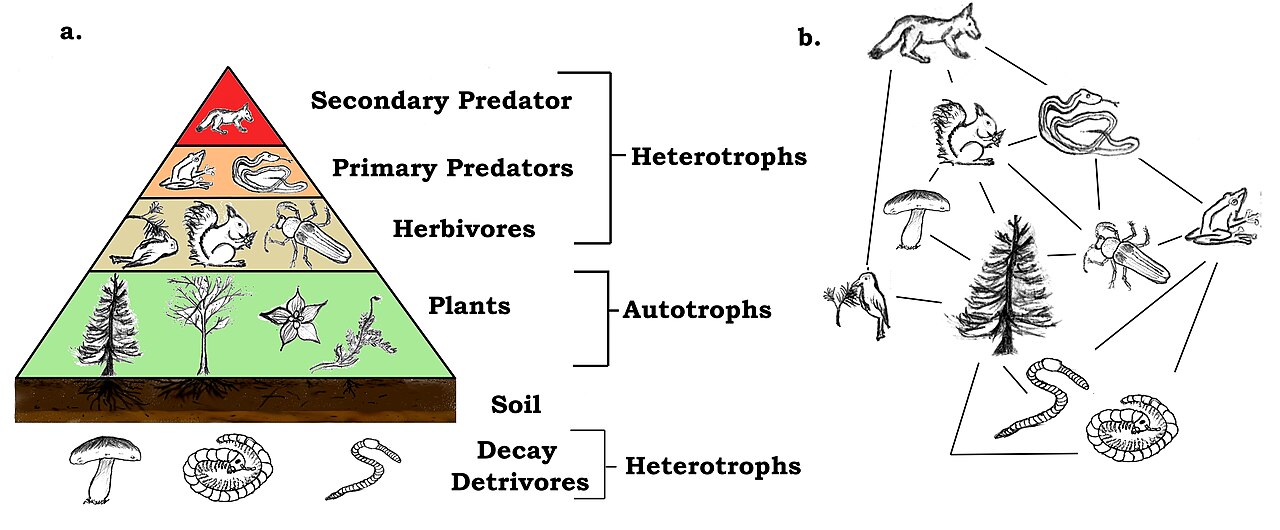
Picture a meadow. Grass is eaten by rabbits and grasshoppers. Rabbits are eaten by foxes and owls. Grasshoppers are eaten by frogs and birds, and the frogs may be eaten by snakes. Draw an arrow for every meal and you get a food web.
A single path of arrows, such as grass to rabbit to fox, is called a food chain. Real animals rarely eat only one thing, so chains cross and join. That tangle of linked chains is the web. Each link between a feeder and its food is called a trophic link, from a Greek word for nourishment.
Ecologists sort living things into two big groups. make their own food. Most of them use chlorophyll to catch sunlight, as plants do. A few, such as sulfur bacteria in hot springs, get energy from chemical reactions and can live in the dark. cannot make food, so they must eat other living things or their remains. Some species cross the line. A carnivorous plant makes food from sunlight and also digests insects.
Food webs include living things of every size, from a microscopic bacterium to a blue whale, and from a giant redwood to a mushroom. They are simplified pictures, because no one can draw every link in a real forest. Even so, they let scientists see how a whole community is held together.
Who sits on which level?
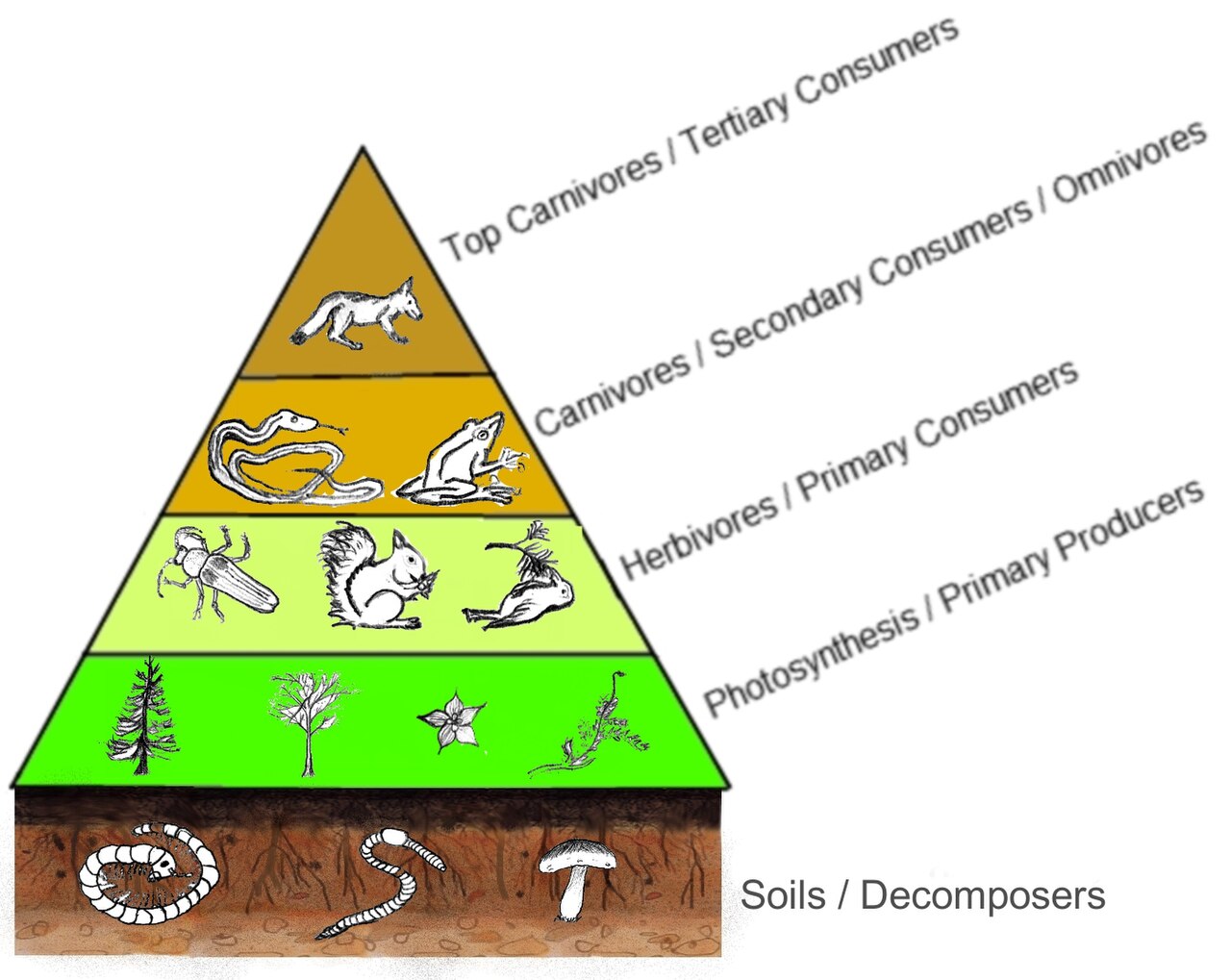
Ecologists give every feeder a position in the web, called its . The word comes from the Greek for feeding.
At the bottom are the producers, such as plants, algae and bacteria that make their own food. They are also called basal species, because nothing in the web is below them. that live on dead matter can sit at the base too.
In the simplest scheme, plants are level 1. Herbivores that eat plants are level 2. Carnivores that eat herbivores are level 3. At the very top are , which no other animal hunts for food. A polar bear is one example.
Real life is messier. , such as bears and humans, eat plants and animals, so they feed on several levels at once. Scientists once thought omnivores were rare. Newer evidence shows they are common. One study found that above the herbivores, food webs are better described as a tangled web of omnivores than as neat layers.
How do we know who eats what? Ecologists study what is inside animals' stomachs, and they watch feeding in the wild. A newer method uses stable isotopes. These are forms of chemical elements that pass from food into an animal's body, so they leave a trace that shows what the animal has been eating.
Where does all the energy go?
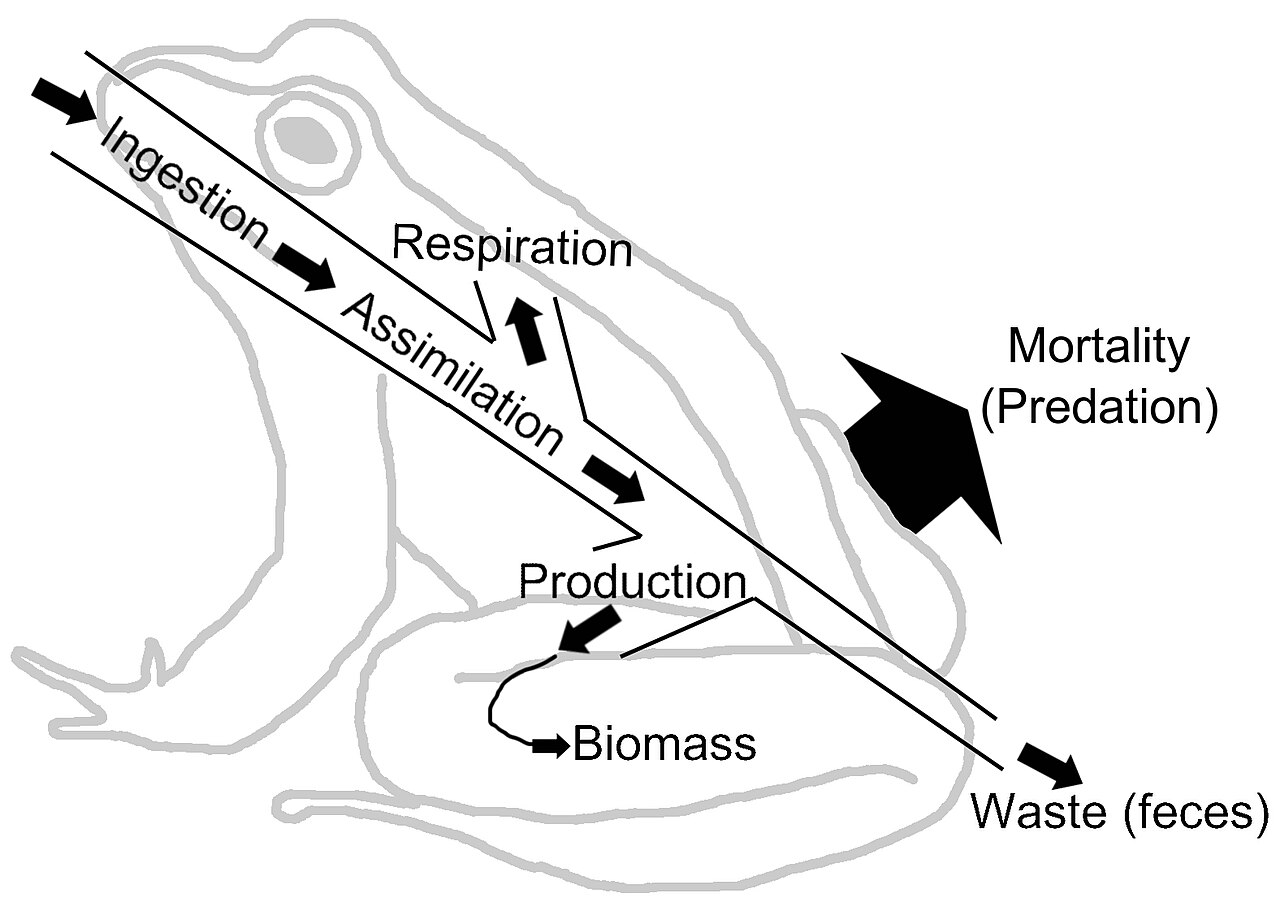
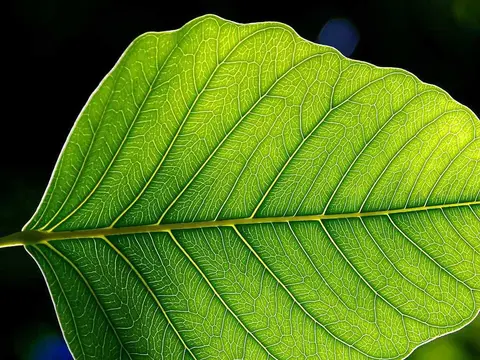
Food webs are really maps of energy. Nearly all of it starts as sunlight, which plants and algae turn into sugars by photosynthesis. When a herbivore eats a plant, some of that stored energy moves along the link. When a carnivore eats the herbivore, some moves on again.
But not much. Usually only about 10 per cent of the energy in one level reaches the next, although measured values range from 5 to 20 per cent. The rest is used up. An animal burns most of its food to move, keep warm and stay alive, and this energy escapes as heat. Some of the food is never digested and leaves as waste. In animals that eat tough, hard-to-digest plants, less than 1 per cent may pass on. Tiny zooplankton eating algae can pass on as much as 40 per cent.
Energy flows in one direction. It enters from the Sun, moves up the web, and leaves as heat. It can never be used again. This is the opposite of the materials that living things are built from, such as carbon and nitrogen. These are recycled over and over.
Because energy drains away at every step, each level supports less living matter than the one below. Ecologists show this with diagrams that follow the energy in, the part that becomes growth, and the parts lost as waste and heat. This simple fact explains most of the shape of food webs.
Why are there so few top predators?
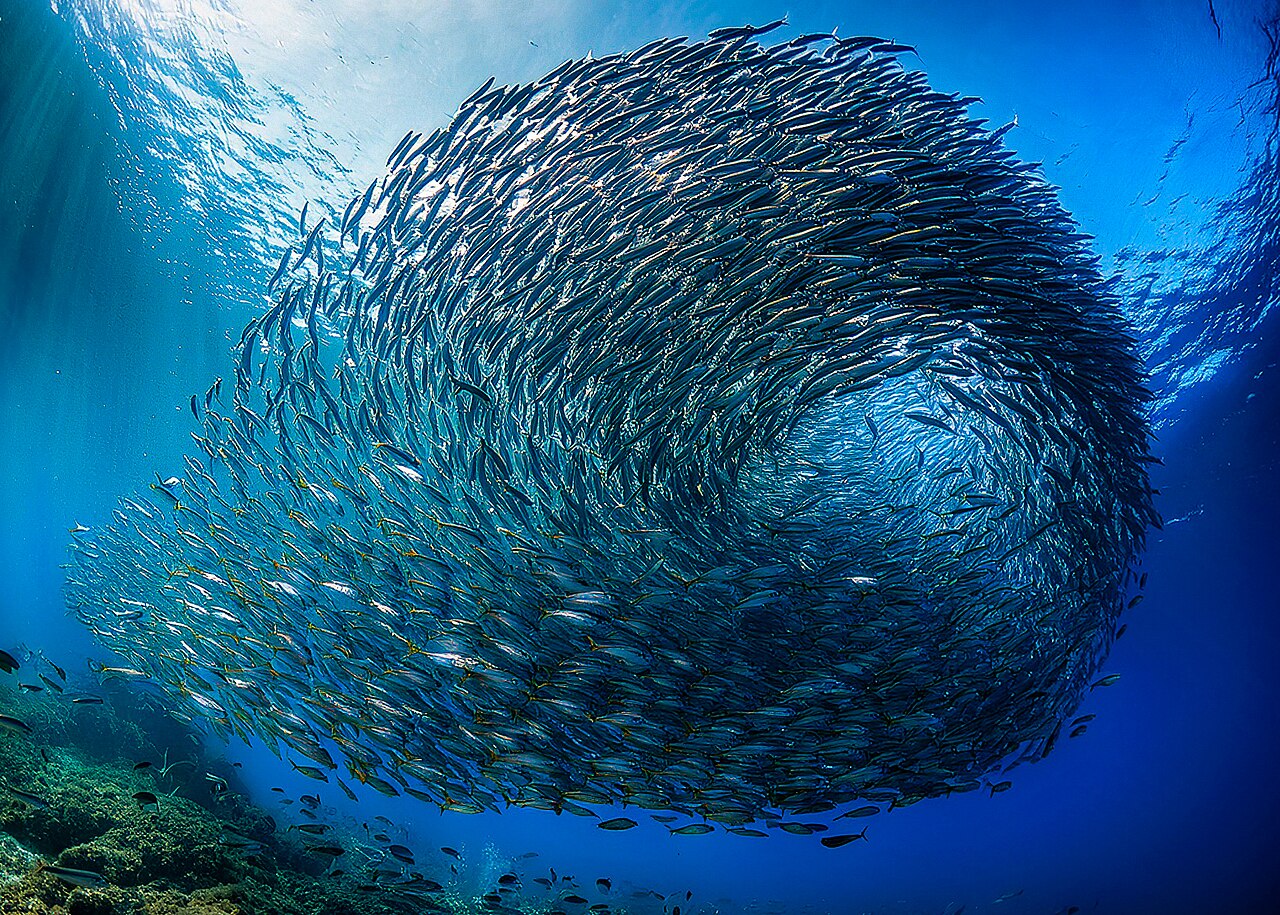
If each step passes on only a small share of energy, the top of a web cannot be crowded. A single polar bear needs a huge number of plants and herbivores underneath it. This is why top predators are rare and why food chains usually have no more than four or five links. After that, too little energy is left to feed another level.
Ecologists draw this idea as an ecological pyramid. Producers form the wide base. Each level above is narrower. A pyramid can count animals, weigh their combined mass, which is called , or measure their energy.
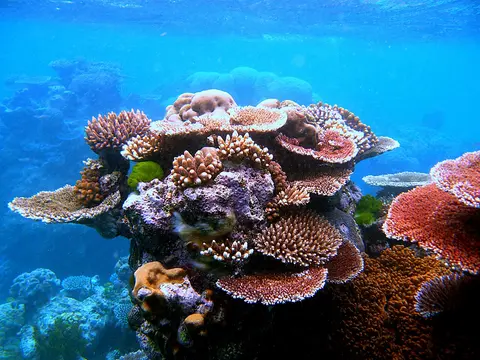
Sometimes the pyramid of biomass turns upside down. This often happens in the sea and on coral reefs. Phytoplankton, the tiny floating algae, are eaten as fast as they grow. They live only a few days and never build up much living matter. The zooplankton that eat them live for weeks. The fish that eat zooplankton live for years. At any one moment, the grazers and predators can add up to more mass than the algae.
The energy pyramid can never be inverted. If every food source is counted, energy always runs out as it moves up. This follows a basic rule of physics called the second law of thermodynamics. Food chains tend to be longer in water than on land.
Who is really in charge?
Imagine a grassy valley full of elk. Why does the grass not disappear? One idea says predators are in charge. Wolves keep the elk numbers down, so plants survive. This is the top-down idea, sometimes called the green-world hypothesis, because the world stays green.
Another idea says plants are in charge. Many plants are hard to eat. They have tough fibres, thorns or poisons, and some have little nutrition. If food is poor, herbivores cannot multiply, however few predators there are. This is the bottom-up idea.
The answer, according to recent studies, is both. Top-down and bottom-up forces shape communities together, and which one matters most depends on the place.
The effects can spread across several levels. When predators cut herbivore numbers, plants grow better even though the predators never eat them. A change that ripples down through the web like this is called a . Some cascades affect only a few species. Others reshape the whole community, such as the amount of plant growth across a landscape.
Wolves hunting elk in Yellowstone National Park in the United States are a famous case. Wolves were brought back there in 1995 after about 70 years away, and scientists have studied how the elk, the trees and many other species have changed since.
Can one species hold up a whole community?
Some links in a food web matter far more than others. Ecologists call species with a very strong effect , after the stone at the top of an arch that holds the others in place.
The idea grew from work by the ecologist Robert Paine on rocky shores. Interest in food webs rose sharply after his studies, which suggested that a complex web was the key to keeping many species alive and a community stable. In his famous experiment, he removed a top predator, a starfish, from patches of shore. The number of species there then fell, because the mussels it had been eating spread and crowded out the rest.
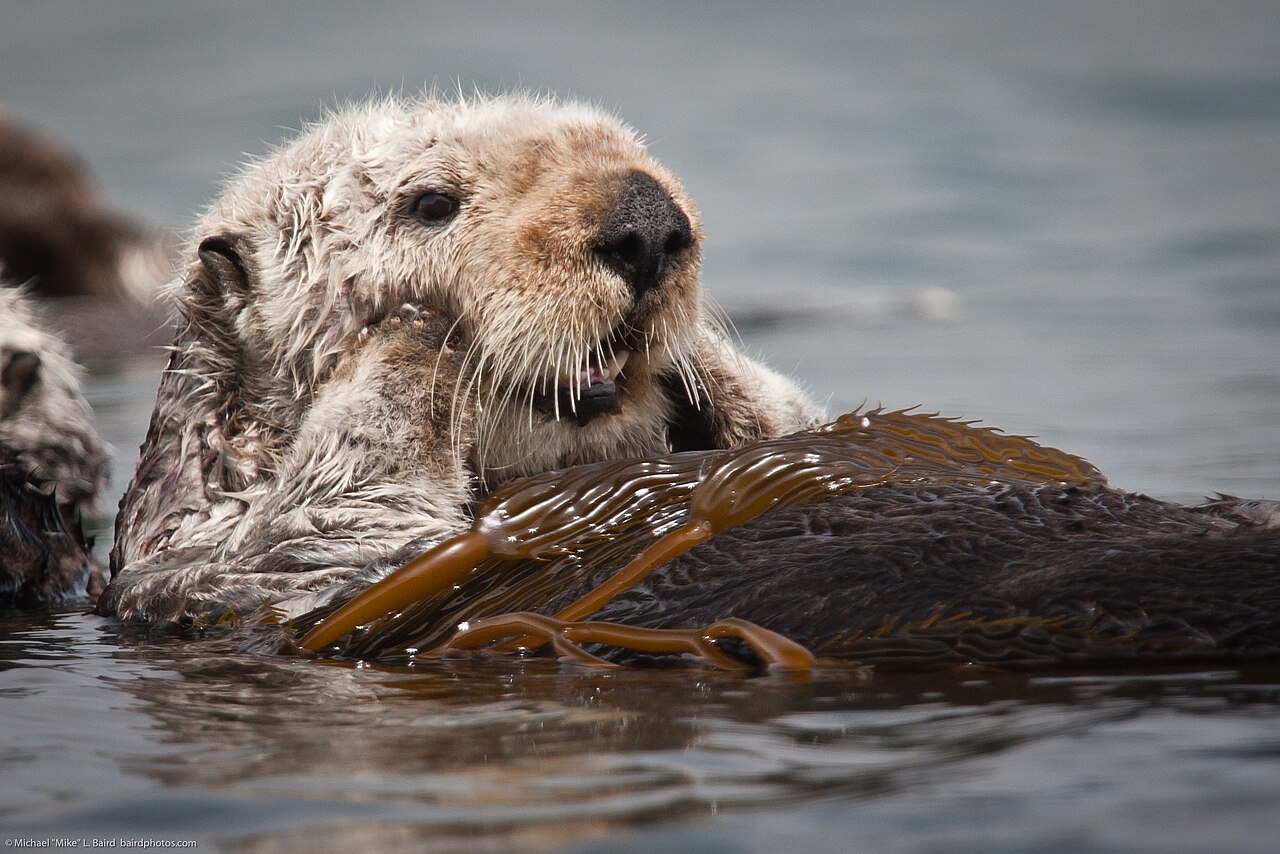
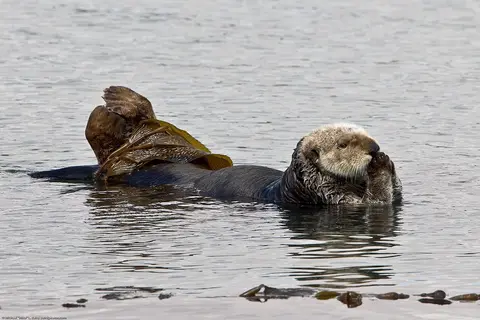
Sea otters on the Pacific coast of North America are another example. They eat sea urchins. Urchins graze on kelp, the giant seaweed that forms underwater forests. Where otters are common, urchins are kept in check and kelp forests thrive, giving shelter to fish and many other animals. Where otters were hunted for their fur and disappeared, urchins multiplied and ate the kelp down to bare rock.
This is why food webs matter for conservation. Losing one strongly linked species can cause losses much further along the web, including among species that never met it. Webs with many links and many species often cope better with change, because there are other routes for energy to take.
What happens to dead things?
Most plant matter is never eaten by a living animal. Leaves fall, trees die, animals die. All this dead organic matter is called . It also includes droppings, dead microbes and fallen wood. It is a huge source of food, and it feeds its own network, the detrital web.
In a detrital web, such as bacteria and fungi break the dead matter down. They release nutrients, which plants can use again. Small animals called detritivores eat the remains and the microbes living on them. Earthworms munching on decaying leaves are detritivores. Carnivores then eat the detritivores. A robin pulling up an earthworm is feeding on the detrital web.
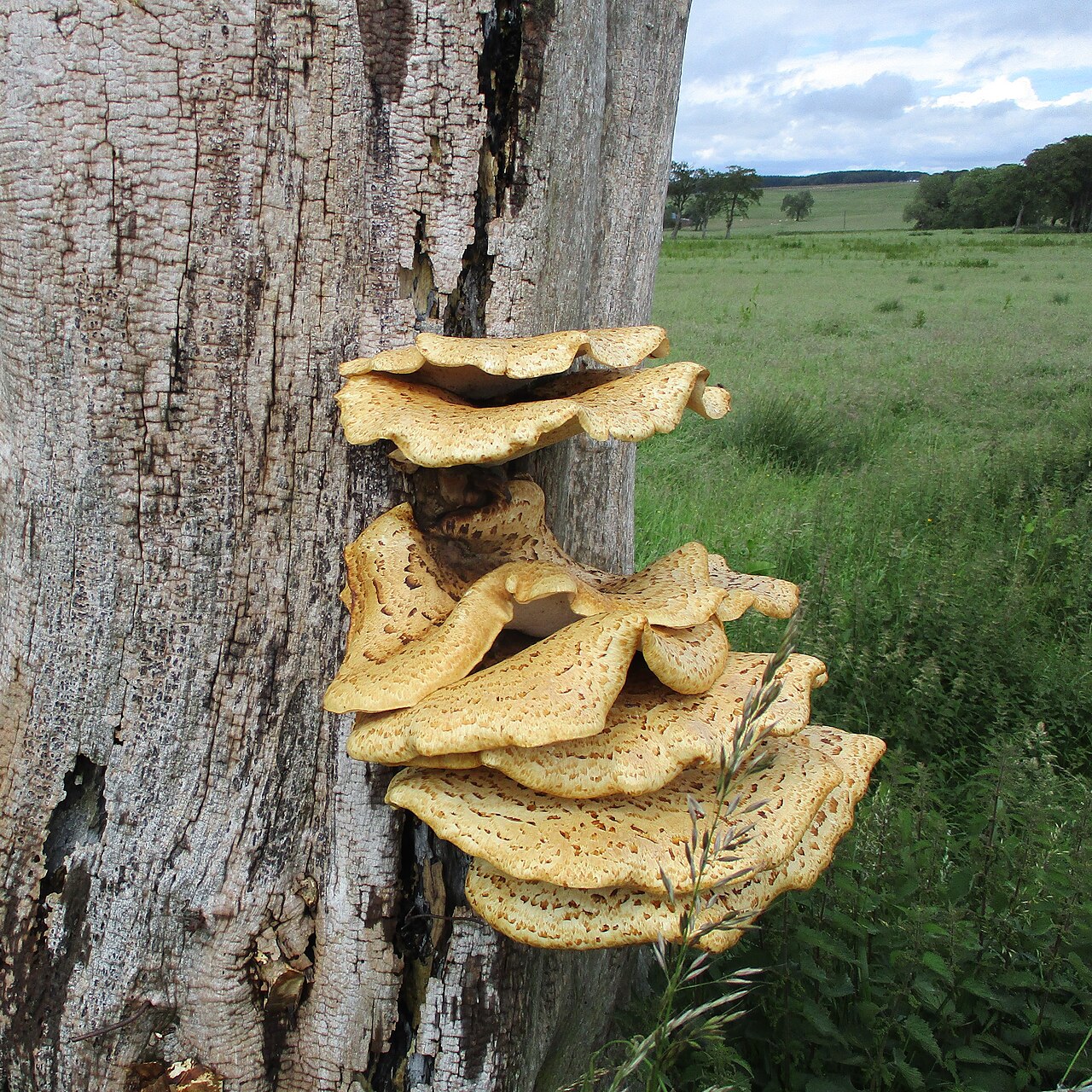
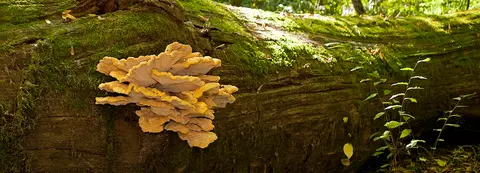
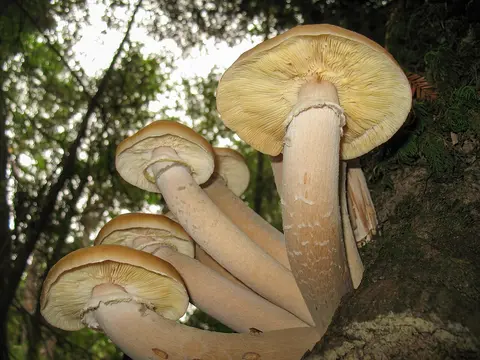
The detrital web is joined to the grazing web, which starts with living plants. Mushrooms are the fruiting bodies of fungi, and many fungi live on dead matter. Deer, squirrels and mice eat mushrooms, so energy passes from the detrital web into the grazing web.
The ecologist Raymond Lindeman stressed the part that decomposers play. In his landmark 1942 paper, he argued that a community cannot be understood without them.
This recycling links food webs to nutrient cycles. Energy flows through a web and is lost as heat. The materials in living things, such as carbon, nitrogen and phosphorus, circle back to the soil and the water and are used again.
How did scientists learn to map the web?

People have long noticed that animals eat each other. The medieval scholar Al-Jahiz wrote that no animal can live without food, and that a hunter cannot escape being hunted in turn. In 1768 John Bruckner called nature one continued web of life. Charles Darwin wrote of an entangled bank, where many plants and animals depend on each other in complex ways.
The first known drawing of a food web was made by the Italian zoologist Lorenzo Camerano in 1880. Others drew their own in 1912 and 1913. In 1927, the British ecologist Charles Elton published Animal Ecology, which made food chains and food webs central to ecology. Raymond Lindeman then showed in 1942 how to follow energy from level to level.
Today ecologists treat food webs as networks, using mathematics also used for other complex systems. They count species and links. One measure, called connectance, is the share of all possible feeding links that actually occur. Studies suggest that species-rich webs often hold together better than poor ones.
Real webs are hard to measure. Scientists estimate that Earth has around 10 million species, and over 95 per cent are microbes and invertebrates. Few have even been named. So researchers also build small models, such as jars of pond water with daphnia feeding on algae, to test ideas under control.
Explore Next
Your audio story keeps playing while you look around.
Words to Know
- apex predator
- A hunter at the top of a food web that no other animal hunts for food.
- autotroph
- A living thing that makes its own food, such as a plant or alga.
- biomass
- The total mass of living matter in an area or at one level of a web.
- decomposer
- A living thing, such as a fungus or bacterium, that breaks down dead matter.
- detritus
- Dead plant and animal matter, including droppings and fallen leaves.
- heterotroph
- A living thing that gets energy by eating other living things or their remains.
- keystone species
- A species that has a much bigger effect on its community than its numbers suggest.
- omnivore
- An animal that eats both plants and other animals.
- trophic cascade
- A chain of effects that runs down a food web when predators change herbivore numbers.
- trophic level
- The position of a species in a food web, counted by steps from the producers.