Triceratops
The three-horned giant with a bony frill, one of the last dinosaurs of all.
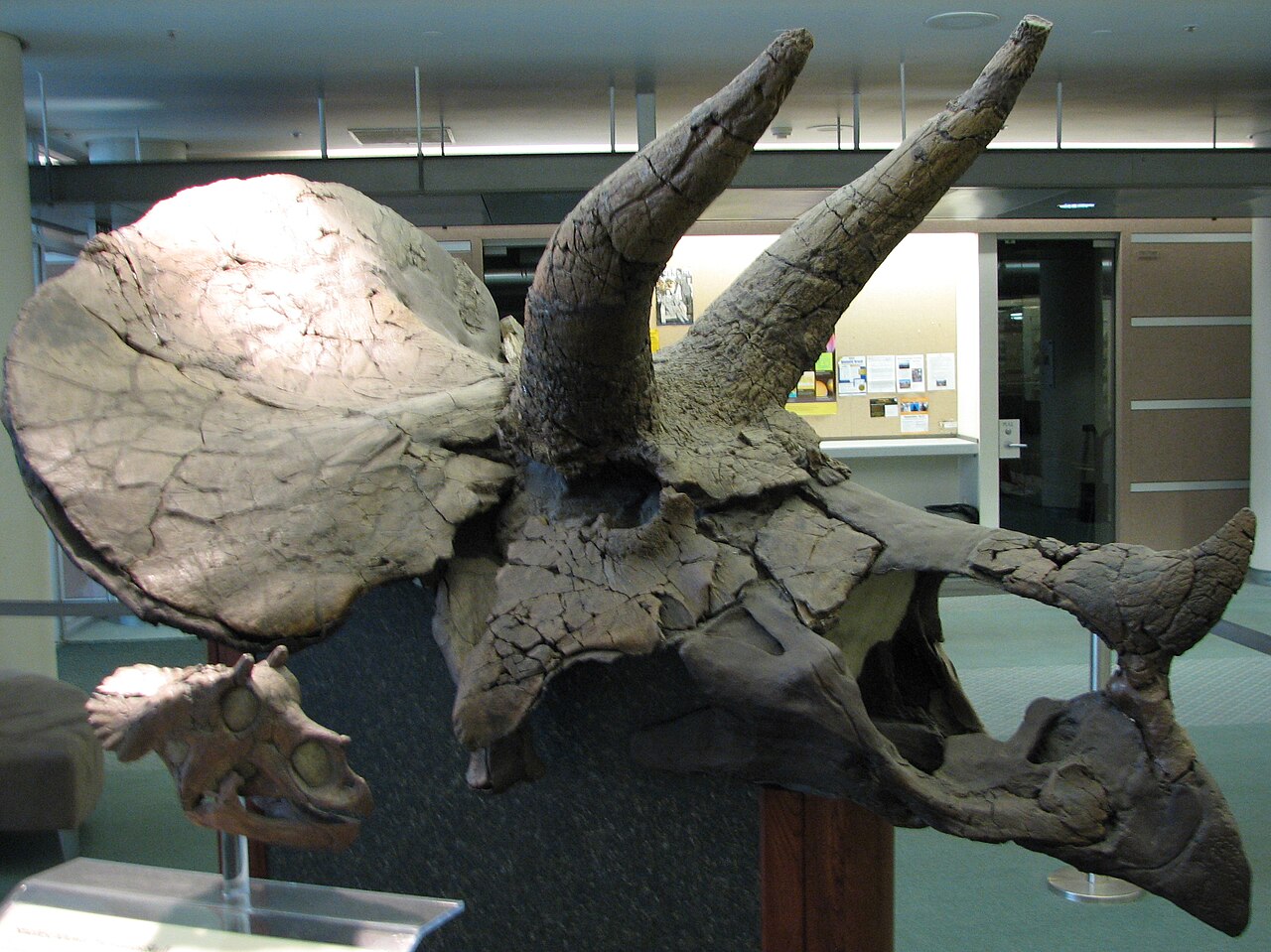
Triceratops was a plant-eating dinosaur about the size of a large truck. It had a huge bony frill, two long brow horns and a shorter horn on the nose. The name means "three-horned face". It lived in western North America between about 69 and 66 million years ago. That puts it among the very last dinosaurs. Its skull fossils are so common that it may have been the most numerous big dinosaur of its time. It shared its home with Tyrannosaurus rex. Scientists still argue about what the horns and frill were for, and even about how many kinds of Triceratops there were.
What was Triceratops like?
Triceratops was a heavy, four-legged plant eater, a bit like a rhinoceros in shape. Rhinos and Triceratops are not related, but they look alike because both evolved a big, strong body and horns. Scientists call this .
An adult was about 8 to 9 metres long. The biggest may have weighed 6 to 10 tonnes. That is as much as a big African elephant, or more. Famous skeletons give a guide. Kelsey was about 7 metres long and weighed an estimated 5.4 tonnes.
The head was the star. It had a long horn above each eye, about a metre long in big adults. A shorter horn sat on the nose. Behind them, a wide of bone covered the neck. The front of the mouth was a toothless beak, like a parrot's.
Triceratops belongs to the , or horned dinosaurs. They began as small animals in Asia. Yinlong, found in China, is one of the earliest known and lived in the Jurassic. Protoceratops came later. By the end of the , ceratopsians in North America were huge.
Triceratops lived to the very end of the dinosaur age. It was among the last non-bird dinosaurs, alive when the asteroid struck 66 million years ago.
How was Triceratops discovered?
The first Triceratops bones were found in 1887. George Cannon, near Denver, Colorado, spotted two giant horns attached to a piece of skull. He sent them to the fossil expert Othniel Charles Marsh at Yale. Marsh thought they came from an extinct giant bison.
A year later, he decided the horns were from a dinosaur. In 1888, a cowboy named Edmund Wilson saw a huge skull sticking out of a ravine in Wyoming. He tried to pull it out with a lasso around a horn, but the horn snapped off and the skull rolled away down the slope. Wilson took the horn to his boss, a rancher named Charles Guernsey. Guernsey showed it to the fossil collector John Bell Hatcher. Marsh sent Hatcher to find the skull.
Marsh first called the skull Ceratops. Then the digging uncovered a third horn on the nose. In 1889, he gave the animal a new name, Triceratops.
Hatcher went on to collect 31 more skulls in just two years. The skulls were large, tough and easy to preserve. That is why we have so many.
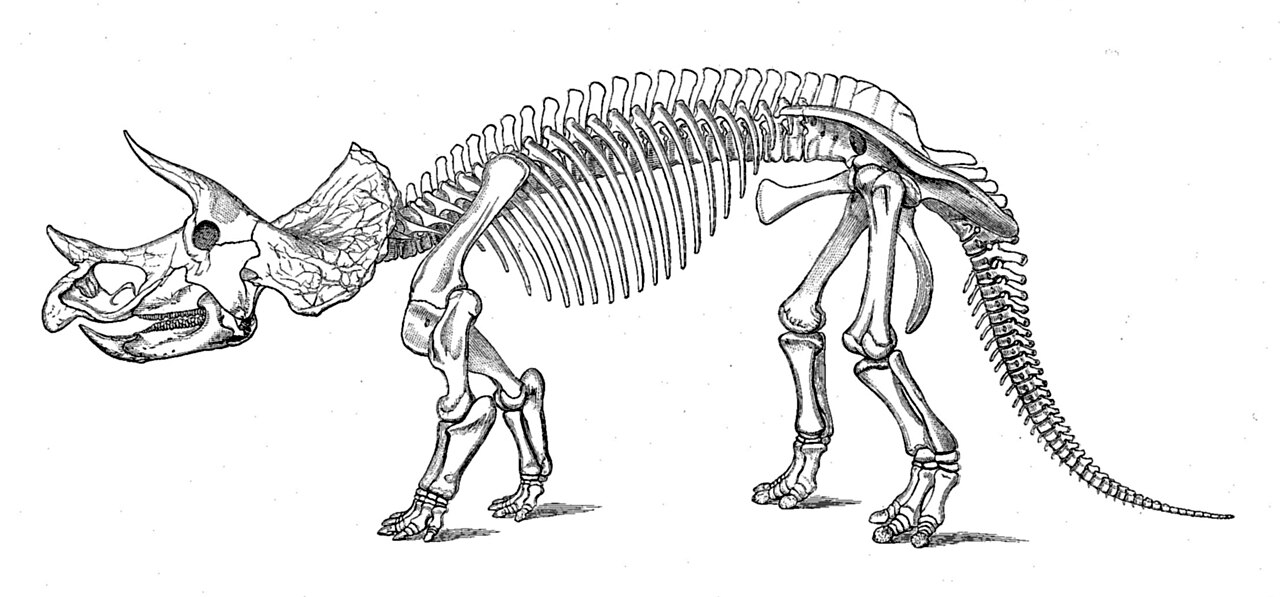
Marsh was then in the middle of the Bone Wars, a long fight with Edward Cope over who could name more dinosaurs. A drawing of the skeleton, made by Marsh's team in 1896, shows how the animal was first imagined.
How many kinds of Triceratops were there?
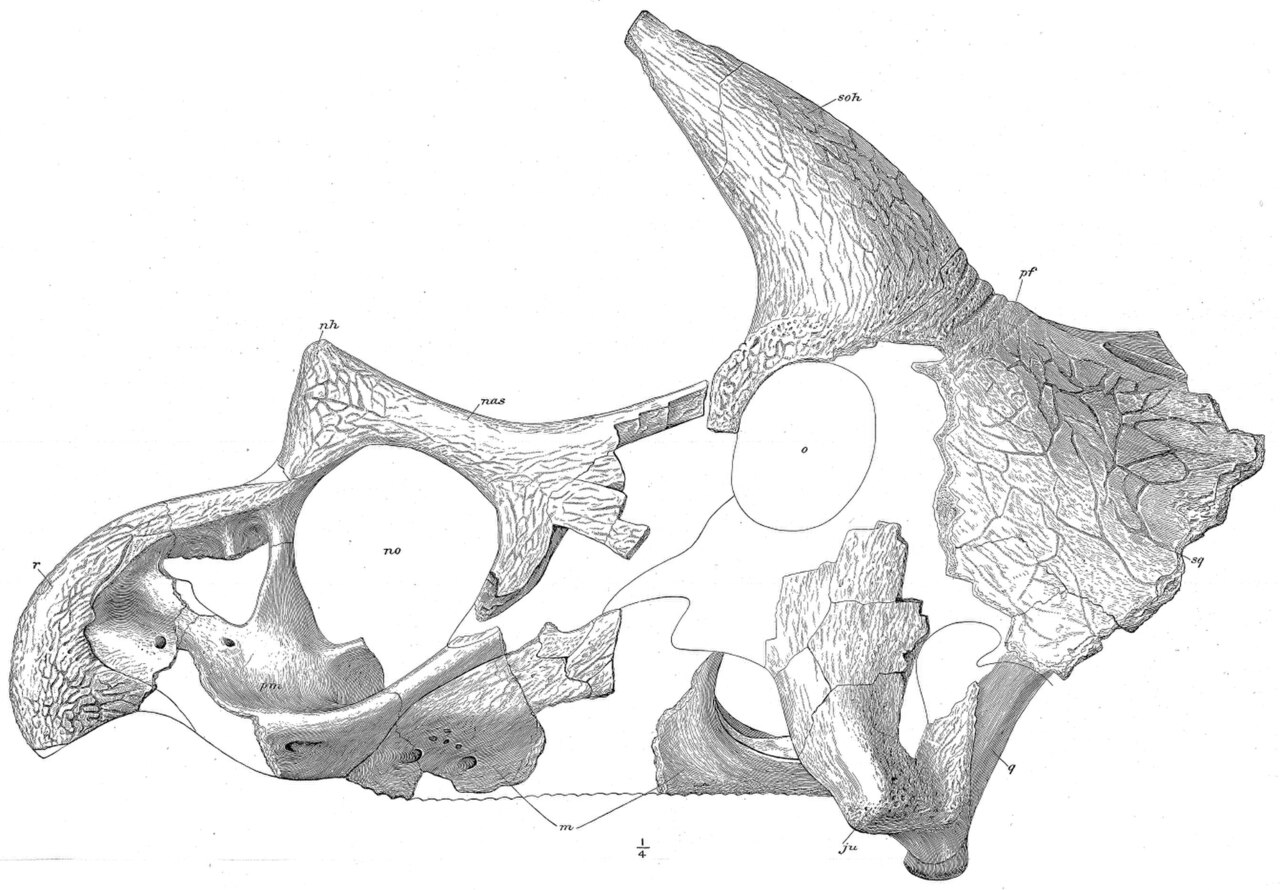
Marsh and later scientists gave Triceratops many different names. In all, 17 species have been named over the years. Many were based on a single skull that looked a bit different.
The skulls do vary. They come from animals of different ages and sexes. Fossils were also squashed in different directions as the rock around them moved. Scientists had to work out which differences were real.
In 1986, John Ostrom and Peter Wellnhofer argued for just one species. Their reason was that a region usually holds only one or two kinds of any large animal. A few years later, Catherine Forster looked at more fossils. She found two groups of skulls. One group had a longer nose horn. The other had a shorter one.
Today, two species are generally accepted. They are Triceratops horridus and Triceratops prorsus. In 2014, John Scannella's team supported this. They found that the two sit in different layers of rock in the Hell Creek rocks of Montana. So they probably did not live at the same time. Most of the other 15 names are now thought to be one of these two, or are based on bones too poor to tell.
This shows how science works. The answer depends on the fossils found, and a new find can change it.
How was Triceratops built?
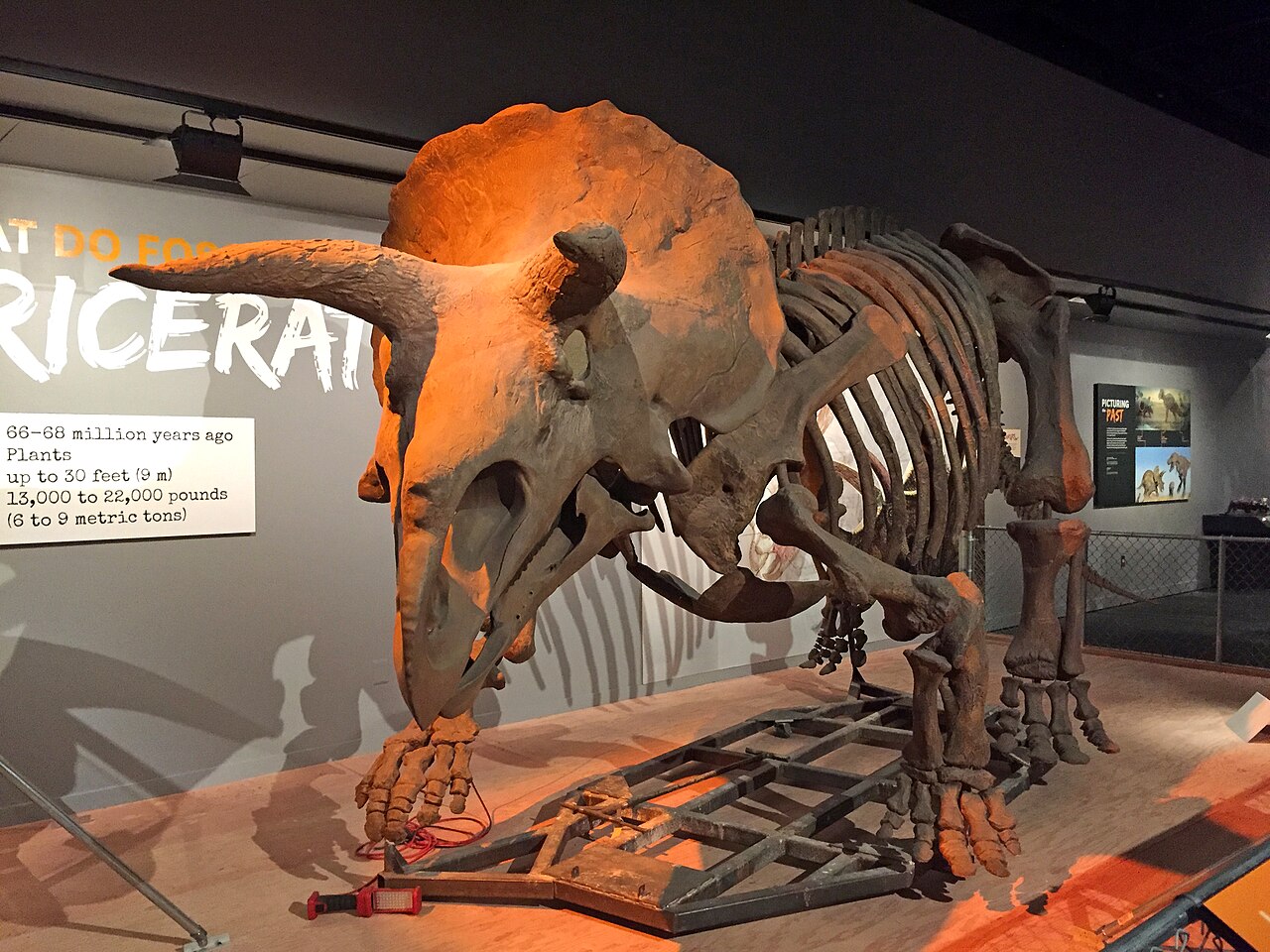
The skull of Triceratops was among the largest of any land animal. The biggest known skull may have been about 2.5 metres long. That is nearly a third of the animal's length.
The skull roof was fused into one strong piece. The was short and solid, unlike the frills of some relatives that had big holes.
The body was strong and stocky. Sturdy legs held up several tonnes. Short hands had three hooves, and the feet had four. The neck bones were fused at the front to hold the heavy head.
How did it stand? Early artists drew Triceratops with its front legs sprawled out like a lizard's. Fossil trackways and new skeleton models show it stood more upright. The elbows bent a little outwards, a pose in between. Rhinos stand in much the same way.
The backbone had about 10 neck bones, 12 back bones and about 45 tail bones. Triceratops walked on four legs, so it did not need a long tail to balance its head.
One study suggests it held its head at about 45 degrees to the ground. That would show off its horns and still let it feed on low plants.
What did Triceratops eat?
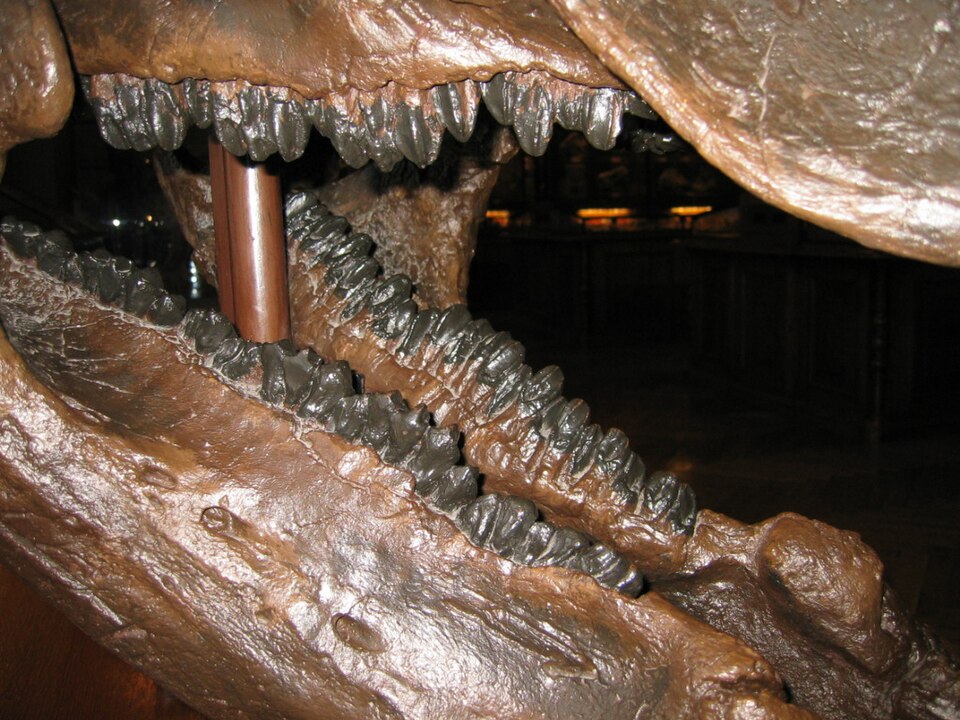
Triceratops ate plants. Its head hung low, so it probably fed on ferns and other low-growing plants. It may also have pushed over taller trees and shrubs with its horns, beak and sheer weight.
The beak was deep and narrow, and it was best at grabbing and plucking rather than biting. Behind it came the teeth.
Triceratops teeth were arranged in groups called batteries. Each side of each jaw had 36 to 40 columns. Each column had 3 to 5 teeth stacked on top of each other. That gave a total of hundreds of teeth, from about 430 to 800. Only a few were in use at any moment. When one wore out, another pushed up to replace it, and this went on all through life.
The teeth sheared against each other, like scissor blades. They cut tough, fibrous plants into smaller bits. A huge animal needs a lot of food, so this was perfect for chewing great volumes of leaves and stems.
Fossil clues show what grew nearby. Plants such as pines, plane trees, hazels, poplars and swamp cypress lived in the same rocks. Palms, cycads and ferns were probably on the menu too.
Teeth of Triceratops and the duck-billed Edmontosaurus show different chemical signatures. So they probably ate different plants or lived in different spots. This is called partitioning, and it let both of them thrive.
What were the horns and frill for?
People often picture Triceratops fighting Tyrannosaurus. There is some real evidence. A Triceratops brow horn and bone show partly healed bite marks from a tyrannosaur. The horn was also broken, and then it regrew. So the two did meet face to face, and the Triceratops survived. We cannot tell which one started it. A different Triceratops hip bone has deep tooth scores. Tyrannosaurus also fed on dead Triceratops.
But defence may not have been the main use. The frill and horns differ a lot between horned dinosaur species, so each species looked unmistakable. This points to . Animals such as deer and antelope use horns today to show off for mates and rivals.
Other evidence supports this. The frill and horns appear very early in life, long before the animal could breed. They may have helped young animals to recognise their own kind. The idea of species recognition is debated, though.
Triceratops may also have used its horns against its own kind. Some skulls have healed holes the size of a Triceratops horn tip. One in about seven skulls shows injury, which is far more than in the related Centrosaurus. Locking horns was possible, though it probably looked different from the fights of modern animals.
The frill might also have helped to shed heat. It cannot explain the huge variety, so display is the better answer.
How did Triceratops grow up?
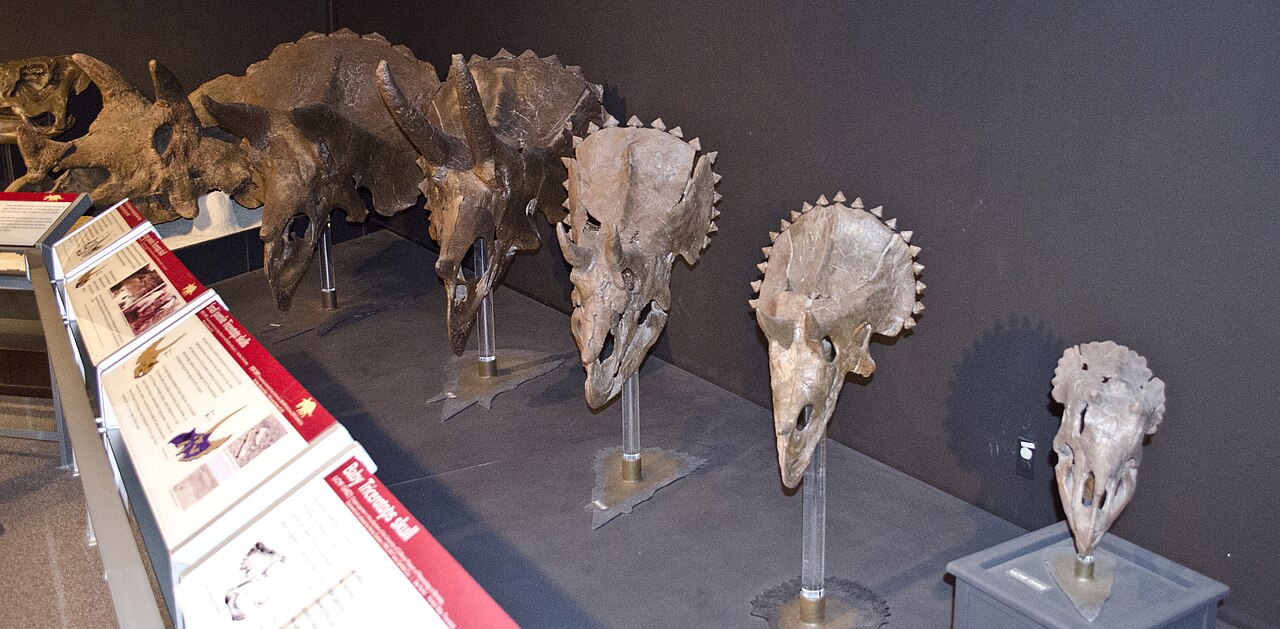
Triceratops fossils come from every stage of life, from tiny babies to old adults. A 2006 study by Jack Horner and Mark Goodwin looked at 28 skulls. It sorted them into four stages: baby, , subadult and adult. The smallest skull was only 38 centimetres long.
The head changed a lot as the animal grew. Babies had small, backward-pointing horns. As they grew, the horns turned forwards and got longer. The little bumps around the edge of the , called epoccipitals, became smaller and flatter. Parts of the horn became hollow. Big John, a huge skeleton sold at auction in Paris in 2021, was guessed by the team that assembled it to be about 60 years old when it died. That is only an estimate.
Then came a surprise. In 2010, John Scannella and Horner suggested that a dinosaur called Torosaurus was just an old, fully grown Triceratops. Torosaurus had a longer frill with two big holes. Skull bone in horned dinosaurs can grow and shrink, so the frill might have stretched and opened holes with age.
That idea sparked a long debate. Other scientists said that no young Triceratops showed signs of turning into a Torosaurus. Studies in 2013 and 2022 supported the view that the two were different animals living at the same time. So most scientists now think that Torosaurus is a separate dinosaur, though the question is not fully settled.
What was its world like?
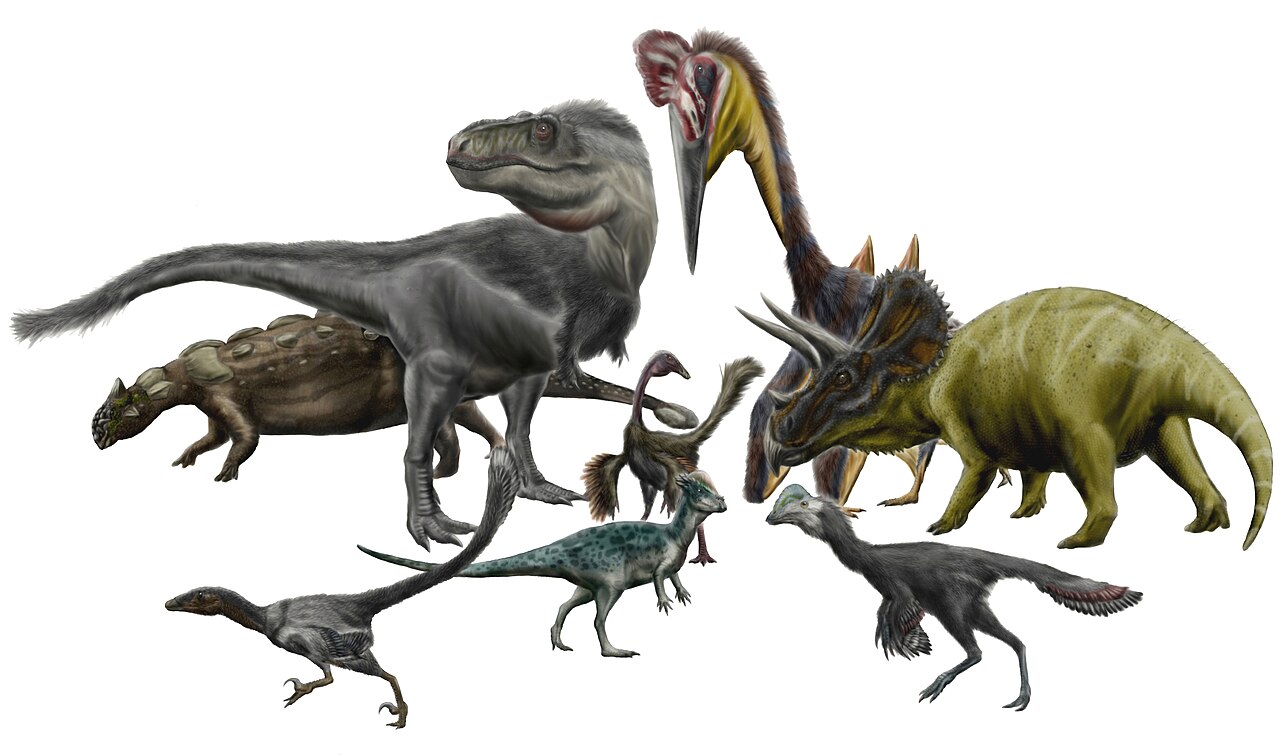
Triceratops lived in the rocks of the Hell Creek and Lance formations, in states such as Montana, Wyoming and the Dakotas. Back then, it was a warm land of floodplains, rivers and forests. Isotope studies suggest it favoured wet areas, though it was not tied to one habitat.
It shared the land with many other animals. Duck-billed Edmontosaurus fed on the same plants. Armoured Ankylosaurus and thick-skulled Pachycephalosaurus lived there too. The hunters included Tyrannosaurus, raptors and fast, ostrich-like dinosaurs. There were also early mammals, crocodiles, turtles and birds.
Triceratops was the most common big dinosaur of its time and place. Barnum Brown said he had seen over 500 skulls in the field. In 1986, Robert Bakker estimated that Triceratops made up five-sixths of the large dinosaurs at the end of the . Skulls survive so well that they may exaggerate the numbers.
Were they herd animals? Popular pictures show herds, but the evidence is thin. Bone beds of other horned dinosaurs hold thousands of animals. Triceratops bone beds are rare. One in Montana holds three young animals. In 2012, three Triceratops of different sizes were found together in Wyoming. They may have been a family. Bones of the biggest one show tooth marks of T. rex.
Triceratops died out 66 million years ago, along with the rest of the non-bird dinosaurs.
What was its skin and body like inside?
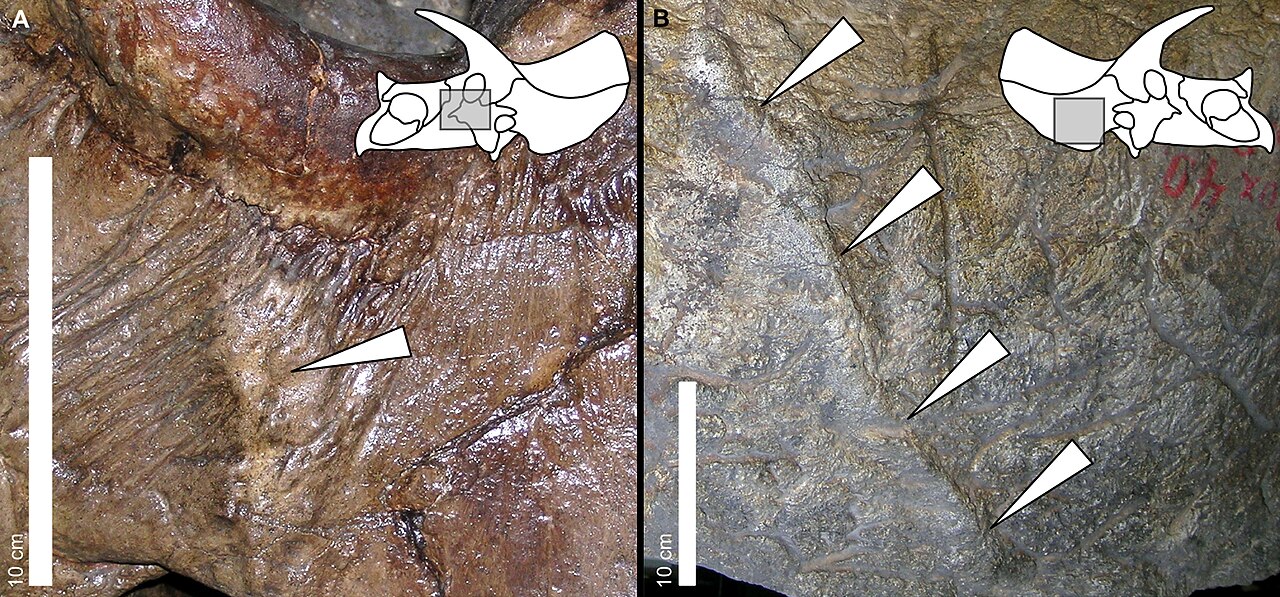
A Triceratops nicknamed Lane, found in Wyoming in 2002, shows what the skin looked like. The skin pattern is preserved over much of the body. It is not the real skin. It is a thin layer of clay that formed from a film of bacteria on the dried body. The clay copied the skin in fine detail.
The skin was covered in large, tile-like scales up to 9 centimetres across. That is the largest known in horned dinosaurs. Between them were bigger scales, over 10 centimetres wide, with six or seven sides. Each had a low, cone-shaped bump in the middle. Skin from a , on another animal, shows small, many-sided scales.
Brain scans of skulls show what it could sense. Triceratops had a poor sense of smell compared with other dinosaurs. Its ears were tuned to low sounds. These are the kinds of sounds a big animal in a herd might make or hear.
A study in February 2026 by Seishiro Tada and colleagues used CT scans to look at the big nose area. It suggested a cooling system, in which moist surfaces inside the nose take heat from the blood going to the brain and eyes. A thick skull would otherwise overheat.
How warm-blooded was it? Studies disagree. A 2022 study of chemical traces suggested a slow, reptile-like metabolism. Another study suggested it was gigantothermic, meaning that its huge body kept heat in. The answer is still open.
Explore Next
Your audio story keeps playing while you look around.
Words to Know
- ceratopsian
- A horned, plant-eating dinosaur with a beak and a frill.
- convergent evolution
- When unrelated animals evolve similar features to meet similar needs.
- Cretaceous
- The last period of the dinosaur age, ending 66 million years ago.
- dental battery
- A block of many stacked teeth that work as one chewing surface.
- display
- A show of horns, colour or movement to attract a mate or warn a rival.
- frill
- The wide plate of bone at the back of a horned dinosaur's skull.
- herbivore
- An animal that eats only plants.
- holotype
- The one specimen used to define a species when it is first named.
- juvenile
- A young animal that has not yet reached adult size.
- niche
- The particular way and place a species finds food and lives.