Tyrannosaurus
The tyrant lizard king, a hunter with a bite like no other land animal.
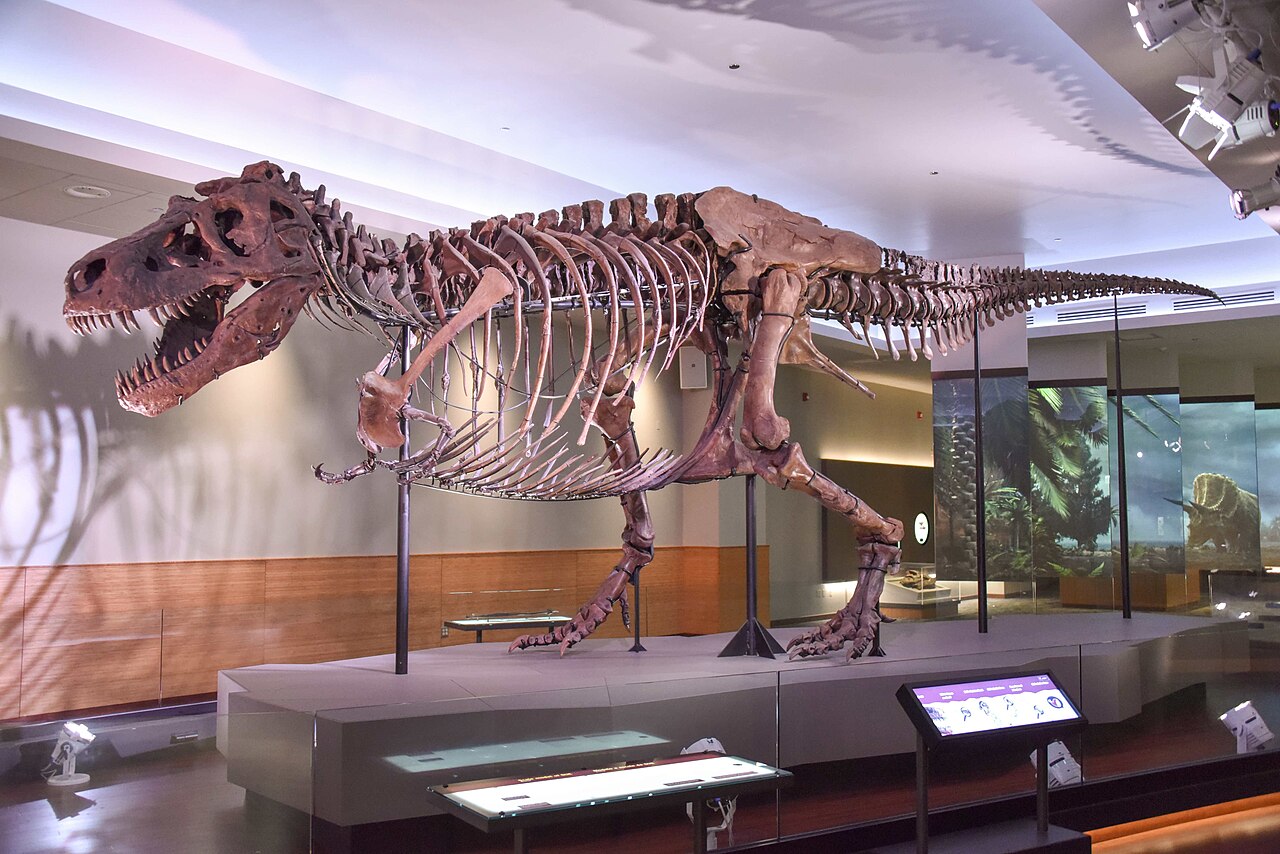
Tyrannosaurus rex is the most famous dinosaur of all. It lived about 69 to 66 million years ago, in what is now western North America. Adults were about 12 to 13 metres long and weighed around 8 tonnes, as heavy as a big elephant. Its skull was packed with teeth the size of bananas, and its bite was the strongest of any land animal known. Yet its arms were tiny. Over 100 years of digging have turned up dozens of skeletons, some nearly complete, and they show how it grew, how it ate and how its family fits in the dinosaur tree.
What was the tyrant lizard king?
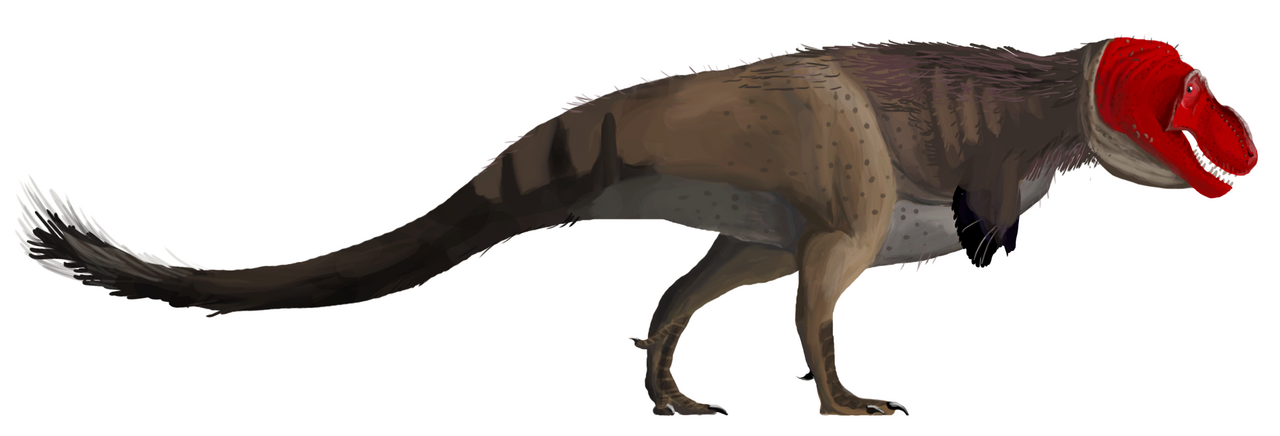
Tyrannosaurus rex was a , one of the two-legged, meat-eating dinosaurs. The name comes from Greek and Latin, because "tyrant" and "lizard" are Greek words and "rex" is Latin for king. Scientists often shorten the name to T. rex.
It lived at the very end of the dinosaur age. Its fossils come from rocks 69 to 66 million years old, in places like Montana, Wyoming and Saskatchewan. At that time, North America was split by a sea, and T. rex lived on the western half, an island continent called .
The biggest adults were around 12 to 13 metres long, about the length of a school bus, and they stood nearly 4 metres high at the hips. Most weight estimates fall between 5.4 and 8 tonnes, and a few giants may have reached almost 9 tonnes.
T. rex walked on two strong back legs, and a long, heavy tail balanced the huge head. It was the biggest meat-eater in its world, and it hunted horned, duck-billed and armoured dinosaurs. Other large theropods may have been as big or bigger, but T. rex is among the largest land hunters ever known.
Who found T. rex?
Small pieces of T. rex turned up long before anyone knew what they were. A tooth was found in Colorado in 1874. In 1892, the fossil hunter Edward Cope found two bones from the back of a big dinosaur and thought they belonged to a horned dinosaur. Years later, they were shown to be T. rex.
The real breakthrough came from Barnum Brown, a fossil hunter for the American Museum of Natural History in New York. In 1900, he found a part skeleton in Wyoming, and in 1902 he found a better one in the Hell Creek rocks of Montana. He wrote that he had never seen anything like it from the Cretaceous.
The museum's president, Henry Fairfield Osborn, gave it the name Tyrannosaurus rex in 1905 and named a second skeleton Dynamosaurus. A year later he saw that they were the same animal and kept the better name.
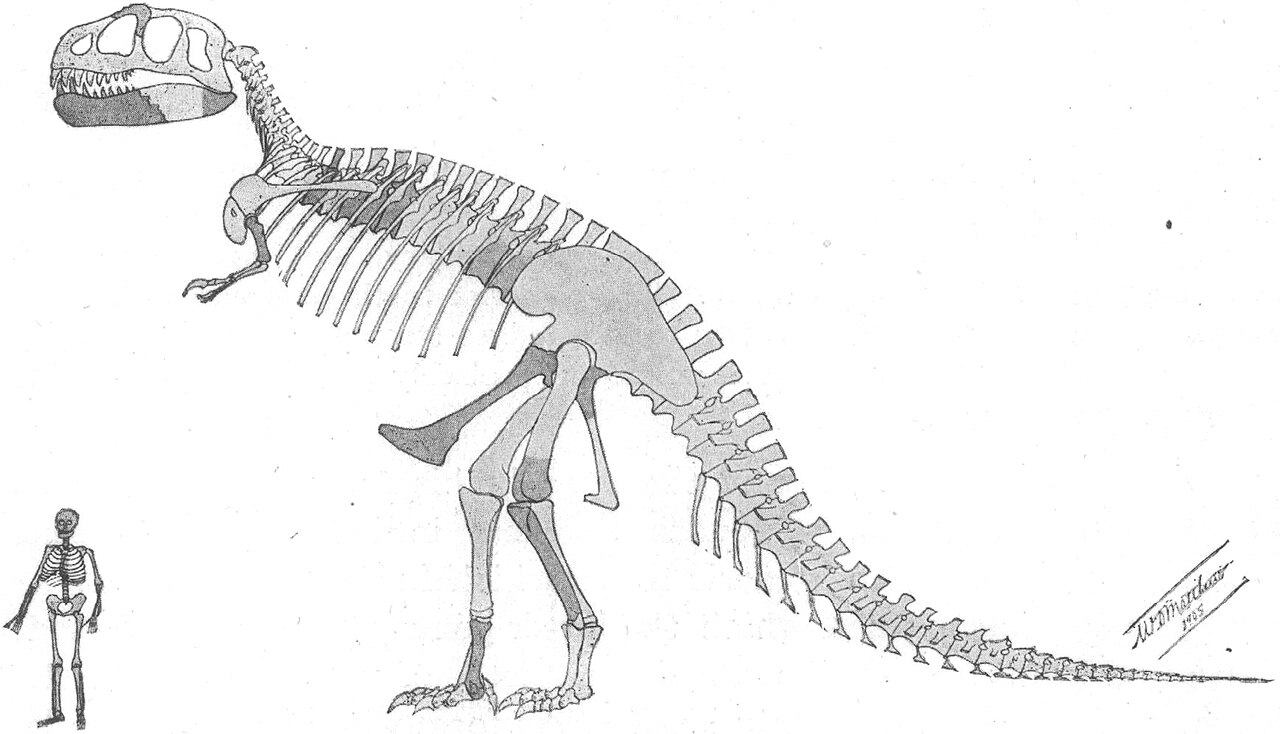
The first picture of the animal was a skeleton drawing in 1905. For decades, books showed T. rex standing upright with its tail dragging, like a kangaroo. Scientists now know it held its body level, with the tail stretched out behind to balance the head.
For 50 years, Brown's skeletons were almost the only ones, because wars and the Great Depression kept diggers out of the field.
Why is Sue so famous?
Interest in T. rex rose again from the 1960s, and today around 40 skeletons are known, from bits to almost whole. The 1990s alone gave nearly twice as many finds as all earlier years.
The star is Sue. On 12 August 1990, the fossil hunter Sue Hendrickson spotted bones sticking out of a cliff in South Dakota. The skeleton is about 85 per cent complete and one of the largest, at about 12.3 metres long. Ownership of the bones ended up in court, and in 1997 the landowner won. The Field Museum in Chicago bought Sue at auction for $7.6 million. The mounted skeleton opened to the public in 2000.
Bones can tell a story. Sue's rings of growth show she reached full size at about 19 and died aged around 28. Newer studies put her age at 27 to 33. She has healed breaks and bite marks from a hard life.
Another famous skeleton is Stan, dug up in South Dakota in 1992. About 70 per cent of Stan is preserved. It shows many old injuries, including a hole in the back of the skull about the size of a T. rex tooth. In 2020, Stan sold at auction for $31.8 million, a record for a fossil at that time. In July 2024, a Stegosaurus called Apex sold for $44.6 million and took the record. Stan now stands in the Natural History Museum Abu Dhabi, which opened in November 2025.
Some T. rex skeletons are named after finders, such as Bucky. At 20 years old, Bucky Derflinger found a toe bone in 1998.
How strong was its bite?
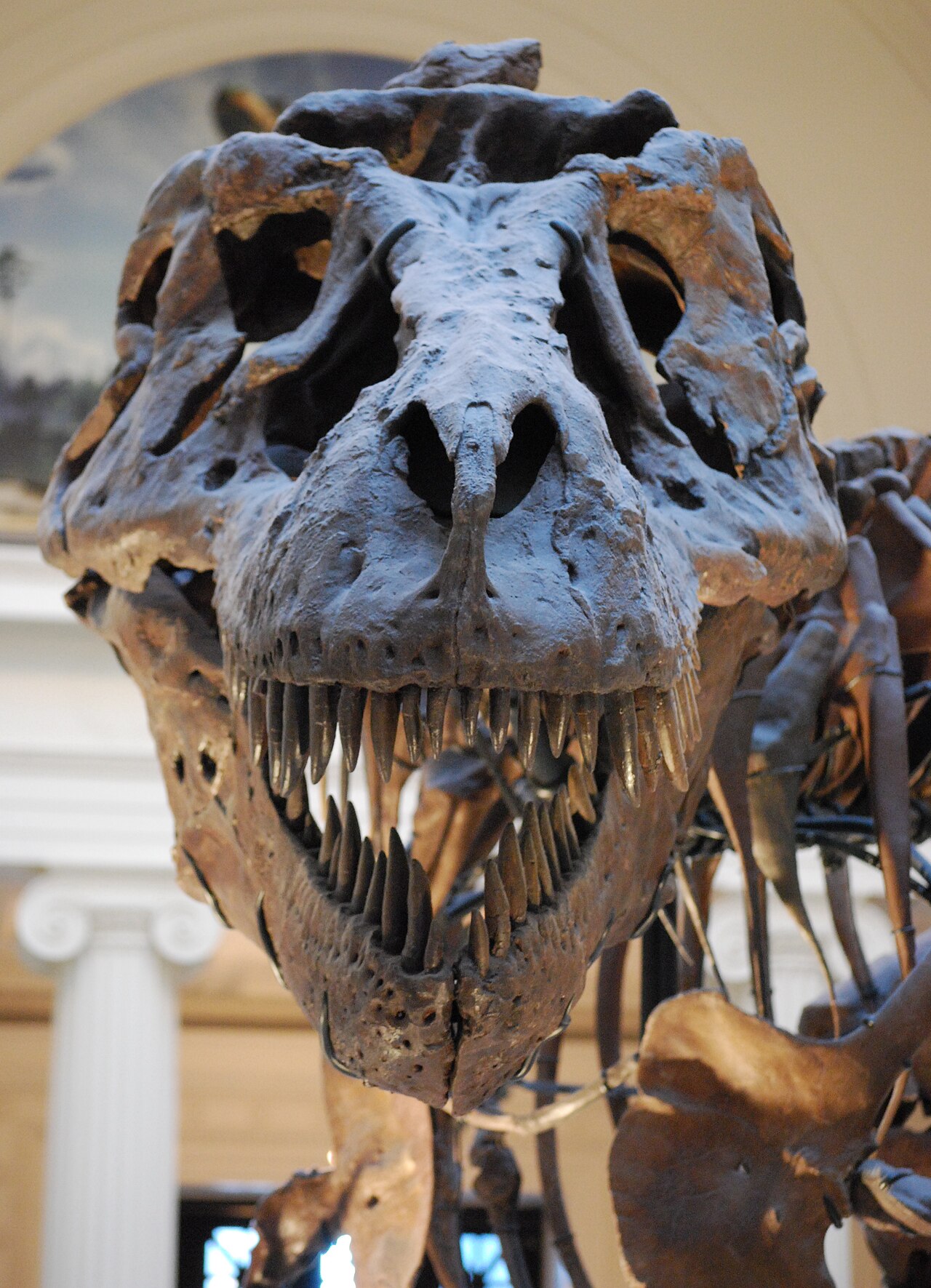
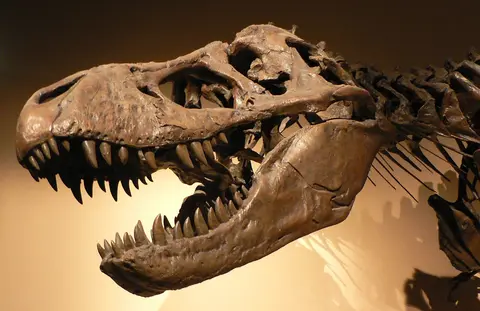
The T. rex skull could be 1.5 metres long, almost as long as an adult person is tall. It was very wide at the back and narrow at the front, and this shape let both eyes look forward, giving it good depth vision.
The skull bones were thick, but many had air spaces inside, which kept the head light. Big holes in the skull saved weight too, and strong muscles filled the gaps.
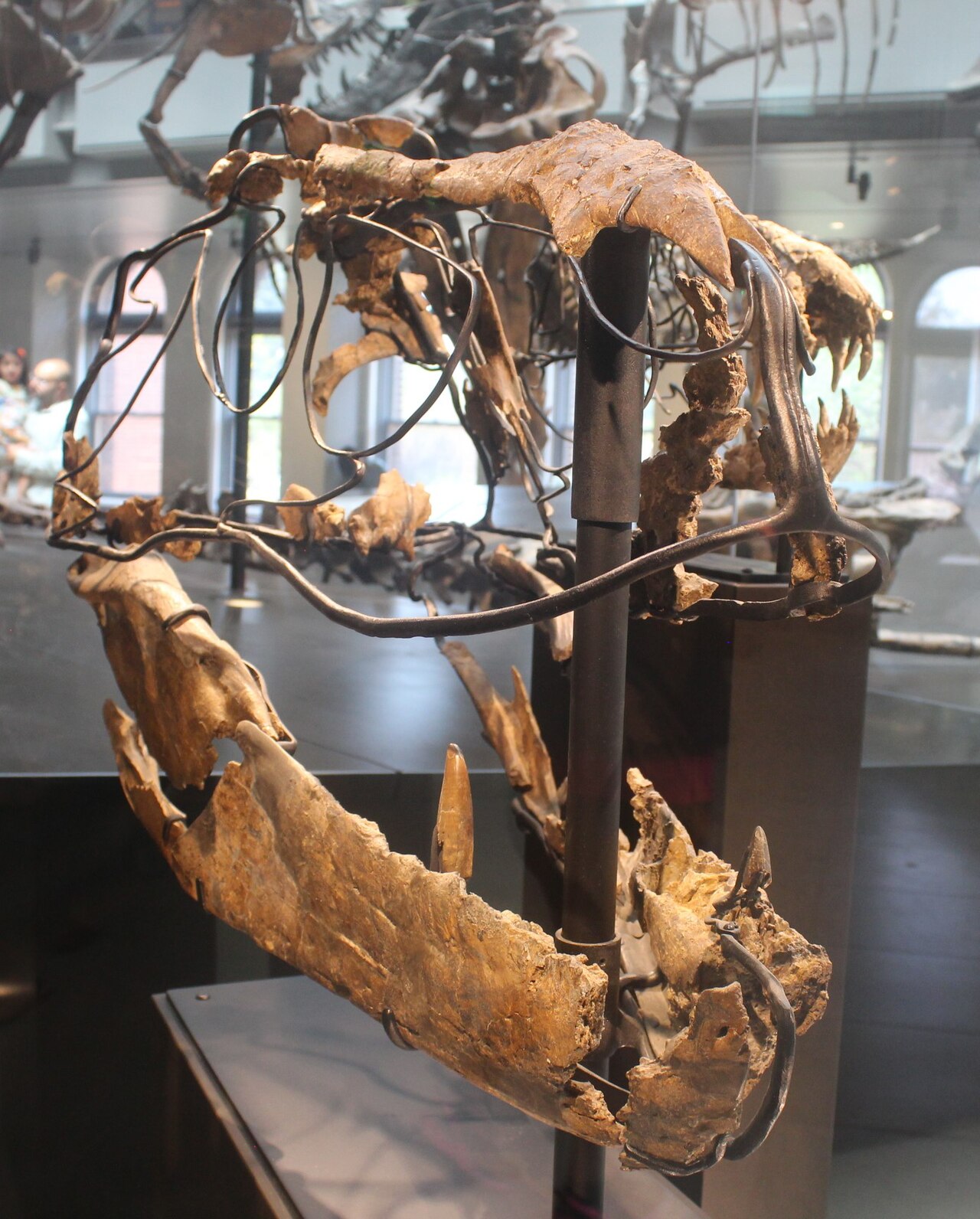
The teeth were the most striking part, and T. rex had about 60 of them. They were not thin blades like a knife. They were thick and ridged, like "lethal bananas", which made them hard to snap. The biggest tooth found was about 30 centimetres long, including the root. That is the longest of any meat-eating dinosaur found so far. Teeth at the front of the upper jaw were smaller and closer together.
The jaw joint was built to take huge force, and estimates put the bite as the strongest of any land animal known. It could crush bone. T. rex bit down, then pulled back to rip off flesh.
How do we know? Scientists compare skull bones to those of crocodiles, birds and other living animals, and they build computer models of the muscles. Fossil bones of its prey show tooth marks that match T. rex teeth.
Why did it have such tiny arms?
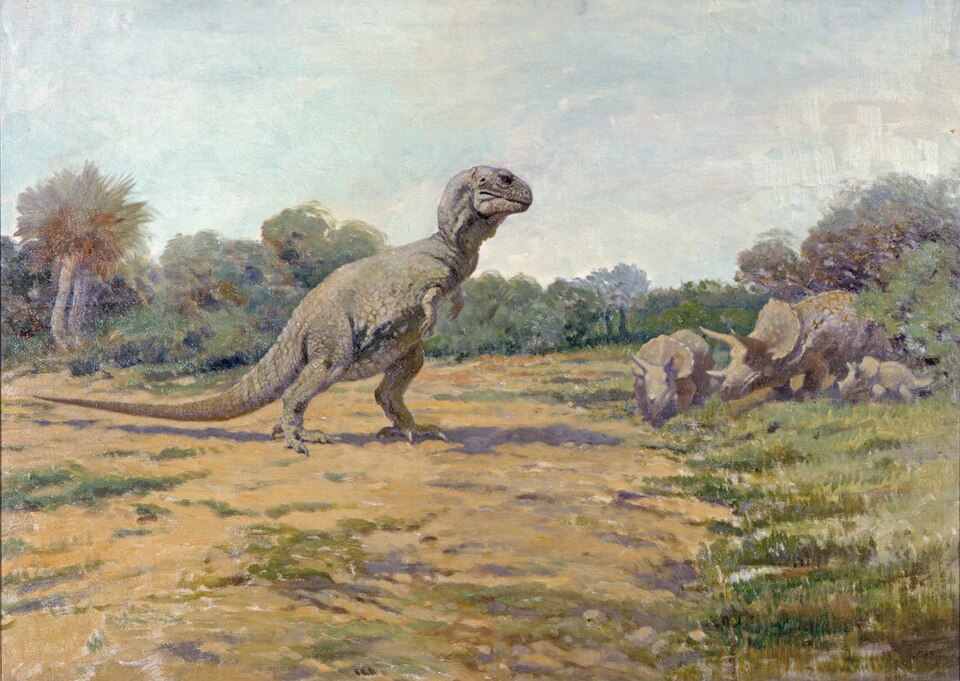
Every picture of T. rex shows its arms. They were less than a metre long and had just two clawed fingers, with a small third finger bone left over. Compared with its giant head and legs, they look tiny.
But they were not weak. The arm bones were thick, and the muscle scars show they were strongly built, so a grown T. rex could probably lift a heavy weight with one arm.
Nobody knows for sure why the arms were so small, but many ideas have been suggested. The head may have done the work that the arms once did, and since the jaws were the main weapon, short arms stayed out of the way. Other tyrannosaurs had small arms too, and in the family tree the arms shrank over millions of years.
The back legs were the opposite, long and very strong. The thigh muscles were huge and attached to the tail. Many bones were hollow, so the skeleton stayed strong without being too heavy.
How fast could it move? Scientists estimate the speed using bone strength and muscle size. T. rex was far too heavy to sprint like a racehorse, so it probably walked quickly and could run in short bursts. The exact top speed is still debated, and estimates vary a lot.
Was T. rex a hunter or a scavenger?
For many years, scientists argued about this. Some said T. rex was a pure , too slow and with arms too small to hunt. Others said it was a top hunter. Today, most scientists agree it was a .
There are several clues. T. rex had good eyesight and a good sense of smell. Its big nose area held large smell-sensing parts of the brain that would help find food from far away. It was also the biggest meat-eater in its world, with no rival to hunt it.
There is direct evidence too. Some duck-billed dinosaur bones show a bite wound that has healed over. That means the animal was alive and escaped, and a scavenger does not need to bite a living animal.
It probably did both, as most big meat-eaters today, such as lions and hyenas, hunt and scavenge. A free meal of a dead animal is hard to turn down.
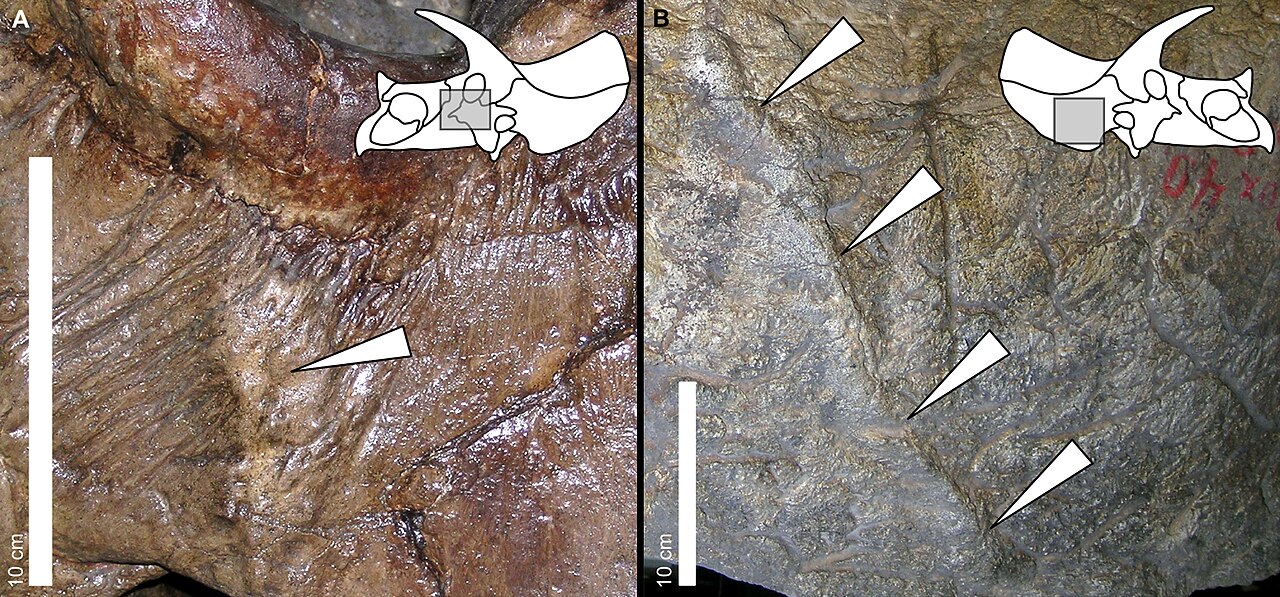
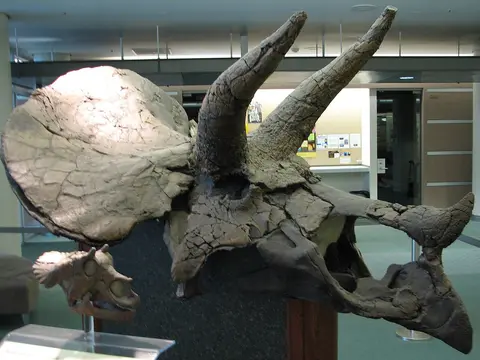
Its main prey was probably duck-billed dinosaurs, and young horned and armoured dinosaurs were also on the menu. Triceratops lived in the same forests, and one Triceratops specimen has bones that show breakage and puncture marks from T. rex teeth.
T. rex was probably the top of its food chain. Young T. rex ate smaller prey than the adults did, so the family used the food of the area in different ways.
How did a T. rex grow up?
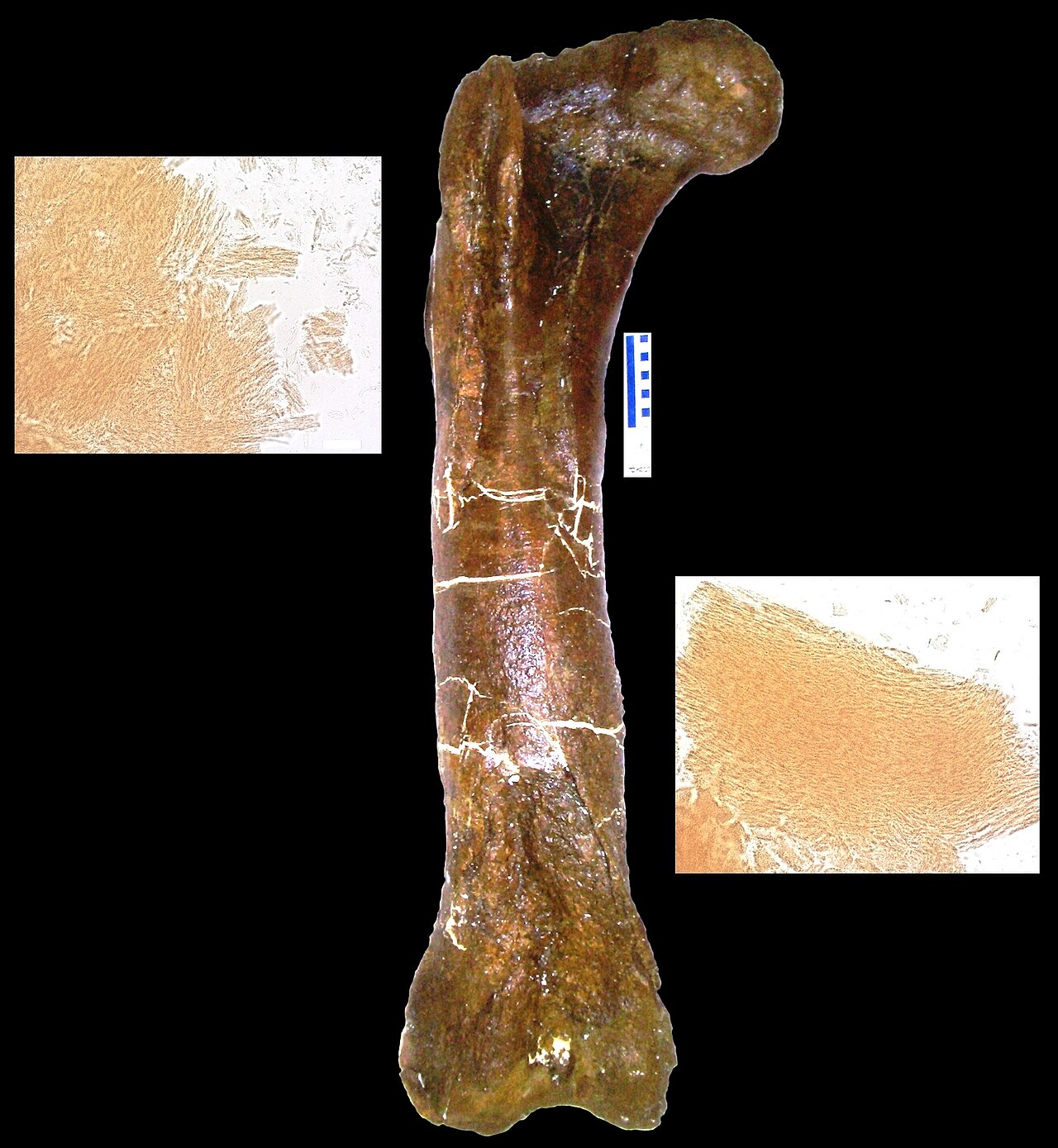
Rings inside fossil bones work a bit like tree rings. Scientists cut thin slices from the bones and count the rings, which shows the age of each animal when it died. When they plot age against weight, the result is a growth curve.
The curve is shaped like a letter S. Young T. rex grew slowly until about the age of 14, and then came a growth spurt. For about four years, a teenager could gain roughly 600 kilograms in a year, and after about age 18 growth slowed down. A study of 17 skeletons, published in January 2026 by Holly Woodward and colleagues, argued that growth was more gradual than that. Hidden suggested that full size might come as late as 35 to 40 years. Results like this change as new tests are done.
T. rex lived fast and died young. Sue lived to about 28 or a little more, and the oldest known T. rex was at least 30. Over half of known adults died within six years of becoming old enough to breed.
One famous skeleton, B-rex, had a special bone tissue inside the thigh bone, the kind that female birds make today to build up calcium for eggs. This showed that B-rex was a female ready to lay eggs.
Eggs and hatchlings are very rare, but a study in July 2026, led by Nicholas Longrich, described the first hatchling bones, found in museum collections. It estimated that a baby was about 75 centimetres long and weighed about 2.5 kilograms or a little less, about as much as a cat.
Did T. rex have feathers?
This is one of the biggest questions about T. rex. Many had feathers, but the question is whether the giants kept them.
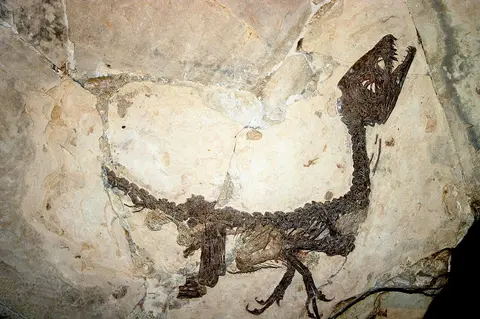
In 2004, scientists described Dilong, a small tyrannosaur from China about 125 million years ago. It had thin, hair-like , the early forms of feathers. Some thought that big tyrannosaurs lost them because large bodies do not lose heat fast. Then came Yutyrannus, a giant tyrannosaur about 9 metres long that also lived in China and was covered in filaments. So size alone did not remove feathers.
What about T. rex itself? Skin patches from a T. rex nicknamed Wyrex show small scales on the tail, hip and neck. A 2017 study of all the skin fossils concluded that T. rex had mostly scales, with feathers at most on the back. A fully feathered T. rex is unlikely, but the question is not closed.
Scientists also found soft tissue in T. rex bones. In 2005, Mary Schweitzer's team broke open a thigh bone and found stretchy tissue and tiny blood vessels, and later tests found pieces of the protein . These match the proteins of birds, which supports the link between birds and dinosaurs. Some scientists are cautious, though, and say contamination is hard to rule out.
Lips are another debate, as some scientists think T. rex had lips that covered its teeth and others say it had flat scales on its snout.
Was T. rex one species, or more?
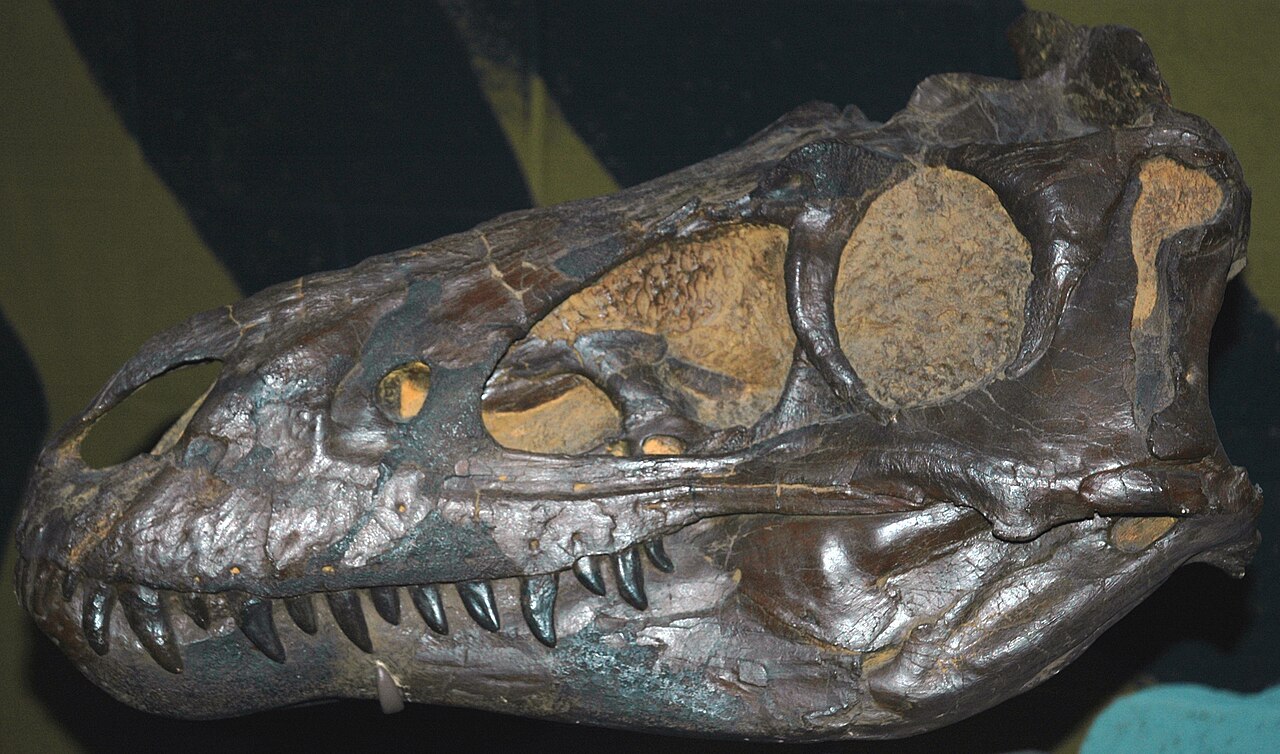
T. rex belongs to the , a family of big hunters with small arms. Its closest relative is probably Tarbosaurus from Mongolia. Some scientists think T. rex's ancestors came from Asia and crossed to North America.
In 2022, a team led by Gregory Paul argued that there were three T. rex . They named two new ones, T. imperator and T. regina. Most scientists were not convinced and say the differences are just natural variation, as in any animal. In 2024, another new species, T. mcraeensis, was named from New Mexico. Later studies questioned it, and the debate goes on.
A bigger puzzle is called Nanotyrannus, "dwarf tyrant". A small, slim skull found in Montana was named in 1988. In 1999, scientists decided it was a teenage T. rex, so Nanotyrannus was dropped. Then in 2025, the researchers Lindsay Zanno and James Napoli described a fully grown skeleton and argued that it shows Nanotyrannus is a separate, smaller species. Other scientists still disagree.
This matters because many of the "teenage T. rex" skeletons might be something else. Counting them, and using them to work out how T. rex grew, depends on the answer. In science, a debate like this is normal. New fossils and new tests keep changing the picture.
Explore Next
Your audio story keeps playing while you look around.

Words to Know
- collagen
- A tough protein found in bone, skin and tendons.
- filament
- A thin, hair-like fibre, the simplest form of feather.
- growth rings
- Lines inside a bone that show how fast the animal grew each year.
- juvenile
- A young animal that has not yet grown to full size.
- Laramidia
- The western island continent of North America in the Late Cretaceous.
- predator
- An animal that hunts and kills other animals for food.
- scavenger
- An animal that eats animals it did not kill.
- species
- A group of living things that can breed together.
- theropod
- A two-legged dinosaur, mostly meat-eating, from which birds evolved.
- tyrannosaurid
- A member of the family of big-headed, small-armed hunters that includes T. rex.