Motion
Everything in the universe is moving, and it depends who is watching.
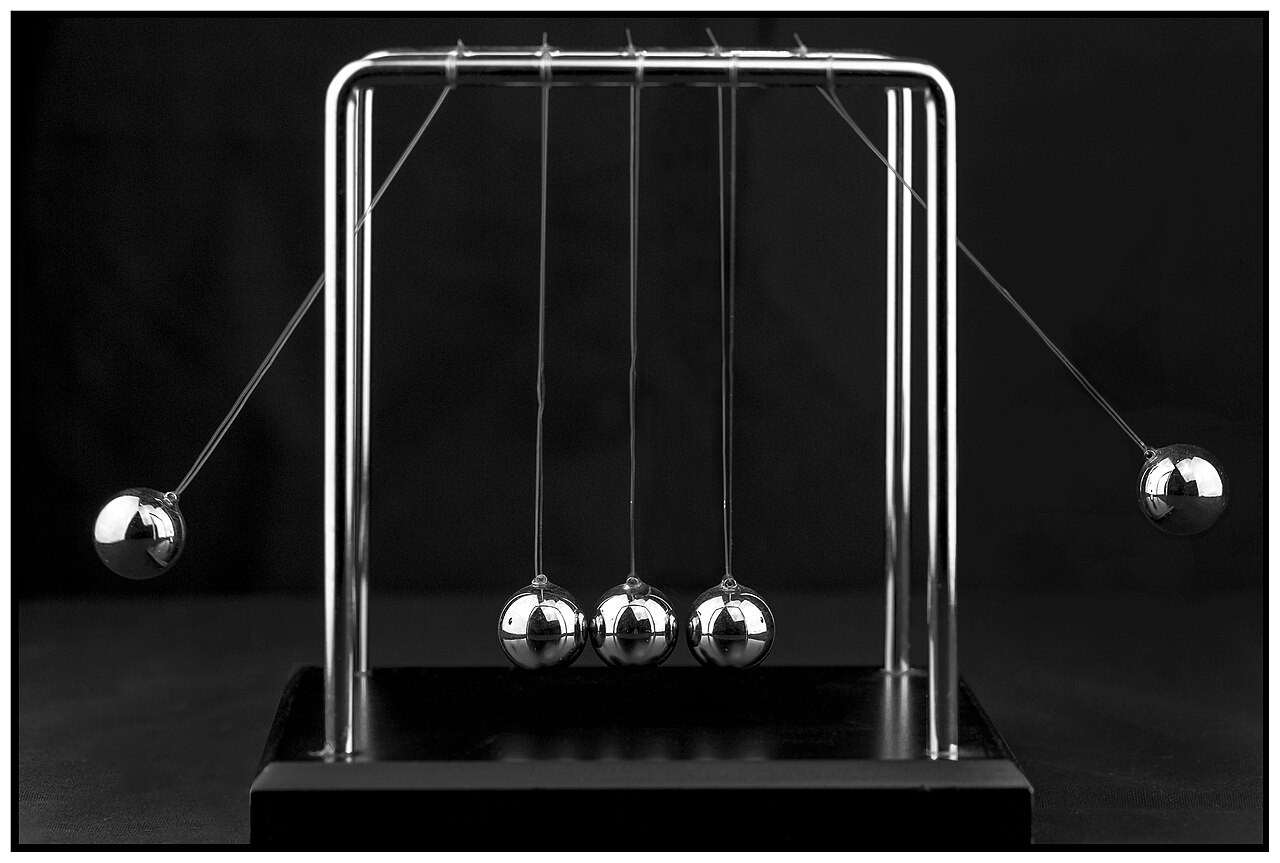
Motion is what happens when an object changes its position as time passes. A ball rolls, a planet orbits and blood flows through your veins. Physicists describe it with a handful of exact ideas such as speed, velocity and acceleration. Isaac Newton's three laws explain why things start, stop and turn. Motion is also stranger than it looks. Nothing is truly still, because you always have to ask what you are measuring against. Right now you are spinning with the Earth, circling the Sun and travelling around the Milky Way. Scientists have found ways to measure and explain all of this motion.
What does it mean to move?

sounds easy. A ball rolls, a bird flies, a car drives past. But physicists ask a careful question first. Moving compared with what?
In physics, motion means that an object changes its position over time. To say where something is, you need a reference point. Your school desk is 3 metres from the door. The door is the reference point. If the distance changes as the seconds tick by, the desk is moving relative to the door.
This idea of relative motion has a surprising result. Think of the passenger sitting opposite you on a train. Compared with you, they are not moving at all. Compared with the station platform, you both rush along. Neither answer is wrong. Each one depends on the , which is the point of view you measure from.
An object that does not change position compared with its surroundings is at rest. But rest is always relative. Modern physics says there is no single, absolute frame of reference that works for the whole universe. Isaac Newton thought there was one. Today scientists agree that you cannot find it. That means everything in the universe can be treated as moving, depending on who is looking.
Physicists split the study of motion into two branches. describes how things move without asking why. asks what cause the movement.
How do we measure motion?
To describe properly, physicists use a few exact words. Many of them sound alike in everyday talk, but each has its own meaning.
Distance is the total length of the path an object travels. Displacement is different. It is the straight-line change in position, with a direction. If you walk once round a running track, your distance is 400 metres but your displacement is zero, because you finish where you started.
Speed tells you how fast an object covers distance. A cyclist who goes 30 kilometres in 2 hours has an average speed of 15 kilometres an hour. is speed with a direction added. A car going 50 kilometres an hour north and one going 50 kilometres an hour south have the same speed but different velocities.
is the rate at which velocity changes. Pressing the pedal speeds a car up. Braking slows it down. Turning the wheel changes its direction. All three are accelerations, because the velocity changes in each case.
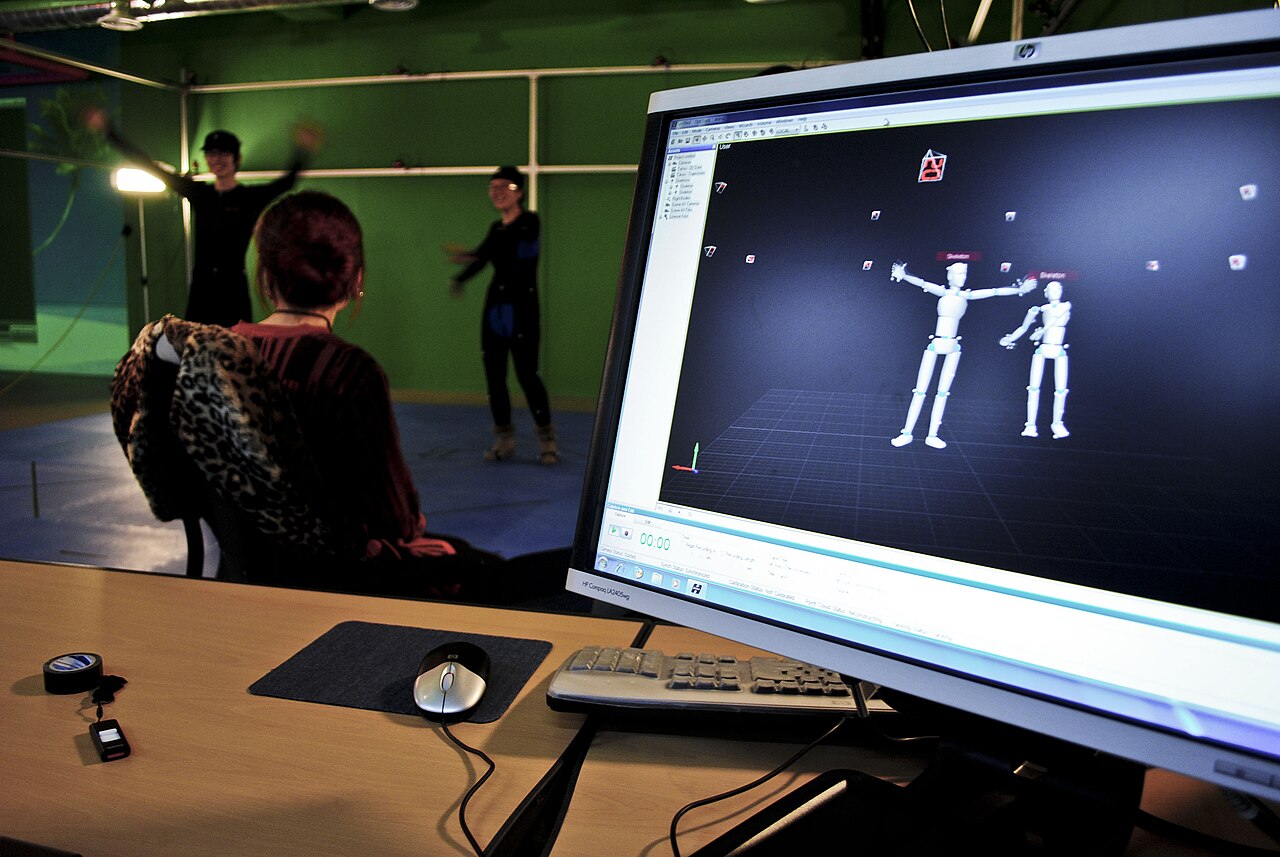
How do we measure all this? Simple tools use a ruler and a stopwatch. Modern labs use far better ones. In motion capture, cameras track markers placed on a person's body many times each second and a computer draws the movement as a moving skeleton. Film studios use it to animate characters, and sports scientists use it to study how athletes run and jump.
Why do things start, stop and turn?
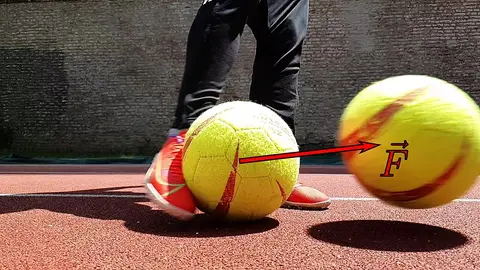
Why does a football stay still until you kick it? Why does it stop rolling in the end? The answers come from three laws that Isaac Newton published in his great book, the Principia, on 5 July 1687.
The first law says that an object at rest stays at rest. An object in keeps moving in a straight line at the same speed. Both stay that way unless a acts on them. This tendency is called . It surprises people, because on Earth things always slow down. The reason is that forces such as friction and air resistance quietly push against them. In the emptiness of space, with almost nothing to slow it, a spacecraft can coast for years.
The second law links force, mass and . For a fixed mass, force equals mass times acceleration. A heavier object needs a bigger push to speed up at the same rate. That is why an empty shopping trolley is far easier to get moving than a full one.
The third law says that every action has an equal and opposite reaction. When you push on a wall, the wall pushes back on you. A rocket works this way. It throws hot gas downwards and the gas pushes the rocket upwards.
Newton's laws were the first to explain both falling apples and orbiting planets with the same mathematics. They united the heavens and the Earth.
How can an object move along a line, a curve or a wheel?
Scientists sort movement into types, and the simplest is linear . An object in linear motion follows a straight path. A train on a long, straight track, or a skier racing down a slope, is a good example.
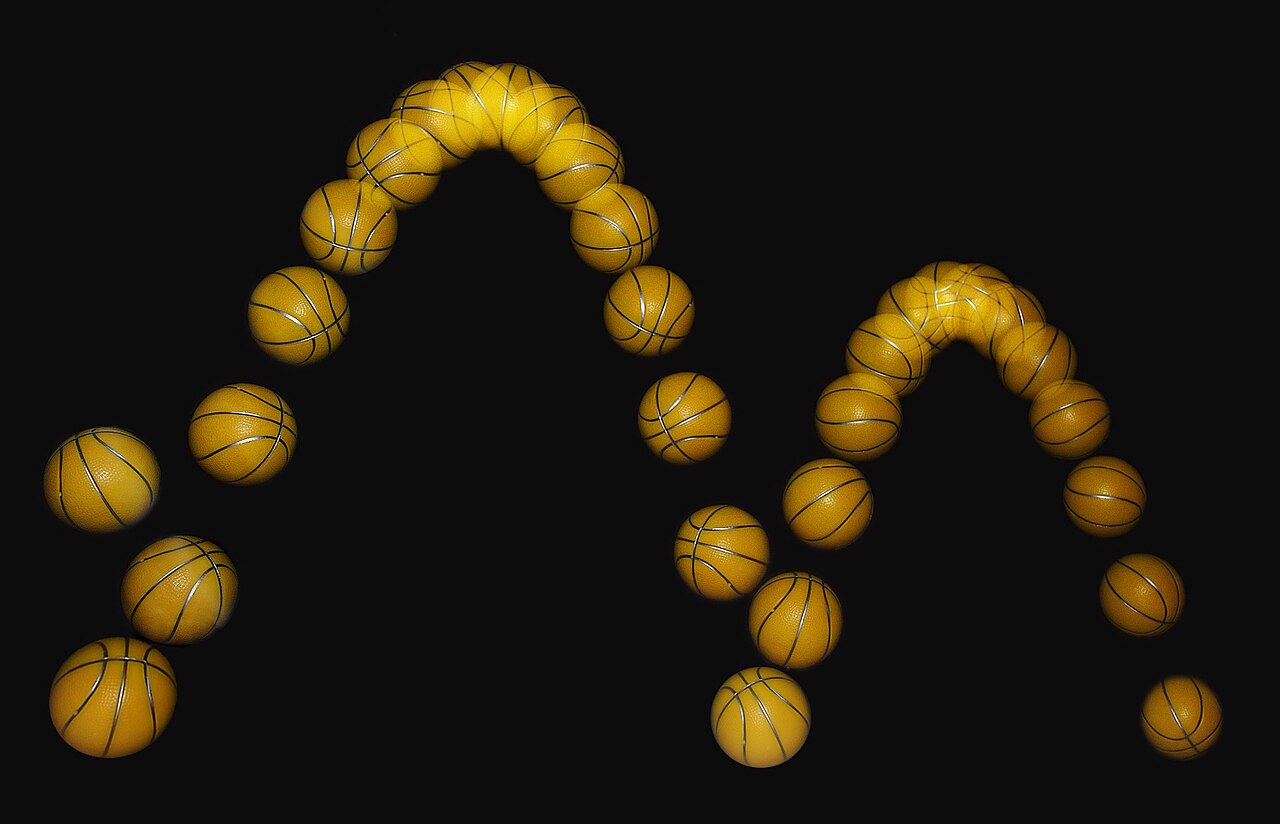
Many paths are not straight. Curvilinear motion follows a curved path, such as a car going round a bend. A thrown ball does something special. It moves forward at a steady rate while gravity pulls it down faster and faster. The two movements together make a curved arc. This is called motion. It describes a basketball shot, a kicked football and a water jet from a hose.
Wheels add another type. A rolling wheel moves forward and spins at the same moment. The invention of the wheel changed transport everywhere. Today, in towns across the world, people travel by bicycle, three-wheeled taxi, motorbike and bus. All of them depend on rolling motion, and each one follows Newton's laws as it speeds up, slows down and steers.
Real movement is often a mix. Think of a cyclist riding up a hill. The bike travels in a line, the wheels roll, the pedals go round in circles and the rider's legs move up and down. Physicists call this combination motion. To understand it, they break it into simpler parts and study each part on its own.
What moves in circles, swings and waves?
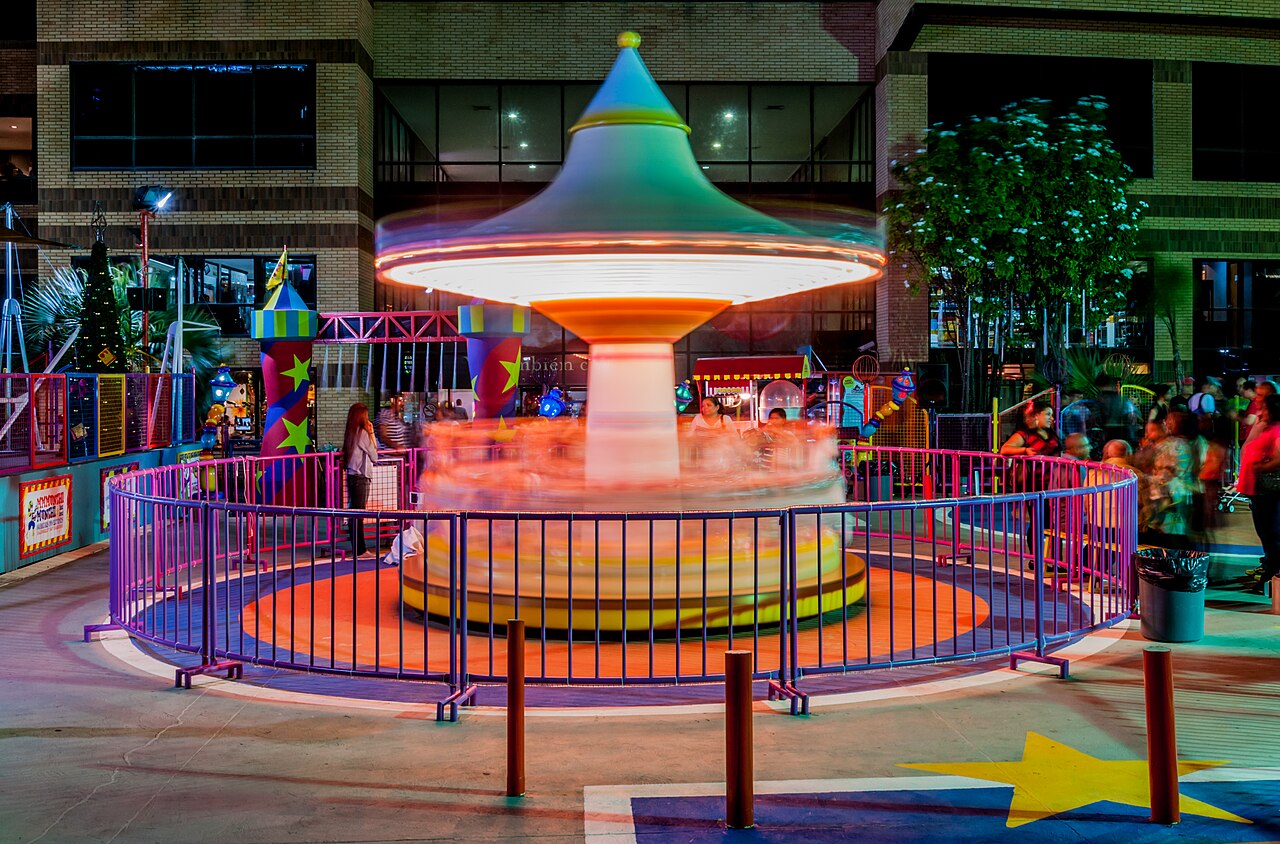
Some repeats itself again and again. Circular motion keeps an object at the same distance from a centre. The seats of a fairground carousel are one example, and a stone whirled on a string is another. The object keeps changing direction, so its keeps changing too. That means it is always accelerating, even if its speed stays the same. Something has to supply the pull towards the centre. For the stone it is the string. For the Moon going round the Earth, it is gravity.
Rotary motion means turning around a fixed point or line. A Ferris wheel and a spinning top do this.
is movement back and forth around a middle position. A child on a swing and a pendulum are good examples. Physicists call the simplest kind simple harmonic motion. In it, the pull back towards the middle gets stronger the further the object moves away. That is why a pendulum swings in a steady rhythm. Clocks used this for centuries.
A vibration is a very fast oscillation. A guitar string vibrates when plucked, and this makes the sound you hear.
A wave is another important kind of motion. In a wave, the energy travels along while the material mostly wobbles in place. A ripple on a pond moves outwards, but the water itself only bobs up and down.
How fast are you moving right now?
Right now you feel still. In fact you are travelling at tremendous speed, and you cannot feel it. There are two reasons. First, you are moving along with everything around you, and Newton's laws mean that steady has no feeling at all. Second, there is no obvious to show it.
Start with Earth's spin. Day and night happen because Earth turns once around its axis. At the equator the ground moves east at about 1,670 kilometres an hour. Earth also orbits the Sun once every 365 days or so, at about 30 kilometres every second. That is more than 100 times faster than an airliner.
The Sun itself is moving. It circles the centre of the Milky Way, and the whole Solar System travels with it, at roughly 220 kilometres a second. One lap takes more than 200 million years. The Milky Way is also moving through space relative to other galaxies.
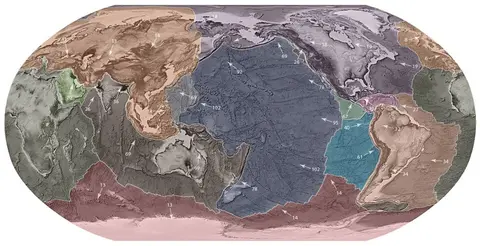
Even the ground beneath you creeps. The continents sit on huge plates that drift a few centimetres a year, about as fast as your fingernails grow.
The biggest motion of all is the expansion of the universe. In the 1920s Edwin Hubble showed that distant galaxies are moving away from us. The further away a galaxy is, the faster it recedes. The space between the galaxies is stretching.
Is there a speed limit in the universe?
Yes, there is. Nothing can travel through empty space faster than light. In a vacuum, light moves at exactly 299,792,458 metres per second, which is about 300,000 kilometres every second. In one second, a beam of light could go round the Earth more than 7 times.
This speed is more than a record for light. It is the upper limit for energy, matter and information. It is also strange in another way. Every observer measures the same value, however fast they are moving themselves. If you chased a light beam in a spaceship, it would still pull away from you at the same speed. Because of this, scientists use the speed of light as a basis of measurement. Since 1983 the metre itself has been defined using it.
This idea led Albert Einstein to special relativity. It describes at speeds close to light, where Newton's rules stop being accurate. His later general relativity added gravity, and showed that mass bends space and time.
Sometimes distant objects seem to move faster than light. Jets of matter from black holes can look that way. It is an illusion. Light from the object takes time to reach us, and this delay fools simple calculations.
For everyday things like cars, planets and rockets, Newton's laws work very well. For atoms, scientists use quantum mechanics, in which the exact place and speed of a particle cannot both be known at once.
Explore Next
Your audio story keeps playing while you look around.


Words to Know
- acceleration
- The rate at which velocity changes.
- Brownian motion
- The random jiggling of very small particles.
- dynamics
- The study of forces and how they change motion.
- force
- A push or pull that can change how an object moves.
- frame of reference
- The point of view or fixed point that you measure movement against.
- inertia
- The tendency of an object to keep doing what it is already doing unless a force acts on it.
- kinematics
- The study of how objects move, without asking what causes the movement.
- motion
- A change in an object's position over time.
- oscillation
- Movement back and forth around a middle position.
- projectile
- An object thrown or launched that then moves only under gravity.
- velocity
- Speed in a particular direction.