Milky Way
Our home galaxy, a spinning city of stars with a black hole at its heart.
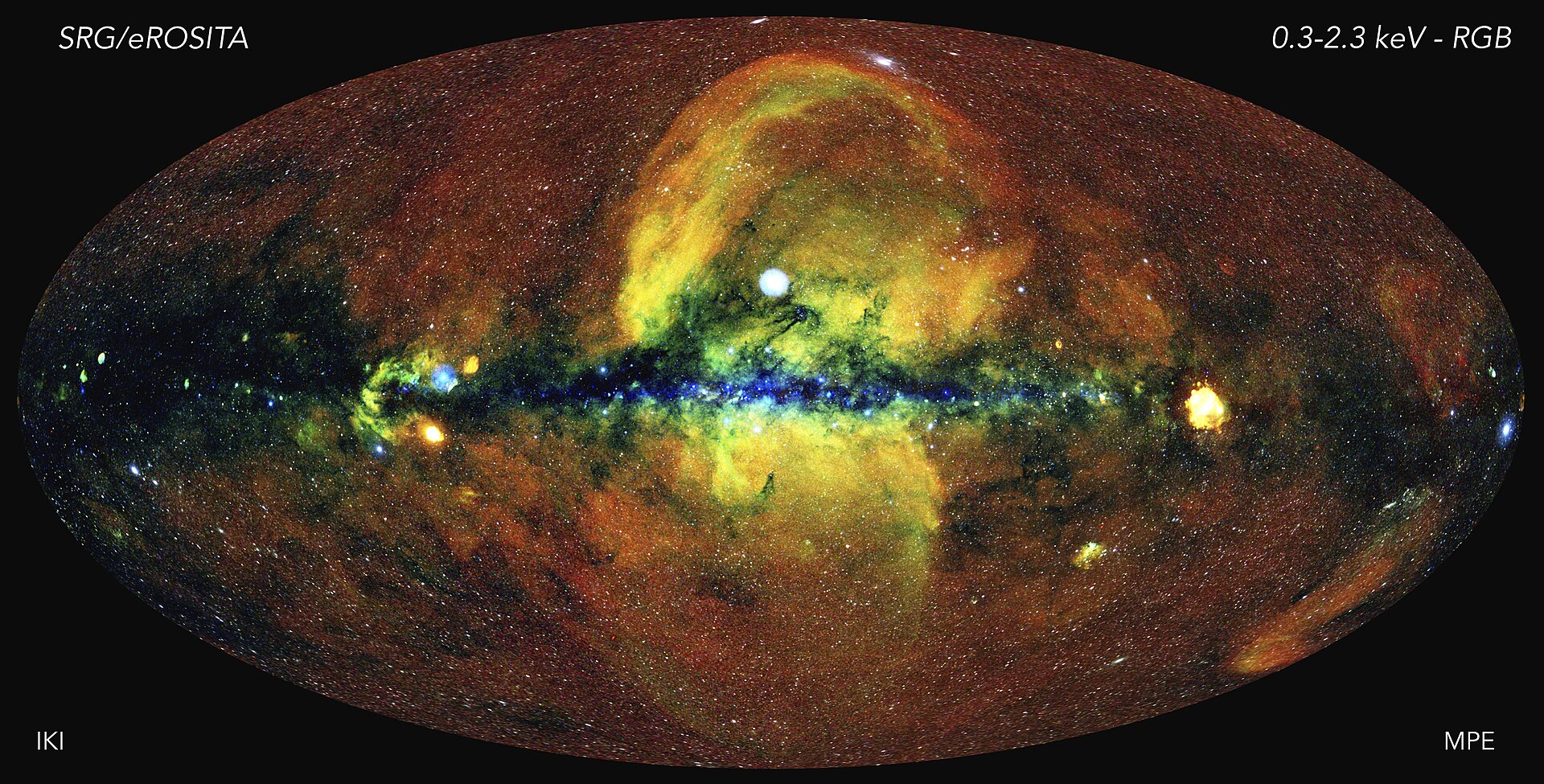
The Milky Way is the galaxy that contains our Sun, our Earth and every star you can see in the night sky. A galaxy is a giant family of stars, gas, dust and invisible dark matter, all held together by gravity. Ours holds somewhere between 100 billion and 400 billion stars. It is shaped like a spiral with a bar across its middle, and a huge black hole sits at its centre. We see it as a hazy glowing band on dark nights, because we live inside its disc. People once believed it was all there was. Finding out how wrong that was is one of the great stories of science.
What is the hazy band across the night sky?
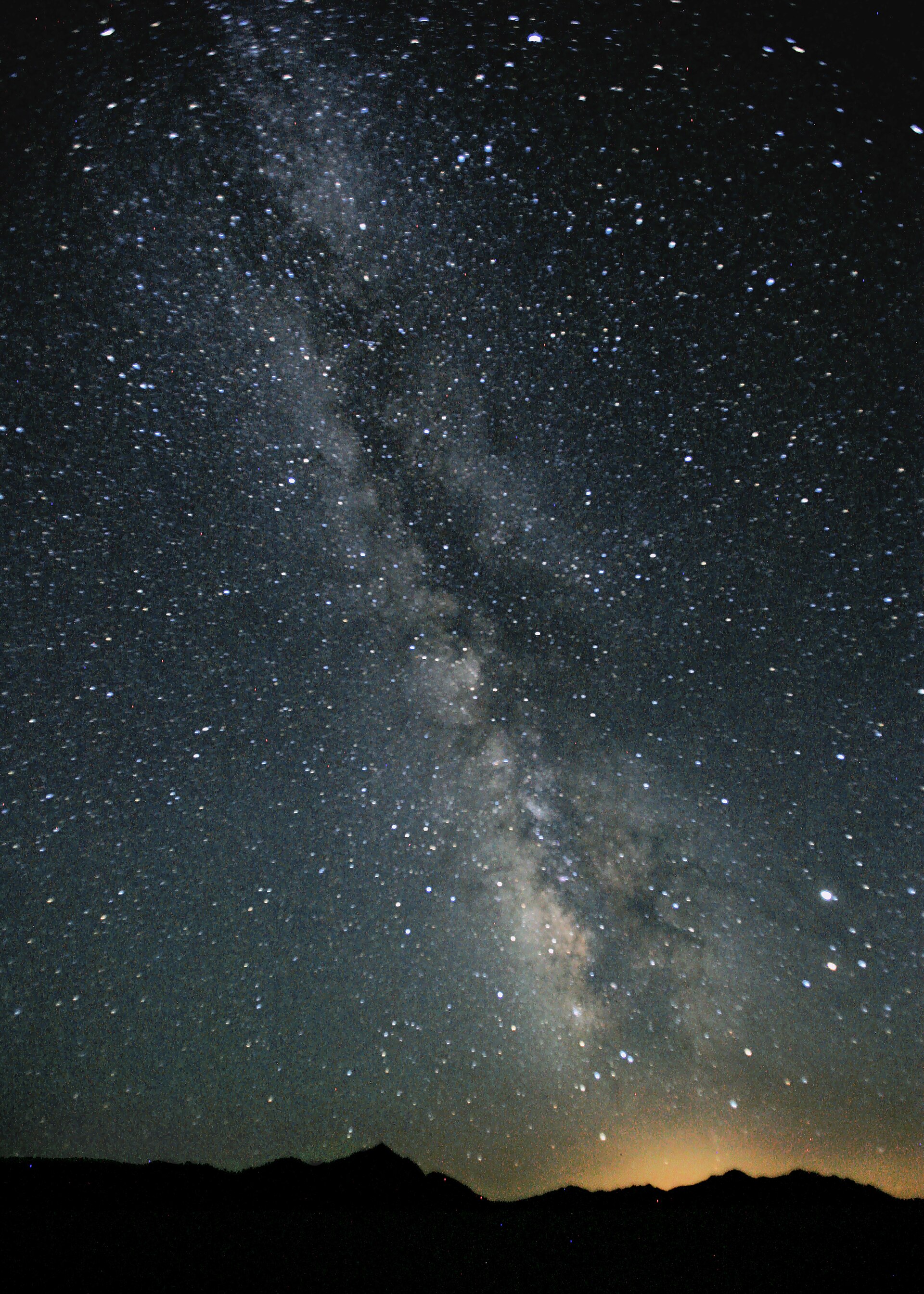
On a clear, dark night away from town lights, a pale stripe of glow arches across the sky. It looks like spilled milk, and that is where the name comes from. The Romans called it via lactea, which means milky road. The Greek word for milk, gala, is also the root of our word .
That glow is not a cloud. It is the light of vast numbers of stars, packed so closely along our line of sight that your eye cannot split them apart. Every single star you can see without a telescope belongs to our galaxy. The name Milky Way, though, is kept for the glowing band itself. The band is about 30 degrees wide, which is roughly the width of three fists held at arm's length.
The band is brightest towards the constellation Sagittarius, because that is the direction of the galaxy's centre. Dark patches cut through it, such as the Great Rift. These are clouds of dust that block the light of the stars behind them. Different peoples have seen different pictures in these patches. The Gomeroi people of Australia saw a giant emu in the sky, while the Inca saw animals made of dark cloud.
Sadly, more than one third of people on Earth cannot see the Milky Way from home, because street lights and other artificial glow drown it out. Moonlight can wash it out too.
How did people find out what the Milky Way really is?
For thousands of years, people could only guess. In the Greek story, the band was milk that sprayed from the goddess Hera when she pushed away the baby Heracles. The Greek thinker Aristotle believed it was a glow in the upper air above Earth. Later scholars disagreed. The Persian astronomer Al-Biruni, who lived about 1,000 years ago, suggested it was a mass of countless tiny star-like fragments.
The proof came in 1610. Galileo Galilei pointed one of the first telescopes at the band and saw that it broke up into huge numbers of faint stars. In 1755 the German philosopher Immanuel Kant guessed that the stars form a spinning disc held together by gravity. We see that disc edge-on from inside it, which makes a band. In 1785 William Herschel tried to map the shape by counting stars in different parts of the sky.
Until the early 1920s, most astronomers thought the Milky Way was the entire universe. Then Edwin Hubble used the powerful Hooker telescope in California to study the Andromeda Nebula. He spotted pulsing stars called , whose true brightness is known, so he could work out how far away they were. Andromeda turned out to be far too distant to be part of our . The universe suddenly became far bigger.
Today the European Space Agency's Gaia spacecraft measures the positions and movements of about 2 billion stars to map our galaxy in detail.
Where do we live inside the Milky Way?
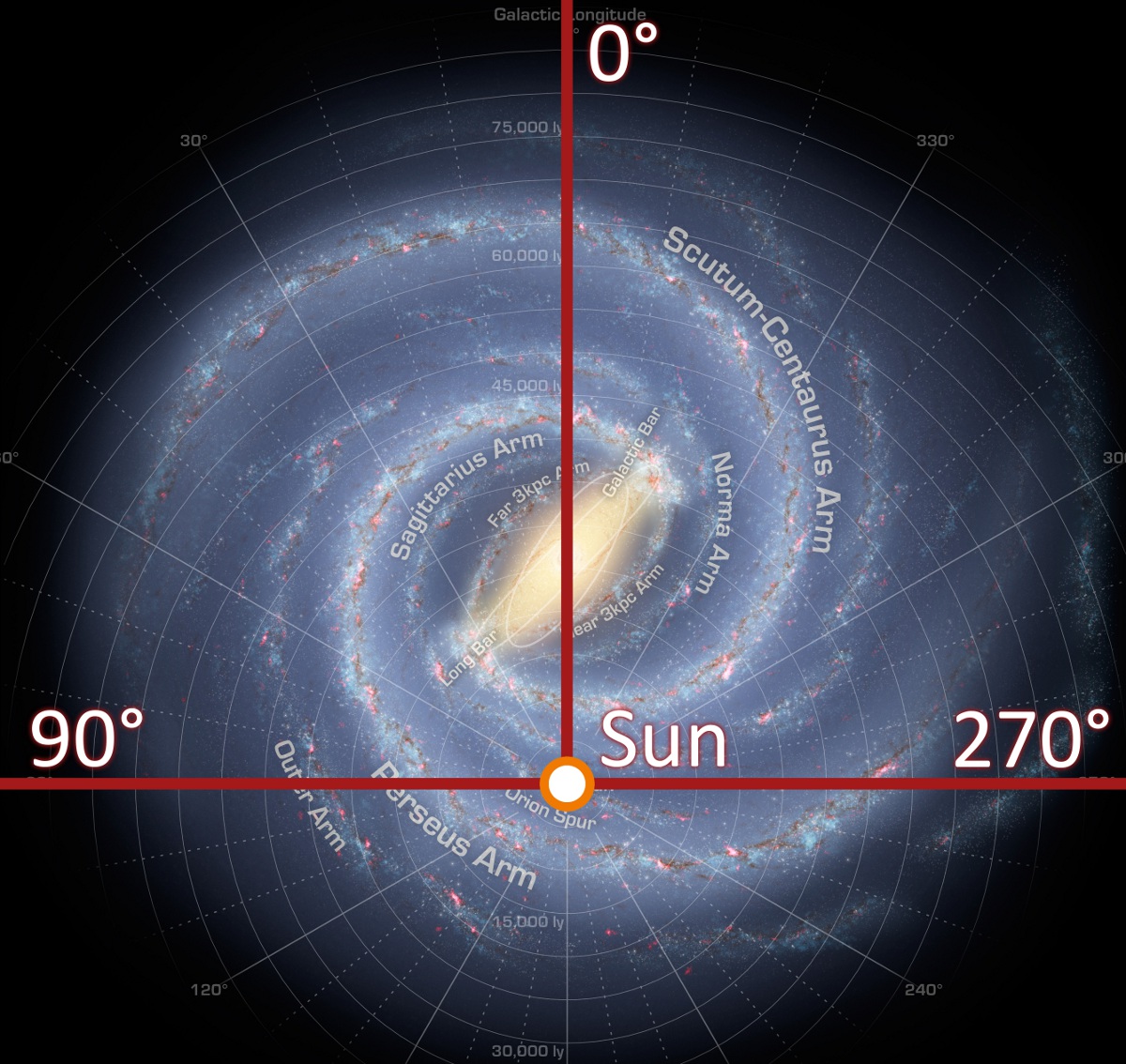
We live inside the , so we cannot photograph it from outside. Astronomers have to work out its shape from within, much like mapping a forest while standing among the trees.
The Sun sits about 27,000 from the centre. A light-year is the distance light travels in one year, which is about 9.5 trillion kilometres. That puts us roughly halfway out from the middle to the edge of the bright disc. Our home is on the inner edge of a small spiral-shaped stretch of gas, dust and stars called the Orion Arm. The Sun is also a little above the middle plane of the disc.
The Sun is not standing still. It circles the centre of the galaxy at about 0.073 per cent of the speed of light, which is hundreds of kilometres every second. Even at that speed, one full orbit takes around 240 million years. This is called a galactic year. The Sun has made about 18 to 20 trips round since it formed. The last time the Solar System was in this part of its orbit, dinosaurs were only just appearing on Earth.
Scientists think our spot may be a good one for life. It is within what they call the galactic habitable zone, far enough from the crowded, violent centre but still rich in the heavy elements that make planets and living things.
How big is the Milky Way?
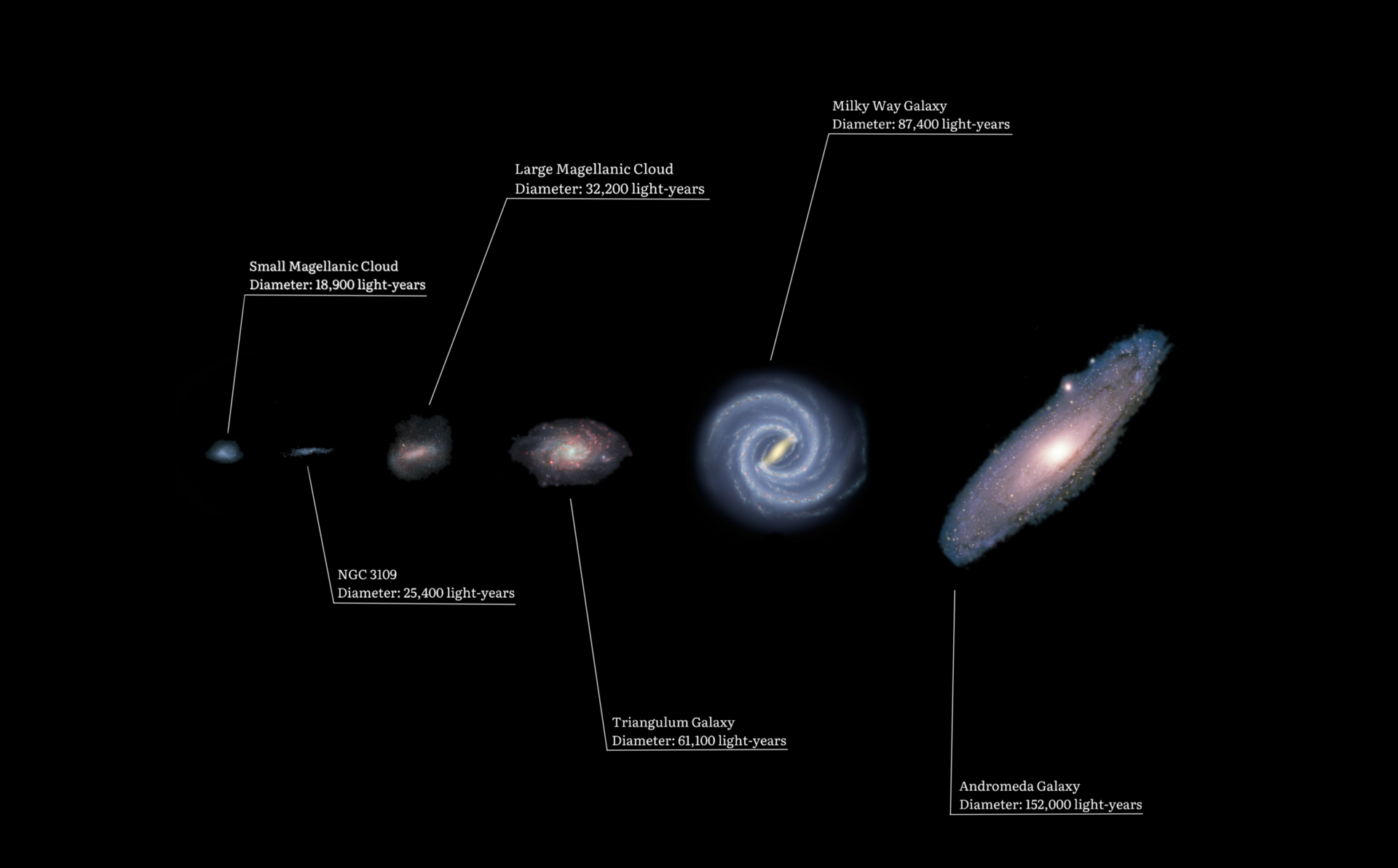
The Milky Way is enormous. Its bright disc is usually given as around 100,000 across. Light, which is the fastest thing in the Universe, would take 100,000 years to cross it. Yet the disc is thin. In the it is only about 1,000 light-years thick, so the is shaped a little like a very flat pancake with a bump in the middle.
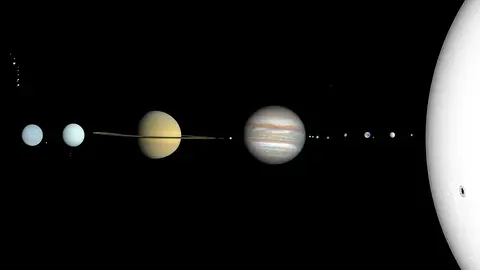
Here is a way to picture the size. If the whole Solar System out to Neptune were shrunk to the size of a coin, the Milky Way would stretch across the entire mainland United States.
Measuring a galaxy's size is surprisingly hard. It has no sharp edge. Stars thin out gradually, and astronomers use different rules to decide where the galaxy stops. Beyond the disc lies an invisible of . Computer models suggest that it may reach out almost 2 million light-years.
The Milky Way is one of the two largest galaxies in the , a family of galaxies that share the same patch of space. The other is the Andromeda Galaxy. Studies suggest that our galaxy is a fairly ordinary spiral rather than a record breaker. It is also part of much larger groupings, called the Virgo Supercluster and the Laniakea Supercluster.
What is inside the Milky Way?
Stars are the main ingredient. Astronomers estimate that our holds between 100 billion and 400 billion of them. The range is wide because small, dim stars are very hard to spot from far away. The Andromeda Galaxy has even more, about a trillion.
The galaxy also holds the leftovers of dead stars. There may be around 10 billion white dwarfs, which are the cooling cores of Sun-like stars. There may be a billion neutron stars, which are incredibly dense, and about 100 million black holes that formed when giant stars collapsed.
Between the stars is the interstellar medium, a thin mixture of gas and dust. By mass the gas is about 90 per cent hydrogen and 10 per cent helium. New stars are born when clouds of this gas collapse under their own gravity.
Planets are everywhere too. Studies using the Kepler space telescope suggest that the average star has at least one planet, so the galaxy may hold 100 billion to 400 billion of them. Some estimates say that there may be billions of Earth-sized worlds in the habitable zones of their stars. The closest known planet beyond our Solar System orbits the red dwarf Proxima Centauri, only 4.2 away. There may also be wandering rogue planets that belong to no star at all.
What shape is our galaxy?
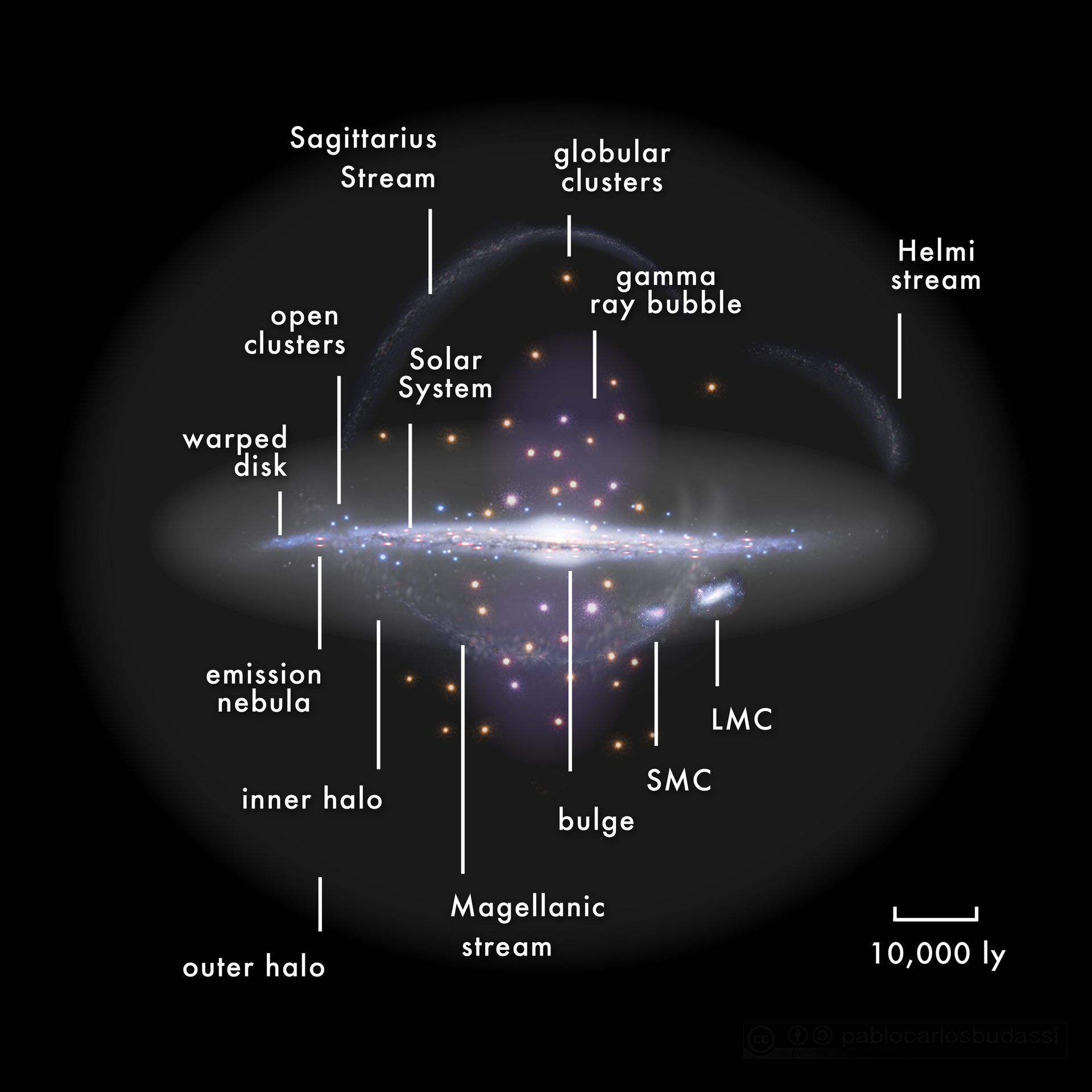
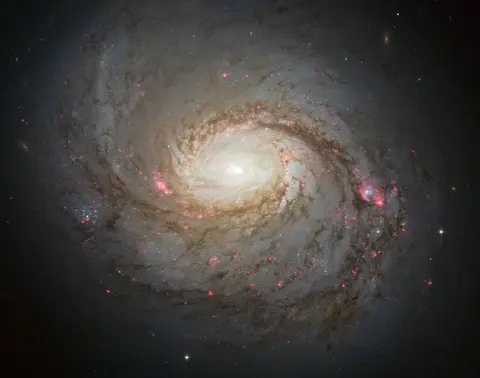
If you could fly far above the Milky Way, you would see a barred spiral . In the middle is a glowing bulge of mostly old stars. A bar of stars stretches across it, and arms of gas, dust and stars curl out from its ends like a slow whirlpool. Astronomers began to suspect the bar in the 1960s. In 2005 the Spitzer Space Telescope showed that it is even larger than expected.
The are where most new stars are born. They hold more gas and dust than the space between them, and that is the raw material of stars. The galaxy seems to have four main arms when we trace young stars and gas. Counting older stars shows only two clear arms, called Perseus and Scutum-Centaurus. Astronomers do not yet know why the two pictures differ.
The disc is also slightly warped, bent a little like the brim of a hat.
Surrounding the disc is the . It is a loose, ball-shaped cloud of very old stars and tight star groups called . No new stars form there, because the halo has little cool gas. Around 40 per cent of the galaxy's globular clusters even orbit in the opposite direction to the disc. Beyond the visible halo lies a huge halo of hot gas and .
What is hiding at the centre of the Milky Way?
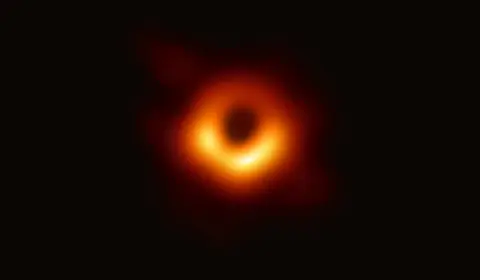
Right at the middle of the lies a powerful radio source called Sagittarius A*, which is said "Sagittarius A-star". Dust hides it from ordinary telescopes, so astronomers use radio, infrared and X-ray instruments to see through.
By tracking the motion of stars close to it, astronomers worked out that something extremely heavy and compact is there. The best explanation is a . A black hole is a region where gravity is so strong that nothing, not even light, can escape. This one has a mass of about 4 million Suns. Most large galaxies seem to have one at their centre.
It is quiet at the moment. It pulls in very little material, so it does not glow like the blazing centres of some other galaxies. It does still flare up sometimes. In 2015 NASA reported an X-ray flare 400 times brighter than normal.
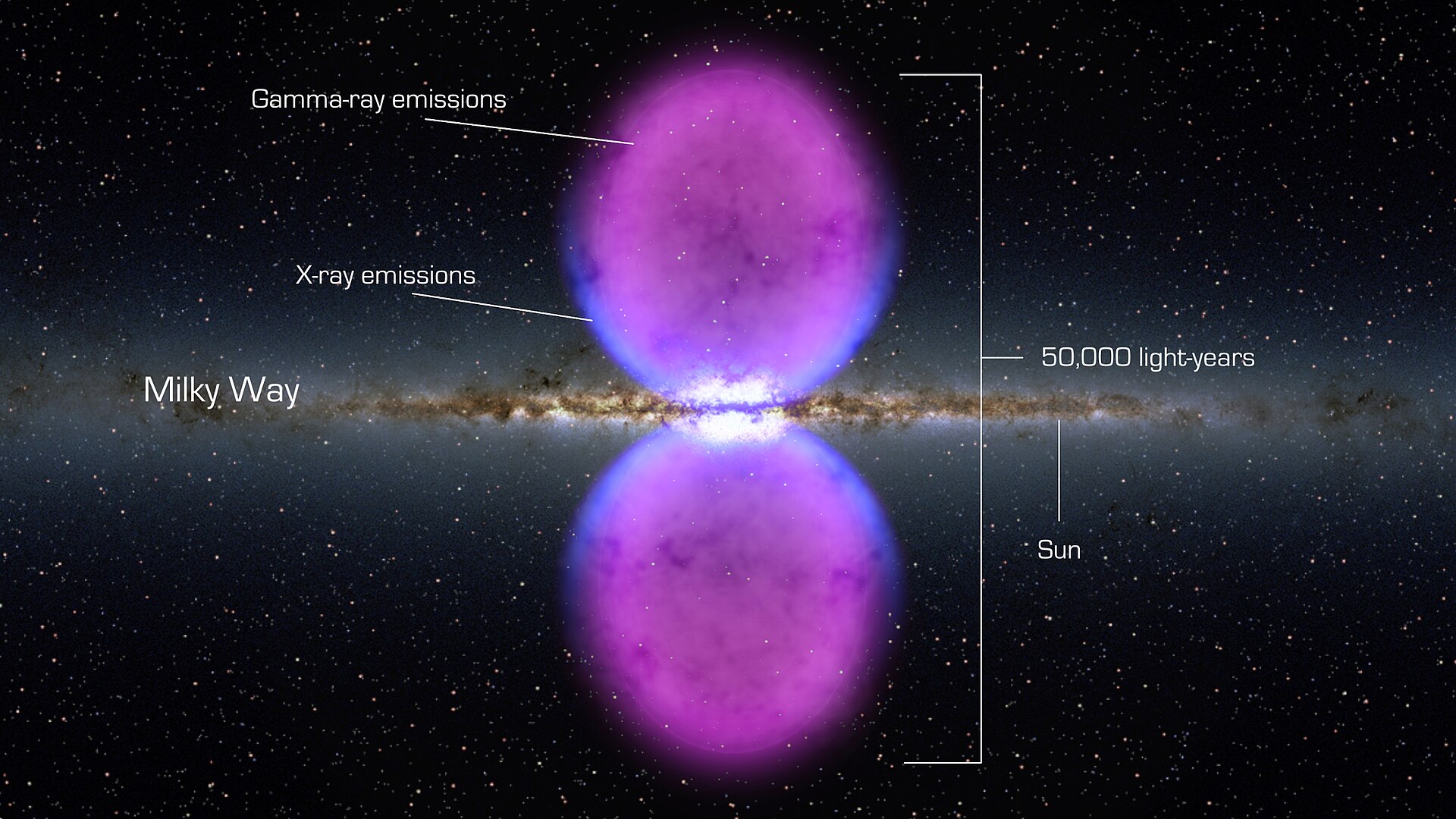
In 2010, the Fermi Gamma-ray Space Telescope found two giant bubbles of high-energy radiation, one above and one below the centre. Each is about one quarter as wide as the whole galaxy. Astronomers think they were blown out a few million years ago, either by a burst of star formation near the centre or by an outburst from the black hole. They are still debating which.
Why does the Milky Way spin, and what is dark matter?
All the stars and gas in the Milky Way circle the centre, held in orbit by gravity. In the Solar System, planets close to the Sun move fastest and distant ones crawl. The works differently. Most stars, away from the central bulge and the outer rim, travel at a similar speed of 200 to 220 kilometres per second.
That should not happen if only the visible matter were pulling on them. Then the outer stars would be slower, because less matter would be tugging them. Instead, the speeds stay about the same, so something unseen must add extra pull.
That something is called . Nobody has yet found out what it is made of. It does not give off or reflect light, but it does pull on other matter with gravity. Studies suggest that around 90 per cent of the Milky Way's mass may be dark matter. A few astronomers think instead that our rules of gravity might need to be changed.
The spin is also the reason the galaxy is a disc. Over time, a spinning cloud of gas flattens out, and most stars formed after that, including our Sun, ended up in the flat disc.
Estimates of the galaxy's total mass range from a few hundred billion to about 1.3 trillion Suns.
How did the Milky Way form, and what happens next?
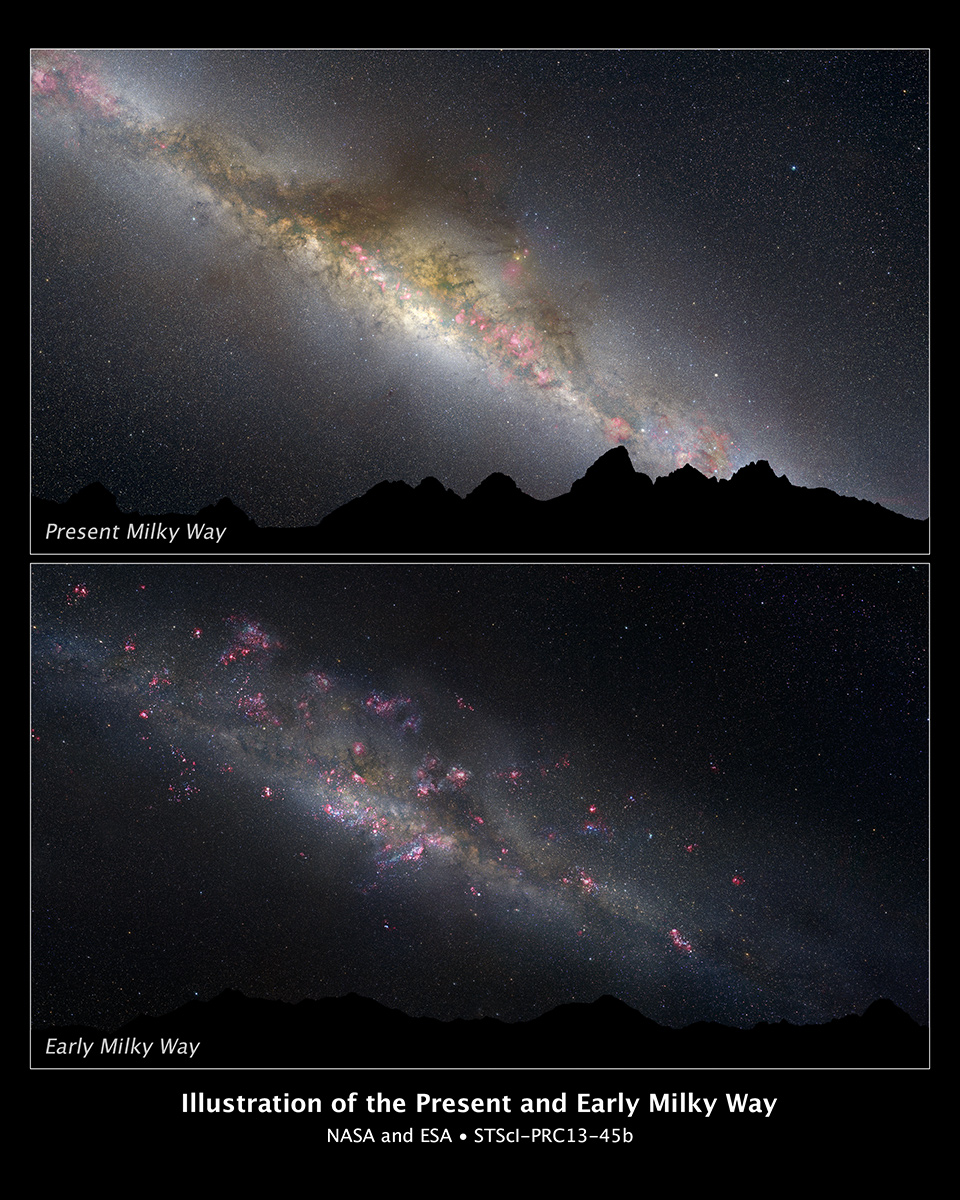
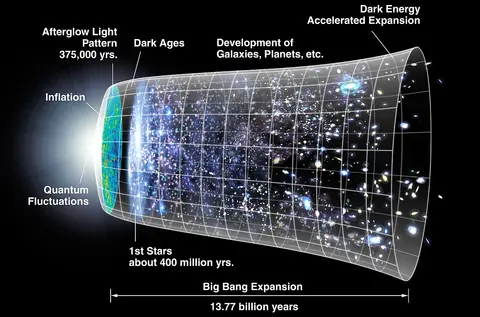
The Milky Way began soon after the Big Bang, which happened about 13.8 billion years ago. Tiny clumps of denser gas and pulled in more material. In some of these clumps the first stars formed. The oldest stars in our are almost as old as the Universe itself.
The young galaxy grew by swallowing others. Around 11 billion years ago it merged with a large galaxy that scientists have nicknamed the Kraken. Nearly half of the galaxy's matter may have come from other galaxies. It still feeds on smaller neighbours. The Large and Small Magellanic Clouds are both being pulled apart slowly, and gas streams from them into the Milky Way.
As the galaxy spun faster, its gas settled into a disc. Later stars, including the Sun, formed there.
The future holds a collision. The Andromeda Galaxy is heading towards us, and the two may meet in about 4 to 5 billion years. A 2025 Hubble and Gaia study gives only about a 50% chance of a merger in the next 10 billion years. Stars are so far apart that few will actually crash. If the galaxies do merge, the result will be one larger galaxy. Our galaxy is also running low on gas for new stars, so star formation will slow down over the next few billion years.
Explore Next
Your audio story keeps playing while you look around.
Words to Know
- Cepheid variable
- A star that brightens and fades in a steady rhythm, which lets astronomers work out its distance.
- dark matter
- Invisible matter that gives off no light but pulls on other matter with gravity.
- galaxy
- A huge group of stars, gas, dust and dark matter held together by gravity.
- globular cluster
- A tight, ball-shaped group of hundreds of thousands of very old stars.
- halo
- The loose ball-shaped region of old stars, gas and dark matter around a galaxy's disc.
- light pollution
- Artificial light that makes the night sky bright and hides faint stars.
- light-year
- The distance light travels in one year, about 9.5 trillion kilometres.
- Local Group
- The family of more than 50 galaxies that includes the Milky Way and Andromeda.
- spiral arm
- A curved stretch of a galaxy's disc where gas, dust and young stars are packed more densely.
- supermassive black hole
- A black hole millions or billions of times heavier than the Sun, found at the centre of most large galaxies.