Particle
The tiny pieces that everything, from dust to stars, is built from.
A particle is a small object that scientists can describe with a few simple properties, such as its mass, its volume or its density. The word covers an enormous range. A particle can be a grain of sand, a speck of dust in a sunbeam, a molecule of water or an electron far too small to see. Scientists use the idea to understand almost everything, from how a ball flies through the air to how galaxies form. Some particles last for billions of years. Others vanish in a tiny fraction of a second. To find out how scientists sort them, and how they spot something no eye can see, start with the question of what counts as a particle at all.
What counts as a particle?
Look at a sunbeam in a dusty room and you can see hundreds of tiny specks drifting about. Each speck is a . In science, a particle is a small object in one place that can be described by properties such as its mass, its volume or its density. Older books sometimes call it a corpuscle.
The word is very general, and each science sharpens it for its own needs. A chemist may mean an atom or a molecule. A builder may mean a grain of sand. A physicist may mean an electron. What they share is the idea of a small piece that can be treated as one thing.
Anything made of particles is called particulate. Today the word is used most often for pollution, meaning tiny bits of soot and dust floating loose in the air. These specks are not joined together. Each one drifts alone, which is why they can be breathed in so easily.
The idea is useful because nature is complicated. If you can describe a crowd, a cloud or a gas as a huge number of particles, the sums become much easier. Scientists have used this trick for centuries, and it still sits at the heart of physics and chemistry.
From stars to electrons: how big is a particle?
Scientists group into three classes by size.
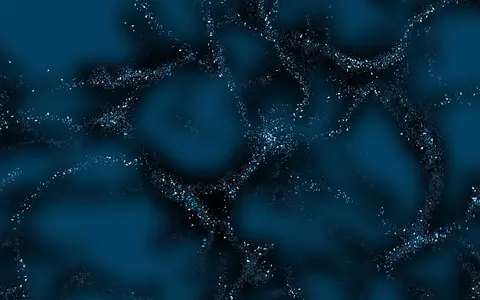
Macroscopic particles are much larger than atoms and molecules. Powder, dust, sand and the broken pieces after a car crash all count. So can something far bigger. When astronomers study a galaxy, they can treat each of its stars as one particle, because the gaps between stars are so huge.
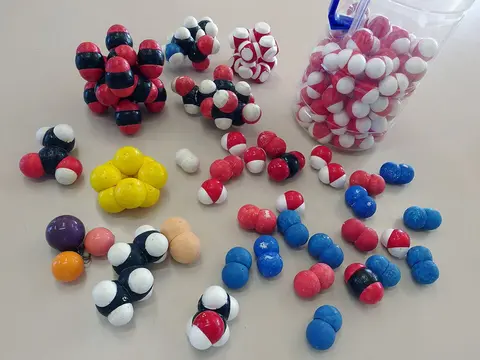
Microscopic particles range from atoms up to molecules. Carbon dioxide molecules, nanoparticles and the particles in paint and milk belong here. A is one billionth of a metre, and an atom is roughly a tenth of a nanometre across. Chemists and atomic physicists study this world.
The smallest are the , which are smaller than an atom. They include the three pieces that make up atoms, called protons, neutrons and electrons. Other kinds appear only in , which are huge machines that smash particles together, or in cosmic rays, which are fast particles arriving from space. Almost all of an atom's mass sits in its nucleus, the tiny core where the protons and neutrons are packed. An atom is 10,000 to 100,000 times wider than its nucleus.
Very small particles do not behave like marbles. Their world is governed by quantum mechanics, where a particle can act like a wave as well as a tiny lump. Physicists call this wave-particle duality.
What are particles made of?

can also be sorted by what they are made of. A is built from other particles. A carbon-14 atom is a neat example. It holds 6 protons, 8 neutrons and 6 electrons, which makes 20 smaller particles in one atom. Protons and neutrons are composite too. Each is made of three smaller particles called .
An , also called a fundamental particle, is not made of any smaller particles, as far as we know. Our best theory is called the Standard Model. It lists only a small number of elementary particles. They include quarks, leptons (the electron is a lepton) and gluons. Gluons carry the strong force, which glues quarks together inside protons and neutrons.
The Standard Model also includes particles that carry forces. The photon, for example, carries the electromagnetic force. In 2012 scientists at CERN, the European particle laboratory near Geneva, announced they had found the Higgs boson, another particle the theory had predicted.
As far as experiments have shown, elementary particles have no inner structure at all. But scientists stay cautious. Some particles that look elementary today might turn out to be composite once we can look more closely. Every time scientists have looked deeper into matter, they have found something new.
Why do some particles fall apart?
Not every lasts. Many break up into other particles, a process called . Both and composite ones can do it. The muon is an elementary particle that decays after only about two millionths of a second. A uranium nucleus is a that decays far more slowly, often over billions of years.
Why does it happen? In general, a particle decays when it can move from a state with more energy to one with less. Nature tends to settle into the lowest energy it can reach, a bit like a ball rolling downhill. As the particle changes, it gives off energy as some form of radiation, such as photons, which are packets of light.
Particles that do not decay are called stable. The electron is stable, and so is the nucleus of a helium-4 atom. Their lifetimes may be infinite, or so long that no experiment could ever see them break down. Scientists call the second kind observationally stable. That means they have been watched for a very long time and have not changed.
Decay matters well beyond the laboratory. It is how radioactive materials work, and it is how doctors and archaeologists can use radioactive atoms. Carbon-14 is used to date ancient wood and bones because it decays at a steady, known rate.
How do we spot particles we cannot see?
No microscope can show an electron. So scientists catch by the trails they leave behind.
One classic tool is the cloud chamber. It holds air saturated with vapour, which is ready to turn into droplets. When a fast particle shoots through, it knocks electrons off the atoms in its path. Droplets form along that path, and a thin white line appears, like the trail behind a high-flying jet. Different particles leave different tracks. Heavy, slow ones make short, thick lines. Light, fast ones make long, thin lines. The Scottish physicist C. T. R. Wilson invented the cloud chamber in the early 1900s, and discoveries made with it included the positron, a kind of mirror-image electron, in 1932.
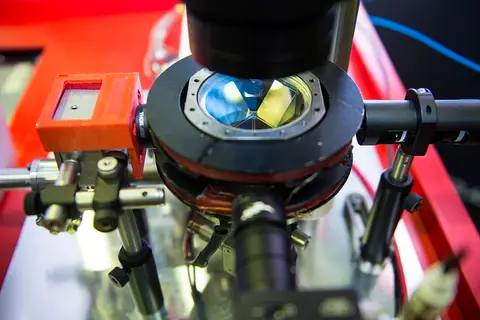
Modern physics uses far bigger machines. A speeds up particles until they are close to the speed of light, then crashes them together. The Large Hadron Collider at CERN has a ring 27 kilometres around. Giant detectors record what flies out of each crash, and computers piece together which particles were made.
Cosmic rays offer another natural experiment. These are particles from space that crash into our atmosphere all the time. Early particle physicists used them to find new particles long before accelerators were strong enough.
What happens when particles float in a liquid or gas?
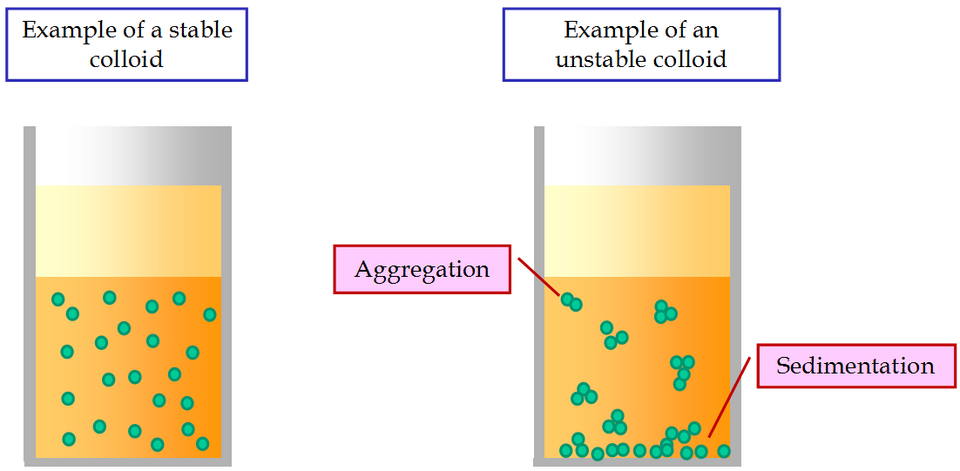
Milk, fog, paint and smoke all share a secret. They are full of tiny spread evenly through another substance. A mixture like this is called a . The particles in a colloid are between about 5 and 200 across. That is small enough to stay floating, yet much bigger than a single atom.
When a substance breaks up into single molecules or ions, it makes a solution instead. Sugar stirred into tea does this. You cannot see the sugar, and it never settles at the bottom of the cup. In a colloid the particles do not dissolve. They stay as separate pieces, held apart so well that they do not drop to the bottom.
Colloids come in many forms. Solid particles can be held in a liquid, as in paint. Solid or liquid particles held in a gas form an . Fog is an aerosol of water droplets, and smoke is an aerosol of solid specks. When the particles join together and grow heavy, a colloid can become unstable, so they clump and sink. That is why some paints must be stirred before use.
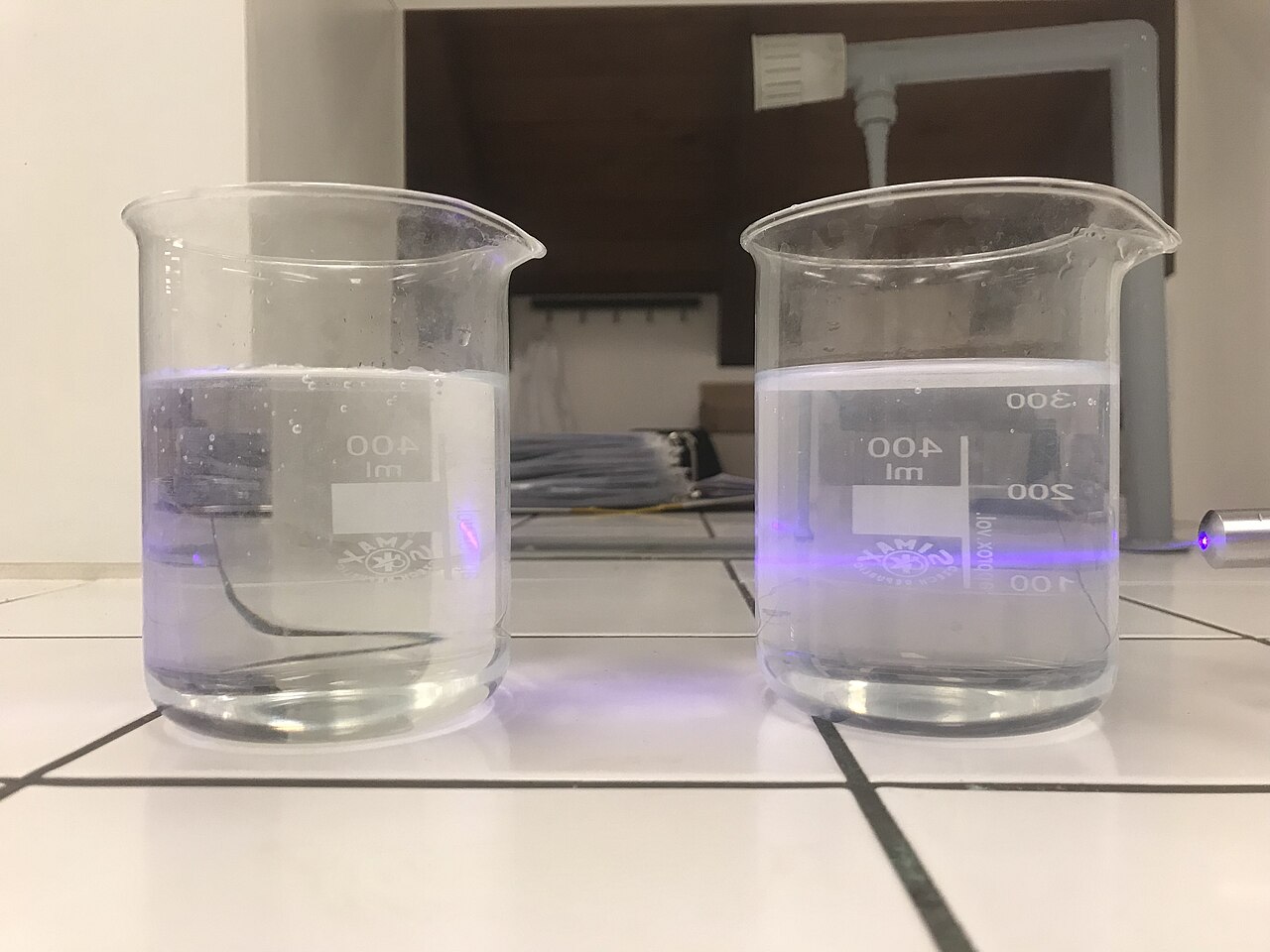
There is a neat way to tell a colloid from a solution. Shine a narrow beam of light through each. In a solution the beam is almost invisible. In a colloid the floating particles scatter the light, so the beam glows like a line drawn through the liquid. This is called the Tyndall effect, after the Irish physicist John Tyndall, who studied it in the 1860s. It is also why sunbeams show up in a dusty room.
Larger particles can drift in other places too. Floating plastic and other rubbish makes marine debris. Old satellites and broken rocket pieces make space debris. A heap of many solid grains, such as sand or grain in a silo, is called a granular material.
Why pretend a baseball is a single point?
Imagine working out where a thrown baseball will land. A real ball spins, rubs against the air and gets pushed by the wind. Its seams create tiny swirls of air. Trying to include everything would be a nightmare.
Two American physics teachers, Francis Sears and Mark Zemansky, showed the answer in their textbook University Physics. Step by step, they strip things away. First, treat the ball as a smooth, hard sphere. Then ignore its spin. Then ignore the push of the air. What is left is a single point with mass, moving under gravity. Physicists call this a point . The sums for it are quick, and they give a good estimate of where the ball lands and how fast it will be going.
This is called modelling. A model keeps what matters and drops what does not. Engineers use point particles to predict rockets. Planners use them to picture people moving through a crowd. Astronomers use them for planets and moons moving in space.
A model is only as good as its match with reality, so scientists test it. If the real ball lands somewhere else, they bring back the details they left out, one at a time, until the answer fits.
When there are huge numbers of particles, such as the molecules in a room of air, the work is called statistical physics. It looks at the average behaviour of the crowd instead of following each one.
How do computers follow millions of particles?
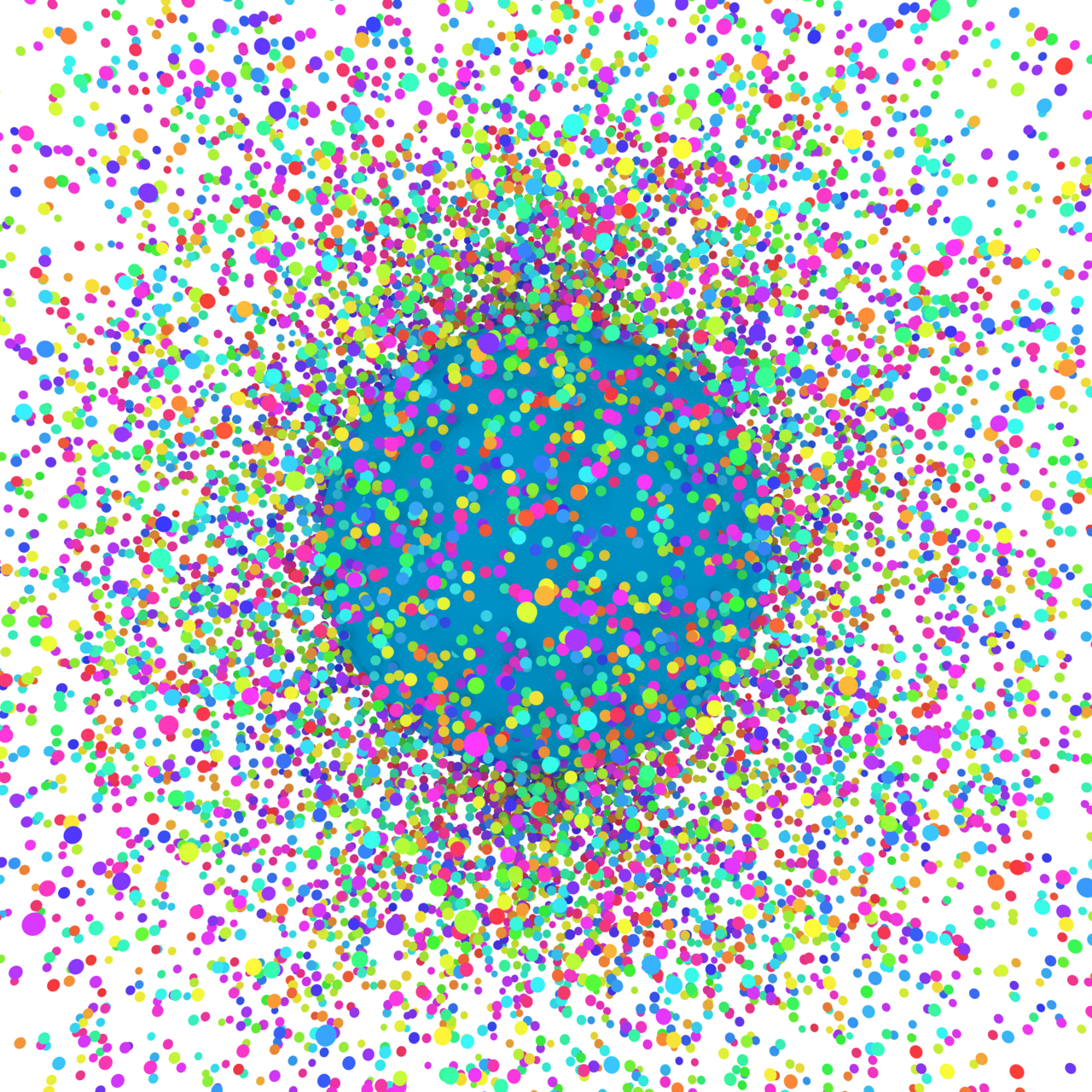
Some questions are too big for any pencil and paper. How did galaxies form? How does water swirl round a ship? To answer them, scientists use computers to run , which are also called N- simulations.
In an N-body simulation, a computer follows a group of particles that pull or push on one another. The letter N stands for how many particles there are. In a space simulation, each particle might stand for a star or a lump of dark matter, and the main force is gravity. The computer works out the pull on every particle, moves each one a tiny step, then does it all again. Repeat that millions of times and a swirling galaxy can grow from a smooth cloud.
There is a catch. Every extra particle has to feel every other one, so the work grows very fast as N rises. A real galaxy has hundreds of billions of stars, far too many to follow one by one. So scientists use fewer particles than the real thing and let each stand for many. They also invent clever shortcuts, called algorithms, to save time.
N-body simulations are common in cosmology, the study of the whole Universe, and in computational fluid dynamics, which models how liquids and gases flow. They let scientists run experiments that would take millions of years in real life.
Explore Next
Your audio story keeps playing while you look around.
Words to Know
- aerosol
- Tiny solid or liquid particles floating in a gas, such as fog or smoke.
- colloid
- A mixture in which tiny particles are spread evenly through another substance.
- composite particle
- A particle made of other particles.
- elementary particle
- A particle that is not made of anything smaller, as far as we know.
- N-body simulation
- A computer model that follows N particles as they push or pull on each other.
- nanometre
- One billionth of a metre.
- particle
- A small object that can be described by properties such as mass, volume and density.
- particle accelerator
- A machine that speeds particles up to very high energies so that they can be studied.
- particle decay
- When a particle breaks up into other particles and gives off energy.
- quark
- An elementary particle that joins with others to make protons and neutrons.
- subatomic particle
- A particle smaller than an atom, such as a proton, neutron or electron.