State of matter
Ice, water and steam are one substance in three states, and there are stranger ones.
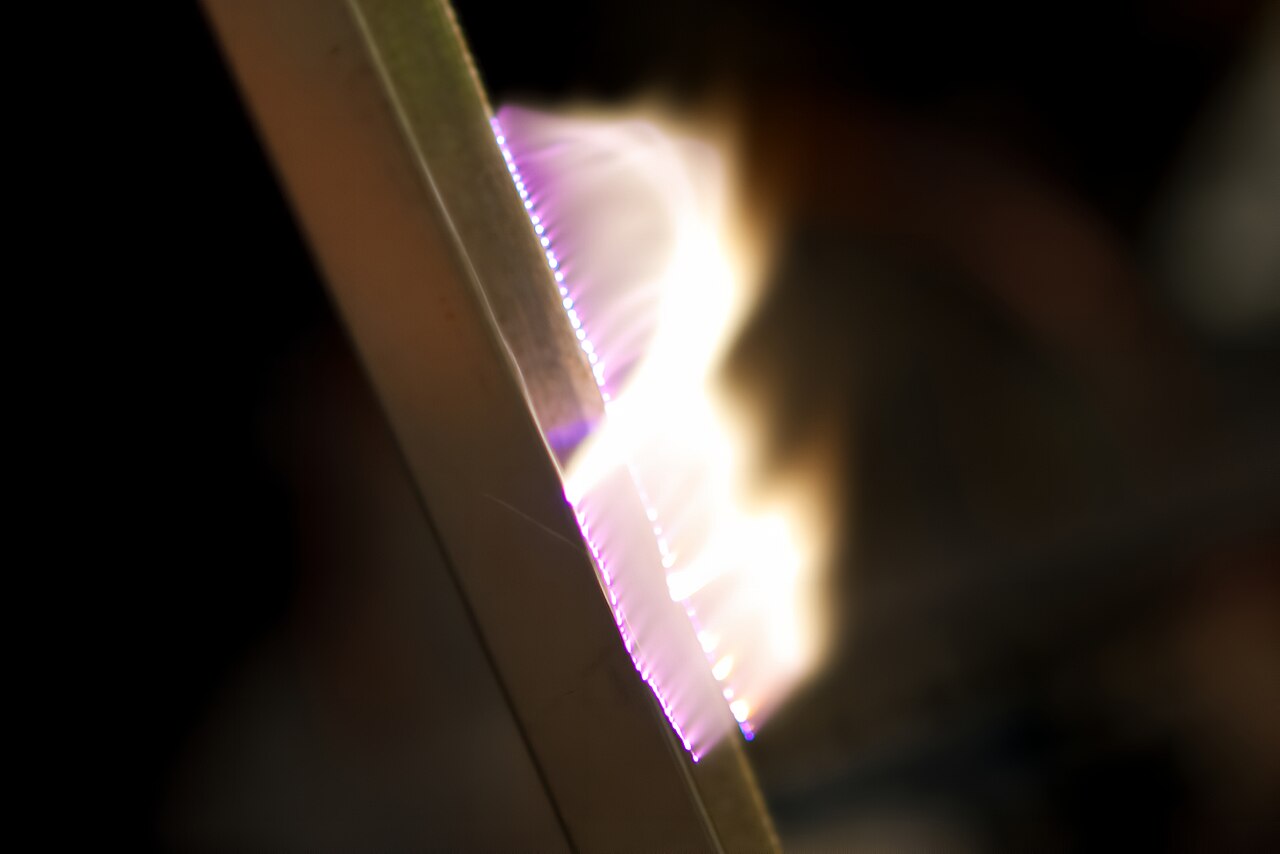
Everything you can touch, drink or breathe is matter, and matter comes in different states. The four you meet in daily life are solid, liquid, gas and plasma. What separates them is how the tiny particles inside are arranged and how freely they move. Ice, water and steam are the same substance in three different states. Plasma glows in lightning and inside every star. Scientists have also found stranger states, such as glass, liquid crystals, superfluids and matter crushed inside dead stars. Each one is a different answer to the same question: how do particles behave when they are packed, heated, cooled or squeezed?
Why does a solid keep its shape?
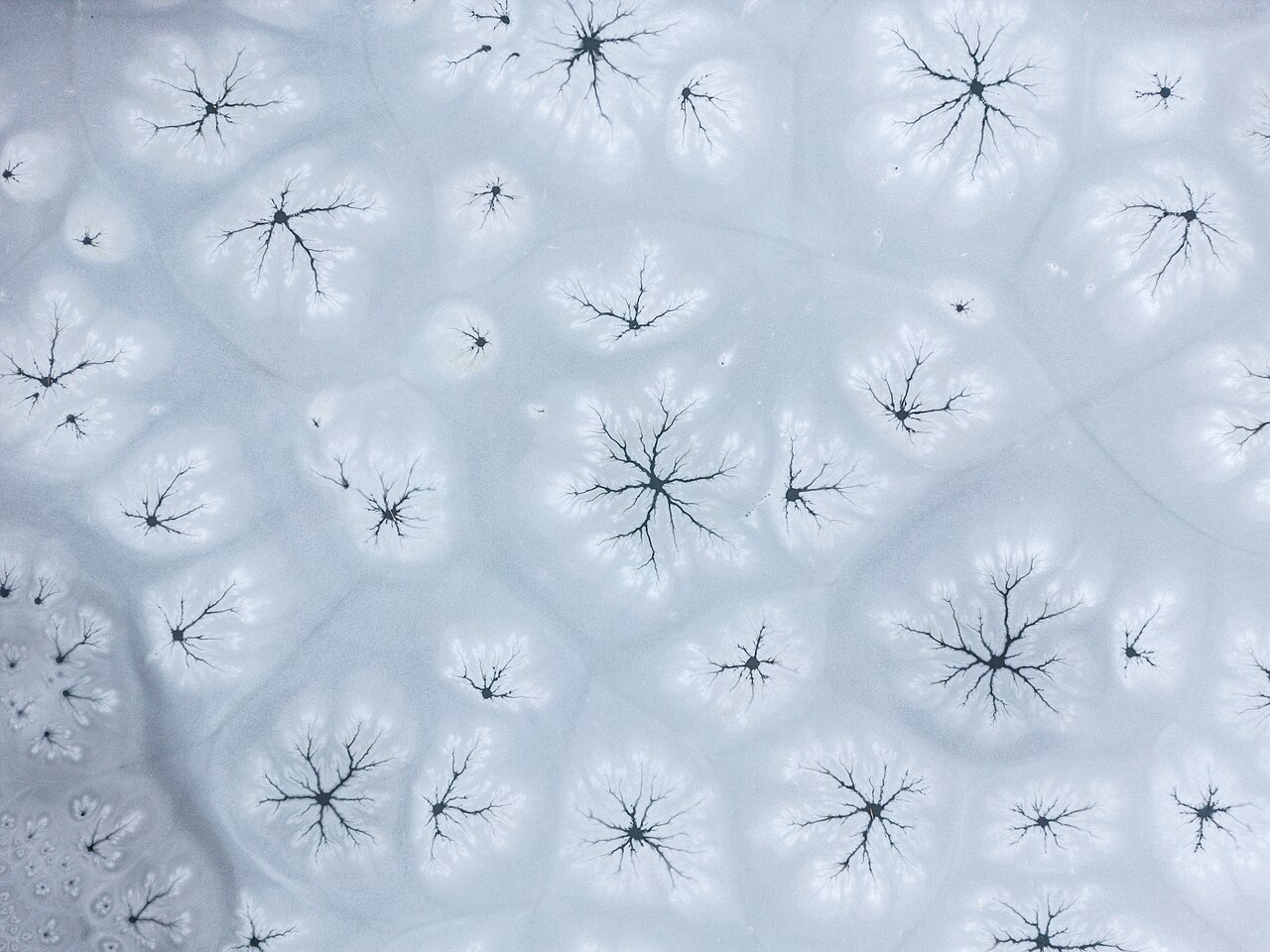
In a solid, the particles are packed tightly together. The forces between them are strong, so the particles cannot wander. They can only vibrate in place, a bit like people jiggling in a crowded lift. That is why a solid has a fixed shape and a fixed volume. You can change its shape only by pushing, cutting or breaking it.
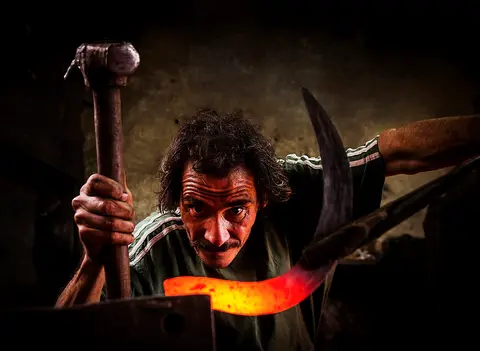
Many solids are . Their particles sit in a neat, repeating pattern, the way oranges are stacked in a crate. There are many possible patterns, and one substance can use more than one. Iron has one crystal pattern below 912 °C and a different one between 912 and 1,394 °C. Ice is even more varied. Scientists know of more than 20 different crystal structures of ice, and new ones are still being found. The 21st, called ice XXI, was reported in 2025. Each forms at its own range of temperatures and pressures.
Not every solid is a crystal. Glass, for example, has its particles in a jumbled order.
Solids can melt into liquids when heated, and liquids can freeze into solids. A solid can also skip the liquid stage and turn straight into a gas. This is called . Dry ice does it, and so does snow on a cold, bright, windy day. A gas can turn straight into a solid too, which is called deposition. Frost on a cold window forms this way.
How do liquids and gases fill their space?
In a liquid, the particles are still close together, but they have enough energy to slide past one another. This is why a liquid takes the shape of its container, yet keeps the same volume. Pour a litre of juice from a tall glass into a wide bowl and it is still a litre. A liquid is also very hard to squash.
Most substances take up more room as a liquid than as a solid. Water is the best-known exception. Ice takes up more space than the water it came from, which is why ice floats.
A gas is different again. The particles move fast and are far apart, much further than the size of the particles themselves. The forces between them are weak. So a gas has no fixed shape or volume. It spreads out to fill whatever space it is in, and it can be squashed into a smaller space. A liquid turns into a gas when it is heated to its boiling point, or when the pressure on it falls.
Below a certain temperature, called the critical temperature, a gas can be turned back into a liquid by squeezing alone. Above that temperature and a matching pressure, something odd happens. The difference between liquid and gas disappears, and the result is a supercritical fluid. It is dense like a liquid but spreads like a gas. Supercritical carbon dioxide is used to pull the caffeine out of coffee beans to make decaffeinated coffee.
What is plasma, the fourth state?
Heat a gas enough and something new happens. The particles move so fast that when they collide, electrons are knocked loose from their atoms. What is left is a mix of ions, which are atoms that have lost electrons, and free electrons. This mix is . Because it contains charged particles, plasma responds to electric and magnetic fields in a way ordinary gas does not.
There are two ways to make plasma. One is to heat a gas to a very high temperature. The other is to put a huge voltage across it, which is what happens in a lightning bolt. If only some electrons break free, the plasma is partly ionised. In the heart of a star, the heat is so great that nearly all the electrons are free. The matter there is bare nuclei swimming in a sea of electrons.
Plasma is rare in everyday life on Earth, but we make it often. It glows in lightning, electric sparks, fluorescent lights, neon signs and old plasma televisions. Some flames contain a little plasma too.
On the scale of the universe, plasma is the most common state of ordinary matter. Stars are made of it, and so is the Sun's glowing outer atmosphere, the corona. About 99% of ordinary matter in the universe is thought to be plasma.
What happens when matter changes state?
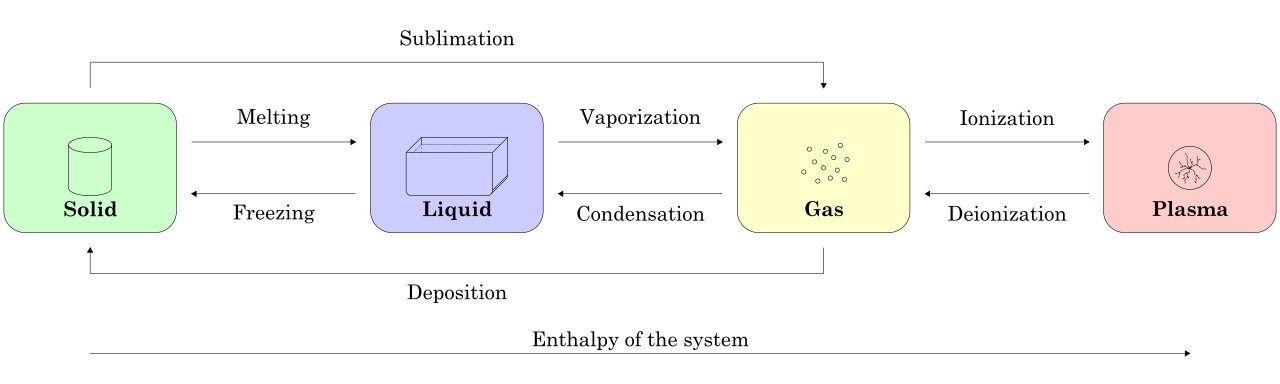
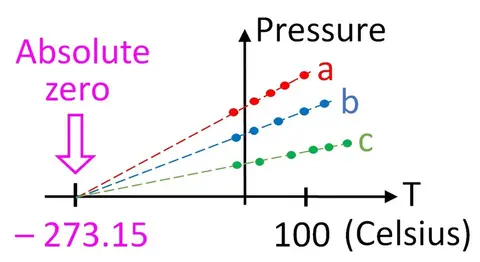
Matter changes state when its temperature or pressure changes. Imagine a substance cooled almost to , the lowest temperature possible. It is a solid, with its particles barely moving. Add heat and the particles shake harder. At the melting point the solid becomes a liquid. At the boiling point the liquid becomes a gas. Heat the gas enough and the electrons are torn away, and it becomes .
Pressure matters too. Lowering the pressure on a liquid can make it boil without any extra heat. Raising the pressure on a gas can squeeze it into a liquid. Every substance has its own melting and boiling points, and they shift as the pressure changes.
A change of state is called a . The mark of a phase transition is that properties change suddenly. Water at 1 °C is a liquid that flows. A little colder, it becomes a hard solid. There is no slow blur in between. Scientists use this idea to define a state of matter. Two sets of conditions are different states if a phase transition separates them.
The word phase is often used as another name for state, but it is more exact. One substance can have several phases in the same state. Ice, for instance, has many solid phases, each with its own pattern. Sometimes a change happens in stages, and the steps in between are called mesophases. They matter for technology.
Which materials are neither quite solid nor quite liquid?
Some materials refuse to fit neatly into the four classic states. Glass is one. Window glass is made mostly from sand, along with other ingredients. Unlike a , its particles have no regular pattern. When glass is heated, it slowly softens through a glass transition instead of melting at a sharp point. Metals, plastics and other materials can also form glasses. A glass could in theory rearrange into a crystal, but the change is so slow that in practice it never happens.
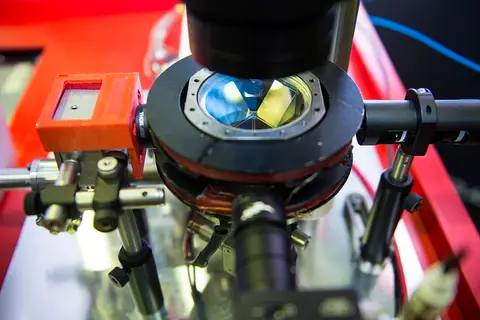
sit between a liquid and a solid. They flow like a liquid, but their long, rod-shaped molecules line up in a common direction, as pencils do in a box. Like a crystal, and unlike an ordinary liquid, they react to polarised light. This is the secret of the liquid crystal displays, or LCDs, in many screens.
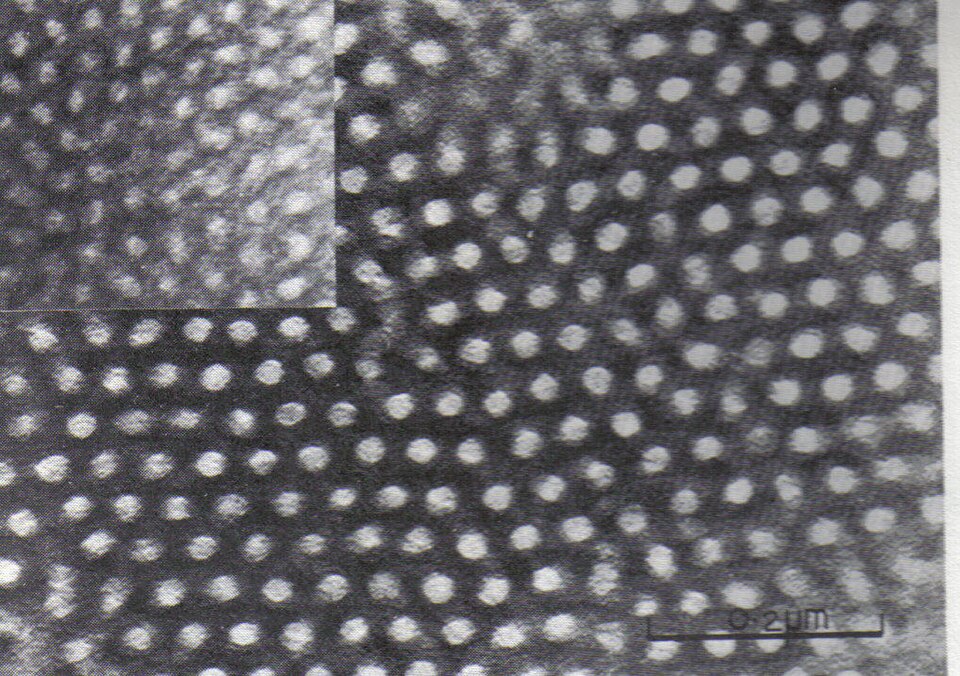
Plastics offer another strange case. A block copolymer is a plastic made of two kinds of chain joined together. The two kinds dislike mixing, as oil dislikes water. But because they are bonded to each other, they cannot split apart into separate lumps. Instead, they form tiny regular patterns only a few nanometres across. A nanometre is a millionth of a millimetre. Each pattern counts as its own phase of matter.
Ionic liquids behave in a similar way. Their positive and negative ions would rather separate, but their electric charges hold them together in tiny layers.
How can a magnet be a state of matter?
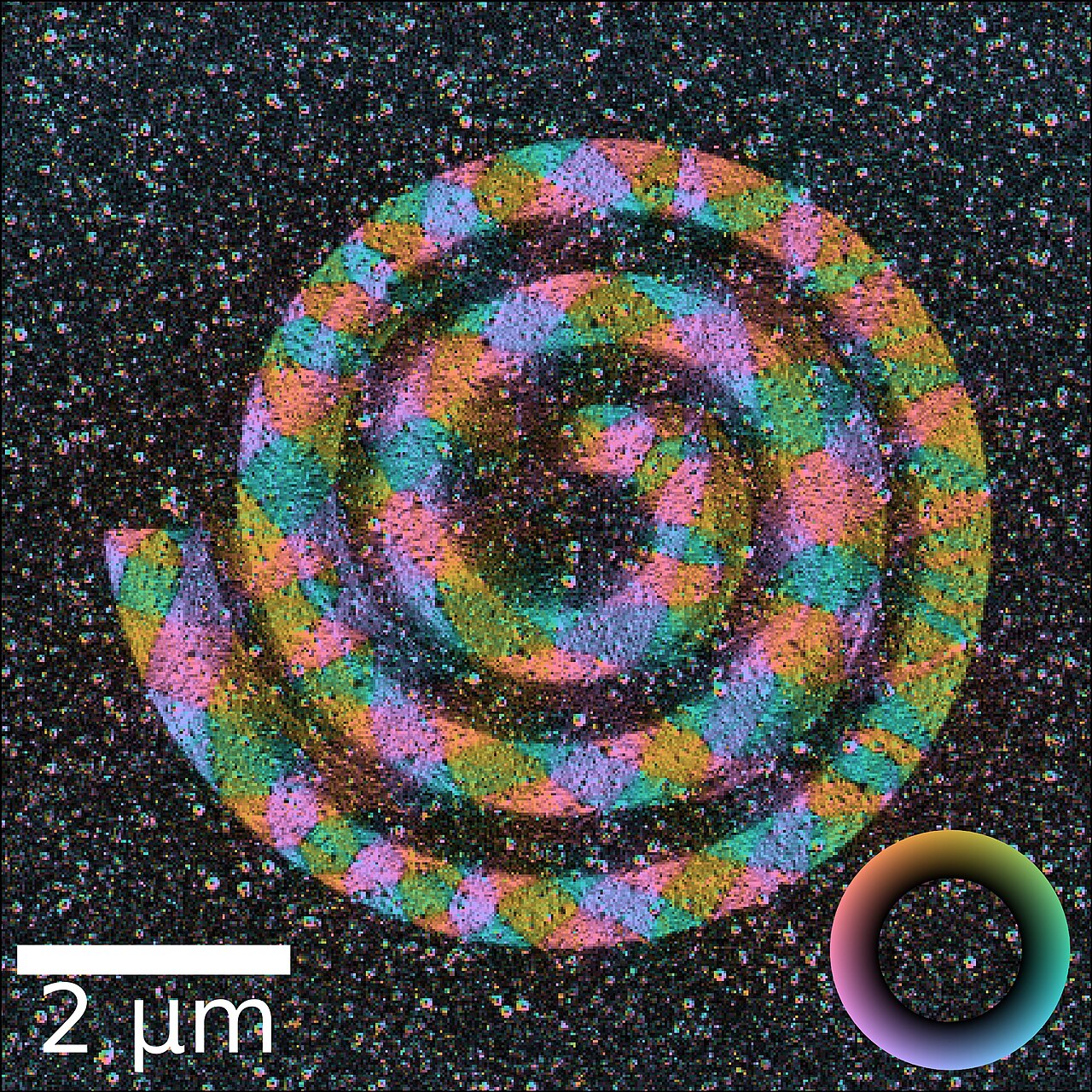
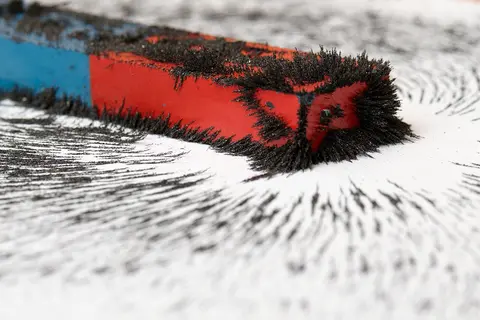
A state of matter does not have to depend on where the atoms sit. It can depend on which way their tiny magnetic arrows point. In some metals, such as iron, many atoms have a magnetic moment. This is a tiny built-in magnet caused by the spin of electrons that are not paired up. Different ways of lining up those arrows make different magnetic states.
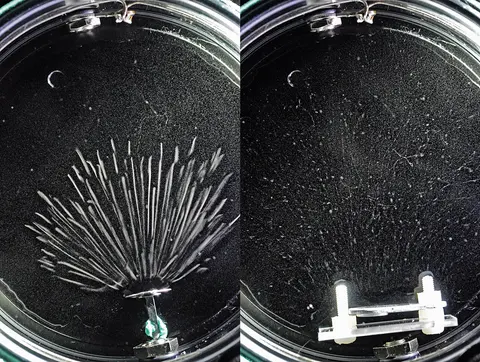
In a ferromagnet, such as solid iron, the arrows inside each small region, called a domain, all point the same way. If the domains also line up with each other, the iron is a permanent magnet. Heat destroys this order. At 768 °C, the Curie point of iron, the magnetism disappears.
An antiferromagnet has two sets of arrows that point in opposite directions and are equal in strength. They cancel out, so the material has no overall magnetism. Nickel oxide is an example. A ferrimagnet also has two opposed sets, but they are unequal. The cancelling is only partial, so the material is still magnetic. The mineral magnetite is one.
The strangest case is a quantum spin liquid. Its magnetic arrows are tangled so that they cannot settle into any neat pattern, even at very low temperatures. It is not a liquid at all, but the disorder is like the jumble inside a liquid, and that gives it its name.
What happens when atoms get almost as cold as possible?
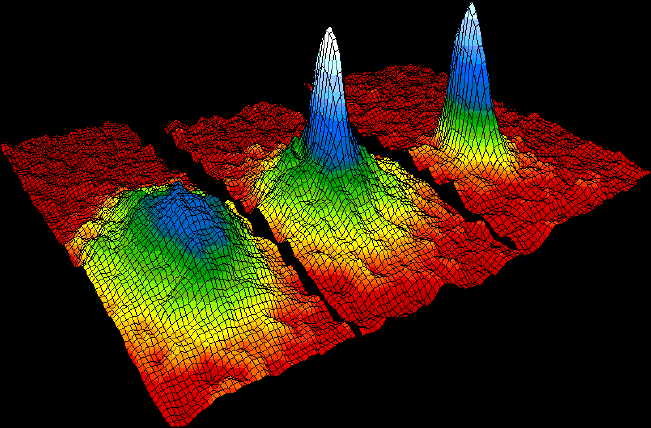
is -273.15 °C. Nothing can be colder. Near that temperature, the rules of quantum physics start to show up in whole clumps of matter.
In 1925 Albert Einstein built on the work of the Indian physicist Satyendra Nath Bose and made a bold prediction. Take a gas of a certain kind of particle, known as bosons, and cool it close to absolute zero. At a particular temperature, a large share of the particles would suddenly drop into the same lowest-energy state. They would stop acting like separate particles and act together as one. This is called a . The name comes from a loose likeness to water vapour condensing into drops.
For many years nobody could make one in a gas. Then in 1995, Eric Cornell and Carl Wieman, working at JILA at the University of Colorado Boulder, made the first with atoms of rubidium. Working separately, Wolfgang Ketterle made another from sodium atoms the same year. Seventy years of waiting had ended.
A condensate is not something you can hold. It is a cloud of atoms chilled to a tiny fraction of a degree above absolute zero. Yet it showed that Einstein's idea from 1925 was right, and it opened a new way to study how matter behaves at its quietest.
Why can a liquid climb out of its cup?
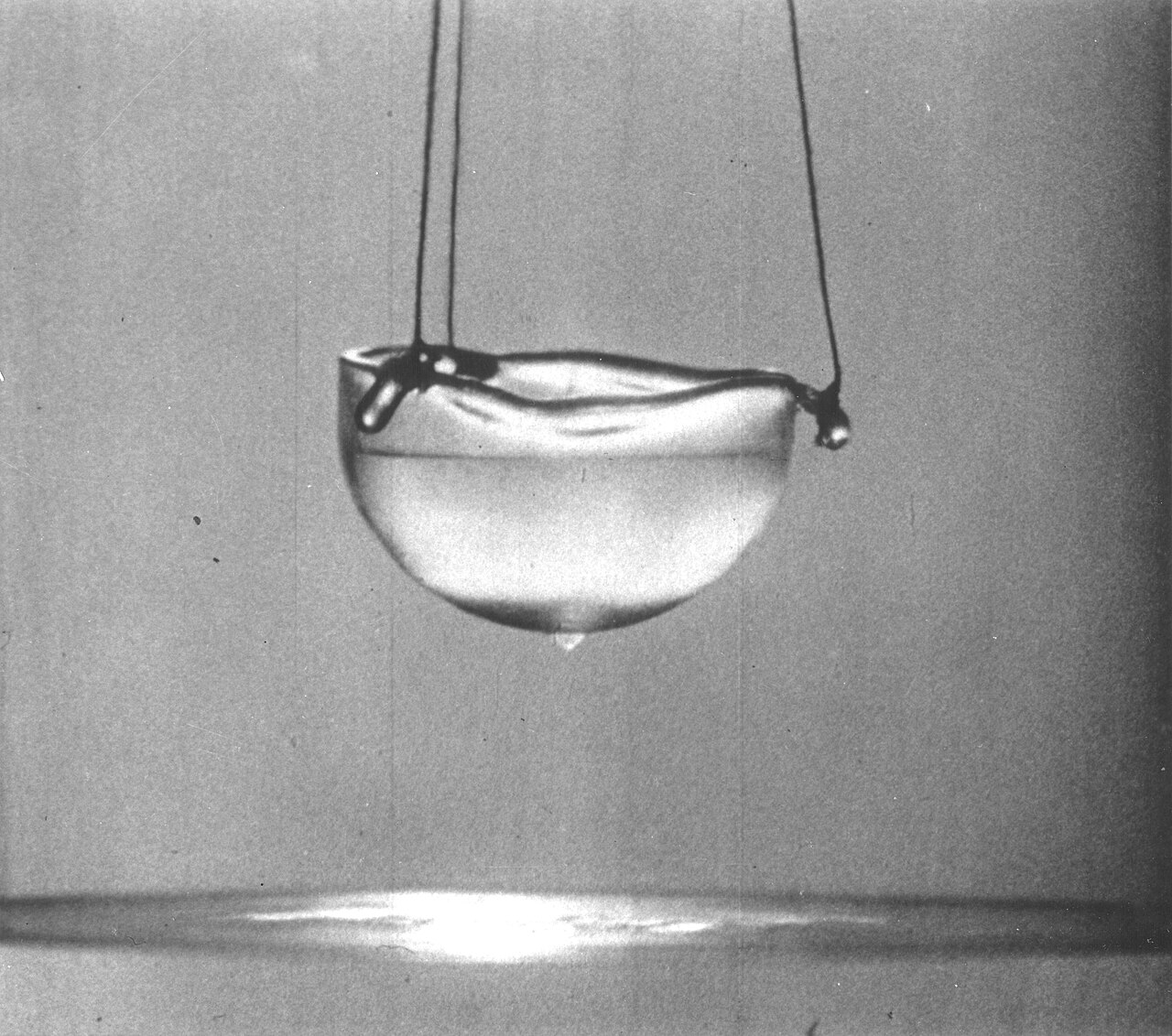
In 1937 scientists found that helium-4, the common kind of helium, does something amazing. Cooled below 2.17 kelvin, which is about -271 °C, it becomes a . A superfluid has no viscosity, which means it flows with no friction at all. It even tries to creep up the wall of its container and spill over the top. If you put it in a spinning container, it forms tiny whirlpools of fixed size. The best explanation is that the helium atoms form a .
The same kind of strangeness shows up with electricity. A is a material with no electrical resistance at all, so a current can flow through it without losing energy. It also pushes magnetic fields out of its inside, which is called the Meissner effect. Heike Kamerlingh Onnes discovered superconductivity in 1911. For 75 years it was known only in some metals and alloys, and only below about 30 kelvin. In 1986 scientists found high-temperature superconductivity in certain ceramics, which work at warmer, though still very cold, temperatures.
Superconducting electromagnets are used in MRI machines, the hospital scanners that make detailed pictures of the inside of the body.
How do electrons manage this? Electrons are fermions, a kind of particle that cannot share a state. But they can team up in pairs, and a pair behaves like a boson. The pairs can then form a condensate like the one Einstein predicted. Helium-3 and cold lithium-6 can form such fermionic condensates too.
What is matter like inside dead stars?
At the other extreme, matter can be squeezed or heated far beyond anything on Earth. When a star runs out of fuel, gravity crushes its core. The pressure becomes so high that quantum rules take over. There is a law, the Pauli exclusion principle, which says that two particles like electrons cannot be in the same state. This law holds the crushed matter up. Scientists call it .
Inside a white dwarf, the core of a dead star like our Sun, the electrons are pushed tightly together, yet still stay with their atoms. In a neutron star the squeeze is far greater. Electrons are forced into protons, and the whole star becomes a dense ball of neutrons about 20 kilometres across. A neutron on its own falls apart in about 10 minutes. Inside a neutron star it cannot. Some large planets like Jupiter, and heavier objects called brown dwarfs, are expected to have a core of metallic hydrogen, another form of degenerate matter.
Protons and neutrons are made of smaller particles called . Normally the strong force locks quarks inside them. At enormous temperatures, the quarks break free and form quark-gluon . It was first detected at CERN in 2000, when heavy atomic nuclei were smashed together at nearly the speed of light. Unlike ordinary plasma, it flows like a liquid.
The early universe may have passed through states like this in the first moments after the Big Bang. Some other states are very new. Supersolids, which flow without friction yet keep a rigid shape, were first made in clouds of ultracold atoms between 2017 and 2019, and scientists are still exploring them.
Explore Next
Your audio story keeps playing while you look around.
Words to Know
- absolute zero
- The lowest temperature possible, -273.15 °C.
- Bose-Einstein condensate
- A state in which many very cold atoms act together as one.
- crystal
- A solid whose particles sit in a regular, repeating pattern.
- degenerate matter
- Matter in dead stars, held up by quantum rules instead of heat.
- liquid crystal
- A material that flows like a liquid but has molecules that line up like a crystal.
- phase transition
- A change from one state or phase to another, with a sudden change in properties.
- plasma
- A very hot gas whose atoms have lost electrons, leaving charged particles that can carry electricity.
- quark
- A tiny particle that makes up protons and neutrons.
- sublimation
- When a solid turns straight into a gas without becoming a liquid.
- superconductor
- A material that carries electricity with no resistance.
- superfluid
- A liquid that flows with no friction at all.