Molecule
Tiny groups of atoms that build water, air, sugar and you.
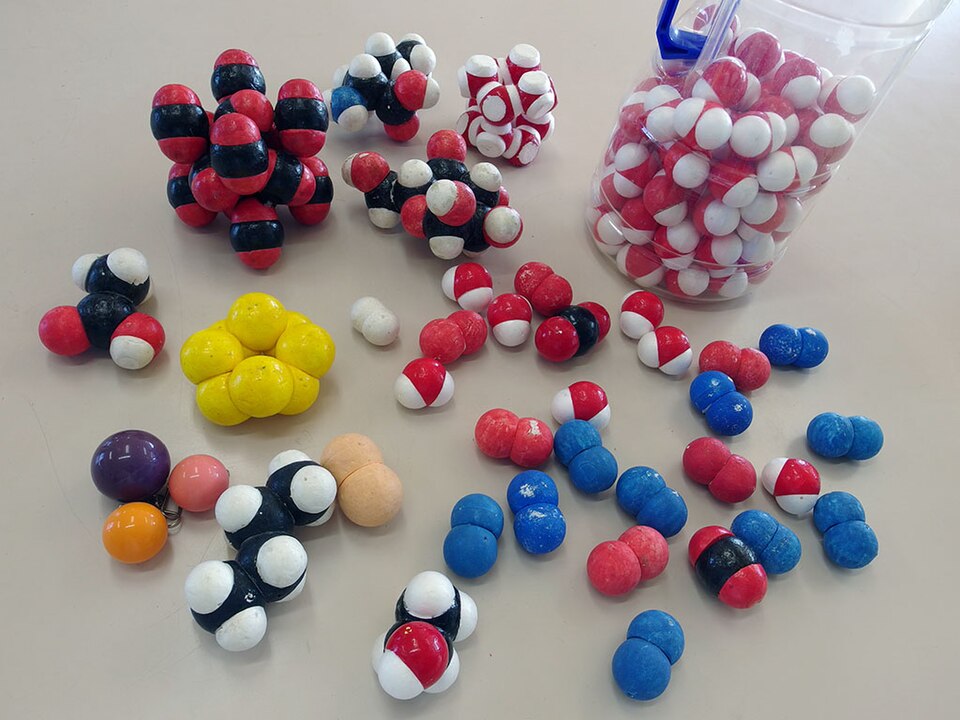
A molecule is a group of two or more atoms held together by chemical bonds. The air you breathe, the water you drink and the DNA that carries your instructions for life are all made of molecules. The smallest has only 2 atoms. Some giants, such as DNA, have billions. Molecules are far too small to see, so scientists had to be clever to prove they exist. They did it with careful measuring in the early 1900s. Today special microscopes can trace the outline of a single molecule. Yet not everything is made of molecules. Rock, salt and metal are built in a different way.
What is a molecule?
Everything around you is built from . Atoms rarely stay alone, though. Most of the time they join up. A molecule is what you get when two or more atoms are held together by attractive forces called . Think of atoms as building bricks and molecules as the models you make with them.
Some molecules have only one kind of atom. The oxygen you breathe is made of 2 oxygen atoms bonded together, written O2. Other molecules mix kinds. Water has 2 hydrogen atoms and 1 oxygen atom, so its formula is H2O. A substance with more than one kind of atom bonded together is called a .
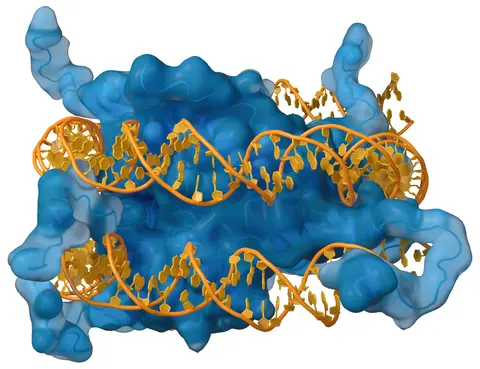
Molecules come in many sizes. Hydrogen, with only 2 atoms, is the smallest. At the other end are huge chains such as DNA. A single DNA molecule from a human cell can hold billions of atoms.
There is a twist for gases. When scientists study how gases move, they often call every gas particle a molecule. That includes helium and neon, which exist as single atoms. So the word can be used loosely. In most chemistry, a molecule means a stable group of two or more atoms with a definite shape.
How did people work out that molecules exist?
The idea that matter is made of tiny pieces is very old. Greek thinkers such as Leucippus and Democritus argued that the universe is made of and empty space. Around 450 BC another Greek, Empedocles, said everything was built from four elements. They were fire, earth, air and water. Forces of attraction and repulsion pushed them together and apart.
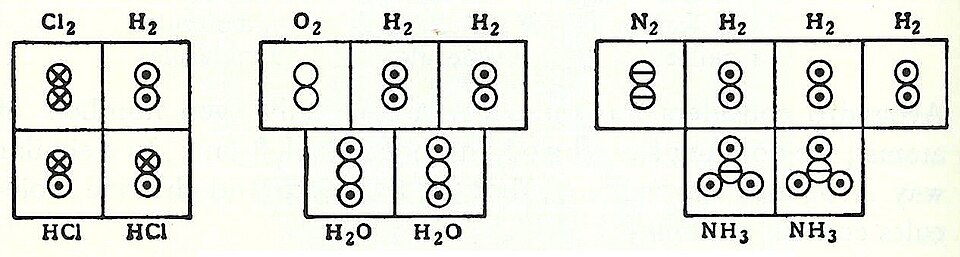
The modern story starts with Robert Boyle. In 1661 he wrote that matter is made of clusters of particles. He said chemical change happens when those clusters rearrange. In 1811 Amedeo Avogadro used the word molecule for such clusters. In 1833 the French chemist Marc Antoine Auguste Gaudin drew diagrams of gas molecules. They included the correct formula for water, H2O.
Drawings were not proof, though. Many scientists still doubted that atoms and molecules were real. The key was Brownian motion, the jittery dance of tiny specks floating in a liquid. In 1905 Albert Einstein showed that the specks should jiggle in exactly this way if invisible molecules were bumping into them, and he worked out by how much. From 1908 the French physicist Jean Perrin measured the motion with great care. He used it, and two other methods, to work out Avogadro's number. That number counts how many particles are in a standard amount of matter. All three methods gave matching answers. That convinced almost everyone. Perrin won the Nobel Prize in Physics in 1926.
Then, in 1931, Linus Pauling used the new science of quantum mechanics to explain how bonds work. Chemistry was never the same.
What holds the atoms together?
have a tiny nucleus with electrons moving around it. Bonds form because of those electrons. When atoms join, they settle into a steadier arrangement than they had apart. The force that keeps them there is a .
Molecules are usually held together by . In a covalent bond, two atoms share a pair of electrons. Both atoms are attracted to the shared pair. That pull balances the way the atoms push each other away, and the result is a steady link. Hydrogen is a good example. Free hydrogen atoms are rare in nature. Each one pairs up with another to make an H2 molecule.
The second main kind is the . Here one atom gives electrons to another. The atom that loses electrons becomes a positively charged . The atom that gains them becomes a negatively charged ion. Opposite charges attract, so the ions stick together. Table salt works this way, with sodium atoms giving electrons to chlorine atoms.
Ionic substances behave differently from covalent ones. They usually form solid lumps with no separate molecules inside. Weaker attractions also exist, such as hydrogen bonds between water molecules. Scientists do not usually count the groups these make as single molecules.
Is everything made of molecules?
It is tempting to say yes, but the answer is no. Molecules are very common. They make up most of the oceans and the atmosphere. Most living things are built from molecules. These include proteins, the amino acids that make proteins, DNA and RNA, sugars, fats and vitamins.
Most of the solid things you can pick up from the ground are different. Sand, clay, pebbles, boulders and the minerals of the Earth are crystals or ionic . Their are linked in a pattern that repeats again and again. There are no neat separate groups. Diamond is a good example. Every carbon atom is bonded to its neighbours, so a whole diamond is one continuous network. Quartz and table salt work in a similar way.
Solid metals are different again. Their atoms share electrons across the whole piece, and a metal does not behave like a molecule. Glass has bonded atoms too. But they sit in a messy order, and no single molecule can be picked out.
This matters because an older idea said a molecule was the smallest piece of a substance that still acts like it. That works for water. It fails for rock or salt. For these, chemists use the term formula unit. It means the simplest repeating ratio of atoms.
How big is a molecule, and can we see one?
Most molecules are far too small to see. Many of the ones chemists use are between a few ångströms and a few dozen ångströms across. An ångström is one ten-billionth of a metre. So these molecules are around a billionth of a metre across, or 1 nanometre. A human hair is tens of thousands of times wider. The smallest molecule of all is hydrogen. Its two sit only 0.74 ångströms apart.
Some molecules are giants. are long chains made of many repeating pieces. The biggest can reach sizes you can see. DNA is a famous example.
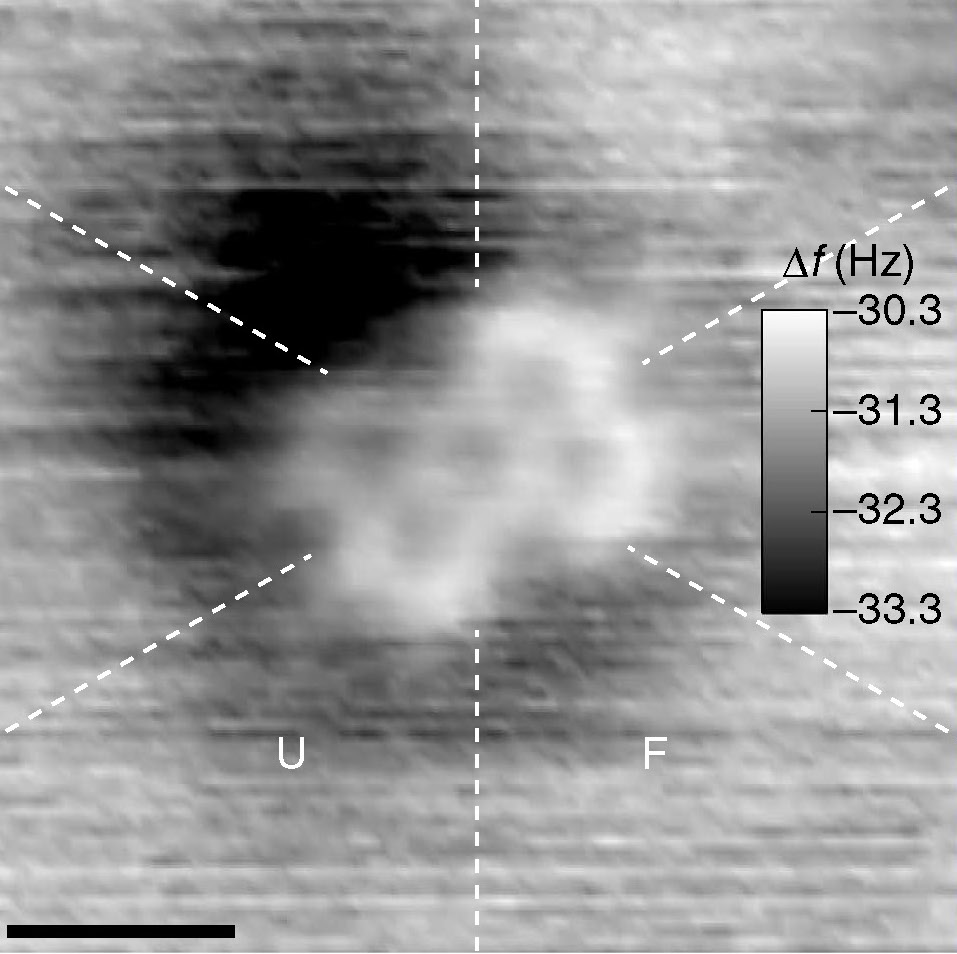
A normal light microscope cannot show single molecules. Scientists found other ways. An atomic force microscope drags an extremely sharp tip across a surface and feels the bumps. By measuring tiny forces, it can trace the outline of a molecule. It can even show the shapes of single atoms. Scanning tunnelling microscopes work in a different way. They measure a tiny flow of electrons between the tip and the surface.
These pictures are not photographs. They are maps built from measurements. But they show real molecules, such as ring-shaped ones with 5-fold symmetry. They match what theory had predicted.
How do chemists write down a molecule?
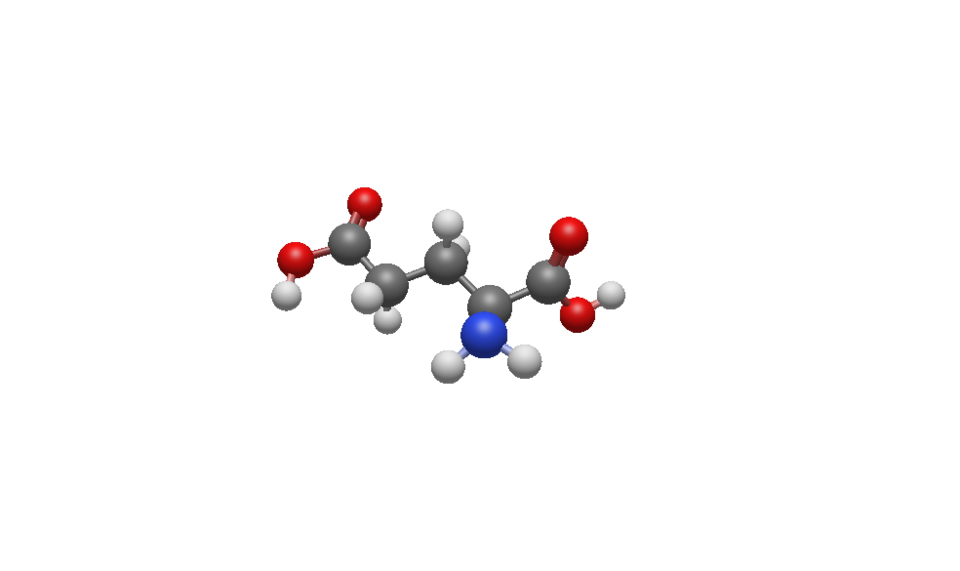
Chemists use a kind of shorthand. A lists the symbols of the elements in a molecule. Small numbers show how many of each. H2O means 2 hydrogen atoms and 1 oxygen atom. CO2, carbon dioxide, has 1 carbon atom and 2 oxygen atoms.
There are different kinds of formula. The empirical formula gives the simplest whole-number ratio of atoms. The molecular formula gives the exact number in one molecule. Sometimes they match. Sometimes they do not. Acetylene, a gas used in welding, has the molecular formula C2H2. Its simplest ratio is CH.
Formulas have a limit. Ethanol, the alcohol in drinks and fuels, has 2 carbon, 6 hydrogen and 1 oxygen atom. Dimethyl ether has exactly the same atoms. But it is a different substance with different properties. Molecules with the same atoms in different arrangements are called .
To solve this problem, chemists draw a structural formula. It shows which atom links to which, like a map. Ball-and-stick models do the same job in three dimensions. A ball-and-stick model of glutamic acid, an amino acid found in proteins, shows how its 19 atoms connect.
Chemists also give each molecule a mass, usually in . One dalton is one twelfth of the mass of a carbon-12 atom.
Why does the shape of a molecule matter?
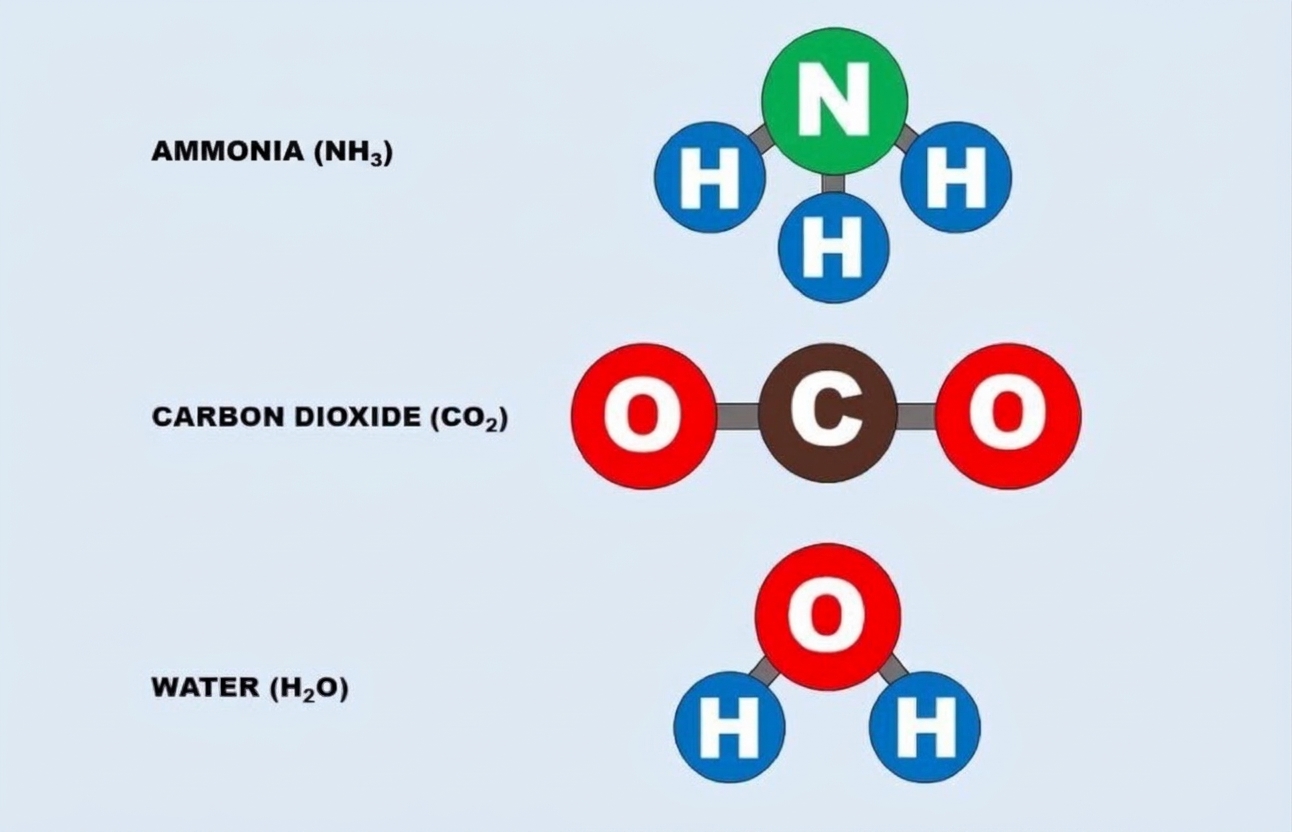
A molecule is not a loose heap of . Its bonds have fixed lengths. Its atoms sit at set angles. The molecule constantly wobbles, stretches and spins around that shape. All the molecules in a pure substance share the same average shape.
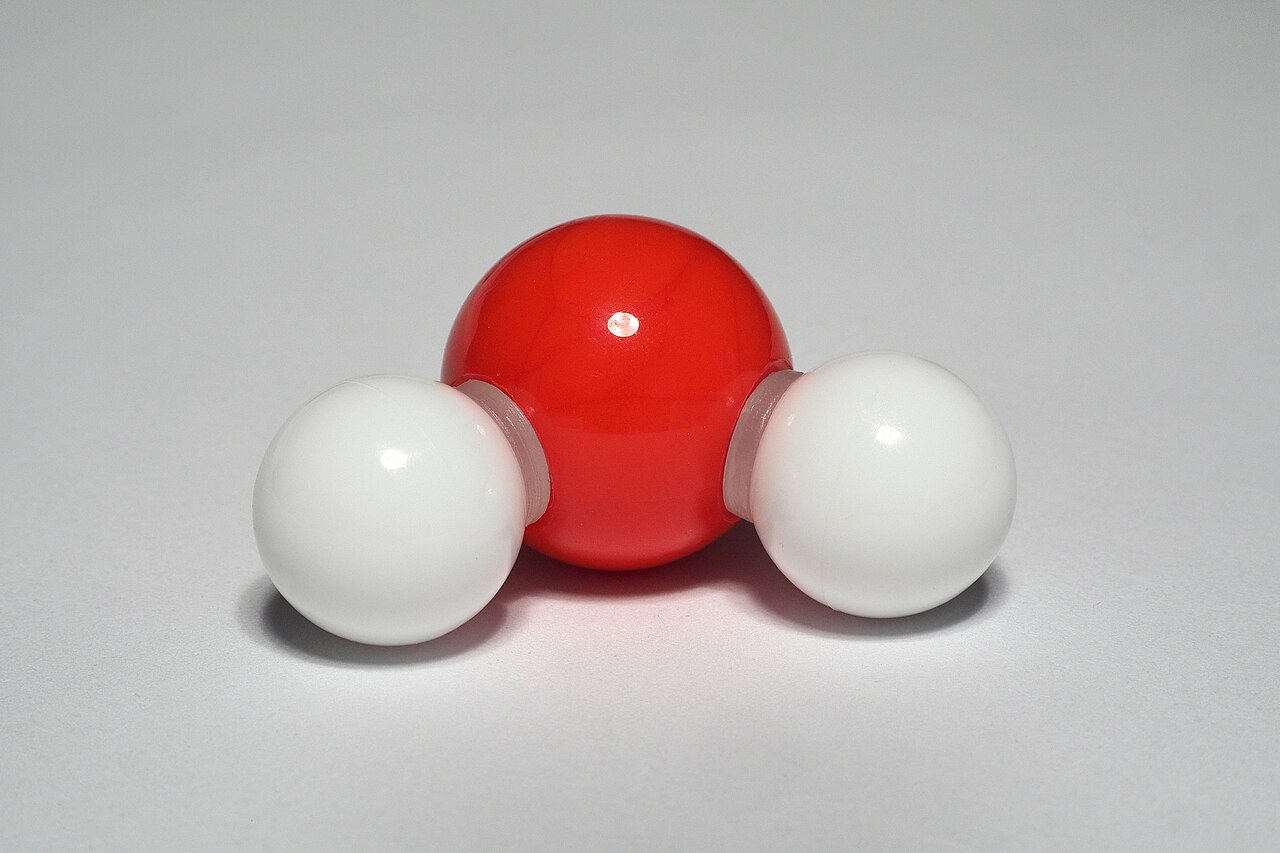
The formula and the shape together decide how a molecule behaves. They decide especially how easily it reacts with others. Water shows this well. Its 3 atoms are not in a straight line. They form a bent shape, with the oxygen at the point. Because of the bend, one side of the molecule is slightly positive and the other slightly negative. That is why water molecules cling to each other. It is also why water can dissolve so many things. Carbon dioxide is straight, and its charge is balanced.
show the power of shape even more. They have the same formula but different structures. So they usually behave very differently. A special group, the stereoisomers, can look almost the same in ordinary tests. Yet they can act differently in living things.
This is why chemists work hard to find the exact shape of molecules. It is also why Pauling's work on bond angles mattered so much.
How can light reveal what a molecule is?

Scientists often learn about molecules by sending energy at them and watching what happens. This is called molecular . A molecule can only hold certain amounts of energy, in steps, a bit like the rungs of a ladder. When it takes in or gives out energy, it jumps between rungs. The pattern of jumps is a fingerprint for that molecule.
Different kinds of energy reveal different things. Microwave spectroscopy measures how molecules rotate. It can identify molecules in outer space. Infrared spectroscopy measures how they vibrate. Bonds stretch, bend and twist like springs. This tells chemists which kinds of bonds are present.
Electrons can also change their arrangement. This makes molecules take in or give out ultraviolet, visible or near-infrared light. Those changes are the reason many substances have colour. Nuclear magnetic resonance (NMR) spectroscopy checks the surroundings of particular atomic nuclei. It tells chemists how many sit in different places in a molecule.
The same ideas let astronomers find molecules in dark clouds of gas and dust between the stars. These clouds are far beyond any laboratory. Nobody needs to visit them. The waves that arrive on Earth carry the fingerprints.
Where do we draw the line on what counts?
You might expect the definition of a molecule to be exact. In fact, scientists have to decide how firmly must be stuck together.
The simplest molecule is the hydrogen molecule-, H2+. It has 2 positively charged protons and 1 negatively charged electron. With only one electron, nothing pushes against it. So physicists can solve the equations of quantum mechanics for it fairly easily. It has the simplest bond of all, a bond made by a single electron.
For bigger molecules the maths gets very hard. Fast computers changed that. Today computational chemistry uses clever approximations to predict the shapes and behaviour of complicated molecules. Chemists can do this before anyone makes them.
The group that sets chemical names and rules is called IUPAC. It suggests a test. As atoms come together, their energy dips down. If the dip is deep enough to trap at least one vibration state, the group counts as a molecule. By that rule, even the helium dimer, He2, counts. It is held together so weakly that it only shows up at extremely low temperatures.
So a molecule is not a fundamental thing, like an electron. It is a useful idea. Chemists use it to describe how strongly atoms attract each other in the world we see.
Explore Next
Your audio story keeps playing while you look around.

Words to Know
- atom
- The tiny building block of matter that makes up every element.
- chemical bond
- A force that holds atoms together in a molecule or crystal.
- chemical formula
- A short code of symbols and numbers that shows which atoms a molecule has.
- compound
- A substance made of more than one kind of atom bonded together.
- covalent bond
- A bond in which two atoms share a pair of electrons.
- dalton
- A unit for the mass of atoms and molecules, equal to one twelfth of a carbon-12 atom.
- ion
- An atom or molecule that has gained or lost electrons and so carries a charge.
- ionic bond
- A bond made by the attraction between positive and negative ions.
- isomer
- One of several molecules that have the same atoms arranged in different ways.
- polymer
- A very long molecule made of many repeating pieces joined in a chain.
- spectroscopy
- A way to study molecules by seeing how they take in or give out energy.