Sound
Invisible shivers in the air that carry music, speech and thunder to your ears.
Every sound you have ever heard began with a vibration. A drum skin shakes, a guitar string trembles, a throat hums, and the shaking pushes on whatever is next to it. That push spreads outwards as a wave, passing from one particle to the next until it reaches your ear. Your brain then turns it into a bang, a song or a friend's voice. Sound can cross air, water and solid rock, but it cannot cross empty space. Scientists study how sound moves, how fast it goes and how we sense it. The story starts with something shaking.
What is sound, really?
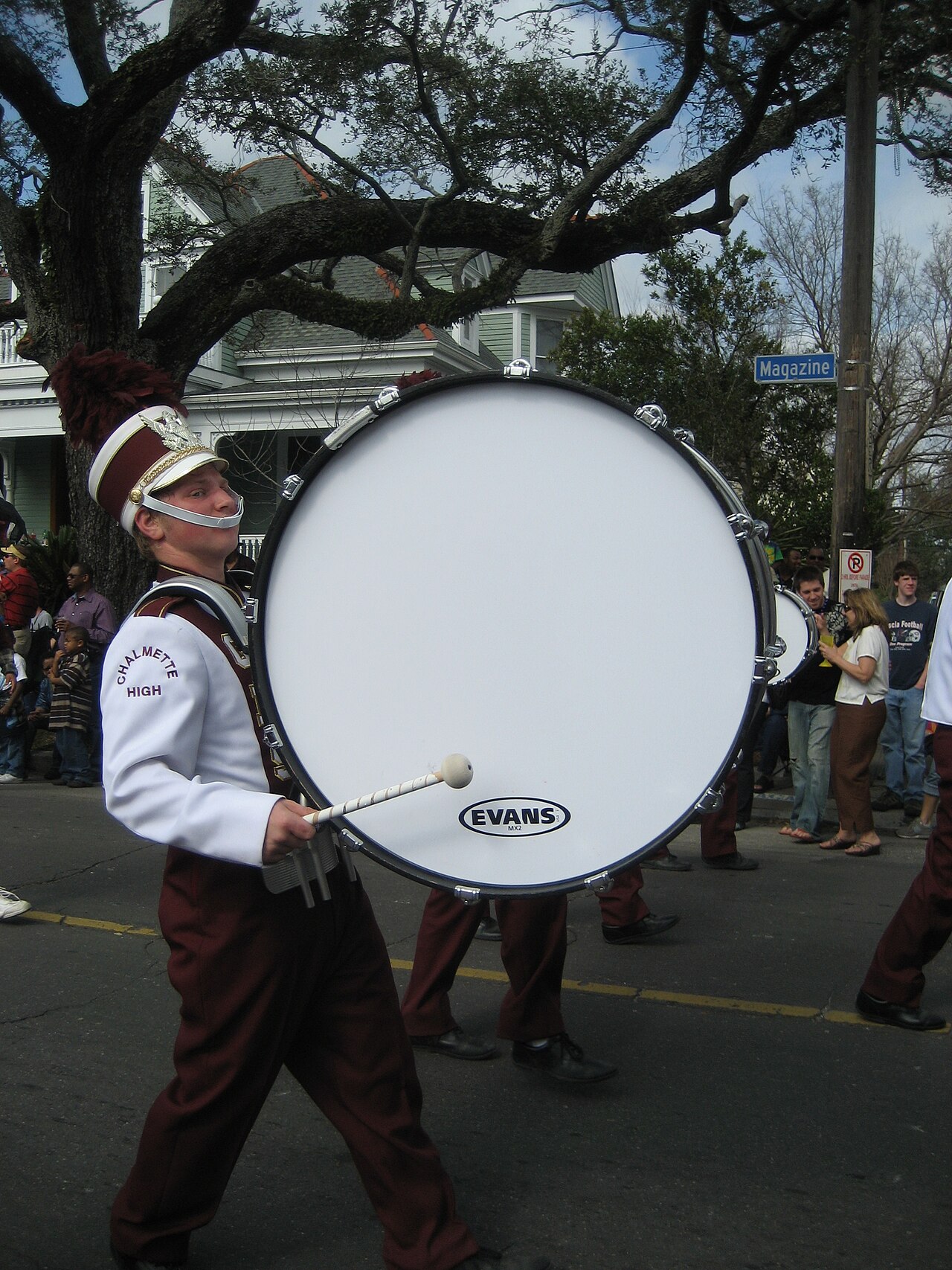
Sound is a that travels. Hit a drum and its skin moves in and out very quickly. Each movement pushes on the air next to it, squeezing the air a little. Then the skin moves back and the air spreads out again. These squeezes and stretches ripple outwards as a sound wave.
The word has two meanings, and scientists keep them apart. In physics, sound is the wave itself, a vibration moving through a material. In biology and psychology, sound is what you sense when that wave reaches your ear and your brain makes sense of it.
That is why people argue about an old riddle. If a tree falls in a forest and nobody is there, does it make a sound? If sound means the wave, the answer is yes, because the falling tree shakes the air. If sound means the experience of hearing, the answer is no, because nobody is there to hear it. Both answers are right, and they depend on which meaning you use.
Nearly everything makes sound. Fire crackles, rain patters, wind rushes and the sea crashes on the shore. Even an earthquake has its own deep rumble. Animals use sound to find food, avoid danger, find their way and call to one another. Humans have gone further, inventing music, the telephone and the radio. In 1857 the Frenchman Édouard-Léon Scott de Martinville built the phonautograph, which traced sound waves as wavy lines on soot-blackened paper. It could not play them back. In 1877 Thomas Edison's phonograph became the first machine to record a voice and play it back.
How does a sound get from there to here?
Sound needs something to travel through. Scientists call that something the . It can be a gas such as air, a liquid such as water, a solid such as steel or even a plasma, the hot, glowing gas found inside stars. Sound cannot travel through a , which is empty space with no matter at all. If you could stand next to an exploding spacecraft in space, you would hear nothing.
In air, it works like this. Something vibrating, such as the cone of a loudspeaker, pushes on the air particles beside it. Those particles bump into their neighbours, which bump into theirs. A wave of squeezed air, called a compression, moves outwards. Behind it comes a stretched region, called a rarefaction. Because the air particles move back and forth along the direction the wave is going, this is called a longitudinal wave.
The important point is that the particles do not travel with the wave. Each one only shuffles a tiny way and returns. Think of a crowd doing a wave at a stadium. The wave goes all the way round, but every person stays in their seat. Only the energy moves.
In solids sound can also travel as a transverse wave, which shakes the material sideways. Along the way, a wave can bounce off a surface, which makes an echo, or it can fade as it spreads out and loses energy. Hard walls bounce sound around, while soft curtains and carpets soak it up. That is why an empty room echoes and a furnished one does not. Architects use this when they design concert halls, so that every seat hears the music clearly.
How did people work out what sound is?
People have puzzled over sound for thousands of years. About 2,500 years ago, the Greek thinker Pythagoras and his followers noticed that a string half as long sounds a note exactly an octave higher. Simple ratios of string lengths, such as 2 to 3, give notes that sound pleasant together.
Measuring sound took much longer. In the 1630s the French friar Marin Mersenne timed the gap between seeing the flash of a distant gun and hearing its bang. His answer, about 450 metres per second, was too high, but it was the right size.
In 1660 the scientist Robert Boyle put a ticking watch inside a glass jar and pumped out the air. As the air left, the ticking grew fainter. When the air rushed back in, so did the sound. This is how we know that sound needs a material to travel through, and why there is no sound in space.
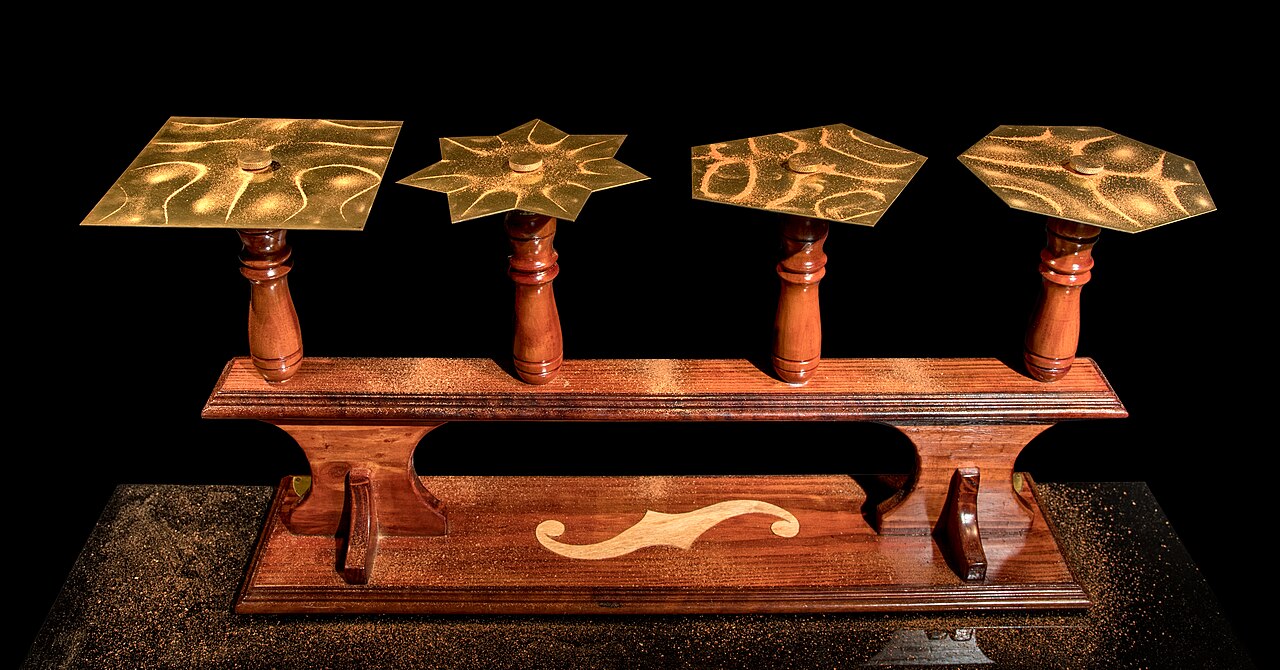
In the late 1700s the German physicist Ernst Chladni found a beautiful way to make sound visible. He sprinkled sand on a flat metal plate, then drew a violin bow across its edge. The plate shook, and the sand bounced away from the parts that moved most. It piled up along the parts that stayed still, and each note made a different pattern. These are now called Chladni figures. Chladni's work helped to start , the science of sound and other mechanical waves. A scientist in this field is called an acoustician.
How fast does sound go?
In air at 20 °C, sound travels at about 343 metres per second. That is around 1,200 kilometres an hour, and it explains why you see lightning before you hear thunder. Light is almost instant, but the sound arrives later. Count the seconds between the flash and the rumble and multiply by 343. That gives the distance to the lightning in metres.
The speed depends on the . In fresh water, sound moves at about 1,482 metres per second, more than four times faster than in air. In steel it is about 5,960 metres per second. The reason is that particles in a stiff solid spring back to their places very quickly, so they pass the wave on faster than the loose particles of a gas can.
Temperature matters too. Warm air carries sound faster than cold air. Each degree Celsius adds about 0.6 metres per second.
The first big attempt to work out the speed of sound came from Isaac Newton. His formula turned out to be wrong. The French mathematician Pierre-Simon Laplace fixed it by noticing that air heats up a little when it is squeezed and cools when it expands. The corrected formula is called the Newton-Laplace equation. It says that sound is faster in materials that are stiffer and lighter.
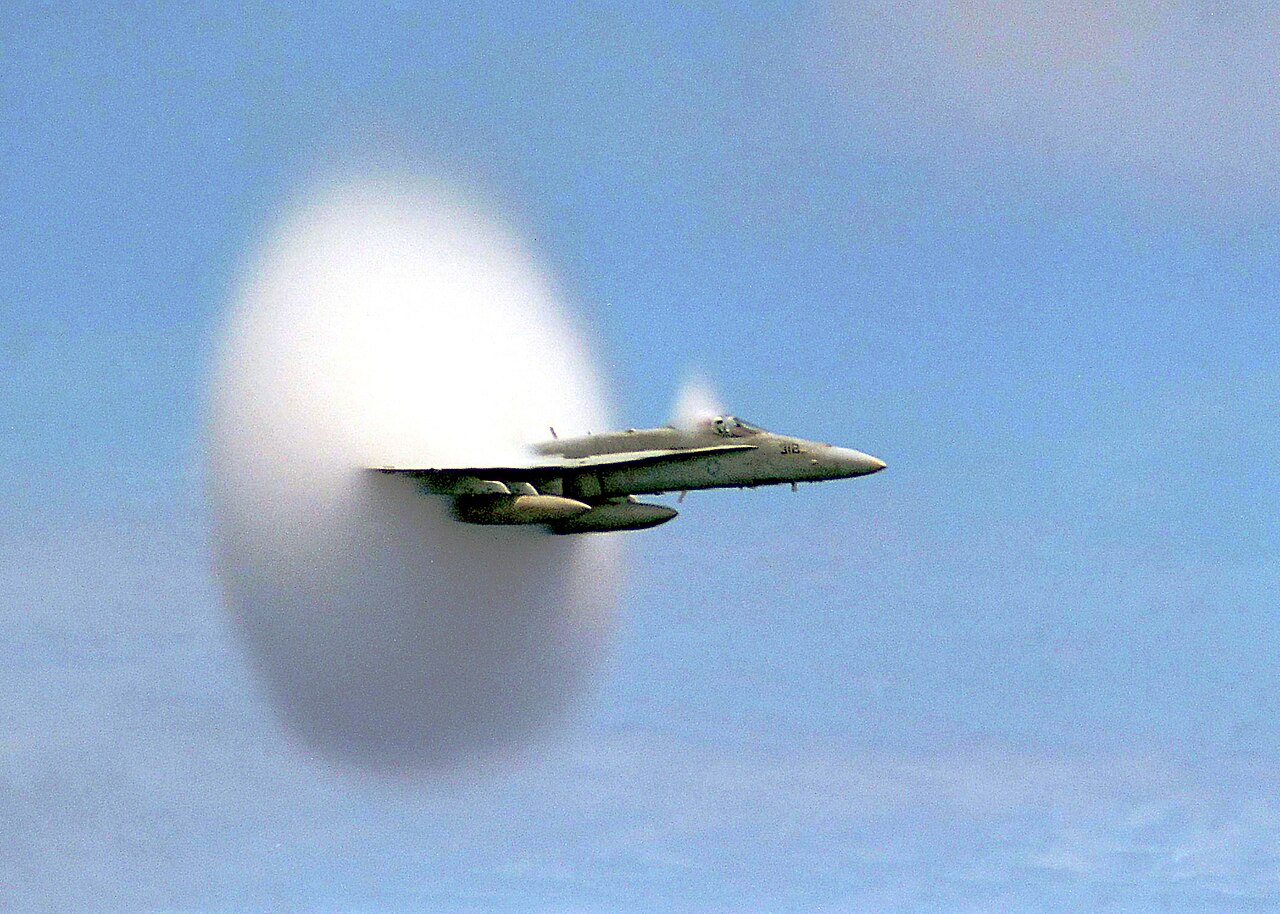
When a jet flies faster than sound, it is called supersonic. Close to the speed of sound, air can form a cloud of water vapour around the aircraft, as often happens around fighter jets.
Why are some sounds high and others low?

is how high or low a sound seems. A mouse squeaks at a high pitch and a lion roars at a low one. Pitch depends on , which is the number of each second. Frequency is measured in hertz, shortened to Hz. A string that vibrates 440 times a second makes a note of 440 Hz. Faster vibrations make a higher pitch.
Tuning forks show this well. A tuning fork is a metal tool with two prongs that vibrates at one fixed frequency when struck. Short, thin prongs shake quickly and ring high. Long, thick prongs shake slowly and ring low. Musicians use forks to check that instruments are in tune.
Frequency is linked to , the distance between one squeeze of air and the next. A high-pitched sound has short waves, and a low-pitched sound has long ones. People can hear frequencies from about 20 Hz to 20,000 Hz, which is 20 kilohertz. In air, those sound waves measure from about 17 metres long down to about 1.7 centimetres.
Most real sounds are mixtures. A musical note has a main vibration, called the fundamental, plus fainter higher ones layered on top. Our brains work out the pitch from this pattern. Sometimes two people disagree about the pitch of a complicated sound, because the brain has to make a choice.
What makes a sound loud?
Loudness is how strong a sound seems. It depends mostly on the size of the pressure changes in the sound wave, which scientists call its . A big squeezes the air harder and sounds louder than a small one. Ears are also affected by time. A very short sound seems softer than a longer one at the same strength, until the sound lasts about a fifth of a second. After that, making it longer does not make it seem louder.
Human ears can notice an enormous range of strengths, from a pin drop to a jet engine. To handle such a huge range, scientists use the scale, written dB. It is a special scale in which each step up of 10 decibels means the sound has 10 times more power. So 30 decibels is 10 times as strong as 20 decibels, and 40 decibels is 100 times as strong as 20 decibels.
To give some feel for the numbers, a whisper is about 30 decibels. A normal talking voice is about 60. A busy road is about 80, and a rock concert is about 110. Sounds above about 120 decibels can hurt the ears.
Our ears do not respond equally to all . They are more sensitive to some than to others. Engineers therefore often use a scale called A-weighting, written dBA, which adjusts the measurement to match what ears pick up. Noise levels in the street and at work are often given in dBA.
Why does a piano sound different from a clarinet?
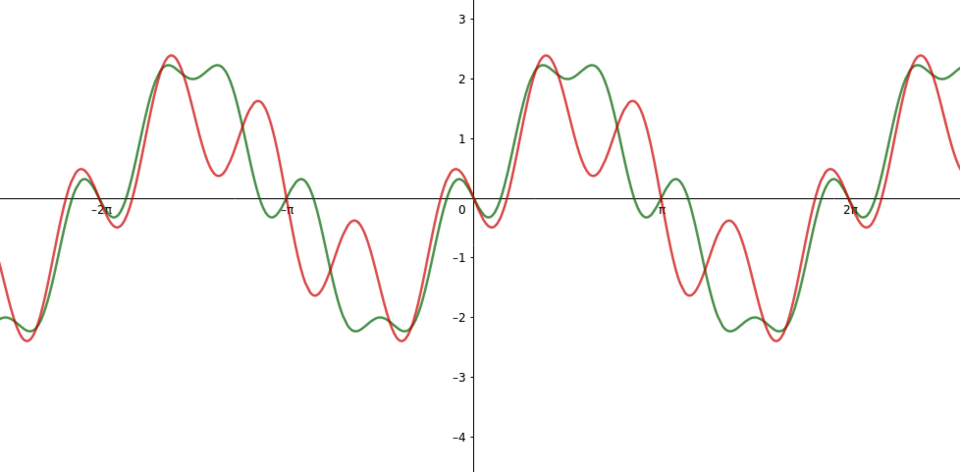
Play the same note on a piano and a clarinet at the same loudness. The is the same, yet you never confuse the two. The difference is called , pronounced TAM-ber. It is the quality or character of a sound. It is what lets you say, "That's an oboe!" or recognise a friend on the phone.
Timbre depends on the fainter , called overtones, that come with the main note. Each instrument has its own mixture of overtones, and the mixture gives the sound wave a particular shape. Two notes of the same pitch can have waves with quite different shapes.
The way a sound changes over time matters even more. A piano note starts with the thump of a hammer, then fades slowly. A clarinet note starts with a breathy hiss of air, then stays steady for as long as the player breathes. Cut off the start of each sound and they become much harder to tell apart.
Two other features help us make sense of the world. Texture is how many sounds are mixed together and how they interact. A single flute has thin texture, while a busy cafe is a thick, jumbled one. Spatial location is where a sound seems to come from, left or right, near or far, above or below. With two ears and a clever brain, you can pick out one voice in a crowd.
How do our ears turn waves into sounds?
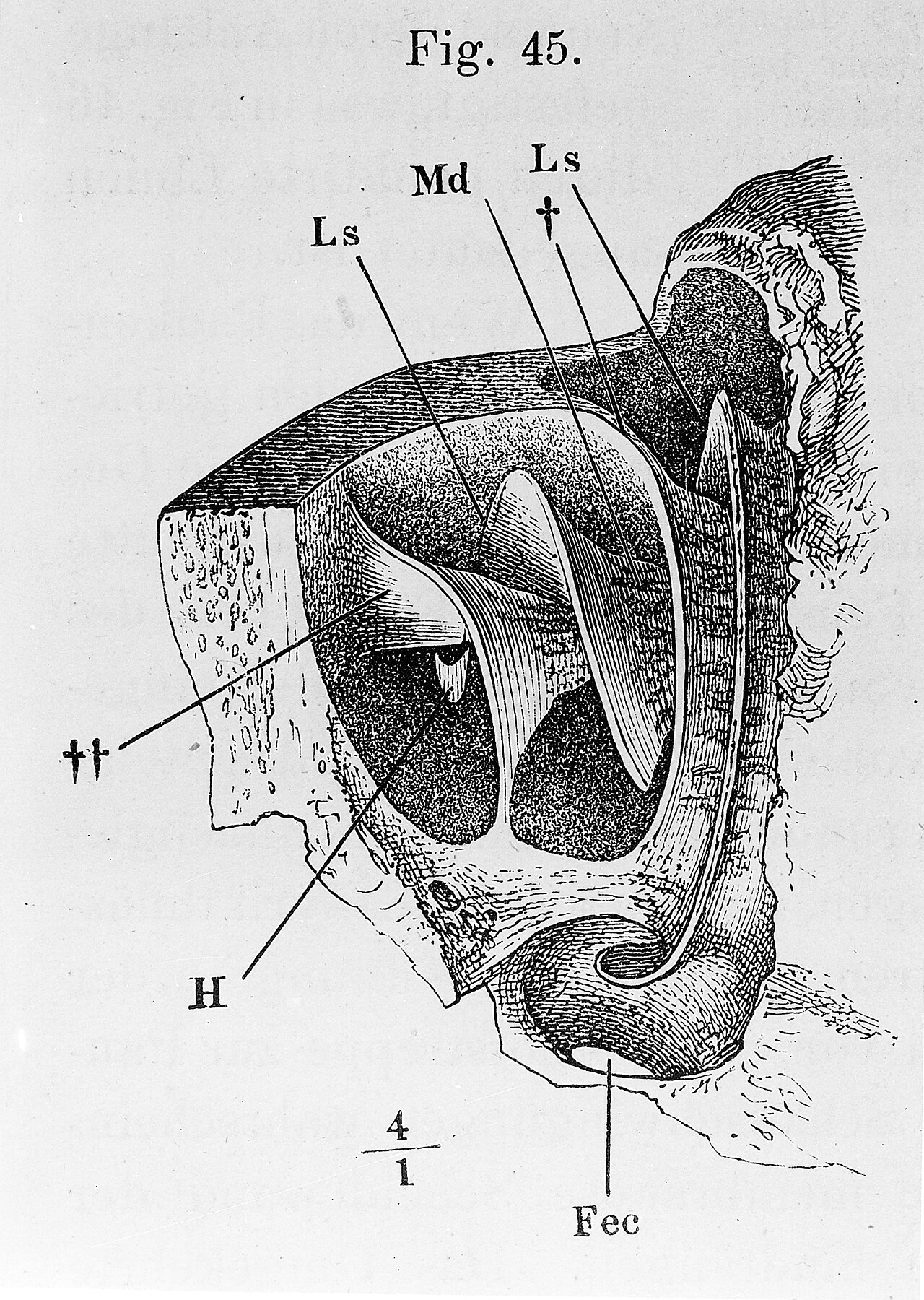
Your ear is a machine for turning pressure waves into nerve signals. It has three main parts.
The outer ear is the part you can see. Its shape collects sound and funnels it down a short tube to the eardrum, a thin skin that shakes in time with the wave. Behind the eardrum, in the middle ear, three tiny bones pass the shaking along. They are the smallest bones in the body, and they make the stronger.
The last bone pushes on the inner ear, which holds a fluid-filled coil called the cochlea. It looks like a snail shell and is only about the size of a pea. Inside, the ripples in the fluid move thousands of tiny hair cells. Hair cells near the start of the coil respond to high , and those near the end respond to low ones. When a hair cell bends, it sends an electrical signal along the auditory nerve to the brain.
The brain then does the hard work, sorting the signals into pitch, loudness, and direction. It is why you can follow a conversation in a noisy room.
Hearing changes through life. Very loud noise can damage the hair cells for good. Also, most people lose some of the highest pitches as they get older, so the top of the hearing range slowly falls.
What about sounds we cannot hear?
Human hearing stops at about 20,000 hertz at the top and 20 hertz at the bottom. But sound does not stop there.
is sound above 20,000 hertz. It is the same kind of wave as the sounds we hear, only with a higher . Ultrasound devices work from 20 kilohertz up to several gigahertz, which is billions of a second. Dogs can hear some sounds above our limit, and bats and dolphins go much further. They use it for echolocation. A bat sends out a squeak, listens for the echo and builds a picture of its surroundings, even in total darkness.
Humans use ultrasound too. Doctors use it for scans, including pictures of babies before birth, because the echoes can show soft parts inside the body safely. It is also used in some medical treatments.
is sound below 20 hertz. We cannot hear it as a note. A low rumble may be heard as a series of separate pulses, like the putt-putt of an idling motorcycle. Whales and elephants can detect infrasound, and they use it to call to each other over huge distances. Scientists use infrasound to detect volcanic eruptions far away, and some music uses it for a deep, throbbing feel.
Sound, then, is a whole range of vibrations. Our ears pick up only a slice of it.
Explore Next
Your audio story keeps playing while you look around.



Words to Know
- acoustics
- The science of sound and other mechanical waves.
- amplitude
- The size of a wave, which sets how loud a sound is.
- decibel
- A unit for measuring how strong a sound is.
- frequency
- The number of vibrations in each second, measured in hertz.
- infrasound
- Sound with a frequency below 20 hertz.
- medium
- The material, such as air or water, that a sound wave travels through.
- pitch
- How high or low a sound seems.
- timbre
- The character of a sound that tells a piano from a clarinet.
- ultrasound
- Sound with a frequency above 20,000 hertz.
- vacuum
- A space with no matter in it, where sound cannot travel.
- vibration
- A quick back-and-forth movement.
- wavelength
- The distance from one squeeze of a sound wave to the next.