Sunspot
Dark freckles on the Sun, made by magnetism and watched for thousands of years.
A sunspot is a dark patch on the Sun's surface. It looks black, but it is still hotter than a pizza oven. It seems dark only because the gas around it is brighter. Sunspots are places where strong magnetic fields push through the surface and cool it. Some are wider than Earth, and a few are big enough to see without a telescope. Their number rises and falls in a cycle of about 11 years. Chinese astronomers recorded them more than 2,000 years ago, and Galileo drew them in the 1600s. Today spacecraft watch them because they signal storms that can reach Earth.
What is a sunspot?
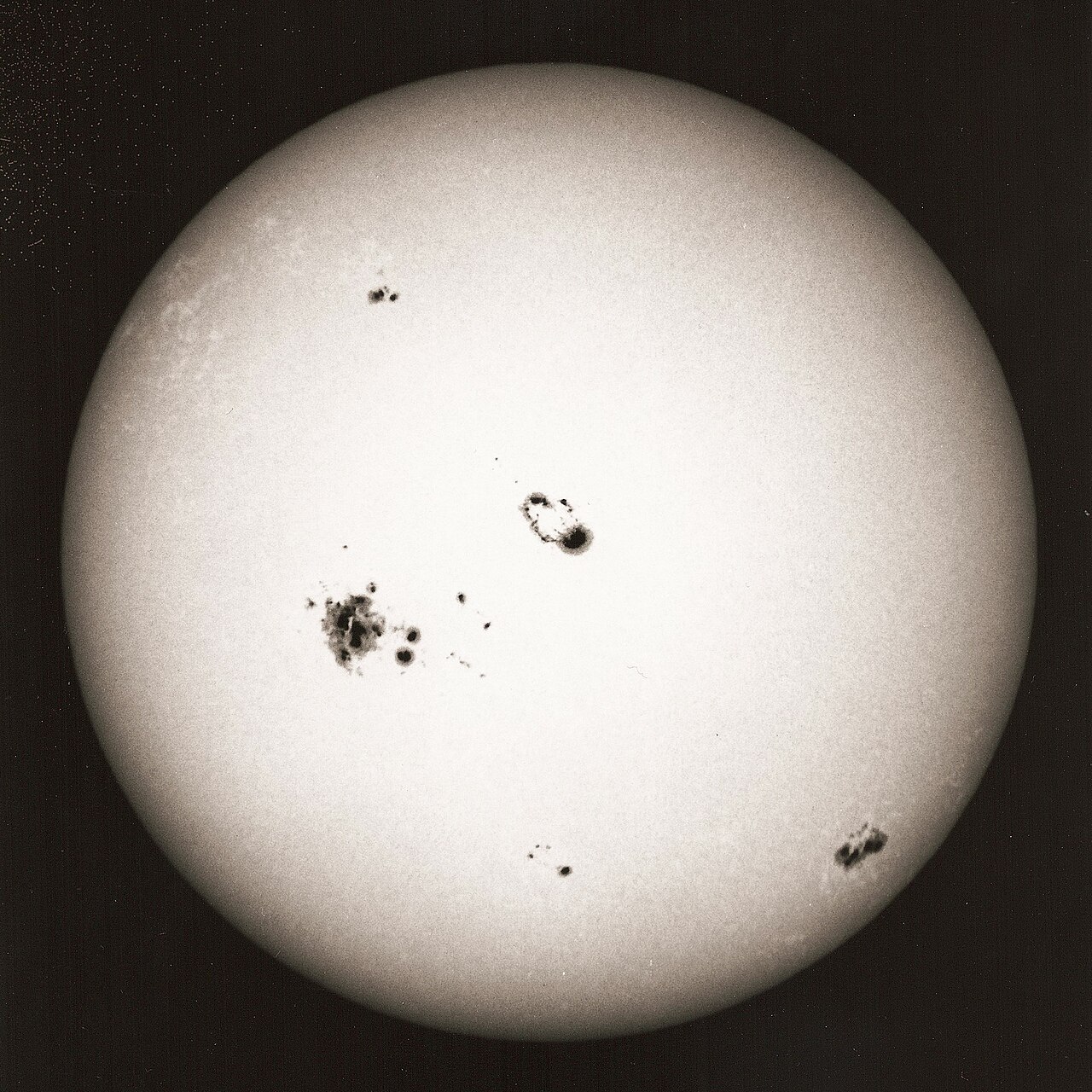
A sunspot is a dark patch on the surface of the Sun. It looks like a freckle on a glowing ball, and it is the easiest feature of the Sun for people to see and follow. Some are small and last a few days. Others grow bigger than Earth and last for months.
The Sun has no solid surface, so a sunspot is not a hole or a crater. The part we see is called the , which means "sphere of light". It is a layer of hot, glowing gas. A sunspot is a patch of that gas that is cooler than the gas around it. Because it gives out less light, it looks dark by comparison.
The word "dark" needs care here. A sunspot is still hot, with a temperature of several thousand degrees. If you could cut one out and hang it in the sky on its own, it would shine brighter than the full Moon and glow a crimson-orange colour. It only looks black because the Sun's normal surface is so much brighter beside it.
Sunspots almost always come in groups, and the groups often form pairs. Each spot in a pair has its own magnetic , which means one acts like the north end of a magnet and the other like the south end. This is the big clue to what sunspots really are. They are not a kind of weather. They are places where the Sun's magnetism breaks through its surface.
The number of sunspots is not steady. It rises and falls in a pattern that takes about 11 years, and astronomers have counted spots for centuries to follow it.
Why are sunspots dark?
The answer is magnetism. Underneath the , the Sun is a boiling sea of hot gas. Heat from the core rises in huge bubbles, cools at the top and sinks again, like water in a pan on a hob. This movement is called , and it is how energy reaches the Sun's surface. It gives the surface a bubbly look made of bright grains called granules.
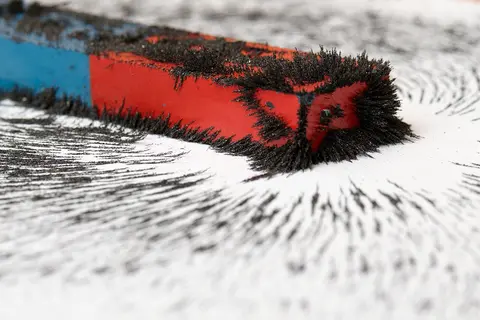
The Sun's gas carries electric charge, so it responds strongly to . Bundles of magnetic field, called flux tubes, sometimes push up through the surface. Inside a sunspot the field is thousands of times stronger than Earth's. That strong field works like a brake on the rising gas and blocks much of the convection.
With less hot gas arriving from below, the patch cools. The ordinary surface of the Sun is about 5,780 kelvin, which is roughly 5,500 degrees Celsius. The darkest part of a sunspot is only about 3,000 to 4,500 kelvin. That difference matters a great deal, because the light given out by a hot object rises steeply with its temperature. A patch that is 1,500 degrees cooler gives out far less light, so it looks dark.
There is one more oddity. Careful measurements show that sunspots are slightly sunken, like shallow dishes pressed into the surface. This is called the Wilson effect. Cooler gas is thinner and lets us see a little deeper into the Sun, so the spot sits lower than its surroundings.
So a sunspot is a place where magnetism has won a small battle against heat.
What does a sunspot look like up close?
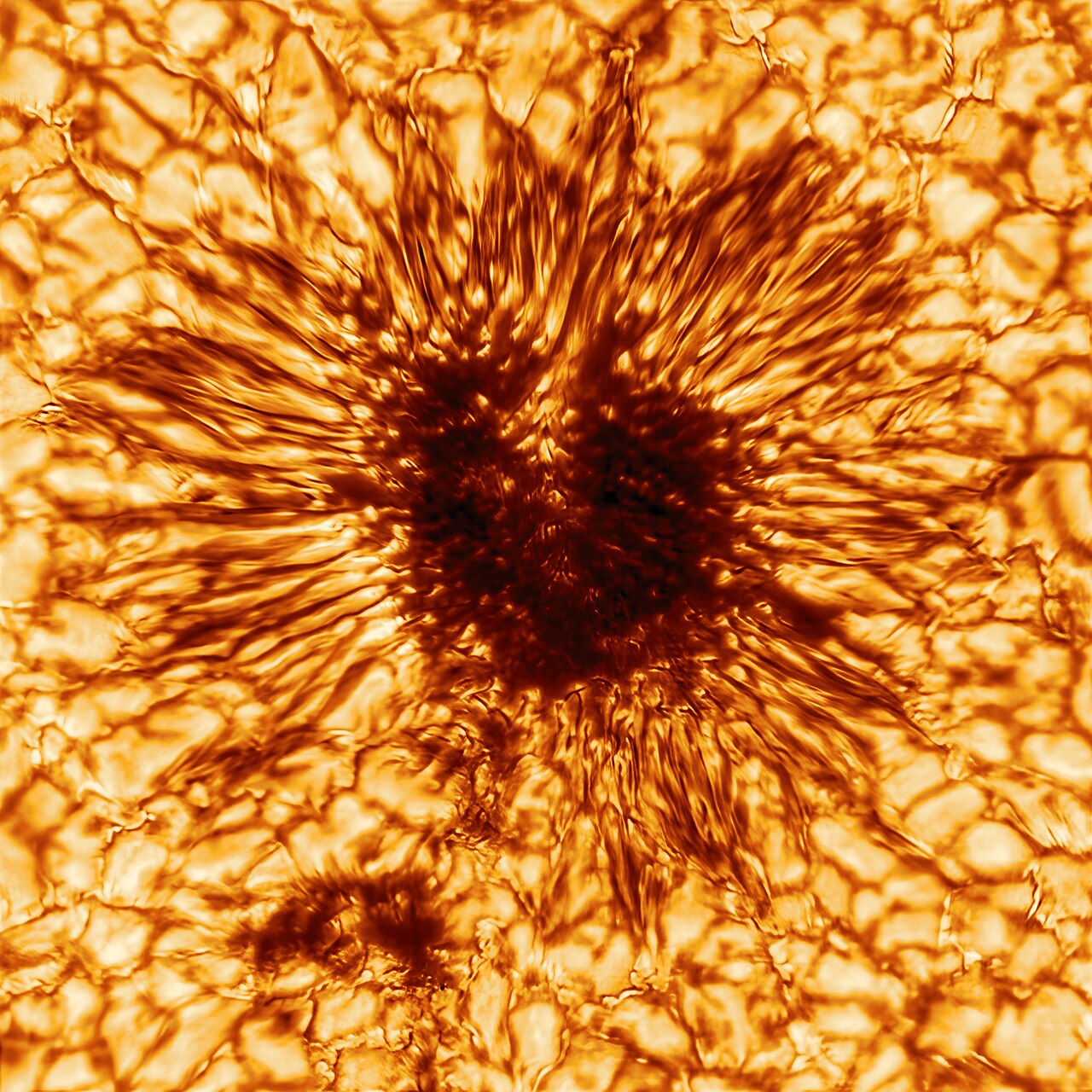
A typical sunspot has two parts. In the middle is the , a Latin word for shadow. It is the darkest and coolest part, and its is strongest and points almost straight up out of the Sun. Around the umbra there is often a lighter ring called the , which means "almost shadow". The penumbra is made of long bright and dark streaks that fan outwards like the spokes of a wheel. Here the magnetic field leans over to the side.
Some groups have several umbrae wrapped in one big penumbra. Sometimes a bright strip, called a light bridge, cuts across a dark umbra. Light bridges often show up when a sunspot is forming or breaking up. In them the magnetic field is weaker, and hot gas can still move.
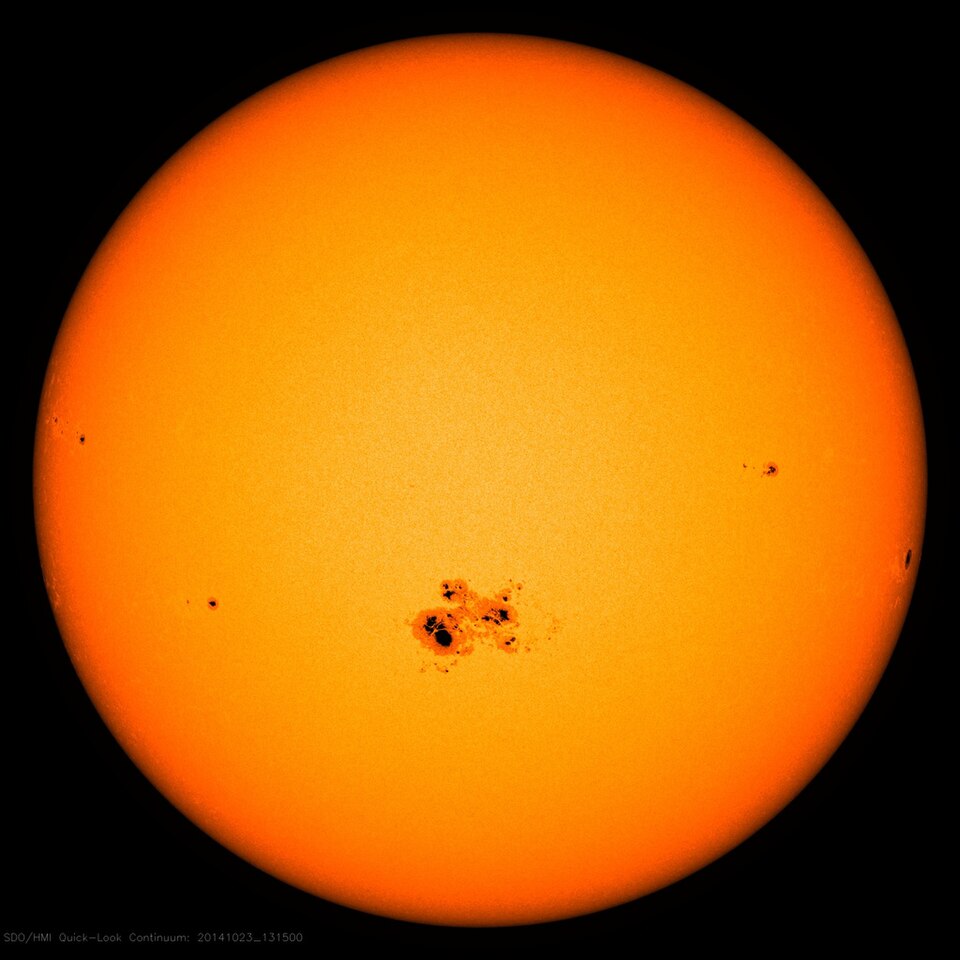
Sunspots come in many sizes. Small ones, called pores, are just dark dots with no penumbra. A pore that grows large enough starts to grow a penumbra and becomes a true sunspot. Large sunspots can be much wider than Earth, which is about 12,700 kilometres across. In October 2014, NASA's Solar Dynamics Observatory watched a group of spots that stretched almost 130,000 kilometres, enough room for ten Earths side by side.
The sharpest views come from the Daniel K. Inouye Solar Telescope in Hawaii, a ground-based telescope with a mirror 4 metres wide. In January 2020 it took its first picture of a sunspot. The image showed fine threads and bubbling gas around the dark core in far more detail than before.
How is a sunspot born, and how does it die?
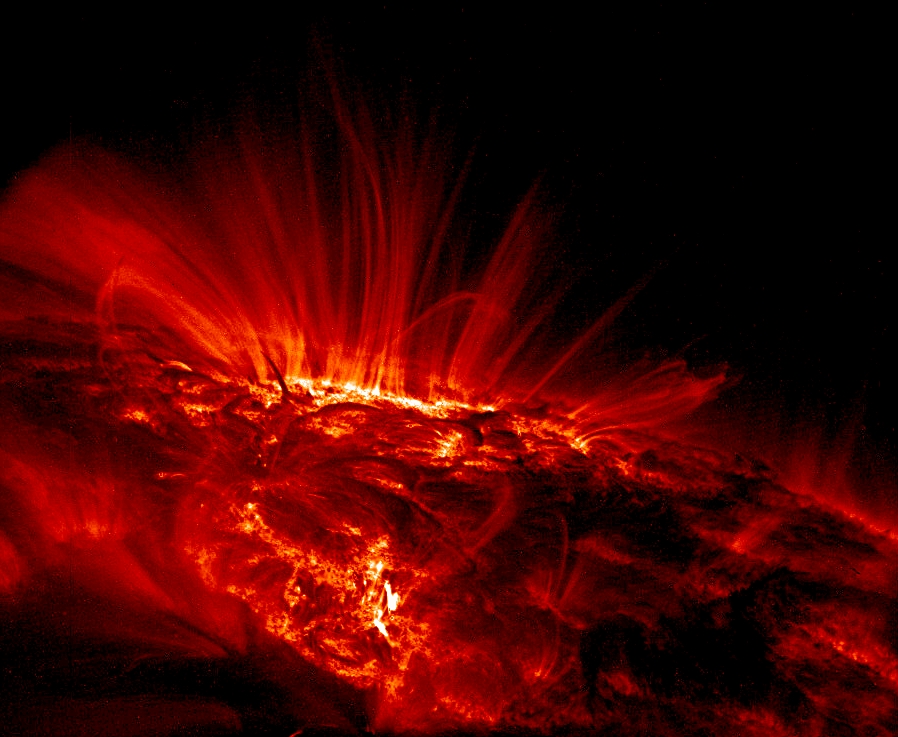
Scientists are still working out the exact details, but the main story is clear. Magnetic flux tubes form deep in the Sun's convective zone, the thick layer where hot gas rises and sinks. Some of them float upwards and poke through the . Wherever one of them breaks through, the surface cools and darkens.
A new sunspot starts as a tiny dark pore. Over days, pores grow, drift towards one another and join up. When a pore is big enough, a begins to form around it. A pair of spots with opposite makes sense if you picture a magnetic loop with both ends sticking out of the surface, one end for each spot.
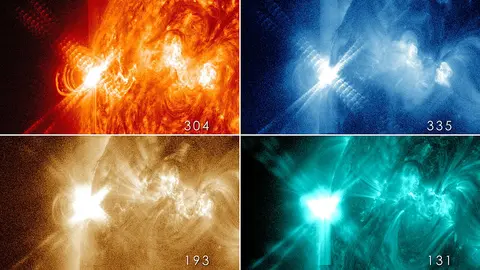
Above a sunspot, the spreads into glowing arches called coronal loops. Images from NASA's TRACE spacecraft show hot gas trapped in them, heated to over one million degrees Celsius. This is far hotter than the surface below, and the changing magnetic field is thought to be part of the reason.
Why do sunspots fade? Here is a puzzle. A tightly packed magnetic field should push itself apart and spread out within hours. Yet sunspots last for days or weeks. In 2001, astronomers used sound waves that travel through the Sun, in a method called helioseismology, to build a 3D picture below a sunspot. They found a strong downdraft under each spot, which spins like a vortex and squeezes the magnetic field together.
In the end the spot does break up. A single sunspot lasts from a few days to a few months, and a whole group of spots can last a little longer.
Who saw sunspots first?
People noticed sunspots long before telescopes. Chinese records are the oldest. The I Ching, a book finished before 800 BC, mentions a small dark mark seen in the Sun. Around 364 BC, the astronomer Gan De noted sunspots in a star catalogue, and by 28 BC Chinese astronomers were logging them regularly in the emperor's official records. In the West, the Greek scholar Theophrastus described one around 300 BC.
The oldest known drawing of sunspots was made by an English monk, John of Worcester, in December 1128.
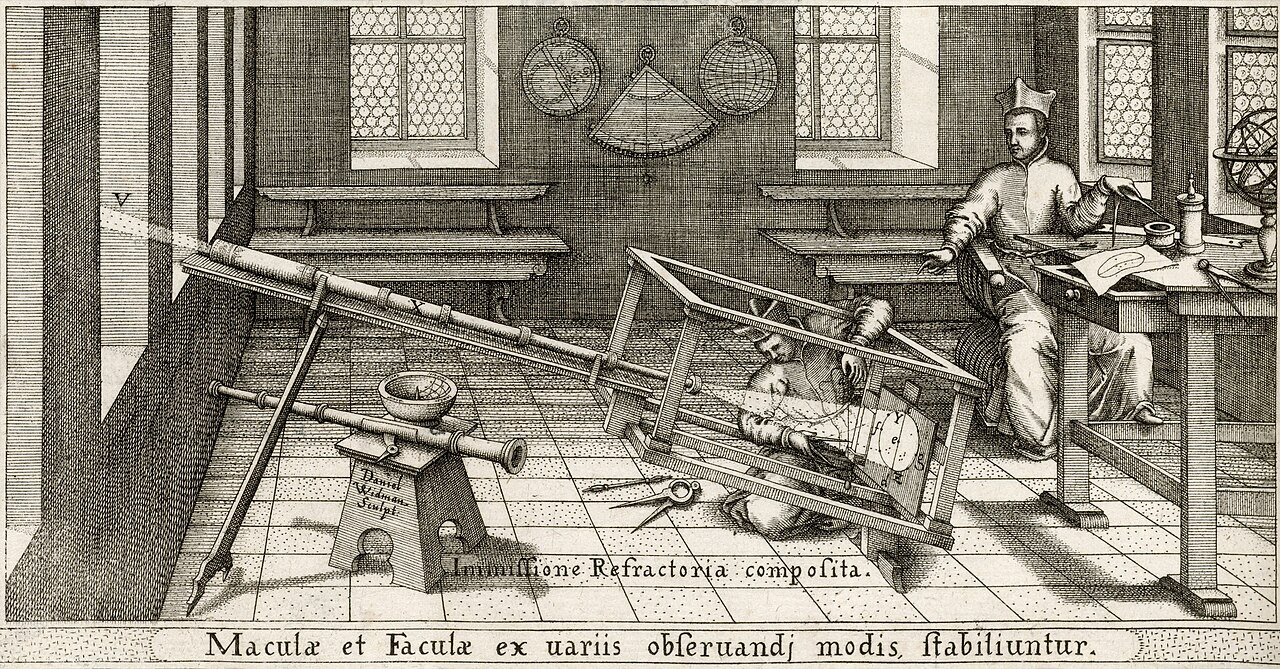
The telescope changed everything. The first person to view sunspots through one was probably Thomas Harriot, an English astronomer, in December 1610. A few months later, in March 1611, two Frisian astronomers, Johannes Fabricius and his father David, saw them too. Johannes died at 29, so his report was overlooked. Meanwhile, Christoph Scheiner, a Jesuit priest in Germany, and Galileo Galilei in Italy made their own discoveries and published them. Galileo began recording in 1612, and the two men argued for years about who deserved the credit.
Staring at the Sun is dangerous, so how did they do it? Scheiner used a trick that is still popular today. He pointed a telescope at the Sun and projected its image onto a screen. Then he could trace the spots with a pencil. His book Rosa Ursina shows him doing exactly that.
Later astronomers kept watching. Johannes Hevelius recorded only 19 sunspot groups between 1653 and 1679, which was a surprisingly quiet time for the Sun.
Why do sunspots come and go every 11 years?
If you counted sunspots every day for years, you would find a rhythm. The numbers climb quickly to a peak, called , and then fall more slowly to a low point called solar minimum. One round takes about 11 years, though it can be anywhere from just under 10 to just over 12. Astronomers number the cycles, beginning with the one that started in the 1750s.
The cycle also moves the spots around. At the start of a cycle, new spots appear far from the equator, at high latitudes. As the cycle goes on, they form closer and closer to the equator. This pattern is known as Spörer's law. For a few years around solar minimum, spots from two cycles are on the Sun together. You can tell them apart by their latitude and by which way their point.
What drives the cycle? In 1908 the American astronomer George Ellery Hale was the first to link sunspots to magnetic fields. He worked out that the Sun's whole magnetic field flips over every 11 years, so it takes about 22 years to return to its starting state. Later, Horace Babcock suggested a model. It says the Sun spins faster at its equator than at its poles, so the magnetic field gets twisted up, and that twisting explains the cycle.
There are longer swings too. From 1900 to 1958 the peaks mostly rose. Then they mostly fell for about 60 years. The Sun had not been that active for more than 8,000 years.
Around 1800, William Herschel noticed that sunspots were scarce from 1795 to 1800. He wondered if that explained high wheat prices. Later tests found no real link.
How do astronomers watch sunspots today?
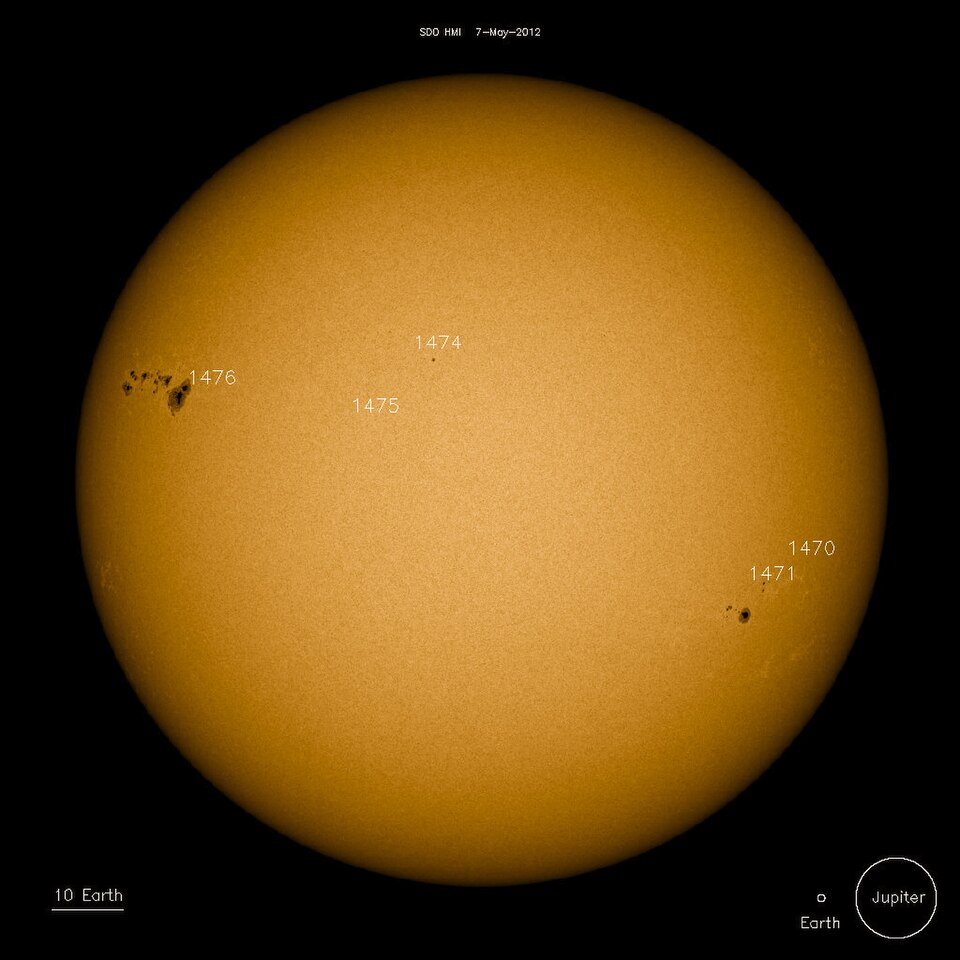
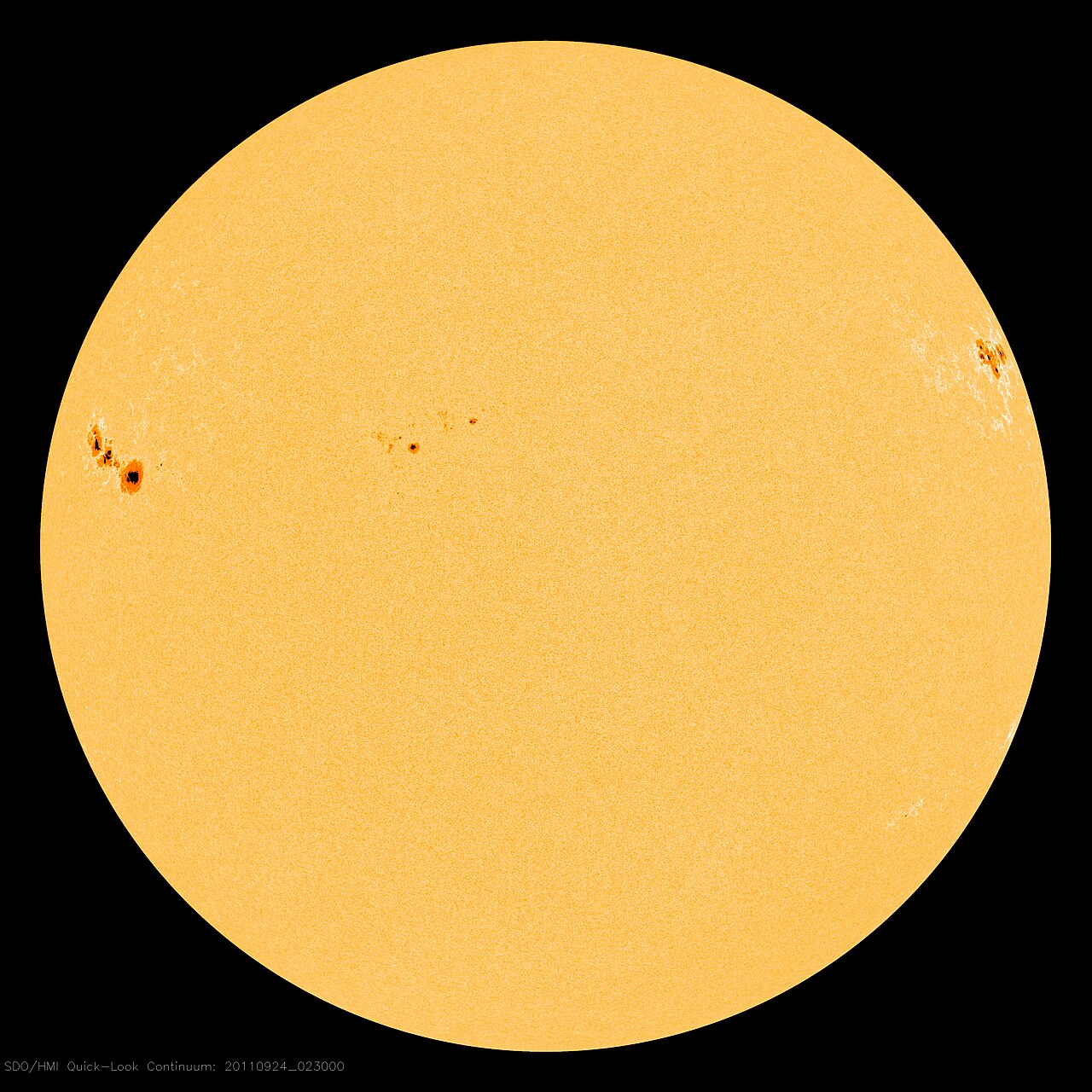
Today scientists watch sunspots with telescopes on the ground and in space. Spacecraft such as NASA's Solar Dynamics Observatory and the Solar and Heliospheric Observatory, known as SOHO, orbit above the atmosphere. They photograph the Sun all the time, so that nothing is missed when a new sunspot group rolls into view. Special tools such as spectroscopes split sunlight into its colours. That lets scientists measure the temperature, movement and magnetism of a sunspot.
Each active group gets an official number, such as 1302 or 1476. Group 1302 in September 2011 had dark cores that were each bigger than Earth, and the whole region stretched more than 100,000 kilometres from end to end. Group 1476 in May 2012 was nicknamed a monster sunspot.
Counting is part of the work. The Wolf number is an index that combines the number of single spots with the number of groups. It lets us compare today's Sun with measurements from the 1700s.
Never look at the Sun directly. It can permanently damage your eyes, and a telescope or binoculars make it far worse. Amateurs use safe methods instead. One method is to project the Sun's image through a telescope onto white card and trace the spots, as Scheiner did. Another is to use a solar filter made for the job. Ordinary sunglasses are not enough.
A sunspot group slowly turns across the Sun's face as the Sun spins, so a patient observer can follow it day by day and see it change.
Do sunspots affect Earth?
Sunspots themselves are harmless. What matters is the magnetic activity that surrounds them. Most , which are sudden bursts of light and energy, start near large sunspot groups. So do , which are giant clouds of charged gas thrown out into space. When one of these hits Earth's , it can cause a magnetic storm.
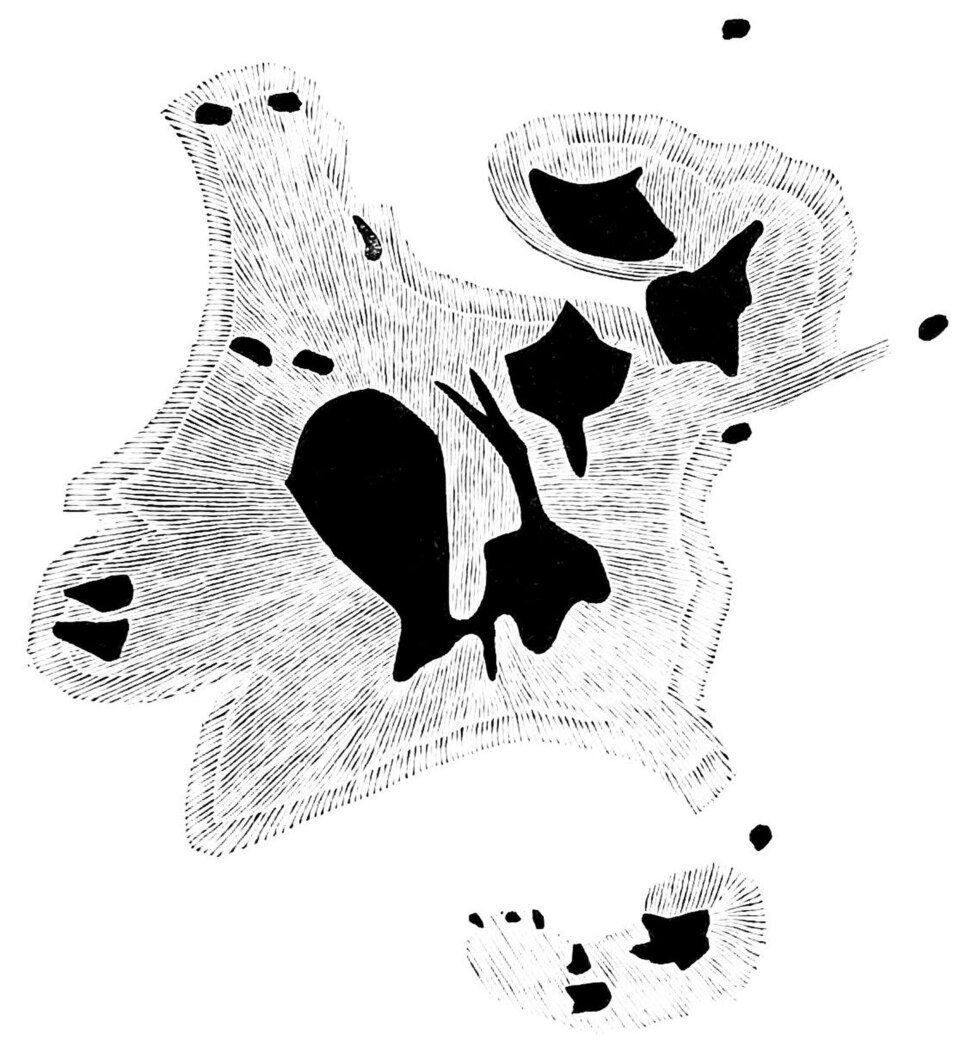
A magnetic storm can disturb radio signals, satellites and power grids. It is also what makes the northern and southern lights flare brightly. Popular Science Monthly printed a drawing in the 1880s that linked a large sunspot to a major magnetic storm. People have suspected the connection for a long time. Because sunspot counts rise and fall with solar activity, they help forecasters predict space weather.
Radio fans watch sunspots closely. When many sunspots appear, the upper atmosphere is better at bouncing radio waves around the world. Amateur radio operators can then talk to people on the other side of the planet.
What about the climate? The Sun does shine a little more brightly when there are more sunspots, by about 0.1%. That is a very small change. The bright patches that surround spots outweigh the darkness of the spots themselves.
A long quiet spell of the Sun called the Maunder Minimum, from about 1645 to 1715, happened during Europe's Little Ice Age. Some people blamed the Sun. But the cooling began before the quiet spell, and most scientists now think volcanic eruptions played the larger part.
Do other stars have spots?
Yes. Spots on other stars are called , and they seem to be common. We cannot see them directly, because even in the best telescopes most stars are just points of light. Astronomers have to detect them in clever ways.
The first idea came in 1947, when the astronomer G. E. Kron suggested that regular dips in the brightness of red dwarf stars were caused by starspots. A star spins, so a big dark patch turns in and out of view and the star's light rises and falls. Since the mid-1990s, techniques have improved a great deal. Measuring brightness has shown starspots growing and shrinking, and some stars even have cycles like the Sun's.
Other methods look at the star's light split into colours. The magnetism in a spot slightly changes the colours, through a process called the Zeeman effect. Another method, called Doppler imaging, builds a rough map of a star's surface. It has shown that spots can be arranged very differently from the Sun's. In some cases they sit near the poles.
Starspots can be much bigger than anything on our Sun. In 1999 the astronomer Klaus Strassmeier reported the largest cool starspot ever seen, on a giant star called XX Trianguli. Both light and dark spots have been measured on stars.
This matters because the stars with the most spots are often young and spin fast. Studying them helps astronomers understand how magnetism works on every star, including the Sun.
Explore Next
Your audio story keeps playing while you look around.
Words to Know
- convection
- The rising of hot gas and sinking of cooler gas.
- coronal mass ejection
- A giant cloud of charged gas thrown out from the Sun.
- magnetic field
- The invisible region around a magnet where it pulls and pushes.
- penumbra
- The lighter, streaky ring around the umbra.
- photosphere
- The bright visible surface layer of the Sun.
- polarity
- Whether a magnetic field points like a north end or a south end.
- solar cycle
- The rise and fall of sunspot numbers over about 11 years.
- solar flare
- A sudden burst of light and energy from the Sun.
- solar maximum
- The time in the cycle with the most sunspots.
- starspot
- A dark or bright patch on the surface of another star.
- umbra
- The dark, cool centre of a sunspot.