Carbon
The element that builds diamonds, pencils and every living thing.

Carbon is element number 6, with the symbol C. It is the black in soot, the writing in a pencil and the sparkle in a diamond. It is also the backbone of every living thing we know. Your body is about 18.5% carbon by mass, more than any other element except oxygen. What makes carbon special is how its atoms link up. They join to each other and to other atoms in more ways than any other element, and that gives about 200 million known compounds. Arranged one way, carbon is soft and black. Arranged another way, it is the hardest natural material on Earth.
Why can carbon build so many things?
A carbon atom has six protons and six electrons. Four of those electrons sit in the outer layer, and those four are the ones that matter. Each can share with a neighbouring atom, so one carbon atom can form up to four bonds. Chemists call this property , and it is the key to everything carbon does.
Because carbon forms strong bonds, and especially strong bonds with other carbon atoms, it can build chains, rings, sheets and cages. Those chains can be very long. Carbon also bonds well with hydrogen, oxygen, nitrogen and many other elements. The result is a huge variety of molecules. About 200 million carbon compounds have been recorded, and chemists say that is only a small fraction of the number that could exist.
This is why carbon is the basis of all known life. Proteins, fats, sugars and DNA are all carbon compounds. Compounds built on chains and rings of carbon joined to hydrogen are called organic compounds, and their study is organic chemistry. People once thought only living things could make them. Then in 1828 the German chemist Friedrich Wöhler made urea, a substance found in urine, from non-living chemicals. Today chemists make organic compounds of every kind, from medicines to plastics and dyes. Carbon is the second most common element in the human body by mass, after oxygen, at about 18.5%.
Carbon is scarce in Earth's crust, only about 0.025% of its mass, which makes it the 15th most common element there. Yet it is everywhere in living things. Its main stores include limestone and other rocks, carbon dioxide in the air, and coal, peat, oil and natural gas. Across the whole universe it is the fourth most common element by mass, after hydrogen, helium and oxygen.
Where did carbon come from?
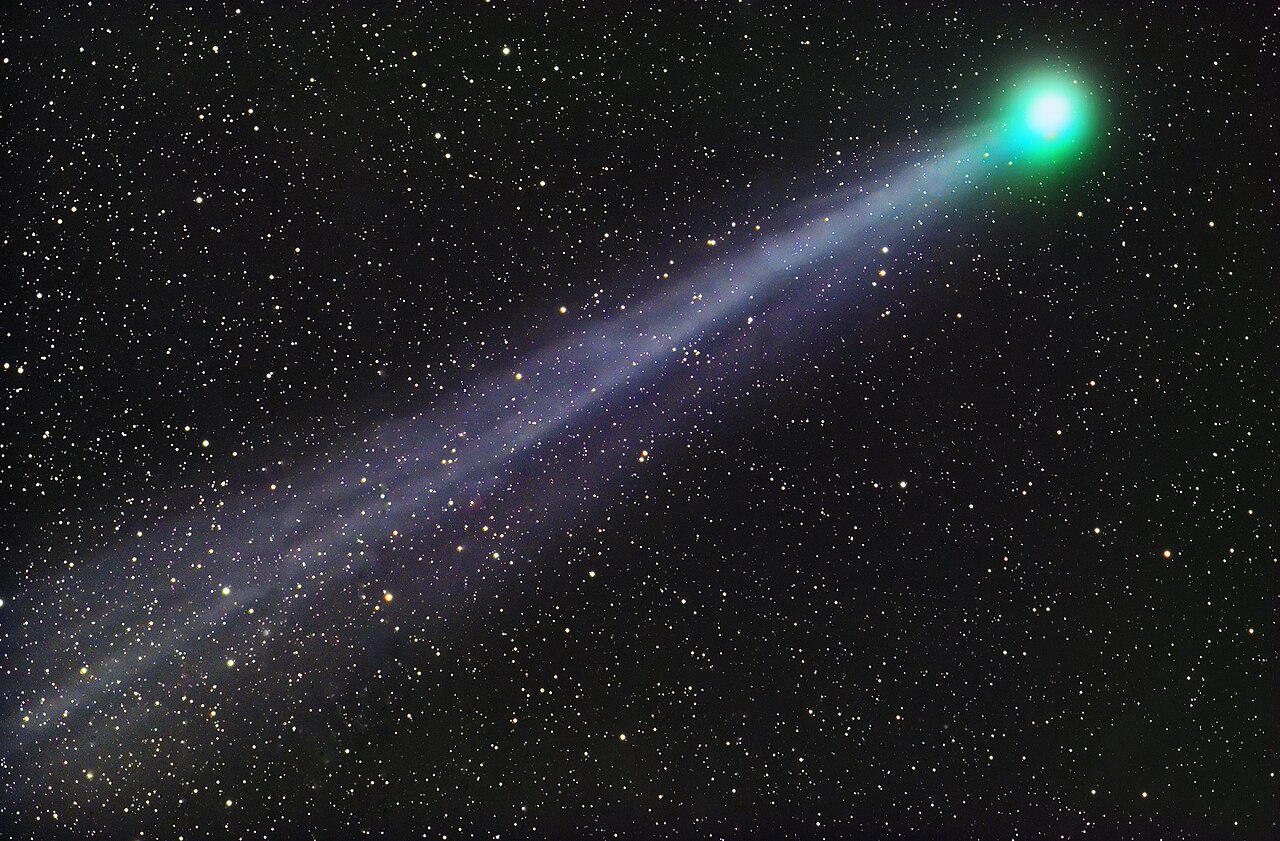
Carbon was not around at the start of the universe. The Big Bang made mostly hydrogen and helium. Heavier elements, including carbon, were built later inside stars, where the heat and pressure join smaller atoms into larger ones. When old stars die, they scatter their carbon into space, and it ends up in new stars, planets and living things. The carbon in your body was made in a star that died before the Sun was born.
Carbon also helps power stars. In the Sun, most energy comes from joining hydrogen into helium directly, but a small share comes from a chain of reactions called the carbon-nitrogen-oxygen cycle. In heavier stars, such as Sirius, that cycle makes most of the energy. Carbon acts like a helper in it, because the atoms take part but come out unchanged at the end.
Carbon shows up across space in other ways. When carbon atoms bond in pairs in a hot, excited gas, the gas glows green. This is why many comets, such as Comet Lovejoy, have a green glow around their heads. Carbon is also an important part of the gas and dust clouds from which stars and planets form.
Some carbon is unstable. Carbon-14 is a radioactive form with a of 5,700 years. That means half of any amount of it breaks down in that time. Scientists use it to find the age of old wood, bones and cloth.
Why is diamond the hardest natural material?
In a , every carbon atom is bonded to four others. The bonds point out like the corners of a pyramid, and the pattern repeats in all three dimensions. The result is a rigid cage with no weak direction. Carbon-to-carbon bonds are very strong, so it takes enormous force to scratch or break the cage. Diamond is the hardest natural substance known when measured by resistance to scratching.
Diamond has other striking properties. It is very clear, so light passes straight through, which helps it sparkle when it is cut. It carries heat better than almost anything else. It does not carry electricity well.
Diamonds form only under very high pressure. Natural ones grow deep inside the Earth and are carried up by volcanic eruptions. People have valued them for a very long time. They were probably known in China as early as 2500 BCE, and India was the leading source from about the 9th century BCE until the mid-1700s.
Diamonds are used for more than jewellery. About 80% of mined diamonds are not good enough to be gems. They go into drill bits, saw blades and polishing powders, where their hardness is exactly what is needed. Scientists also use two diamonds to squeeze small samples to huge pressures in a tool called a diamond anvil cell.
Why can a pencil write?
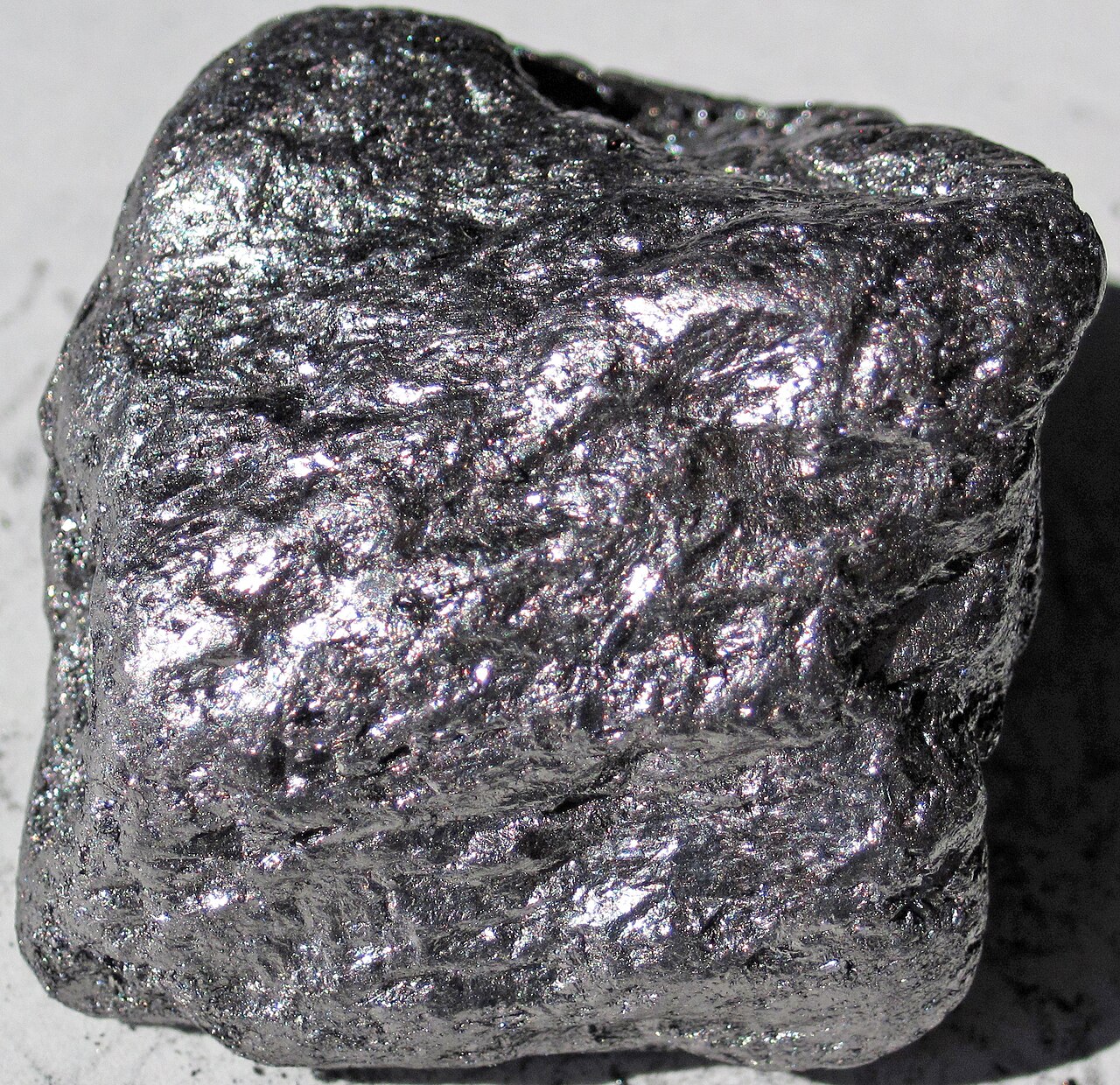
is made of the same atoms as , but it behaves in almost every way the opposite. It is soft, grey-black and slippery. It is also opaque, so you cannot see through it, and it conducts electricity.
The difference is the arrangement. In graphite, each carbon atom is bonded to only three others, in flat sheets of six-sided rings, like chicken wire. The bonds inside a sheet are strong. But the sheets are stacked loosely, held together only by weak forces, so they slide over each other easily. When you press a pencil on paper, thin layers rub off and leave a grey line. The name graphite comes from the Greek word for 'to write'.
One electron from each atom is free to roam along its sheet, and that is why graphite carries electricity. It is a poorer conductor than most metals, but still useful.
The 'lead' in a pencil has never been lead. For a long time, graphite was mistaken for a form of lead. A big, pure deposit at Borrowdale in England was so good that, until the 19th century, pencils were made by sawing natural graphite into strips and putting them in wood. Today the graphite is mixed with clay.
Graphite has many other jobs. It is a lubricant, a pigment, and a material for electrodes in batteries and brushes in electric motors. It is also used inside some nuclear reactors to slow down neutrons.
Can diamond turn into graphite?
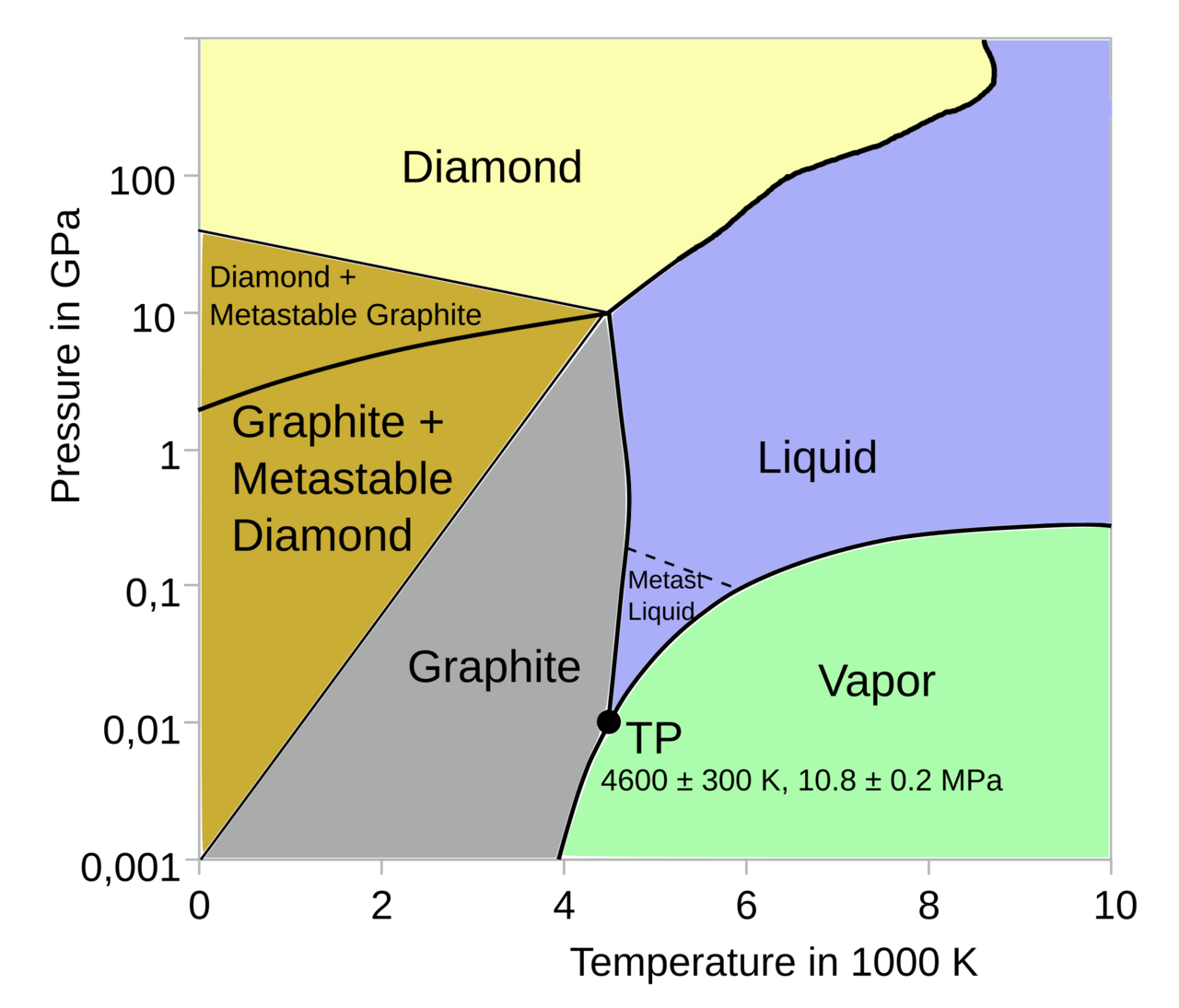
At normal temperatures and pressures, is the more stable form of carbon. In theory, then, should slowly turn into graphite. The phrase 'diamonds are forever' is not quite true in chemistry.
In practice it does not happen, because the atoms must pass through a high-energy stage to rearrange. This barrier is so large that the change is too slow to see. A diamond will last far longer than any person. Heat changes this. At very high temperatures, diamond does turn into graphite, and diamonds can burn up in a house fire.
A graph called a phase diagram shows which form of carbon is stable at each temperature and pressure. Graphite wins at low pressure. Diamond wins when pressure is very high, such as deep underground. This is why diamonds form in the Earth's depths and why makers of artificial diamonds need huge presses.
Carbon has another unusual feature. At normal air pressure, carbon has no melting point. It goes straight from solid to gas, a change called , at about 3,900 kelvin, which is roughly 3,600 °C. That is the highest sublimation point of any element. Liquid carbon can exist only above about 4,000 kelvin and at more than 100 times atmospheric pressure. It is a dark, runny, shiny liquid, and it is hard to study.
What else can carbon become?
and are not the only forms of carbon. Forms of the same element with different atom arrangements are called , and carbon has many.
Amorphous carbon has no regular pattern. It is the black powder in charcoal, soot and activated carbon. Charcoal is made by heating wood with very little air, and people have done this for thousands of years.
In 1985, three scientists, Robert Curl, Harold Kroto and Richard Smalley, discovered a new family called the . The first was a hollow ball of 60 carbon atoms, nicknamed the buckyball because it looks like a football. Other fullerenes are tubes, called nanotubes, which are far thinner than a human hair. The three scientists won the Nobel Prize in Chemistry in 1996.
Then came , a single flat sheet of graphite one atom thick, with its atoms in a honeycomb pattern. In 2004 Andre Geim and Konstantin Novoselov, at the University of Manchester, peeled it off a lump of graphite with sticky tape. They won the Nobel Prize in Physics in 2010. Graphene is one of the strongest materials ever tested. It also conducts heat and electricity very well. Engineers hope to use it in electronics and many other products. Making it cheaply in large amounts is still a challenge.
How did people work out what carbon is?
Carbon is one of the few elements known since ancient times. Prehistoric people knew soot and charcoal. Early civilisations made charcoal by heating wood in a clay-covered pile, shutting out the air, much as it is made today.
The name comes from the Latin carbo, meaning coal or charcoal. In German, Dutch and Danish, the word for carbon means 'coal-stuff'.
Working out that and charcoal were the same element took until the 1700s. In 1722, René Réaumur showed that iron turns into steel by taking in some substance, which we now know is carbon. In 1772, the French chemist Antoine Lavoisier burned samples of charcoal and diamond. Neither gave off water, and both gave the same amount of carbon dioxide per gram. So diamond was a form of carbon.
In 1779, Carl Wilhelm Scheele showed that , then thought to be a form of lead, was really a form of carbon, with a little iron mixed in. In 1786, three French scientists confirmed that graphite was mostly carbon by burning it in oxygen. They suggested the name carbone. In 1789, Lavoisier listed carbon as an element in his textbook.
The , found in 1985, were the next big surprise. They showed that even an old, familiar element can still hide new forms.
Where do we get graphite and diamonds?
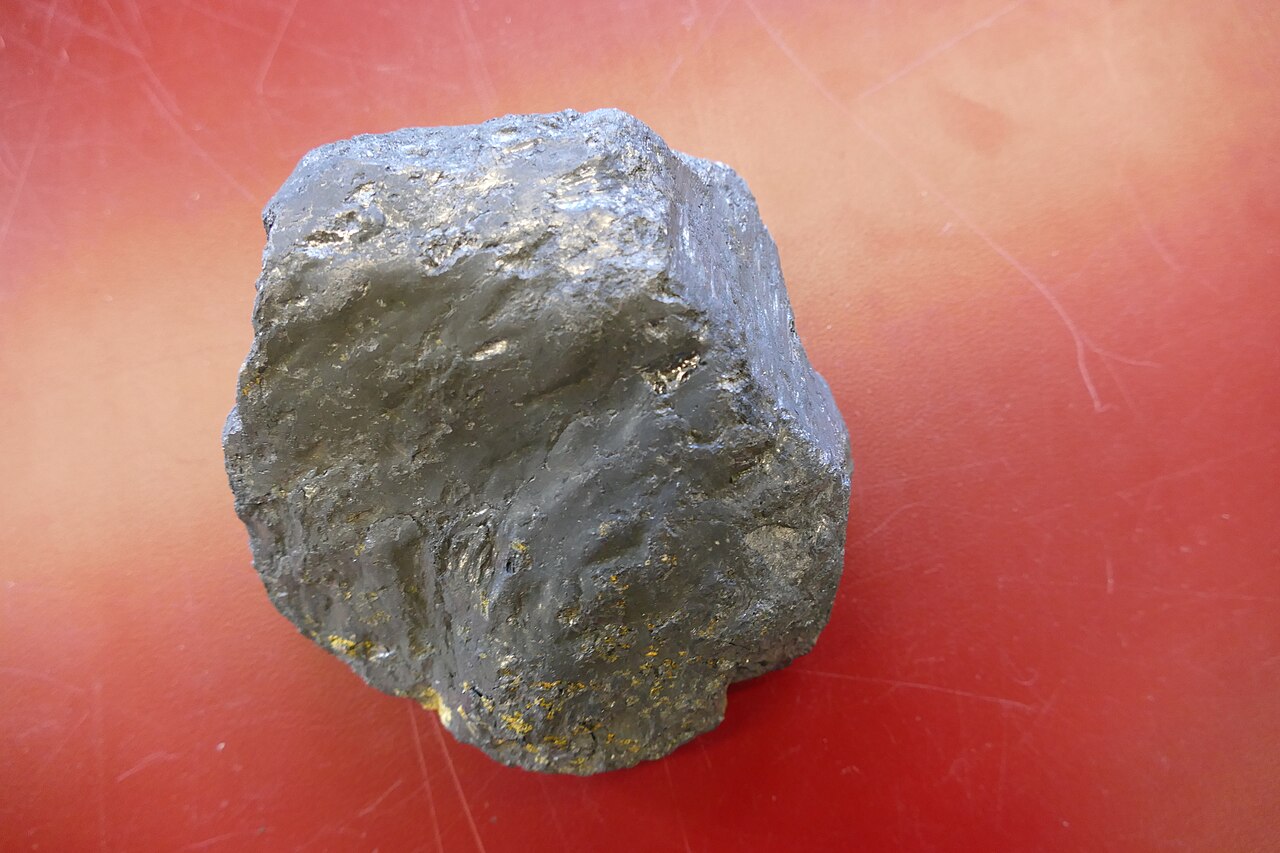
Natural is mined in many countries. In 2025 the world produced about 1.8 million tonnes, and China supplied more than four fifths of it. Madagascar, Tanzania and Brazil are among the other producers. Graphite forms inside rock that has been heated and squeezed over long ages. To get it out, miners crush the rock and float the lighter graphite off on water. The highest quality graphite, in lumps, is mined commercially only in Sri Lanka.
are harder to find. Only a tiny fraction of the ore is diamond. The ore is crushed, carefully, so large stones do not break. The pieces are sorted by density. Then X-rays pick out the diamonds, and the last sorting is done by hand.
For centuries, diamonds came only from river gravels in southern India. Brazil found diamonds in 1725. Then in the 1870s, South Africa's diamond fields opened the era of mining diamonds from their volcanic source rock. Today major producers include Russia, Botswana, Canada and the Democratic Republic of Congo. The Argyle mine in Australia, which was the single largest source, has closed.
Since the 1950s, scientists have also made diamonds in laboratories. One method squeezes graphite with huge presses at high temperature. Another builds diamond atom by atom from a carbon-rich gas. Today more than 15 billion carats of synthetic diamond are made each year, mostly as grit and powder for industry. That is more than a hundred times the weight of all the diamonds mined.
What do we use carbon for?
Carbon is everywhere in daily life. Most of what we use for energy is a carbon compound. Coal, oil and natural gas are , which formed from ancient living things. Burning these fuels releases carbon dioxide.
Plastics are made from long chains of carbon atoms called . So are natural materials such as wood, cotton, wool and silk. Most of the materials in our clothes, shoes and homes contain carbon.
Adding a little carbon to iron makes steel. In a furnace, carbon in the form of coke takes oxygen away from iron ore and leaves metal. Carbon fibre is another useful form. It is made by heating special plastic threads until only carbon is left. Plastics reinforced with it are light and stronger than steel for their weight, so they are used in bikes, aircraft and racing cars.
Carbon black is a fine soot that colours ink, paint and printer toner. It is also added to rubber to make tyres tougher. Activated charcoal has a huge surface, so it can trap other molecules. It is used in water filters, gas masks and cooker hoods, and in medicine to soak up poisons in the stomach.
Pure carbon is not poisonous. Ötzi the Iceman, who lived about 5,200 years ago, had tattoos made with carbon that were still visible. But carbon compounds range from harmless sugars to deadly ones such as cyanide and carbon monoxide. Carbon monoxide forms when fuel burns with too little air. It has no colour or smell and stops the blood carrying oxygen, which is why homes with gas boilers have alarms for it.
Where does carbon go?
Carbon atoms do not stay put. They travel between the air, living things, the oceans and the rocks, in a great loop called the carbon cycle. Plants and algae take carbon dioxide from the air and use sunlight to build sugars. This is photosynthesis. Animals eat the plants. Living things breathe carbon dioxide back out, and when they die, fungi and bacteria break them down and release the rest.
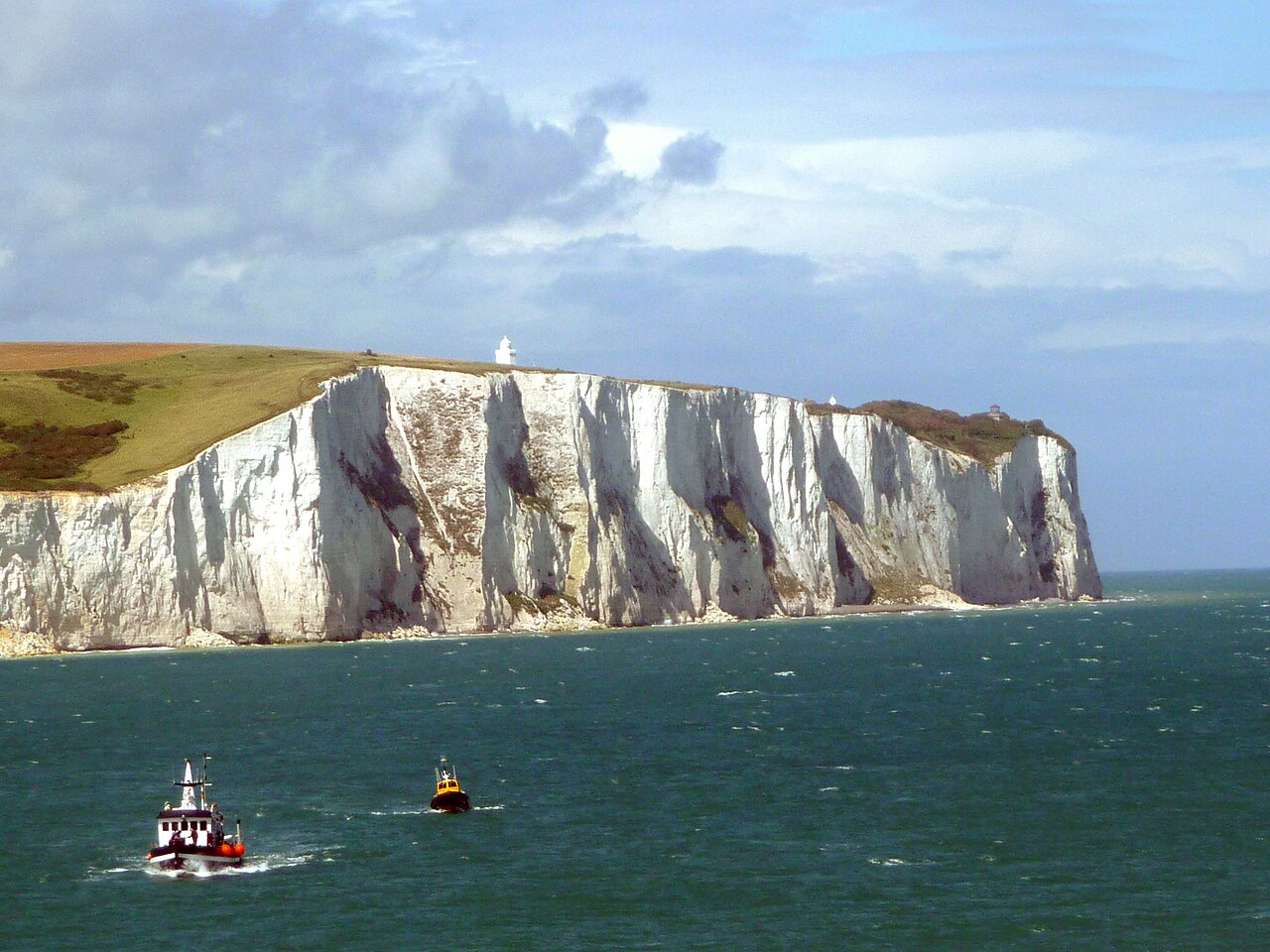
The oceans hold more than 40 times as much carbon as the air. Carbon dioxide dissolves in seawater, and tiny sea creatures use it to build shells of calcium carbonate. When they die, the shells sink and pile up on the sea floor. Over millions of years they harden into chalk and limestone. The White Cliffs of Dover are made of the shells of tiny algae that lived about 70 to 100 million years ago.
Rocks are the biggest store of all. Carbon can stay locked in them for hundreds of millions of years, until volcanoes release some of it as gas. Coal, oil and natural gas formed in a similar slow way, from plants and plankton buried before they could rot. People are now digging those fuels up and burning them within a few centuries, so carbon that took millions of years to store is returning to the air very fast.
How is carbon changing the climate?

Carbon dioxide is only a tiny part of the air, but it matters a great deal. Sunlight passes through it easily. The warmed ground then gives off heat as infrared rays, and carbon dioxide absorbs some of that heat and sends part of it back down. This is the . Without it, Earth would be frozen.
In 1856 the American scientist Eunice Foote showed that a jar of carbon dioxide heated up more in sunlight than a jar of ordinary air. In 1859 the Irish physicist John Tyndall measured how carbon dioxide traps heat rays. In 1896 the Swedish chemist Svante Arrhenius calculated that adding more of it would warm the planet.
Around 1750, before factories and engines, the air held about 280 parts per million of carbon dioxide. In 1958 the American scientist Charles David Keeling began measuring it on Mauna Loa, a volcano in Hawaii. His record, the Keeling Curve, has climbed every year since. In 2025 it averaged about 427 parts per million, about half as much again as before industry. Burning coal, oil and gas now releases nearly 40 billion tonnes of carbon dioxide a year.
The extra gas has warmed Earth by about 1.3 °C since the late 1800s. Seas are rising, heatwaves are becoming more common, and the oceans are turning more acidic as they soak up carbon dioxide. In the Paris Agreement of 2015, nearly every country agreed to try to keep warming well below 2 °C. That means cutting the carbon dioxide from fuels close to zero.
Explore Next
Your audio story keeps playing while you look around.
Words to Know
- allotrope
- One of several different forms of the same element, with its atoms arranged differently.
- diamond
- The hardest natural material, a form of carbon with each atom bonded to four others.
- fossil fuel
- A fuel such as coal, oil or gas that formed from ancient living things.
- fullerene
- A hollow ball or tube made of carbon atoms.
- graphene
- A single flat sheet of graphite, one atom thick.
- graphite
- A soft, black form of carbon made of sheets that slide over each other.
- greenhouse effect
- The warming of a planet when gases in its air trap some of the heat given off by the ground.
- half-life
- The time it takes for half of a radioactive substance to break down.
- isotope
- A form of an element with a different number of neutrons.
- polymer
- A very long molecule made of many repeating units.
- sublimation
- When a solid turns straight into a gas.
- tetravalent
- Able to form up to four bonds, as carbon can.