Chemical element
Just 118 kinds of atom build every star, rock, ocean and person.
Everything you can touch is built from a short list of ingredients. Scientists call them chemical elements. Each element is one kind of atom, and so far we know 118 of them. Hydrogen, oxygen, iron and gold are all elements. Water is not an element, because it is made of two different kinds of atom joined together. The elements make up the Sun, the oceans, your bones and the phone in your pocket. Some formed in the first minutes of the universe. Others were made inside stars or in huge explosions. A few exist only because people built them in laboratories.
What is a chemical element?
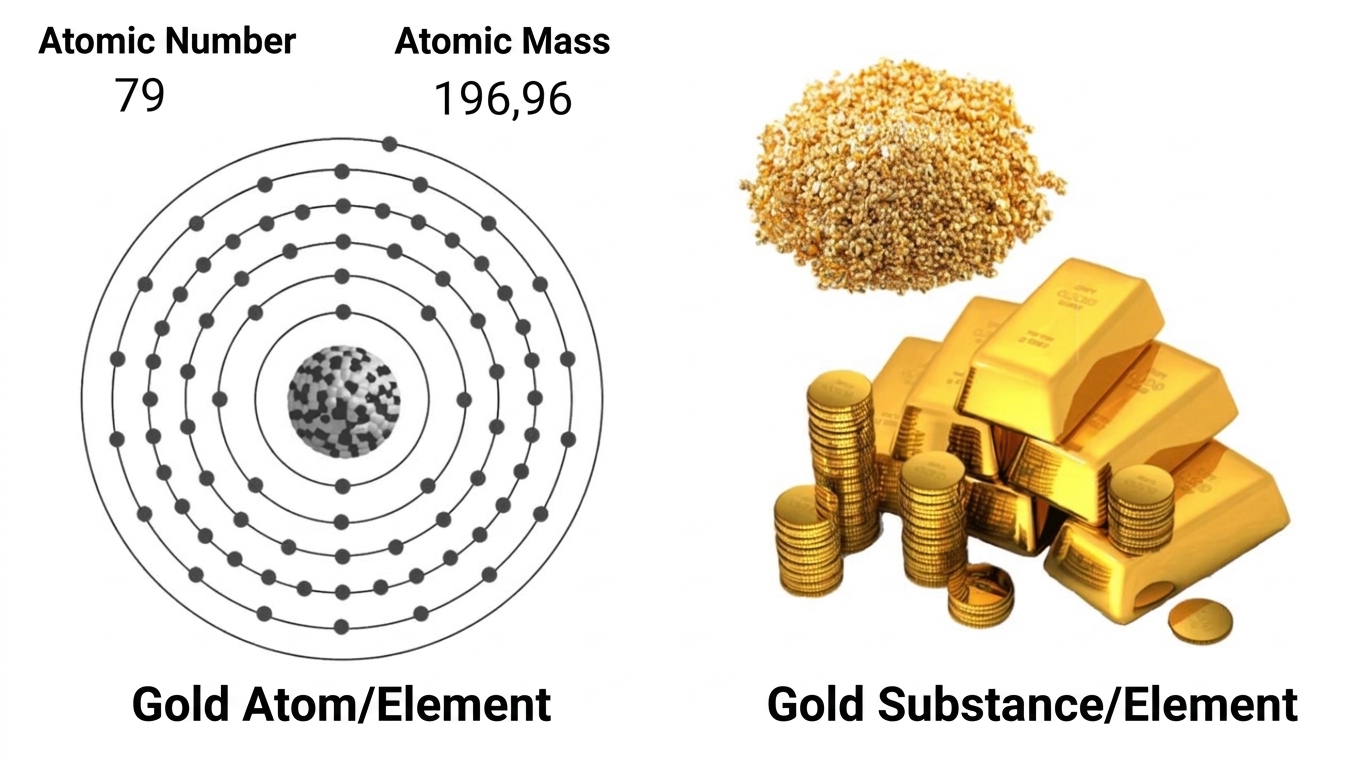
A chemical element is one kind of . Atoms are the tiny building blocks of matter, and each element has its own kind. Every atom of oxygen is oxygen. Every atom of gold is gold. You cannot break oxygen into something simpler by heating it, burning it or mixing it with acid.
The word "element" is used in two ways, and both are correct. It can mean the kind of atom, such as the oxygen atoms inside water. It can also mean a pure sample made of only that kind of atom. A gold bar and a balloon of helium gas are examples.
This matters because water contains the elements hydrogen and oxygen, but water itself is not an element. It is a , a substance made of different elements joined by chemical bonds. Its properties are very different from those of hydrogen and oxygen gas. Hydrogen burns, oxygen helps things burn, and water puts fires out.
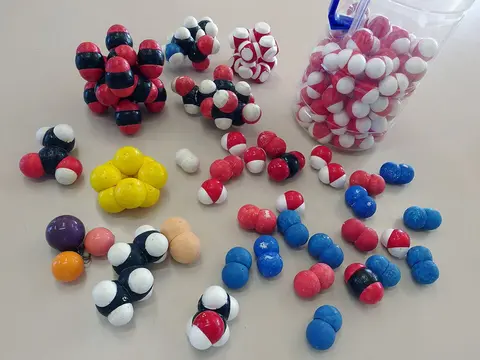
Elements can also join up with their own kind. Two hydrogen atoms bond to form a hydrogen molecule. Air is mostly a mixture of nitrogen and oxygen molecules. It also holds small amounts of carbon dioxide and argon. Nearly every element on Earth is found locked inside compounds or mixtures. Fewer than 20 are ever found on their own in the ground. Gold and platinum are two of them.
What makes one element different from another?
The answer is the number of protons in an 's . The nucleus is the tiny core of an atom. That number is called the . Oxygen has an atomic number of 8, so every oxygen atom has 8 protons. Carbon has 6. Gold has 79. If an atom has a different number of protons, it is a different element.
Protons carry an electric charge, and the charge decides how many electrons an atom holds. Electrons are the tiny particles that sit around the nucleus. They decide how an atom behaves in chemical reactions. That is why the proton count controls so much.
The nucleus also holds neutrons. Atoms of the same element can have different numbers of neutrons. These versions are called . Carbon always has 6 protons, but it can have 6, 7 or 8 neutrons. They are named carbon-12, carbon-13 and carbon-14, using the total count of protons and neutrons. Almost 99 out of every 100 natural carbon atoms are carbon-12.
Isotopes of one element behave in almost the same way in chemistry, because they have the same electrons. Some isotopes are , which means their nuclei slowly break apart. When that happens, the atom can change into a different element. Carbon-14 is one of these, and scientists use it to date old objects.
Can one element look completely different?
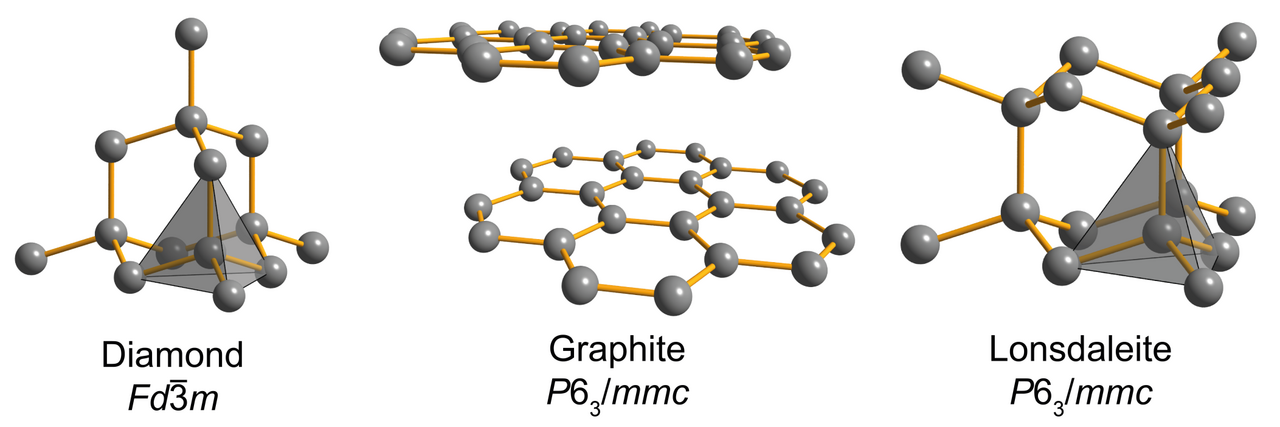
Yes. of the same element can join together in more than one pattern. These different patterns are called , and they can have very different properties.
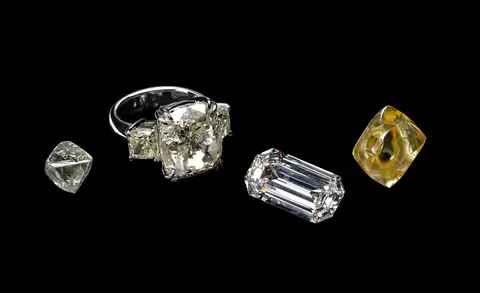
Carbon is the famous example. In diamond, each carbon atom is bonded to four others in a rigid, three-dimensional shape. That makes diamond one of the hardest natural materials. In graphite, the atoms sit in flat layers that slide over each other. That is why pencil lead leaves marks on paper and feels slippery. Both are made of nothing but carbon.
There are more. A single layer of graphite is called graphene and is very strong. Fullerenes are nearly spherical cages of carbon atoms. Carbon nanotubes are tiny tubes with the same hexagon pattern. Carbon has at least eight allotropes in all.
Density shows the difference. Graphite is about 2.3 times as heavy as water for the same volume. Diamond is about 3.5 times as heavy, because its atoms are packed more tightly.
Other elements do this too. Phosphorus has several forms, including white phosphorus. Deep inside a planet, enormous pressure can squeeze elements into new crystal patterns. These never appear at the surface. The element is the same, and only the arrangement changes.
Where did the elements come from?
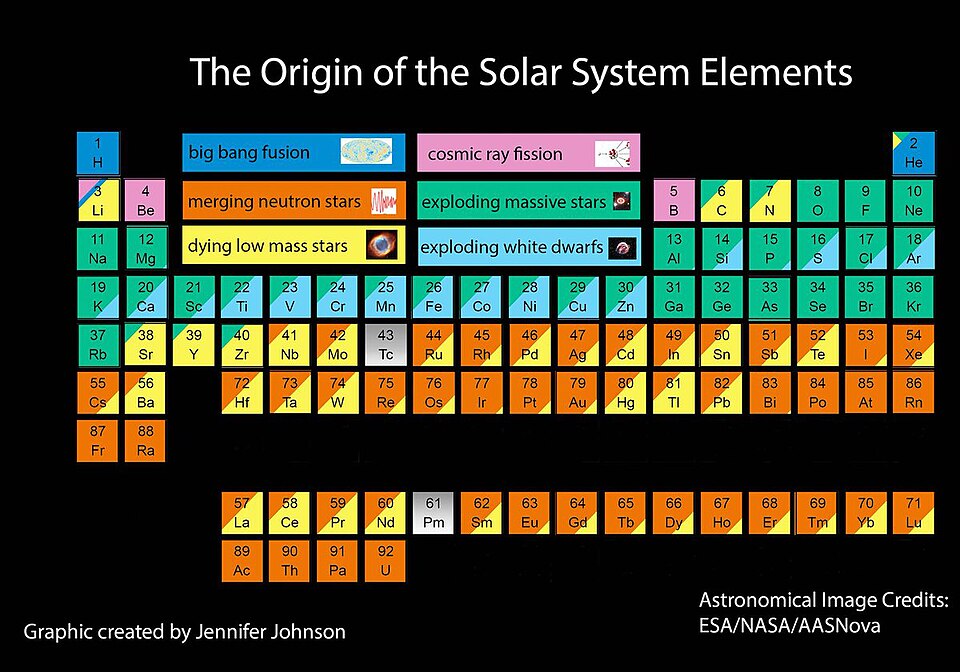
Elements were made in several different ways, and some are still being made today.
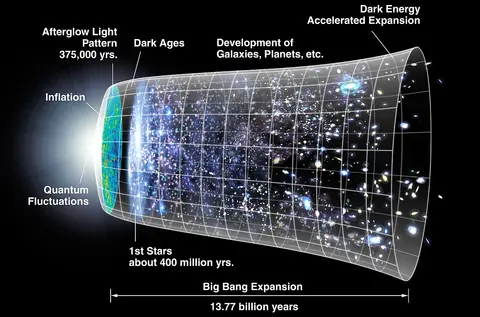
The first were made in the Big Bang, the start of the universe, about 13.8 billion years ago. In the first few minutes, the universe was hot and dense enough for protons and neutrons to stick together. This made hydrogen and helium, with tiny traces of lithium. Even now, about three quarters of ordinary matter is hydrogen and about a quarter is helium.
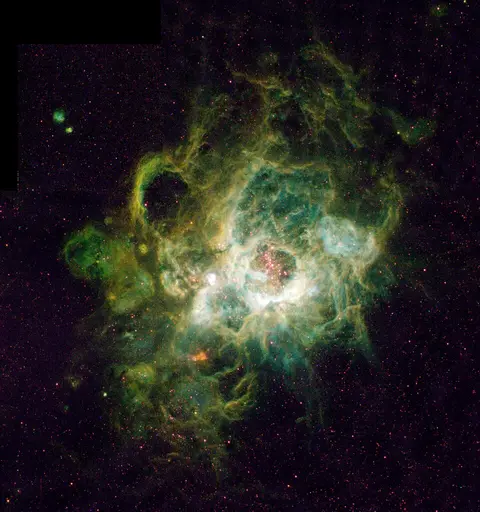
Stars made the next batch. Inside a star, nuclei are squeezed together so hard that they fuse into bigger ones. This is , and it makes the energy that lets the Sun shine. Fusion in stars builds elements from carbon up to iron.
Iron is the end of the line. Fusing nuclei heavier than iron takes in energy instead of releasing it, so a star cannot power itself that way. Heavier elements such as gold and uranium form in far more violent events. These include explosions and the collisions of neutron stars. Lithium, beryllium and boron are made when fast particles from space called cosmic rays smash heavier apart.
This means the carbon in your body was made inside stars. Those stars died long before the Sun was born.
How did people work out what elements are?
Early people used elements long before they knew what they were. They found gold, copper, sulphur and carbon in the ground and learned to use them. But nobody yet understood that these were basic ingredients.
The ancient Greeks asked what everything is made of. Around 360 BC, the philosopher Plato wrote about four elements, which were earth, water, air and fire. His student Aristotle added a fifth, aether, which he thought formed the heavens. These were ideas about the world, not results from experiments. Later, alchemists tried for centuries to change metals such as lead into gold. It never worked, but they discovered useful methods and substances.
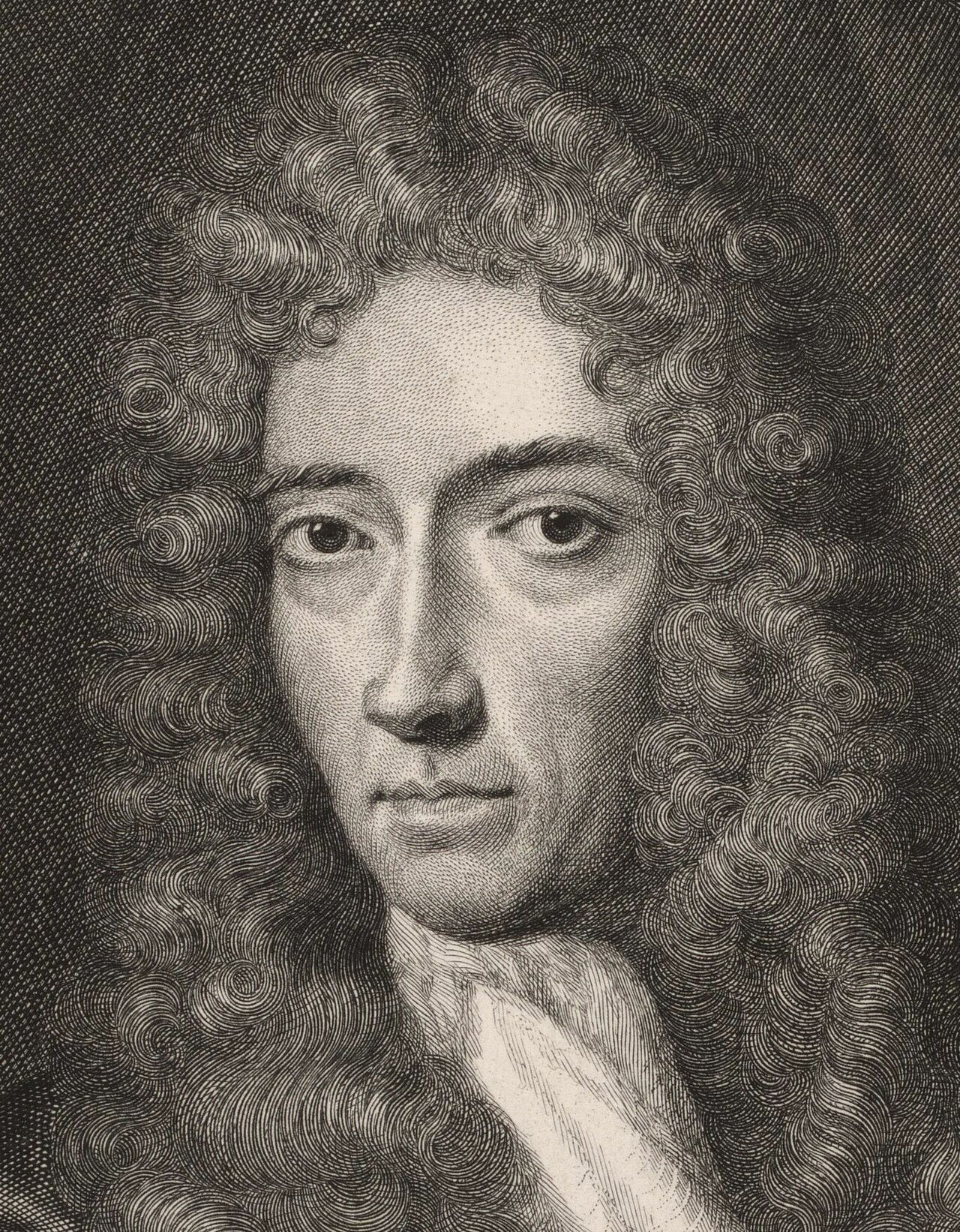
The big change came in 1661, when Robert Boyle published The Sceptical Chymist. Boyle argued against any fixed list of elements. He pictured matter as made of tiny particles that could join up in many ways. He said elements should be found by experiment.
In 1789, Antoine Lavoisier published the first modern list of elements, with 33 entries. Some, such as light and heat, were wrong. Over the next years, chemists tested substances, found new elements and measured how heavy their were. By 1818 Jöns Jacob Berzelius had worked out atomic weights for 45 of the 49 elements known then.
How did Mendeleev organise the elements?
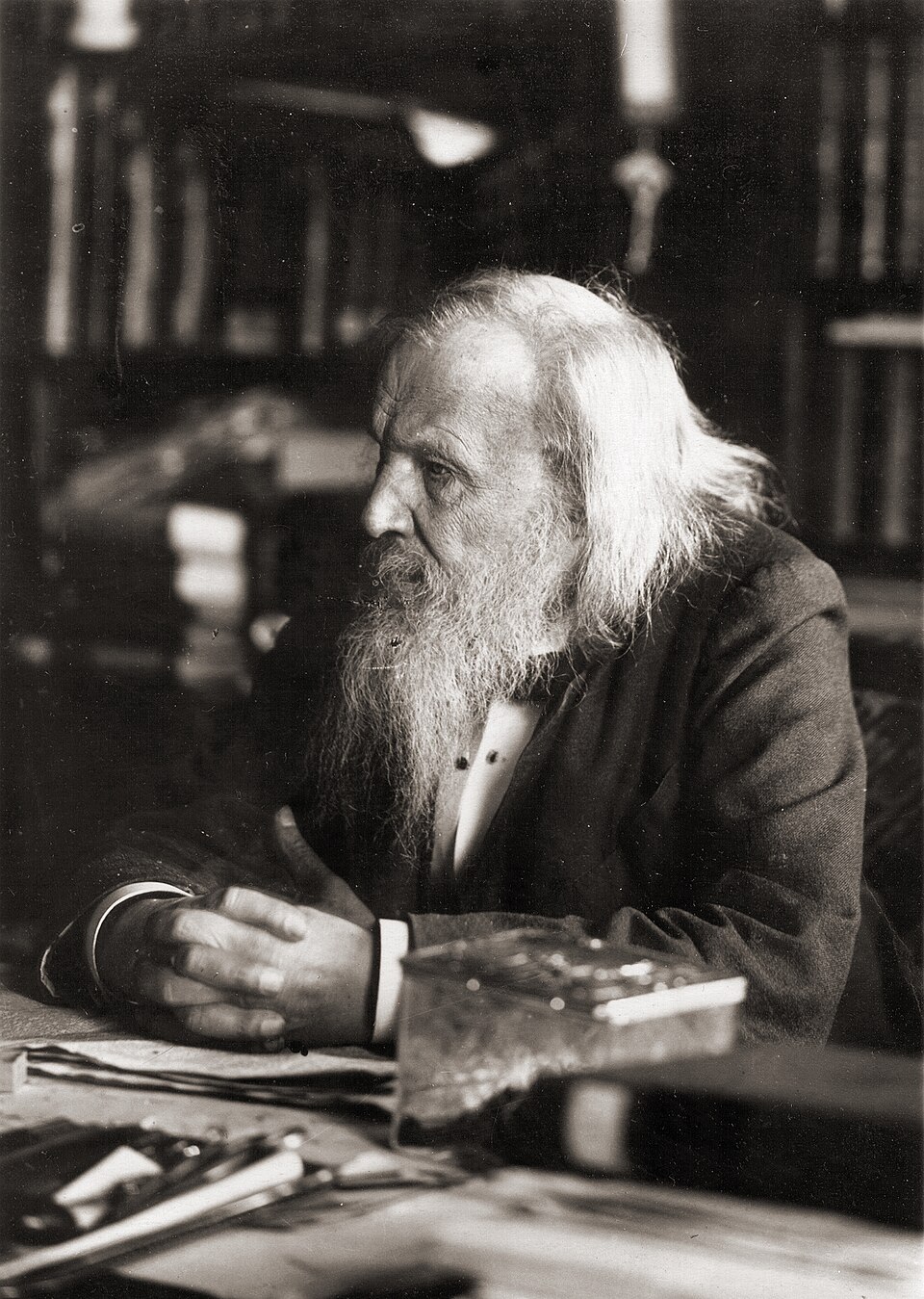
By the 1860s, chemists knew dozens of elements, but there was no map. Some elements behaved alike, and nobody knew why. In 1869, the Russian chemist Dmitri Mendeleev published the first recognisable .
Mendeleev had 63 elements to work with. He lined them up in order of increasing weight. He noticed that similar properties came round again and again at regular steps. The word for this repeating pattern is periodic. He started a new row each time the pattern repeated. So elements with similar behaviour ended up in the same column.
The table was powerful because it could predict. Where the pattern broke, Mendeleev left gaps for elements nobody had found yet. He described what those missing elements should be like. When chemists later discovered new elements, they fitted the gaps. Gallium, found in 1875, was one of them.
The table was not perfect. Today we know an element's place depends on its number of protons, not its weight. Argon has an of 18 and potassium has 19, yet argon is slightly heavier. Ordering by atomic number fixes this.
Even so, the idea was right. The table could explain and predict at the same time, and that is what makes a scientific model useful.
How does the periodic table work?
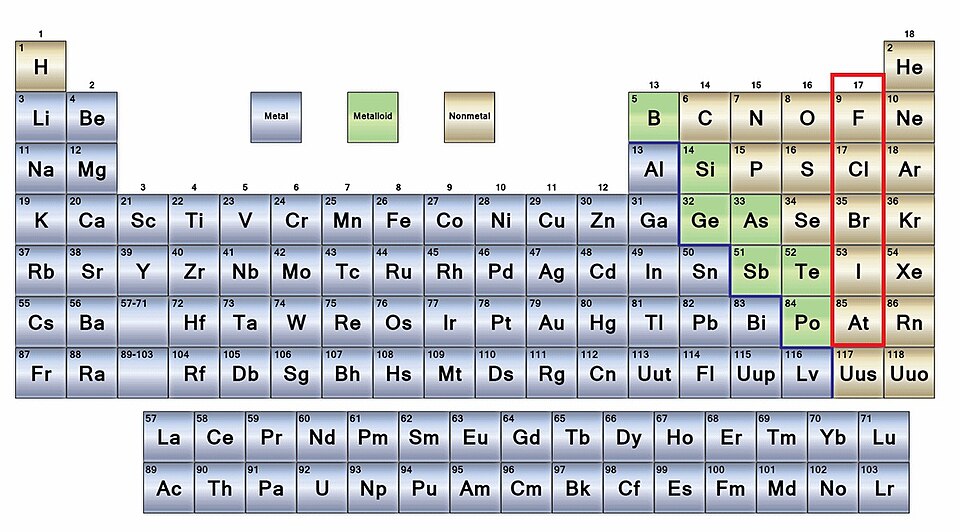
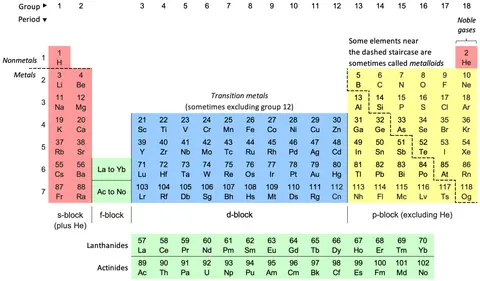
The modern arranges all 118 elements by , starting with hydrogen at 1. Each row is called a period. Elements in the same period have the same number of electron shells. Shells are the layers where electrons sit around the . Each column is called a group, and there are 18 of them. Elements in a group behave alike, because their outermost electrons are arranged in a similar way.
The table also sorts elements into families. Metals conduct electricity and heat well. Nonmetals do not. sit in between, and many are used as semiconductors in electronics. Alkali metals such as sodium and potassium are very reactive. Halogens such as chlorine are reactive nonmetals. Noble gases such as helium and argon hardly react with anything.
States of matter vary too. At 0 degrees Celsius, most elements are solid and several are gases. Only bromine and mercury are liquid. Helium is odd, because it stays liquid even at absolute zero under normal air pressure.
Chemists, physicists, geologists, doctors and engineers all use the table. Where an element sits can tell you how it is likely to react. It can also hint at what the element might bond with. It is one of the most useful pictures in all of science.
Why does gold have the symbol Au?
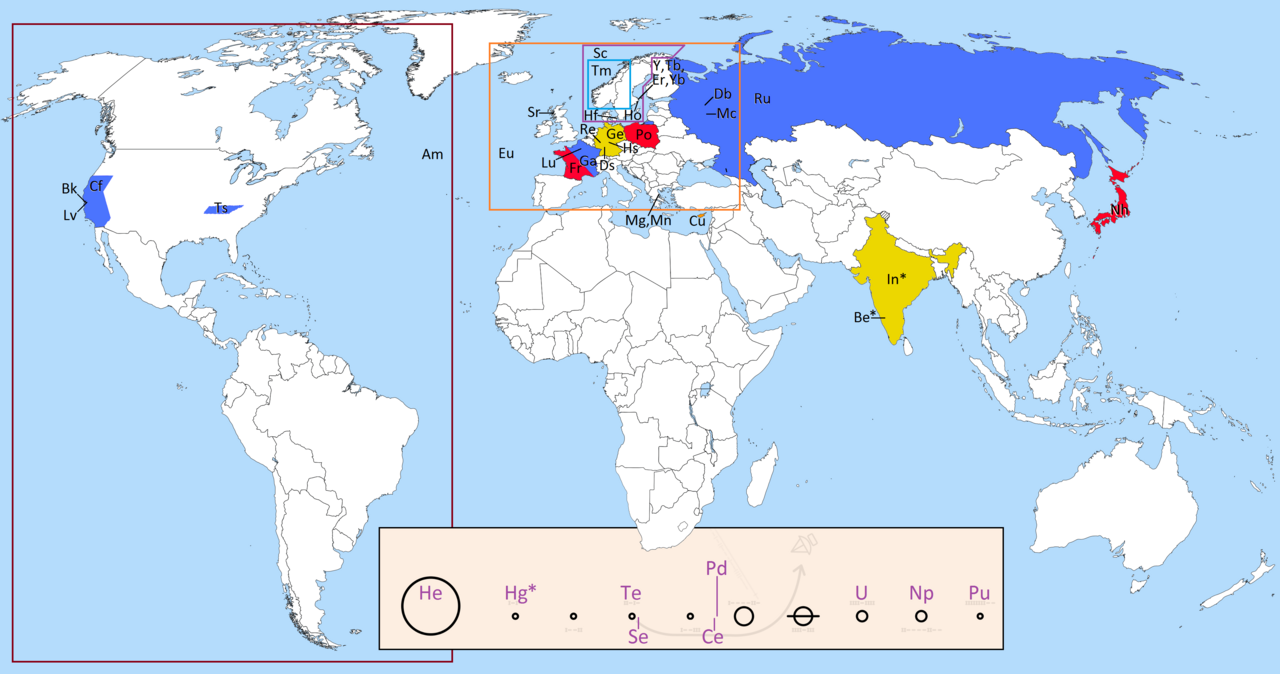
Every element has a name, an and a symbol. Names are older than the science. Many ancient elements such as gold, iron and mercury kept the names people had always used. Others were named for places, people and ideas. Europium is named after Europe, and einsteinium after Albert Einstein. In total, 41 elements have names linked to places.
Before 1814, alchemists drew strange picture symbols. John Dalton later used circles to show . Then in 1814, the Swedish chemist Jöns Jacob Berzelius invented the system we still use. Each element gets a capital letter, sometimes followed by a small one. H is hydrogen and Ca is calcium.
Latin was the language of science at the time, so Berzelius based many symbols on Latin names. That is why gold is Au, from aurum, and iron is Fe, from ferrum. Silver is Ag, lead is Pb, and mercury is Hg. Sodium is Na and potassium is K, from the Neo-Latin natrium and kalium. Tungsten is W, from its other name, wolfram.
Symbols are the same in every language, so a chemist in Japan can read a formula written in Brazil. Today an international group called decides the official names of elements, including the newest ones made in laboratories.
What are the elements around us and inside us?
The elements are not shared out equally. In the universe as a whole, hydrogen and helium are by far the most common. Earth is different, because the young Sun's heat drove most of the lightest gases away from the inner planets. Oxygen is the most abundant element in Earth's crust by mass. It is mostly locked in minerals with silicon. Aluminium makes up about 8% of the crust by mass. The core of the Earth is rich in iron.
Living things use a different mix again. Human bodies follow the pattern of seawater, with extra carbon and nitrogen. Carbon and nitrogen are needed for proteins and for the DNA that carries instructions in our cells. Phosphorus is part of DNA and of ATP, the molecule that moves energy around inside cells. Some creatures need special elements. Green plants use magnesium in chlorophyll, which captures sunlight. Many shellfish use calcium for their shells. Red blood cells carry oxygen using iron.
Not every element is stable. Elements 1 to 82 each have at least one stable form, with two exceptions, technetium and promethium. Beyond that, every is . The 24 heaviest elements are all made in laboratories, and their atoms break down quickly. Element 118 is called oganesson, and element 117 is called tennessine. New ones are still being sought.
Explore Next
Your audio story keeps playing while you look around.
Words to Know
- allotrope
- One of the different forms of the same element, such as diamond and graphite.
- atom
- The tiny building block of matter, made of a nucleus and electrons.
- atomic number
- The number of protons in an atom, which decides which element it is.
- compound
- A substance made of atoms of different elements joined together.
- isotope
- A version of an element with a different number of neutrons.
- IUPAC
- The international group that decides the official names of chemical elements.
- metalloid
- An element with properties between those of a metal and a nonmetal.
- nuclear fusion
- The joining of small atomic nuclei into bigger ones, which releases energy.
- nucleus
- The tiny, dense core of an atom, made of protons and neutrons.
- periodic table
- A chart that arranges all the elements by atomic number into rows and columns.
- radioactive
- Describes atoms whose nuclei slowly break apart and give off energy.
- supernova
- The huge explosion of a massive star at the end of its life.