Big Bang
How everything we can see grew from an unimaginably hot, dense beginning.
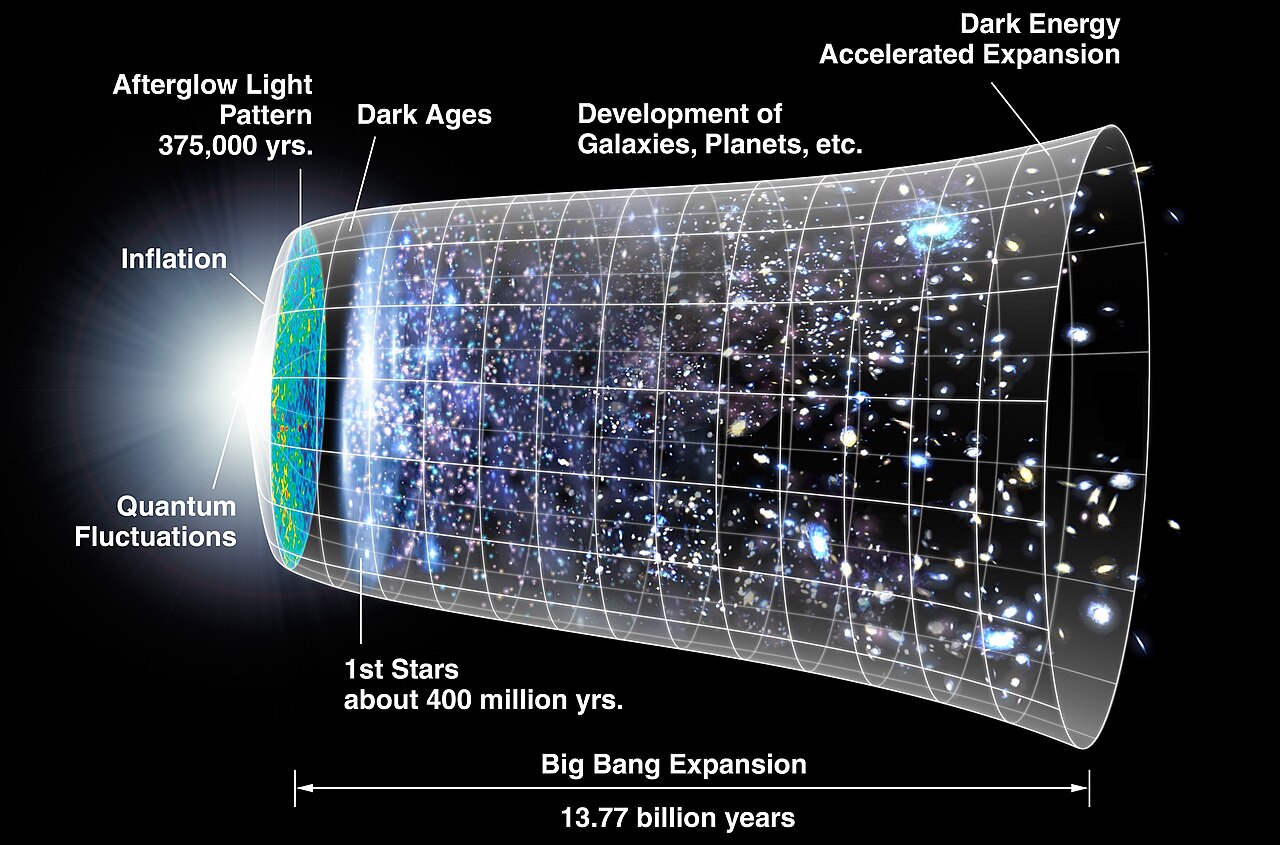
About 13.8 billion years ago, the whole universe was far smaller, hotter and denser than anything we know today. Since then, space itself has been stretching, and that stretching carried matter apart and let it cool. The Big Bang is the scientific theory that describes this story, from the first fraction of a second to the galaxies we see now. It is not a guess. Several different kinds of evidence point to it, from the glow of the early universe to the amounts of hydrogen and helium in the sky. It also leaves big questions open, and those are every bit as exciting.
What was the Big Bang?
The Big Bang is the idea that the universe began very hot and dense. It has been expanding and cooling ever since. Picture a cooling kettle that never stops spreading out. Early on, everything we can now see was packed into a tiny region. Today that same material is spread across billions of light years.
The name is a little misleading. There was no explosion in the middle of an empty room. Space itself was expanding everywhere at once, so there is no central point that the universe burst out from. Galaxies are not flying through space like fireworks. The space between them is growing, a bit like dots on a balloon drifting apart as you blow it up.
The theory works by running the story backwards. Astronomers measure how fast the universe is expanding now. Then they use the laws of physics to work out how it looked in the past. The further back they go, the hotter and denser it gets. This points to a start about 13.8 billion years ago.
There is one important limit. The theory describes how the universe grew and changed from an early hot state. It does not explain where space, time and energy came from in the first place. The very earliest moments are beyond what our current physics can handle.
How do we know the universe is expanding?
The first clue came from light. When a galaxy moves away from us, its light is stretched to longer wavelengths, so it looks redder. This is called . It works a little like an ambulance siren dropping in pitch as it speeds away. In 1912 the American astronomer Vesto Slipher studied spiral nebulae. Almost all were redshifted, so they were moving away from us.
At that time nobody knew what these spirals were. In 1923 and 1924 Edwin Hubble measured the great distance to the nearest ones. They were whole galaxies far outside our own Milky Way. He then compared distances with redshifts. In 1929 he found a pattern. The further away a galaxy is, the faster it is moving away. This is now called Hubble's law.
The theory had already arrived on paper. In 1922 the Russian mathematician Alexander Friedmann used Einstein's equations to show that the universe could be expanding. Einstein himself had favoured a universe that stayed the same size. In 1927 the Belgian physicist and priest Georges Lemaître reached the same idea on his own. Then in 1931 he went further. If the universe is growing now, he reasoned, it must have been smaller long ago, and once all of it was squeezed into a single "primeval atom".
What happened in the very first second?
Nobody knows exactly, because the conditions were so extreme that our best theories stop working. The earliest moment we can say much about is called the Planck time, a tiny fraction of a second after the start. Before it, scientists would need a theory of gravity that works at the smallest scales. No such theory has been accepted yet.
Most models then include a burst called . At about a trillionth of a trillionth of a trillionth of a second, the universe grew incredibly fast. In one calculation, everything we can see today grew from far smaller than a proton to less than a metre across. Inflation also helps explain why the universe looks so similar in every direction. It explains why its shape is so close to flat, too. Tiny quantum wobbles were stretched out and became the seeds of future galaxies.
Afterwards the universe was a hot soup of particles. Matter and , which destroy each other when they meet, were made in nearly equal amounts. But there was a tiny extra amount of matter, about one part in 30 million in one estimate. When most of the matter and antimatter wiped each other out, that leftover became everything we see. Nobody yet knows why matter won.
How did the first atoms form?
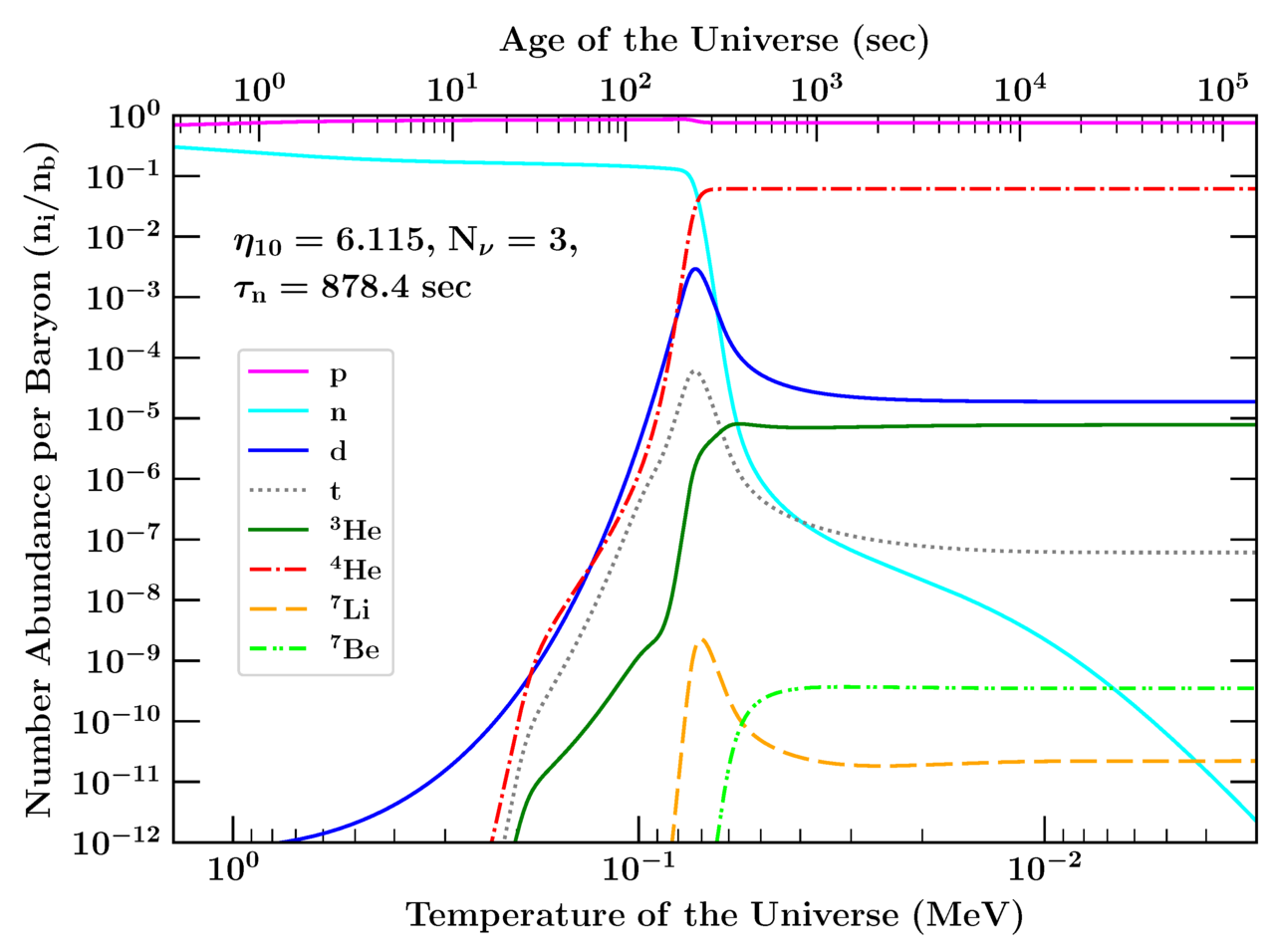
As the universe expanded, it cooled. A millionth of a second in, quarks had joined together into protons and neutrons. These are the building blocks of the centre of every atom. A few minutes later the temperature had dropped to about a billion degrees. That was cool enough for some protons and neutrons to stick together. They formed the nuclei of helium and a little lithium. This stage is called Big Bang . Most protons stayed on their own and became the nuclei of hydrogen, the simplest element.
This gives scientists a test. The theory predicts that the young universe should be roughly three quarters hydrogen and one quarter helium by mass. Other light elements should be rare. That is what astronomers measure in the oldest gas clouds. In 2011 they even found clouds with no detectable heavy elements. That fits gas left over from this early time.
For a long time the universe was a glowing, foggy plasma. Light kept bumping into free electrons and could not travel far. After about 380,000 years the universe had cooled. Electrons could now settle onto nuclei and make the first complete atoms. This is called . Suddenly light could move freely, and the fog cleared.
What is the afterglow of the Big Bang?
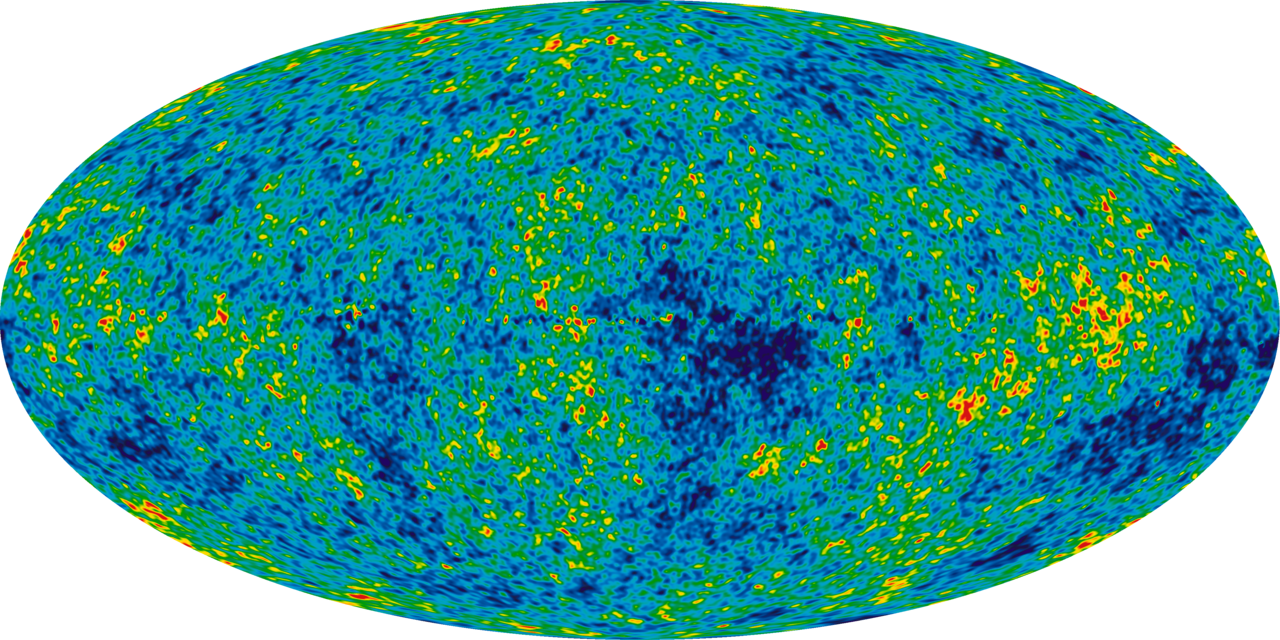
When the fog cleared at , the light that was set free began to travel across the universe. It is still travelling. Because space has stretched by a factor of about a thousand since then, the light has stretched too. It has turned from bright glow into faint microwaves. We call it the , or CMB.
The CMB was predicted around 1950 by George Gamow, Ralph Alpher and Robert Herman. Then in 1964 two radio engineers, Arno Penzias and Robert Wilson, found it by accident. They were using a sensitive antenna and kept picking up a faint hiss from every direction. They had not been looking for it. Penzias and Wilson shared the 1978 Nobel Prize in Physics. By the late 1960s most scientists had been convinced that the Big Bang beat its rival, the steady-state idea.
Later space missions mapped it in great detail. NASA's COBE satellite showed in 1990 that the glow matches a perfect hot object. It has now cooled to about 2.7 kelvin. In 1992 it found tiny differences across the sky, about one part in 100,000. These ripples mark places that were a little denser. Later missions such as WMAP and Planck made sharper maps. John Mather and George Smoot won the 2006 Nobel Prize in Physics for the COBE work.
How did stars and galaxies appear?
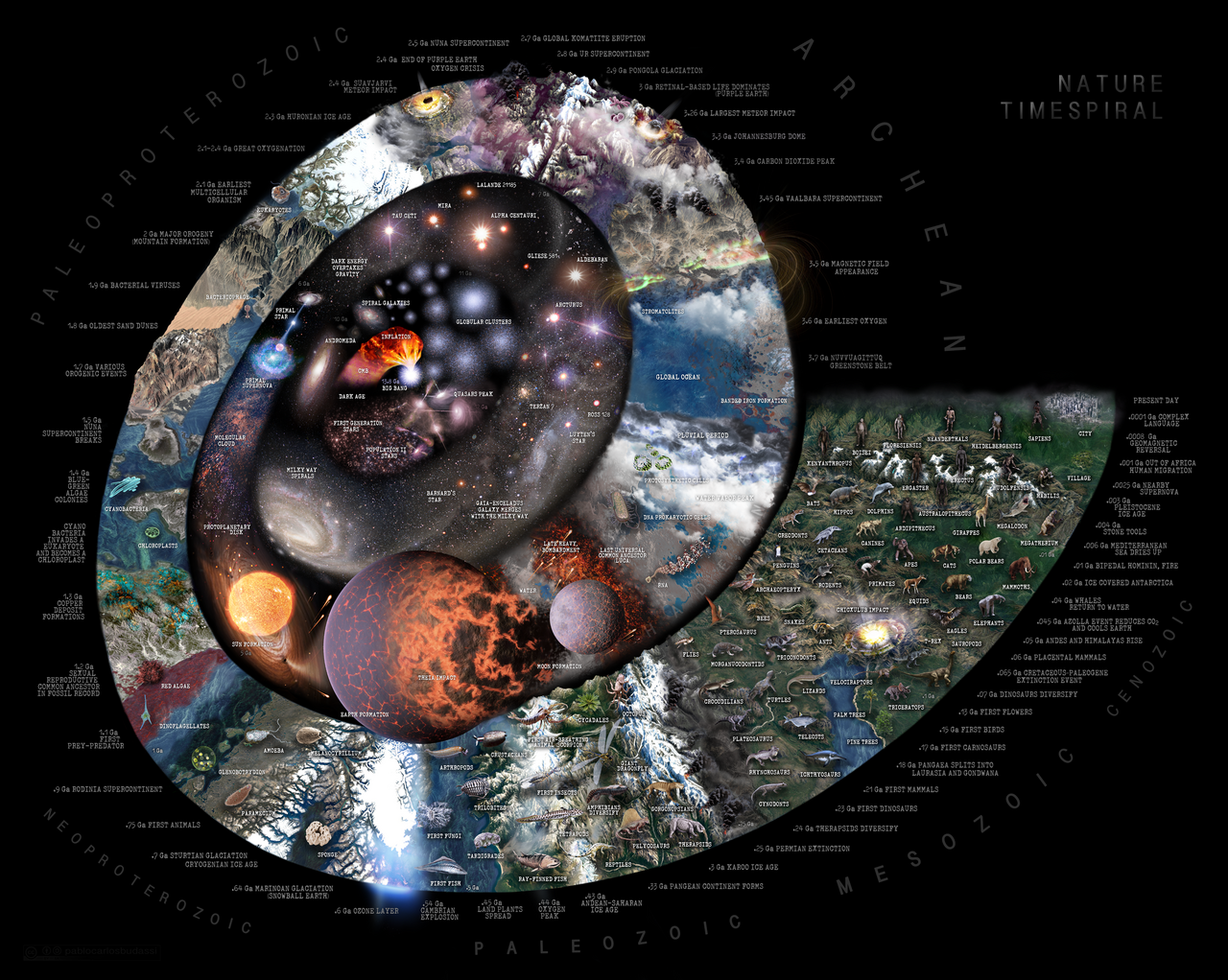
After the universe was full of gas but had no stars. Gravity went to work on the slightly denser patches, the ones that began as quantum ripples during . They pulled in more gas and became denser still. Over time this built clouds of gas, then the first stars, then whole galaxies.
Gravity had help. Astronomers think that a mysterious invisible material called added to the pull and gave gas somewhere to gather. Computer simulations start from the early universe and include dark matter. They produce webs of galaxies very like the ones we observe. Observations suggest that the first galaxies and quasars formed within a billion years of the Big Bang. Quasars are very bright galaxy centres. Over time they gathered into clusters and superclusters.
We can watch this history happen. Light from far-off galaxies takes billions of years to reach us, so telescopes show them as they once were. Distant galaxies look different from nearby ones, because the stars in them are younger. This helped rule out the steady-state idea. It said the universe should look the same at all times.
The first stars made the heavier elements, such as carbon and oxygen, in their cores. Later generations of stars and planets, including our Sun and Earth, were built from that material.
What are dark matter and dark energy?
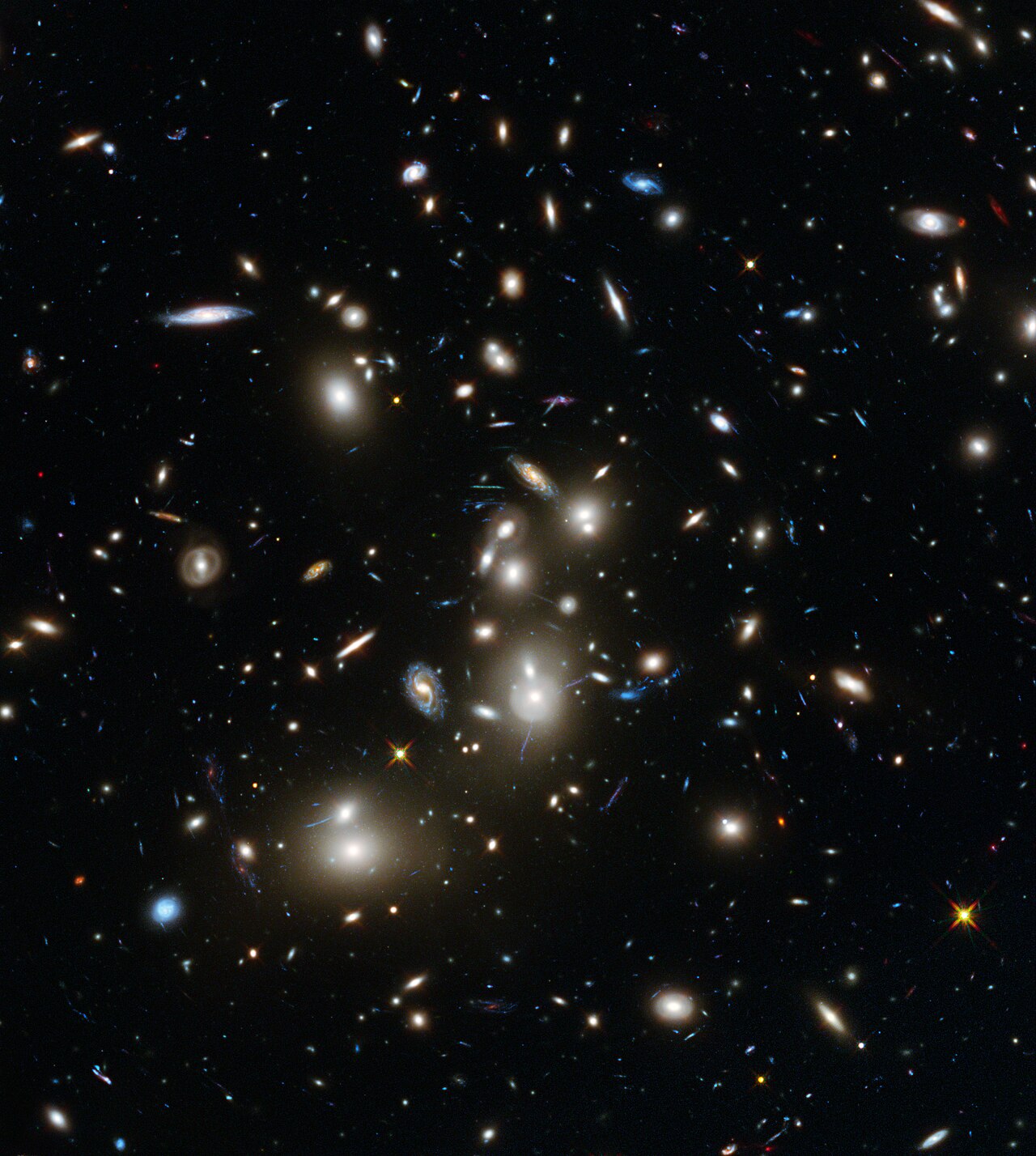
Here is a surprise. The stars, planets and gas we know about make up only about 5% of the universe's total mass and energy. The rest is two things we cannot see directly. makes up about 27%. makes up about 68%.
Dark matter does not give out or soak up light. We know it is there because of its gravity. In the 1970s and 1980s, astronomers found that galaxies behave as if they hold much more mass than the stars and gas show. No dark matter particle has yet been caught in a laboratory, though several experiments are trying.
Dark energy is even stranger. Telescopes studied a kind of exploding star called a Type Ia supernova. In 1998 two teams of astronomers used them to show that the of the universe is speeding up. The discovery won the 2011 Nobel Prize in Physics. Early on, matter was packed closely together and its gravity slowed the stretching. As space grew and matter thinned out, dark energy took over and the expansion began to accelerate. This happened when the universe was roughly half its present age.
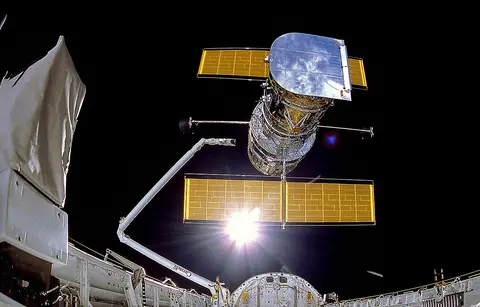
The Hubble Space Telescope and others now give precise measurements of this expansion. Yet there is a puzzle. Different methods give slightly different values for how fast the universe is growing, a mismatch called the Hubble tension. Scientists are still working out why.
What will happen to the universe in the future?
The will not stop. is making it speed up, so the galaxies beyond our own nearby group will drift farther and farther away. Most cosmologists expect an ending called the Big Freeze. Stars will use up their gas, the last of them will fade, and over trillions of years the universe will grow cold and dark.
Two other endings would need dark energy to change. In the Big Crunch the expansion would reverse and everything would fall back together. In the Big Rip, dark energy would grow so strong that it tore apart galaxies, stars and finally atoms. Current measurements do not favour either one.
Nothing about this is close. The Sun has billions of years left. Meanwhile astronomers are working on the Hubble tension, and they will keep measuring the expansion more precisely, because the final answer depends on what dark energy really is.
Where did the name come from, and what is still unknown?
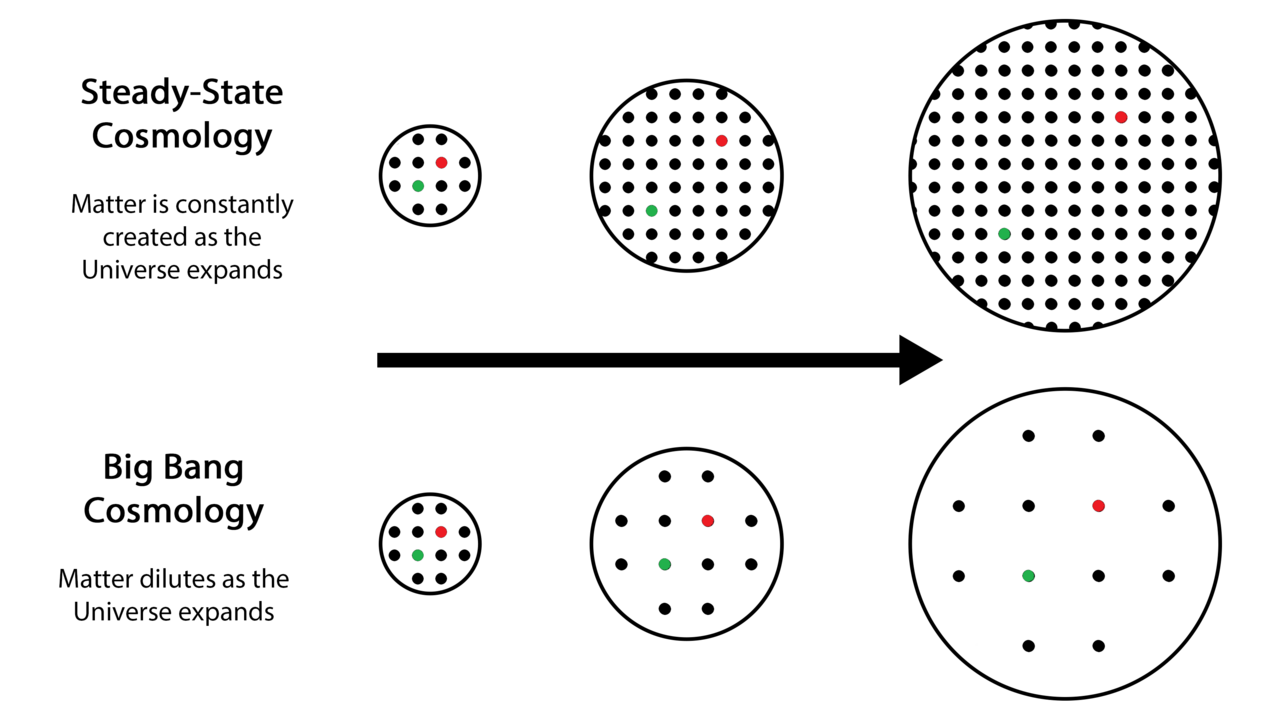
The name came from a rival. After the Second World War, two ideas competed. One was Lemaître's expanding universe. The other was the steady-state model, backed by the English astronomer Fred Hoyle. In it, new matter appears as space expands, so the universe looks much the same at all times. In March 1949 Hoyle used the phrase "big bang" on BBC radio to describe the other idea. Many people think he meant it as a joke against it, but he said he did not. The name stuck, though it only became widely used in the 1970s.
Evidence settled the argument. The microwave background, the light elements and the changing look of distant galaxies all fit the Big Bang. They do not fit the steady-state idea. These are sometimes called the pillars of the theory.
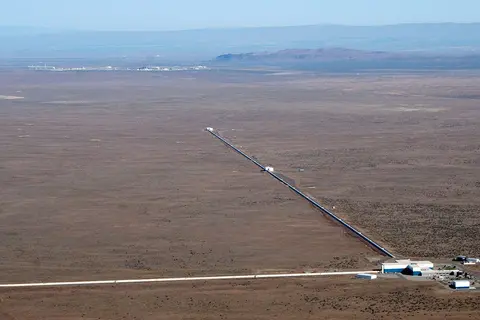
In 1981 Alan Guth added the idea of to repair some gaps in the early story. Even so, big questions remain. What happened before or at the very start? Why is there more matter than ? What are and ? Future detectors might even spot ripples called gravitational waves left from less than a second after the start.
One point is often misunderstood. Some people think that galaxies far away moving faster than light breaks physics. It does not, because it is space stretching, not galaxies racing through it.
Explore Next
Your audio story keeps playing while you look around.
Words to Know
- antimatter
- Matter made of particles that destroy ordinary matter when they meet it.
- cosmic microwave background
- Faint microwave light left over from when the universe first became transparent.
- dark energy
- A mysterious form of energy that seems to be speeding up the expansion of the universe.
- dark matter
- Invisible material that we detect only through its gravity.
- expansion
- The stretching of space itself, which carries distant galaxies apart.
- inflation
- A very brief burst of extremely fast growth in the first tiny fraction of a second.
- nucleosynthesis
- The making of new atomic nuclei by joining protons and neutrons.
- recombination
- The time when electrons joined nuclei to make the first atoms and light could travel freely.
- redshift
- The stretching of light to longer, redder wavelengths when its source moves away.
- steady-state theory
- A rival idea that the universe has always looked the same, with new matter appearing as it expands.