Chemical reaction
How atoms swap partners to turn one substance into something completely new.
Burning wood, rusting iron, baking a cake and digesting your lunch all have one thing in common. In each case, some substances disappear and different ones take their place. That change is called a chemical reaction. The atoms do not vanish or turn into other elements. They break their links and join up again in a new pattern, and the new pattern has new properties. Chemical reactions power your body, drive cars and light fireworks. They also make steel, medicines, fertilisers and plastics. Learning how they work means learning why the world around us changes, and how people learn to steer those changes.
What really happens when a substance changes into another?
In a chemical reaction, one set of substances turns into a different set. The substances you start with are called . The new substances you finish with are called . A reaction can be as quick as a match flaring up or as slow as iron turning to rust over many months.
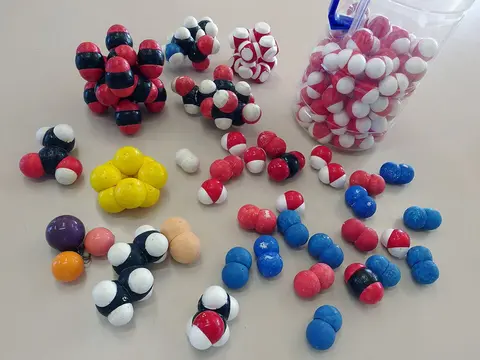
What changes is the way atoms are joined together. Atoms are held to each other by , which come from the electrons that move around them. During a reaction, some bonds break and new ones form. The atoms themselves stay the same, so a carbon atom going in is still a carbon atom coming out. Only its partners change. That is why a reaction can never turn lead into gold. The elements stay put, and only the combinations change.
The products usually look and behave very differently from the reactants. Sodium is a soft, fizzing metal and chlorine is a poisonous green gas. Join them and you get table salt, which you sprinkle on chips. Because the pattern of atoms has changed, the properties have changed too.
How can you tell that a reaction has happened? There are some common clues. A gas may bubble out. A solid may appear in a clear liquid. The temperature may rise or fall. A substance may change state or colour. None of these clues is proof on its own, since ice melting also changes state. Together they tell chemists to look closer.
Not all changes count. Melting ice and dissolving sugar change how a substance looks without making a new substance. A chemical reaction always makes something new.
How do chemists write a reaction down?
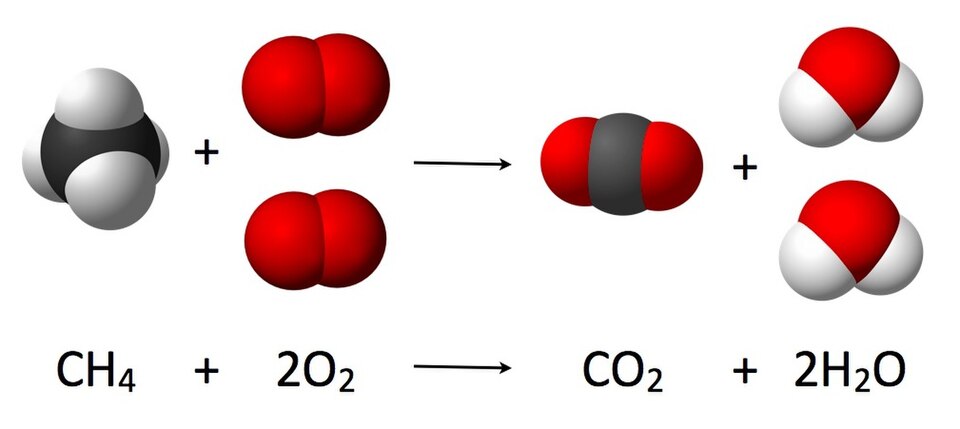
Chemists use a short code called a . The go on the left and the go on the right. An arrow between them is read as the word "yields". When methane gas burns in oxygen, the equation is CH4 + 2O2 → CO2 + 2H2O. In words, one methane molecule and two oxygen molecules yield one carbon dioxide molecule and two water molecules.
Look closely and you will find the same number of atoms on each side. Count them. There is 1 carbon atom on both sides, 4 hydrogen atoms and 4 oxygen atoms. This is no accident. It follows the law of conservation of mass, which says that atoms are never created or destroyed in a reaction. An equation that obeys the law is called balanced. Chemists balance an equation by putting numbers in front of the formulas until the atom counts match.
Equations can carry more detail. A small note above the arrow can show that heat, light or a is needed. A double arrow shows that a reaction can run both ways, which leads to a balance called chemical . For longer reactions, chemists draw a reaction scheme that also shows the steps in between.
The idea behind balancing came from careful weighing. Early chemists noticed that gases combine in fixed proportions. With John Dalton's atomic theory, this led to rules that tell a chemist how much of each substance a reaction needs.
Why do some reactions give out heat and others take it in?
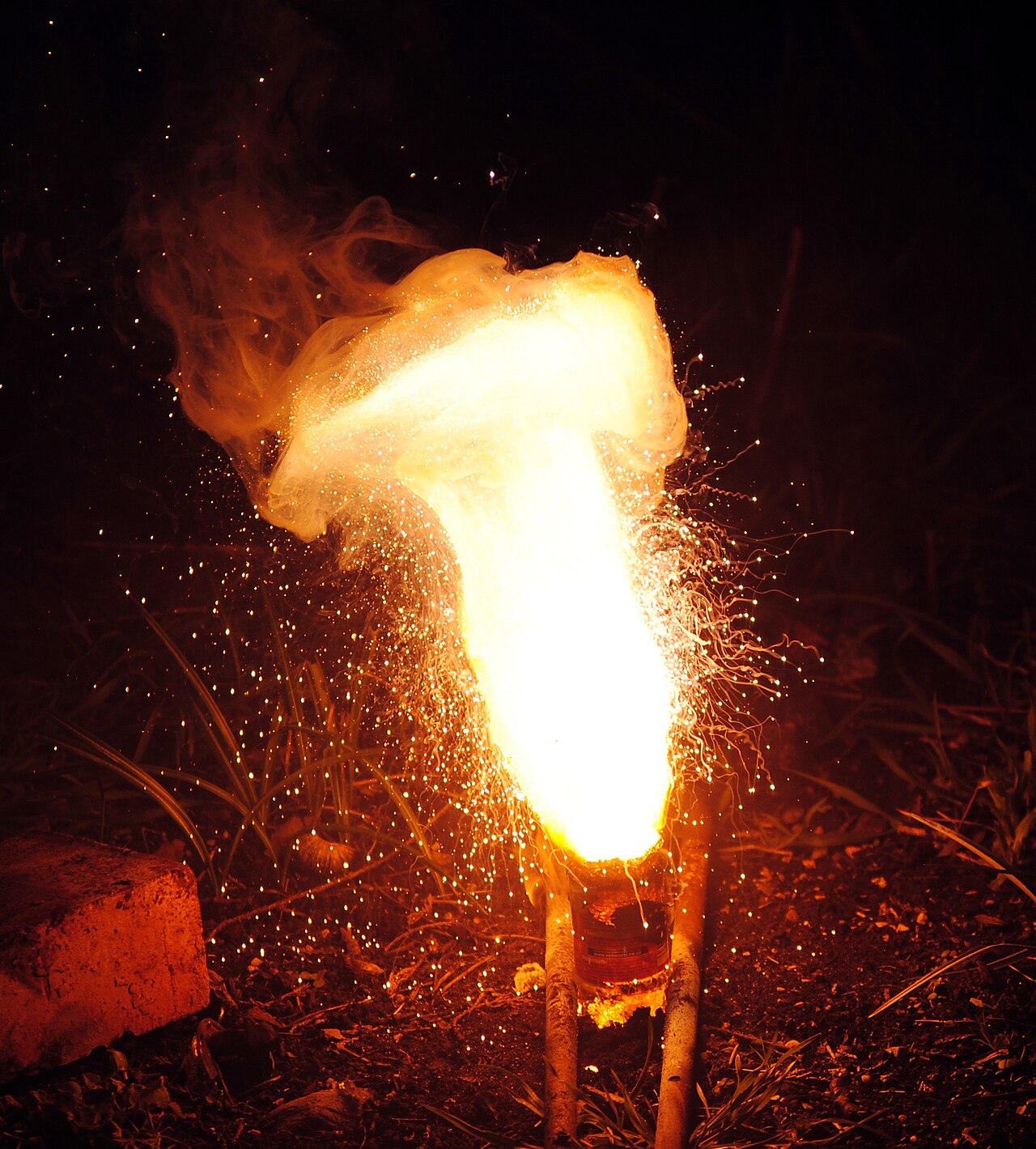
Every reaction involves energy. Breaking bonds takes energy, and forming new bonds gives energy back. If more energy is released than was needed, the extra leaves as heat or light. This is an reaction. Burning is the best-known example. A thermite reaction between aluminium powder and iron oxide is a dramatic one. It gets so hot that it makes molten iron, which flies out as bright sparks. Workers still use it to weld railway lines, especially in remote places where bulky equipment is hard to bring.
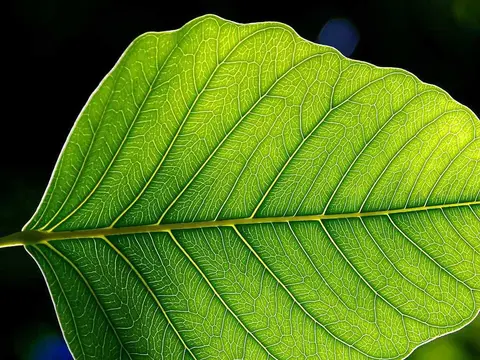
An reaction works the other way. It soaks up energy from its surroundings, so it can feel cold. Photosynthesis in plant leaves is an example, because it needs the energy of sunlight to run.
Chemists also ask whether a reaction will happen by itself. Two things decide it. One is whether energy is released. The other is entropy, a measure of how spread out and disordered things are. Nature tends to favour reactions that make more disorder, such as turning a solid into a gas. That is why some endothermic reactions work well at high temperatures.
Most reactions can also run backwards. Think of a reaction going forward while its reverse goes the other way at the same time. At first the forward reaction is faster. As build up, the reverse speeds up until both go at the same rate. The mixture then stops changing overall. Chemists call this chemical . It is why a reaction does not always use up every .
What makes a reaction fast or slow?
For two molecules to react, they must first meet and collide. They also need enough energy when they hit. The smallest amount of energy needed to get a reaction going is called its . Think of pushing a boulder over a hill. You must give it a big push first, but after that it rolls down by itself.
This idea explains what speeds reactions up. Heating the mixture gives molecules more energy and makes them collide more often, so more collisions are strong enough to work. Raising the concentration packs more molecules into the same space, so they meet more often. Squeezing gases together does the same. Crushing a solid into powder exposes more of its surface, so there are more places where a reaction can start. Some reactions also need ultraviolet light to break the first bonds.
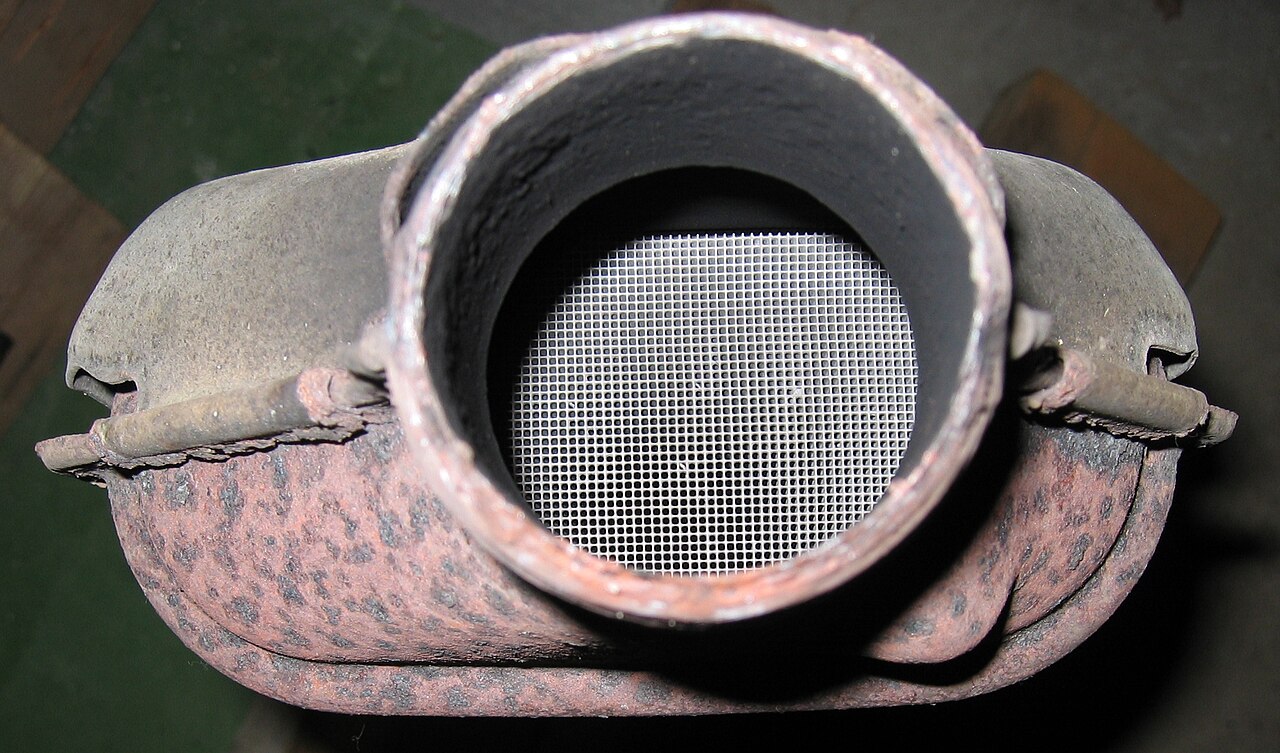
The most useful trick is a . A catalyst is a substance that offers the an easier route with a lower hill to climb. It speeds the reaction up and comes out unchanged, so it can be used again and again. Most industrial catalysts are solids, often platinum or similar metals. They are spread over a fine mesh to give them a huge surface. The exhaust system of a car holds one. It turns harmful gases from the engine into less harmful ones.
Substances that slow a reaction down are called inhibitors. Others, called catalytic poisons, can stop a catalyst working at all.
What are the main kinds of reaction?
Chemists sort reactions into types so they can spot patterns. Four basic types cover many simple cases.
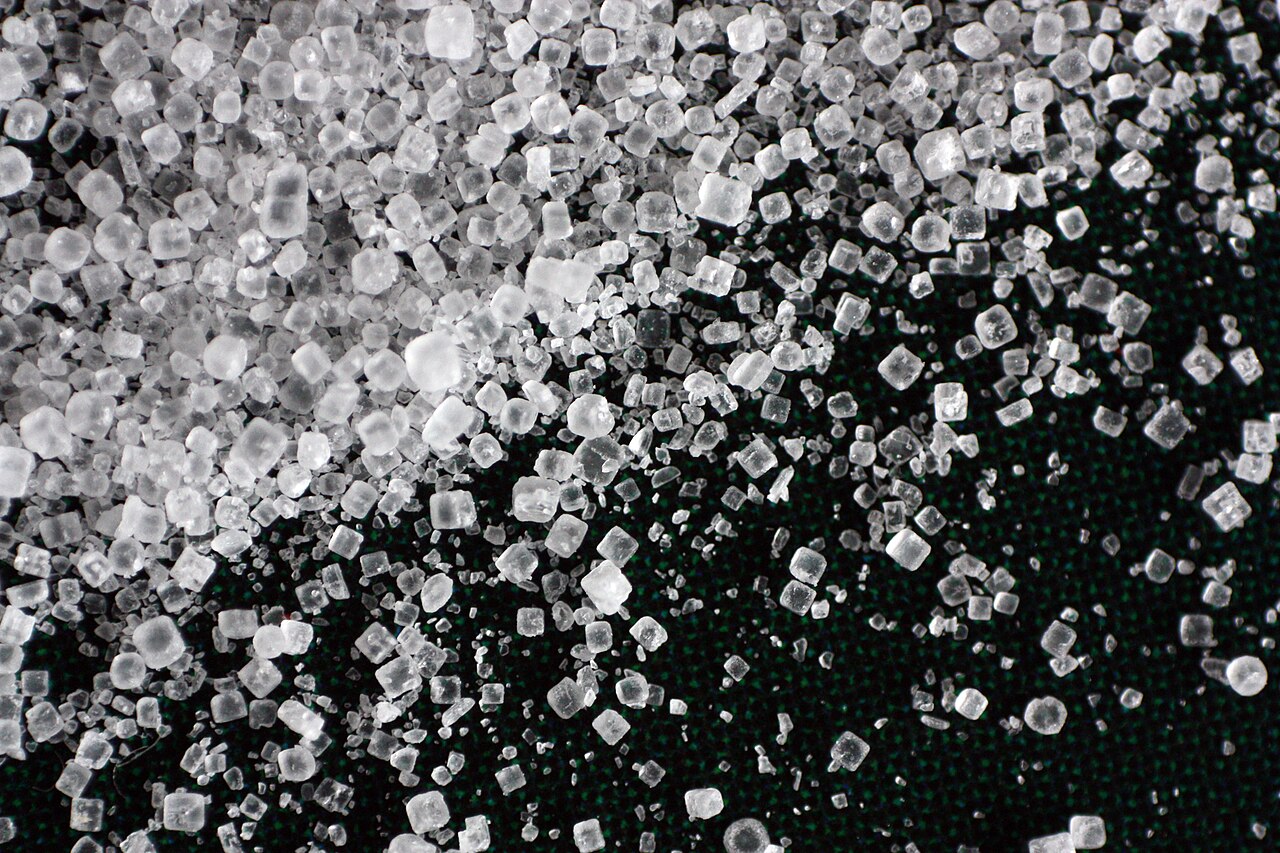
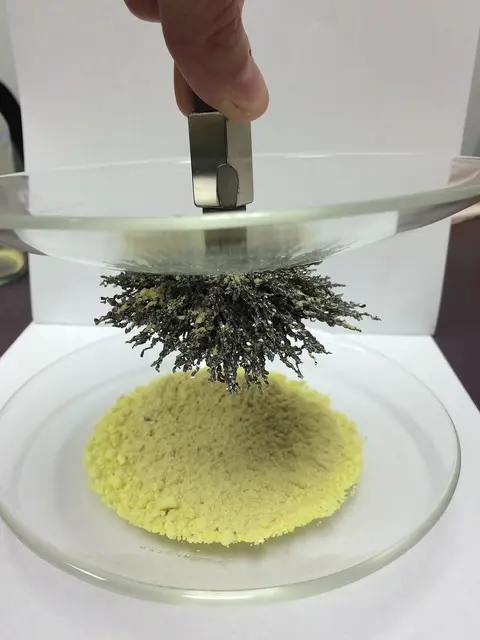
In a synthesis reaction, simple substances join to make a more complex one. Sodium metal and chlorine gas make sodium chloride, which is table salt. Iron and sulphur make iron sulphide. A decomposition reaction is the opposite. A substance breaks down into simpler parts. Passing electricity through water splits it into hydrogen gas and oxygen gas.
In a single displacement reaction, one element pushes another out of a compound and takes its place. Magnesium can take the place of hydrogen in water. In a double displacement reaction, two compounds swap partners. Barium chloride and magnesium sulphate do this. They give barium sulphate and magnesium chloride.
Some double displacement reactions make a solid appear in a clear liquid. This is called precipitation. It happens when dissolved particles join into something that will not stay dissolved. Mix lead nitrate and potassium iodide solutions and a bright yellow solid, lead iodide, appears. Slow precipitation can grow large, neat crystals. Quick precipitation gives a fine powder.
Combustion is another key type. A fuel reacts with oxygen and gives out heat and light. Octane, a part of petrol, releases about 5,500 kilojoules of energy for every 114 grams burned.
What do electrons, acids and light have to do with reactions?
Many reactions are about moving tiny particles. In a , electrons move from one substance to another. The substance that loses electrons is oxidised. The one that gains them is reduced. When sodium meets chlorine, each sodium atom gives up 1 electron and each chlorine atom takes 1. Both become charged particles called ions. Opposite charges hold the ions together in salt. The word redox joins reduction and oxidation, because one never happens without the other.
Redox reactions also power batteries. Electrons flow through a wire as they pass from one substance to the other, and that flow is electricity. Charging a battery forces the reaction to run backwards. Electrolysis uses electricity to make elements such as chlorine and aluminium.
In an acid-base reaction, the particle that moves is a proton, which is a hydrogen ion. An acid gives away protons and a base takes them. If exactly the right amounts of acid and base meet, they cancel each other out. This is neutralisation, and it forms a salt.
Light can start reactions too. In photochemical reactions, molecules absorb light and gain enough energy to break bonds. Plants use this for photosynthesis, which builds sugar from carbon dioxide and water. Your skin uses sunlight to make vitamin D. The first step of seeing in your eye is also a light reaction.
How do reactions run inside living things?
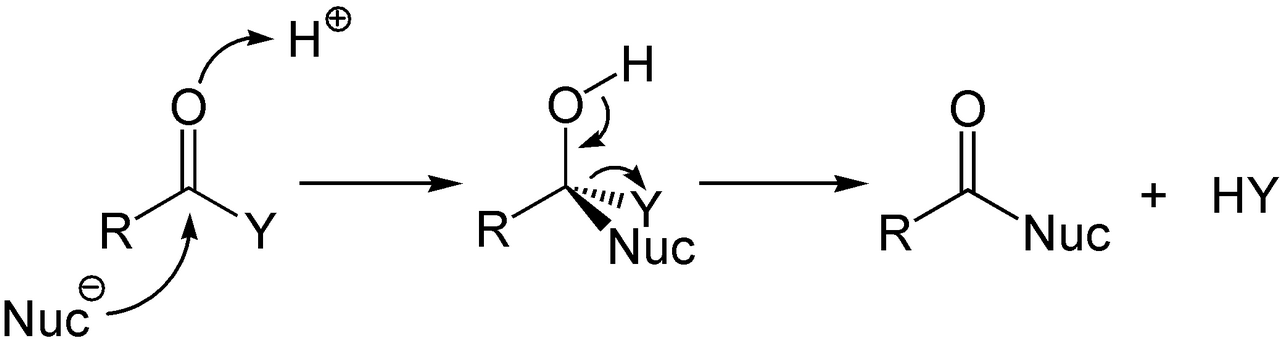
Your body carries out thousands of reactions every second. Together they are called metabolism. In your cells, glucose from food reacts with oxygen from the air. The reaction releases energy, which the cell stores in a molecule called ATP. ATP then passes that energy on to power other reactions, such as moving muscles.
Body temperature is far too low for most reactions to happen quickly. Living things solve this with . An enzyme is a protein that works as a . Each one is shaped for a particular job. The reaction happens in a small pocket called the active site, where the are held in the right position. Without enzymes, many reactions in a cell would be too slow for life to go on.
Reactions between carbon compounds are the subject of organic chemistry. Carbon atoms form long chains and rings, so there are almost endless ways to build and rearrange molecules. Chemists group these reactions into kinds. In substitution, one group of atoms is swapped for another. In addition, molecules join across a double bond. Many reactions are named after the people who found them.
For a long time people believed that only living things could make the molecules of life. In 1828 Friedrich Wöhler made urea, a substance in urine, from non-living ingredients. That changed the idea for good.
How did people learn what reactions are?

People have used chemical reactions for thousands of years, long before they understood them. Early peoples used fire, fermented drinks and heated ores to get metals. Ancient Greek thinkers such as Empedocles said that everything was made of four elements. These were fire, water, air and earth. In the Middle Ages, alchemists tried to turn lead into gold. They failed, but they learned how to make acids and salts. By about the year 1300 they were making sulphuric and nitric acid.
Scientists later tried to explain burning. In 1667 Johann Becher suggested that burning things release a fire-like substance called phlogiston. The idea lasted over a century. Then in 1785 Antoine Lavoisier showed that burning is a reaction with oxygen from the air. He measured masses carefully. His work helped to show that mass is conserved in reactions.
In 1808 Joseph Louis Gay-Lussac found that gases react in fixed proportions. With John Dalton's atomic theory, this led the way to .
Reactions then moved into factories. The lead chamber process of 1746 made sulphuric acid on a large scale. In 1909 and 1910, the Haber process was developed to make ammonia from nitrogen and hydrogen. Ammonia is used to make fertiliser, which helps to grow food for billions of people.
How do we use reactions and watch them happen?
Chemical engineers use reactions to turn raw materials into useful . The raw materials include oil, mineral ores and air. The aim is to get as much product as possible. They also want to use few chemicals and little energy, and to make little waste. A helps on all three counts. At an oil refinery, heavy hydrocarbons are cracked into smaller molecules that are used to make petrol. Fertilisers, plastics, medicines and metals all begin with reactions that someone has designed with care.
Chemists often plan a new product by working backwards. They start with the molecule they want. Then they imagine which bonds to break to reach simpler starting materials. This planning method is called retrosynthesis.
Watching a reaction is a challenge, because speed matters. Slow reactions can be checked while they run. A chemist can measure acidity with pH. Or they can see how the colour of a mixture changes as it absorbs light. Another method adds a radioactive atom to a reaction and follows where it goes. Doctors use this idea to trace how substances move around the body.
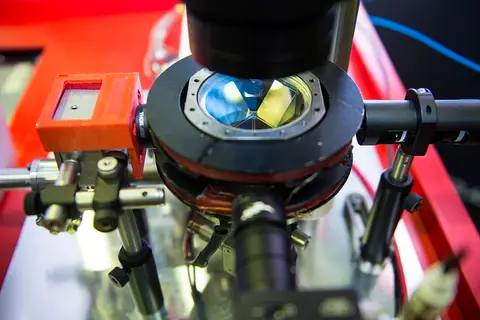
The fastest reactions finish in a tiny fraction of a second. To see them, scientists use laser flashes that last only a few femtoseconds. A femtosecond is a millionth of a billionth of a second. That is quick enough to catch the fleeting stage when bonds are half broken and half formed.
Explore Next
Your audio story keeps playing while you look around.
Words to Know
- activation energy
- The energy needed to get a reaction started.
- catalyst
- A substance that speeds up a reaction and is not used up by it.
- chemical bond
- The link between atoms that holds them together in a molecule or crystal.
- chemical equation
- A short code that shows the reactants and products of a reaction.
- endothermic
- Describes a reaction that takes in energy from its surroundings.
- enzyme
- A protein that acts as a catalyst in living things.
- equilibrium
- The point where forward and backward reactions go at the same speed.
- exothermic
- Describes a reaction that gives out energy, usually as heat or light.
- precipitate
- A solid that forms inside a liquid during a reaction.
- product
- A new substance made by a chemical reaction.
- reactant
- A substance that you start with in a chemical reaction.
- redox reaction
- A reaction in which electrons move from one substance to another.