Astronaut
The trained star sailors who ride rockets to live and work beyond Earth.
An astronaut is a person trained to travel in a spacecraft and work as part of its crew. The word comes from Ancient Greek and means 'star sailor'. Since Yuri Gagarin's flight in 1961, about 600 people have flown in space. Some have orbited Earth for months, a few have walked on the Moon, and one woman has spent more than 600 days up there in total. Astronauts face rocket launches, weightless floating and real danger, and they prepare for years to cope with all of it. Who are they, what do their names mean, how do they train, and what does space do to the human body?
What is an astronaut?
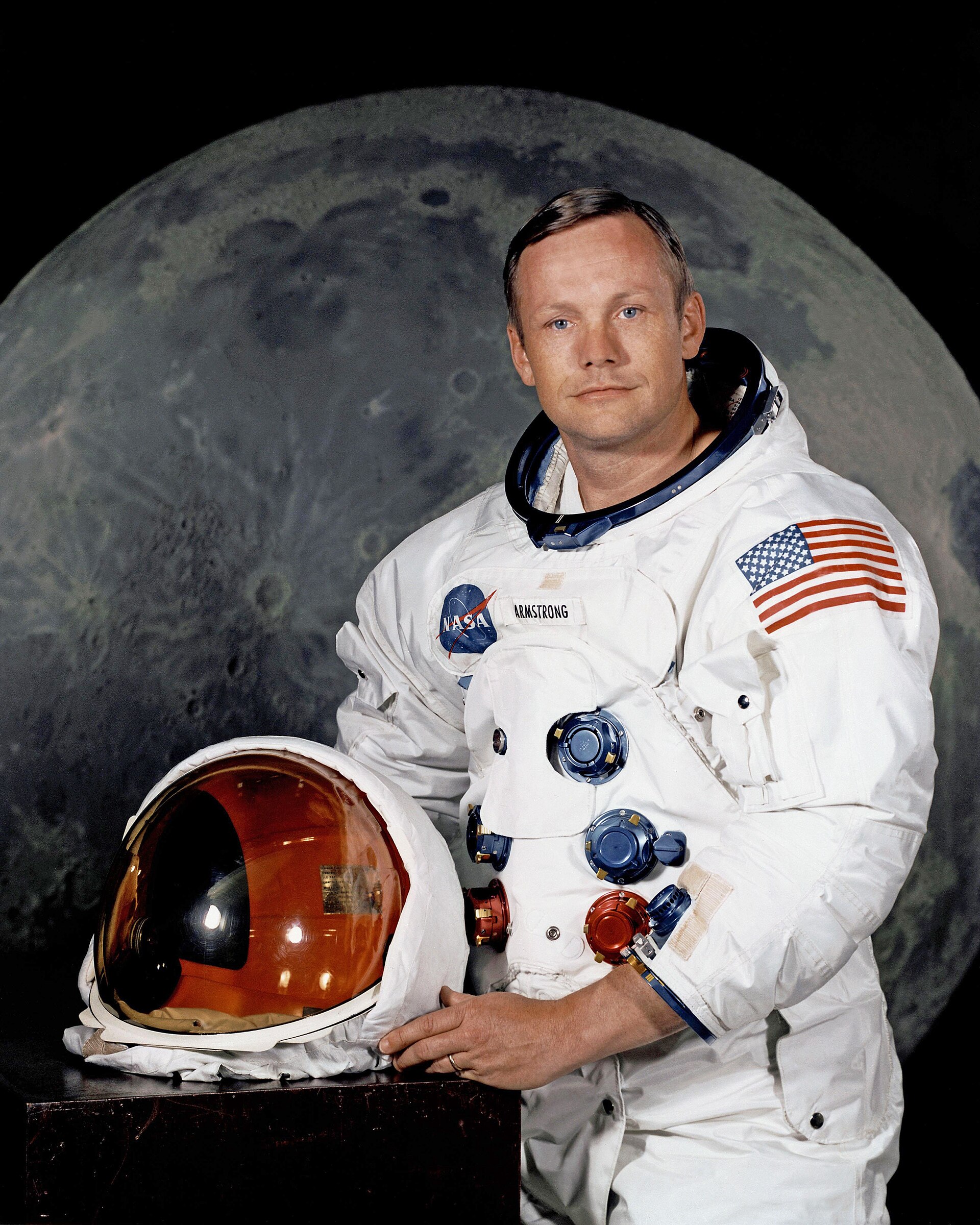
An is someone a spaceflight programme has trained and sent into space. Their job is to command a spacecraft or to serve as one of its crew. The word joins two Ancient Greek words, one meaning 'star' and one meaning 'sailor'. It was probably inspired by 'aeronaut', an older word for the first balloon travellers of the 1780s.
The word was around long before anyone left Earth. An 1880 novel used it to mean a spacecraft. In 1930 a science fiction story used it for a space traveller. In 1959 spaceflight was close, and NASA officials argued about what to call their crews. One preferred ''. Flights would go into the whole cosmos, he said, not only to the stars. Most of the team liked 'astronaut', and that word stuck.
Until 2002 only governments trained astronauts, using either their armed forces or civilian space agencies. That changed in 2004. A privately funded rocket plane called SpaceShipOne flew into space. It created a new group, the commercial astronauts. Today people also use the word for scientists, journalists and tourists who travel to space. Agencies keep stricter meanings for their own crews.
Why are there cosmonauts and taikonauts too?

Different countries have different names for their space travellers. All of them are in the widest sense, but the names show who sent them.
In English, a space traveller from Russia or the old Soviet Union is called a . The word comes from the Russian 'kosmonavt', which means 'sailor of the cosmos'. Soviet engineer Mikhail Tikhonravov is credited with coming up with it. The first cosmonaut was Yuri Gagarin, an air force pilot.
China's space travellers are often called in English. The word is based on the Mandarin 'taikong', which means 'space'. It became common in 2003, when Yang Liwei flew on Shenzhou 5. Its exact origin is unclear, and the word is informal. In China itself, every space traveller officially has the title 'hangtianyuan', meaning 'celestial navigator'.
Other names appear now and then. French space travellers are sometimes called spationauts. India's planned crews have prompted talk of 'vyomanaut', from the Sanskrit word for sky. Dutch, German and Swedish all use words that translate as 'space traveller'.
So far only three countries have launched people into space on their own spacecraft. They are Russia, the United States and China. Everyone else has flown with one of them.
Where does space begin?
Earth's air does not stop at a clear edge. It gets thinner as you climb. So deciding who has reached space means drawing a line somewhere. Different groups draw it in different places.
The international body that keeps spaceflight records uses the . It lies 100 kilometres above sea level. At that height the air is too thin for wings to hold a craft up. Above it, a vehicle must travel at orbital speed to stay up. It works more like a spacecraft than an aeroplane. The United States uses a lower line, about 80 kilometres, for its own awards. NASA, the military and commercial crews who fly above it receive wings.
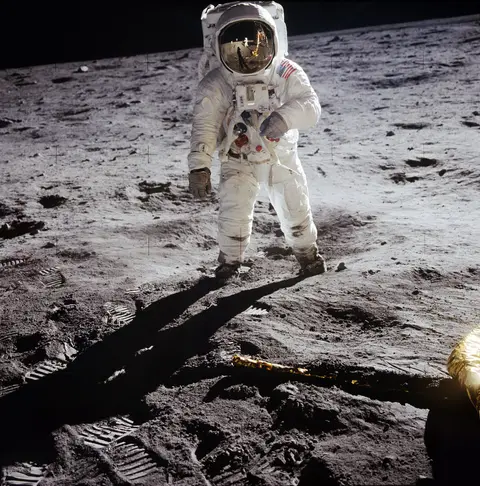
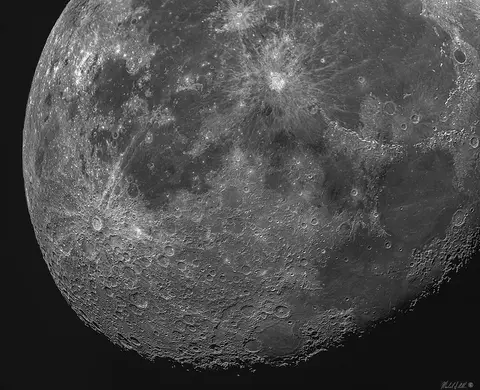
By the international definition, 552 people from 36 countries had reached 100 kilometres or more by 2021. Of them, 549 reached low Earth or went beyond. Only 28 people have ever travelled farther than low Earth orbit, and all of them went to the Moon. Twenty-four flew on Apollo missions. Some orbited it, some landed on it and one crew looped around it. In April 2026 the four Artemis II astronauts flew around it too. Jim Lovell, John Young and Eugene Cernan went there twice.
One early record belongs to X-15 rocket plane pilot Joseph Walker. He crossed the 100 kilometre line twice in 1963. That made him the first person to reach space twice.
Who were the first people in space?
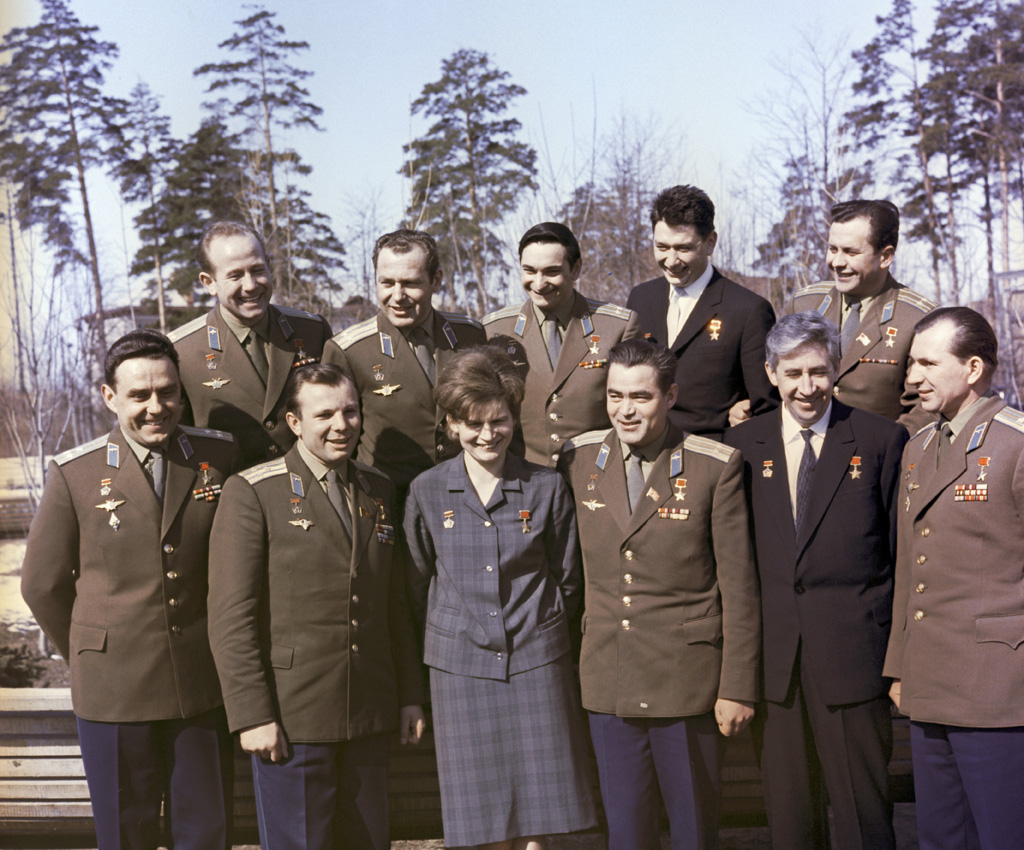
The first human in space was Soviet pilot Yuri Gagarin. On 12 April 1961 he blasted off in Vostok 1 and circled Earth once. The trip took 108 minutes. He was one of six men given the title of pilot- in January 1961.
America followed within weeks. On 5 May 1961 Alan Shepard flew Freedom 7 on a 15 minute flight. It went up and came down again without orbiting. That is called a . John Glenn was the first American to Earth, on 20 February 1962.
The Soviet Union also sent the first woman. Valentina Tereshkova flew Vostok 6 alone in June 1963 and orbited for almost three days. She was also the first civilian in space. The first American woman, Sally Ride, flew on the Space Shuttle in 1983. Mae Jemison became the first African American woman in space in 1992.
On 18 March 1965 Alexei Leonov stepped outside his Voskhod 2 spacecraft on the first . Ed White made the first American spacewalk about two and a half months later.
Space soon became more international. Czechoslovakia's Vladimir Remek flew in 1978. He was the first space traveller from outside the Soviet Union and the United States. Helen Sharman became the first Briton in space in 1991.
How do you become an astronaut?
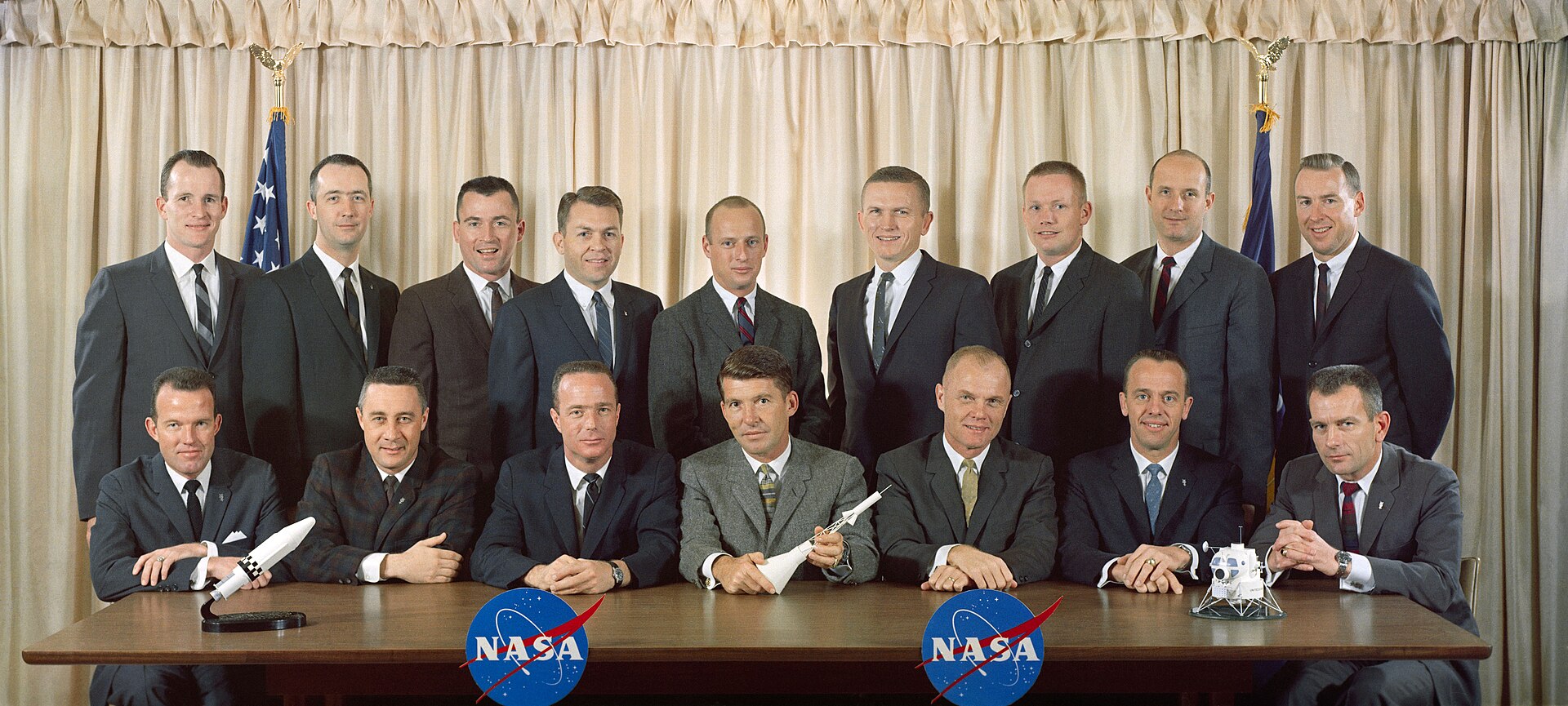
NASA chose its first in 1959. In the early years it picked military pilots. They were used to flying fast jets and staying calm in emergencies. Many were test pilots. The first seven became known as the Mercury Seven. Two of them, John Glenn and Scott Carpenter, had no university degree when picked.
Today the rules are different. A NASA candidate must be a US citizen. They also need a master's degree in a subject such as engineering, biology, computer science or mathematics. Medical doctors and test pilot school graduates can meet the degree rule in other ways. Candidates also need two years of related work, or 1,000 hours as pilot in command of a jet. They must pass a tough medical check. They also need strong teamwork, leadership and communication skills.
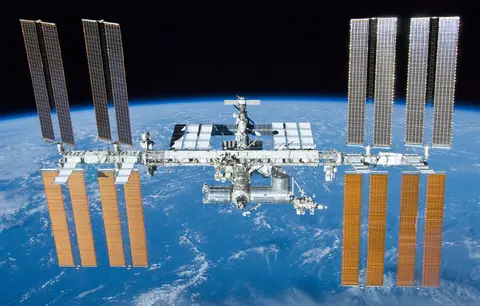
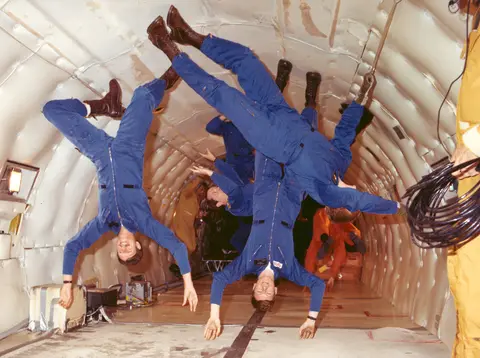
Once chosen, candidates train for about 20 months. They practise underwater in a huge pool called the Neutral Buoyancy Laboratory. Water balances their weight, a bit like floating in space. They also fly high-performance T-38 jets and learn every system on the International Space Station. To feel weightlessness for short spells, they ride in an aircraft that flies steep arcs. Its nickname is the Vomit Comet.
European, Canadian, Japanese and other agencies run their own selection and training.
What is daily life like in orbit?
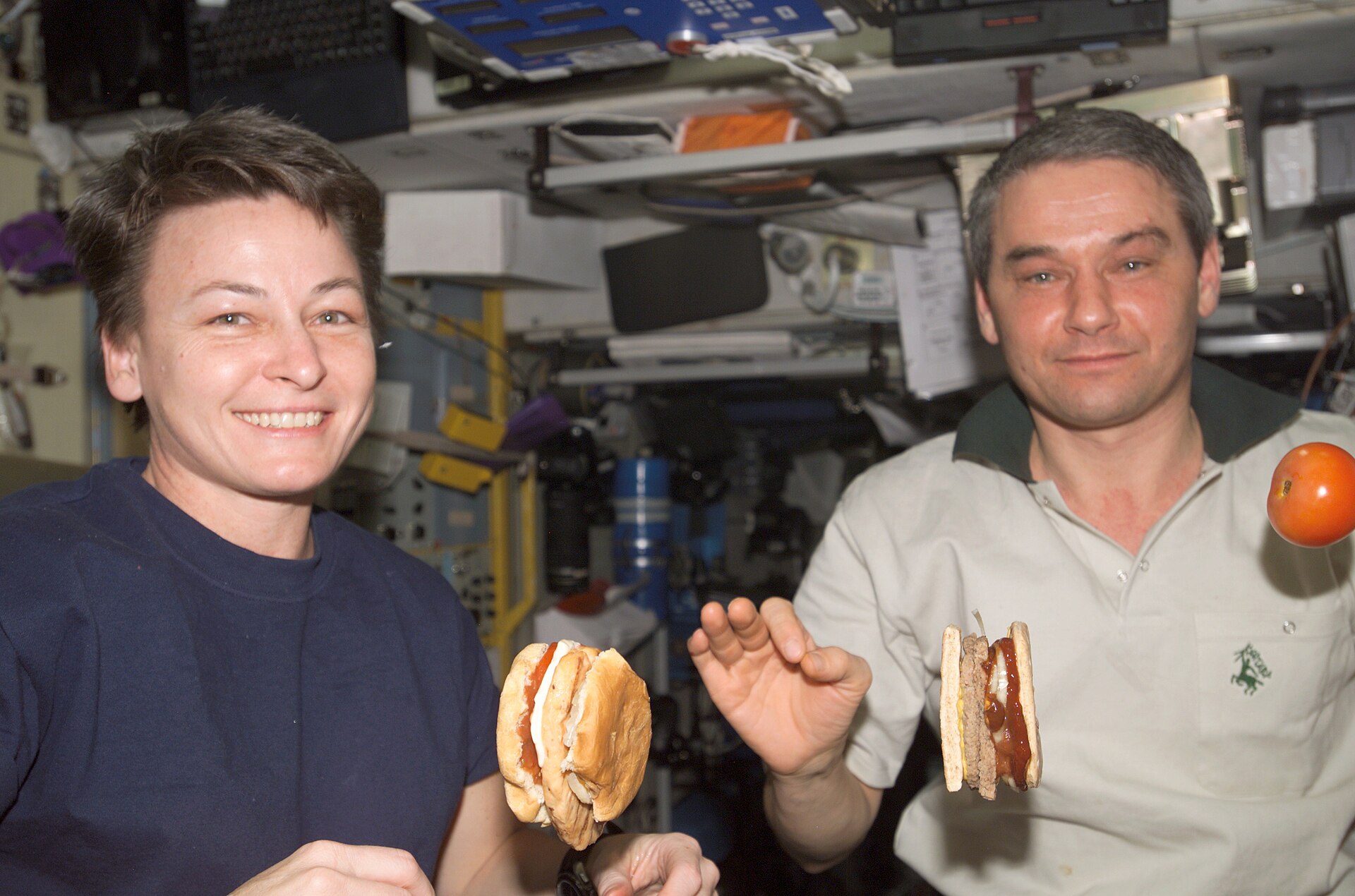
On the International Space Station everything floats. The crew sleep in fixed bunks or tied-down bags. They must fasten tools and food so nothing drifts away. A meal can include a floating tomato or hamburger, as a photograph of Peggy Whitson and Valery Korzun shows.
Food is carefully planned. On the Space Shuttle, worked with nutritionists and chose menus about five months before launch. Experts checked each food for nutrition and tested how it behaves in reduced gravity. A formula for how much energy the body uses at rest sets each person's calories.
Water is precious because every litre has to be carried up on a rocket. People on Earth, especially in rich countries, use a great deal each day. Astronauts on the station limit themselves to a small fraction of that.
Some parts of life in space are not pleasant. Gherman Titov was the first person to suffer space sickness. In 1990 journalist Toyohiro Akiyama had a severe case that slowed his work on the Mir station. Titov was also the first person to sleep in space.
When the mission ends, the crew return in a capsule. Crews of the Russian Soyuz spacecraft land on the flat plains of Kazakhstan. In 2016 NASA's Tim Kopra phoned home from beside his capsule minutes after touchdown.
What does space do to the human body?
Humans evolved for life on Earth, with its gravity, its thick air and its shield against radiation. Away from those protections, the body changes. Doctors have recorded many health risks for . These include loss of bone and muscle, sleep problems, radiation damage, a weaker immune system and poorer eyesight.
The eye problem is common enough to have a name. NASA flight surgeons saw it in nearly two thirds of astronauts after long stays on the station. Brain scans have shown that long trips change the position and structure of the brain. A 2020 study of eight found useful changes too, such as better control of the hands.
Microbes behave differently too. In 2006 a Space Shuttle experiment found that a food poisoning bacterium became stronger when grown in space. Scientists in 2018 listed the bacteria living on the station, so they could keep watching them.
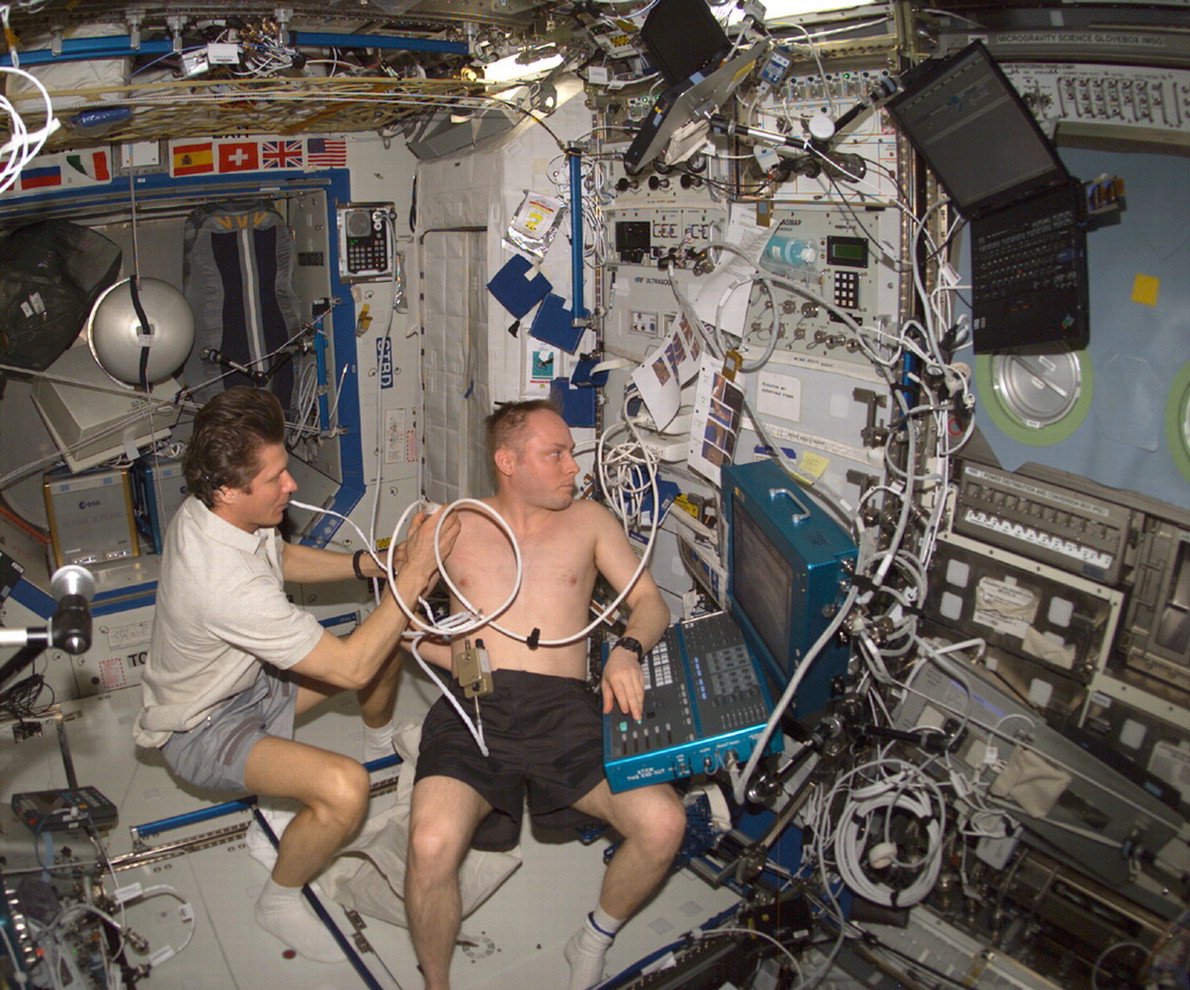
How do researchers deal with all this? They run huge medical studies in . In one study, astronauts such as Gennady Padalka scan each other with ultrasound. Experts on the ground give advice by radio. The same technique now helps with sports injuries. It could also help in remote places on Earth where no doctor is nearby.
These studies matter most for a trip to Mars. It would last far longer than any station stay.
Can anyone pay to fly into space?
For decades only government employees flew in space. Then wealthy private travellers began to buy seats. This created a puzzle about who counts as an .
The first self-funded space tourist was American businessman Dennis Tito. He flew on a Russian Soyuz to the International Space Station in April 2001. South African Mark Shuttleworth followed in 2002. Others paid the company Space Adventures for a ticket, including Anousheh Ansari, Charles Simonyi, Richard Garriott and Guy Laliberté.
There were other firsts along the way. In 1990 Toyohiro Akiyama became the first journalist in space. A Japanese television company paid for his trip to the Mir station. Mike Melvill piloted SpaceShipOne in 2004 on the first flight with entirely private funding. In 2021 Jared Isaacman commanded Inspiration4, the first mission to paid for by a private person.
So are tourists astronauts? NASA and Russia's space agency use the phrase '' for paying passengers on their missions. In July 2021 the US aviation regulator changed its rules, after the suborbital trips of Jeff Bezos and Richard Branson. A commercial astronaut must now do something in flight that helps public safety or spaceflight safety. Under that rule neither man qualified. In December 2021, though, the agency closed its wings programme and listed everyone who had flown above 80 kilometres, both men included.
How dangerous is the job?
Spaceflight is among the riskiest jobs there is. Rockets carry huge amounts of fuel. Spacecraft must survive both launch and a fiery return. A single fault can be fatal.
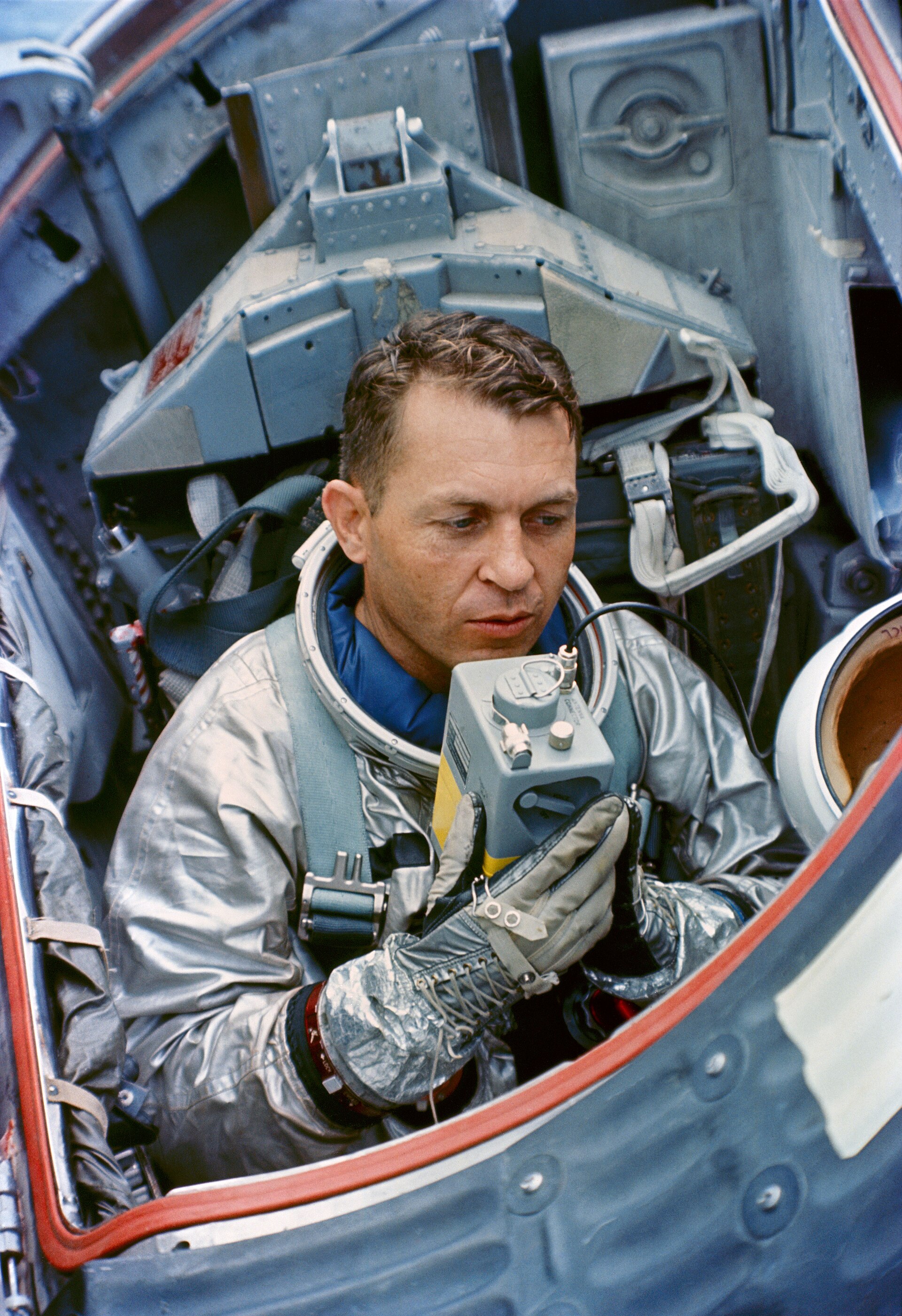
By 2021, 18 had died during four spaceflights. Thirteen were American, four were Russian or Soviet and one was Israeli. A further 11 people died while training for spaceflight. Six of those 11 died in crashes of training jets. One drowned in water recovery training. Four died in fires in pure oxygen. Elliot See, a NASA astronaut preparing to command Gemini 9, was killed in one of the jet crashes.
The training deaths show why the job is so serious even before launch. Engineers learned from each disaster and changed spacecraft, checks and procedures.
Astronauts honour those who died. In 1971 David Scott left a small statue called Fallen Astronaut on the Moon during Apollo 15. A plaque beside it listed eight astronauts and six known to have died by then. The Space Mirror Memorial in Florida lists Americans who died in flight or training. It stands at the Kennedy Space Center Visitor Complex.
Astronauts also receive badges and pins. NASA gives a silver pin after candidate training and a gold pin after the first flight.
Explore Next
Your audio story keeps playing while you look around.
Words to Know
- astronaut
- A person trained to fly in or work aboard a spacecraft.
- cosmonaut
- The English word for a Russian or Soviet space traveller.
- Kármán line
- The height of 100 kilometres that is used as the international edge of space.
- microgravity
- The floating feeling in orbit, where gravity seems almost absent.
- mission specialist
- A crew member who handles science and experiments rather than flying the vehicle.
- orbit
- The curved path a spacecraft follows around Earth.
- spaceflight participant
- A paying passenger who is not a professional astronaut.
- spacewalk
- Work done outside a spacecraft while wearing a spacesuit, also called extravehicular activity.
- sub-orbital flight
- A flight that reaches space but comes back down without circling Earth.
- taikonaut
- An informal English word for a Chinese space traveller.