Black Hole
A place where gravity is so strong that not even light gets out.
A black hole is a region of space where gravity is so strong that nothing can escape from it, not even light. It is not a hole at all. It is a huge amount of matter squeezed into a tiny space. Black holes form when giant stars die, and some grow to be millions or billions of times heavier than the Sun. We cannot see them directly, because they give out no light of their own. Yet astronomers have weighed them, tracked the stars that circle them and even taken pictures of the glowing gas around them. An idea from the 1700s has become a proven part of our universe.
What is a black hole, really?
Everything with mass pulls on everything else. This pull is called gravity. To escape the pull of a planet, a rocket needs a certain speed, known as the . From Earth it is about 11 kilometres every second. A smaller, denser world needs a higher speed.
Now squash a huge amount of matter into a very small space. The escape velocity climbs higher and higher. At last it passes the speed of light, which is the fastest speed there is. Nothing can go faster than light, so nothing can leave. That object is a black hole.
The edge of the trap is called the . It is not a solid surface. It is a boundary in space. Anything can cross it on the way in, but nothing can cross it on the way out. Because light cannot come out either, the black hole looks completely dark.
A black hole is not a cosmic vacuum cleaner. Far away from it, its gravity is the same as that of any other object with the same mass. If the Sun were swapped for a black hole of equal mass, Earth would keep orbiting as before, only in the dark. Gravity becomes extreme only very close to the horizon.
What would you find inside?
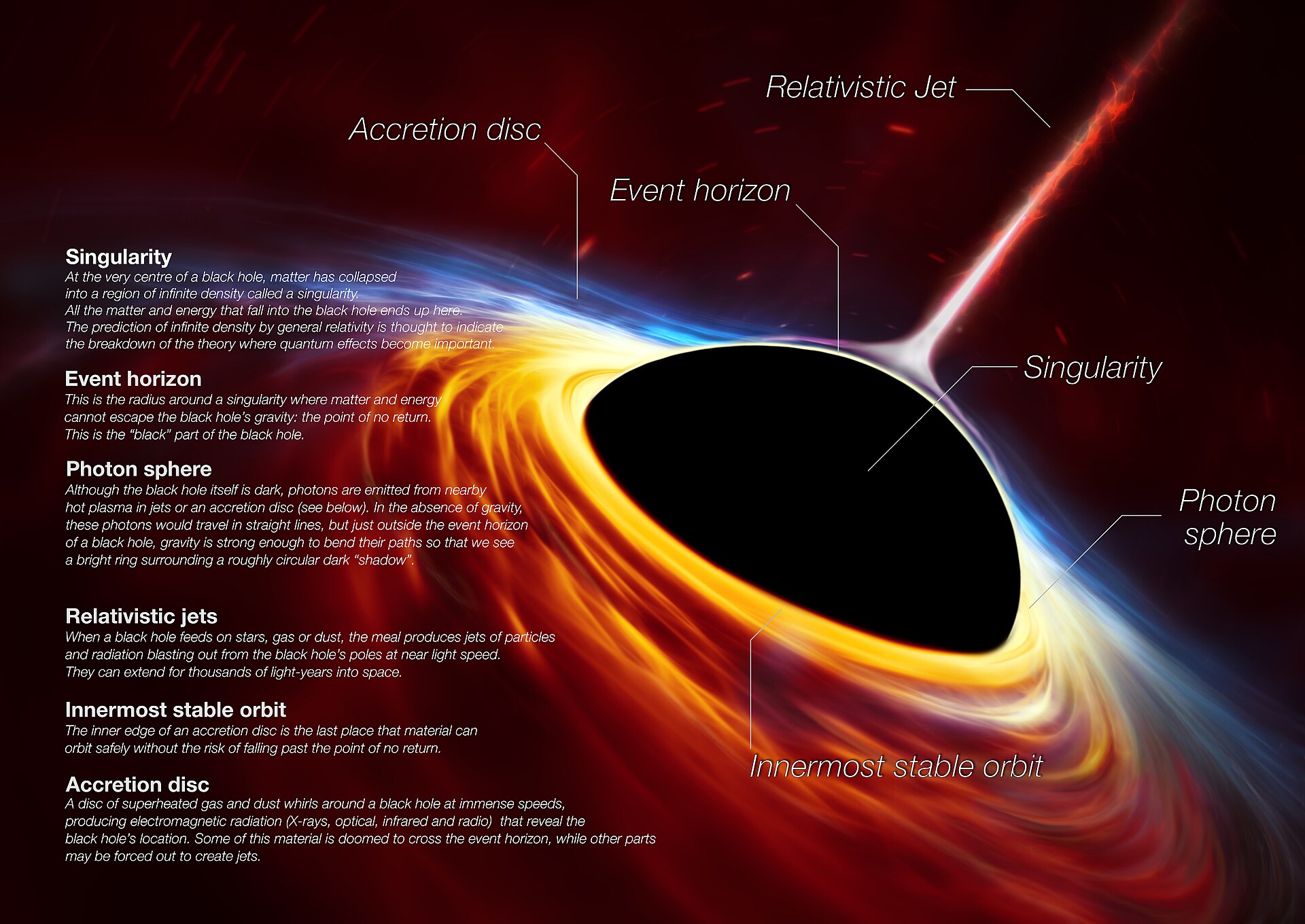
A black hole has a few key parts. At the outside is the . Its size depends on the mass of the black hole. This size is called the Schwarzschild radius, after the scientist who first worked it out. The more massive the black hole, the bigger the horizon.
At the very centre is the . This is where, according to Einstein's theory, all the mass is crushed into a point of zero size and infinite density. Scientists do not think that is the full truth. Our best theory of gravity stops working there, because quantum effects, which rule the tiniest things, should take over. No one has yet built a theory that joins the two together.
What would happen to a falling astronaut? Gravity would pull harder on their feet than on their head. The stretch would grow until they were pulled apart. Scientists call this . For a small black hole it would begin before the horizon. For a very large one it would come later.
Outside the horizon, a spinning black hole may be wrapped in a glowing disc of gas called an . Some also fire out narrow jets of matter. A black hole has only three basic properties that can be measured from far away: its mass, its spin and its electric charge.
How does a black hole bend light and slow time?
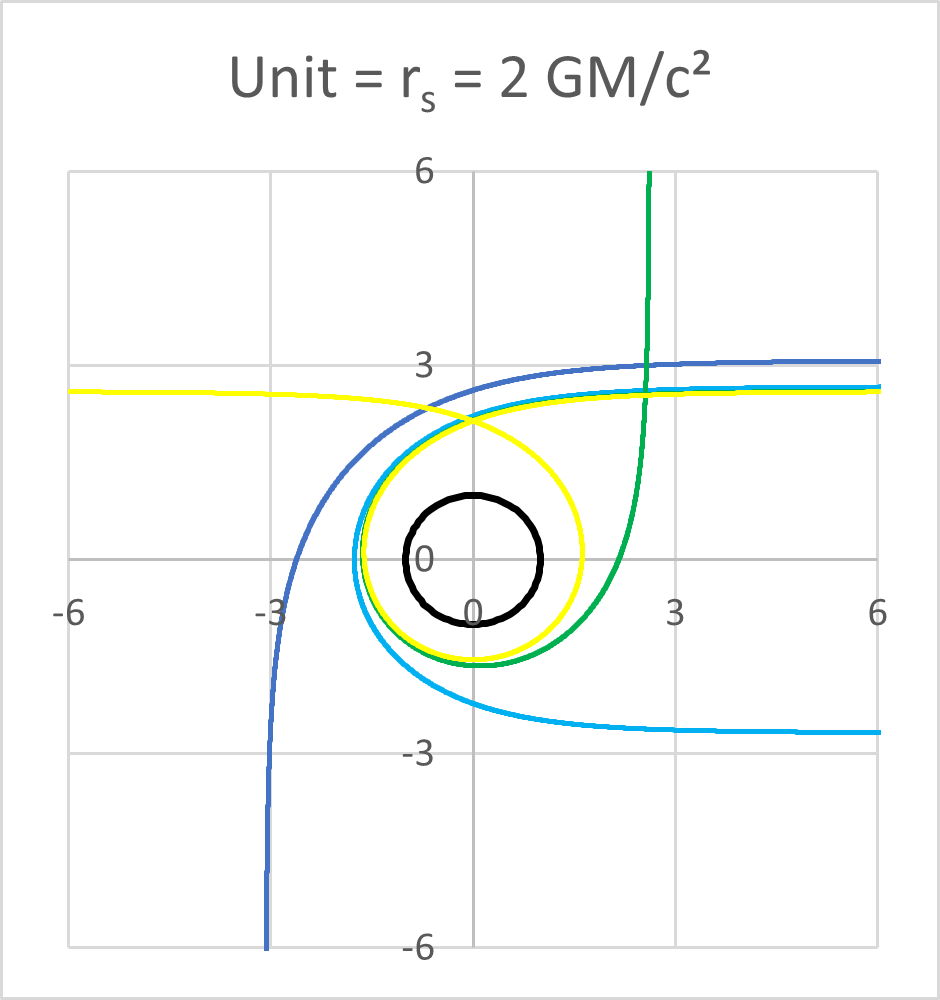
Einstein's theory of says that mass bends space and time together, which scientists call spacetime. Light follows the bends. Near a black hole the bending is so strong that light is pulled onto curved paths. This is called gravitational lensing.
Closer in, there is a ring called the photon sphere. Light that arrives here from the right angle can circle the black hole for a while. The orbit is not stable, though. A tiny nudge sends the light either outwards to freedom or inwards across the horizon. For a black hole that does not spin, the photon sphere is 1.5 times the radius of the horizon.
Time is bent too. A clock close to a black hole ticks more slowly than a clock far away. This is called gravitational time dilation. Seen from far away, an object falling in seems to slow down near the horizon. Its light turns redder and dimmer, and then it fades from view. Usually this takes less than a second.
The falling object itself would notice nothing odd. Its own clock would seem to tick normally as it crossed the horizon. The two views are both correct. They depend on where you are standing.
How is a black hole born?
Most black holes begin with a star. A star shines because it is a giant furnace, and its heat pushes outwards. That push balances the inward pull of its own gravity. When the star runs low on fuel, the push weakens and gravity wins.
What happens next depends on the mass left in the core. A light star such as our Sun ends as a small, dense white dwarf. A heavier core collapses further and becomes a neutron star. There the pressure from the neutrons packed together can still hold off gravity. But if the core is heavier than a limit of a few times the mass of the Sun, nothing known can stop the collapse. A black hole forms. Often the outer layers of the star are blown away first in a huge explosion called a supernova.
Black holes can also grow. They pull in gas and dust, swallow stars and merge with other black holes. The giants at the centres of galaxies, called , may have grown this way over billions of years. Others may have formed directly when huge clouds of gas collapsed in the young universe.
Some scientists think tiny primordial black holes may have formed soon after the Big Bang. No one has found one yet.
Who first imagined a star that traps light?
In 1784 an English clergyman and scientist named John Michell worked out that a star 500 times wider than the Sun, with the same density, would hold on to its own light. A few years later the French scientist Pierre-Simon Laplace made the same suggestion. They called such objects dark stars. They also noticed that such a star might still be found by its pull on other stars. Interest faded when scientists decided that light behaves like a wave, and it was unclear how gravity would pull on a wave.
The modern story began with Albert Einstein, who published his theory of in 1915. Within months, Karl Schwarzschild solved Einstein's equations for a single round mass. His answer had a strange boundary, which we now call the Schwarzschild radius. At first nobody knew what it meant.
In 1939 Robert Oppenheimer and his student Hartland Snyder showed that a collapsing star could really form a black hole. That same year Einstein argued the opposite, and he stayed doubtful. In 1958 David Finkelstein showed that the boundary was a one-way door, the .
The name arrived in the 1960s. The physicist John Wheeler helped make it famous, though others had used it before him.
When did black holes become real?
For decades many scientists thought black holes were a mathematical curiosity. They suspected that the odd results came from making the sums too tidy. The mid-1960s to the mid-1970s changed this. It is often called the golden age of black hole research.
In 1963 Roy Kerr found the exact solution for a spinning black hole. Later Roger Penrose and Stephen Hawking proved that singularities are a natural result of and not a quirk of perfect symmetry. Penrose shared the 2020 Nobel Prize in Physics for this work. Hawking had died in 2018.
Observers made progress too. In 1967 Jocelyn Bell Burnell and Antony Hewish discovered pulsars, which were soon shown to be fast-spinning neutron stars. Until then even neutron stars had been only an idea. If they were real, then the next step, a black hole, seemed far more believable.
Then came Cygnus X-1. This strong source of X-rays had been found in 1964. Observations in the early 1970s showed it was a black hole drawing gas from a companion star. It was the first object that astronomers widely accepted as a black hole. Since then, astronomers have found a couple of dozen more in our own galaxy.
How can we find something we cannot see?

A black hole gives out no light, so astronomers look for its effects on everything nearby. Detectives do the same when they follow footprints.
Gas that falls towards a black hole does not drop straight in. It swirls into an . Friction heats the gas to millions of degrees, and it shines brightly, especially in X-rays. Telescopes in space can detect those rays, and that is how Cygnus X-1 was found. Around the biggest black holes the glow can outshine a whole galaxy. These objects are called , and they are among the brightest things in the universe.
Stars can give clues too. A star that strays too close to a can be stretched into long streams of gas. They shine fiercely before they vanish. If stars are seen orbiting something unseen, their paths reveal how heavy it is and where it sits. A mass that great in so small a space cannot be a neutron star.
Finally, there are black holes that sit alone and give out almost nothing. Scientists think there may be hundreds of millions of these in the Milky Way. We could find them by the way their gravity bends the light of stars behind them.
Have we ever seen a black hole?
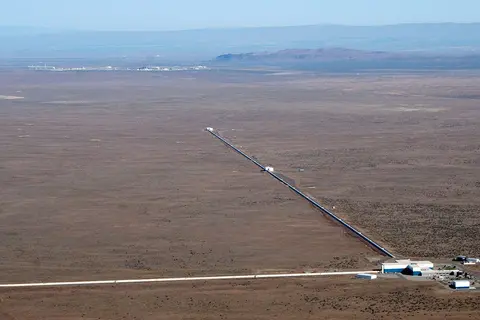
Yes, in two ways. The first is by sound, in a manner of speaking. When two black holes spiral together and merge, they send out ripples in spacetime called . On 14 September 2015 the LIGO detectors in the United States caught the first ones ever seen. The signal matched two black holes of about 36 and 29 times the mass of the Sun joining into one. The announcement came in February 2016. Many more mergers have been found since.
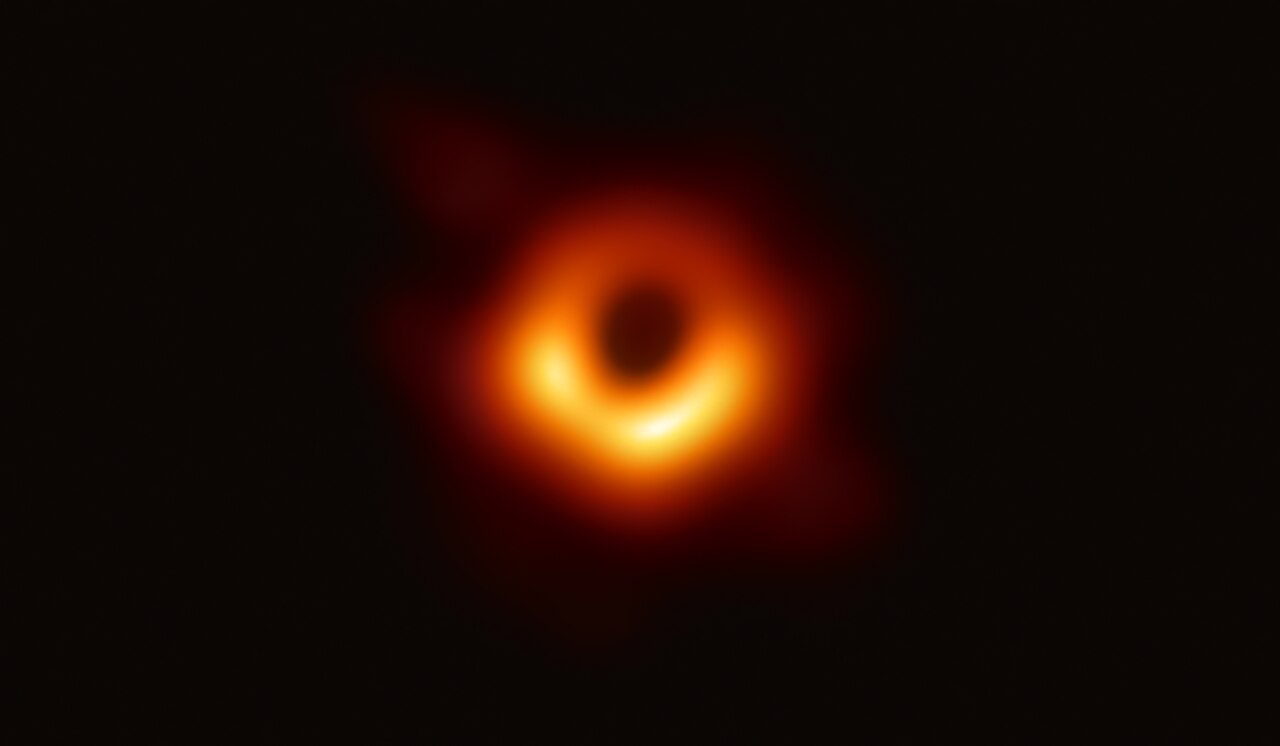
The second way is by picture. The Telescope is not one telescope. It links radio dishes on several continents, so that together they act like a dish as big as the Earth. In April 2017 eight observatories watched the galaxy Messier 87 for 10 days. Two years of computing turned the data into a picture released on 10 April 2019.
The image shows a bright, orange ring around a dark patch. The dark patch is the black hole's shadow. The ring is hot gas, with light bent around the black hole. In May 2022 the same team released a picture of the black hole at the heart of our own galaxy.
What lurks at the centre of our galaxy?
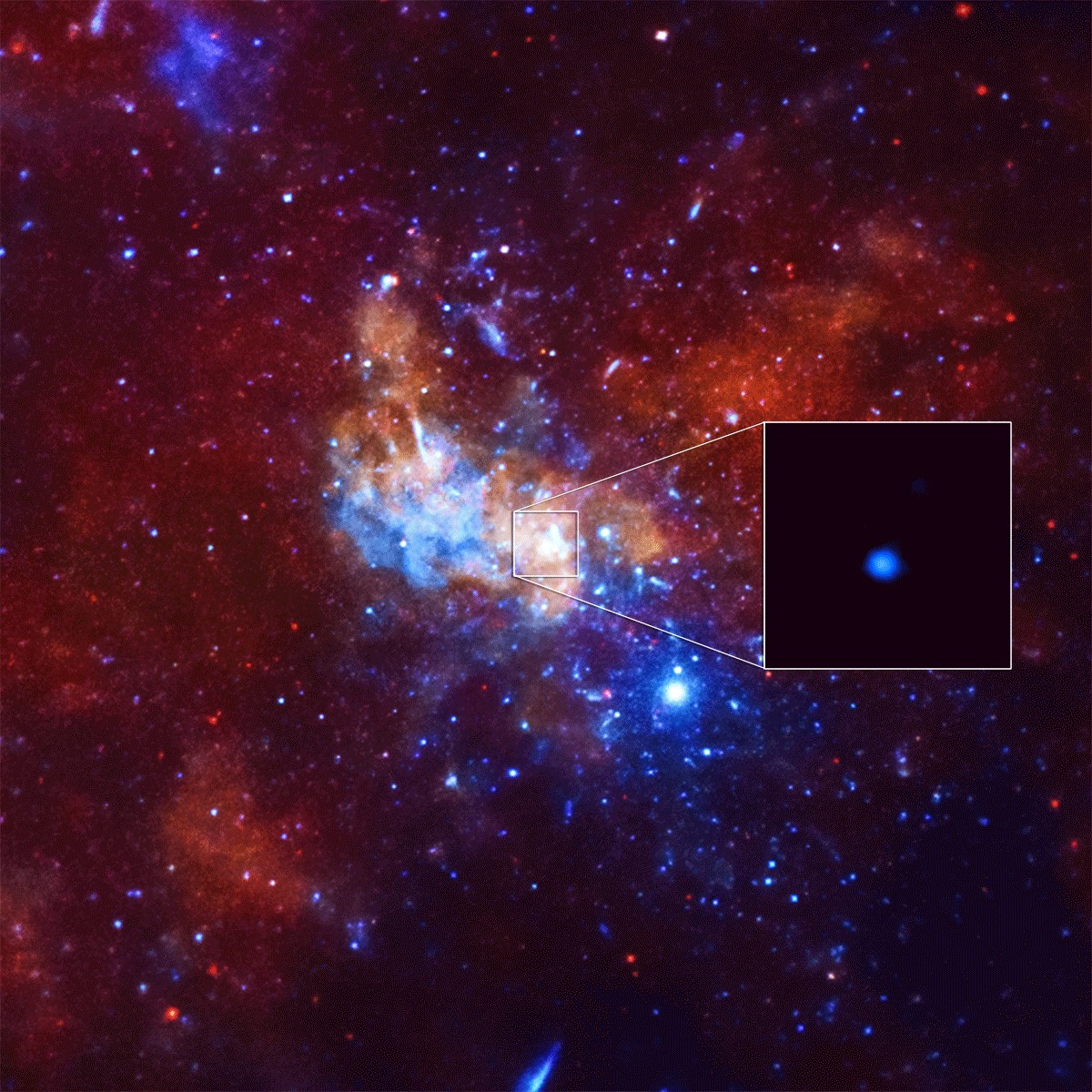
Scientists think that most large galaxies have a at their centre. Ours is called Sagittarius A*, said as "Sagittarius A-star". Its mass is about 4 million times that of the Sun.
How do we know? Since 1995 astronomers have tracked the paths of stars near the galactic centre. They race around an invisible object, and their orbits show how heavy it is. The 2022 image from the Telescope showed the same ring and shadow as the black hole in Messier 87. The Milky Way's black hole is far smaller, and it was harder to image because the gas around it changes quickly.
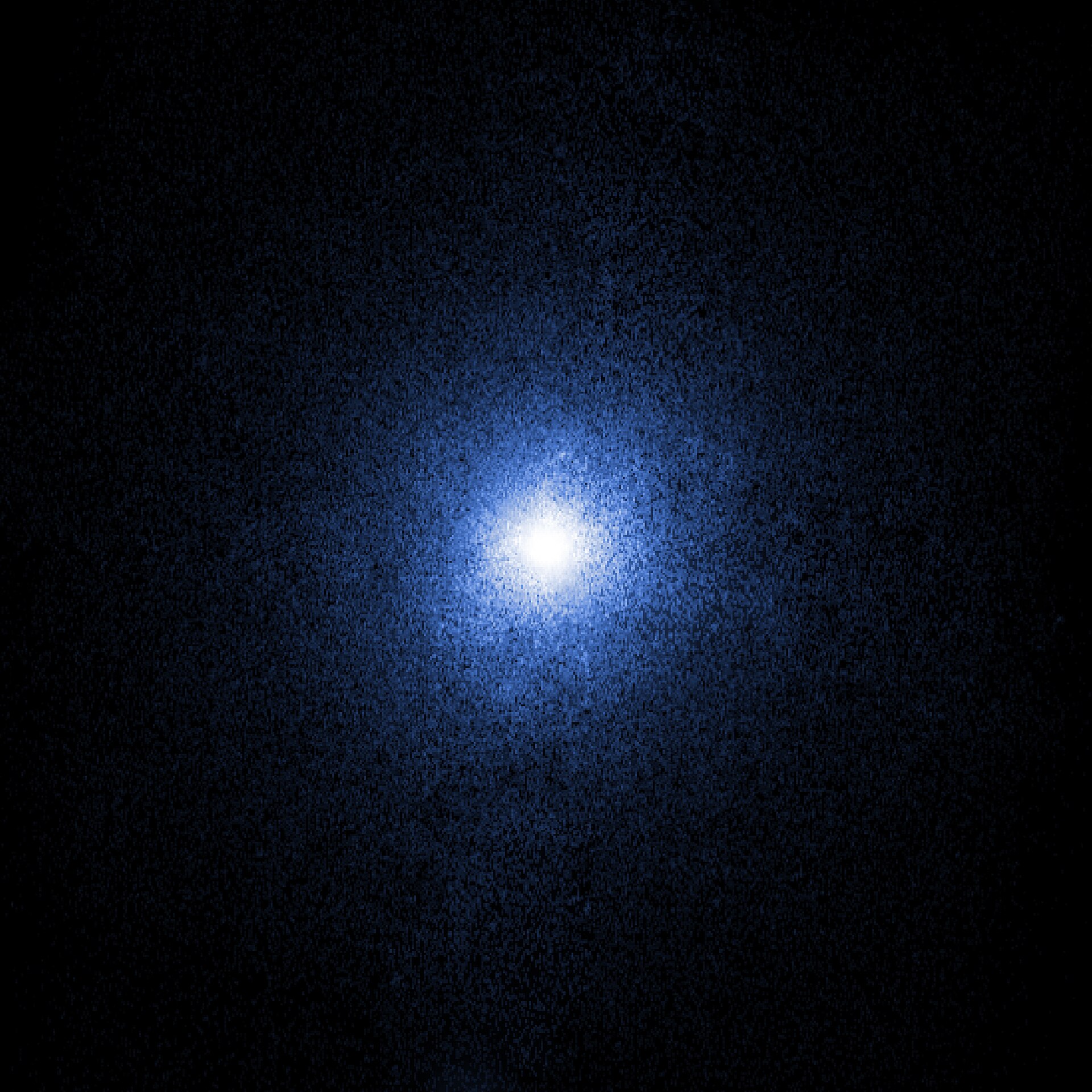
Sagittarius A* is quiet these days. Yet it sometimes flares. NASA's Chandra X-ray Observatory has recorded the biggest X-ray flare yet seen from it. We do not fully know why it happens.
How did supermassive black holes grow so big? One idea is that they began as black holes from the first giant stars and then grew by swallowing gas and merging. Another is that they began as vast clouds of gas that collapsed directly. This is still an open question. The Webb telescope and others are searching the young universe for clues.
Can a black hole ever die?
In 1974 Stephen Hawking made a surprising prediction. By combining quantum physics with gravity, he showed that black holes should give off a faint glow of particles. This is now called . It means that a black hole slowly loses mass and, in the end, evaporates.
The effect is tiny for big black holes. A black hole with the mass of a star would have a temperature of only about 62 billionths of a degree above absolute zero. That is colder than the faint glow left over from the Big Bang, so such a black hole takes in more energy than it gives out. It will keep growing for a very long time. Only a black hole lighter than the Moon would be warm enough to shrink. A very small one would vanish in a fraction of a second.
Nobody has seen Hawking radiation. It is too weak to detect from Earth.
Black holes also raise puzzles that remain unsolved. If something falls in, what happens to the information about what it was? Hawking radiation seems to carry none of it out. This is called the information paradox. Solving it may need a new theory of gravity.
Explore Next
Your audio story keeps playing while you look around.
Words to Know
- accretion disc
- A flat, swirling ring of hot gas that spirals towards a black hole.
- escape velocity
- The speed an object needs to break free from the pull of a planet, star or black hole.
- event horizon
- The boundary around a black hole beyond which nothing can come back out.
- general relativity
- Einstein's theory that mass bends space and time, and that this bending is gravity.
- gravitational waves
- Ripples in spacetime, made when huge masses such as black holes merge.
- Hawking radiation
- A faint glow that a black hole is predicted to give off, which makes it slowly lose mass.
- quasar
- An extremely bright centre of a distant galaxy, powered by a feeding supermassive black hole.
- singularity
- The centre of a black hole, where the theory says matter is crushed to infinite density.
- spaghettification
- The stretching of an object into a long thin strand by the uneven pull of strong gravity.
- supermassive black hole
- A black hole with millions or billions of times the mass of the Sun, found at the centre of most galaxies.