Universe
Everything that exists: all of space, all of time, and the mysteries inside them.
The universe is everything: all of space, all of time, and every star, planet, rock and ray of light inside them. The part we can see is about 93 billion light-years across, and nobody knows how much lies beyond. It began in an event called the Big Bang about 13.8 billion years ago, and it has been stretching ever since. Today it holds hundreds of billions of galaxies. Yet the atoms that make up stars, planets and people are only about 5 per cent of what is out there. The rest is dark matter and dark energy, two mysteries that scientists are still working hard to solve.
What counts as the universe?
The universe is all of space and time, together with everything inside them. That means every planet, moon, star and , plus the empty gaps between them. It also includes light, heat and every other kind of energy. The laws of physics, which decide how matter and energy behave, belong to it too.
Scientists call space and time joined together . Albert Einstein's theories showed that the two cannot be pulled apart. Heavy objects bend spacetime around them, and in his theory that bending is what we feel as gravity. The physicist John Archibald Wheeler summed it up in one line. Spacetime tells matter how to move, and matter tells spacetime how to curve.
The word universe comes from Latin, where universum meant "combined into one". The Roman writer Cicero used it. Another word for the same idea is the cosmos. That is why the science of the universe as a whole is called . Ancient Greek thinkers also used a phrase meaning "the all".
People often ask where the edge of the universe is, or where its centre sits. Careful measurements say it has neither. On the very largest scales, galaxies are spread out in much the same way in every direction. A universe like that looks alike from every place inside it, so no spot can claim to be the middle.
How big is the universe?
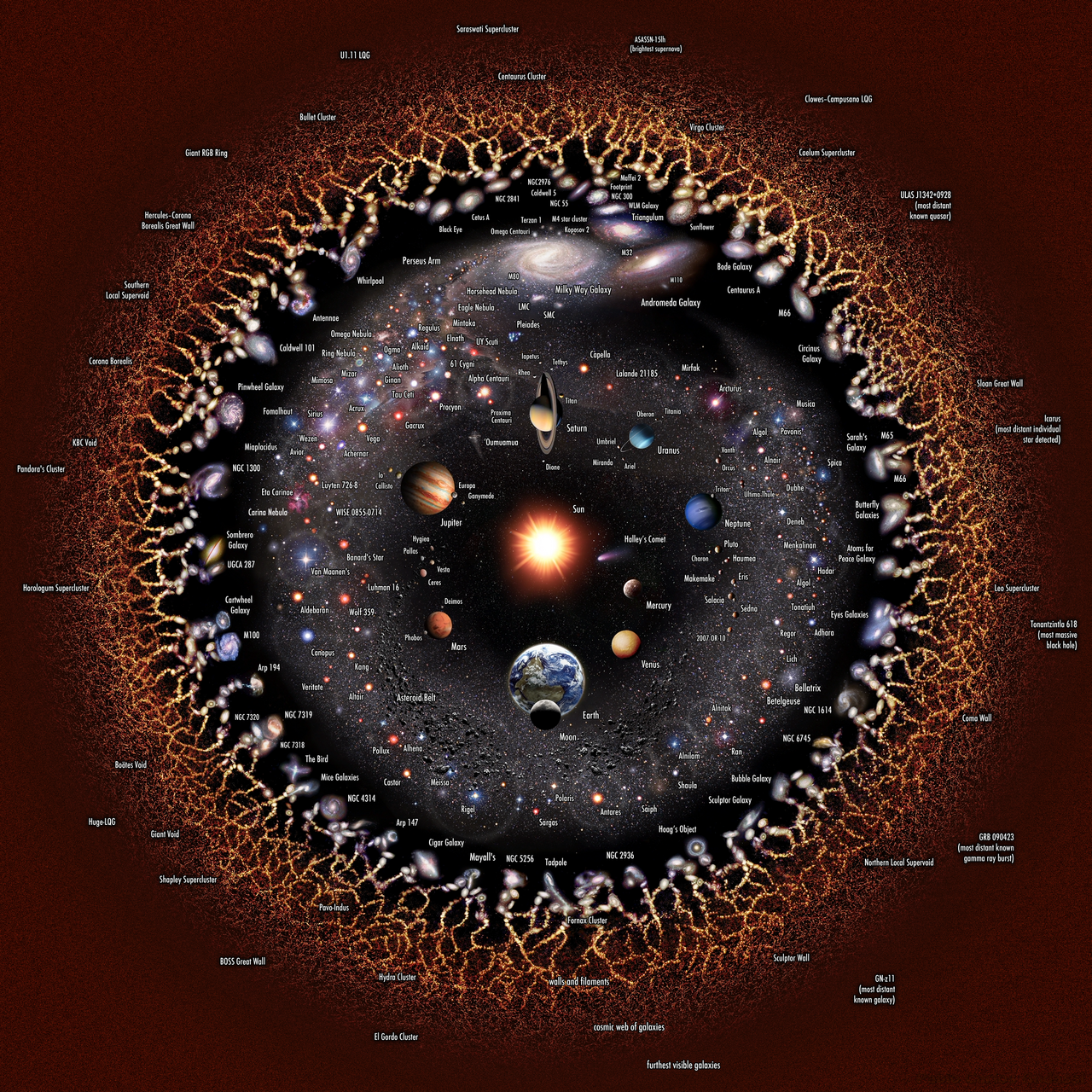
Nobody knows how big the whole universe is. What we can measure is the . This is the part whose light has had time to reach us. Light travels at about 300,000 kilometres every second, but the universe has only existed for about 13.8 billion years. Light from farther away has not arrived yet.
The edge of the observable universe is about 46 billion away in every direction, so it is about 93 billion light-years across. A light-year is the distance light travels in one year, which is about 9.5 trillion kilometres. You might expect the edge to be only 13.8 billion light-years away. It is farther because space itself stretched while the light was on its way, carrying the distant galaxies even further off.
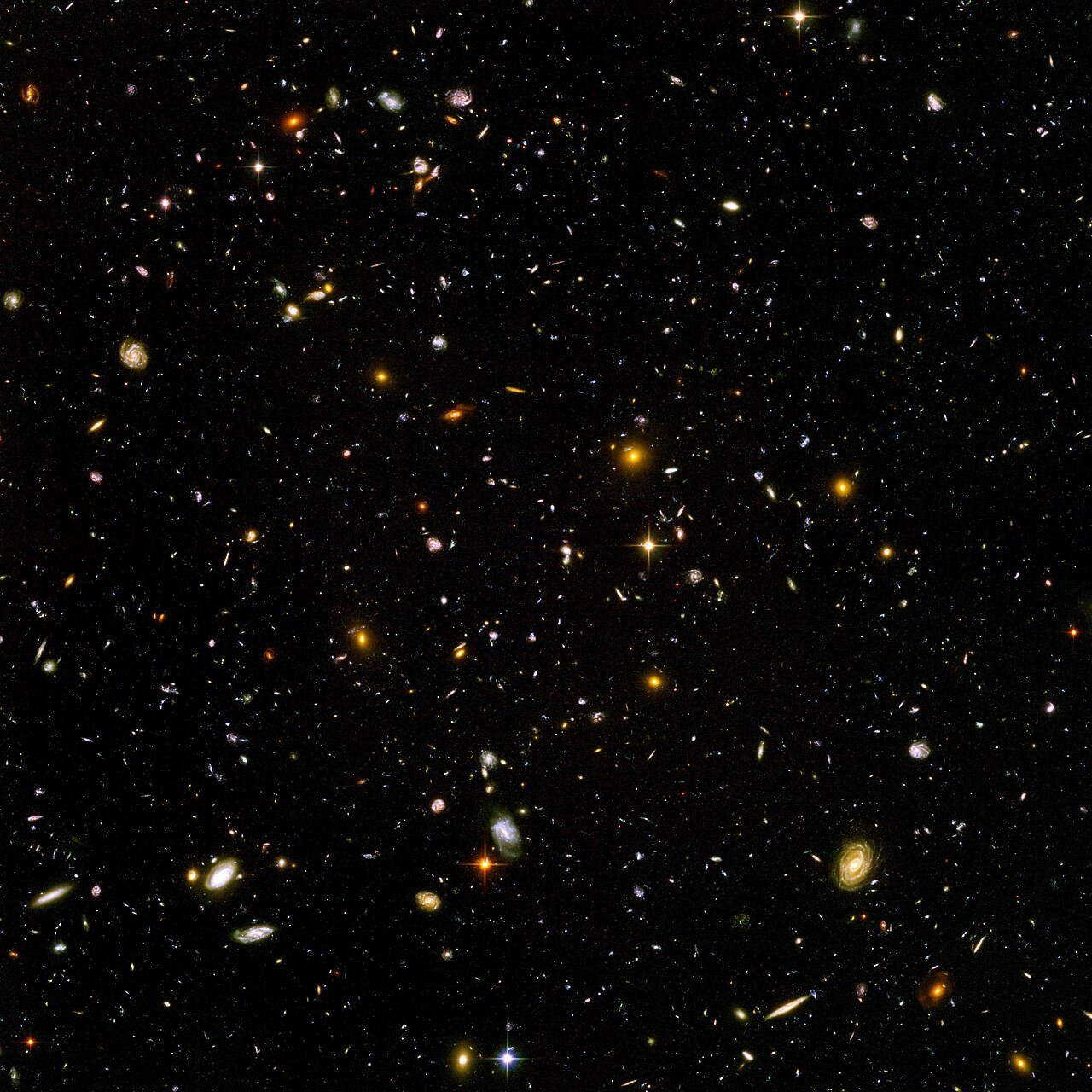
Inside that region the numbers are huge. Astronomers estimate that there are hundreds of billions of galaxies, and perhaps as many as 2 trillion. Our own , the Milky Way, is about 100,000 light-years across. The nearest large neighbour, the Andromeda Galaxy, is about 2.5 million light-years away. Altogether the observable universe may hold as many as a 1 followed by 24 zeros of stars. That is more than all the grains of sand on every beach on Earth.
Beyond the edge, space may go on for a very long way or even for ever. We cannot tell, because no signal from out there can reach us.
How did the universe begin?
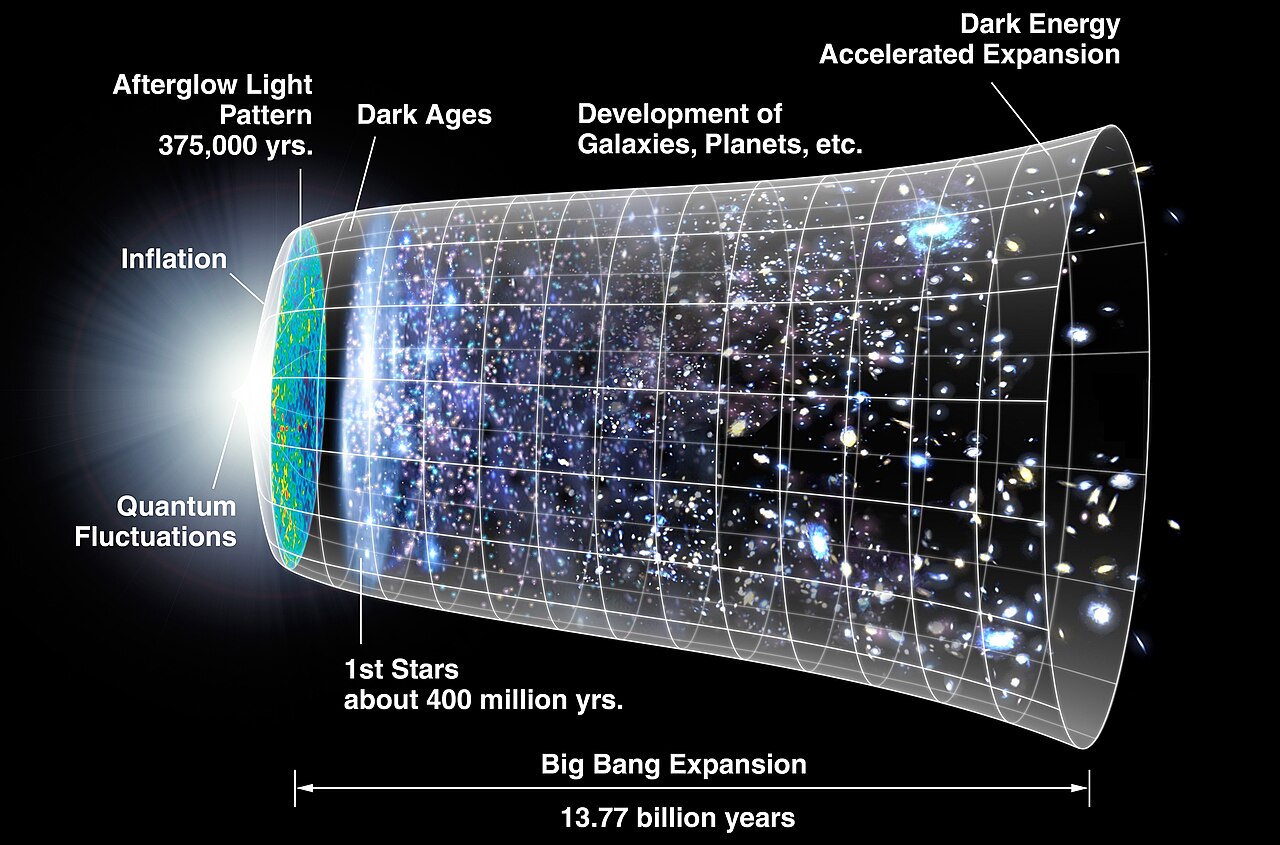
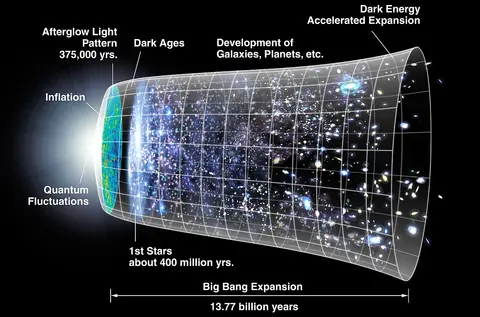
The best explanation we have is the theory. It says that the early universe was extremely hot and dense, and that it has been expanding and cooling ever since. The Big Bang was not an explosion in empty space. Space and time themselves began to exist and then stretched, and that stretching continues today.
In the first tiny fraction of a second, the universe may have grown enormously fast in a burst called inflation. The four basic forces of nature separated from one another. Within seconds, the first particles joined into protons and neutrons. For about 20 minutes the universe was hot enough for these to fuse into the nuclei of helium atoms. When that stopped, about three quarters of its ordinary matter was hydrogen and about a quarter was helium.
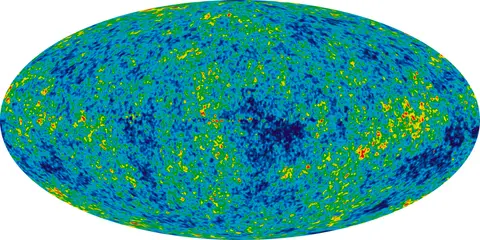
For the next 380,000 years, the universe was a glowing fog of electrons and nuclei. Light could not travel far through it. Then it cooled enough for atoms to form. Light was suddenly free to fly across space, and some of that first light is still around us. We call it the .
What happened before the Big Bang? Physicists do not know. The physics of the very first instant is not understood, so we cannot say if anything came before time zero.
How did the first stars and galaxies appear?
After the first atoms formed, the universe was a dark sea of hydrogen and helium gas. It was not perfectly smooth. Some places were slightly denser than others, and the extra pull of gravity there gathered even more material. , the invisible material that pulls with gravity, formed the first clumps. Ordinary gas then fell into them like water running into a dip.
Between about 100 and 300 million years after the , the first stars switched on. They were probably huge, very bright and short-lived. Their light started to break up the hydrogen fog around them. They also did something even more important. Inside a star, atoms are crushed together to make heavier elements. When those first stars died, they scattered the new elements into space.
Gravity kept pulling stars together into galaxies. Over billions of years, later generations of stars formed from gas that now contained carbon, oxygen, iron and more. Planets are built from these heavier elements, and so are living things. The iron in your blood and the calcium in your bones were made inside stars. Those stars died long before the Sun was born.
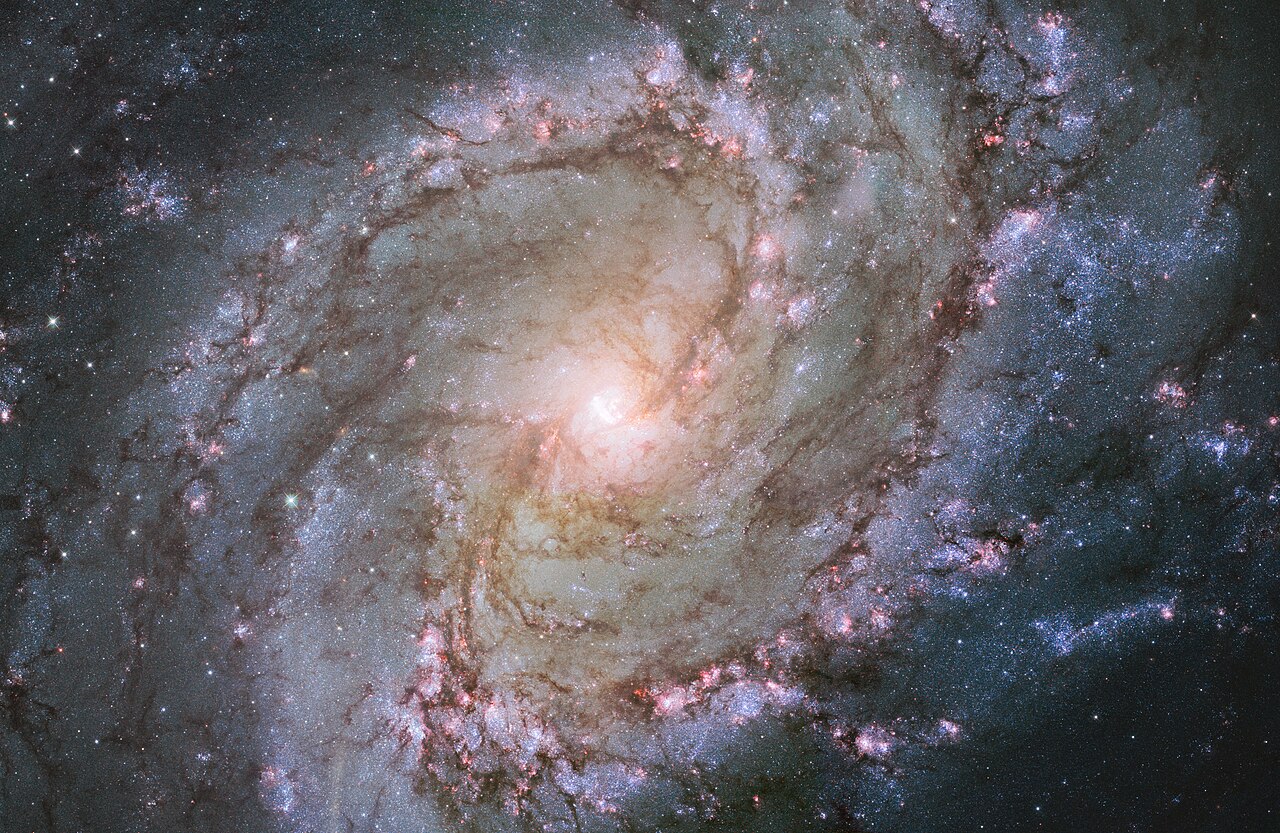
Today, many stars in a have planets. A galaxy called Messier 83 shows the story in one place. It has old stars, dust and bright pink clouds where new stars are forming.
What is the cosmic web?
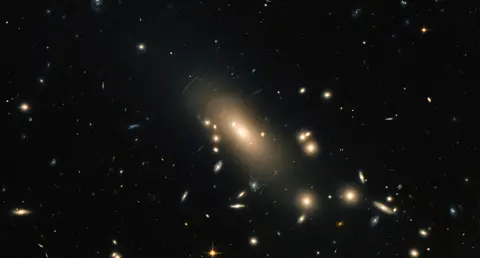
Stars gather into galaxies, and galaxies gather into larger groups. The Milky Way belongs to the Local Group, a collection of galaxies that stretches over about 10 million . The Local Group sits inside a much bigger structure called the Laniakea Supercluster, which is more than 500 million light-years wide.
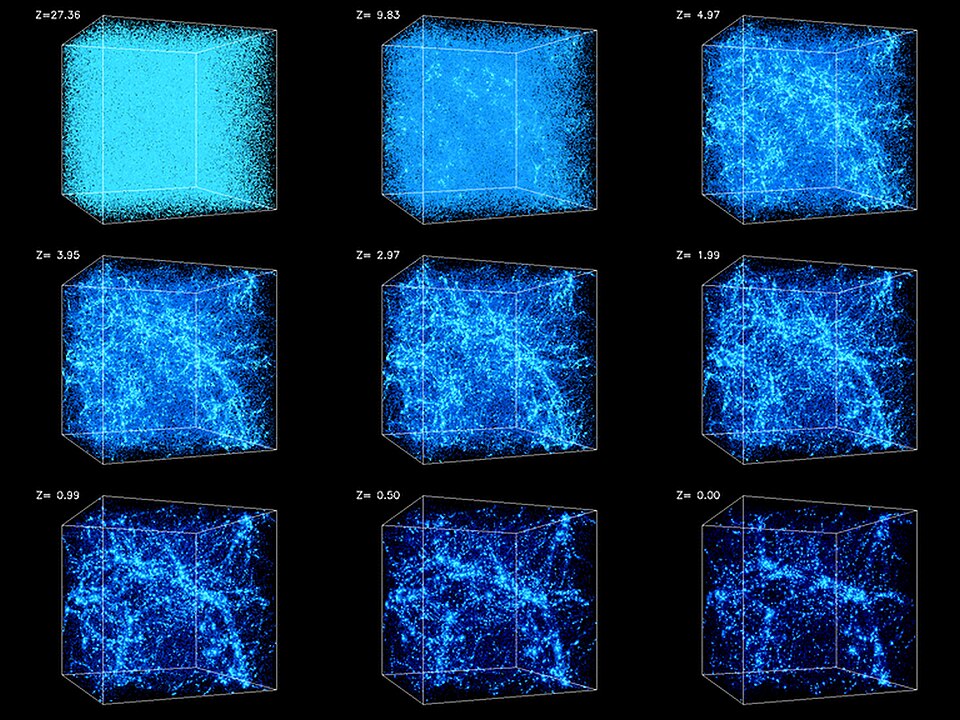
When astronomers map thousands of galaxies, a surprising pattern appears. Galaxies line up in long threads called , with clusters of galaxies where threads cross. Between the filaments are enormous voids that hold very few galaxies. A typical void is tens or hundreds of millions of light-years across. The largest one known measures about 1.8 billion light-years. The whole pattern looks like a foam or a sponge, and it is called the cosmic web.
Gravity built this web over billions of years. Computer simulations can show that growth. It starts when the universe was young and almost smooth, with only tiny differences in density. pulls together first, and the galaxies form along its threads. The simulation ends in a web that looks very like the one we see in the real sky.
Zoom out much further, beyond about 300 million light-years, and the foam smooths out. At that scale the universe looks much the same everywhere.
What is the universe made of?
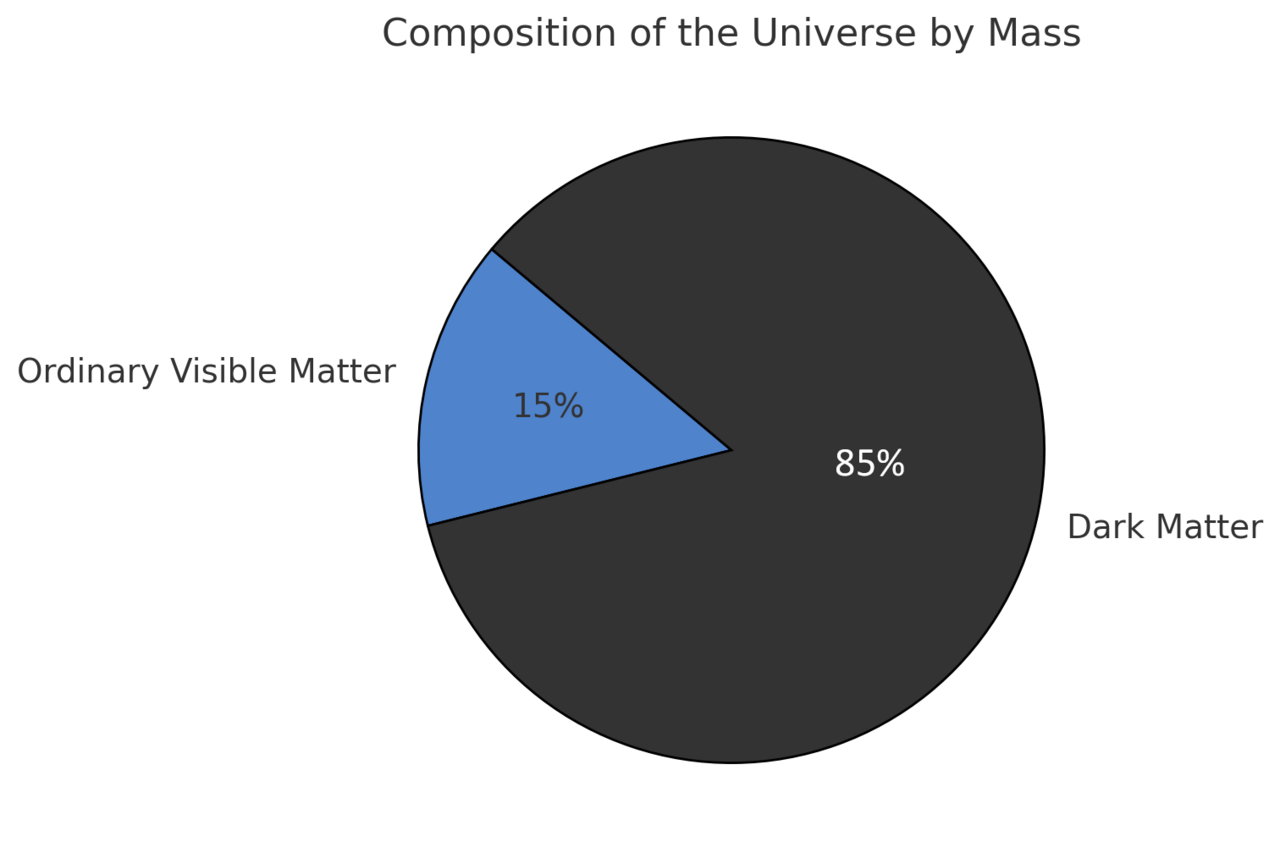
Everything you can see and touch is made of ordinary matter, which means atoms. Planets, stars, gas clouds, air and people all count. Yet ordinary matter is only about 5 per cent of the universe. It is spread so thinly that the average works out at about 1 proton in every 4 cubic metres of space.
The rest is made of two ingredients that nobody has yet explained. About 27 per cent is . It gives off no light and takes in no light, so telescopes cannot see it. We know it is there because of its gravity. Galaxies spin and bend light in ways that would be impossible if only the visible matter were present. Dark matter makes up about 85 per cent of all the matter in the universe.
The remaining 68 per cent is . It is the name given to whatever is making the expansion of the universe speed up. We do not know what it is. One idea is that empty space itself holds a small amount of energy. As space grows, there is more of it. The Planck satellite gave the exact shares as 4.9, 26.8 and 68.3 per cent.
Even the ordinary matter holds a surprise. Stars and glowing gas inside galaxies make up less than 10 per cent of it. Most atoms are in thin gas that is much harder to see.
How do we know the universe is expanding?
The first clue is light from distant galaxies. When a moves away from us, its light is stretched to longer wavelengths, which look redder. This is called . Astronomers found in the early 1900s that far-off galaxies are almost all redshifted. The farther away they are, the bigger the shift. That means the galaxies are moving apart, as if the space between them is growing.
The second clue is the . It is the glow left behind when the universe first turned transparent. Expansion has stretched the light into microwaves. Their temperature is about 2.7 kelvin, which is around minus 270 degrees Celsius. Satellites called COBE, WMAP and Planck have mapped it. It is almost the same in every direction. Tiny patches of warmer and cooler glow show the first seeds of the cosmic web.
A third clue is the amount of helium and hydrogen. The theory predicts how much of each formed in the first 20 minutes. Old gas clouds match it.
Before 1998, most scientists expected the expansion to be slowing down, because gravity pulls everything together. Then two teams measured the brightness of exploding stars called Type Ia supernovae. The stars were fainter than expected, so they were farther away. The expansion is speeding up, and is the name for the cause.
How did people picture the universe in the past?
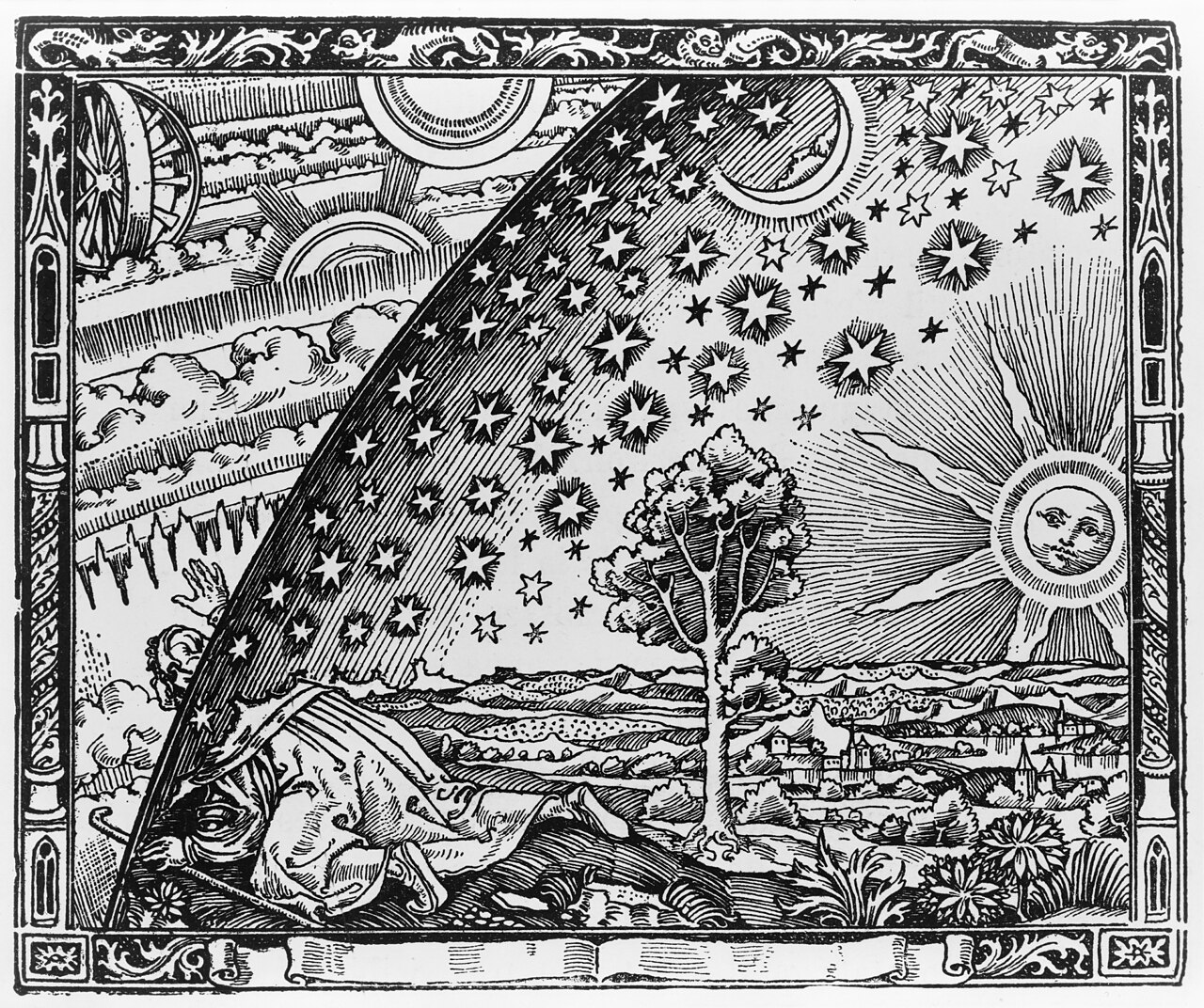
Almost every culture has told stories about how the world began. Some describe a world born from an egg, as in the Chinese tale of Pangu. Others say a god shaped the world from something that already existed. The Babylonian epic Enuma Elish and Norse stories about the giant Ymir work this way. These stories have mattered to people for thousands of years.
Ancient Greek and Indian thinkers also asked what the world was made of, but they looked for answers in nature. Thales said everything came from water. Empedocles named four elements: earth, water, air and fire. Democritus and the Indian philosopher Kanada both suggested that matter is built from tiny, indivisible atoms. Many early models placed Earth at the centre of everything.
Over the centuries, better observations changed that picture. Nicolaus Copernicus put the Sun at the centre of the Solar System. Tycho Brahe recorded careful measurements of the planets, and Johannes Kepler used them to find the laws of planetary motion. Isaac Newton then explained them with his law of universal gravitation.
The modern era began in 1915, when Einstein published his general theory of relativity. For the first time, scientists had equations that could describe the whole universe. They covered how it began, how it changes and how it might end. Astronomers then found that the Sun is one star among hundreds of billions in the Milky Way. The Milky Way is one of hundreds of billions of galaxies.
How will the universe end, and could there be others?
Nobody knows for certain, because the answer depends on two things. One is how much matter there is, and the other is what does. If the universe held enough matter, gravity would one day win. The expansion would stop and reverse, ending in a Big Crunch. Some ideas say a crunch might even lead to a new .
Measurements say the universe is very close to flat, with a density near the line between collapse and endless growth. With dark energy pushing it to expand faster, the most likely outcome is that it expands for ever. Stars would use up their fuel and galaxies would drift apart. The universe would cool towards a Big Freeze, also known as heat death. If dark energy grew stronger over time, it could even tear galaxies and atoms apart in a Big Rip. Scientists treat these as possibilities to test, and not as predictions.
Some physicists also wonder whether our universe is the only one. In multiverse ideas, ours is one of many separate universes, a bit like soap bubbles that never touch. Different universes could have different physical laws. This is a speculative idea, and nobody has found a way to test it.
For now the story is open. The Big Bang, and dark energy are three of the biggest questions in science.
Explore Next
Your audio story keeps playing while you look around.
Words to Know
- Big Bang
- The hot, dense beginning from which the expanding universe grew.
- cosmic microwave background
- The oldest light in the universe, released when the first atoms formed.
- cosmology
- The science that studies the universe as a whole.
- dark energy
- The unknown cause of the speeding up of the universe's expansion.
- dark matter
- Invisible matter that we detect only through its gravity.
- filament
- A long thread of galaxies stretching across space.
- galaxy
- A huge group of stars, gas, dust and dark matter held together by gravity.
- light-year
- The distance light travels in one year, about 9.5 trillion kilometres.
- observable universe
- The part of the universe whose light has had time to reach us.
- redshift
- The stretching of light to redder colours as its source moves away.
- spacetime
- Space and time joined together as one four-part fabric.
- supernova
- The huge explosion of a star at the end of its life.