Galaxy
Gigantic islands of stars, gas and dark matter scattered across the universe.
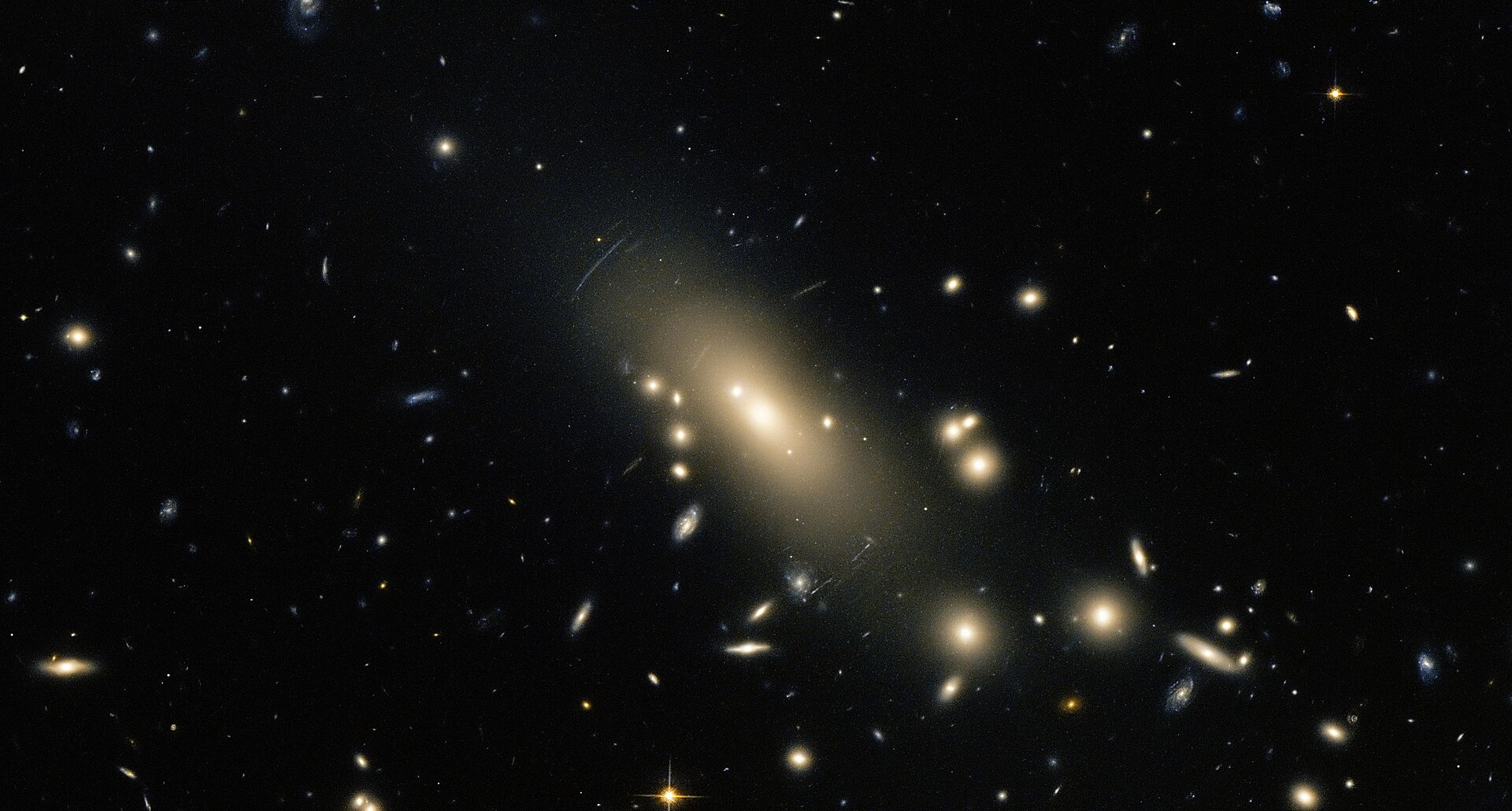
A galaxy is a vast city of stars, gas, dust and dark matter, all held together by gravity. Our Sun belongs to one called the Milky Way, which has 100 to 400 billion stars. Beyond it lie hundreds of billions more galaxies, some with only a few thousand stars and some with a hundred trillion. They spiral, collide, merge and sometimes shine with the light of a black hole. Galaxies are the building blocks of the universe, and astronomers have only worked out what they are in the last hundred years. What are they made of, how do they form and how do we know?
What is a galaxy?
A is a huge family of stars held together by gravity. Besides stars, a galaxy holds the leftovers of dead stars, clouds of gas and dust, and something invisible called . Gravity is the glue. Every part of the galaxy pulls on every other part, so the whole crowd stays together and circles around its centre.
The word comes from the Greek word for milk. Ancient Greeks named the pale band of light that stretches across a dark night sky the Milky Way. Today that name belongs to our own galaxy, and "galaxy" is the word for all the others too.
Galaxies come in very different sizes. A small dwarf galaxy may have fewer than a thousand stars. The biggest known giants have around a hundred trillion. An average galaxy has about 100 million stars.
The stars are not the main ingredient. In a typical galaxy most of the mass is dark matter, which gives out no light but does pull on everything around it. Stars and glowing gas clouds called nebulae make up only a few per cent of the total. Many galaxies also have a at their centre, a region so dense that nothing nearby can escape its pull.
What is our home galaxy like?

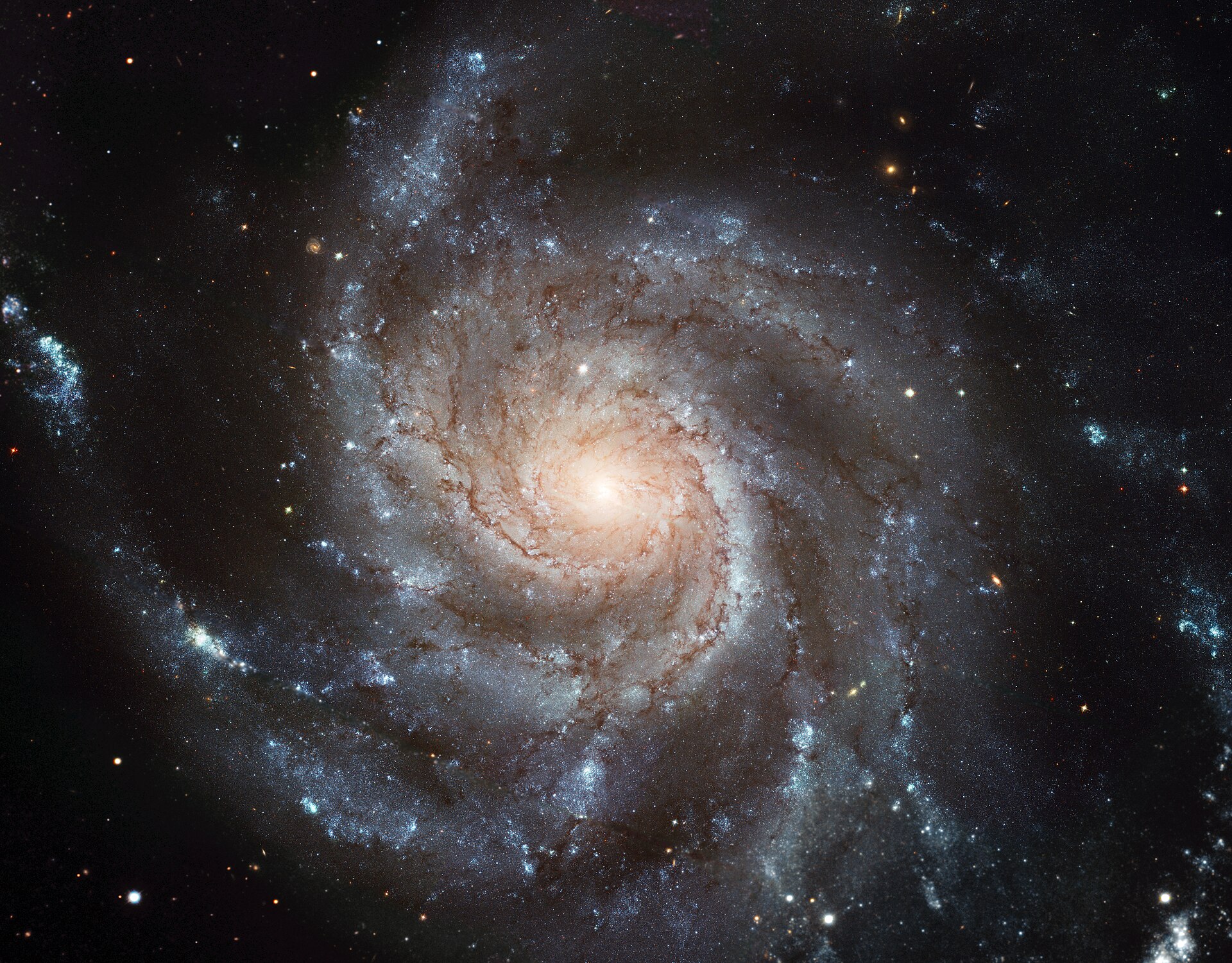
You live in a called the Milky Way. It is a flat disc of stars with a bar-shaped band of stars across its middle and long, curling arms. Astronomers call this shape a barred spiral. If you could look down on it from far above, it would look a bit like a pinwheel.
The numbers are enormous. The Milky Way is about 100,000 across, although some measurements give at least 87,400 because the edge is hard to define. A light-year is the distance light travels in one year, which is about 9.5 trillion kilometres. The disc is only about 3,000 light-years thick, so it is far wider than it is deep. It holds 100 to 400 billion stars. Estimates of its total mass range from a few hundred billion to about 1.3 trillion times the mass of our Sun.
Our Sun is one ordinary star out in the disc, a long way from the centre. We cannot see the shape of the Milky Way from outside, because we are inside it. On a dark night away from town lights, you see the disc edge-on as a milky band, because you are looking along its length at billions of faint stars.
At the very centre is a . The Milky Way also has satellites. At least a dozen dwarf galaxies circle it, and astronomers estimate that 300 to 500 more are still to be found. The Milky Way is even swallowing some of them.
How did we find out that other galaxies exist?
For a long time nobody knew what the Milky Way was. The Greek thinker Democritus guessed that it might be made of distant stars. Aristotle disagreed and thought it was a glow high in Earth's air. In 1610 Galileo pointed a telescope at it and saw that it really was a huge number of faint stars.
In 1750 the English astronomer Thomas Wright suggested that the Milky Way is a rotating disc of stars. He also guessed that some of the fuzzy patches seen through telescopes might be other Milky Ways. These patches were called spiral nebulae, and for more than a century nobody could tell what they were. Some people called them island universes.
Measuring distance settled the question. In 1917 Heber Curtis studied exploding stars in the Andromeda and found they were far fainter than ones in our , so Andromeda had to be much farther away. He and Harlow Shapley argued about it in 1920 in the Great Debate. Then Edwin Hubble used a new 100-inch telescope on Mount Wilson in California. He picked out single stars in Andromeda, including pulsing stars called Cepheids, whose brightness reveals how far away they are. They were much too distant to belong to the Milky Way. In 1926 Hubble also published a way of sorting galaxies by shape, and astronomers still use it today.
What shapes do galaxies come in?
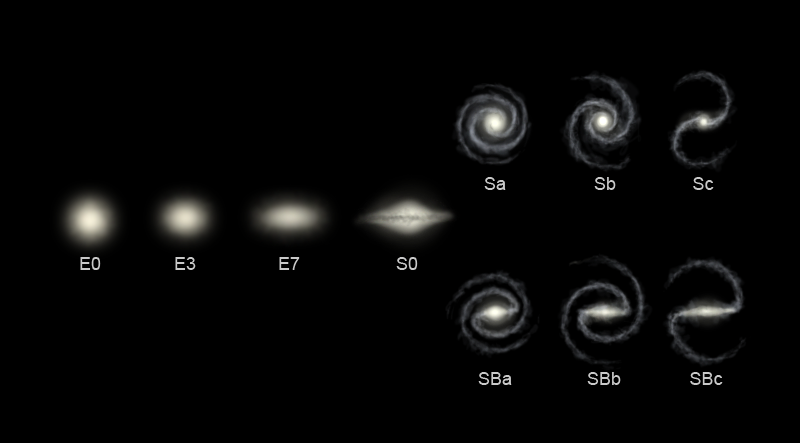
Galaxies come in three main types: spirals, ellipticals and irregulars. Hubble's sorting scheme draws them in a famous diagram.
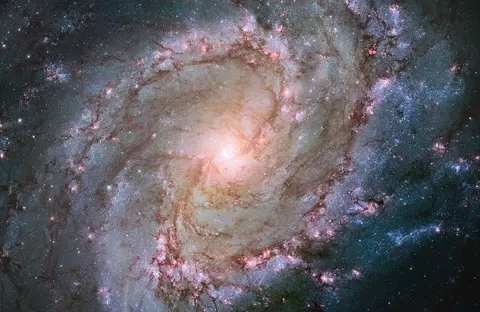
Spiral galaxies, like the Milky Way, have a spinning disc, a bulge of older stars in the middle and bright arms. The arms shine because they are crowded places where new, hot stars are born. They are not solid. Stars move in and out of the arms, a bit like cars slowing down in a traffic jam and speeding up again. Many spirals also have a bar across the middle.
Elliptical galaxies are smooth balls or egg shapes. They have little gas and dust, so they make few new stars and are mostly made of older ones. Their stars orbit in all directions, like a swarm of bees. The biggest galaxies of all, called cD galaxies, are giant ellipticals that probably grew by swallowing many smaller galaxies.
Lenticular galaxies sit between the two. They have a disc but almost no clear arms. Irregular galaxies have no tidy shape at all, such as the Magellanic Clouds near the Milky Way.
Most galaxies are not giants. They are dwarfs, often a hundred times smaller than the Milky Way, with anything from a few thousand to a few billion stars.
Which galaxies have rings, shells or almost no stars?
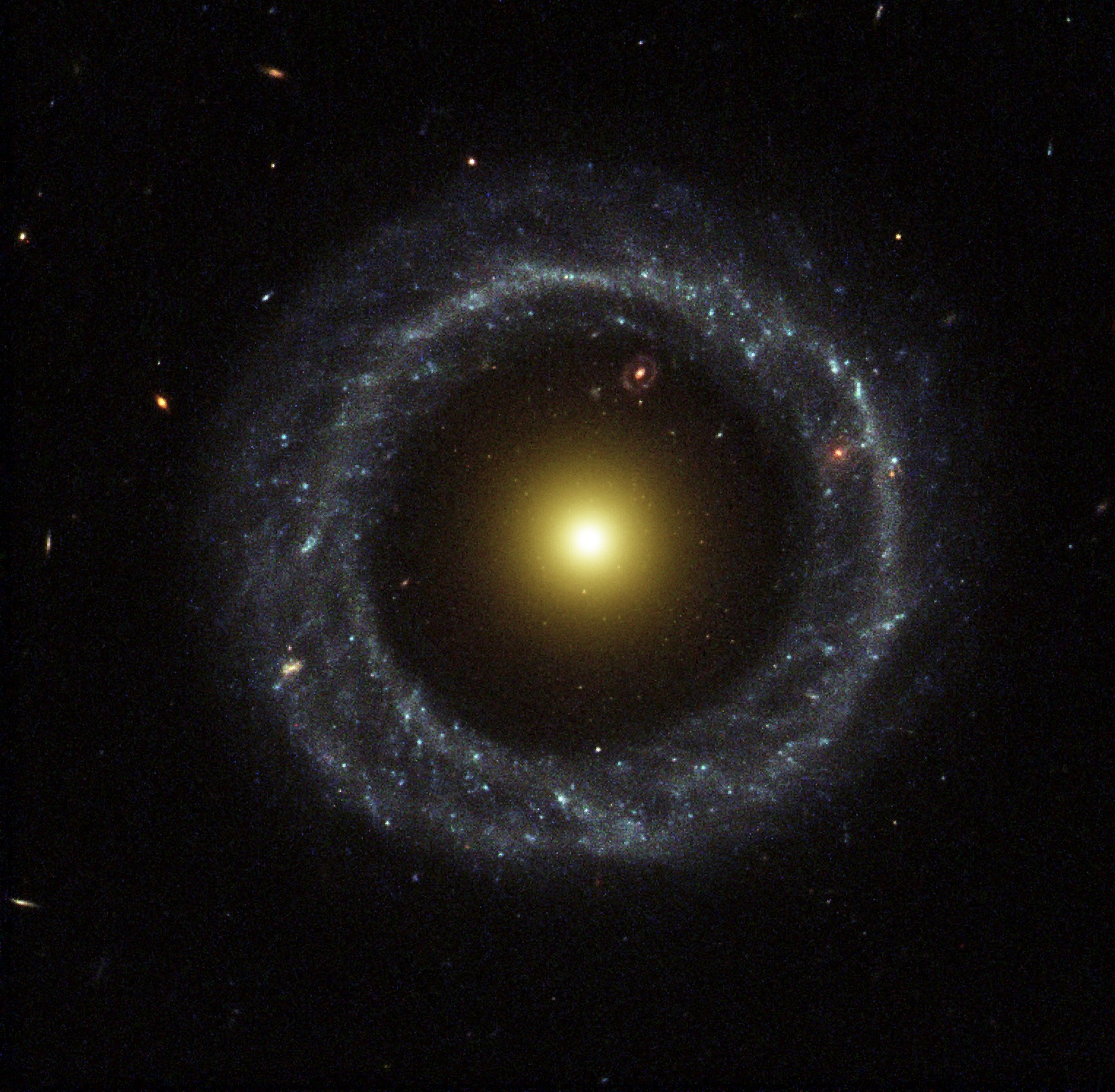
Some galaxies are stranger than the standard shapes. Many of them got that way because of a meeting with another .
A ring galaxy has a ring of stars and gas around an almost empty core. Astronomers think a ring forms when a smaller galaxy plunges through the middle of a spiral. The crash sends a wave of gas and stars rippling outwards, like a stone dropped in a pond. Hoag's Object is a famous example. Infrared pictures of the Andromeda Galaxy show rings too, so it may have had such a collision.
A shell galaxy is an with its stars arranged in layers, like the skins of an onion. About one elliptical galaxy in ten has shells, and nobody has ever seen them in a spiral. They probably form when a big galaxy swallows a smaller one and the stars slosh back and forth, making ripples. The galaxy NGC 3923 has more than 20 shells.
At the other extreme are ultra-diffuse galaxies. Some are so faint that they are nicknamed dark galaxies. One may be as wide as the Milky Way but have only one per cent as many visible stars. One idea is that these galaxies lost their gas early, so they stopped making new stars.
What happens when galaxies collide?
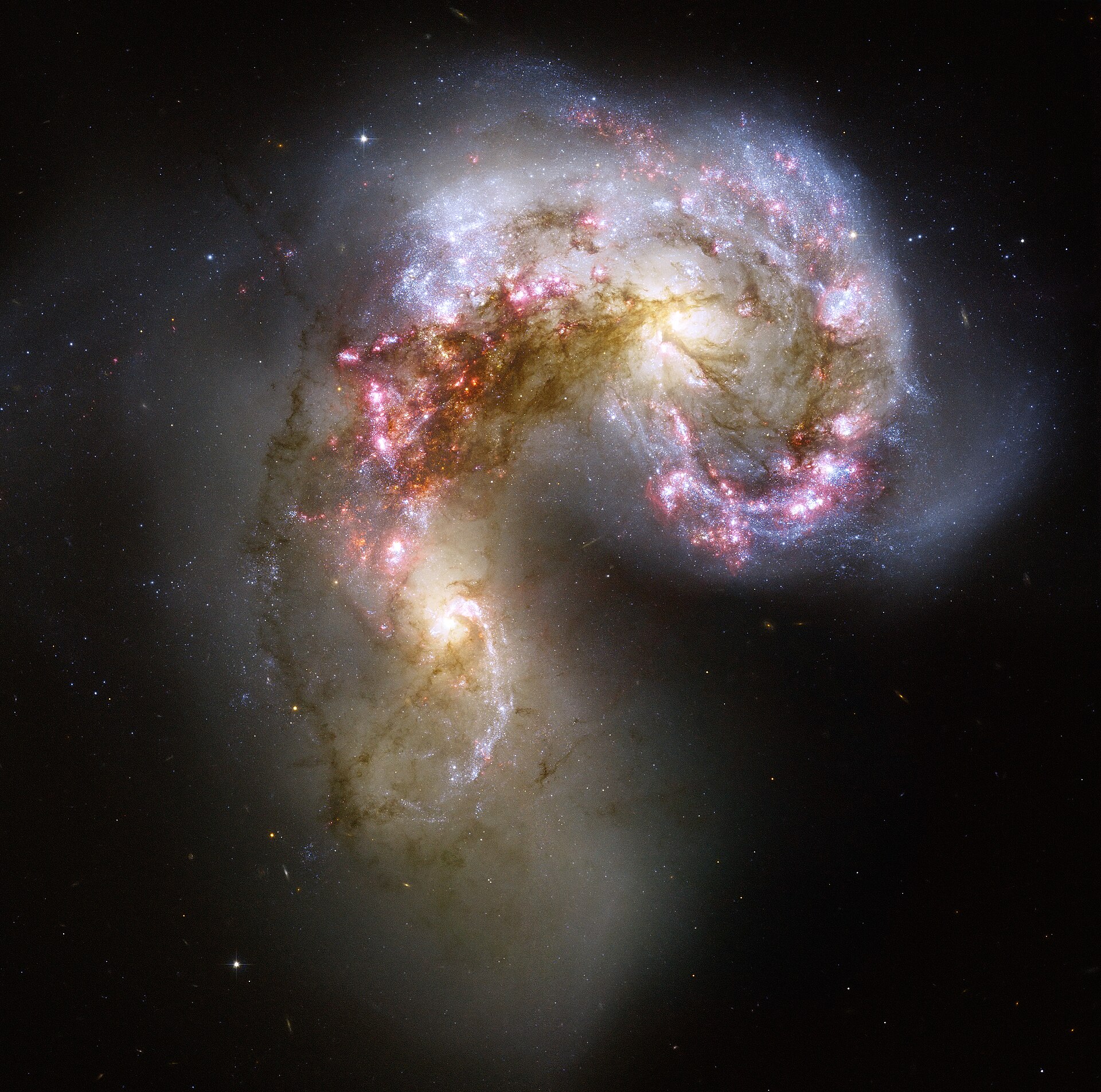
Galaxies are so spread out that collisions look dramatic but are gentle for the stars themselves. When two galaxies pass through each other, their stars almost never hit. There is far too much space between them. The gas and dust are different. The clouds crash together, and this can set off the birth of new stars. A collision can also stretch a into bars, rings or long tails.
If two galaxies are moving too slowly to pass through, they merge into one bigger galaxy. When one is much bigger than the other, the small one is torn apart and the big one hardly notices. Astronomers call this galactic cannibalism. The Milky Way is doing it right now to two small galaxies, the Sagittarius Dwarf and the Canis Major Dwarf. The Antennae Galaxies are two galaxies in the middle of a merger, with billions of new stars forming.
Some galaxies make stars at a wild rate. This is called a . A galaxy cannot keep it up for long because it would use up its gas, so a starburst usually lasts only about 10 million years. That is a short time for a galaxy. Messier 82, which had a close encounter with its larger neighbour Messier 81, is the classic example. Starbursts were more common when the universe was young.
What powers the brightest galaxies?
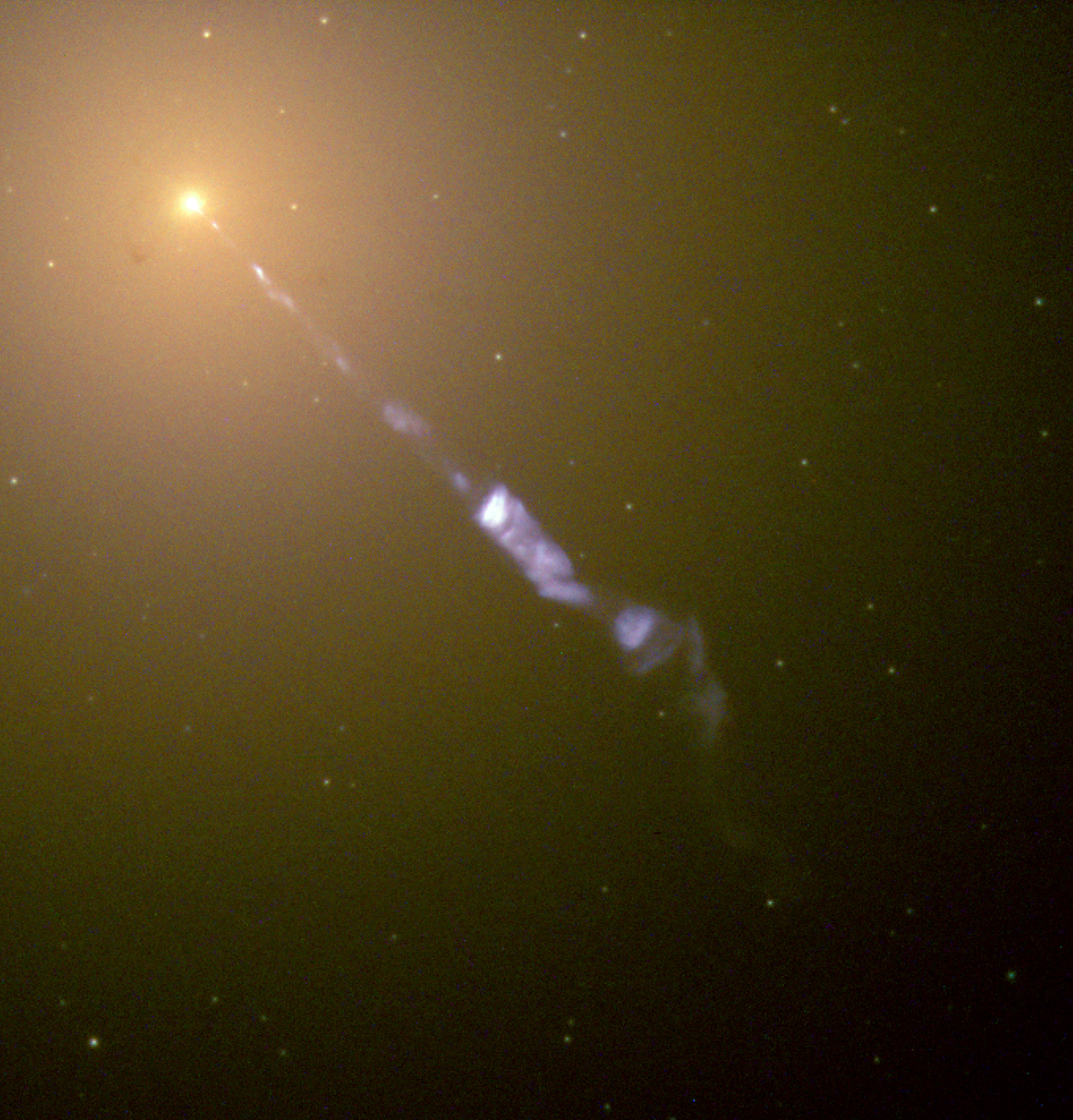
In some galaxies the centre outshines everything else. These are called active galaxies. A large share of their energy comes from a tiny region at the core, called an active galactic nucleus, and not from their stars.
The engine is a . Gas and dust spiral towards it in a flat, whirling disc. As matter falls inwards, it releases huge amounts of energy as light and other radiation. How bright the nucleus gets depends on the black hole's mass and on how fast it is fed. In about one active in ten, a pair of jets also shoots out in opposite directions at close to the speed of light. Astronomers do not yet fully understand how the jets form.
are the most powerful active nuclei. A quasar can shine 100 times brighter than the whole Milky Way. The first ones found looked like stars, so people were puzzled about what they were. Seyfert galaxies are a gentler kind, in which the galaxy around the bright core is still easy to see.
Jets can power giant radio lobes. The galaxy Alcyoneus has lobes spanning about 16 million .
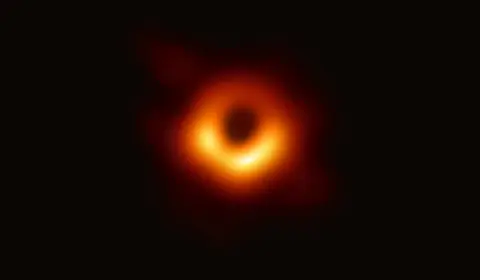
How do we know about black holes in galaxy centres? Stars racing around galaxy centres, X-rays from hot gas and, since 2019, pictures from the Event Horizon Telescope all show supermassive black holes at their cores.
How are galaxies arranged across the universe?
Galaxies are rarely alone. Only about 5 per cent are isolated, meaning they have not met a of similar size in the past few billion years. Most belong to groups or to clusters, which hold hundreds to thousands of galaxies. Clusters are often ruled by one giant that slowly tears apart its neighbours.
The Milky Way belongs to the , about 10 million wide. Its two big members are the Milky Way and the Andromeda Galaxy, which is about 2.5 million light-years away. Most of the others are dwarfs. The Local Group is part of the Virgo Supercluster, and that sits inside an even bigger structure called Laniakea.
Superclusters hold tens of thousands of galaxies. On the largest scale, galaxies line up in sheets and long threads, with enormous empty voids between them. The Hercules-Corona Borealis Great Wall, the largest structure found so far, is about 10 billion light-years long.
The universe is expanding, so most galaxies are drifting apart. Groups and clusters hold together because gravity pulls their members harder than expansion pushes them apart. In a cluster about 70 to 80 per cent of the mass is . Hot gas makes up another 10 to 30 per cent, and the galaxies themselves are only a few per cent.
How do galaxies form?
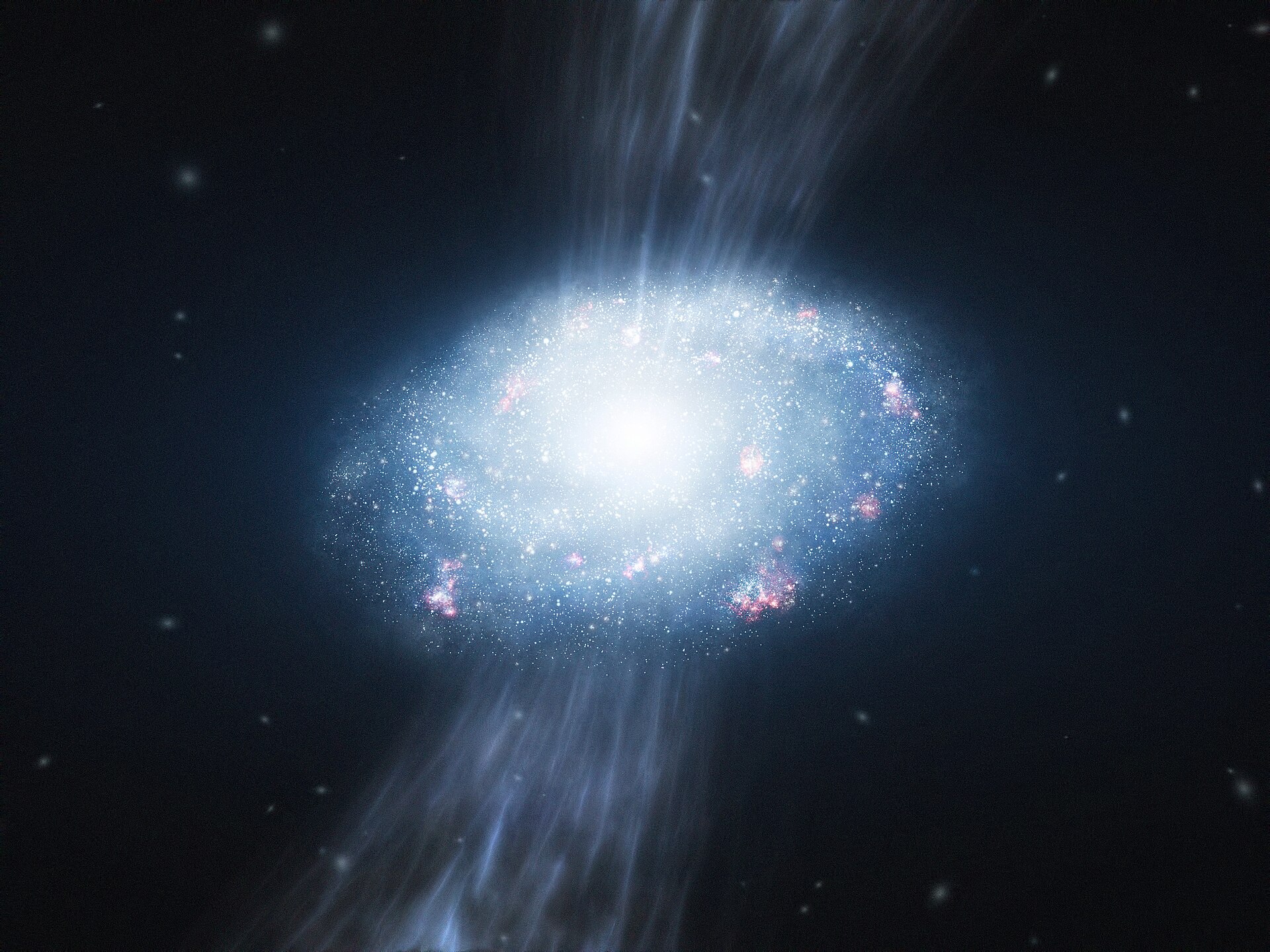
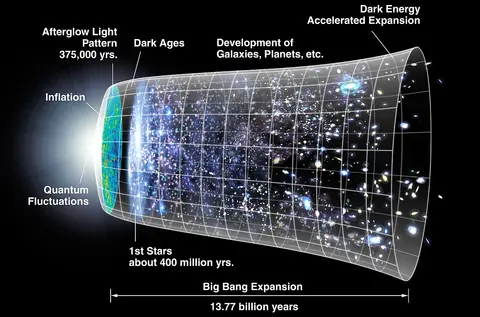
Galaxies began to form soon after the Big Bang. About 380,000 years after it, the first atoms of hydrogen and helium formed. There were no stars yet, so this long, dark period is called the dark ages.
The young universe was not perfectly smooth. Some places had slightly more matter than others. gathered first, forming clumps called halos. Their gravity then pulled in hydrogen and helium gas. The gas heated up as it fell in, and it had to cool before it could squeeze together further. Gas that cooled enough formed clouds, then the first stars, and the first galaxies took shape.
Small galaxies formed first. Over billions of years they merged into bigger ones, and they kept pulling in fresh gas from the space around them. This is why mergers and gas inflow are still important today.
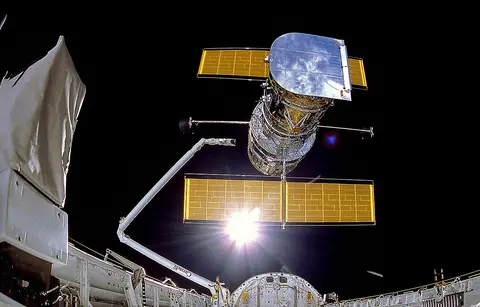
Dark matter also explains something puzzling. In the 1970s Vera Rubin measured how fast stars orbit in galaxies. They moved much faster than the visible stars and gas could explain. Astronomers now think the extra pull comes from dark matter. The Hubble Space Telescope and other instruments let us look back at galaxies from the early universe, because their light has travelled for billions of years to reach us.
Explore Next
Your audio story keeps playing while you look around.
Words to Know
- Cepheid variable
- A star that pulses in brightness, which lets astronomers work out its distance.
- dark matter
- Invisible matter that gives out no light but pulls on everything with gravity.
- elliptical galaxy
- A smooth, ball-shaped or egg-shaped galaxy made mostly of older stars.
- galaxy
- A huge system of stars, gas, dust and dark matter held together by gravity.
- galaxy cluster
- A group of hundreds or thousands of galaxies bound together by gravity.
- light-year
- The distance light travels in one year, about 9.5 trillion kilometres.
- Local Group
- The small group of galaxies that includes the Milky Way and Andromeda.
- nebula
- A cloud of gas and dust in space.
- quasar
- An extremely bright galaxy core powered by a black hole eating matter.
- spiral galaxy
- A galaxy with a flat spinning disc and bright curving arms.
- starburst
- A short period when a galaxy makes new stars at a very fast rate.
- supermassive black hole
- A black hole millions or billions of times heavier than the Sun, found at the centre of many galaxies.