Dwarf planet
Round little worlds that orbit the Sun but share their neighbourhood.

A dwarf planet is a world that orbits the Sun and is big enough for its own gravity to pull it into a round shape. It is not big enough to rule its neighbourhood the way Earth or Jupiter does. Pluto is the most famous example. For 76 years it was the ninth planet, until astronomers voted in 2006 to give it a new title. Ceres, which hides among the rocks of the asteroid belt, was also once called a planet. Both have now been visited by spacecraft, and both turned out to be full of surprises. So what makes a world a dwarf planet, why did Pluto lose its place, and how do we know so much about worlds that are billions of kilometres away?
What makes a world a dwarf planet?
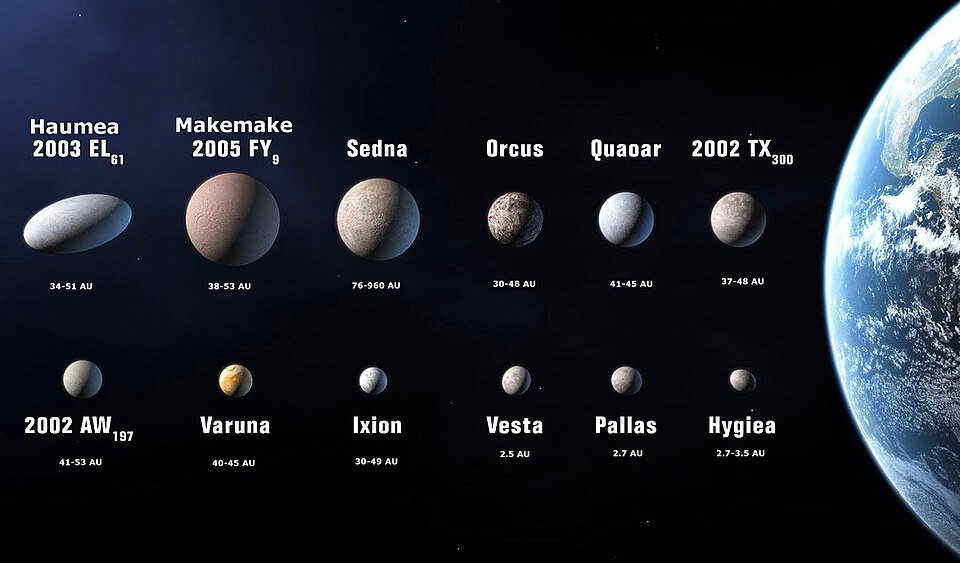
A has to pass three tests. First, it must travel around the Sun, not around another planet. That rules out moons, even big ones. Second, it must be massive enough for gravity to squash it into a round shape. Third, it must have failed to clear its , which means it still shares its path with lots of other objects.
The third test is the one that separates a dwarf planet from a full planet. A planet like Neptune is so massive that, over billions of years, it has swept up, flung away or captured nearly everything else near its orbit. A dwarf planet cannot do this. Ceres travels among countless asteroids. Pluto travels among the icy bodies of the , a wide ring of frozen leftovers beyond Neptune.
The , or IAU, is the group that names objects in space. In August 2006 it wrote these rules down. Under them, a dwarf planet is not counted as one of the planets, even though the name sounds as if it should be. Many scientists still find that confusing, and the argument is still going.
There is no fixed size for a dwarf planet. What counts is the shape and the neighbourhood, not the number of kilometres across.
Why are dwarf planets round?
Small space objects are lumpy. A rock a few kilometres across has so little gravity that its shape is decided by how it formed and how it was hit. Many are piles of rubble stuck together loosely, and their shapes look like potatoes.
Bigger objects behave differently. Gravity pulls every part of a world toward its centre, and the deeper you go the greater the pressure becomes. In a large enough world the rock and ice deep inside grow soft and slowly flow, like very stiff dough. Mountains that rise too high slowly sink, and hollows slowly fill in. Astronomers call this gravitational relaxation.
In the end the body reaches a state called . It is as round as it can be, given how fast it spins. A world that spins fast bulges at its middle, like a squashed ball. A slowly spinning one stays almost perfectly round. Haumea spins so quickly that it is stretched into a shape like an egg, about twice as long as it is wide.
This roundness is the defining limit for a . The size needed depends on what the world is made of and how warm its inside has been. Astronomers once guessed that icy worlds only 400 km across could manage it. Newer research suggests the real limit is bigger, and about 900 km across may be nearer the mark for worlds beyond Neptune.
How did Ceres and Pluto lose their planet titles?
Ceres was found on 1 January 1801 in the gap between Mars and Jupiter. Astronomers welcomed it as a new planet. Soon they found others in the same gap, and by around 1851 the list of planets had grown to 23. That was too many, so they began calling the small ones asteroids, a word from Greek meaning 'star-like', and sorted them as minor planets.
Pluto was found on 18 February 1930 and became the ninth planet. At first it seemed large. For almost 50 years people thought it was bigger than Mercury. Then in 1978 astronomers discovered Pluto's moon Charon. The way Charon moved let them weigh Pluto properly for the first time. Pluto had about one-twentieth of the mass of Mercury, and was far smaller than anyone had thought. It also had a strongly stretched, tilted unlike the other planets.
The 1990s brought the next clue. Telescopes began to find many icy bodies in the same region as Pluto, and many of them travelled on similar paths. Pluto looked less like a lonely ninth planet and more like the biggest member of a crowd. The story of Ceres was repeating itself. Once enough neighbours were found, a world once called a planet came to be seen as one of many.
Why did astronomers vote Pluto out?
In January 2005 a team led by Mike Brown found Eris, an icy world beyond Pluto. It looked slightly bigger than Pluto, and some news reports called it the tenth planet. Astronomers faced a hard choice. If Eris was a planet, then other worlds of that size would be planets too, and the list might grow quickly.
The question went to the IAU General Assembly in August 2006. The first draft would have made Charon, Eris and Ceres planets as well, giving twelve. Many astronomers objected. Two Uruguayan astronomers, Julio Ángel Fernández and Gonzalo Tancredi, then suggested a middle category for objects that are round but have not cleared their . The new plan dropped Charon, and moved Pluto, Ceres and Eris into the middle group. The members voted for it, and the Solar System had 8 planets.
Not everyone agreed. Some scientists made bumper stickers and T-shirts in protest. Alan Stern, who led NASA's mission to Pluto, argues that a world should be judged by what it is made of, not by where it travels. He still calls Pluto a planet. Mike Brown, who found Eris, supports the vote. Today the debate is mostly about the word 'planet' and not about the science, because everyone agrees on what these worlds are like.
Which worlds are dwarf planets?
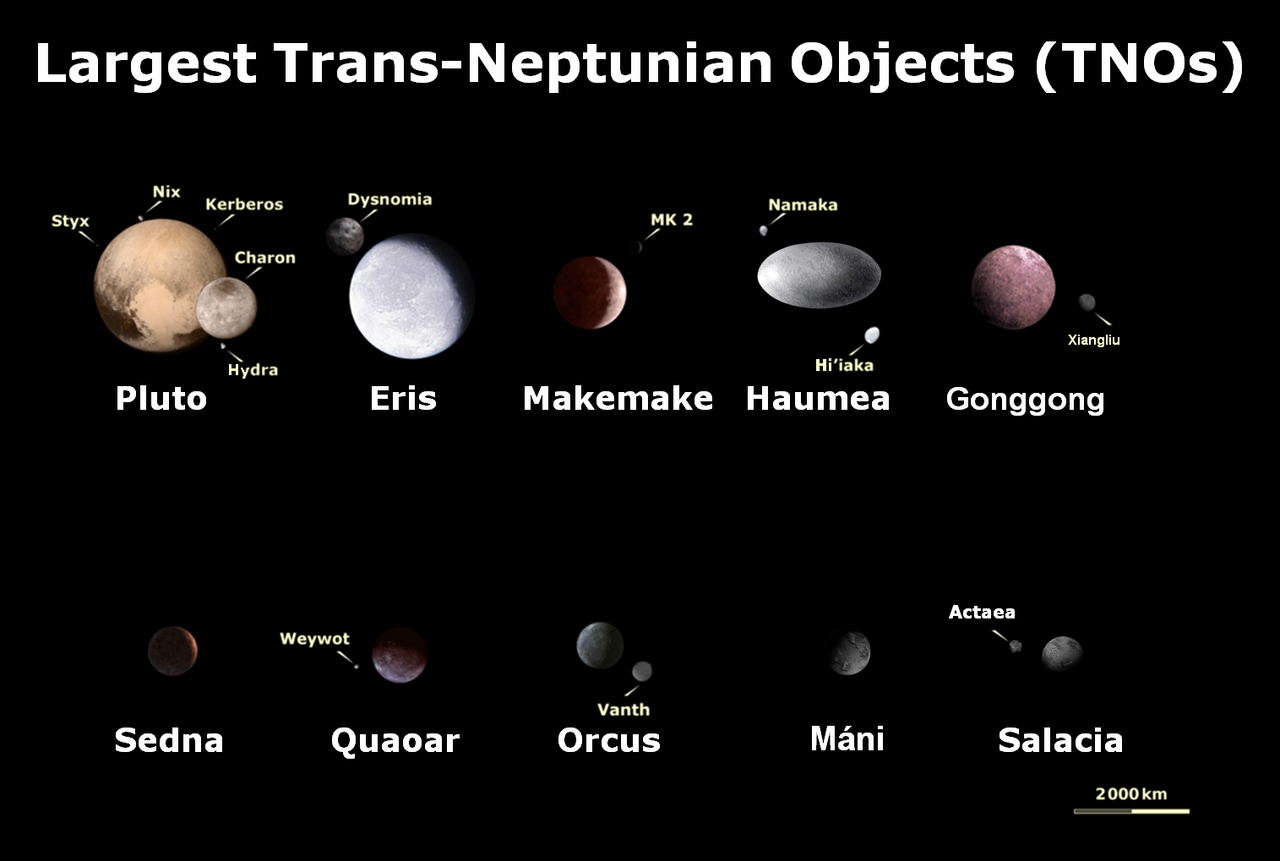
Astronomers agree that at least nine worlds are . In rough order of size they are Pluto, Eris, Haumea, Makemake, Gonggong, Quaoar, Orcus, Sedna and Ceres. A tenth, Salacia, is a borderline case. Only Ceres lives among the asteroids. The rest travel in the cold outer Solar System beyond Neptune.
The IAU has formally named only five: Ceres, Pluto, Eris, Haumea and Makemake. The others are widely called dwarf planets by astronomers, but they still wait for an official decision. Mike Brown has kept a list of hundreds of candidates since 2011, ranked from 'near certain' to 'possible'.
Measuring them is hard, because they are small and faint. That is why this list keeps changing. Some candidates may be rounder than they look, and some that look round may not be. In 2024 astronomers found that Quaoar's shape does not match its present spin. They think it was once spinning fast and settled into shape, then slowed down and kept its shape, like a snapshot of its past.
The IAU also gave the group beyond Neptune a name. In 2008 it called the dwarf planets of that region . Other astronomers did not use the word, and it never became popular.
How do we weigh a world with a moon?
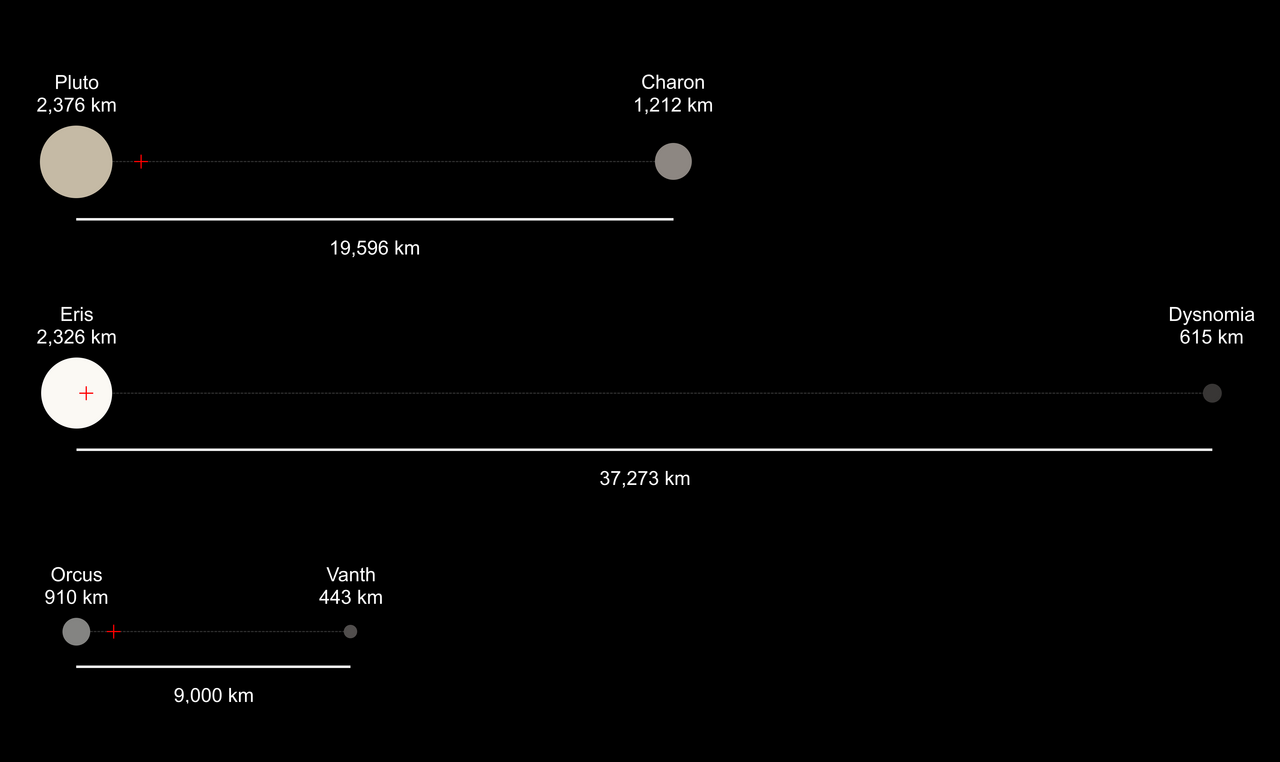
are far too distant to put on a scale, so astronomers use a trick. Gravity makes a moon circle its world, and the speed and size of that circle depend on the world's mass. If you can watch a moon for long enough, you can work out how heavy its partner is.
That is exactly how Charon revealed the true mass of Pluto in 1978. Of the ten largest candidates, seven have at least one known moon: Eris, Haumea, Makemake, Gonggong, Quaoar, Orcus and Salacia. Pluto has five. Once you know the mass and the width, you can work out the density, and density tells you whether a world is mostly rock or mostly ice.
Sedna is the odd one out. It has no known moon, so its mass is hard to estimate.
Some pairs are so closely matched that they behave like a double world. Pluto and Charon are , which means each always shows the same face to the other. Eris and its moon Dysnomia are locked the same way. Charon is about half the width of Pluto, so some people call the pair a double dwarf planet. The IAU still counts Charon as a moon of Pluto, because no official rule exists yet for what makes a double dwarf planet.
What did the Dawn spacecraft find at Ceres?
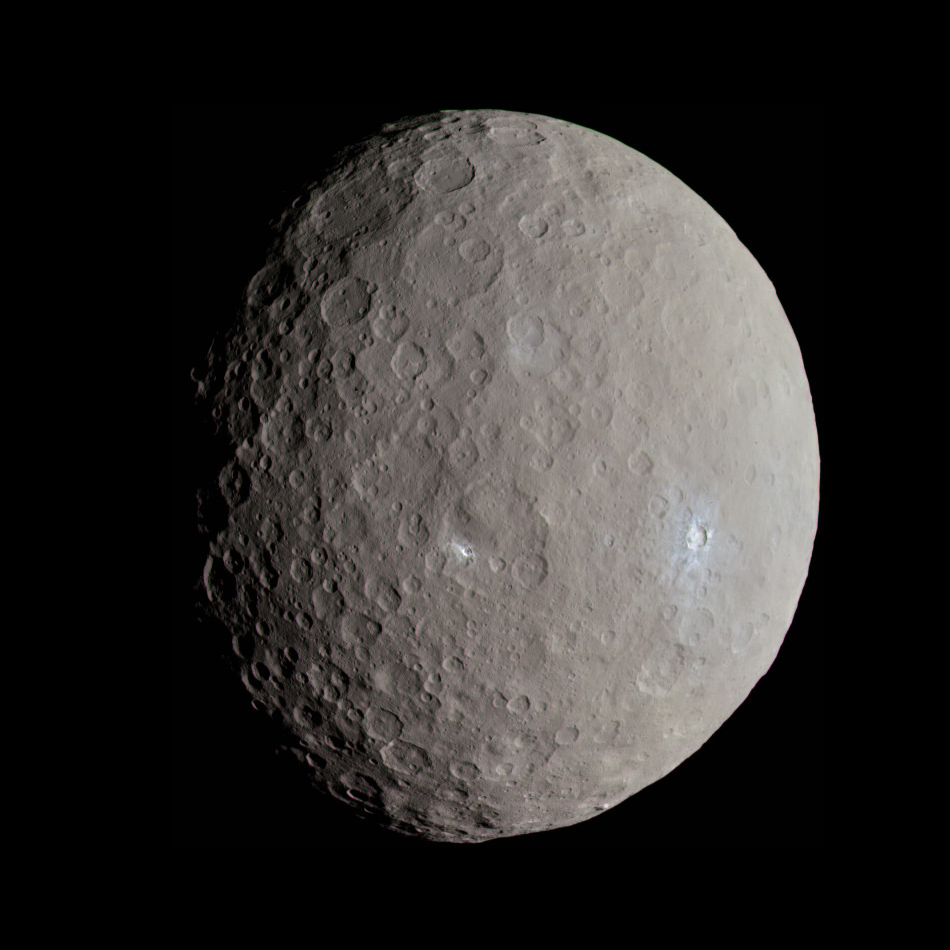
Ceres is the only in the inner Solar System, and it holds about two-fifths of the mass of the whole . On 6 March 2015 NASA's Dawn spacecraft slipped into around it. This made Dawn the first spacecraft ever to visit a dwarf planet.
Before Dawn, Ceres was a blurry dot. Up close, it was a cratered, icy world with a few puzzling bright patches. The bright patches proved to be salt deposits left behind when salty water reached the surface and the water dried out or froze away. Ceres also has , which are volcanoes that erupt icy slush instead of hot lava. Salty water seems to seep through the ground beneath the surface.
This showed that a small, cold world can still be geologically active, with changing ground and chemistry. It also hinted at a surprising past. Ceres seems to be an icy body that may have formed in the outer Solar System, not a plain big rock of the asteroid belt. Some scientists now call it an ice dwarf.
Dawn had already studied another large asteroid, Vesta, before it arrived at Ceres. Studying the two worlds one after the other let scientists compare a dry, rocky body with a wetter, icier one.
What did New Horizons see at Pluto?
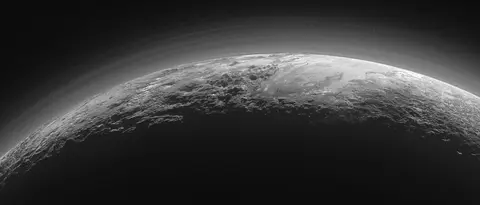
On 14 July 2015 NASA's New Horizons spacecraft raced past Pluto and its five moons. It had travelled for more than nine years to get there. The probe did not stop or . It flew through the system at high speed, taking pictures and measurements as it went.
Pluto turned out to be anything but a dull ball of ice. Its surface has tall mountains made of water ice. Water ice behaves like solid rock at Pluto's bitter cold, and these peaks drift slowly in glaciers of frozen nitrogen. Pluto also has a thin atmosphere, mostly nitrogen. Its colours range from pale cream to a deep red-brown.
There are signs that a salty ocean may lie deep beneath the ice. Heat left over from Pluto's formation, plus heat from radioactive elements, could keep that water from freezing solid. A world so far from the Sun was expected to be dead, yet it has weather, glaciers and perhaps a hidden sea.
After Pluto, New Horizons carried on. It took distant pictures of other , including Eris, Haumea and Makemake, along with Quaoar. It also looked at smaller candidates. These pictures help show how these different worlds compare.
Which worlds are almost dwarf planets?
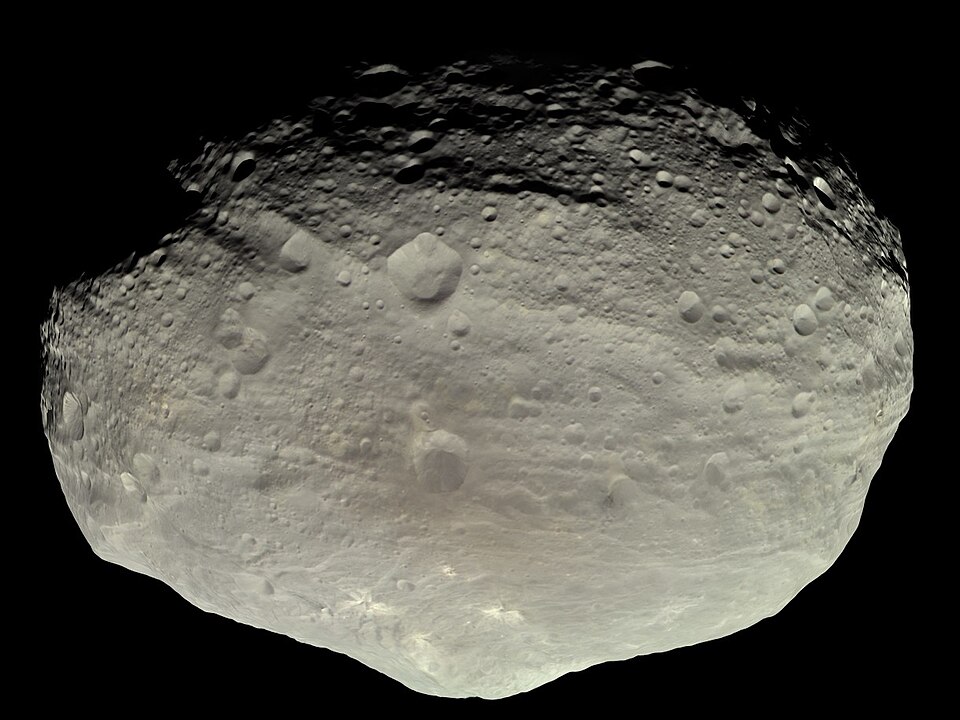
Some worlds look like but miss one of the rules. Vesta is the second most massive object in the . It was once round, but huge impacts later carved out two giant craters named Rheasilvia and Veneneia. Its shape no longer fits an equilibrium shape, so it is not usually counted.
Triton, the biggest moon of Neptune, is more massive than both Eris and Pluto. Scientists think it started out as a dwarf planet far out in the Solar System and was captured by Neptune. Phoebe, a moon of Saturn, is a captured object that was probably round early in its life. Probes such as Voyager 2 and Cassini have photographed them, and what they learned helps us understand dwarf planets.
At least 19 moons are round, and seven are heavier than Pluto or Eris. They fail the dwarf planet test only because they circle a planet and not the Sun. Alan Stern calls such moons 'satellite planets'.
Far beyond Pluto lies Sedna, which has an that takes it much farther out than Neptune. Sedna may be a dwarf planet, and James Webb Space Telescope results from 2022 suggest it has melted and changed inside, as larger worlds have. Astronomers expect more to be found.
Explore Next
Your audio story keeps playing while you look around.
Words to Know
- asteroid belt
- A region between Mars and Jupiter that holds millions of rocky bodies.
- cryovolcano
- A volcano that erupts ice, water or slush instead of hot rock.
- dwarf planet
- A round world that orbits the Sun but has not cleared its orbit of other objects.
- hydrostatic equilibrium
- The state of a world that gravity has pulled into a round or slightly squashed shape.
- International Astronomical Union
- The international group of astronomers that names and classifies objects in space.
- Kuiper belt
- A wide ring of icy bodies beyond the orbit of Neptune.
- orbit
- The path one object takes around another.
- plutoid
- A name the IAU gave in 2008 to dwarf planets beyond Neptune.
- tidally locked
- Always showing the same face to a partner world.
- trans-Neptunian object
- Any object that orbits the Sun farther away than Neptune.