Pluto
A small, icy world at the edge of the Sun's family, with a heart on its face.
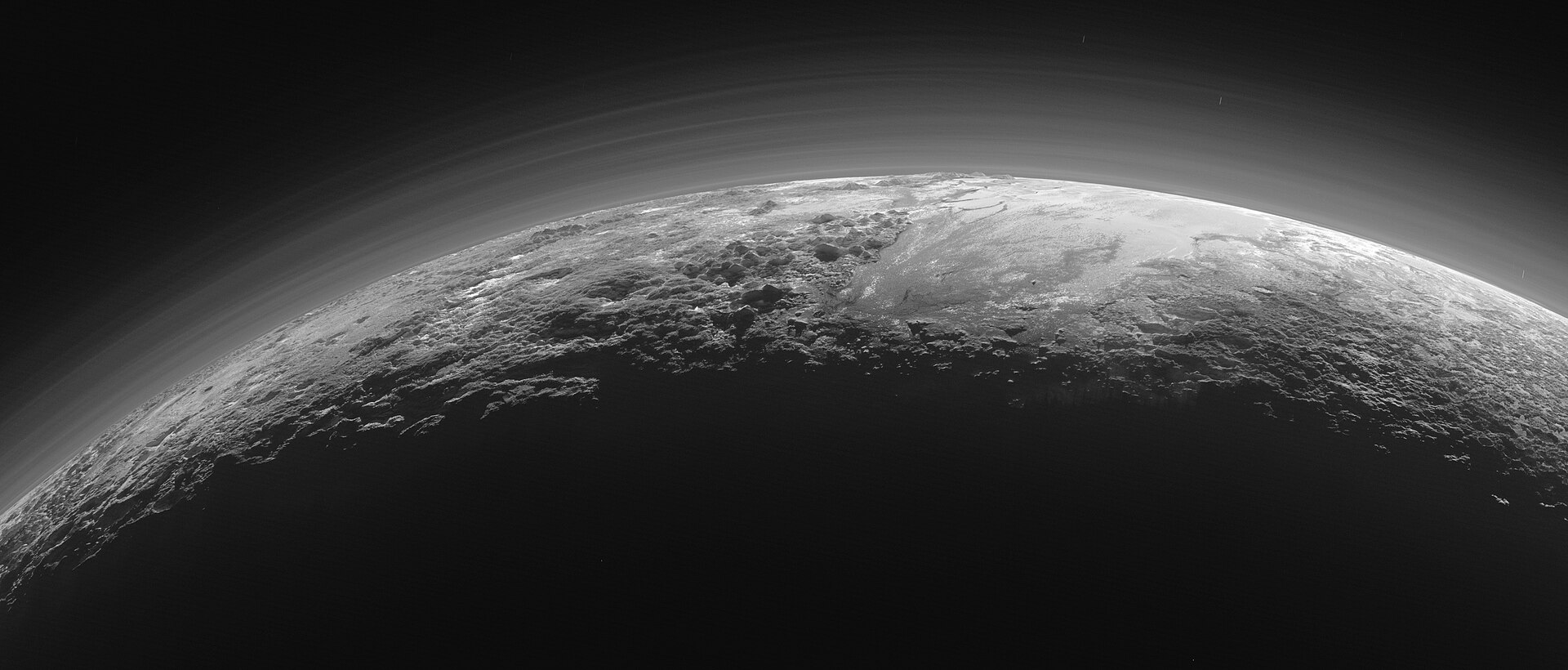
Pluto is a dwarf planet far beyond Neptune, so distant that sunlight takes 5.5 hours to reach it. It is smaller than our Moon and takes 248 Earth years to travel once around the Sun. When Clyde Tombaugh found it in 1930, the world called it the ninth planet. In 2006 astronomers changed the rules, and Pluto was given a new label. The story did not end there. In 2015 a spacecraft called New Horizons flew past and showed mountains of ice, a vast heart-shaped plain, blue haze and a possible hidden ocean. How was it found, why was it reclassified, and what is it really like?
What kind of world is Pluto?
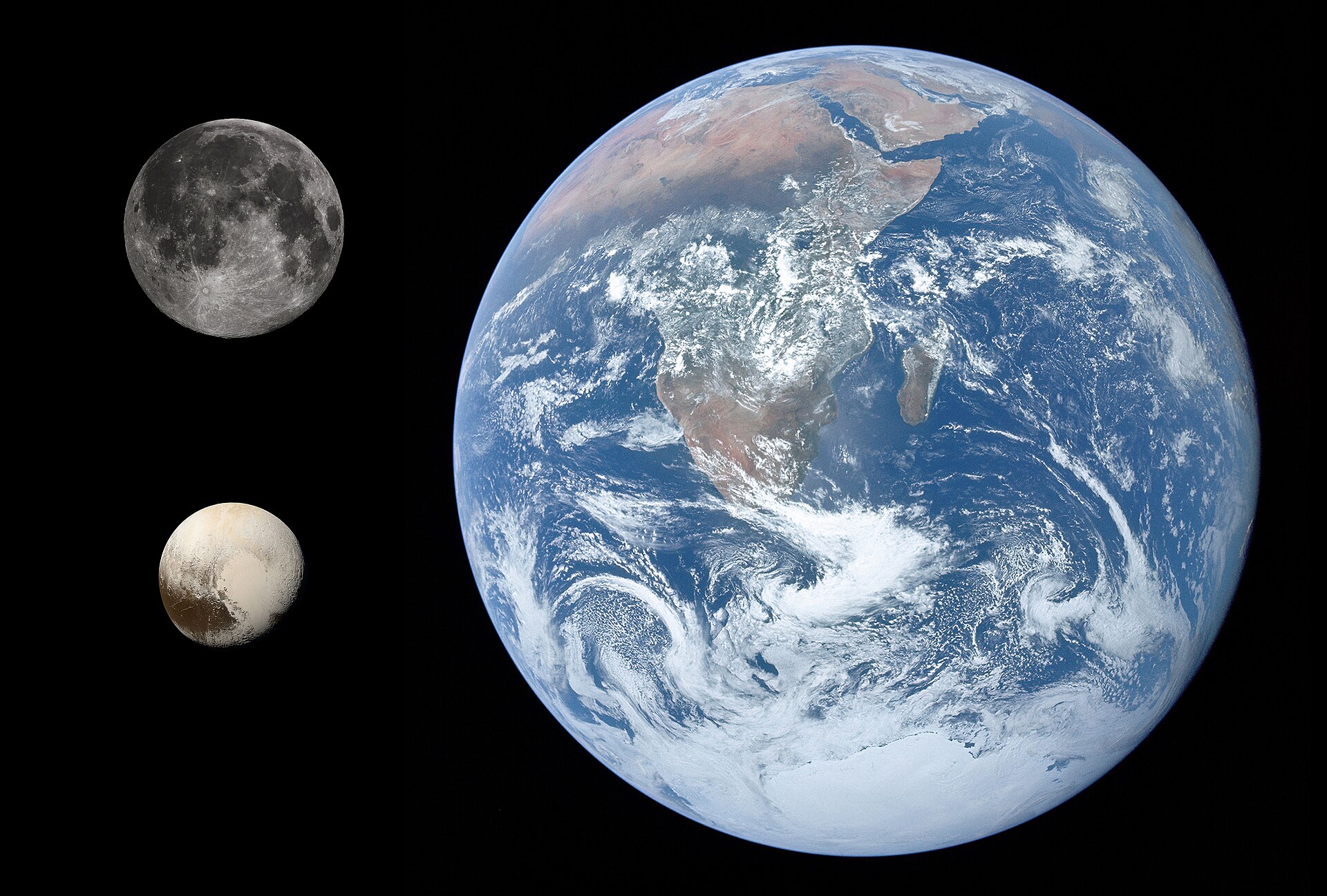
Pluto is a . That means it the Sun and is massive enough for its own gravity to pull it into a round shape, but it has not cleared other objects out of its path. It belongs to the , a wide ring of icy bodies beyond the orbit of Neptune.
Pluto is small. Its width is about 2,377 km, which is roughly two-thirds the width of our Moon. Its mass is only about one-sixth of the Moon's, and about 0.2 percent of Earth's. Its surface area is a little bigger than Russia's. Even so, it is the largest known object in the Kuiper belt by volume. Another dwarf planet, Eris, is slightly more massive, but Pluto is a touch wider.
Because Pluto is so light, its gravity is weak. You would weigh only about 6 percent of your Earth weight there. A jump would carry you far higher than on Earth.
Pluto is made of rock and ice. Scientists think a dense rocky core sits inside a thick layer of water ice. The surface is coated with frozen nitrogen, methane and carbon monoxide, which are gases on Earth. It is so far from the Sun that these gases freeze solid, the way water freezes in a winter puddle.
Who found Pluto, and who named it?
The hunt began with a puzzle. In the 1840s Urbain Le Verrier used the laws of gravity to predict where an unseen planet, Neptune, must be, because Uranus was being pulled off course. Later astronomers thought something else was still tugging at Uranus. The wealthy American Percival Lowell called this guessed-at world Planet X and searched for it from his observatory in Arizona until he died in 1916.
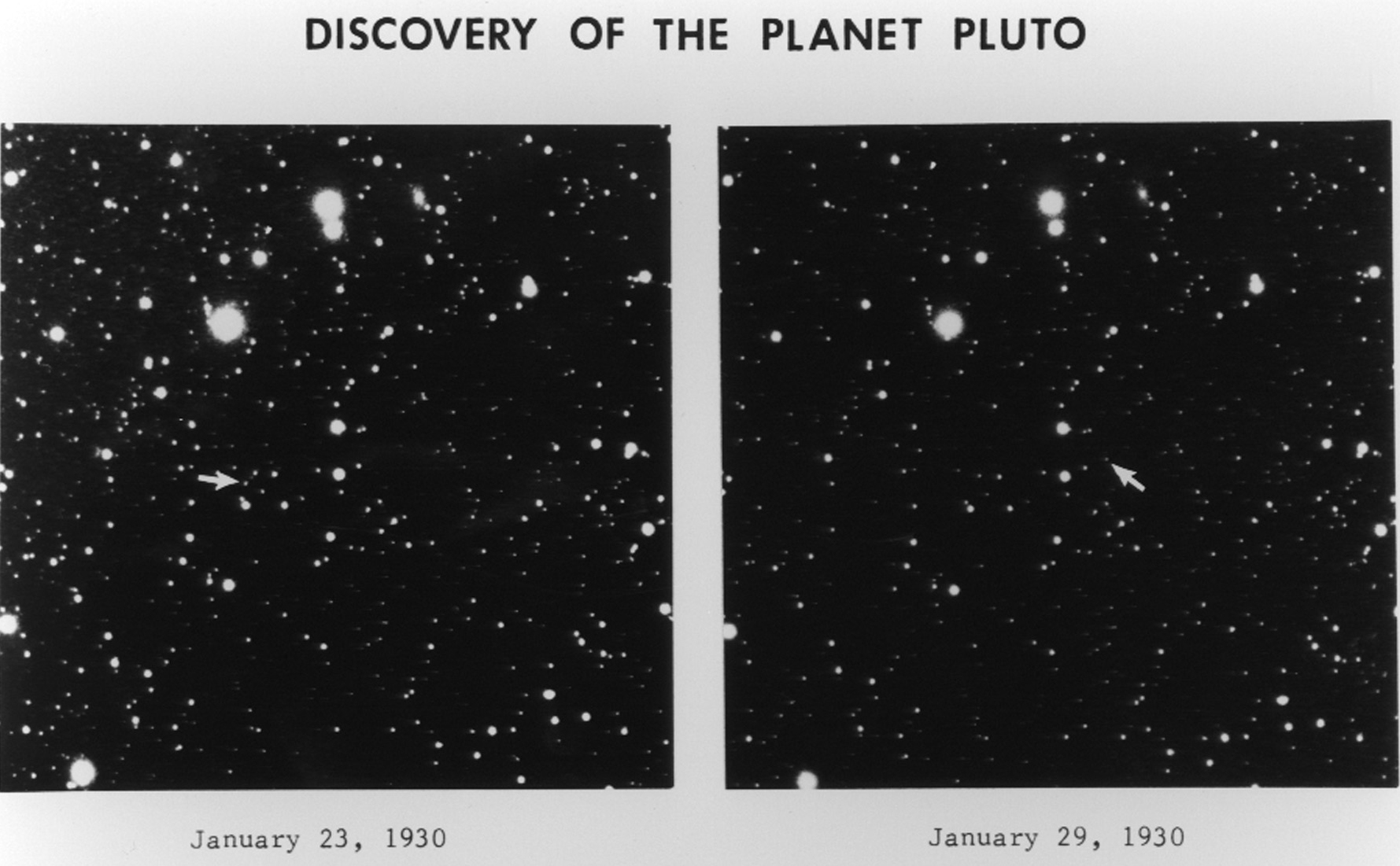
The search restarted in 1929. A young assistant named Clyde Tombaugh took pairs of photographs of the night sky, weeks apart. He then used a , a device that flicks quickly between two plates, so that anything that had moved seemed to jump. On 18 February 1930 he spotted a moving dot on plates taken that January. The discovery was announced on 13 March 1930.
Thousands of suggestions for a name arrived. One came from Venetia Burney, an 11-year-old schoolgirl in Oxford, England. She proposed Pluto, the Roman god of the underworld, because the planet was so dark and distant. Her grandfather passed the idea on, and the Lowell staff voted for it. The first two letters are also the initials of Percival Lowell. Pluto later gave its name to the element plutonium, and many people believe it also inspired Mickey Mouse's dog, though that link is unconfirmed.
Why is Pluto no longer called a planet?
At first Pluto looked like a proper ninth planet. Then it kept shrinking. Early estimates in 1931 said it was as heavy as Earth. In 1978 the discovery of its moon Charon allowed scientists to weigh Pluto properly, and it turned out to be only about 0.2 percent of Earth's mass. It was far too small to disturb Uranus, so Planet X had never been needed.
Then came a second shock. From 1992 astronomers began finding many icy bodies beyond Neptune, in the same region as Pluto. Pluto was not a lonely oddball. It was the first-known member of a crowd. In 2005 a team announced Eris, an object a little more massive than Pluto, which the press first called a tenth planet.
In August 2006 the International Astronomical Union, the group that sets official names in astronomy, voted on a definition. A planet must the Sun, be round, and have cleared the area around its orbit of other objects. Pluto fails the last test, because it shares its region with many other bodies. Earth, by contrast, has far more mass than all the other things in its path put together. Pluto was named a instead.
Not everyone agreed. Some planetary scientists, including the leader of the New Horizons mission, still call Pluto a planet. The argument is about how to define a word, not about what Pluto is made of.
Why does a year on Pluto last 248 Earth years?
Pluto is on average about 40 times farther from the Sun than Earth is. A far-away object has a longer path to travel and moves more slowly along it, so one lap takes about 248 Earth years. Pluto has completed less than one since 1930. It will finish its first lap since discovery in 2178.
The orbit is also unusual. The eight planets travel in nearly circular paths on a flat plane. Pluto's path is a stretched oval, tilted by more than 17 degrees. For about 20 years in each lap, it comes closer to the Sun than Neptune does. This last happened between 1979 and 1999.
So why do the two never collide? First, when Pluto is inside Neptune's orbit, it is also high above the plane, about 8 times the Earth-Sun distance north of Neptune's path. Second, the two worlds are locked in a pattern called a . Every time Neptune goes round the Sun 3 times, Pluto goes round 2 times. Their gravity keeps this rhythm steady, so they never come close. Many other objects share the pattern and are called .
Pluto also spins on its side. Its axis is tilted by 120 degrees, so its seasons are extreme. Its day lasts 6.4 Earth days.
What does Pluto's surface look like?
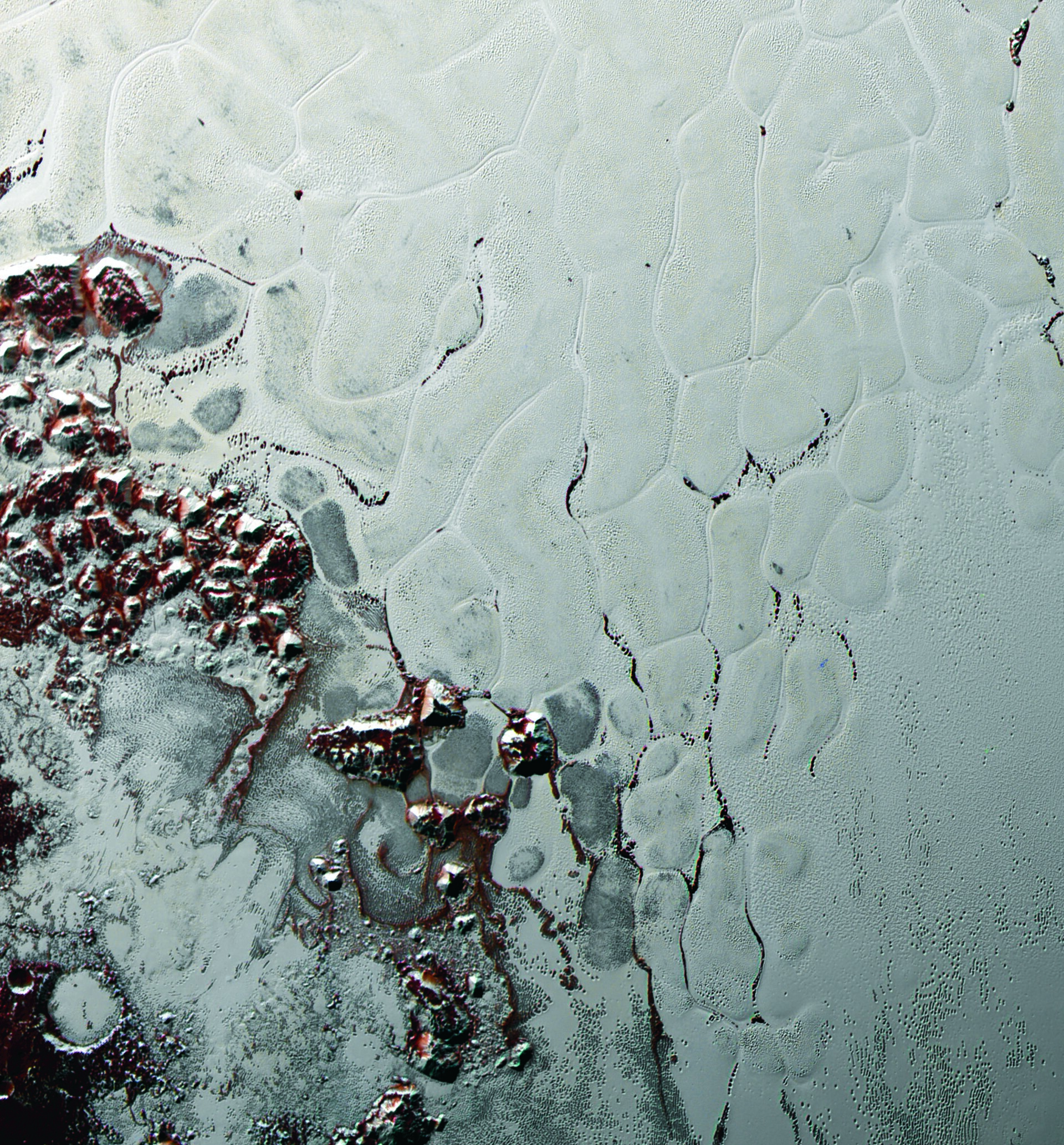
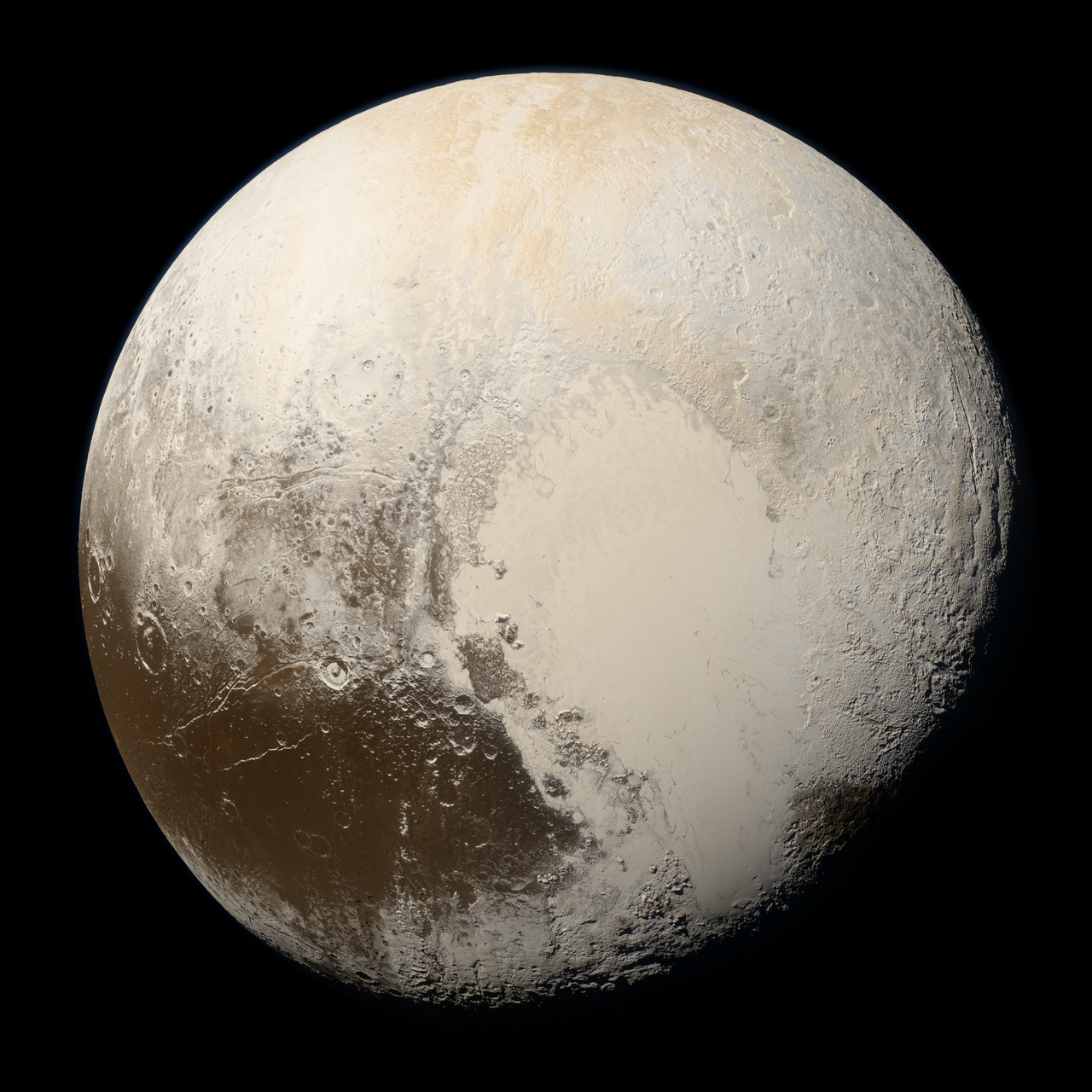
Before 2015 the best pictures of Pluto were a few blurry pixels. New Horizons changed that. It showed a world with as much contrast as any in the Solar System, with colours from charcoal black to dark orange to white.
The most famous feature is a bright, heart-shaped area named Tombaugh Regio, after the discoverer. Its left half is a huge basin called Sputnik Planitia, about 1,000 km wide. It is filled with frozen nitrogen and carbon monoxide, split into patterns of many-sided cells. Each cell is a place where slightly warmer ice rises from below, spreads, cools and sinks again, like the wax in a lava lamp. This is called .
The plain has almost no craters. Craters build up over time, so a surface without them must be young. Sputnik Planitia is less than 10 million years old, which is brief for a Solar System body that is about 4.6 billion years old. Glaciers of nitrogen ice flow into and out of the basin, and there are dunes made of tiny methane grains blown by wind.
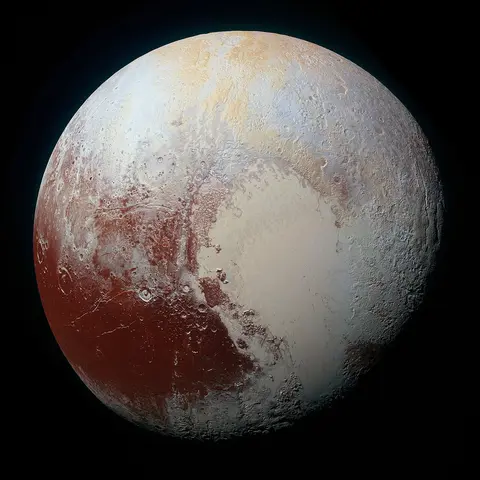
The mountains are made of water ice. At Pluto's temperatures, water ice is as hard as rock. Dark areas nicknamed the Whale and the Brass Knuckles show that the surface also has reddish and dark patches, probably made when sunlight changes gases in the air into tar-like stains.
Could there be an ocean inside Pluto?
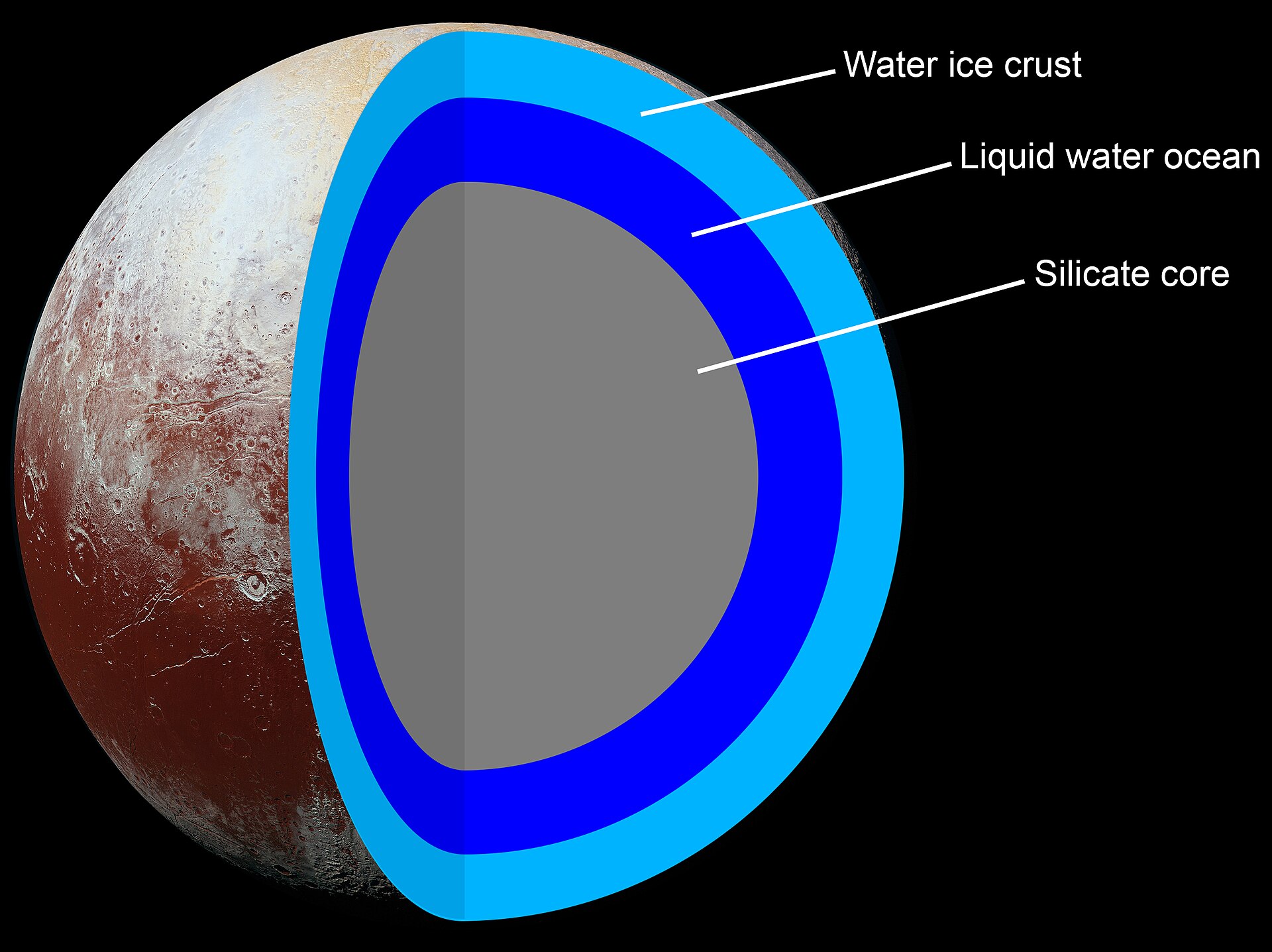
Nobody has looked inside Pluto, so scientists work out its interior from clues. One clue is its density, which is higher than ice alone. That suggests a rocky core wrapped in a mantle of water ice. When Pluto formed, the radioactive elements in its rock gave off heat. This warmth may have helped the rock sink to the middle while the ice floated above it.
That heat may not have faded completely. Some scientists think a layer of liquid water, perhaps 100 km thick, may still lie between the core and the icy mantle. Salty or antifreeze-like chemicals could stop it from freezing in the cold.
There is evidence for this idea. In 2016 researchers at Brown University simulated the impact that probably dug out Sputnik Planitia. Their results suggested that water from below welled up after the collision, which would need an ocean at least 100 km deep. A 2020 study went further and said Pluto may have had an ocean from the start, so it might once have been able to support life. A 2022 study proposed that the mountains Wright Mons and Piccard Mons are clusters of ice volcanoes. Such volcanoes erupt water and ammonia instead of lava, and they would need an inner heat source.
These ideas are still being tested. The ocean has not been confirmed.
Does Pluto have an atmosphere and blue skies?
Yes, but a very thin one. It is made mostly of nitrogen, with some methane and carbon monoxide. At the surface its pressure is roughly 100,000 to one million times lower than Earth's air pressure. It exists because ice on the surface slowly turns straight into gas, a change called . The gas and the ice stay in balance with each other.
Pluto's atmosphere changes with the seasons. Scientists once expected it to freeze onto the ground as Pluto moved away from the Sun. Measurements show it stays gaseous around the whole . In 2019 and 2021 astronomers reported that the pressure had fallen by about 20 percent since 2016, so the atmosphere keeps surprising us.
New Horizons took a picture while looking back at Pluto after passing it. Sunlight was behind the , and about 20 thin, evenly spaced layers of blue haze glowed around its edge, reaching up to 150 km high. They may be pressure waves caused by air flowing over mountains. The haze is made of tiny particles, which scatter blue light, much as air does in Earth's sky.
The air also has a surprise. Methane warms the atmosphere to a temperature a few tens of degrees above the ground. Yet the upper air was colder than predicted.
Why do Pluto and Charon circle each other?
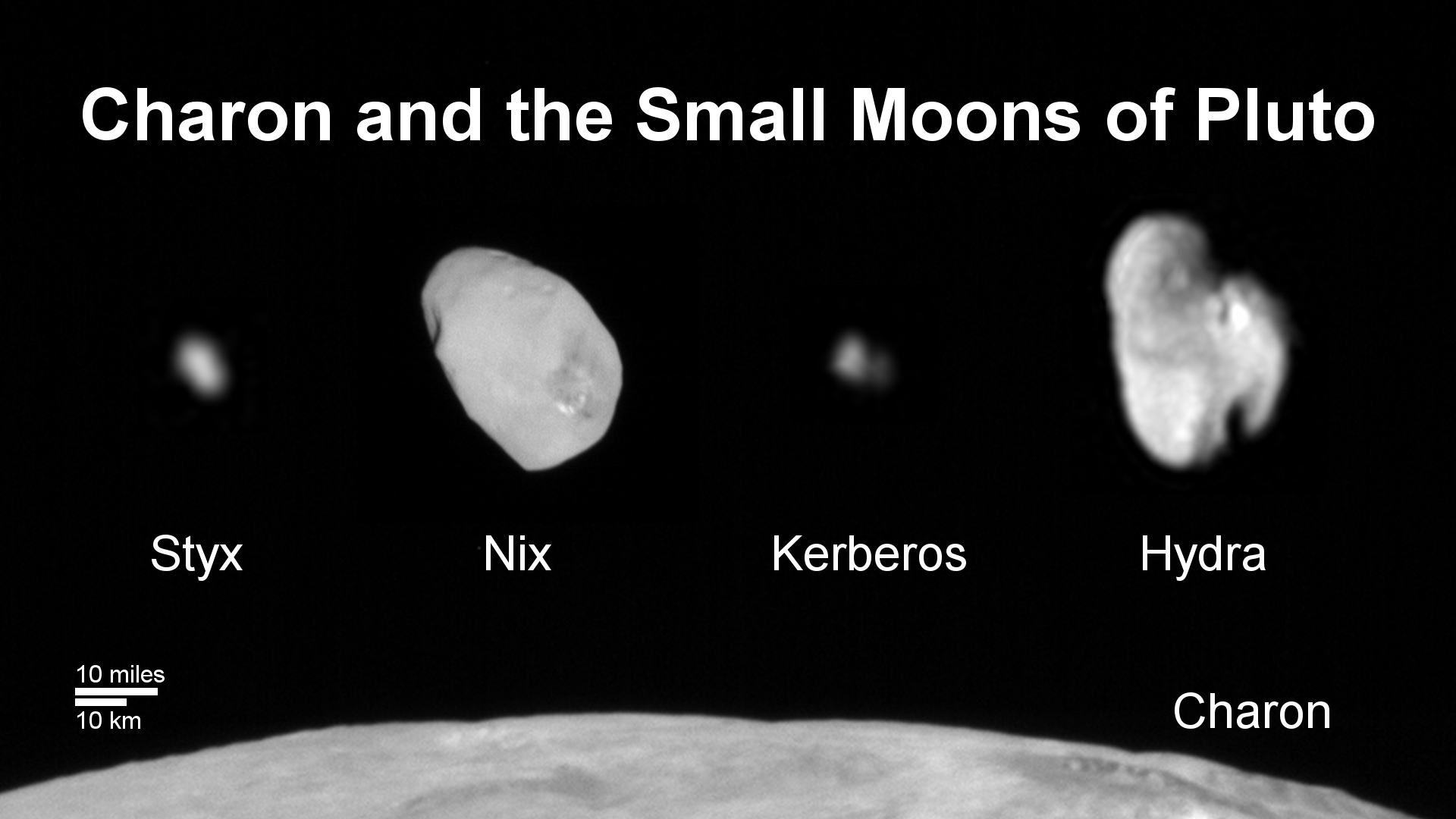
Pluto has five known moons. The biggest, Charon, was found in 1978 by the astronomer James Christy. Its width is just over half of Pluto's, which is huge for a moon. Charon is so massive that the point the two worlds balance around, called the , lies outside Pluto, in the space between them. The two bodies that point like partners in a dance, so some scientists call them a double .
They are also . Each keeps the same face toward the other, much as the Moon always shows us one side of itself. That means you could see Charon from only one half of Pluto. From that side it would hang almost still in the sky.
Four small moons orbit beyond Charon, in this order: Styx, Nix, Kerberos and Hydra. Nix and Hydra were found in 2005 using the Hubble Space Telescope, Kerberos in 2011 and Styx in 2012. They are tiny, irregular lumps of ice, only tens of kilometres across. Their names come from the same story as Pluto. Styx is a river of the underworld and Kerberos is a version of Cerberus, the dog that guarded it. Nix is a goddess of darkness and Hydra a many-headed serpent.
Many scientists think Charon formed after a giant collision, much as the Moon is thought to have formed from Earth.
How did a spacecraft reach Pluto?
For decades Pluto was only a dot, even in large telescopes. From Earth it is so faint that you need a telescope with a mirror around 30 cm wide to see it, and it never shows a disc. Early maps came from watching Charon pass in front of Pluto and measuring the changing brightness. Later the Hubble Space Telescope made blurry maps.
In January 2006 NASA launched New Horizons toward Pluto. In early 2007 it used the gravity of Jupiter as a slingshot to gain speed. After 3,462 days of travel, it passed Pluto on 14 July 2015 and flew by at high speed. It had no fuel to stop and settle into . The science began five months before the closest approach and continued afterwards.
The spacecraft carried cameras, instruments for studying the chemistry of surfaces and a radio experiment to probe the atmosphere. Sending the pictures home was slow. The very last of the 6.25 gigabytes of data from the encounter did not arrive until 25 October 2016.
New Horizons only photographed the northern half of Pluto and the equator in detail, so large parts of the south are still unseen. Scientists have argued for a new orbiter that would use Charon's gravity to steer and map the whole world. After Pluto, New Horizons moved on to explore other objects.
Explore Next
Your audio story keeps playing while you look around.

Words to Know
- barycentre
- The balance point that two bodies orbit around.
- blink comparator
- A device that flicks between two photographs so that moving objects seem to jump.
- convection
- The slow churning of a material as warmer parts rise and cooler parts sink.
- dwarf planet
- A round object that orbits the Sun but has not cleared its orbit of other bodies.
- flyby
- A space mission that passes close to a target without stopping or orbiting it.
- Kuiper belt
- A ring of icy bodies beyond the orbit of Neptune.
- orbit
- The path an object takes around another.
- plutino
- A Kuiper belt object that orbits twice for every 3 orbits of Neptune.
- resonance
- A steady pattern in which two orbiting bodies repeat the same positions, such as Pluto's 2 laps to Neptune's 3.
- sublimation
- Turning straight from a solid into a gas without becoming a liquid.
- tidally locked
- Always showing the same face to the body it orbits.