Spiral galaxy
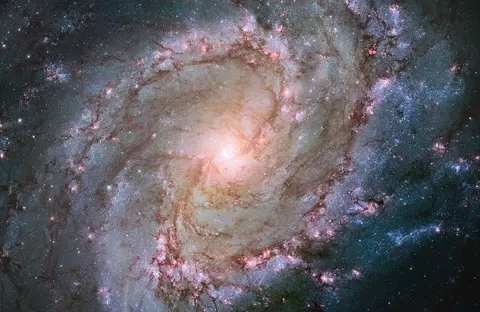
Giant spinning cities of stars, with glowing arms that curl around a bright heart.
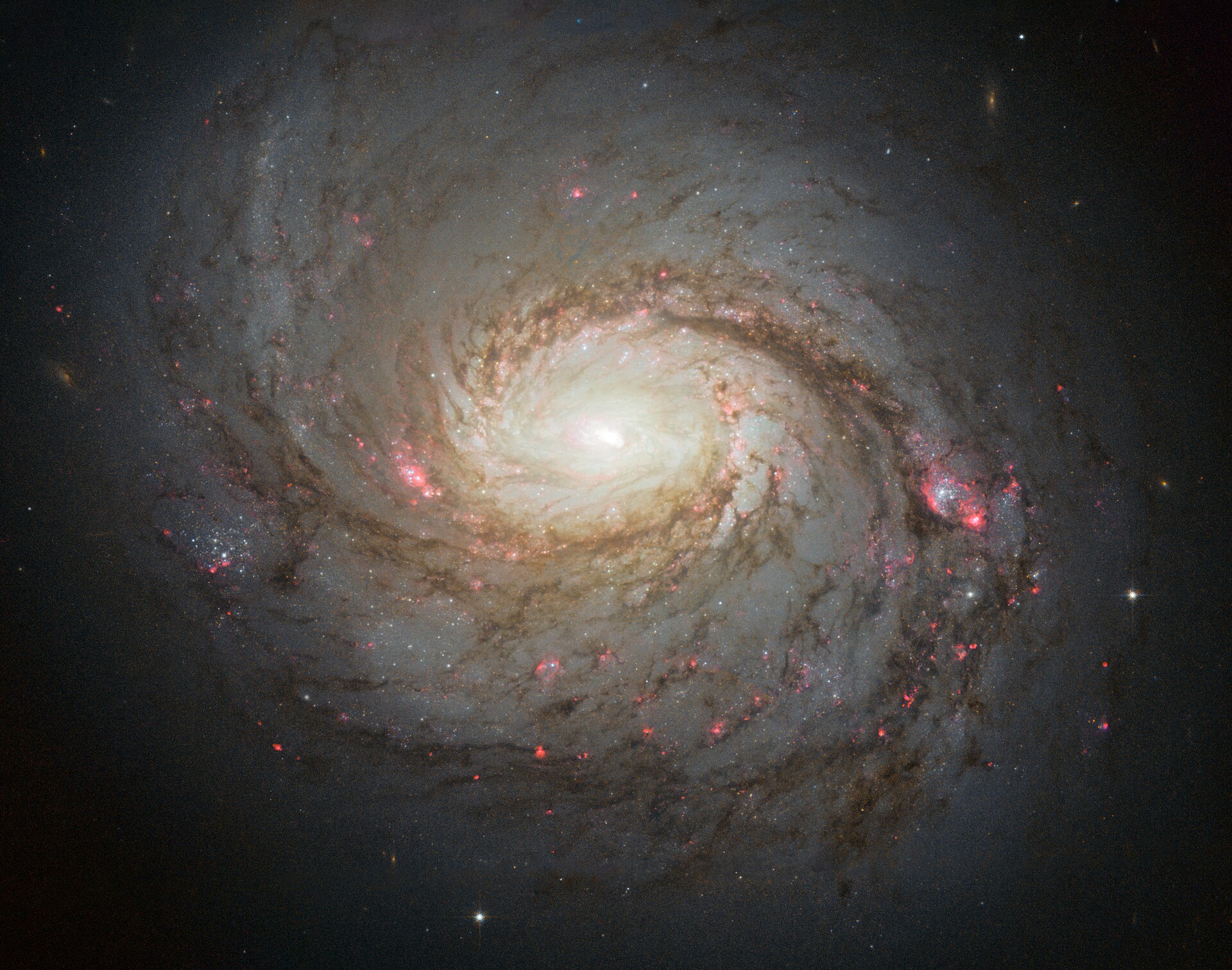
A spiral galaxy is a huge, flat disc of stars, gas and dust that spins around a bright centre. Curling arms sweep out from the middle, which gives these galaxies their name. Our own Milky Way is a spiral galaxy, and so is its neighbour Andromeda. Each one holds many billions of stars. The arms glow because they are full of newborn stars. Astronomers first saw the swirls in the 1800s and thought they were clouds inside our own galaxy. Then they found out the truth, and our picture of the Universe grew far larger.
What is a spiral galaxy?
A is a giant family of stars held together by gravity. Galaxies come in several shapes. Some are round balls of old stars, called elliptical galaxies. Some have no clear shape at all and are called irregular. A spiral galaxy is the kind that looks like a cosmic pinwheel, with a flat, spinning and arms that curl outwards from the centre.
Most spirals have the same basic parts. The disc is a thin sheet of stars, gas and dust. At the middle sits the , a thick, tightly packed crowd of stars. Around everything lies a much fainter . Together these parts can hold many billions of stars.
The disc is very thin compared with its width. Its thickness is at most about one fifth of its width, and in many spirals it is far less. If you could shrink a spiral to the size of a dinner plate, the disc would be no thicker than a short stack of pancakes. That flat shape is a clue to how spirals work. Everything in the disc is turning around the same centre, a bit like water circling a plughole.
Astronomers sort galaxies using a scheme set out by the American astronomer Edwin Hubble. He published the scheme in 1926 and described spirals in his 1936 book The Realm of the Nebulae. Today spirals and irregular galaxies together make up about 60% of the galaxies in the Universe. Spirals mostly live in quiet, thinly filled parts of space, and they are rare in the crowded hearts of galaxy clusters.
What is inside a spiral galaxy?
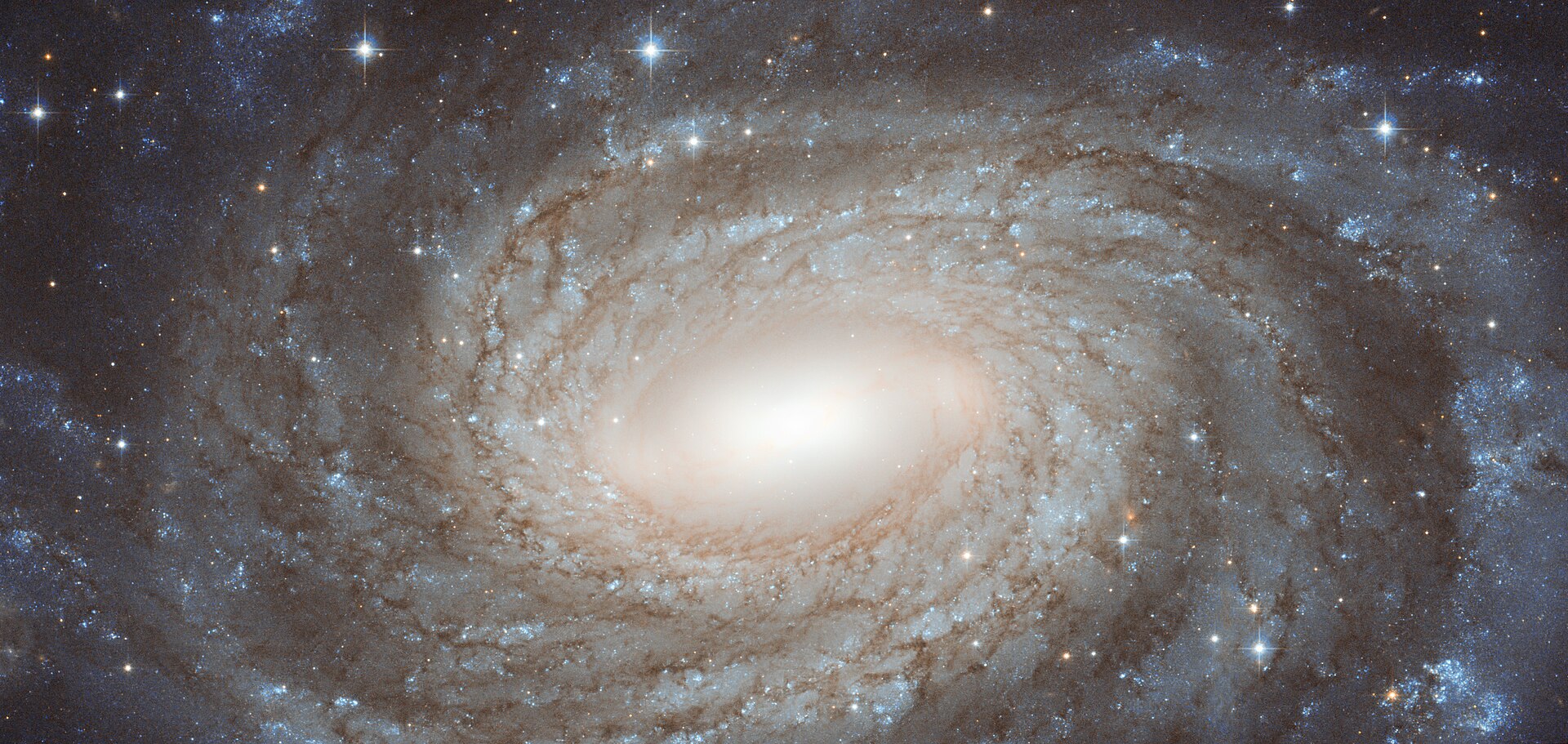
A spiral is built from several layers, and each one has its own story.
The holds most of the bright material. Here you find young stars, old stars, clouds of gas and lanes of dust. The disc spins, so the stars in it travel in big, nearly circular paths around the centre.
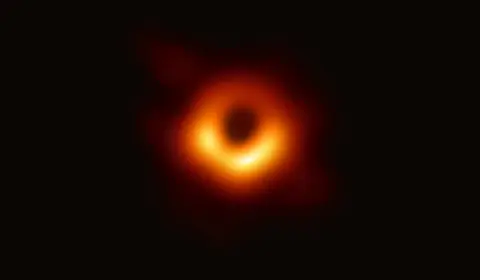
The sits in the middle of the disc. In many spirals it is made mostly of older, redder stars, and it looks like a small elliptical galaxy. In others it is smaller and holds younger, bluer stars. Many bulges seem to hide a at their very centre. This is an object with the mass of millions of stars or more, squeezed into a tiny space. Our own galaxy has one, called Sagittarius A*. Astronomers have found evidence for the same thing in other spirals, such as Messier 106.
The is a roughly round cloud around the whole galaxy. It holds some old stars and many , which are tight balls of very old stars. Halo stars do not always follow tidy paths. Some of them came from small galaxies that merged with the spiral and were pulled apart. The Milky Way is swallowing a small galaxy this way right now.
Finally, there is a halo of dark matter. We cannot see it, but astronomers believe it exists because of the way spiral galaxies spin.
Why do the arms shine so brightly?
Look at a picture of a spiral and your eye goes straight to the arms. They are brighter than the space between them, and the reason is the kind of stars they hold. Spiral arms are busy star nurseries. Clouds of gas and dust gather there and collapse to form new stars. Many of these new stars are big, hot and blue. They burn fiercely and shine far more brightly than a star like our Sun.
Big stars also live fast. They use up their fuel in a few million years, which is a blink in the life of a galaxy. So the brightest stars are always found close to the place where they were born. That keeps the arms glowing.
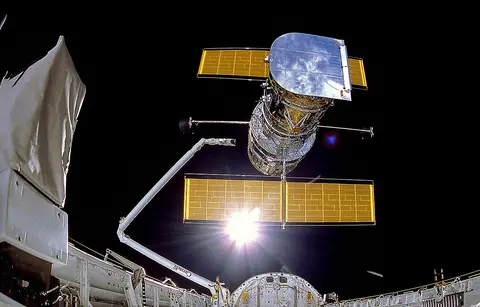
Older stars are spread more widely, and they glow more gently. , which telescopes such as Webb can see, helps to pick them out. Their light shows the full shape of the galaxy, not only the bright young arms.
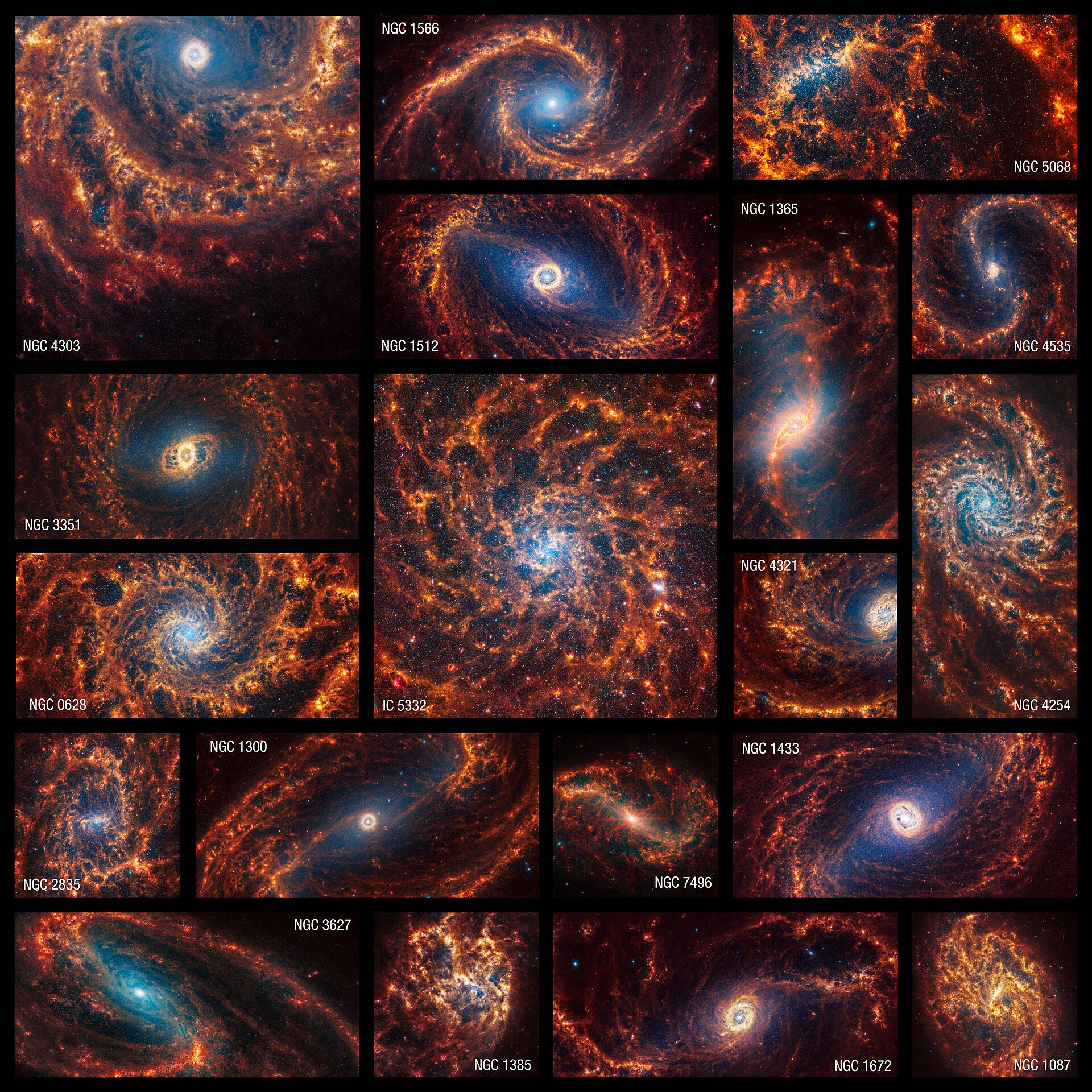
The James Webb Space Telescope has photographed 19 nearby spirals. In those images millions of stars appear as tiny points of light. Looking at so many galaxies together shows how alike spirals are, even though each one is different in the details.
Why do some spirals have a bar?
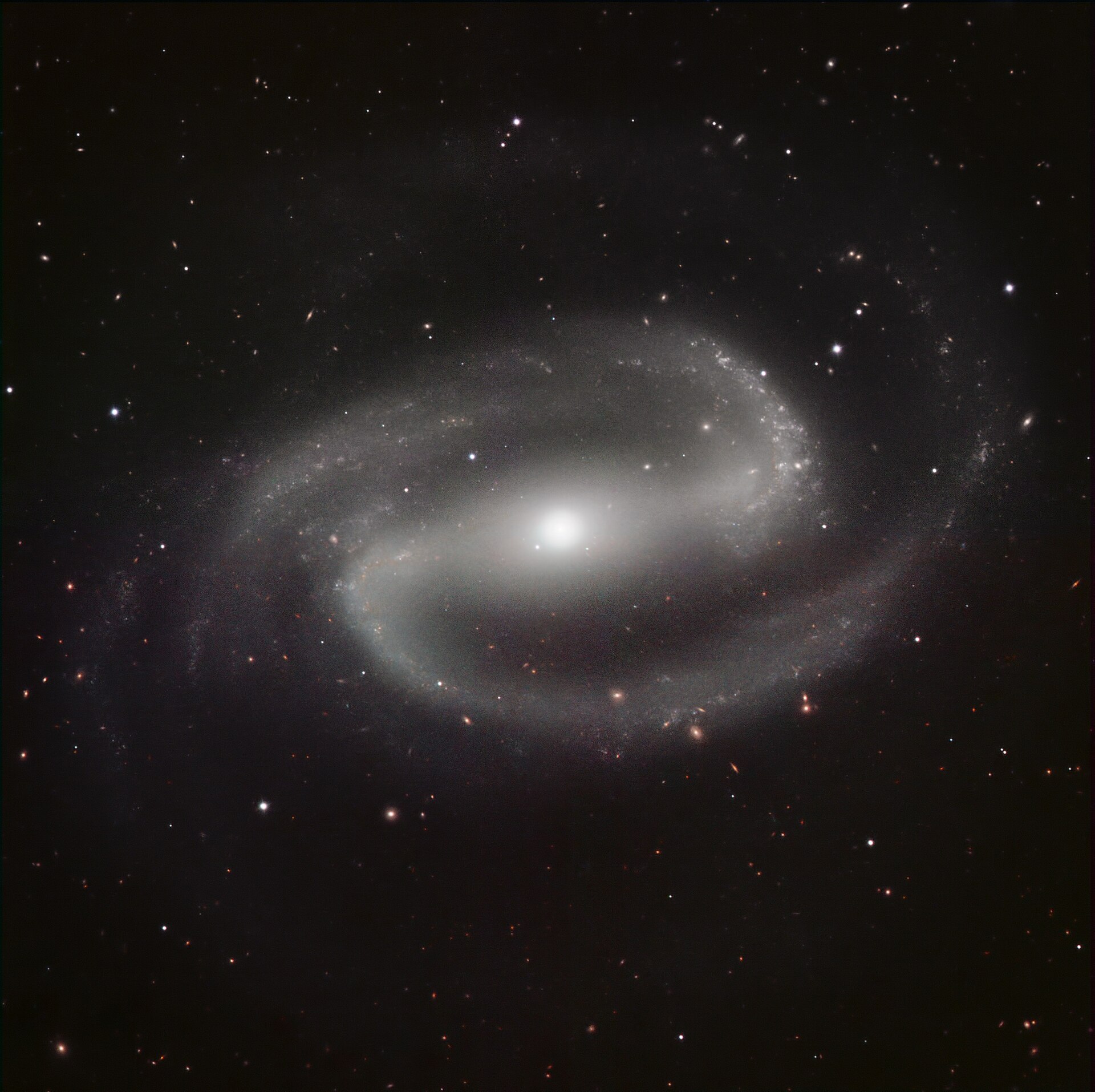
Many spiral galaxies have a long bar of stars running across the middle. The arms do not begin at the centre. They start at the ends of the bar. About two-thirds of spirals have such a bar, and they are called . The bar can be strong and easy to see, or weak and hard to spot. Astronomers add a capital B to the name of the type, as in SBc.
Bars are not a permanent feature of the Universe. They seem to build up over a very long time. Light from faraway galaxies is very old, so looking far away is like looking back in time. About 8 billion years ago only about 10% of spirals had bars. About 2.5 billion years ago the share was about one quarter. Today about two-thirds of nearby spiral galaxies have them.
A bar may help to move gas inwards, towards the centre of a . That gas could then feed new star formation or a black hole. Astronomers are still studying how much this really happens.
If a spiral is seen edge-on, its bar is hard to see. Even so, astronomers can sometimes spot X-shaped or peanut-shaped patterns of stars above and below the . These patterns are a sign that a bar is hidden inside.
Is our own galaxy a spiral?
Yes. The Milky Way is a spiral , and it has a bar. We live inside it, about halfway between the centre and the edge. That makes it hard to study. It is a bit like trying to map a city while standing in one of its streets.
For a long time astronomers thought the Milky Way was an ordinary spiral without a bar. In the 1960s they began to suspect that it had one. The proof came in 2005. The Spitzer Space Telescope, which sees that can pass through dust, showed that the bar in the middle of our galaxy is even bigger than anyone had thought.
At the heart of the Milky Way lies Sagittarius A*, a . It has about 4 million times the mass of the Sun.
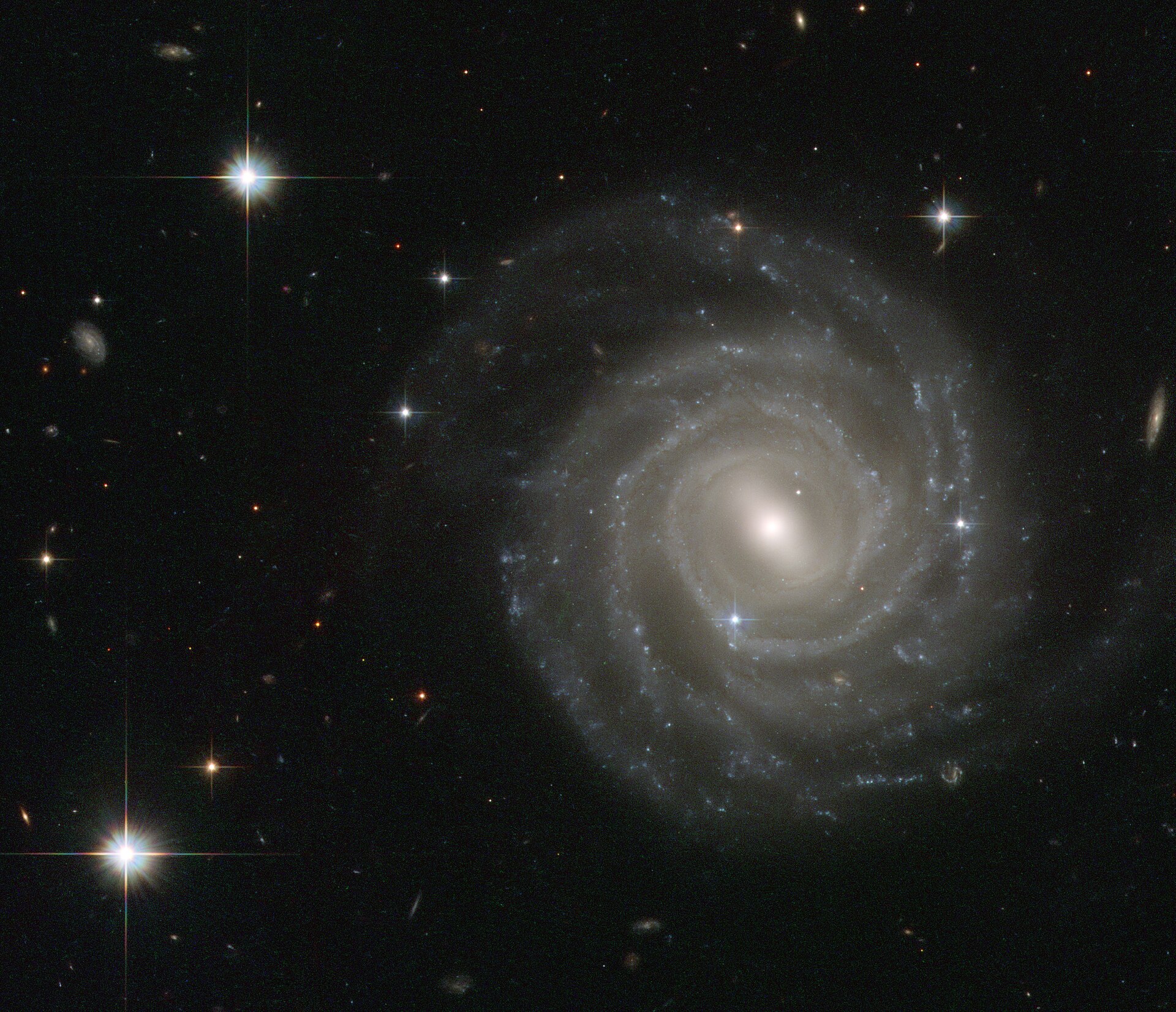
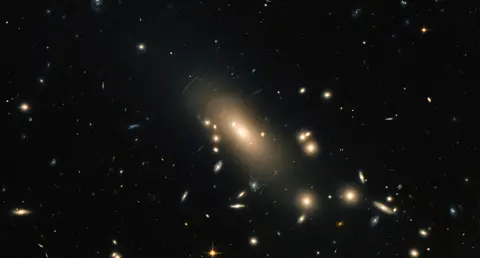
A different galaxy, UGC 12158, is a seen face-on, and it is a useful guide to what our own galaxy might look like from far above. It has a bar across the middle and arms that curl away from the ends of the bar, which is the pattern astronomers think the Milky Way follows.
Seen from Earth, the Milky Way is the pale band of light that stretches across a dark night sky. That band is our view along the .
How do astronomers sort spiral galaxies?
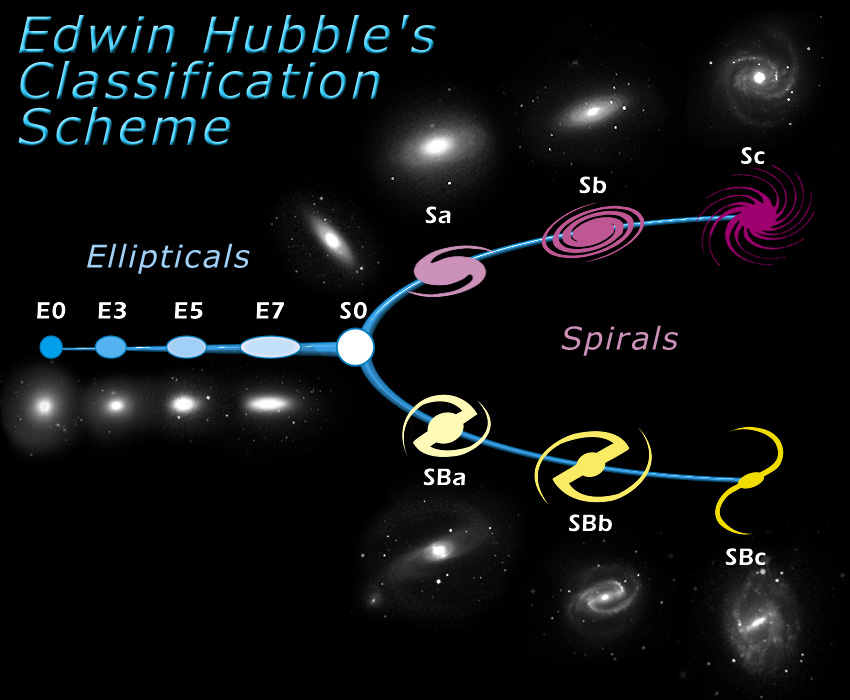
Edwin Hubble sorted galaxies by their shape. His scheme is called the Hubble sequence, and people often draw it as a tuning fork. On the handle are the round elliptical galaxies. The fork splits into two prongs. One prong holds ordinary spirals and the other holds .
Along each prong, galaxies are labelled with a small letter: a, b or c. The label tells you how tightly the arms are wound and how big the is.
Sa galaxies, and the barred version SBa, have a large bulge and arms wrapped tightly around it. The bulge is mostly made of old, red stars. Sc and SBc galaxies sit at the other end. They have a small bulge made of young, blue stars, and their arms are loose and open. Sb galaxies fall in between.
The scheme is neat, but nature is not always neat. In June 2019, volunteers from the Zoo project reported results which suggest that the usual classification of spirals may need updating. Galaxy Zoo is a project where members of the public help astronomers sort pictures of galaxies.
Even so, the tuning fork is still a well known way to organise galaxies, and it is a good starting point for anyone learning to read their shapes.
Why do spiral arms exist?
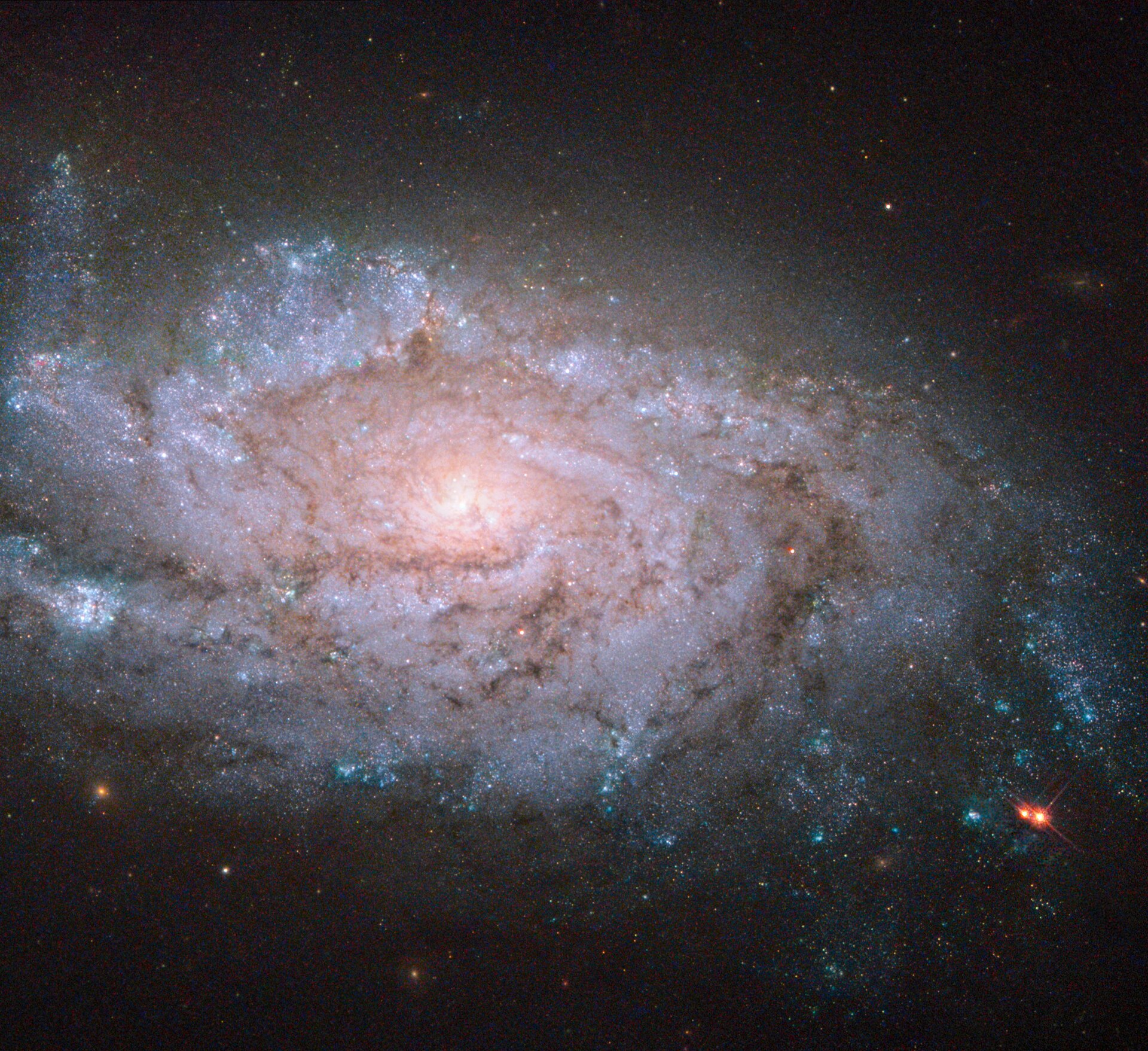
This question puzzled astronomers for decades. A first guess is that the arms are fixed lines of stars, like the spokes of a wheel. In 1925 a Swedish astronomer called Bertil Lindblad showed that this cannot be true. Stars close to the centre of a complete their orbits faster than stars far out. If arms were fixed lines of stars, the inner parts would race ahead. After a few turns the arms would be wound up tight like a clock spring. This is called the winding problem.
Yet real spiral arms do not wind up. So something else must be going on. In 1964 the astronomers C. C. Lin and Frank Shu built the first successful theory. They said that arms are not fixed groups of stars at all. They are waves of extra density, a bit like a traffic jam on a motorway. Cars move into the jam, slow down, and then leave it again. In the same way, stars and gas drift into an arm, linger for a while, and then move out the other side.
When gas is squeezed inside the wave, it forms new stars. That is why arms are full of young, bright stars. A second idea says that exploding stars send shock waves through gas, which trigger more star birth nearby. Both ideas may be partly right and could explain different types of arms.
How did we find out they are galaxies?
For a long time nobody knew what spirals were. In 1845 an Irish astronomer, Lord Rosse, pointed his huge telescope, nicknamed the Leviathan, at a fuzzy patch of light called M51. He saw that it had a spiral shape, and he drew it. His drawings look a lot like modern photographs. The patch became known as the Whirlpool . He found more swirls in Messier 99 and Messier 33, and in 1850 he made the first drawing of the spiral shape of Andromeda.
These objects were called spiral nebulae, because was the word for any fuzzy cloud in the sky. Many astronomers thought they were gas clouds inside our own galaxy. Others suspected they were separate galaxies, far away.
In 1920 two astronomers, Heber Curtis and Harlow Shapley, argued about this in what is now called the Great Debate. Neither could settle it with evidence.
The answer came in 1923 and 1924. Edwin Hubble found in some of the spiral nebulae, including the one in Andromeda. A Cepheid is a star that brightens and fades in a steady pattern. Its pattern tells astronomers how bright it really is, so they can work out how far away it is. Hubble's measurements put these stars far outside the Milky Way. The spirals were whole galaxies, each one like ours. The phrase spiral nebula soon fell out of use.
How far back can we see spiral galaxies?
Light takes time to travel across space. When we see a faraway , we see it as it was when its light set out. That makes telescopes a kind of time machine. The farthest spirals show us what galaxies looked like billions of years ago.
As of 2024, the oldest and most distant known spiral is BRI 1335-0417. Its light took about 12.4 billion years to reach Earth. Another galaxy, called Zhúlóng, may be even older, but this is still being studied. A2744-DSG-z3 is the oldest known spiral with many arms. Its light has been travelling for about 11.5 billion years.
Another very early spiral is BX442. It is about 11 billion years old, which is more than 2 billion years older than any grand design spiral found before it. Grand design spirals are the ones with two bold, clear arms. Computer models suggest that BX442 has its shape because a small companion galaxy is tugging on it with gravity. The same models say its spiral pattern will last only about 100 million years.
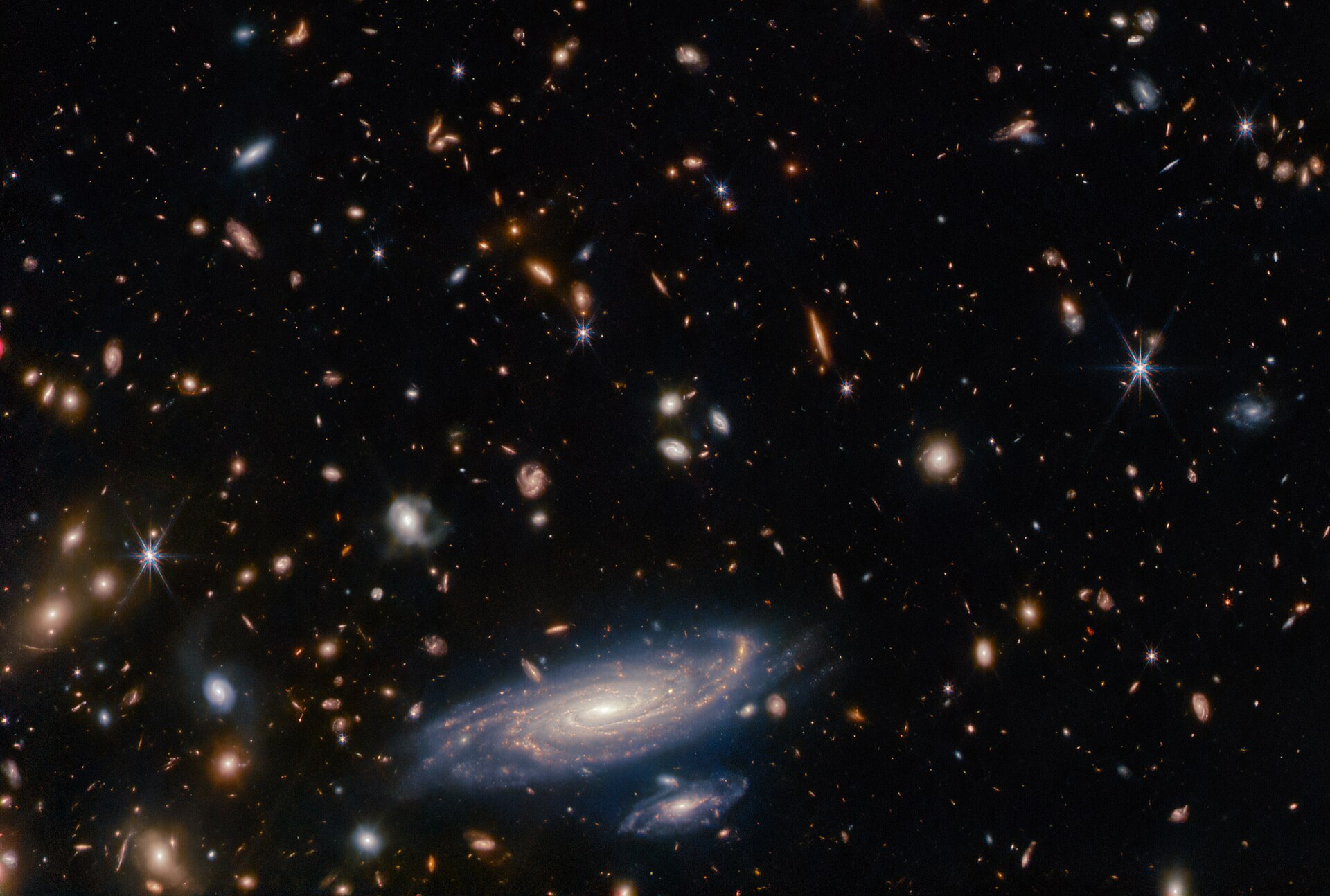
Not every spiral is far away. NGC 2008 lies about 425 million from Earth. Another spiral, LEDA 2046648, is about 1 billion light-years away. Webb has photographed it among thousands of other galaxies.
Explore Next
Your audio story keeps playing while you look around.
Words to Know
- barred spiral
- A spiral galaxy with a bar of stars across its middle.
- bulge
- The thick, crowded group of stars at the centre of a spiral galaxy.
- Cepheid variable
- A star that brightens and fades steadily, which helps astronomers measure distances.
- density wave
- A moving ripple of extra crowding that forms a spiral arm.
- disc
- The flat, spinning part of a spiral galaxy where the arms lie.
- galaxy
- A huge group of stars, gas and dust held together by gravity.
- globular cluster
- A tight ball of very old stars.
- halo
- A faint, roughly round cloud of old stars around a galaxy.
- infrared light
- Light with a longer wavelength than we can see, which can pass through dust.
- light-year
- The distance light travels in one year, about 9.5 trillion kilometres.
- nebula
- A cloud of gas and dust in space, or in the past any fuzzy patch in the sky.
- supermassive black hole
- A black hole with the mass of millions of stars or more, found at the centre of most large galaxies.