Stellar evolution
How stars are born, shine for ages and die in ways that depend on their weight.
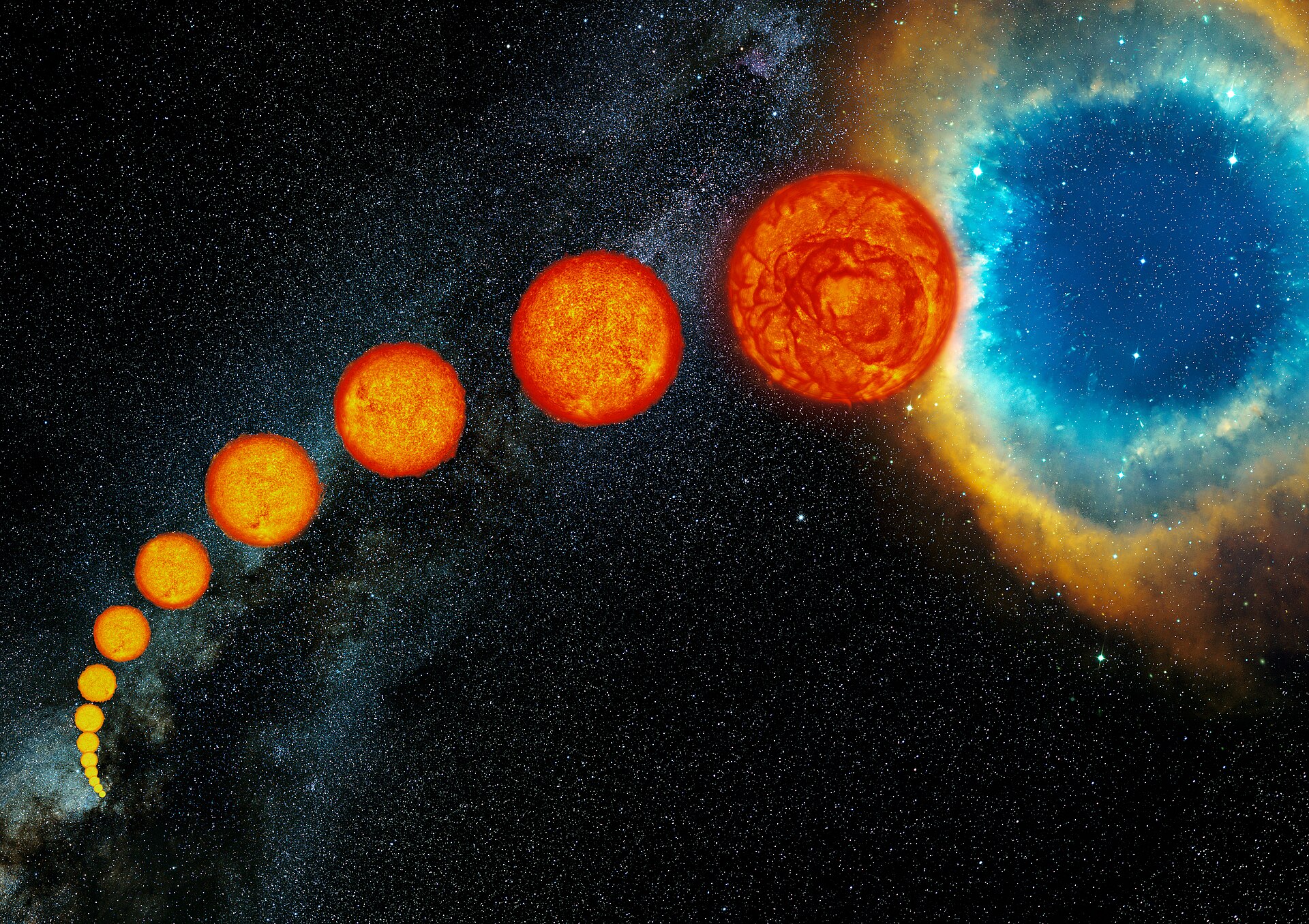
Stars look fixed in the night sky, yet every one of them is changing. Each is born in a cloud of gas and dust, shines for millions or trillions of years, and eventually runs out of fuel. How it ends depends on how much mass it has. A star like our Sun fades into a glowing shell and a small, dense white dwarf. A giant star explodes as a supernova and leaves a neutron star or a black hole. Astronomers cannot watch one star for its whole life, so they piece together the story from many stars and computer models. What makes one star fade quietly and another explode?
What is the life story of a star?
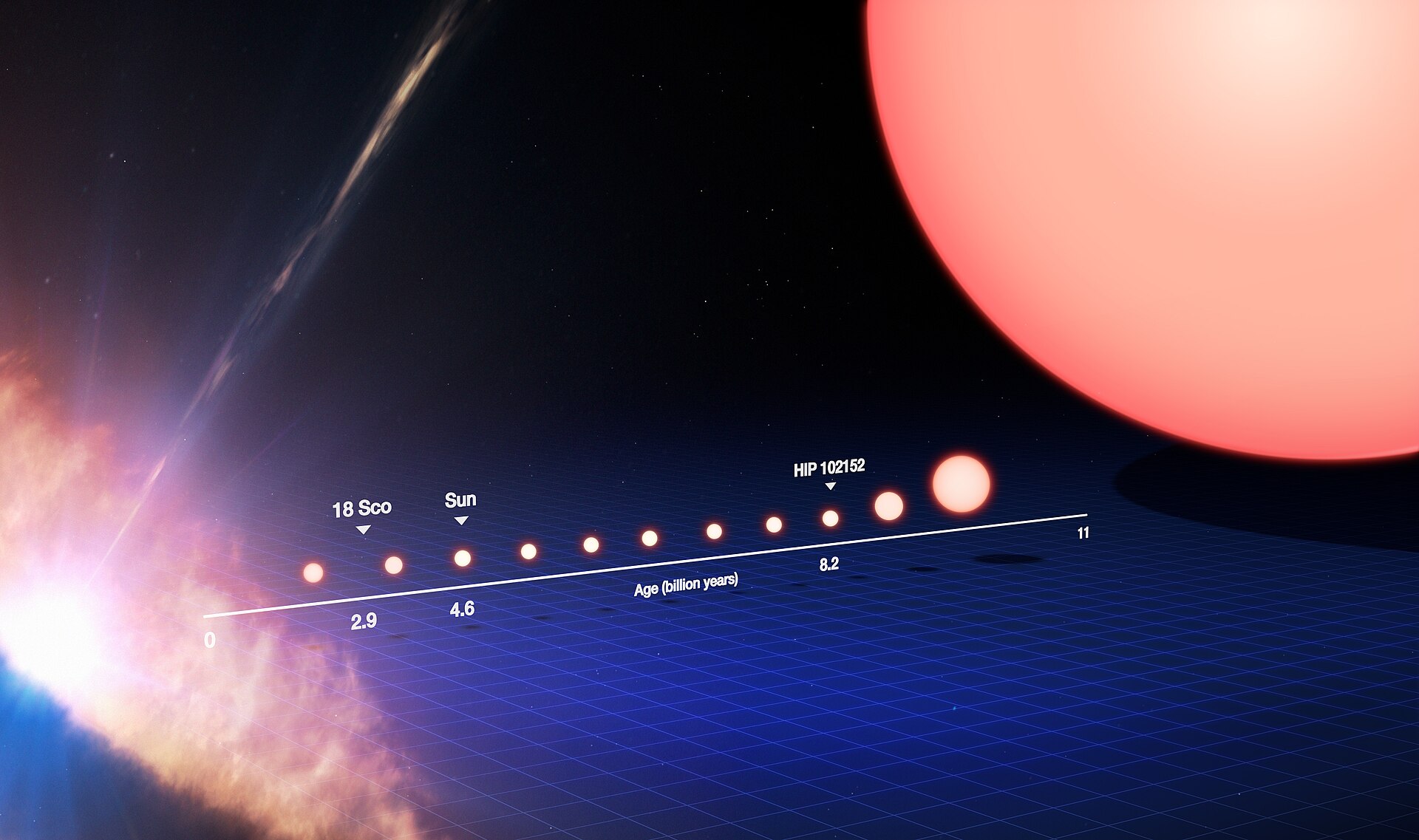
Stars are born, they live for a very long time, and they die. Astronomers call this journey stellar evolution. The word evolution here means change over time. It has nothing to do with living things.
Every star begins as a cloud of gas and dust floating in space. Gravity pulls the cloud together, and it heats up until it starts to shine. For most of its life a star is stable. It turns hydrogen into helium deep in its core, and this releases the energy that makes it glow.
What happens next depends on one thing above all, the star's mass. Mass is how much matter an object contains. Astronomers measure it in , where 1 solar mass is the mass of our Sun.
A star like the Sun swells into a , puffs off its outer layers and shrinks to a . A star with about 10 times the Sun's mass or more ends in a huge explosion called a . It leaves behind a or a .
Mass also sets the length of a star's life. The heaviest stars last only a few million years. The lightest ones can shine for trillions of years, far longer than the universe has existed so far.
How can we know what stars do over billions of years?
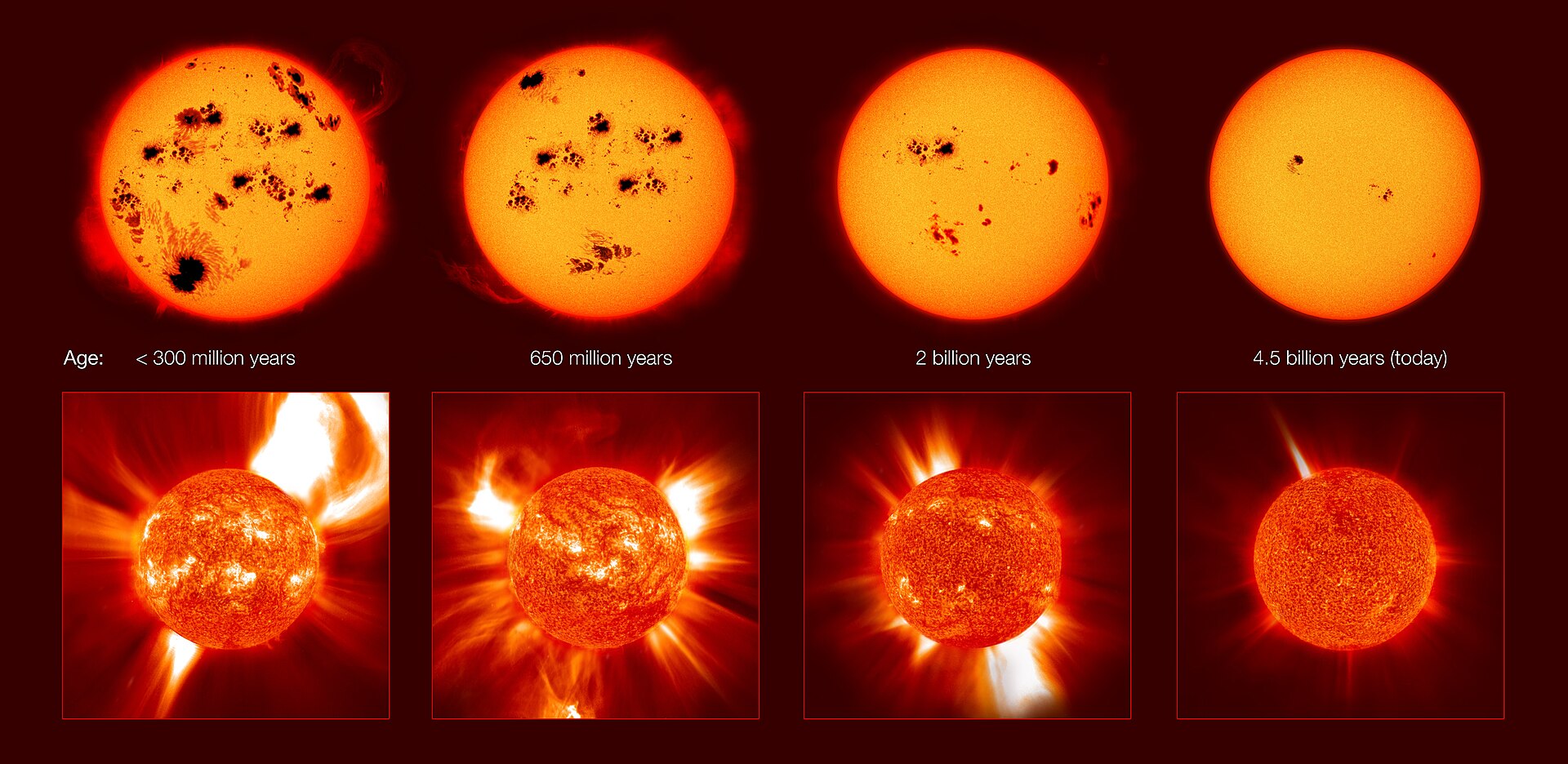
Nobody can watch one star for its whole life. Most changes in a star happen far too slowly to notice, even over many centuries. A human lifetime is like a single frame of a film that lasts for billions of years.
So astronomers use a clever trick. Imagine spending one afternoon in a busy park. You would see babies, children, adults and grandparents. You could work out how people grow and age without following one person for eighty years. Astronomers do the same with the sky. They study huge numbers of stars, each at a different point in its life, and fit the snapshots together into one story.
The second tool is the computer model. A stellar evolution model is a set of mathematical rules based on how gas, gravity and fusion behave. Scientists feed in a star's mass and its chemical makeup. The computer then works out how its brightness and surface temperature should change over time. If the model matches the stars we see, it is probably doing something right.
Models can also estimate how old a star is. Scientists compare a star's properties with the track the model predicts for a star of the same mass. The best match gives the age.
How is a star born?
Stars form inside giant molecular clouds. These are enormous, cold clouds of gas and dust, and some are many light-years across. Parts of a cloud can be a little denser than the rest. Gravity pulls those parts together, and the cloud breaks into smaller and smaller clumps.
When gas falls inwards it heats up, because the energy of falling is turned into heat. As a clump gets hotter and more squashed, it becomes a spinning ball of very hot gas called a . A protostar keeps growing by pulling in more gas and dust from the cloud around it. The dust hides it from view, so astronomers hunt for protostars with infrared light, which passes through dust better than visible light. A space telescope called WISE has found many of them this way.
A protostar may also keep a flat disc of leftover material around it. Planets can grow from such a disc, which is how planetary systems begin.
Not every ball of gas becomes a star. If a protostar has less than about 8 per cent of the Sun's mass, its centre never gets hot enough to fuse hydrogen. It becomes a brown dwarf. Brown dwarfs glow faintly and cool slowly over hundreds of millions of years.
What keeps a star shining for billions of years?
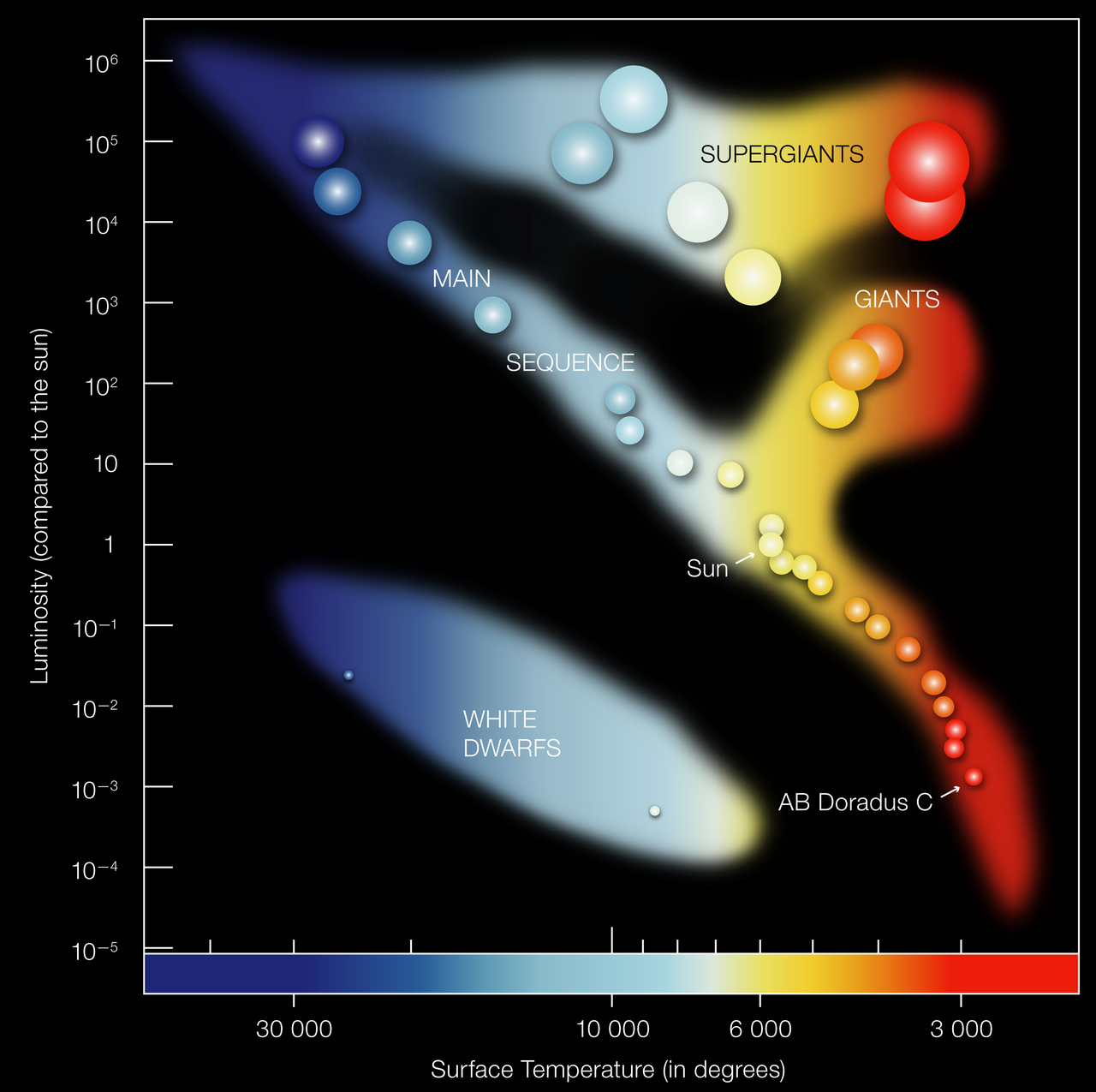
When the centre of a reaches about 10 million kelvin, hydrogen atoms start to fuse into helium. This releases a great deal of energy. The energy pushes outwards and balances the inward pull of the star's own gravity. This balance is called hydrostatic equilibrium. A star in balance stays the same size for a very long time, and it has joined the .
The main sequence is the long, stable adult stage of a star. Astronomers show it on a chart called the Hertzsprung-Russell diagram. Each star is a dot, placed by how bright it is and how hot its surface is. Most stars fall along a diagonal band, and where a star sits on that band depends on its mass.
The surprise is that bigger stars die younger. A massive, hot star burns through its fuel extremely fast. A hot O-type star leaves the main sequence after only a few million years. A middle-sized yellow dwarf like the Sun stays for about 10 billion years, and the Sun is roughly halfway through. A small red dwarf sips its hydrogen so slowly that it can last for hundreds of billions of years or more.
Why do stars swell into red giants?
Sooner or later the hydrogen in a star's core runs low. The core is mostly helium now, and fusion there fades. Without the push of fusion energy, gravity squeezes the core smaller and hotter.
The heat does something odd. Hydrogen in a shell around the core starts to fuse, and the star's outer layers puff outwards and cool. The star grows through the subgiant stage and then becomes a . It is cooler on the surface, which is why it looks red, but it is huge and very bright. Aldebaran in the constellation Taurus and Arcturus in Bootes are red giants you can see in the night sky.
In a star like the Sun, the helium core eventually gets hot enough, at about 100 million kelvin, for helium to fuse too. In stars of 0.6 to 2 , this can start in a helium flash. The flash is fierce but it happens inside the star, so we could not see it from outside.
Later the star burns helium in the core to make carbon and oxygen. When the helium is gone, it swells again along the asymptotic giant branch. Its energy output may flare in bursts called thermal pulses, and it may throb in size like a slow heartbeat.
What is a planetary nebula?
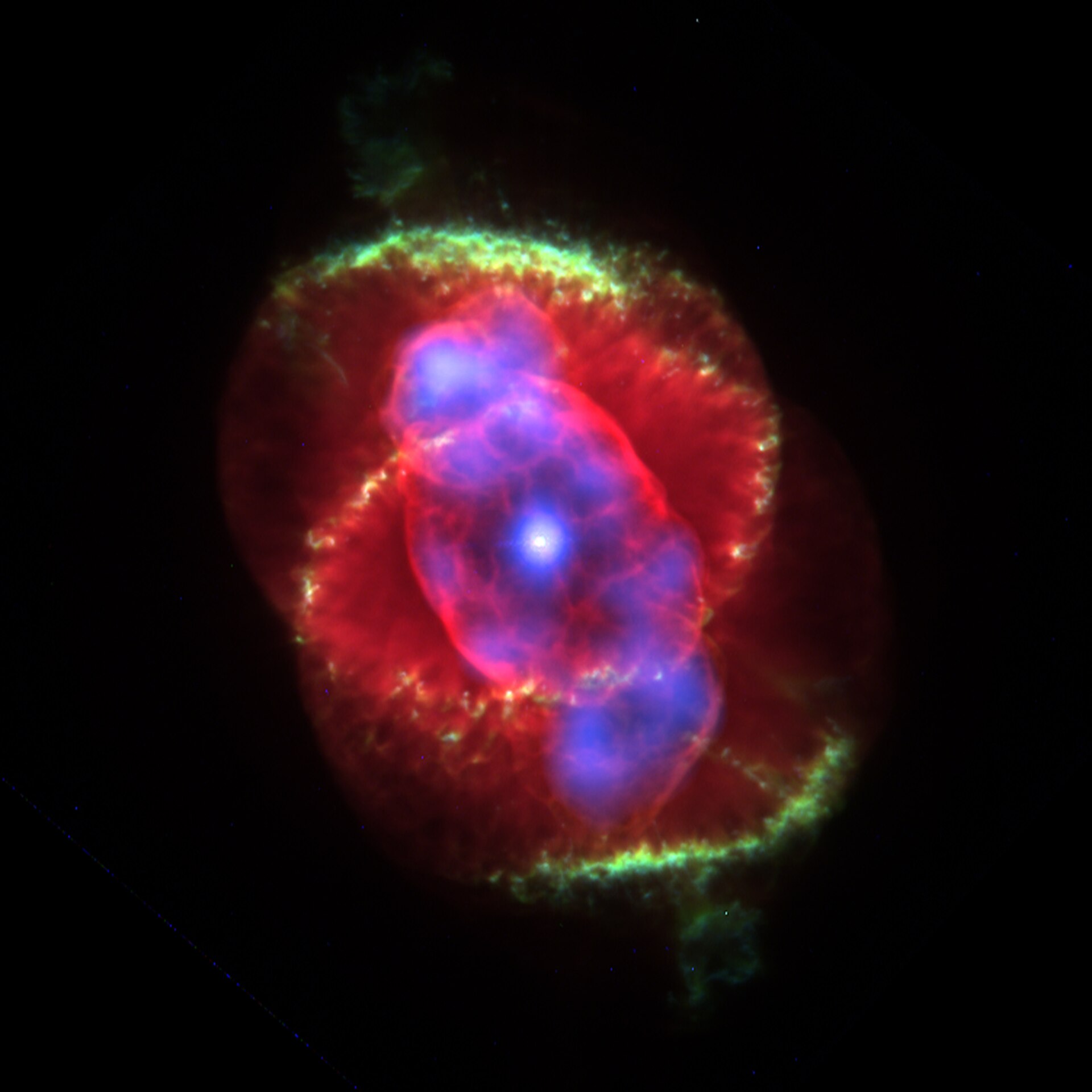
A Sun-like star cannot fuse carbon, so at the end of its days it runs out of fuel. Its core shrinks again, and the star blows its outer layers away in a strong stream of gas. Astronomers call this a superwind.
The cloud of gas that spreads out is called a . The name is misleading. Early astronomers saw round, fuzzy shapes through small telescopes that looked a little like planets. They have nothing to do with planets.
In the middle of the shell sits the bare, extremely hot core of the old star. Its fierce radiation makes the gas glow in beautiful colours. The Cat's Eye , photographed by the Hubble Space Telescope, is a famous example.
The gas is rich in elements that the star made during its life, such as carbon and oxygen. As the cloud drifts away and cools, tiny grains of dust and molecules form in it. This material will later mix into new clouds of gas, where new stars and planets can form. That is one way the stuff inside old stars becomes the raw material for the next generation.
What is a white dwarf, and what comes after?
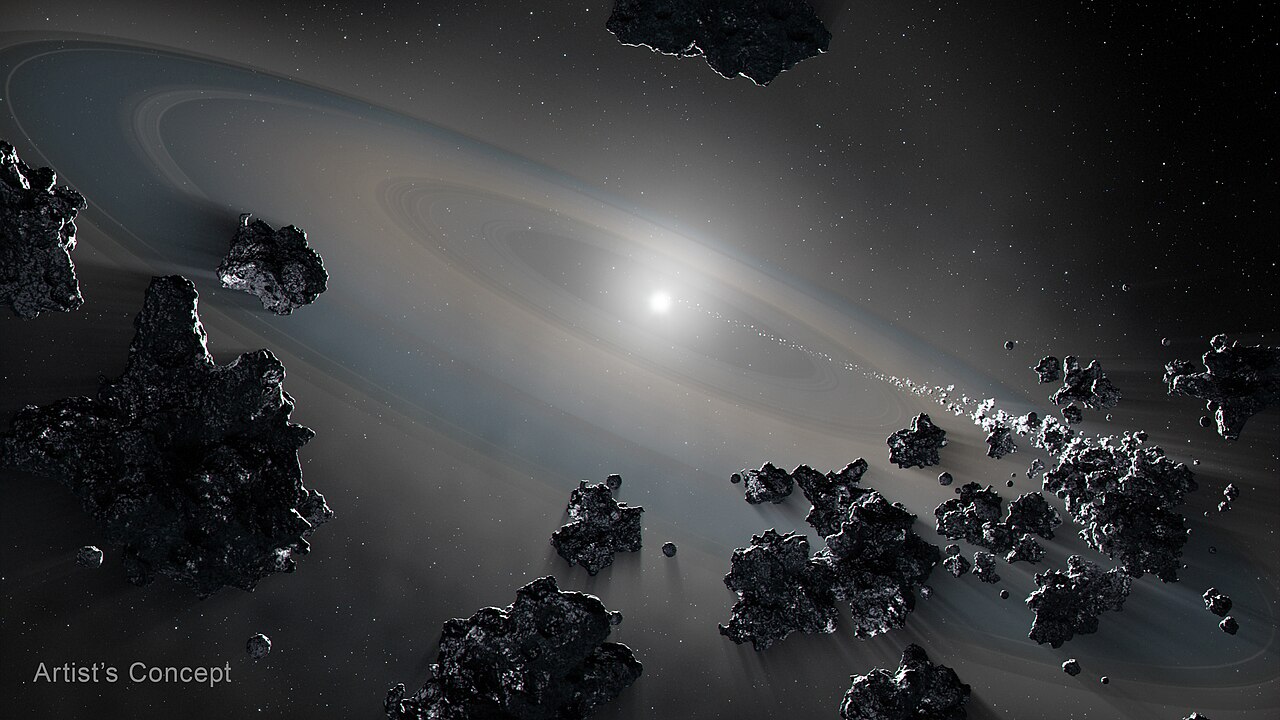
What remains of a Sun-like star is a . It holds about half the mass of the Sun, squeezed into a ball roughly the size of the Earth. One teaspoon of it would weigh as much as a car.
Why does it not collapse further? Electrons, the tiny particles in atoms, cannot be crowded together beyond a point. Their resistance, called electron degeneracy pressure, balances gravity. Heavier white dwarfs are actually smaller.
A new white dwarf is scorching, above 100,000 kelvin at its surface. It has no fuel left, so it cools by radiating heat into space for billions of years. Eventually it should become a cold, dark ball called a black dwarf. The universe is not old enough for any black dwarf to exist yet.
White dwarfs in pairs can be dramatic. If a white dwarf pulls hydrogen from a close companion star, the gas can flare in a runaway reaction on its surface. This is a nova. If a white dwarf gains so much mass that it passes the Chandrasekhar limit, about 1.4 , it can blow up completely as a Type Ia . These explosions can be brighter than the supernova that ends a massive star.
Red dwarfs are the exception. The universe is too young for any of them to have died, so their ends come only from models. These suggest they will slowly brighten and then become white dwarfs.
Why do the biggest stars live fast and die young?
A star with 10 or more times the Sun's mass is a different beast. Its core is so heavy that helium starts fusing at once, before the core becomes crowded with electrons. So when a massive star swells, it does not brighten as dramatically as a Sun-like star. It becomes a supergiant, enormous and extremely luminous.
The most massive stars lose mass at a huge rate. Their light is so strong that it blows their outer layers away. Some strip themselves before they can become red supergiants, and stay blue-white and very hot.
Inside, the core grows hotter and denser than in any smaller star. It fuses helium into carbon and oxygen. Then it fuses carbon into neon, sodium and magnesium. Heavier elements follow, in a chain of reactions that ends with a core made largely of iron. The star ends up built in layers, with lighter elements still fusing in shells around the middle.
The whole chain from carbon to iron takes only a few hundred years, which is a blink for a star. The outer layers have no time to react, and from outside the star looks much the same. Iron is the end of the line. Fusing it does not release energy, so the core can no longer hold up against gravity.
What happens when a giant star explodes?
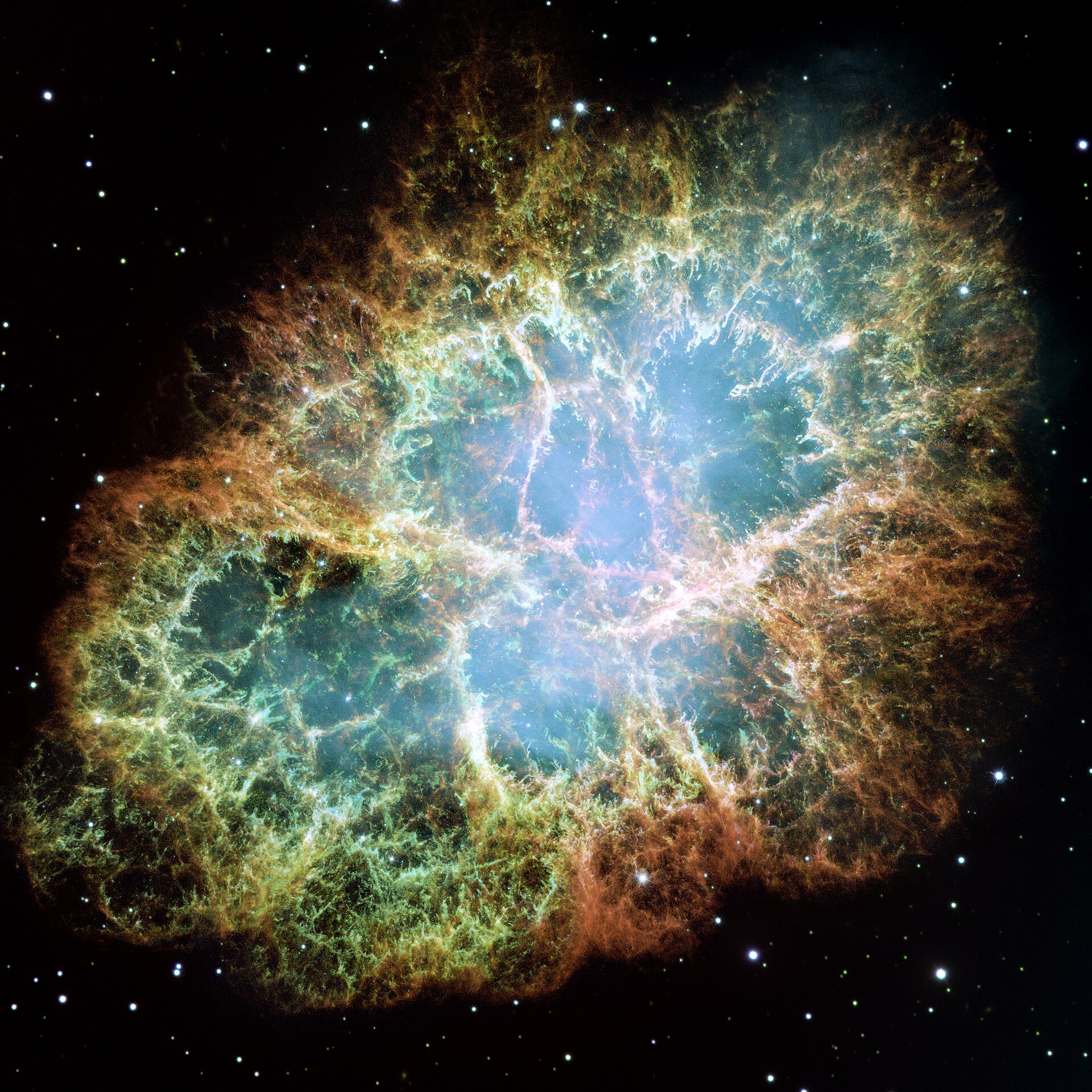
When the iron core grows too heavy, it collapses. Electrons are pushed into the nuclei of atoms, and the core becomes a ball of neutrons. The material falling inwards bounces back, and a powerful shock wave blasts outwards. The star is torn apart. This is a .
Exactly how the collapse turns into an explosion is still not fully understood. Computer models do not yet produce enough energy to match what we see. We do know that the collapse makes a huge burst of ghostly particles called neutrinos. Astronomers detected such a burst from supernova SN 1987A.
Supernovae also make new elements. In the chaos, atoms capture neutrons and become heavier than iron, up to uranium and perhaps beyond. Supernovae and the collisions of both help to explain the heavy elements found in our Solar System.
The Crab is the glowing remains of a supernova. Japanese and Chinese astronomers recorded the explosion in 1054. The nebula is about 11 light-years across.
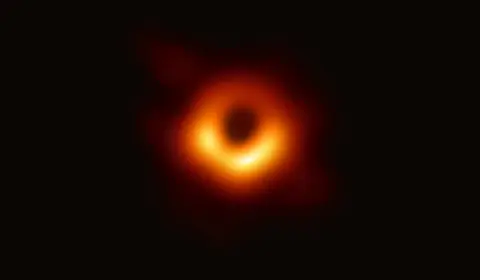
What is left behind depends on mass. The core may become a neutron star, only about 10 kilometres in radius, yet heavier than the Sun. A spinning neutron star that sweeps a beam of radio waves past Earth is a . Some spin more than 600 times a second. If the core is heavier still, nothing can stop it collapsing, and it becomes a . Whether a star can collapse straight to a black hole without a visible supernova is still unknown.
Explore Next
Your audio story keeps playing while you look around.
Words to Know
- black hole
- A region where gravity is so strong that nothing can escape.
- main sequence
- The long, stable stage when a star fuses hydrogen in its core.
- nebula
- A cloud of gas and dust in space.
- neutron star
- A tiny, extremely dense star made mostly of neutrons.
- nuclear fusion
- The joining of small atomic nuclei into larger ones, which releases energy.
- planetary nebula
- A glowing shell of gas thrown off by a dying Sun-like star.
- protostar
- A young, forming star that has not yet started fusing hydrogen.
- pulsar
- A spinning neutron star that sends out regular pulses of radiation.
- red giant
- A large, cool, bright star near the end of its life.
- solar mass
- A unit of mass equal to the mass of the Sun.
- supernova
- The huge explosion that ends the life of a massive star.
- white dwarf
- The small, hot, dense core left behind by a Sun-like star.